
9 3 Animals migrate in response to changes
- Slides: 45
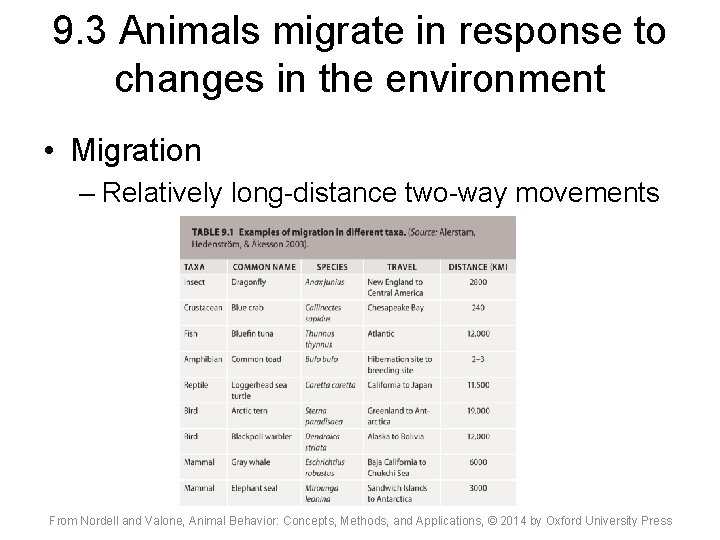
9. 3 Animals migrate in response to changes in the environment • Migration – Relatively long-distance two-way movements From Nordell and Valone, Animal Behavior: Concepts, Methods, and Applications, © 2014 by Oxford University Press
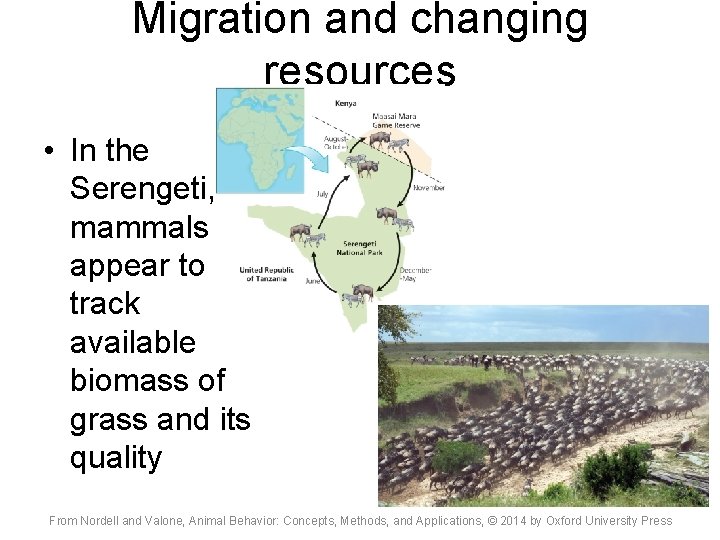
Migration and changing resources • In the Serengeti, mammals appear to track available biomass of grass and its quality From Nordell and Valone, Animal Behavior: Concepts, Methods, and Applications, © 2014 by Oxford University Press
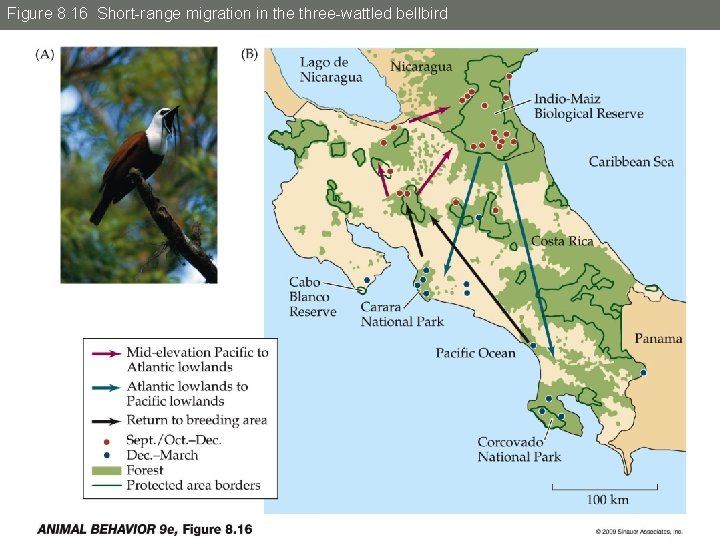
Figure 8. 16 Short-range migration in the three-wattled bellbird
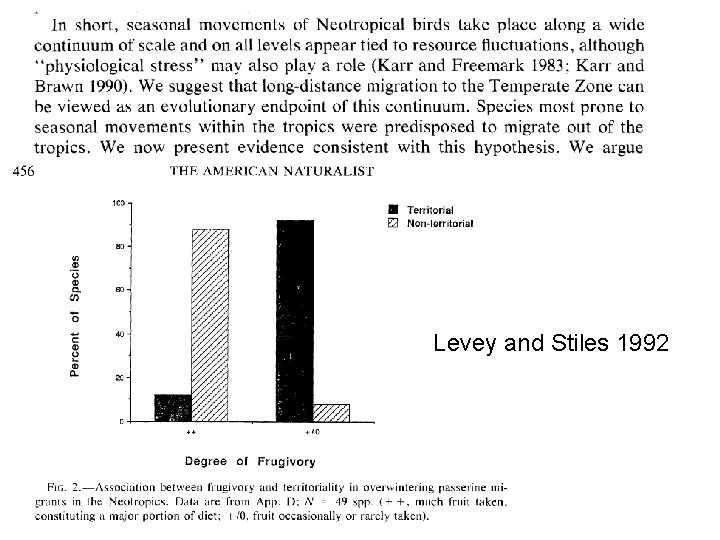
Levey and Stiles 1992
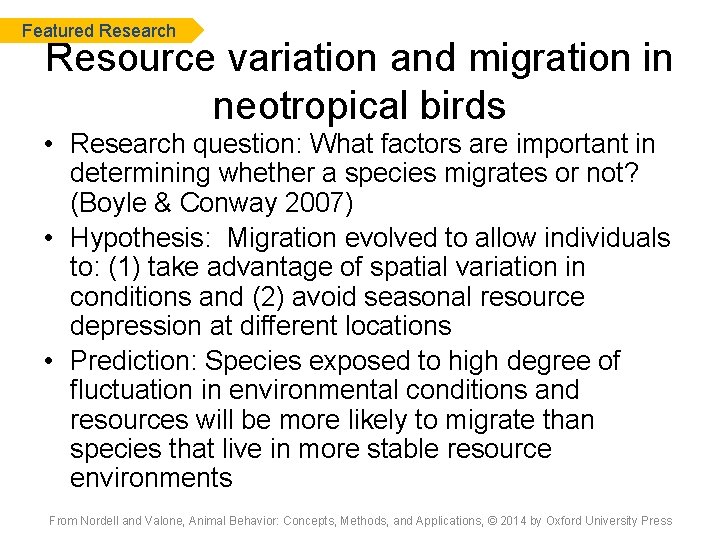
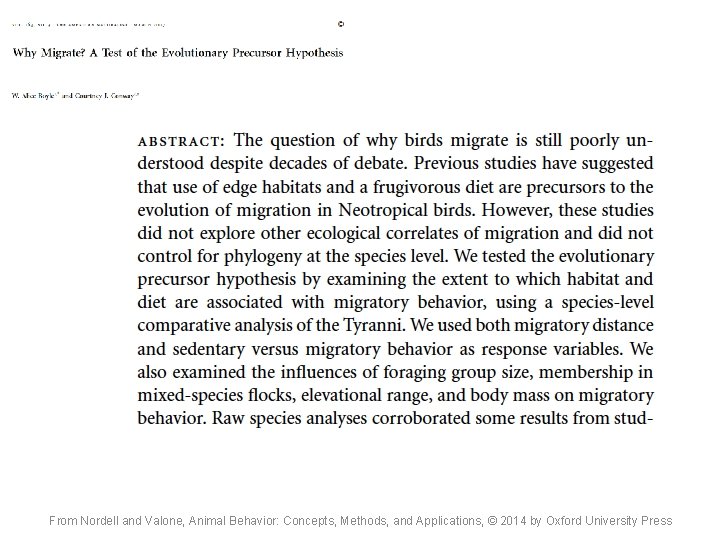
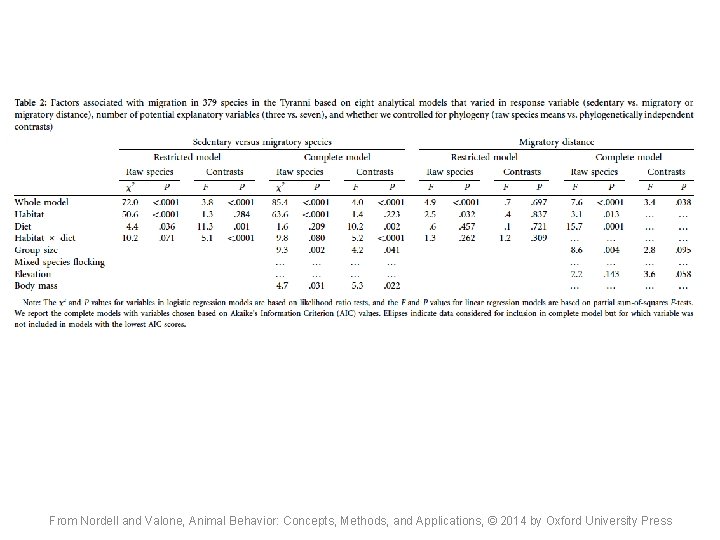
Featured Research Resource variation and migration in neotropical birds • Research question: What factors are important in determining whether a species migrates or not? (Boyle & Conway 2007) • Hypothesis: Migration evolved to allow individuals to: (1) take advantage of spatial variation in conditions and (2) avoid seasonal resource depression at different locations • Prediction: Species exposed to high degree of fluctuation in environmental conditions and resources will be more likely to migrate than species that live in more stable resource environments From Nordell and Valone, Animal Behavior: Concepts, Methods, and Applications, © 2014 by Oxford University Press
From Nordell and Valone, Animal Behavior: Concepts, Methods, and Applications, © 2014 by Oxford University Press
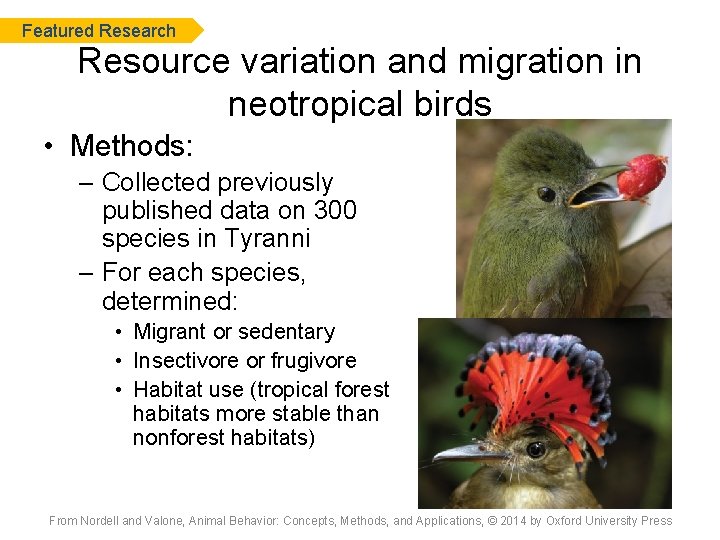
Featured Research Resource variation and migration in neotropical birds • Methods: – Collected previously published data on 300 species in Tyranni – For each species, determined: • Migrant or sedentary • Insectivore or frugivore • Habitat use (tropical forest habitats more stable than nonforest habitats) From Nordell and Valone, Animal Behavior: Concepts, Methods, and Applications, © 2014 by Oxford University Press
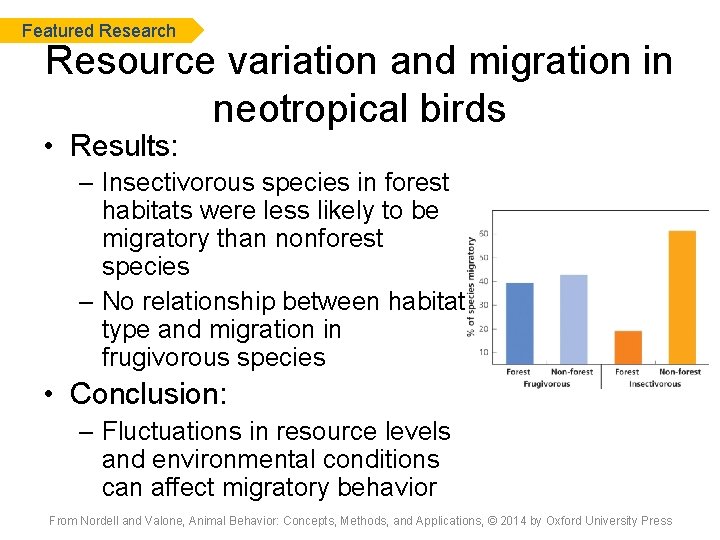
Featured Research Resource variation and migration in neotropical birds • Results: – Insectivorous species in forest habitats were less likely to be migratory than nonforest species – No relationship between habitat type and migration in frugivorous species • Conclusion: – Fluctuations in resource levels and environmental conditions can affect migratory behavior From Nordell and Valone, Animal Behavior: Concepts, Methods, and Applications, © 2014 by Oxford University Press
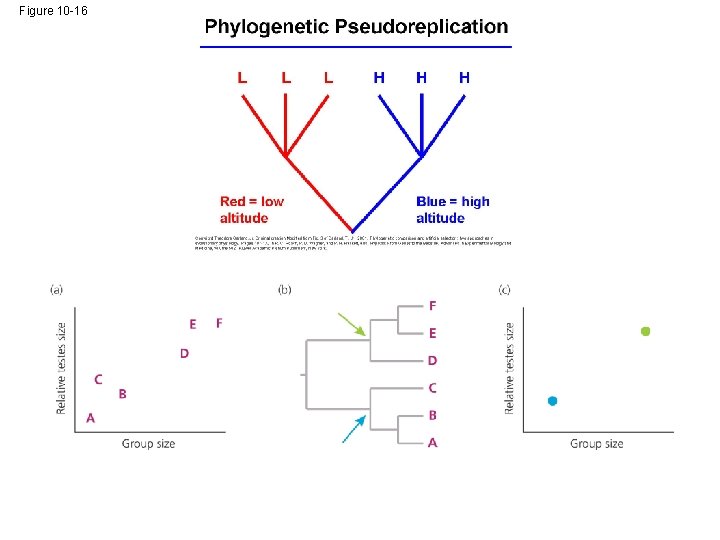
Figure 10 -16
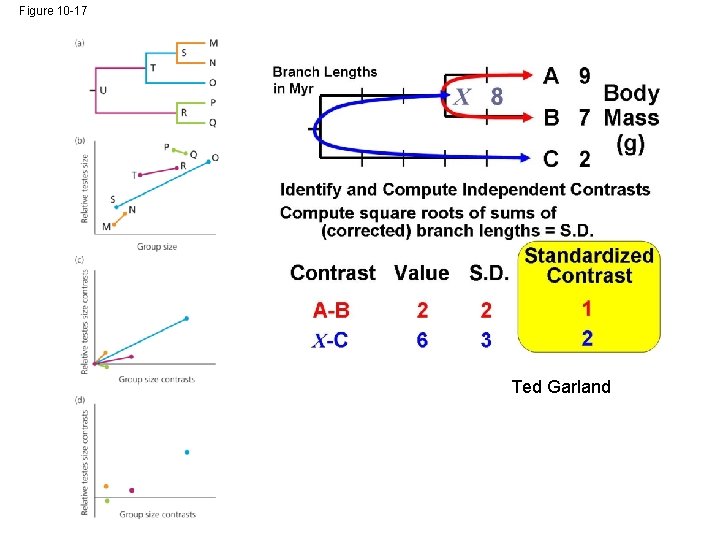
Figure 10 -17 Ted Garland
From Nordell and Valone, Animal Behavior: Concepts, Methods, and Applications, © 2014 by Oxford University Press
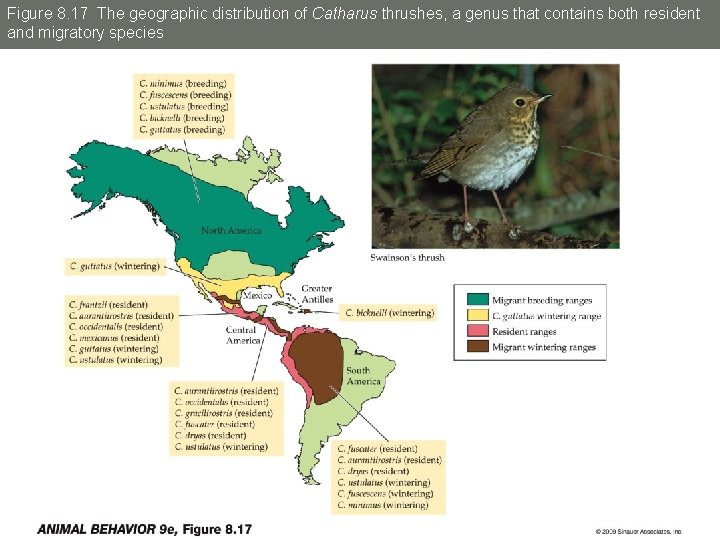
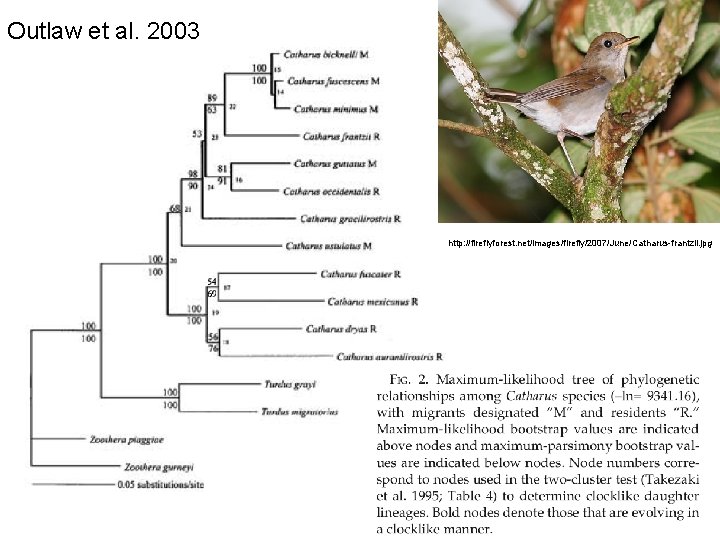
Figure 8. 17 The geographic distribution of Catharus thrushes, a genus that contains both resident and migratory species
Outlaw et al. 2003 http: //fireflyforest. net/images/firefly/2007/June/Catharus-frantzii. jpg
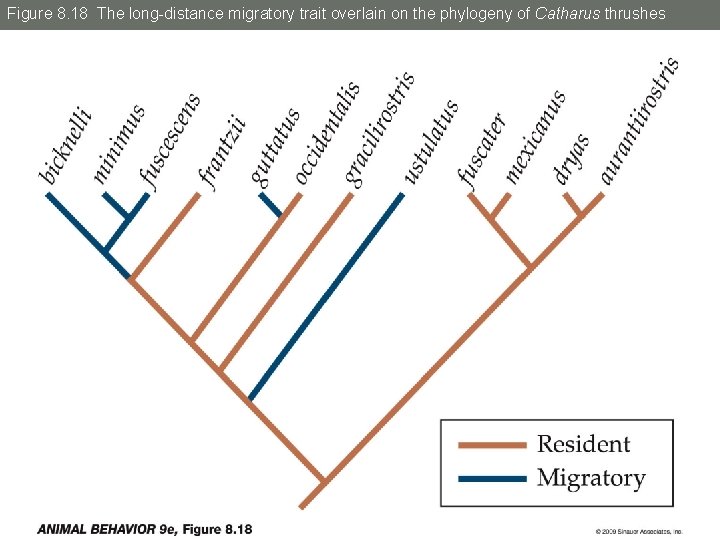
Figure 8. 18 The long-distance migratory trait overlain on the phylogeny of Catharus thrushes
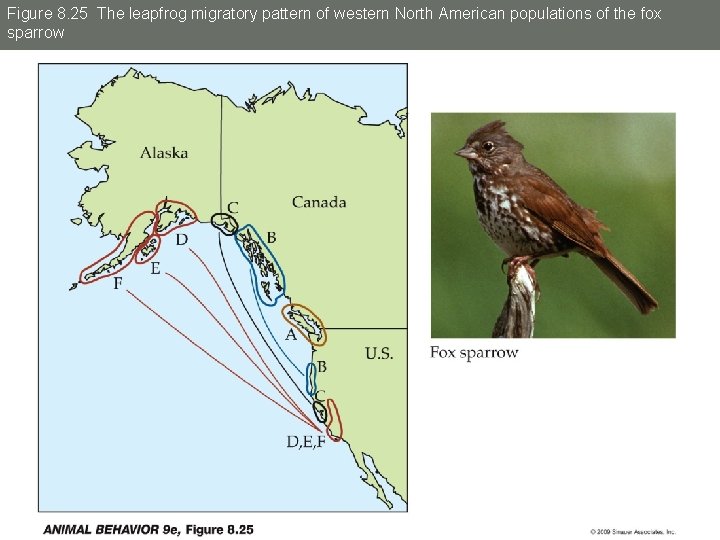
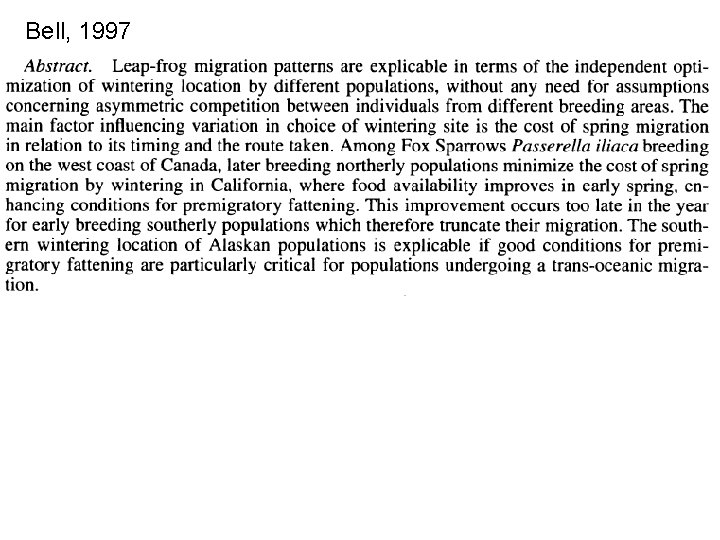
Figure 8. 25 The leapfrog migratory pattern of western North American populations of the fox sparrow
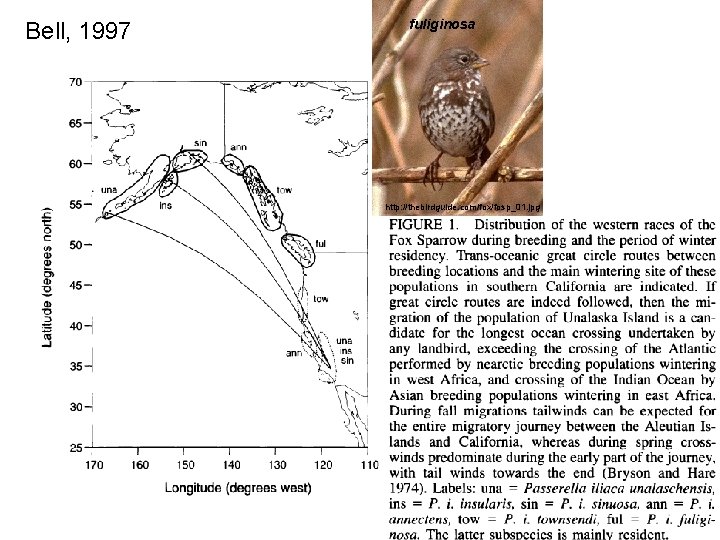
Bell, 1997 fuliginosa http: //thebirdguide. com/fox/fosp_01. jpg
Bell, 1997
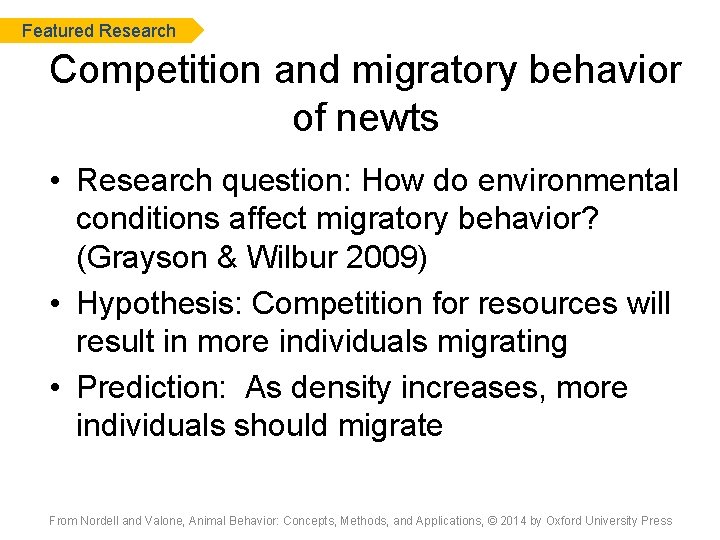
Featured Research Competition and migratory behavior of newts • Research question: How do environmental conditions affect migratory behavior? (Grayson & Wilbur 2009) • Hypothesis: Competition for resources will result in more individuals migrating • Prediction: As density increases, more individuals should migrate From Nordell and Valone, Animal Behavior: Concepts, Methods, and Applications, © 2014 by Oxford University Press
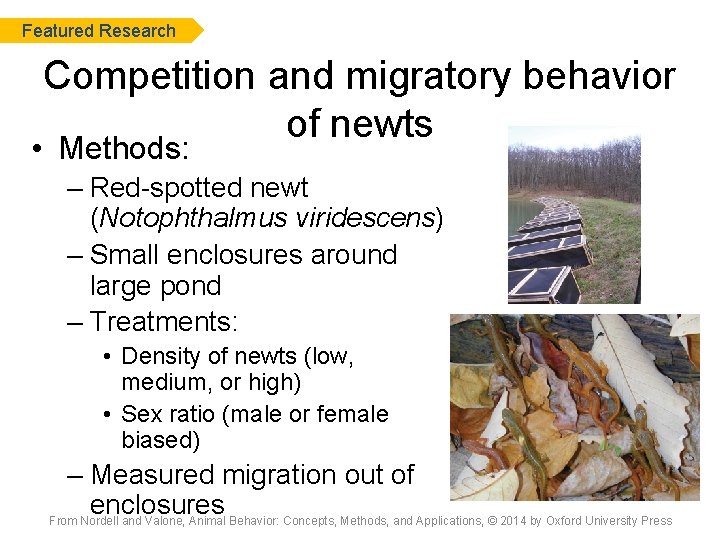
Featured Research Competition and migratory behavior of newts • Methods: – Red-spotted newt (Notophthalmus viridescens) – Small enclosures around large pond – Treatments: • Density of newts (low, medium, or high) • Sex ratio (male or female biased) – Measured migration out of enclosures From Nordell and Valone, Animal Behavior: Concepts, Methods, and Applications, © 2014 by Oxford University Press
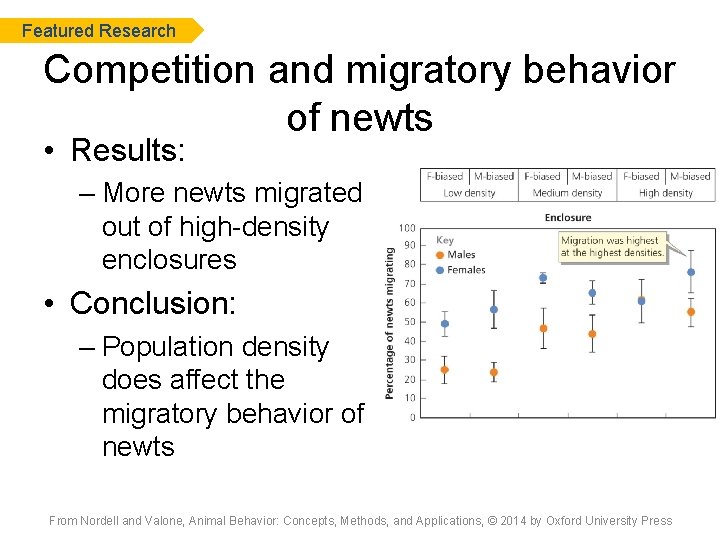
Featured Research Competition and migratory behavior of newts • Results: – More newts migrated out of high-density enclosures • Conclusion: – Population density does affect the migratory behavior of newts From Nordell and Valone, Animal Behavior: Concepts, Methods, and Applications, © 2014 by Oxford University Press
Maintenance of polymorphism in migratory behavior • Migratory behavior could be a fixed, genetic trait, and frequency-dependent selection maintains the polymorphism • Migratory behavior is dependent on individual condition From Nordell and Valone, Animal Behavior: Concepts, Methods, and Applications, © 2014 by Oxford University Press
Featured Research Competition and migratory behavior of dippers • Research question: What maintains resident and migratory behaviors within a population? (Gillis et al. 2008) From Nordell and Valone, Animal Behavior: Concepts, Methods, and Applications, © 2014 by Oxford University Press
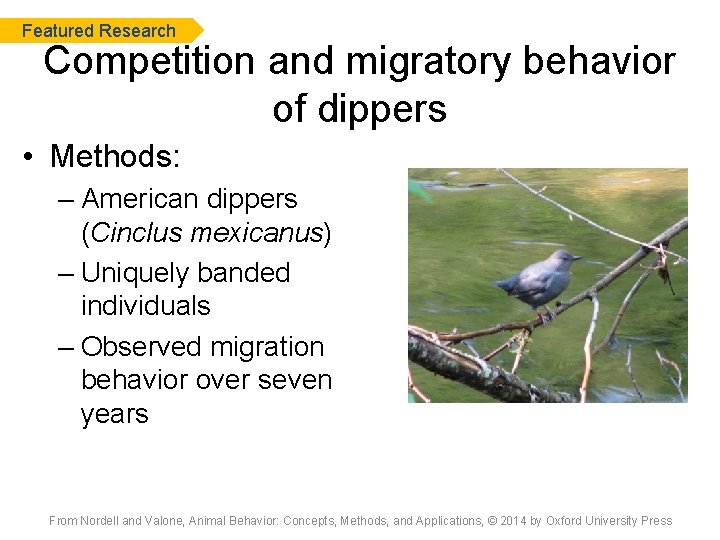
Featured Research Competition and migratory behavior of dippers • Methods: – American dippers (Cinclus mexicanus) – Uniquely banded individuals – Observed migration behavior over seven years From Nordell and Valone, Animal Behavior: Concepts, Methods, and Applications, © 2014 by Oxford University Press
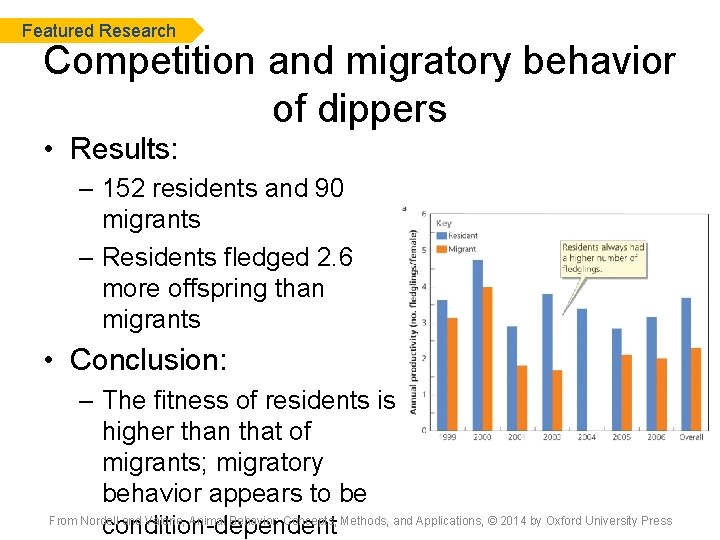
Featured Research Competition and migratory behavior of dippers • Results: – 152 residents and 90 migrants – Residents fledged 2. 6 more offspring than migrants • Conclusion: – The fitness of residents is higher than that of migrants; migratory behavior appears to be From Nordell and Valone, Animal Behavior: Concepts, Methods, and Applications, © 2014 by Oxford University Press condition-dependent
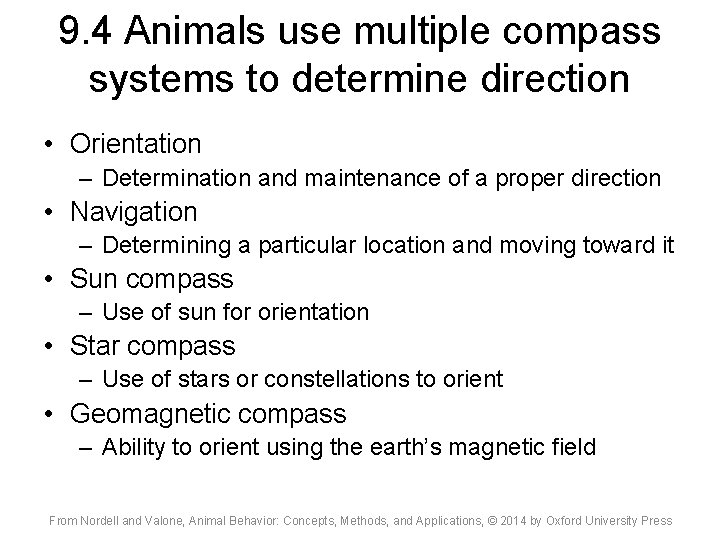
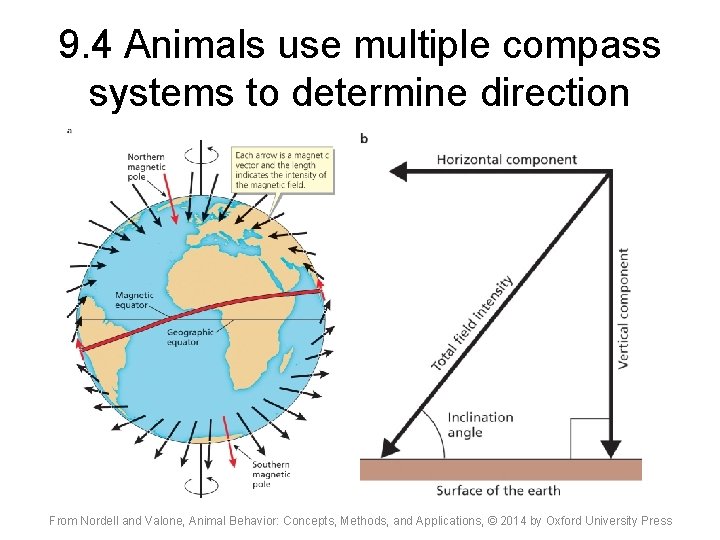
9. 4 Animals use multiple compass systems to determine direction • Orientation – Determination and maintenance of a proper direction • Navigation – Determining a particular location and moving toward it • Sun compass – Use of sun for orientation • Star compass – Use of stars or constellations to orient • Geomagnetic compass – Ability to orient using the earth’s magnetic field From Nordell and Valone, Animal Behavior: Concepts, Methods, and Applications, © 2014 by Oxford University Press
9. 4 Animals use multiple compass systems to determine direction From Nordell and Valone, Animal Behavior: Concepts, Methods, and Applications, © 2014 by Oxford University Press
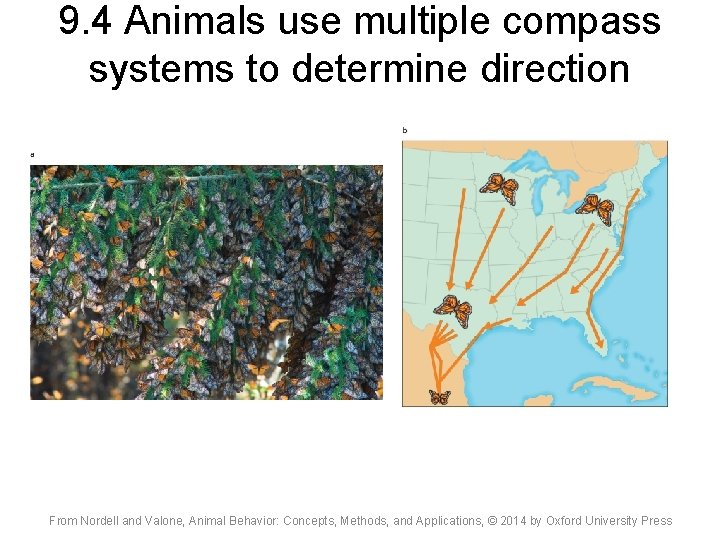
9. 4 Animals use multiple compass systems to determine direction From Nordell and Valone, Animal Behavior: Concepts, Methods, and Applications, © 2014 by Oxford University Press
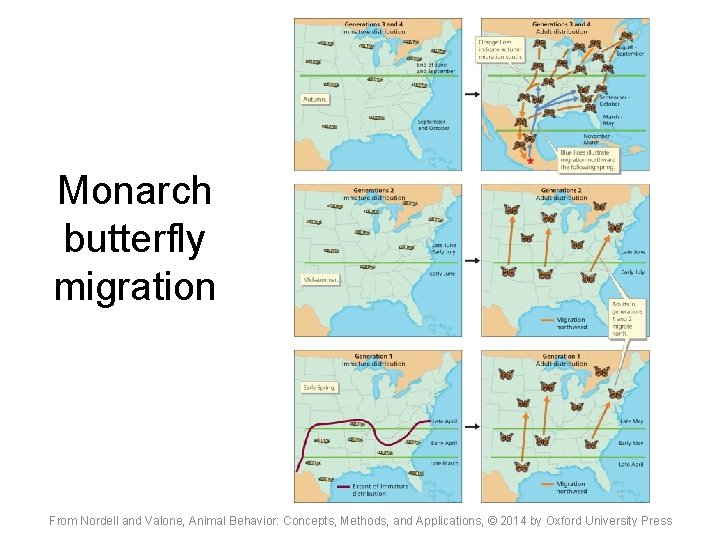
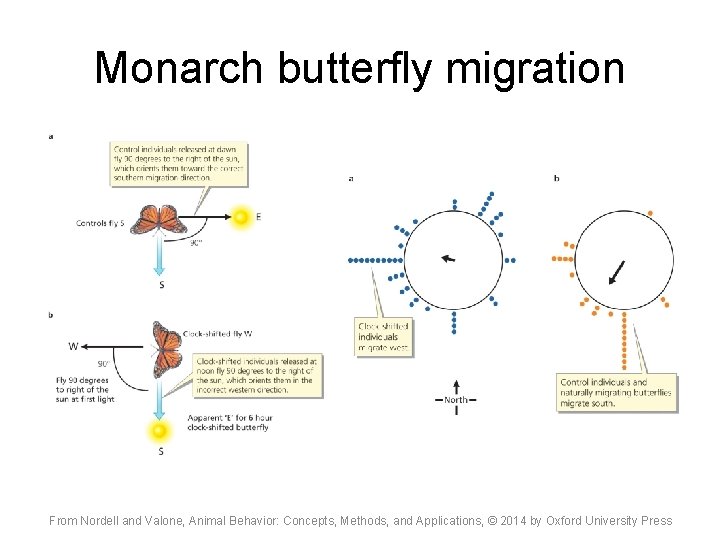
Monarch butterfly migration From Nordell and Valone, Animal Behavior: Concepts, Methods, and Applications, © 2014 by Oxford University Press
Monarch butterfly migration From Nordell and Valone, Animal Behavior: Concepts, Methods, and Applications, © 2014 by Oxford University Press
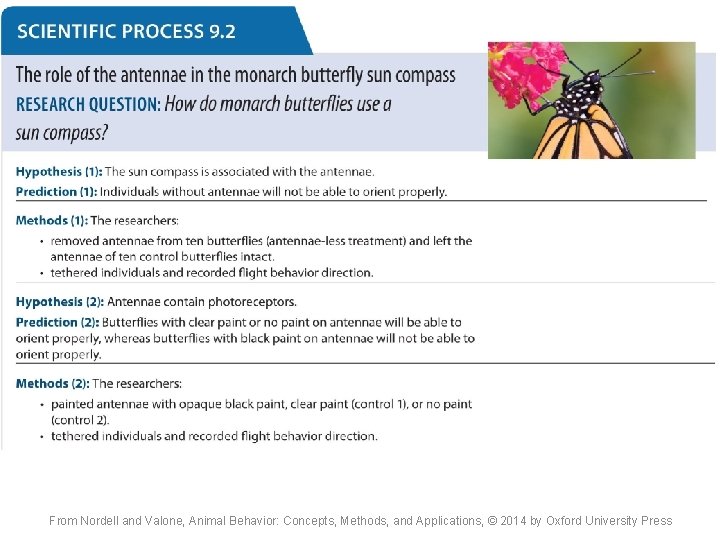
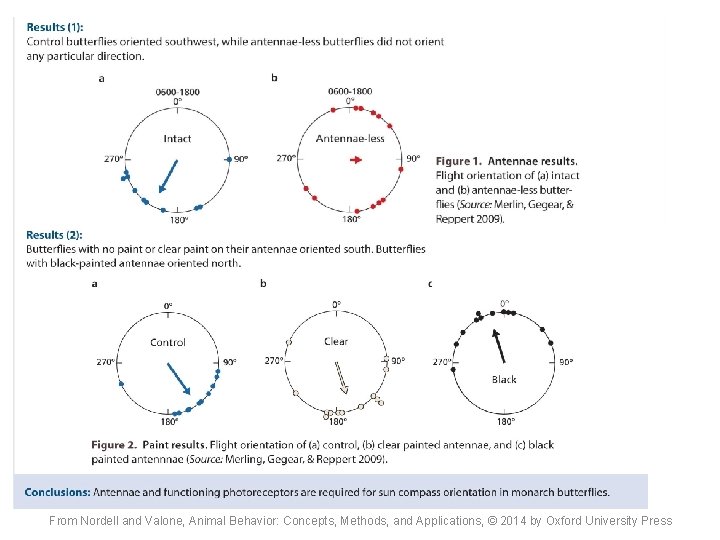
From Nordell and Valone, Animal Behavior: Concepts, Methods, and Applications, © 2014 by Oxford University Press
From Nordell and Valone, Animal Behavior: Concepts, Methods, and Applications, © 2014 by Oxford University Press
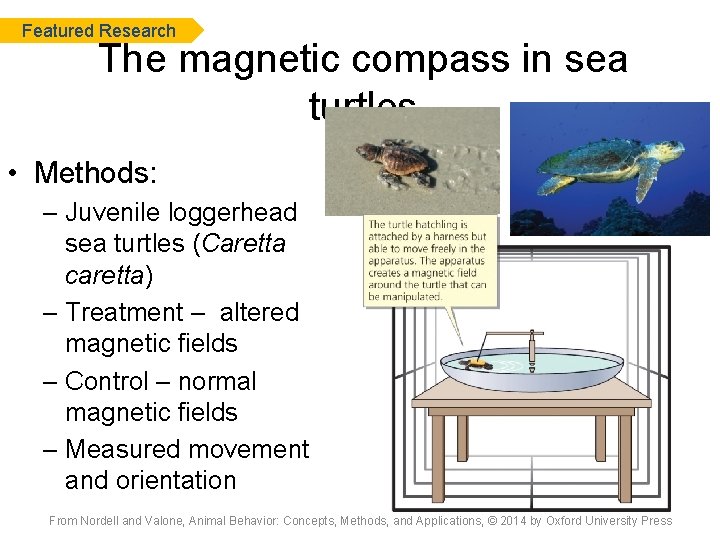
Featured Research The magnetic compass in sea turtles • Research question: Can sea turtles use a magnetic compass? (Lohmann 1991) From Nordell and Valone, Animal Behavior: Concepts, Methods, and Applications, © 2014 by Oxford University Press
Featured Research The magnetic compass in sea turtles • Methods: – Juvenile loggerhead sea turtles (Caretta caretta) – Treatment – altered magnetic fields – Control – normal magnetic fields – Measured movement and orientation From Nordell and Valone, Animal Behavior: Concepts, Methods, and Applications, © 2014 by Oxford University Press
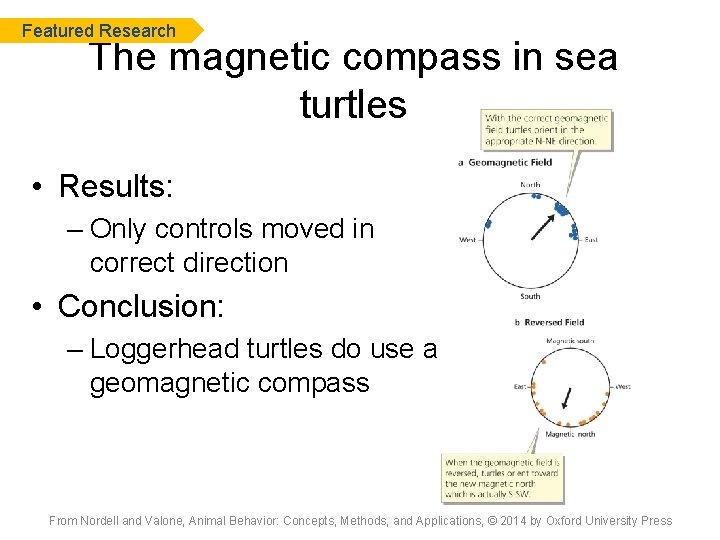
Featured Research The magnetic compass in sea turtles • Results: – Only controls moved in correct direction • Conclusion: – Loggerhead turtles do use a geomagnetic compass From Nordell and Valone, Animal Behavior: Concepts, Methods, and Applications, © 2014 by Oxford University Press
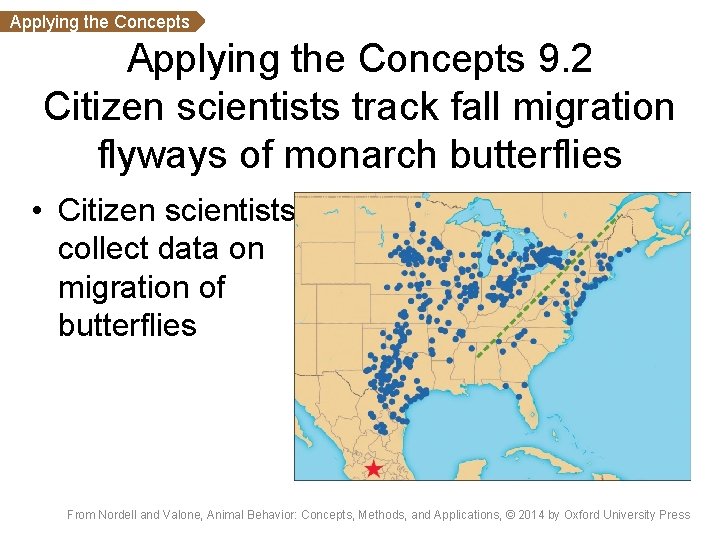
Applying the Concepts 9. 2 Citizen scientists track fall migration flyways of monarch butterflies • Citizen scientists collect data on migration of butterflies From Nordell and Valone, Animal Behavior: Concepts, Methods, and Applications, © 2014 by Oxford University Press
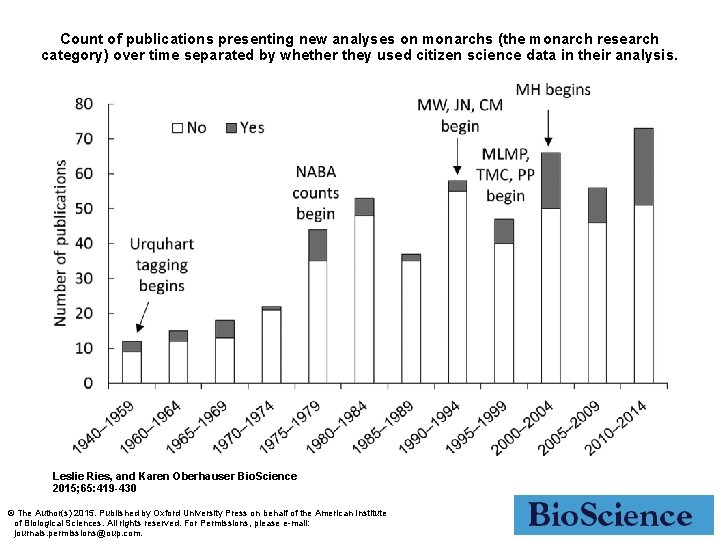
Count of publications presenting new analyses on monarchs (the monarch research category) over time separated by whether they used citizen science data in their analysis. Leslie Ries, and Karen Oberhauser Bio. Science 2015; 65: 419 -430 © The Author(s) 2015. Published by Oxford University Press on behalf of the American Institute of Biological Sciences. All rights reserved. For Permissions, please e-mail: journals. permissions@oup. com.
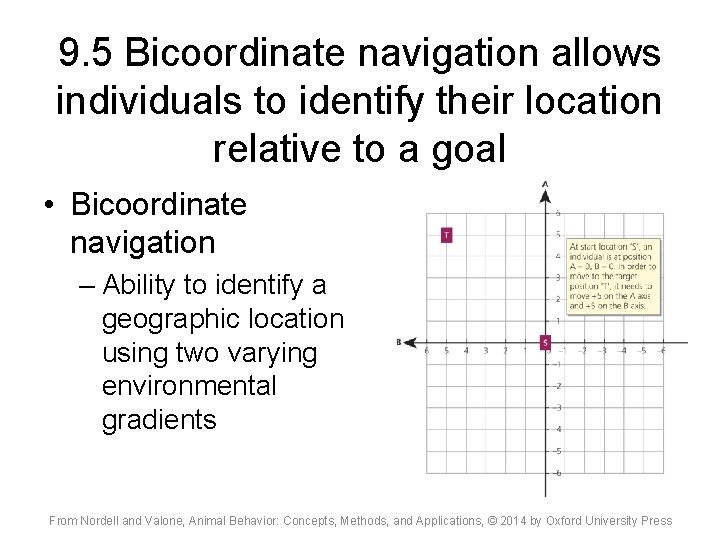
9. 5 Bicoordinate navigation allows individuals to identify their location relative to a goal • Bicoordinate navigation – Ability to identify a geographic location using two varying environmental gradients From Nordell and Valone, Animal Behavior: Concepts, Methods, and Applications, © 2014 by Oxford University Press
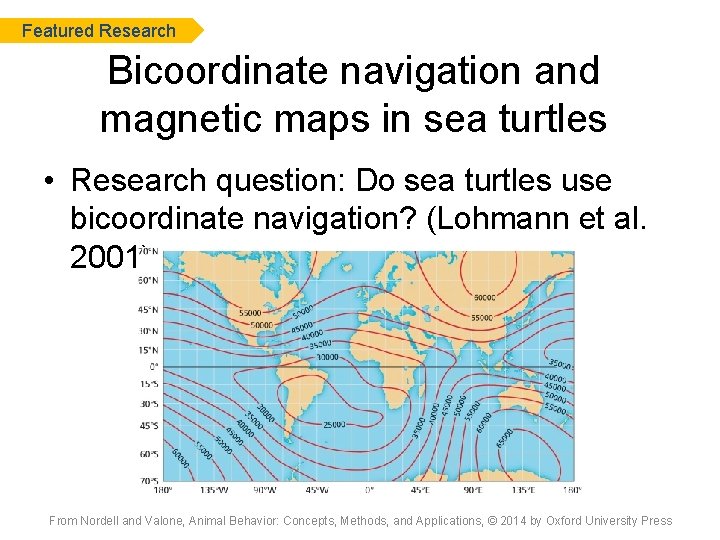
Featured Research Bicoordinate navigation and magnetic maps in sea turtles • Research question: Do sea turtles use bicoordinate navigation? (Lohmann et al. 2001) From Nordell and Valone, Animal Behavior: Concepts, Methods, and Applications, © 2014 by Oxford University Press
Featured Research Bicoordinate navigation and magnetic maps in sea turtles • Methods: – Juvenile loggerhead sea turtles (Caretta caretta) – Exposed to three magnetic fields – Measured orientation and movement From Nordell and Valone, Animal Behavior: Concepts, Methods, and Applications, © 2014 by Oxford University Press
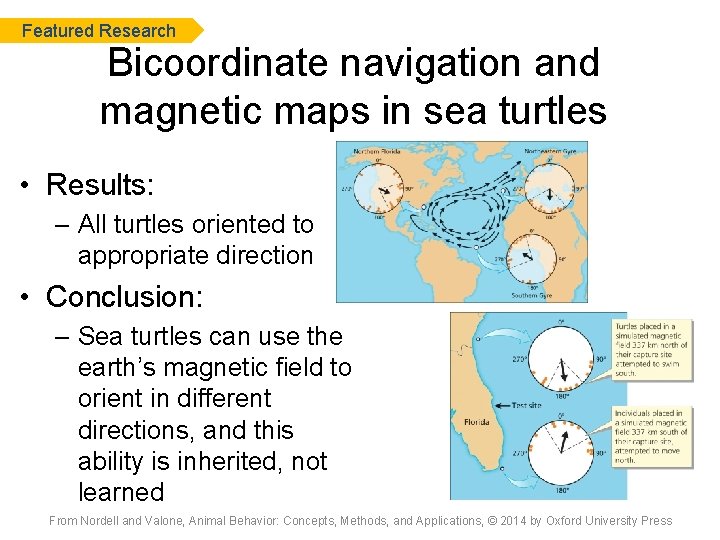
Featured Research Bicoordinate navigation and magnetic maps in sea turtles • Results: – All turtles oriented to appropriate direction • Conclusion: – Sea turtles can use the earth’s magnetic field to orient in different directions, and this ability is inherited, not learned From Nordell and Valone, Animal Behavior: Concepts, Methods, and Applications, © 2014 by Oxford University Press
Featured Research Bicoordinate navigation in birds • Research question: Do birds display bicoordinate navigation? (Chenetsov, Kishkinev, & Mouritse 2008)? From Nordell and Valone, Animal Behavior: Concepts, Methods, and Applications, © 2014 by Oxford University Press
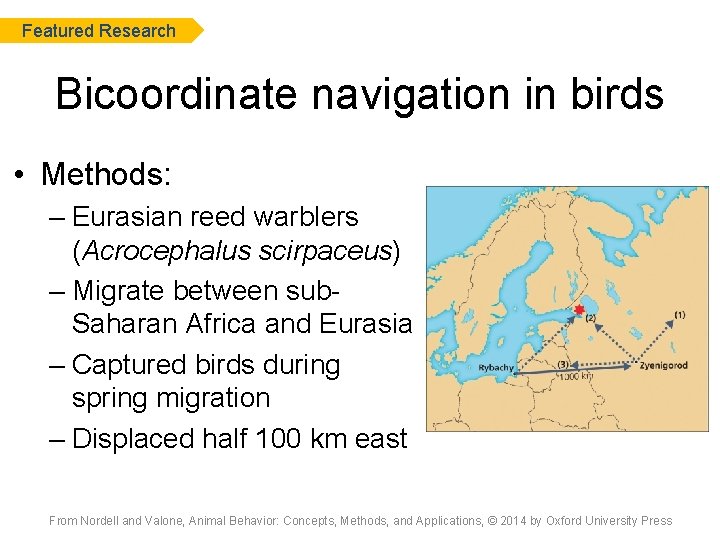
Featured Research Bicoordinate navigation in birds • Methods: – Eurasian reed warblers (Acrocephalus scirpaceus) – Migrate between sub. Saharan Africa and Eurasia – Captured birds during spring migration – Displaced half 100 km east From Nordell and Valone, Animal Behavior: Concepts, Methods, and Applications, © 2014 by Oxford University Press
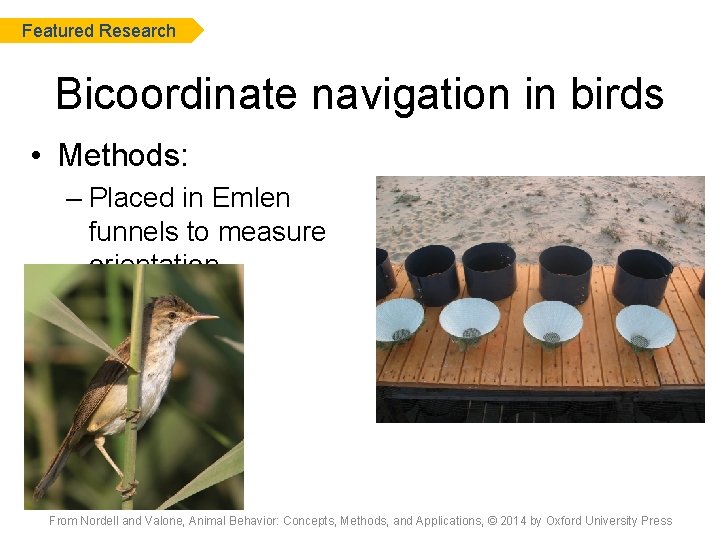
Featured Research Bicoordinate navigation in birds • Methods: – Placed in Emlen funnels to measure orientation From Nordell and Valone, Animal Behavior: Concepts, Methods, and Applications, © 2014 by Oxford University Press
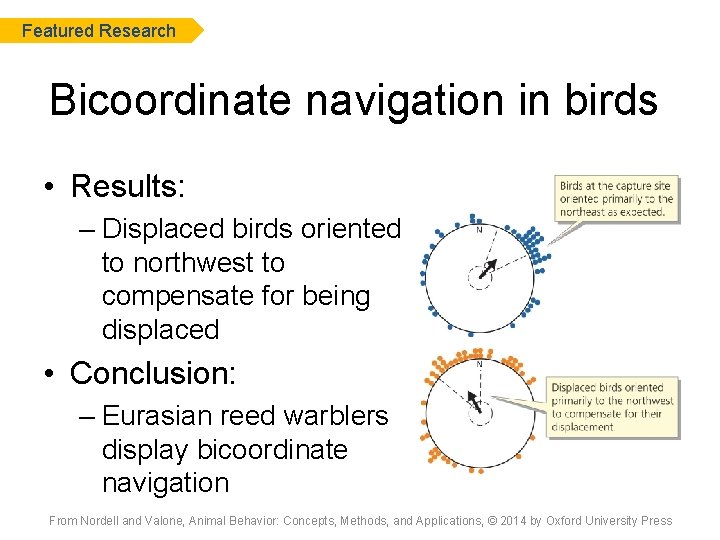
Featured Research Bicoordinate navigation in birds • Results: – Displaced birds oriented to northwest to compensate for being displaced • Conclusion: – Eurasian reed warblers display bicoordinate navigation From Nordell and Valone, Animal Behavior: Concepts, Methods, and Applications, © 2014 by Oxford University Press
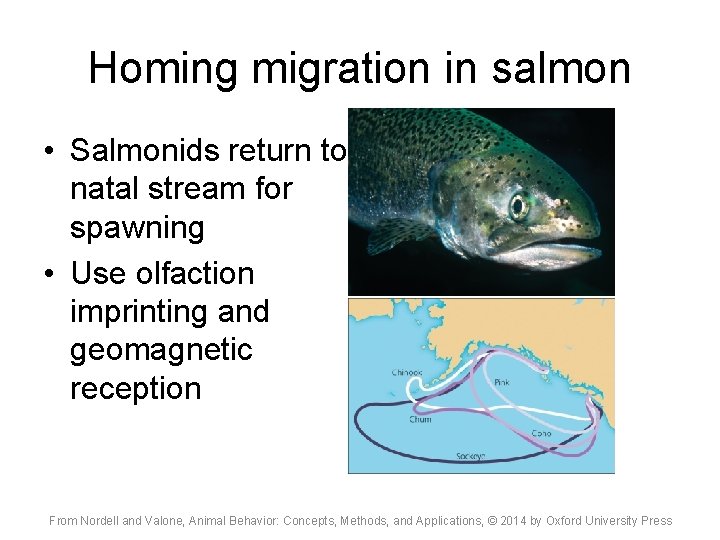
Homing migration in salmon • Salmonids return to natal stream for spawning • Use olfaction imprinting and geomagnetic reception From Nordell and Valone, Animal Behavior: Concepts, Methods, and Applications, © 2014 by Oxford University Press