
9 2 SUM AND DIFFERENCE FORMULAS FOR SINE

- Slides: 11
9. 2 SUM AND DIFFERENCE FORMULAS FOR SINE AND COSINE Functions Modeling Change: A Preparation for Calculus, 4 th Edition, 2011, Connally
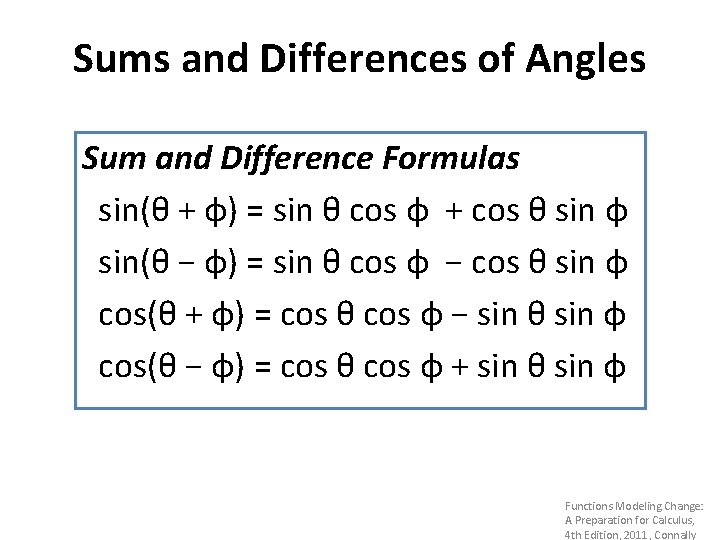
Sums and Differences of Angles Sum and Difference Formulas sin(θ + φ) = sin θ cos φ + cos θ sin φ sin(θ − φ) = sin θ cos φ − cos θ sin φ cos(θ + φ) = cos θ cos φ − sin θ sin φ cos(θ − φ) = cos θ cos φ + sin θ sin φ Functions Modeling Change: A Preparation for Calculus, 4 th Edition, 2011, Connally
Sums and Differences of Angles Example 1 Find an exact value for cos 15◦. Solution Let θ = 45◦ and φ = 15◦. Then cos 15◦ = cos(45◦ - 15◦) = cos 45◦ cos 15◦ + sin 45◦sin 15◦ = We can check our answer using a calculator: and cos 15◦ = 0. 9659. Functions Modeling Change: A Preparation for Calculus, 4 th Edition, 2011, Connally
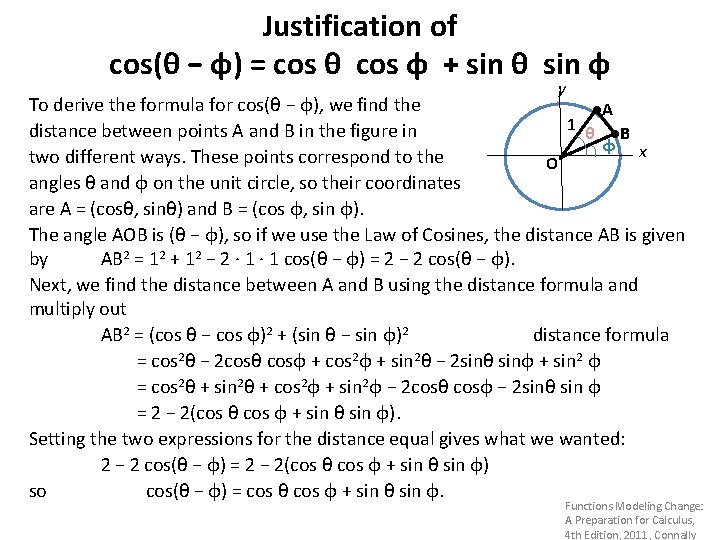
Justification of cos(θ − φ) = cos θ cos φ + sin θ sin φ y To derive the formula for cos(θ − φ), we find the ●A 1 distance between points A and B in the figure in θ ●B φ x two different ways. These points correspond to the O angles θ and φ on the unit circle, so their coordinates are A = (cosθ, sinθ) and B = (cos φ, sin φ). The angle AOB is (θ − φ), so if we use the Law of Cosines, the distance AB is given by AB 2 = 12 + 12 − 2 · 1 cos(θ − φ) = 2 − 2 cos(θ − φ). Next, we find the distance between A and B using the distance formula and multiply out AB 2 = (cos θ − cos φ)2 + (sin θ − sin φ)2 distance formula = cos 2θ − 2 cosθ cosφ + cos 2φ + sin 2θ − 2 sinθ sinφ + sin 2 φ = cos 2θ + sin 2θ + cos 2φ + sin 2φ − 2 cosθ cosφ − 2 sinθ sin φ = 2 − 2(cos θ cos φ + sin θ sin φ). Setting the two expressions for the distance equal gives what we wanted: 2 − 2 cos(θ − φ) = 2 − 2(cos θ cos φ + sin θ sin φ) so cos(θ − φ) = cos θ cos φ + sin θ sin φ. Functions Modeling Change: A Preparation for Calculus, 4 th Edition, 2011, Connally
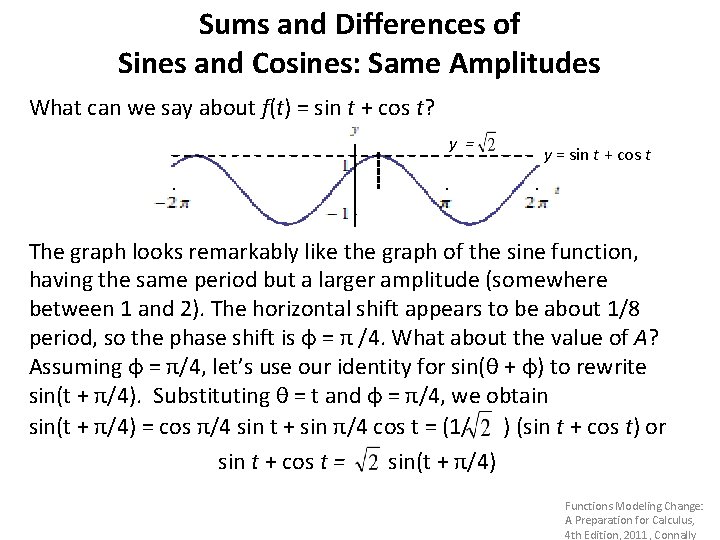
Sums and Differences of Sines and Cosines: Same Amplitudes What can we say about f(t) = sin t + cos t? y = sin t + cos t The graph looks remarkably like the graph of the sine function, having the same period but a larger amplitude (somewhere between 1 and 2). The horizontal shift appears to be about 1/8 period, so the phase shift is φ = π /4. What about the value of A? Assuming φ = π/4, let’s use our identity for sin(θ + φ) to rewrite sin(t + π/4). Substituting θ = t and φ = π/4, we obtain sin(t + π/4) = cos π/4 sin t + sin π/4 cos t = (1/ ) (sin t + cos t) or sin t + cos t = sin(t + π/4) Functions Modeling Change: A Preparation for Calculus, 4 th Edition, 2011, Connally
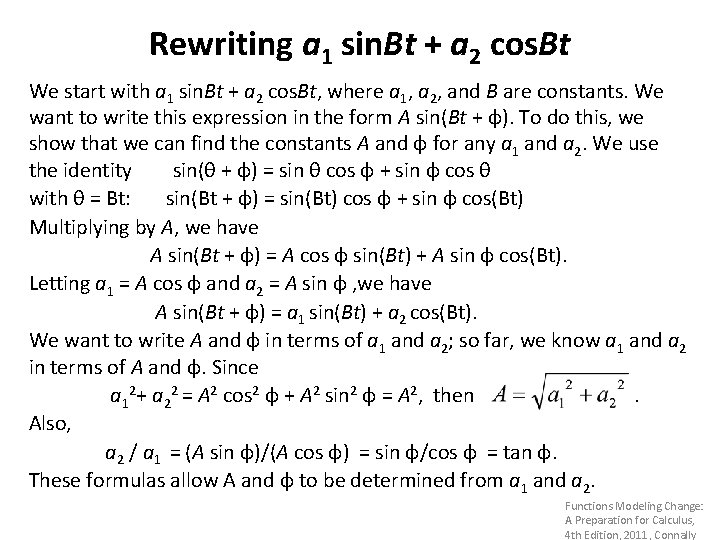
Rewriting a 1 sin. Bt + a 2 cos. Bt We start with a 1 sin. Bt + a 2 cos. Bt, where a 1, a 2, and B are constants. We want to write this expression in the form A sin(Bt + φ). To do this, we show that we can find the constants A and φ for any a 1 and a 2. We use the identity sin(θ + φ) = sin θ cos φ + sin φ cos θ with θ = Bt: sin(Bt + φ) = sin(Bt) cos φ + sin φ cos(Bt) Multiplying by A, we have A sin(Bt + φ) = A cos φ sin(Bt) + A sin φ cos(Bt). Letting a 1 = A cos φ and a 2 = A sin φ , we have A sin(Bt + φ) = a 1 sin(Bt) + a 2 cos(Bt). We want to write A and φ in terms of a 1 and a 2; so far, we know a 1 and a 2 in terms of A and φ. Since a 12+ a 22 = A 2 cos 2 φ + A 2 sin 2 φ = A 2, then. Also, a 2 / a 1 = (A sin φ)/(A cos φ) = sin φ/cos φ = tan φ. These formulas allow A and φ to be determined from a 1 and a 2. Functions Modeling Change: A Preparation for Calculus, 4 th Edition, 2011, Connally
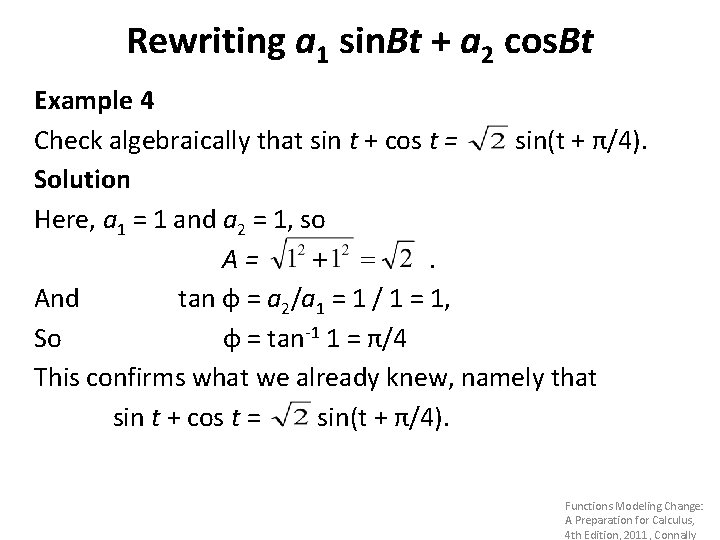
Rewriting a 1 sin. Bt + a 2 cos. Bt Example 4 Check algebraically that sin t + cos t = sin(t + π/4). Solution Here, a 1 = 1 and a 2 = 1, so A=. And tan φ = a 2/a 1 = 1 / 1 = 1, So φ = tan-1 1 = π/4 This confirms what we already knew, namely that sin t + cos t = sin(t + π/4). Functions Modeling Change: A Preparation for Calculus, 4 th Edition, 2011, Connally
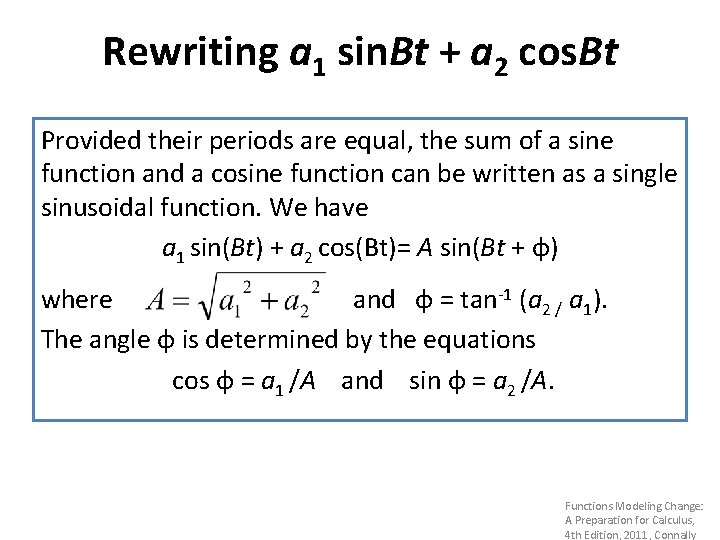
Rewriting a 1 sin. Bt + a 2 cos. Bt Provided their periods are equal, the sum of a sine function and a cosine function can be written as a single sinusoidal function. We have a 1 sin(Bt) + a 2 cos(Bt)= A sin(Bt + φ) where and φ = tan-1 (a 2 / a 1). The angle φ is determined by the equations cos φ = a 1 /A and sin φ = a 2 /A. Functions Modeling Change: A Preparation for Calculus, 4 th Edition, 2011, Connally
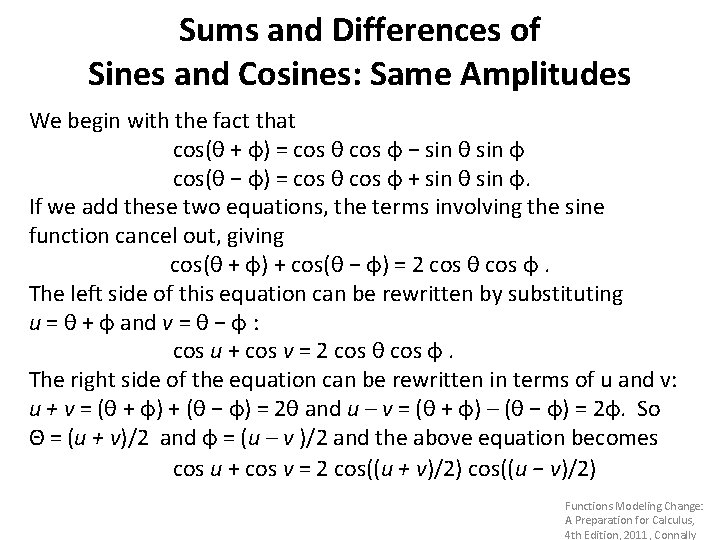
Sums and Differences of Sines and Cosines: Same Amplitudes We begin with the fact that cos(θ + φ) = cos θ cos φ − sin θ sin φ cos(θ − φ) = cos θ cos φ + sin θ sin φ. If we add these two equations, the terms involving the sine function cancel out, giving cos(θ + φ) + cos(θ − φ) = 2 cos θ cos φ. The left side of this equation can be rewritten by substituting u = θ + φ and v = θ − φ : cos u + cos v = 2 cos θ cos φ. The right side of the equation can be rewritten in terms of u and v: u + v = (θ + φ) + (θ − φ) = 2θ and u – v = (θ + φ) – (θ − φ) = 2φ. So Θ = (u + v)/2 and φ = (u – v )/2 and the above equation becomes cos u + cos v = 2 cos((u + v)/2) cos((u − v)/2) Functions Modeling Change: A Preparation for Calculus, 4 th Edition, 2011, Connally
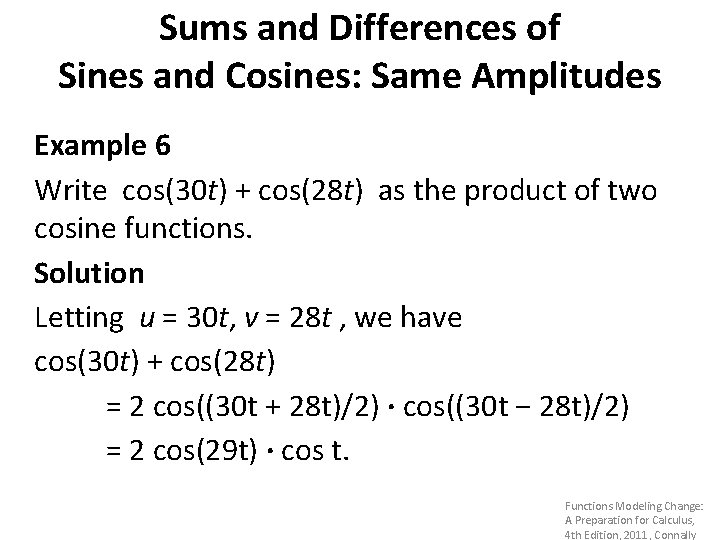
Sums and Differences of Sines and Cosines: Same Amplitudes Example 6 Write cos(30 t) + cos(28 t) as the product of two cosine functions. Solution Letting u = 30 t, v = 28 t , we have cos(30 t) + cos(28 t) = 2 cos((30 t + 28 t)/2) · cos((30 t − 28 t)/2) = 2 cos(29 t) · cos t. Functions Modeling Change: A Preparation for Calculus, 4 th Edition, 2011, Connally
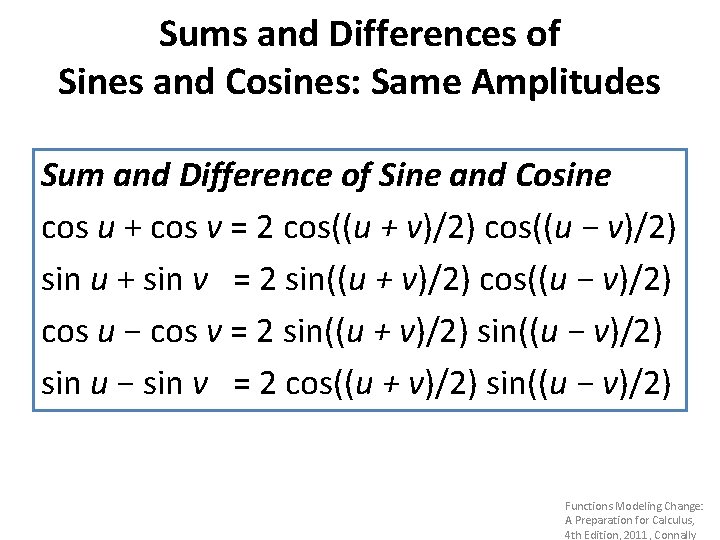
Sums and Differences of Sines and Cosines: Same Amplitudes Sum and Difference of Sine and Cosine cos u + cos v = 2 cos((u + v)/2) cos((u − v)/2) sin u + sin v = 2 sin((u + v)/2) cos((u − v)/2) cos u − cos v = 2 sin((u + v)/2) sin((u − v)/2) sin u − sin v = 2 cos((u + v)/2) sin((u − v)/2) Functions Modeling Change: A Preparation for Calculus, 4 th Edition, 2011, Connally