
9 2 Calculating Acceleration The relationship of acceleration
- Slides: 7
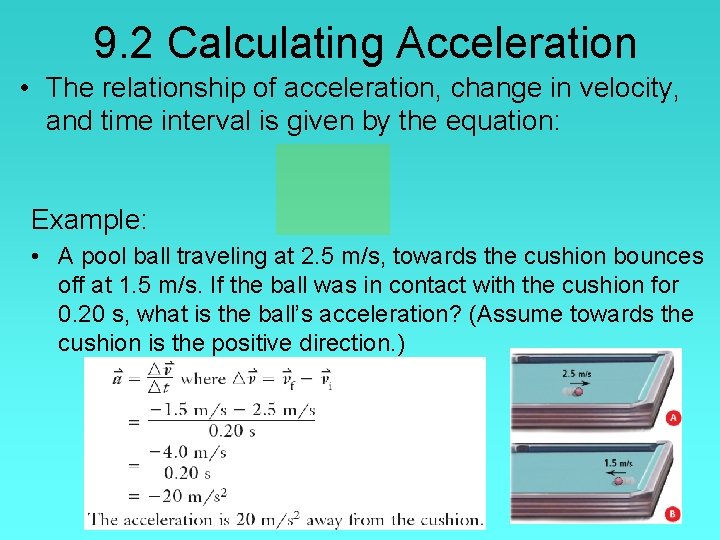
9. 2 Calculating Acceleration • The relationship of acceleration, change in velocity, and time interval is given by the equation: Example: • A pool ball traveling at 2. 5 m/s, towards the cushion bounces off at 1. 5 m/s. If the ball was in contact with the cushion for 0. 20 s, what is the ball’s acceleration? (Assume towards the cushion is the positive direction. )
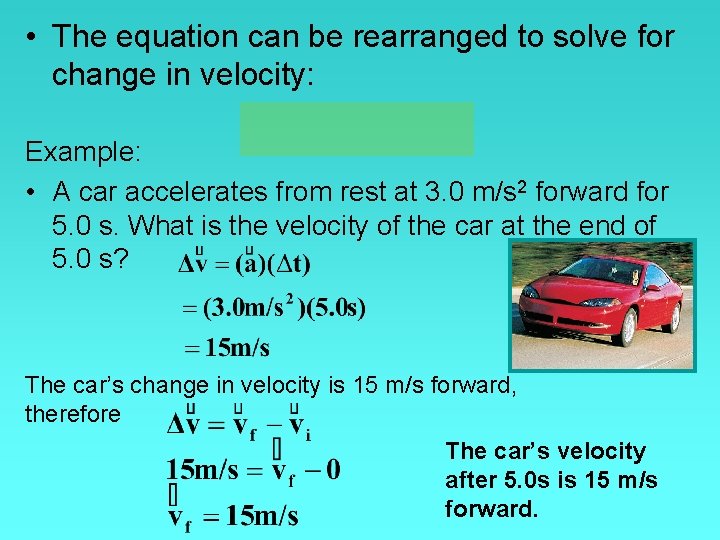
• The equation can be rearranged to solve for change in velocity: Example: • A car accelerates from rest at 3. 0 m/s 2 forward for 5. 0 s. What is the velocity of the car at the end of 5. 0 s? The car’s change in velocity is 15 m/s forward, therefore The car’s velocity after 5. 0 s is 15 m/s forward.
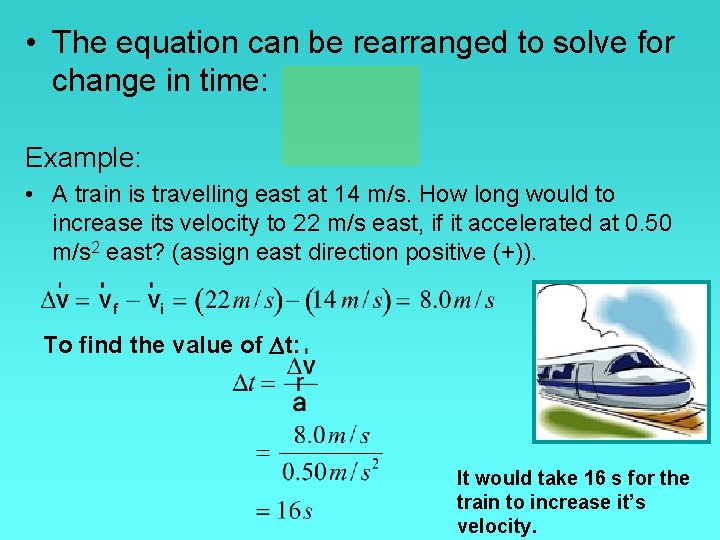
• The equation can be rearranged to solve for change in time: Example: • A train is travelling east at 14 m/s. How long would to increase its velocity to 22 m/s east, if it accelerated at 0. 50 m/s 2 east? (assign east direction positive (+)). To find the value of Dt: It would take 16 s for the train to increase it’s velocity.
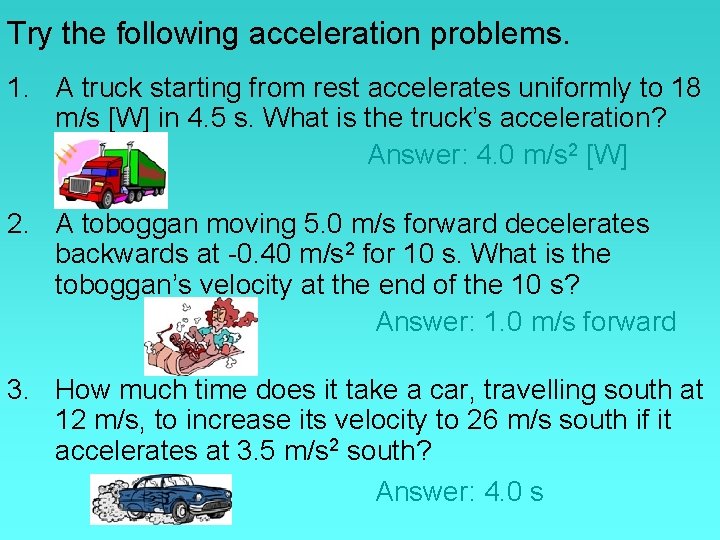
Try the following acceleration problems. 1. A truck starting from rest accelerates uniformly to 18 m/s [W] in 4. 5 s. What is the truck’s acceleration? Answer: 4. 0 m/s 2 [W] 2. A toboggan moving 5. 0 m/s forward decelerates backwards at -0. 40 m/s 2 for 10 s. What is the toboggan’s velocity at the end of the 10 s? Answer: 1. 0 m/s forward 3. How much time does it take a car, travelling south at 12 m/s, to increase its velocity to 26 m/s south if it accelerates at 3. 5 m/s 2 south? Answer: 4. 0 s
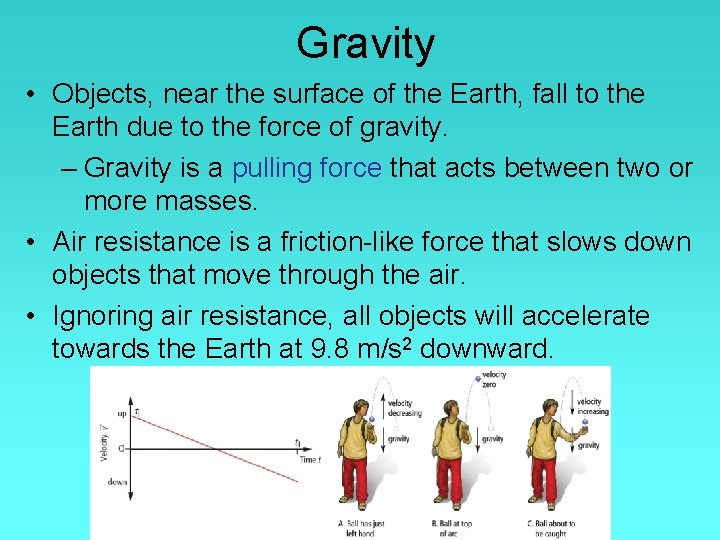
Gravity • Objects, near the surface of the Earth, fall to the Earth due to the force of gravity. – Gravity is a pulling force that acts between two or more masses. • Air resistance is a friction-like force that slows down objects that move through the air. • Ignoring air resistance, all objects will accelerate towards the Earth at 9. 8 m/s 2 downward.
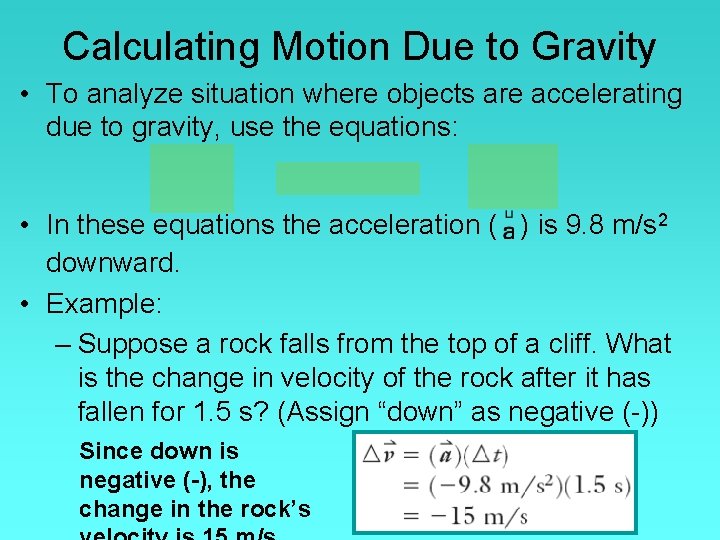
Calculating Motion Due to Gravity • To analyze situation where objects are accelerating due to gravity, use the equations: • In these equations the acceleration ( ) is 9. 8 m/s 2 downward. • Example: – Suppose a rock falls from the top of a cliff. What is the change in velocity of the rock after it has fallen for 1. 5 s? (Assign “down” as negative (-)) Since down is negative (-), the change in the rock’s
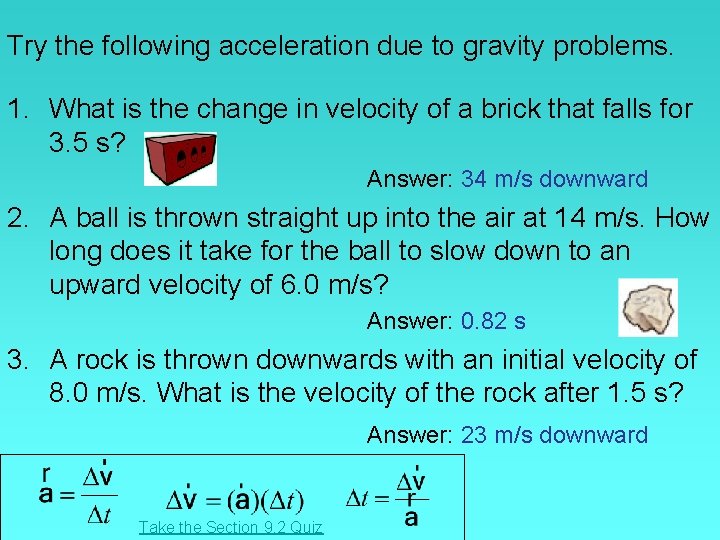
Try the following acceleration due to gravity problems. 1. What is the change in velocity of a brick that falls for 3. 5 s? Answer: 34 m/s downward 2. A ball is thrown straight up into the air at 14 m/s. How long does it take for the ball to slow down to an upward velocity of 6. 0 m/s? Answer: 0. 82 s 3. A rock is thrown downwards with an initial velocity of 8. 0 m/s. What is the velocity of the rock after 1. 5 s? Answer: 23 m/s downward Take the Section 9. 2 Quiz