
9 2 Calculating Acceleration Part 1 VelocityTime Graphs
- Slides: 5
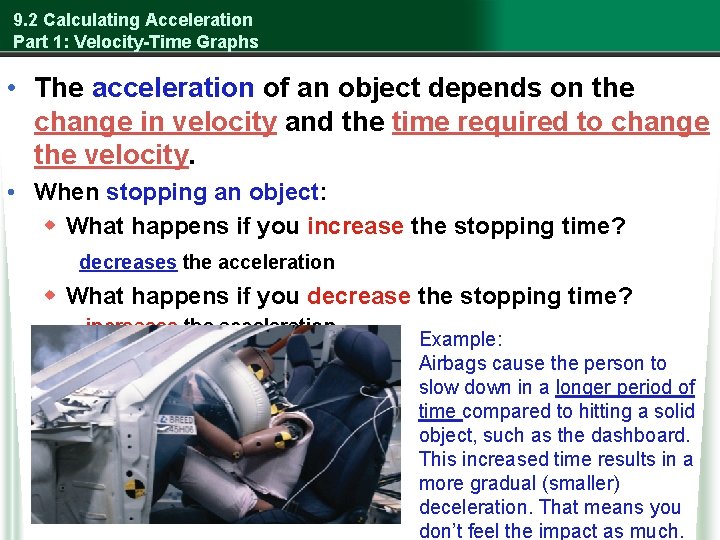
9. 2 Calculating Acceleration Part 1: Velocity-Time Graphs • The acceleration of an object depends on the change in velocity and the time required to change the velocity. • When stopping an object: w What happens if you increase the stopping time? decreases the acceleration w What happens if you decrease the stopping time? increases the acceleration Example: Airbags cause the person to slow down in a longer period of time compared to hitting a solid object, such as the dashboard. This increased time results in a more gradual (smaller) deceleration. That means you don’t feel the impact as much.
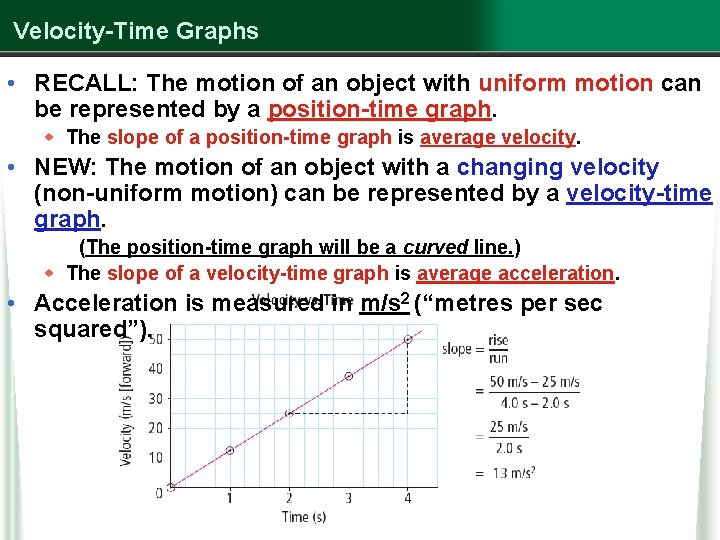
Velocity-Time Graphs • RECALL: The motion of an object with uniform motion can be represented by a position-time graph. w The slope of a position-time graph is average velocity. • NEW: The motion of an object with a changing velocity (non-uniform motion) can be represented by a velocity-time graph. (The position-time graph will be a curved line. ) w The slope of a velocity-time graph is average acceleration. • Acceleration is measured in m/s 2 (“metres per sec squared”).
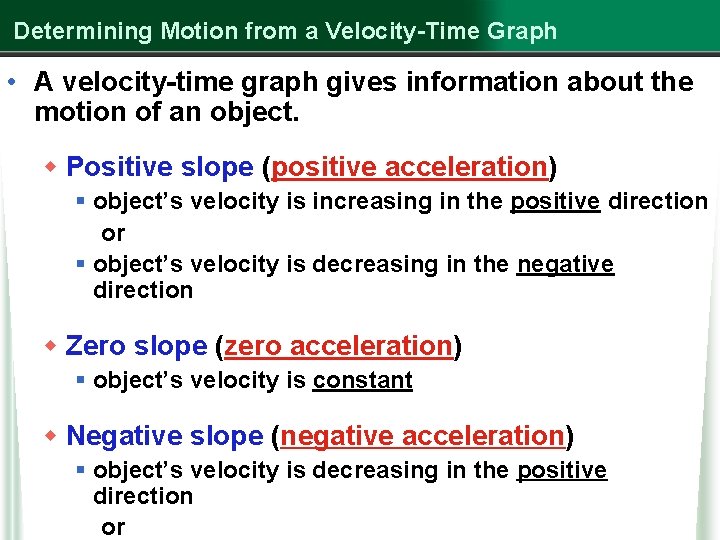
Determining Motion from a Velocity-Time Graph • A velocity-time graph gives information about the motion of an object. w Positive slope (positive acceleration) § object’s velocity is increasing in the positive direction or § object’s velocity is decreasing in the negative direction w Zero slope (zero acceleration) § object’s velocity is constant w Negative slope (negative acceleration) § object’s velocity is decreasing in the positive direction or
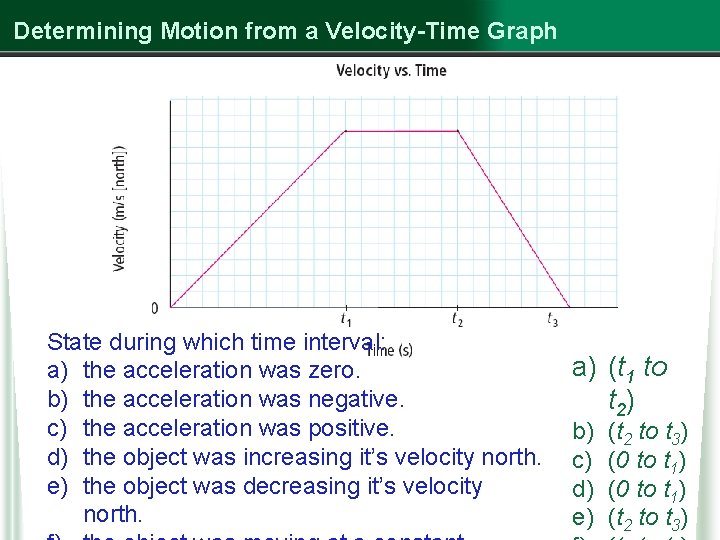
Determining Motion from a Velocity-Time Graph State during which time interval: a) the acceleration was zero. b) the acceleration was negative. c) the acceleration was positive. d) the object was increasing it’s velocity north. e) the object was decreasing it’s velocity north. a) (t 1 to t 2) b) c) d) e) (t 2 to t 3) (0 to t 1) (t 2 to t 3)
ASSIGNMENT 1. Workbook p. 173 -175