
9 15 2009 Alfalfa Fertility Brian Arnall Soil

9 -15 -2009
Alfalfa Fertility Brian Arnall Soil Ferity Extension OSU
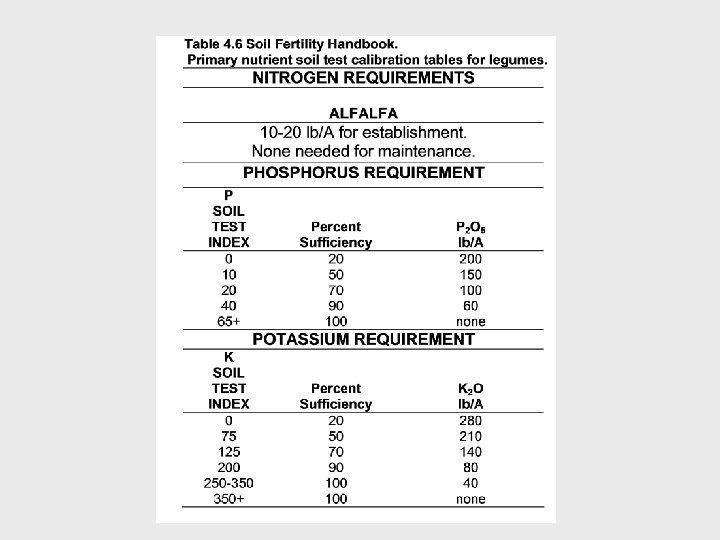
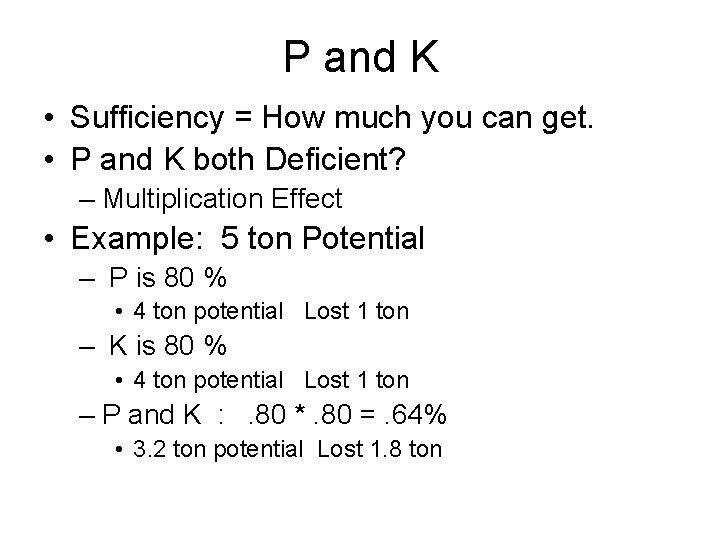
P and K • Sufficiency = How much you can get. • P and K both Deficient? – Multiplication Effect • Example: 5 ton Potential – P is 80 % • 4 ton potential Lost 1 ton – K is 80 % • 4 ton potential Lost 1 ton – P and K : . 80 *. 80 =. 64% • 3. 2 ton potential Lost 1. 8 ton
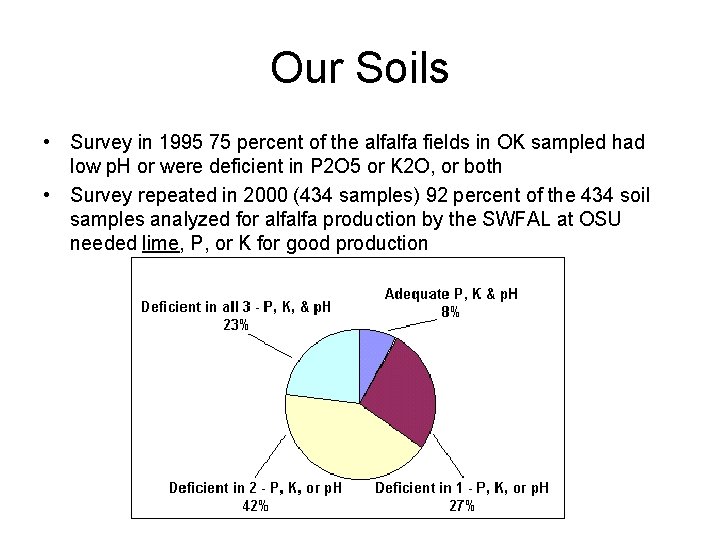
Our Soils • Survey in 1995 75 percent of the alfalfa fields in OK sampled had low p. H or were deficient in P 2 O 5 or K 2 O, or both • Survey repeated in 2000 (434 samples) 92 percent of the 434 soil samples analyzed for alfalfa production by the SWFAL at OSU needed lime, P, or K for good production
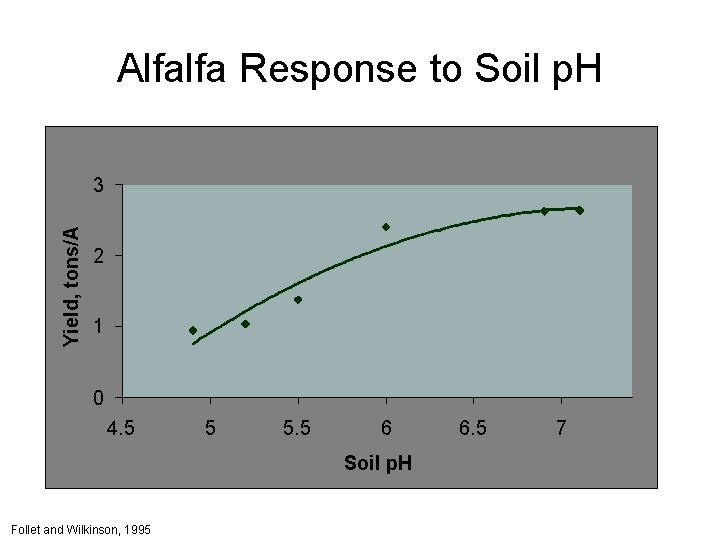
Alfalfa Response to Soil p. H Yield, tons/A 3 2 1 0 4. 5 5 5. 5 6 Soil p. H Follet and Wilkinson, 1995 6. 5 7
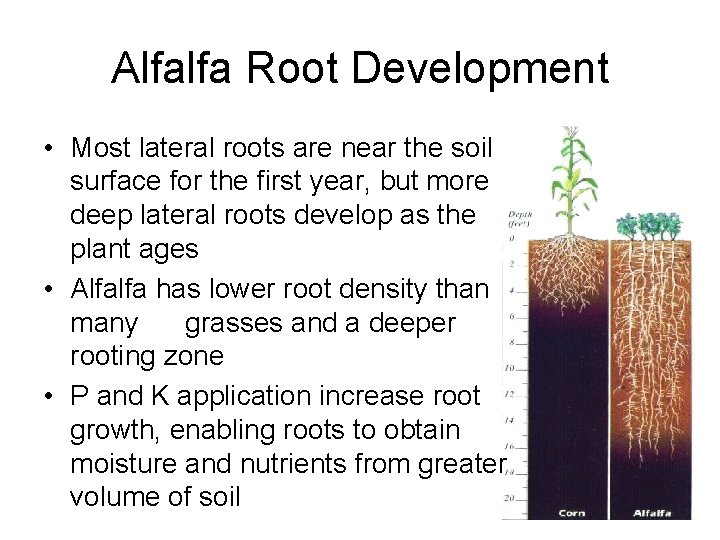
Alfalfa Root Development • Most lateral roots are near the soil surface for the first year, but more deep lateral roots develop as the plant ages • Alfalfa has lower root density than many grasses and a deeper rooting zone • P and K application increase root growth, enabling roots to obtain moisture and nutrients from greater volume of soil
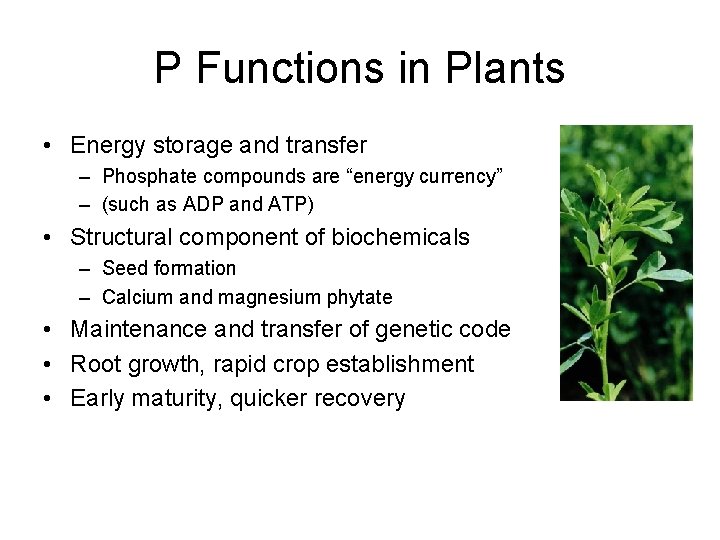
P Functions in Plants • Energy storage and transfer – Phosphate compounds are “energy currency” – (such as ADP and ATP) • Structural component of biochemicals – Seed formation – Calcium and magnesium phytate • Maintenance and transfer of genetic code • Root growth, rapid crop establishment • Early maturity, quicker recovery
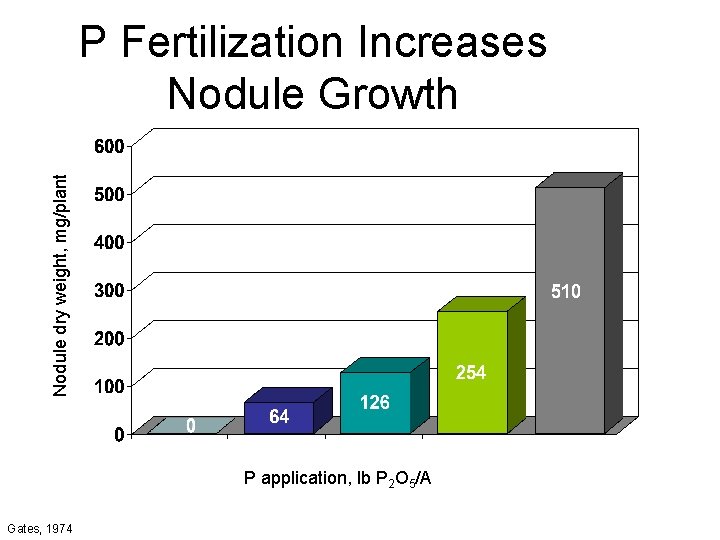
Nodule dry weight, mg/plant P Fertilization Increases Nodule Growth P application, lb P 2 O 5/A Gates, 1974
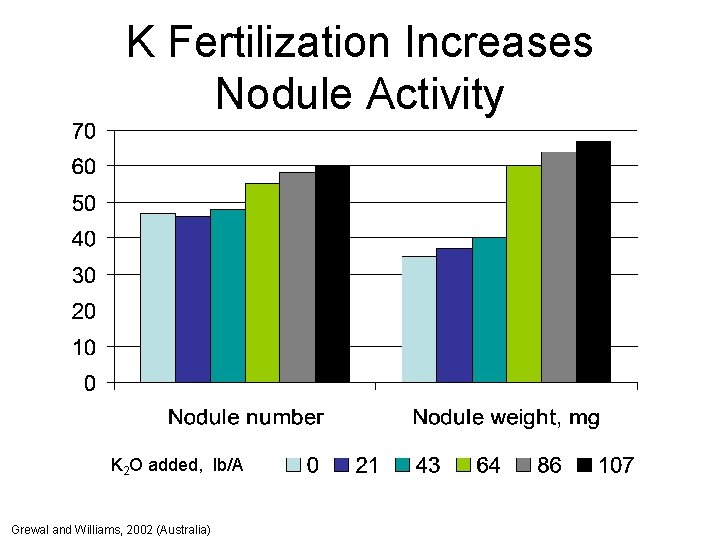
K Fertilization Increases Nodule Activity K 2 O added, lb/A Grewal and Williams, 2002 (Australia)
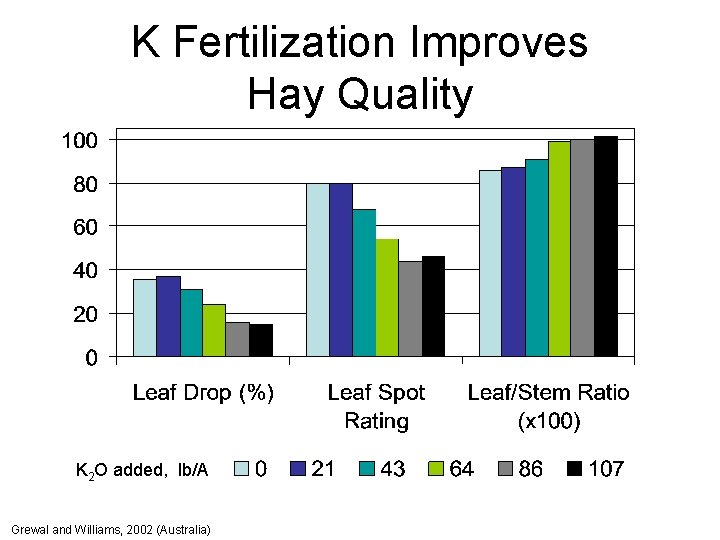
K Fertilization Improves Hay Quality K 2 O added, lb/A Grewal and Williams, 2002 (Australia)
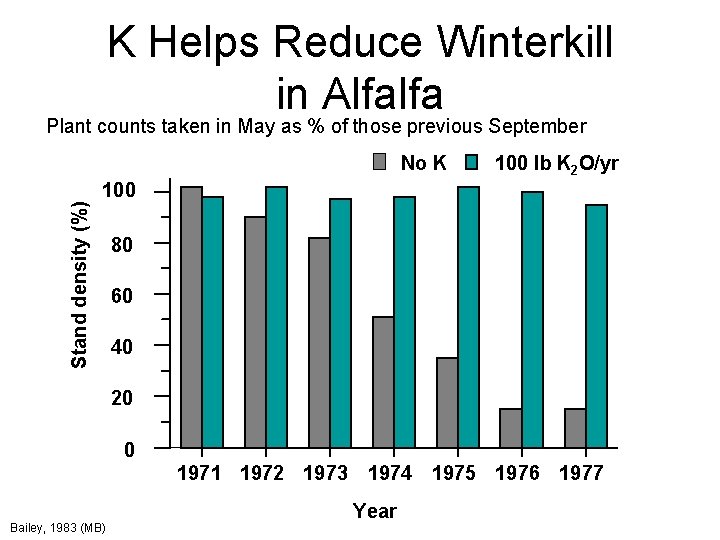
K Helps Reduce Winterkill in Alfalfa Plant counts taken in May as % of those previous September No K 100 lb K 2 O/yr Stand density (%) 100 80 60 40 20 0 1971 1972 1973 1974 1975 1976 1977 Bailey, 1983 (MB) Year
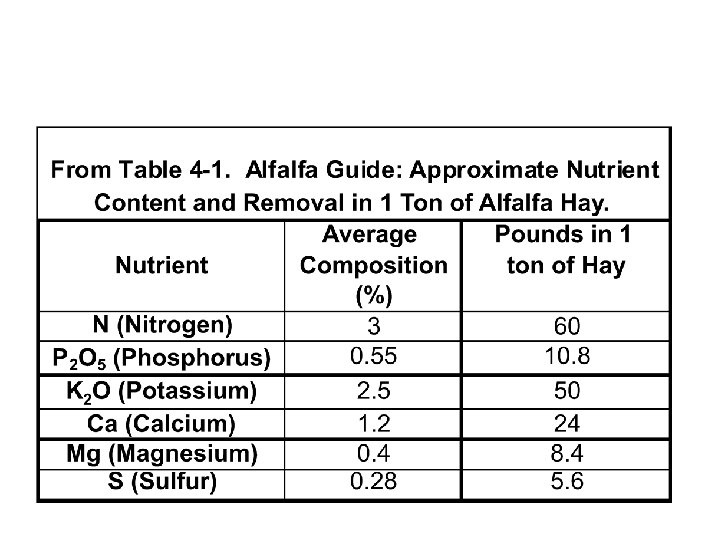
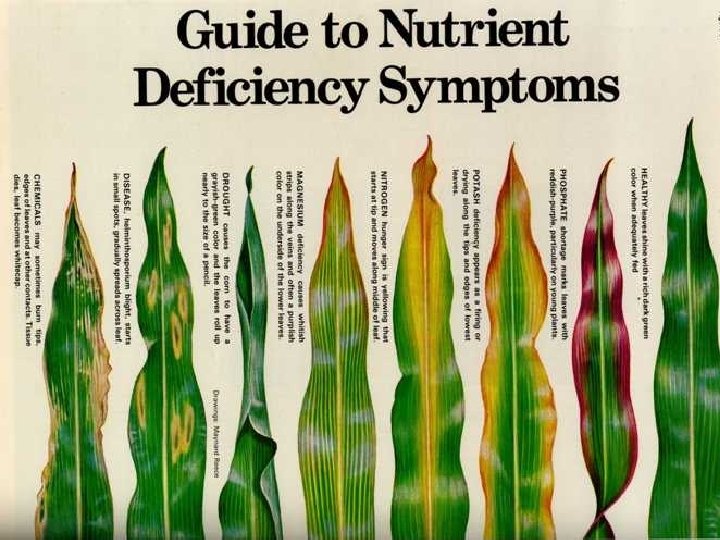
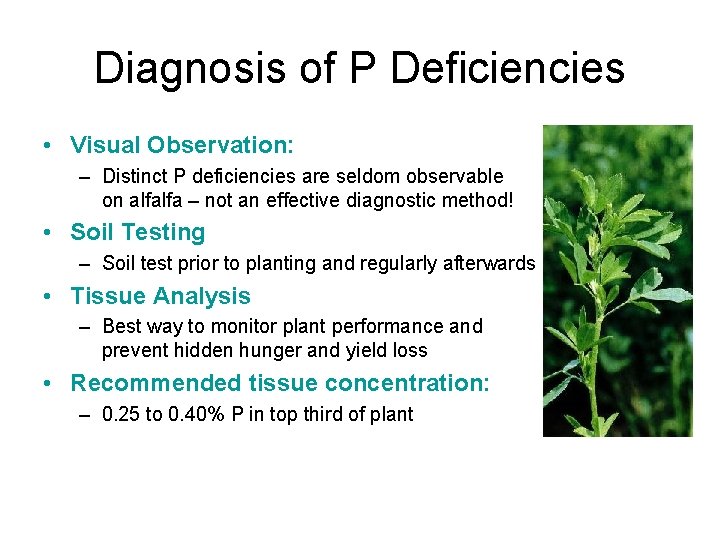
Diagnosis of P Deficiencies • Visual Observation: – Distinct P deficiencies are seldom observable on alfalfa – not an effective diagnostic method! • Soil Testing – Soil test prior to planting and regularly afterwards • Tissue Analysis – Best way to monitor plant performance and prevent hidden hunger and yield loss • Recommended tissue concentration: – 0. 25 to 0. 40% P in top third of plant
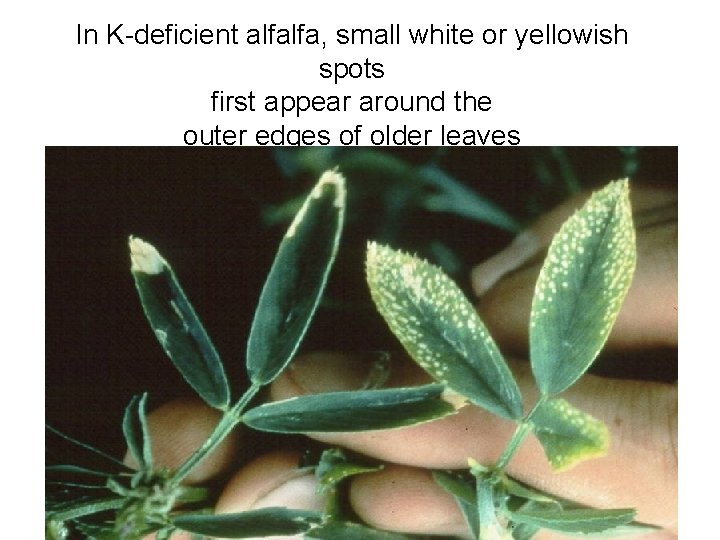
In K-deficient alfalfa, small white or yellowish spots first appear around the outer edges of older leaves
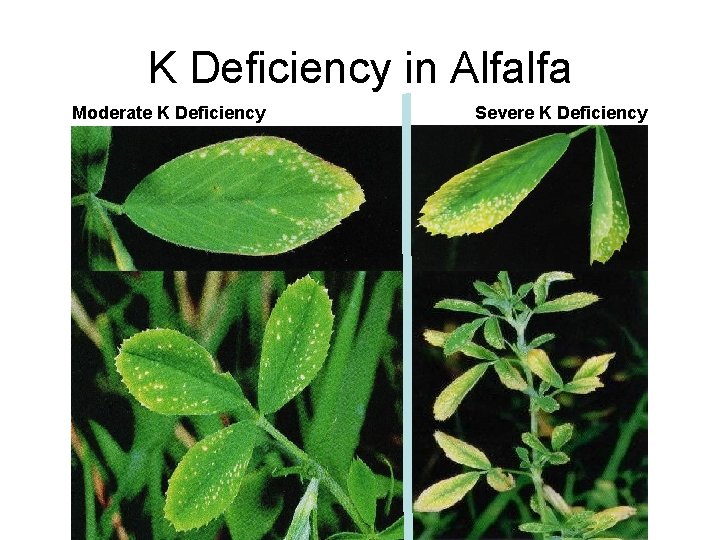
K Deficiency in Alfalfa Moderate K Deficiency Severe K Deficiency
Micro Nutrients • Secondary and Micronutrients—Deficiencies of the secondary elements (calcium, magnesium, and sulfur) and micronutrients (iron, zinc, manganese, copper, boron, molybdenum, and chlorine) are usually not a problem with alfalfa production in Oklahoma. Some magnesium, boron, sulfur, and zinc deficiencies have been reported in the extreme southeastern part of Oklahoma. Response to sulfurcontaining fertilizers can only be expected under high-yielding dryland production. • Special fertilizers containing secondary and micronutrients should not be applied to alfalfa unless there is strong evidence of a deficiency. However, it is critical that soil p. H and levels of phosphorus and potassium have been corrected before trying to confirm a secondary or micronutrient deficiency.
Years 3 -6 • Thinning Stand Fertilization? • Beware!!!
Thank you

- Slides: 24