
9 1 Describing Acceleration We have already examined
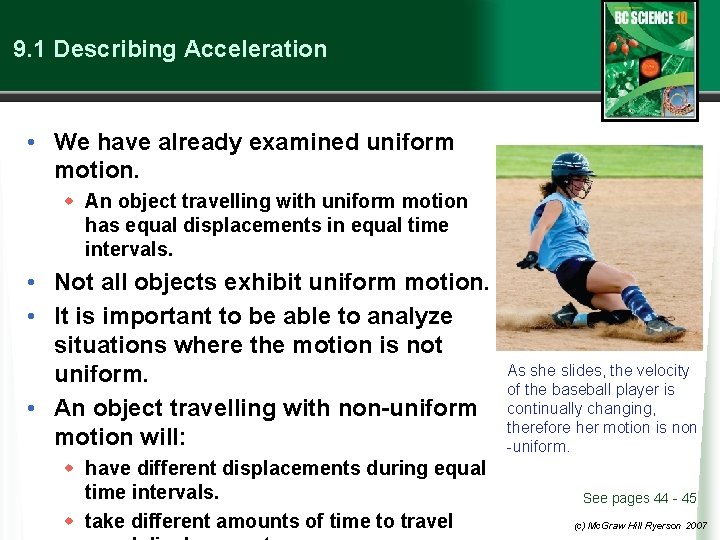
9. 1 Describing Acceleration • We have already examined uniform motion. w An object travelling with uniform motion has equal displacements in equal time intervals. • Not all objects exhibit uniform motion. • It is important to be able to analyze situations where the motion is not uniform. • An object travelling with non-uniform motion will: w have different displacements during equal time intervals. w take different amounts of time to travel As she slides, the velocity of the baseball player is continually changing, therefore her motion is non -uniform. See pages 44 - 45 (c) Mc. Graw Hill Ryerson 2007
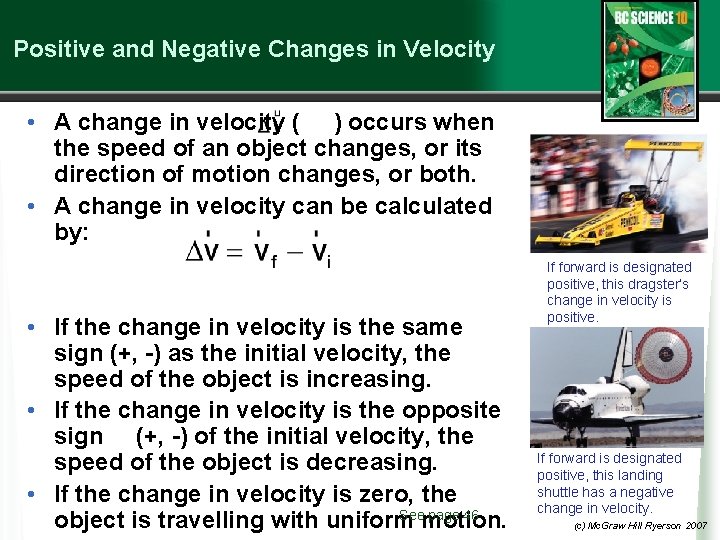
Positive and Negative Changes in Velocity • A change in velocity ( ) occurs when the speed of an object changes, or its direction of motion changes, or both. • A change in velocity can be calculated by: • If the change in velocity is the same sign (+, -) as the initial velocity, the speed of the object is increasing. • If the change in velocity is the opposite sign (+, -) of the initial velocity, the speed of the object is decreasing. • If the change in velocity is zero, the See page 46 object is travelling with uniform motion. If forward is designated positive, this dragster’s change in velocity is positive. If forward is designated positive, this landing shuttle has a negative change in velocity. (c) Mc. Graw Hill Ryerson 2007
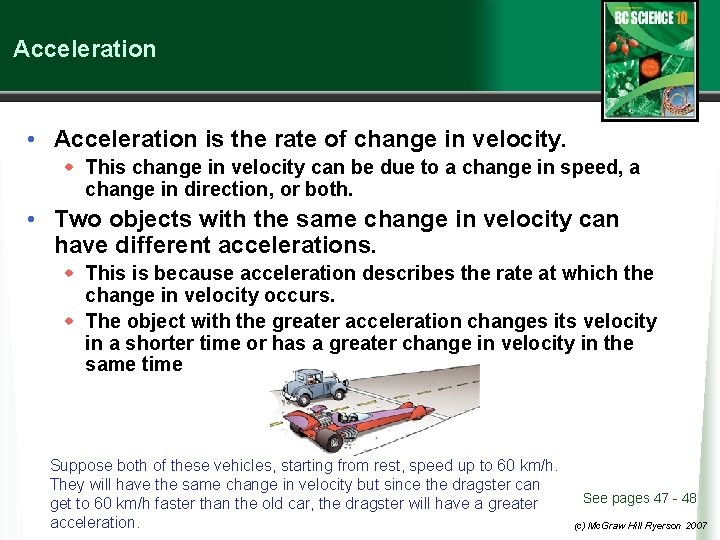
Acceleration • Acceleration is the rate of change in velocity. w This change in velocity can be due to a change in speed, a change in direction, or both. • Two objects with the same change in velocity can have different accelerations. w This is because acceleration describes the rate at which the change in velocity occurs. w The object with the greater acceleration changes its velocity in a shorter time or has a greater change in velocity in the same time Suppose both of these vehicles, starting from rest, speed up to 60 km/h. They will have the same change in velocity but since the dragster can get to 60 km/h faster than the old car, the dragster will have a greater acceleration. See pages 47 - 48 (c) Mc. Graw Hill Ryerson 2007
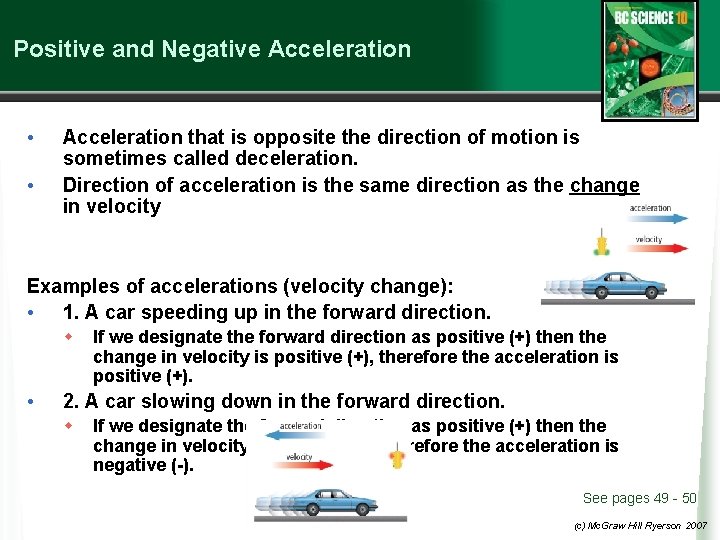
Positive and Negative Acceleration • • Acceleration that is opposite the direction of motion is sometimes called deceleration. Direction of acceleration is the same direction as the change in velocity Examples of accelerations (velocity change): • 1. A car speeding up in the forward direction. w • If we designate the forward direction as positive (+) then the change in velocity is positive (+), therefore the acceleration is positive (+). 2. A car slowing down in the forward direction. w If we designate the forward direction as positive (+) then the change in velocity is negative (-), therefore the acceleration is negative (-). See pages 49 - 50 (c) Mc. Graw Hill Ryerson 2007

Positive and Negative Acceleration Examples of accelerations (direction change): • 3. A car speeding up in the backward direction. w If we designate the backward direction as negative (-) then the change in velocity is negative (-). w This means that the acceleration is negative (-) even though the car is increasing its speed. Remember positive (+) and negative (-) refer to directions. See pages 49 - 50 (c) Mc. Graw Hill Ryerson 2007
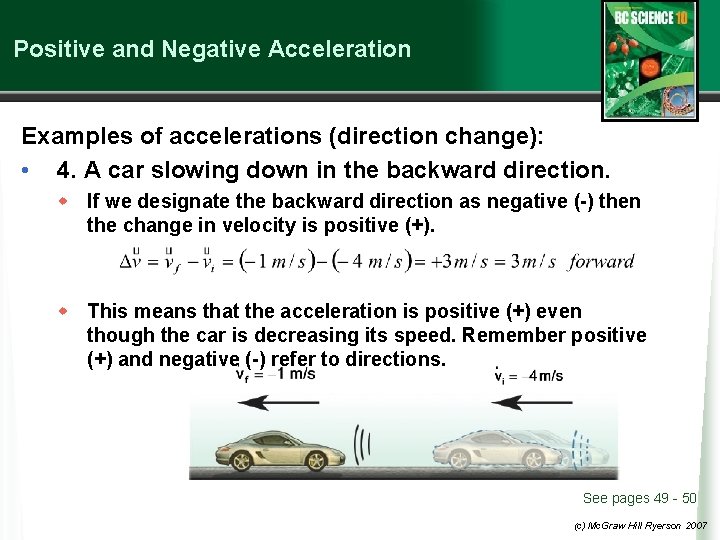
Positive and Negative Acceleration Examples of accelerations (direction change): • 4. A car slowing down in the backward direction. w If we designate the backward direction as negative (-) then the change in velocity is positive (+). w This means that the acceleration is positive (+) even though the car is decreasing its speed. Remember positive (+) and negative (-) refer to directions. See pages 49 - 50 (c) Mc. Graw Hill Ryerson 2007
- Slides: 6