
9 1 Describing Acceleration An object travelling with
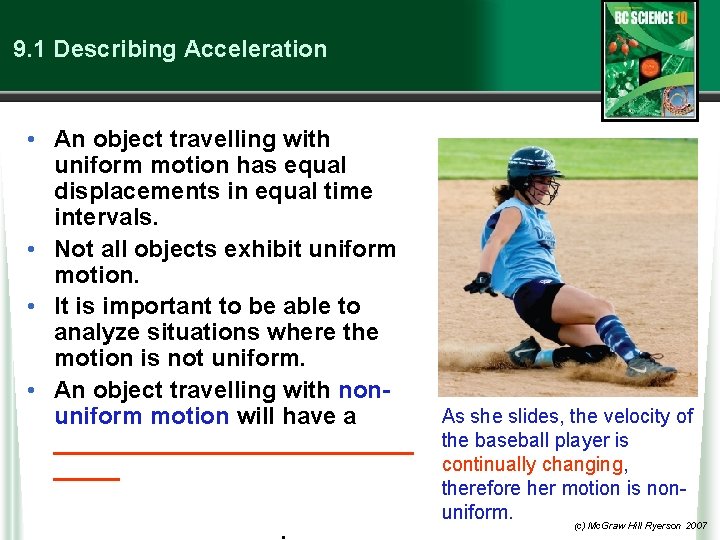
9. 1 Describing Acceleration • An object travelling with uniform motion has equal displacements in equal time intervals. • Not all objects exhibit uniform motion. • It is important to be able to analyze situations where the motion is not uniform. • An object travelling with nonuniform motion will have a ______________. As she slides, the velocity of the baseball player is continually changing, therefore her motion is nonuniform. (c) Mc. Graw Hill Ryerson 2007
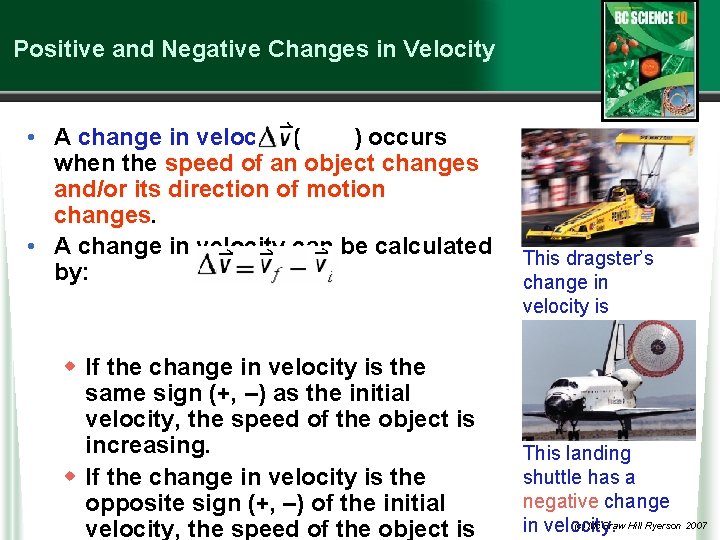
Positive and Negative Changes in Velocity • A change in velocity ( ) occurs when the speed of an object changes and/or its direction of motion changes. • A change in velocity can be calculated by: w If the change in velocity is the same sign (+, –) as the initial velocity, the speed of the object is increasing. w If the change in velocity is the opposite sign (+, –) of the initial velocity, the speed of the object is This dragster’s change in velocity is positive. This landing shuttle has a negative change (c) Mc. Graw Hill Ryerson 2007 in velocity.
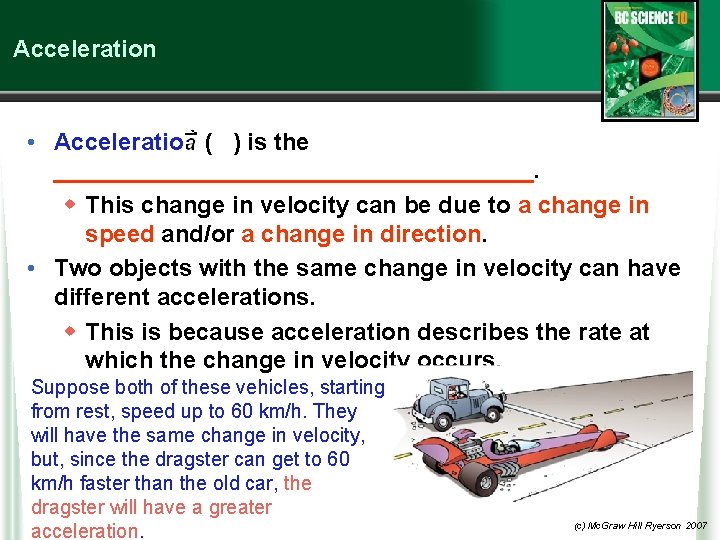
Acceleration • Acceleration ( ) is the __________________. w This change in velocity can be due to a change in speed and/or a change in direction. • Two objects with the same change in velocity can have different accelerations. w This is because acceleration describes the rate at which the change in velocity occurs. Suppose both of these vehicles, starting from rest, speed up to 60 km/h. They will have the same change in velocity, but, since the dragster can get to 60 km/h faster than the old car, the dragster will have a greater acceleration. (c) Mc. Graw Hill Ryerson 2007
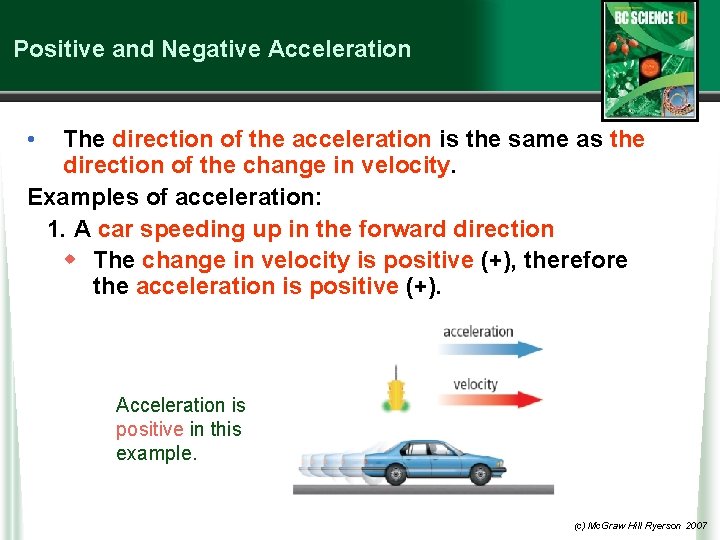
Positive and Negative Acceleration • The direction of the acceleration is the same as the direction of the change in velocity. Examples of acceleration: 1. A car speeding up in the forward direction w The change in velocity is positive (+), therefore the acceleration is positive (+). Acceleration is positive in this example. (c) Mc. Graw Hill Ryerson 2007
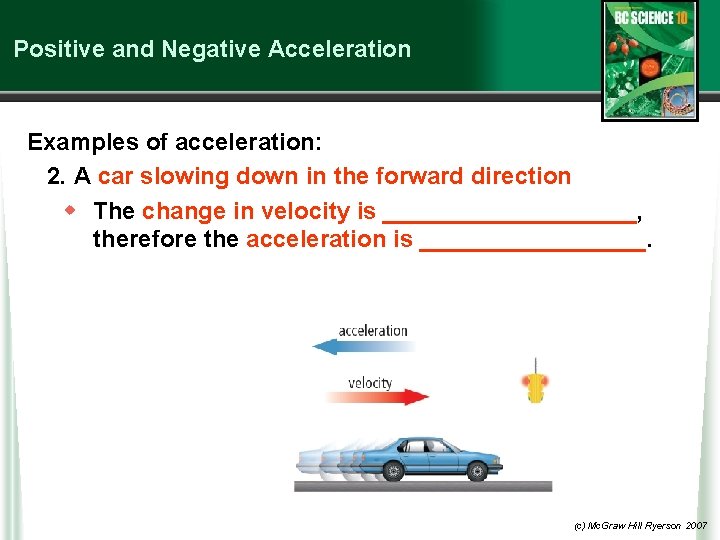
Positive and Negative Acceleration Examples of acceleration: 2. A car slowing down in the forward direction w The change in velocity is __________, therefore the acceleration is _________. (c) Mc. Graw Hill Ryerson 2007
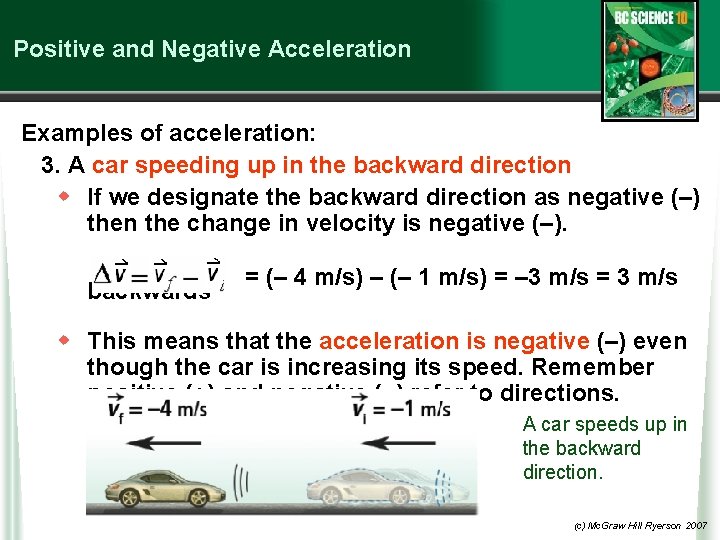
Positive and Negative Acceleration Examples of acceleration: 3. A car speeding up in the backward direction w If we designate the backward direction as negative (–) then the change in velocity is negative (–). backwards = (– 4 m/s) – (– 1 m/s) = – 3 m/s = 3 m/s w This means that the acceleration is negative (–) even though the car is increasing its speed. Remember positive (+) and negative (–) refer to directions. A car speeds up in the backward direction. (c) Mc. Graw Hill Ryerson 2007
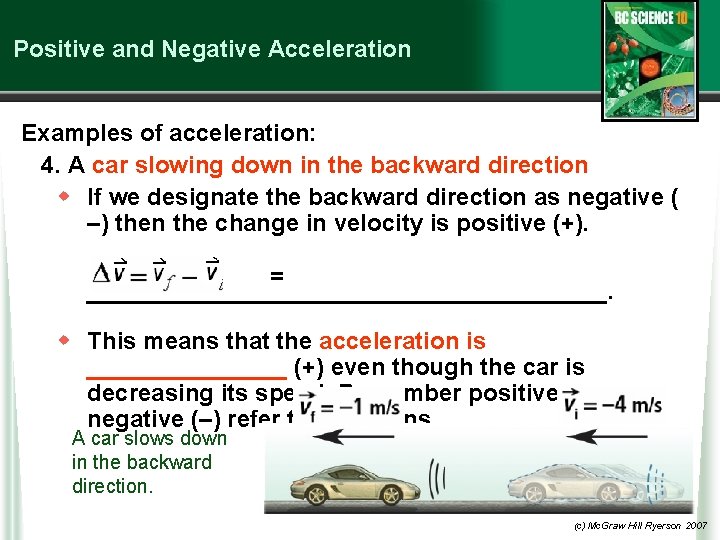
Positive and Negative Acceleration Examples of acceleration: 4. A car slowing down in the backward direction w If we designate the backward direction as negative ( –) then the change in velocity is positive (+). = ____________________. w This means that the acceleration is ________ (+) even though the car is decreasing its speed. Remember positive (+) and negative (–) refer to directions. A car slows down in the backward direction. (c) Mc. Graw Hill Ryerson 2007
- Slides: 7