
9 1 American Citizenship CITIZENSHIP BY BIRTH Jus

[ 9. 1 ] American Citizenship
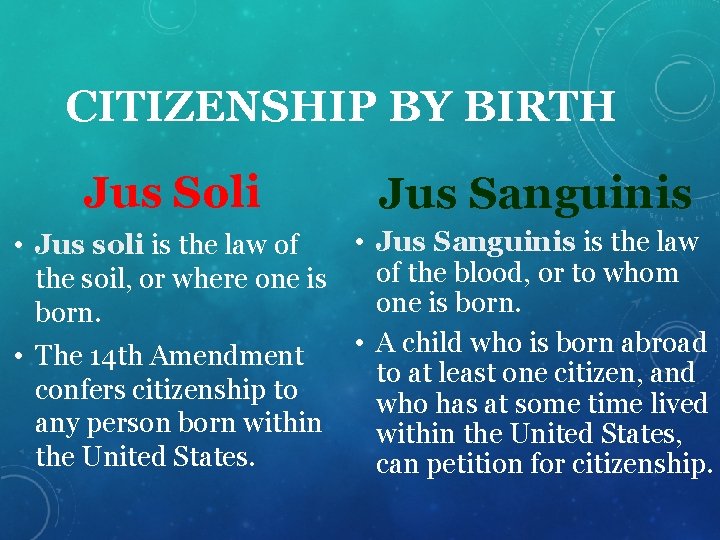
CITIZENSHIP BY BIRTH Jus Soli Jus Sanguinis • Jus Sanguinis is the law • Jus soli is the law of of the blood, or to whom the soil, or where one is born. • A child who is born abroad • The 14 th Amendment to at least one citizen, and confers citizenship to who has at some time lived any person born within the United States, the United States. can petition for citizenship.
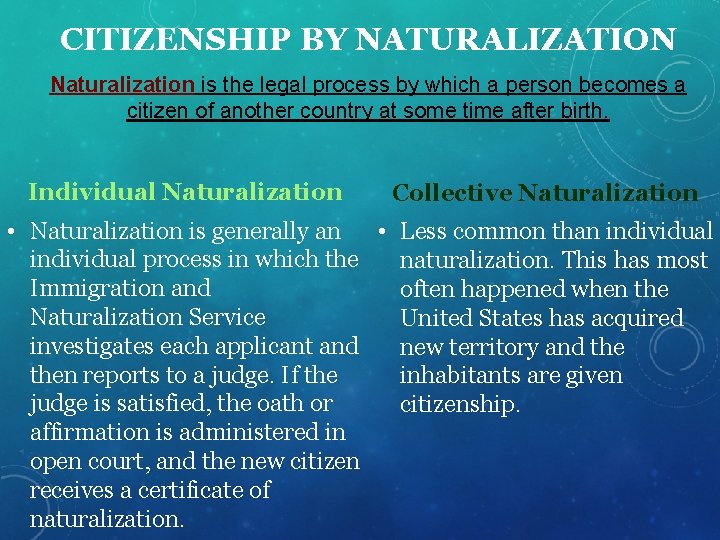
CITIZENSHIP BY NATURALIZATION Naturalization is the legal process by which a person becomes a citizen of another country at some time after birth. Individual Naturalization Collective Naturalization • Naturalization is generally an • Less common than individual process in which the naturalization. This has most Immigration and often happened when the Naturalization Service United States has acquired investigates each applicant and new territory and then reports to a judge. If the inhabitants are given judge is satisfied, the oath or citizenship. affirmation is administered in open court, and the new citizen receives a certificate of naturalization.

Natural-Born Citizenship can be acquired at birth either through jus soli—law of soil—or jus sanguinis—law of blood. Analyze Charts What is the difference between jus soli and jus sanguinis?
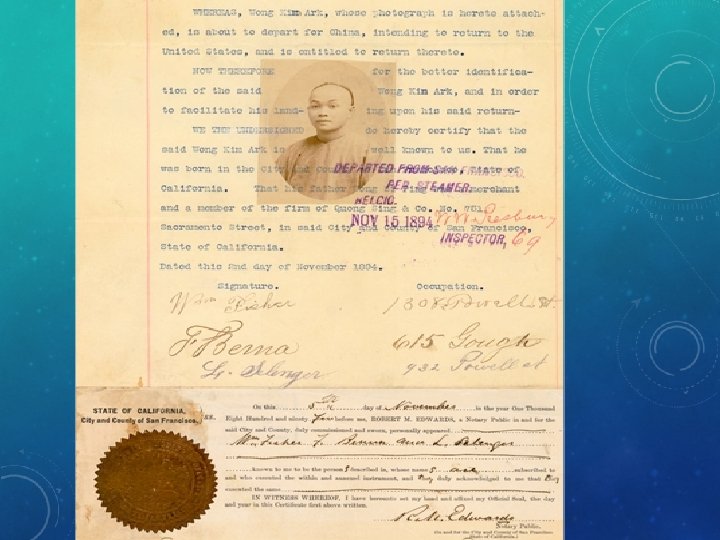
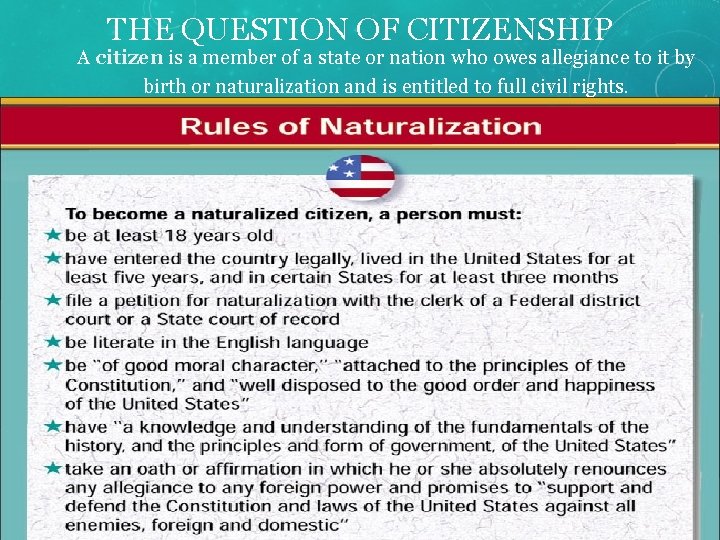
THE QUESTION OF CITIZENSHIP A citizen is a member of a state or nation who owes allegiance to it by birth or naturalization and is entitled to full civil rights. 1 2 3 Chapter 21, Section 4
LOSS OF CITIZENSHIP Expatriation • Expatriation is the legal process by which a loss of citizenship occurs. • Expatriation is a voluntary act. • The Supreme Court has held that the Constitution prohibits automatic expatriation, so an individual cannot have his or her citizenship taken away for breaking a law. Denaturalization • Denaturalization is the process by which citizens can lose their citizenship involuntarily. • This process can only occur by court order and only after it has been shown that the person became a citizen by fraud or deception.
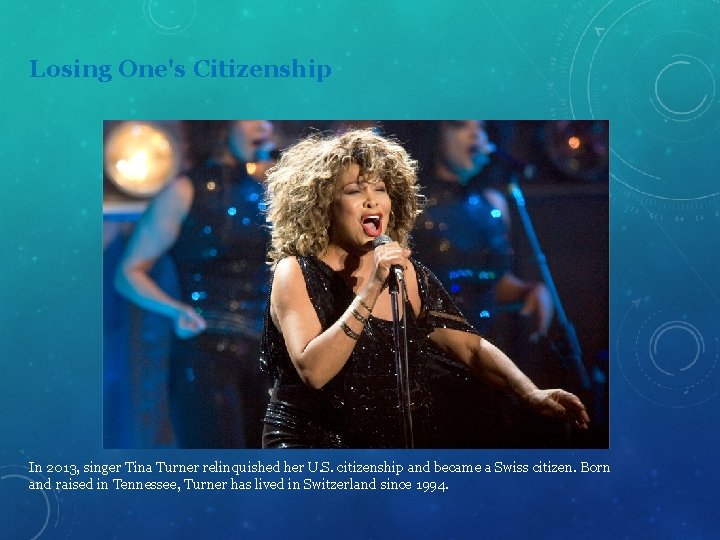
Losing One's Citizenship In 2013, singer Tina Turner relinquished her U. S. citizenship and became a Swiss citizen. Born and raised in Tennessee, Turner has lived in Switzerland since 1994.
Government Immigration Policies • The Quota System- limiting numbers of immigrants from one country to another • Current Immigration Policies- limits of 675, 000/year (permanent) and 53 million/year (temporary) • Those given preference have family members living in the US or have special skills/talents • People Excluded from Immigrating- criminals. diseases, addicts, illiterates, mentally distrurbed • Deportation- removal of an immigrant from one country to their home country
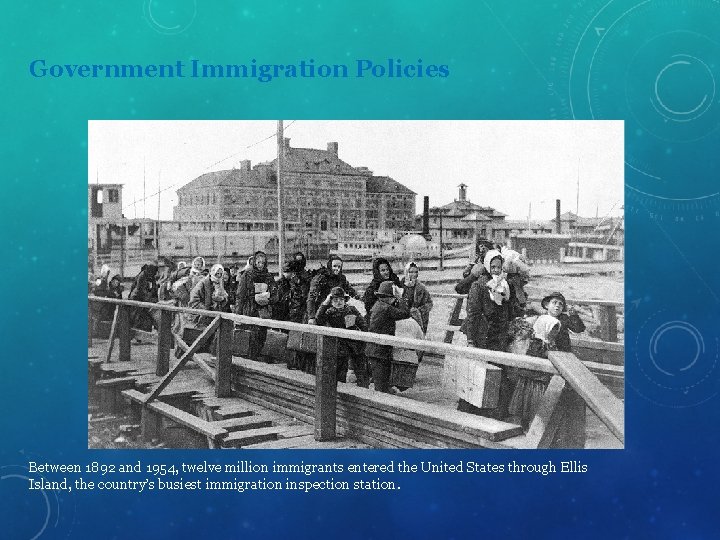
Government Immigration Policies Between 1892 and 1954, twelve million immigrants entered the United States through Ellis Island, the country’s busiest immigration inspection station.
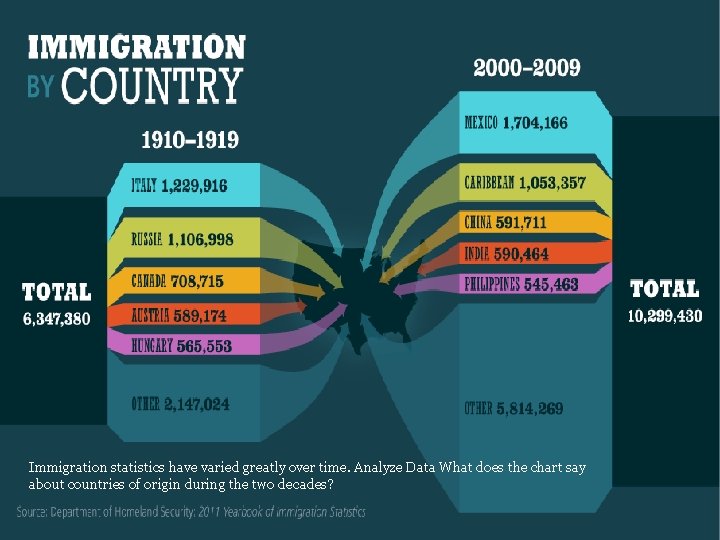
Government Immigration Policies Immigration statistics have varied greatly over time. Analyze Data What does the chart say about countries of origin during the two decades?
CIVIL RIGHTS HISTORY Native Americans • 2 million people live on “reservations” • Push for more sovereignty on their land • Ex. – gambling operation rights • Art. 1, Sec. 8 – commerce clause give Congress right to regulate Indian tribes
CIVIL RIGHTS HISTORY Latino/Latina Rights • 55 million in US (about 10 million in 1980) • Mexican -rights issues include Bilingual education programs, immigration • Puerto Rican –PR is a commonwealth of US, citizens can move freely back and forth, not represented in Congress, don’t have to pay federal tax
CIVIL RIGHTS HISTORY • Cubans – 1960 s, many fled communist takeover by Castro, “wet foot, dry foot” policy • Central and South American – political trouble is driving people to US, face similar bilingual and immigration issues
HISPANIC AMERICANS • Taxing Spanish-speaking workers even though they were US citizens • Hate crimes • Effect of immigration policies
CIVIL RIGHTS HISTORY Asian American • 18 million in US • Chinese Exclusion Act 1882 – lasted through WWII • Demands of assimiliation • WWII – Japanese racism – internment • Korematsu v. US (1944) • Has yet to be overturned
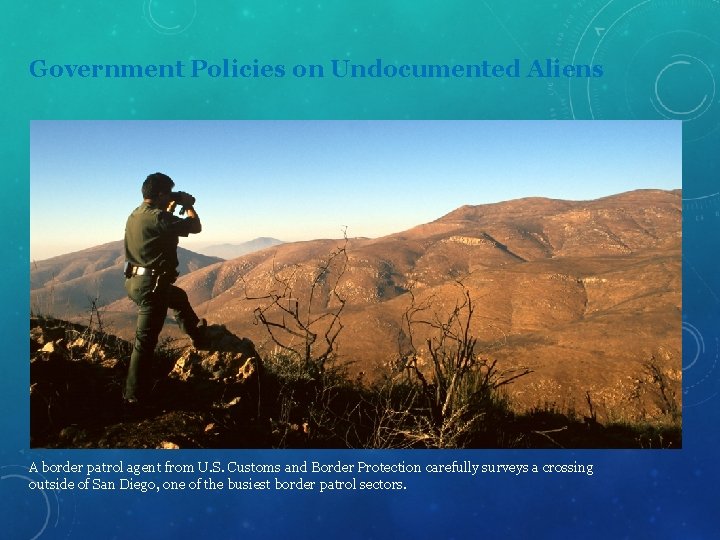
Government Policies on Undocumented Aliens A border patrol agent from U. S. Customs and Border Protection carefully surveys a crossing outside of San Diego, one of the busiest border patrol sectors.
Why are issues related to the way a person can become a citizen of the United States more important today than they were in the early days of our country? A. Citizenship followed State residency in the early days of our country. B. Very few people immigrated to our country until the 20 th century. C. Immigration reform legislation is overdue and has been difficult to enact. D. Quota laws passed in the past 50 years clarified who can become citizens.
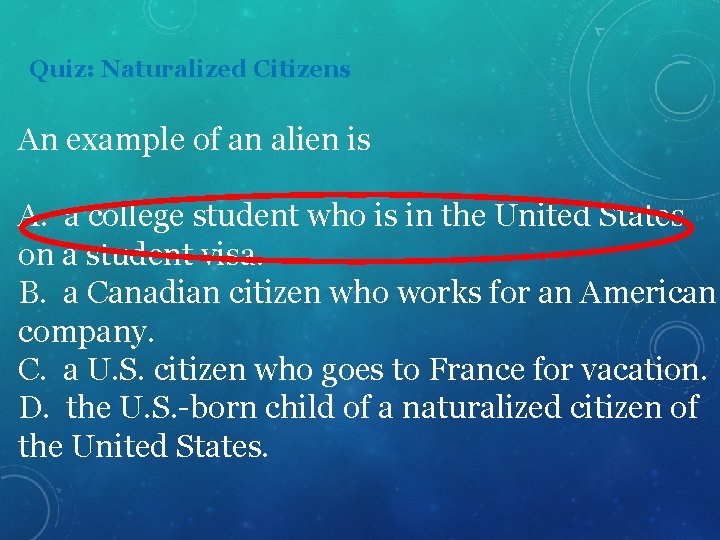
Quiz: Naturalized Citizens An example of an alien is A. a college student who is in the United States on a student visa. B. a Canadian citizen who works for an American company. C. a U. S. citizen who goes to France for vacation. D. the U. S. -born child of a naturalized citizen of the United States.
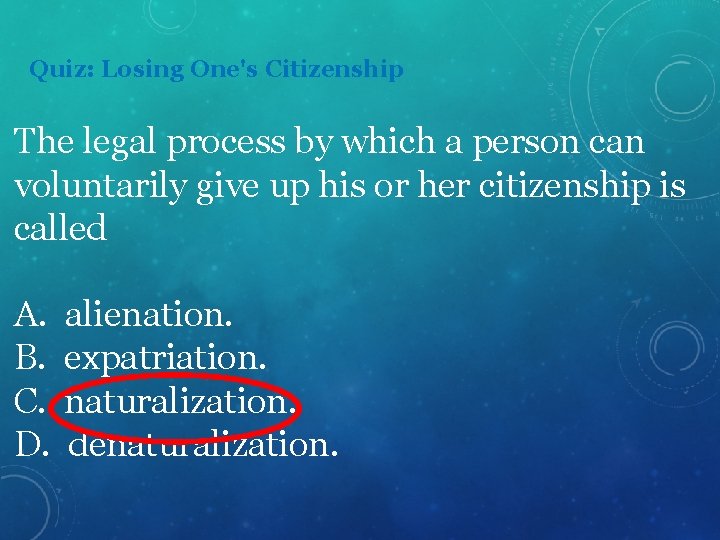
Quiz: Losing One's Citizenship The legal process by which a person can voluntarily give up his or her citizenship is called A. B. C. D. alienation. expatriation. naturalization. denaturalization.
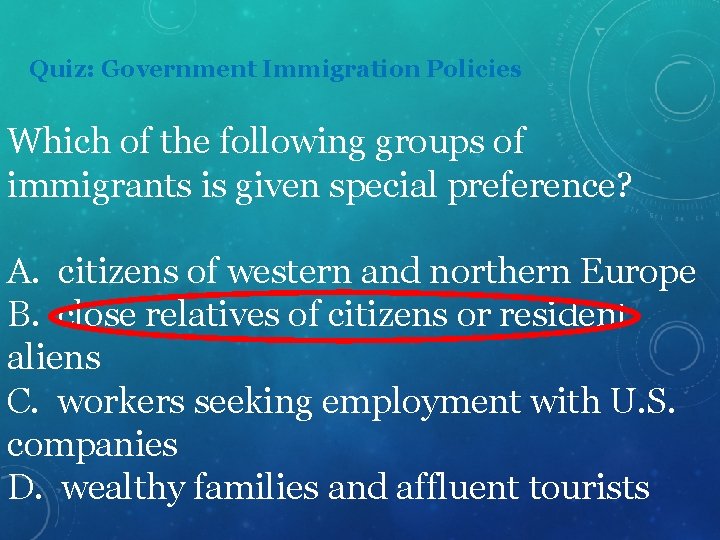
Quiz: Government Immigration Policies Which of the following groups of immigrants is given special preference? A. citizens of western and northern Europe B. close relatives of citizens or resident aliens C. workers seeking employment with U. S. companies D. wealthy families and affluent tourists
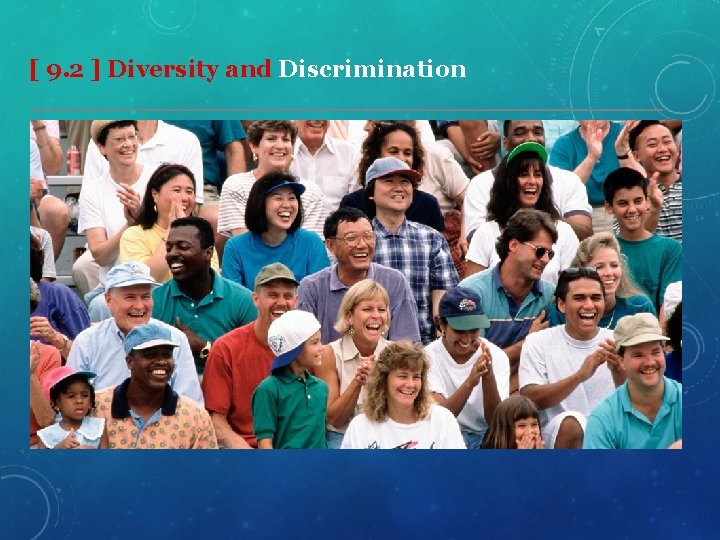
[ 9. 2 ] Diversity and Discrimination
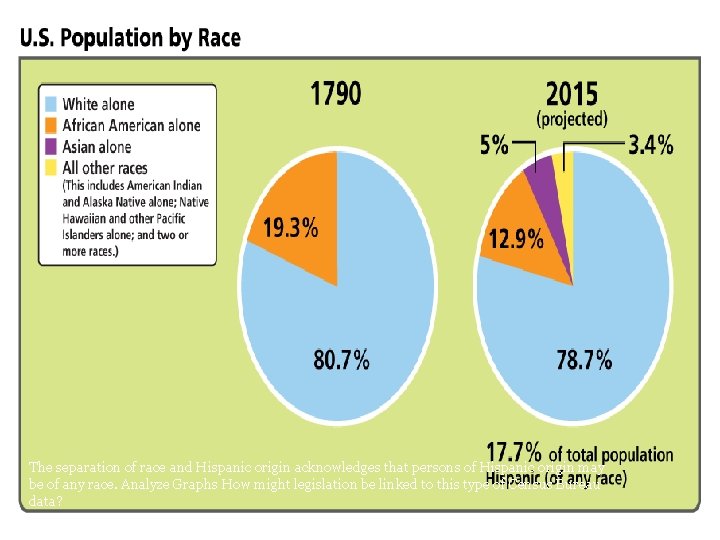
A Changing American Culture The separation of race and Hispanic origin acknowledges that persons of Hispanic origin may be of any race. Analyze Graphs How might legislation be linked to this type of Census Bureau data?
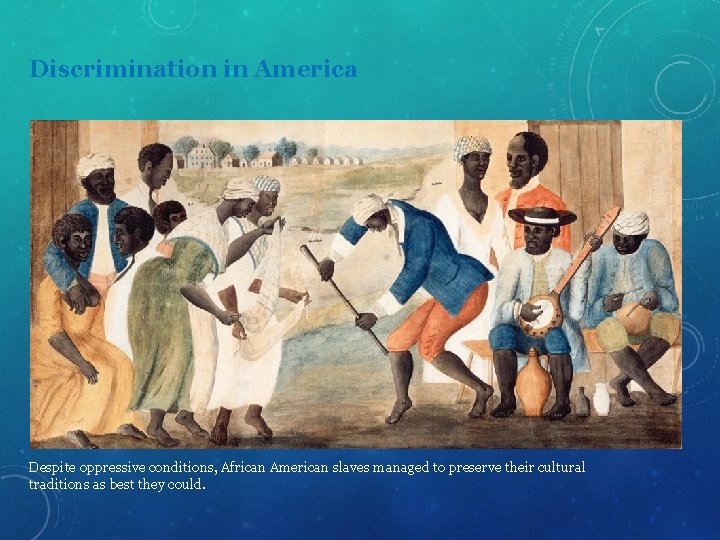
Discrimination in America Despite oppressive conditions, African American slaves managed to preserve their cultural traditions as best they could.
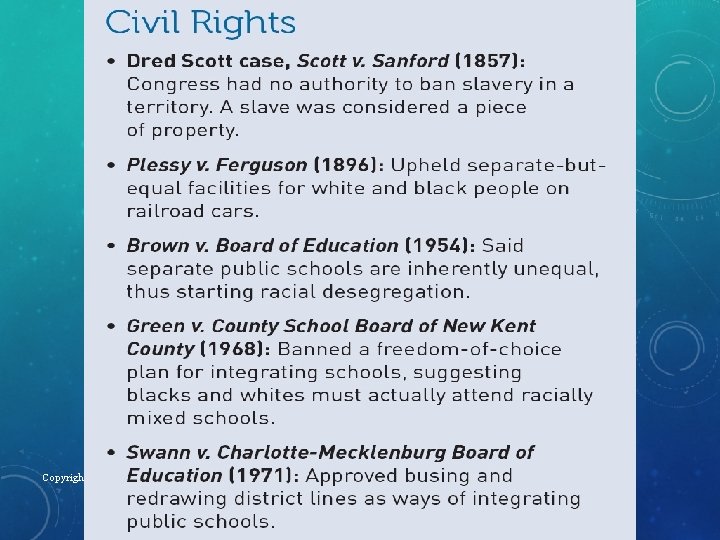
PLESSY V. FERGUSON • Facts • In LA, law required blacks and whites to sit in separate cars • Plessy (1/8 black) refused to follow the law • Holding- as long as facilities are equal, separate is ok • Court can’t force social equality
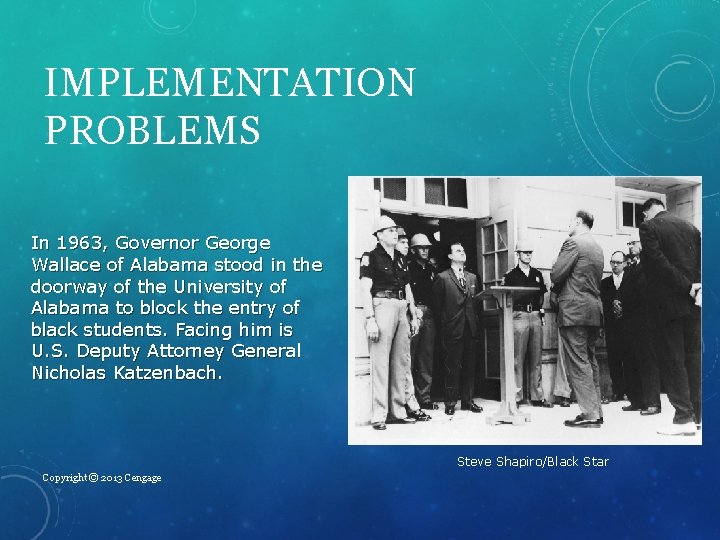
IMPLEMENTATION PROBLEMS In 1963, Governor George Wallace of Alabama stood in the doorway of the University of Alabama to block the entry of black students. Facing him is U. S. Deputy Attorney General Nicholas Katzenbach. Steve Shapiro/Black Star Copyright © 2013 Cengage
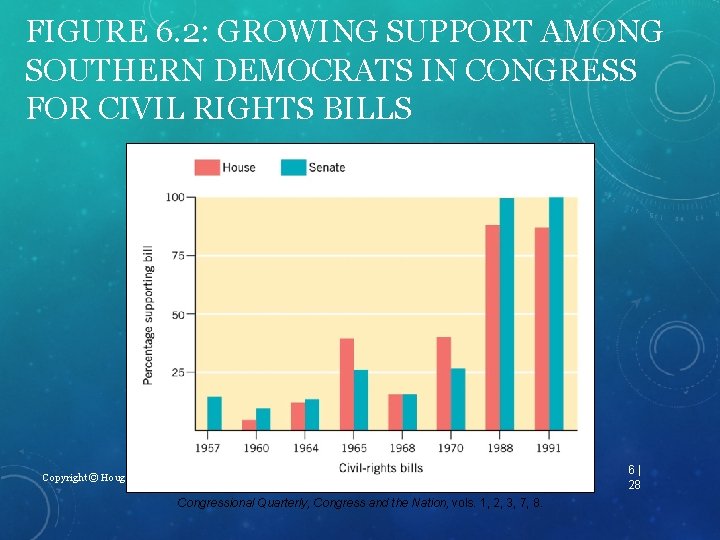
FIGURE 6. 2: GROWING SUPPORT AMONG SOUTHERN DEMOCRATS IN CONGRESS FOR CIVIL RIGHTS BILLS Copyright © Houghton Mifflin Company. All rights reserved. Congressional Quarterly, Congress and the Nation, vols. 1, 2, 3, 7, 8. 6| 28
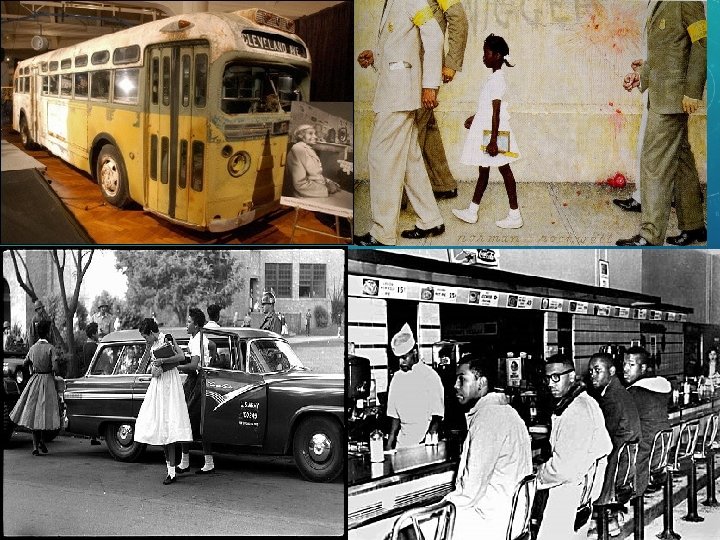
THE CAMPAIGN FOR CIVIL RIGHTS • Sit-ins and freedom rides, voter registration efforts • Martin Luther King, Jr. , Rosa Parks—Montgomery bus boycott • From nonviolent civil disobedience to the “long, hot summers” of racial violence (1964– 1968) Copyright © Houghton Mifflin Company. All rights reserved. 6| 29
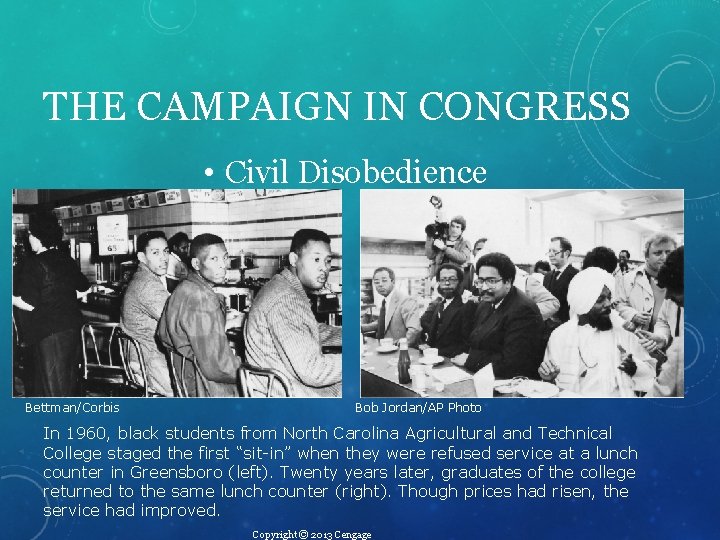
THE CAMPAIGN IN CONGRESS • Civil Disobedience Bettman/Corbis Bob Jordan/AP Photo In 1960, black students from North Carolina Agricultural and Technical College staged the first “sit-in” when they were refused service at a lunch counter in Greensboro (left). Twenty years later, graduates of the college returned to the same lunch counter (right). Though prices had risen, the service had improved. Copyright © 2013 Cengage
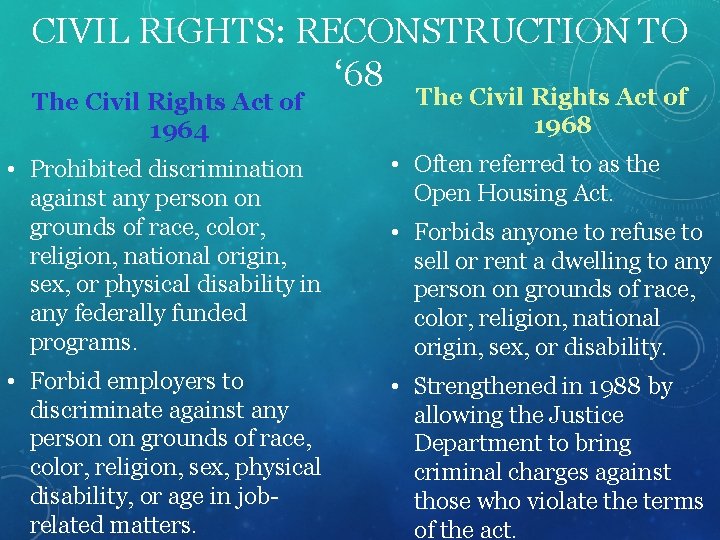
CIVIL RIGHTS: RECONSTRUCTION TO ‘ 68 The Civil Rights Act of 1964 The Civil Rights Act of 1968 • Prohibited discrimination against any person on grounds of race, color, religion, national origin, sex, or physical disability in any federally funded programs. • Often referred to as the Open Housing Act. • Forbid employers to discriminate against any person on grounds of race, color, religion, sex, physical disability, or age in jobrelated matters. • Strengthened in 1988 by allowing the Justice Department to bring criminal charges against those who violate the terms of the act. • Forbids anyone to refuse to sell or rent a dwelling to any person on grounds of race, color, religion, national origin, sex, or disability.
Copyright © 2013 Cengage
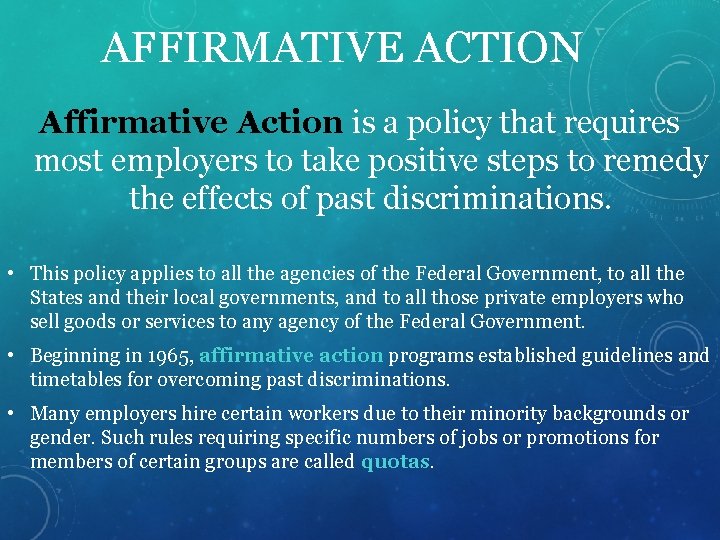
AFFIRMATIVE ACTION Affirmative Action is a policy that requires most employers to take positive steps to remedy the effects of past discriminations. • This policy applies to all the agencies of the Federal Government, to all the States and their local governments, and to all those private employers who sell goods or services to any agency of the Federal Government. • Beginning in 1965, affirmative action programs established guidelines and timetables for overcoming past discriminations. • Many employers hire certain workers due to their minority backgrounds or gender. Such rules requiring specific numbers of jobs or promotions for members of certain groups are called quotas.
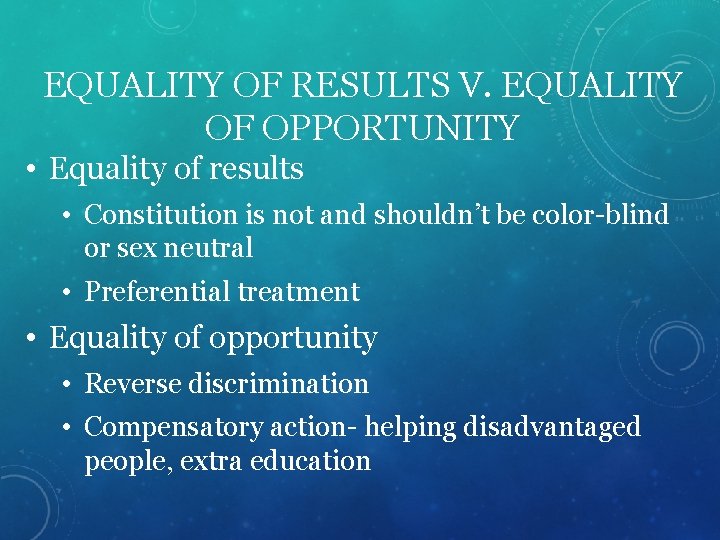
EQUALITY OF RESULTS V. EQUALITY OF OPPORTUNITY • Equality of results • Constitution is not and shouldn’t be color-blind or sex neutral • Preferential treatment • Equality of opportunity • Reverse discrimination • Compensatory action- helping disadvantaged people, extra education
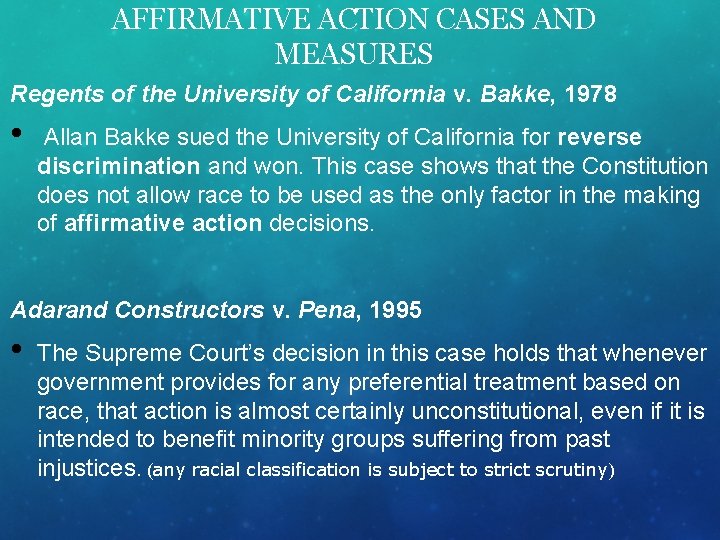
AFFIRMATIVE ACTION CASES AND MEASURES Regents of the University of California v. Bakke, 1978 • Allan Bakke sued the University of California for reverse discrimination and won. This case shows that the Constitution does not allow race to be used as the only factor in the making of affirmative action decisions. Adarand Constructors v. Pena, 1995 • The Supreme Court’s decision in this case holds that whenever government provides for any preferential treatment based on race, that action is almost certainly unconstitutional, even if it is intended to benefit minority groups suffering from past injustices. (any racial classification is subject to strict scrutiny)
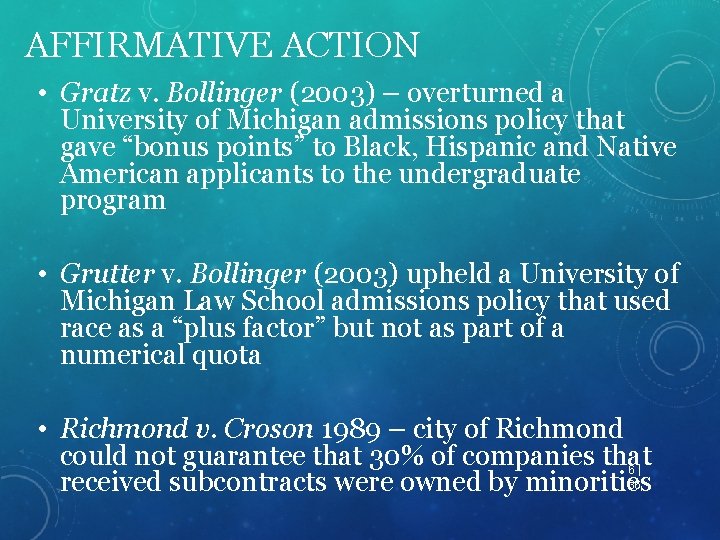
AFFIRMATIVE ACTION • Gratz v. Bollinger (2003) – overturned a University of Michigan admissions policy that gave “bonus points” to Black, Hispanic and Native American applicants to the undergraduate program • Grutter v. Bollinger (2003) upheld a University of Michigan Law School admissions policy that used race as a “plus factor” but not as part of a numerical quota • Richmond v. Croson 1989 – city of Richmond could not guarantee that 30% of companies that 6| 36 received subcontracts were owned by minorities
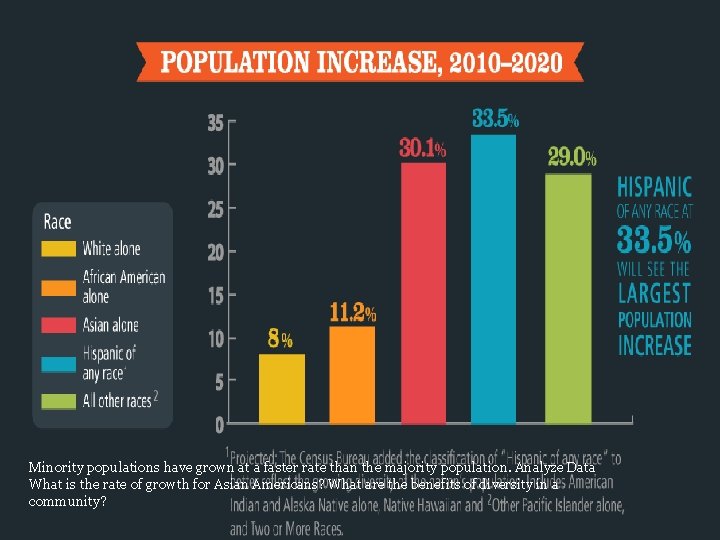
Discrimination in America Minority populations have grown at a faster rate than the majority population. Analyze Data What is the rate of growth for Asian Americans? What are the benefits of diversity in a community?
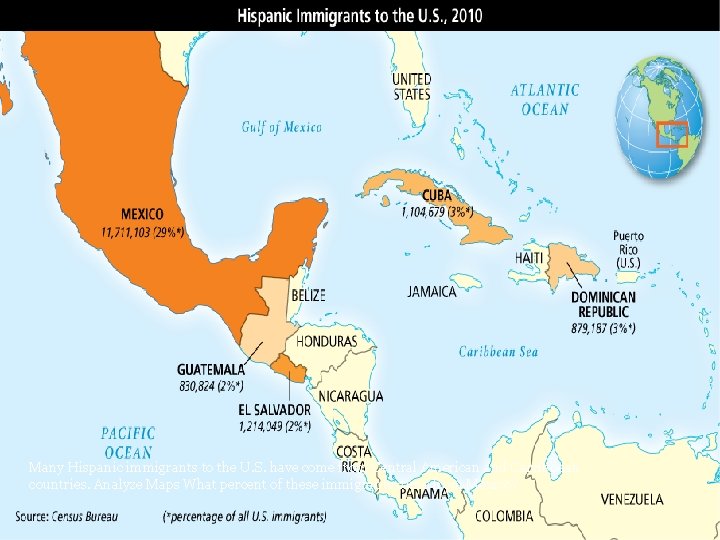
Discrimination in America Many Hispanic immigrants to the U. S. have come from Central American and Carribbean countries. Analyze Maps What percent of these immigrants came from Mexico?
TEST FOR DENIAL OF RIGHTS • Reasonableness standard- when laws treat groups differently the different treatment must be reasonable and not arbitrary • Intermediate scrutiny – somewhere b/w reasonableness and strict scrutiny • Law must rest on some ground of difference having a fair and substantial relation to the object of legislation so that all persons similarly circumstanced should be treated a like • Strict scrutiny- drawing distinctions between groups of people are inherently suspect
CLASSIFICATIONS • Strict scrutiny: racial classifications are inherently suspect and are upheld only if they serve a “compelling public interest. ” • Mid-level review: gender classifications must bear a substantial relationship to an important legislative purpose • Rational basis test: other classifications must be reasonable, bearing a rational relationship to a legitimate governmental interest.
CLASSIFICATION BY SEX • Overall, the Court has ruled that laws that treat men differently than women will be overturned unless (1) they are intended to serve an “important government objective” and (2) they are “substantially related” to achieving that goal.
WOMEN AND EQUAL RIGHTS • Civil Rights Act (1964) • Title VII – prohibits gender discrimination in employment, extended to sexual harassment • Hostile environment: creating a setting in which harassment impairs a person’s ability to work; employers are liable if they were negligent (knew about the conduct but did nothing to stop it) • Comparable worth – “equal pay for equal work” • Title IX – provide equal funding for all programs that receive federal funding
PRIVACY AND SEX • In 1965, Supreme Court held that states could not prevent the sale of contraceptives, because that violated the zone of privacy (not mentioned in the Constitution, but the Court inferred from the Bill of Rights)
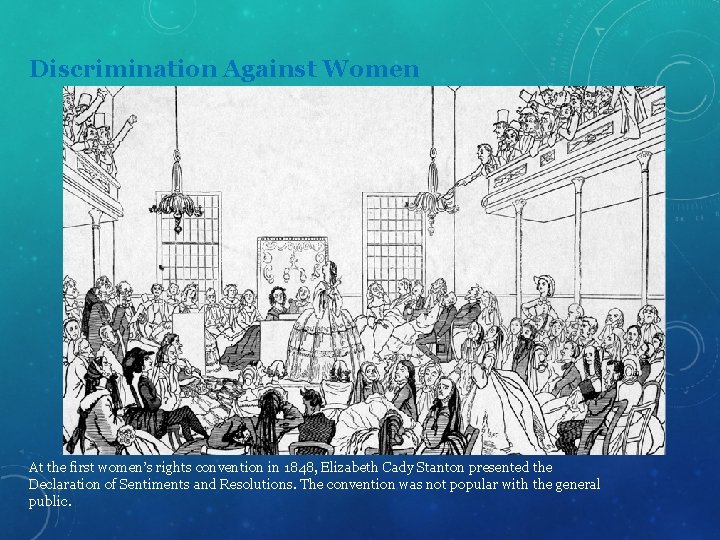
Discrimination Against Women At the first women’s rights convention in 1848, Elizabeth Cady Stanton presented the Declaration of Sentiments and Resolutions. The convention was not popular with the general public.
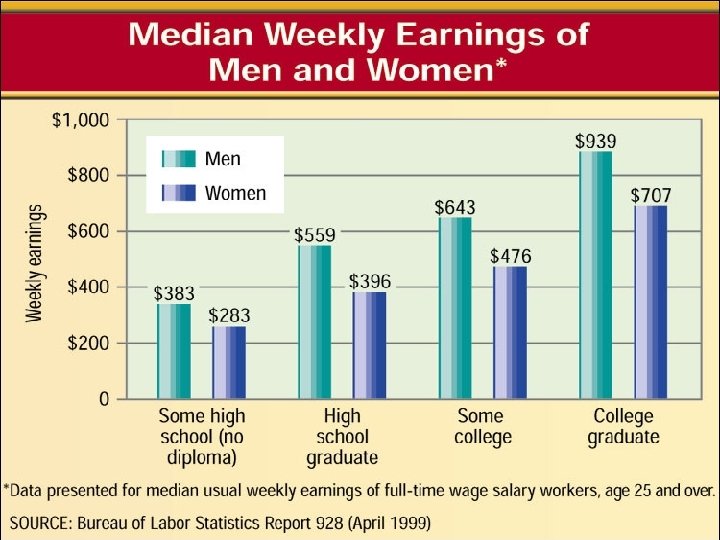
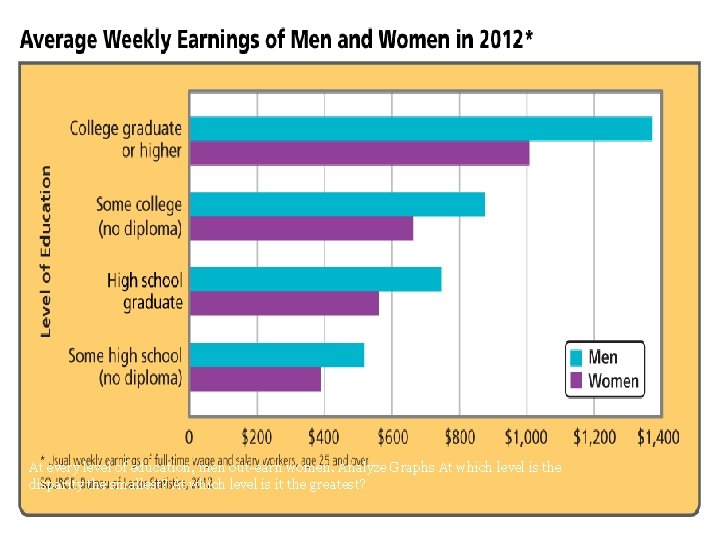
Discrimination Against Women At every level of education, men out-earn women. Analyze Graphs At which level is the disparity the smallest? At which level is it the greatest?
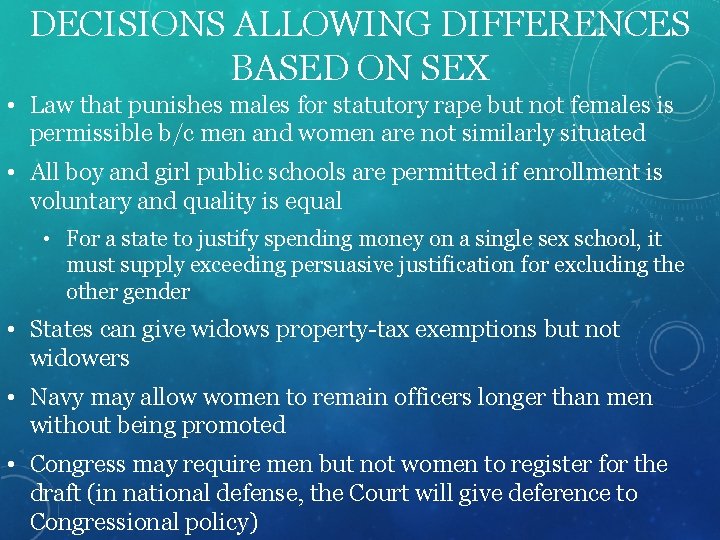
DECISIONS ALLOWING DIFFERENCES BASED ON SEX • Law that punishes males for statutory rape but not females is permissible b/c men and women are not similarly situated • All boy and girl public schools are permitted if enrollment is voluntary and quality is equal • For a state to justify spending money on a single sex school, it must supply exceeding persuasive justification for excluding the other gender • States can give widows property-tax exemptions but not widowers • Navy may allow women to remain officers longer than men without being promoted • Congress may require men but not women to register for the draft (in national defense, the Court will give deference to Congressional policy)
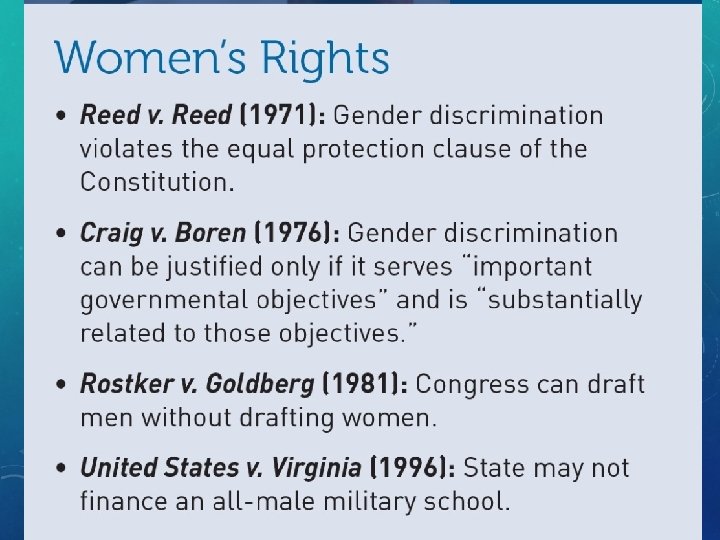
Copyright © 2013 Cengage
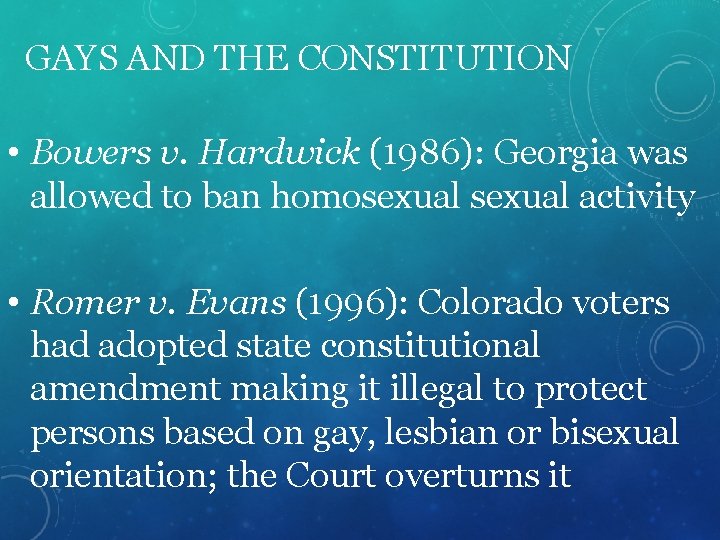
GAYS AND THE CONSTITUTION • Bowers v. Hardwick (1986): Georgia was allowed to ban homosexual activity • Romer v. Evans (1996): Colorado voters had adopted state constitutional amendment making it illegal to protect persons based on gay, lesbian or bisexual orientation; the Court overturns it
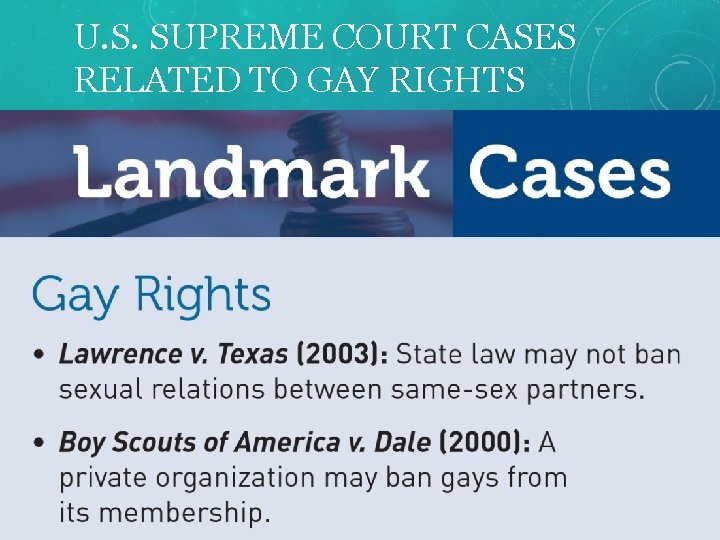
U. S. SUPREME COURT CASES RELATED TO GAY RIGHTS Copyright © 2013 Cengage
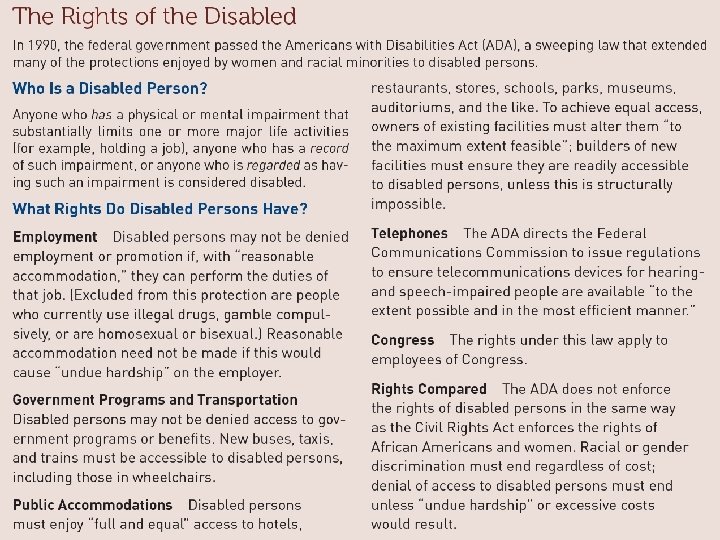
Copyright © 2013 Cengage
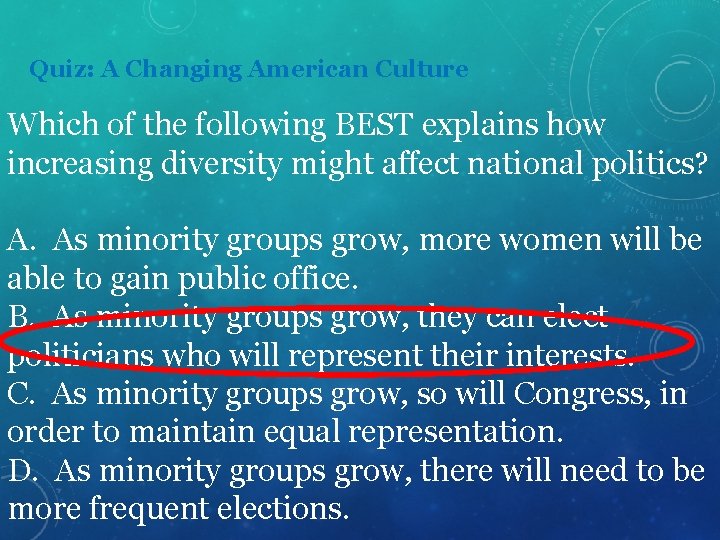
Quiz: A Changing American Culture Which of the following BEST explains how increasing diversity might affect national politics? A. As minority groups grow, more women will be able to gain public office. B. As minority groups grow, they can elect politicians who will represent their interests. C. As minority groups grow, so will Congress, in order to maintain equal representation. D. As minority groups grow, there will need to be more frequent elections.
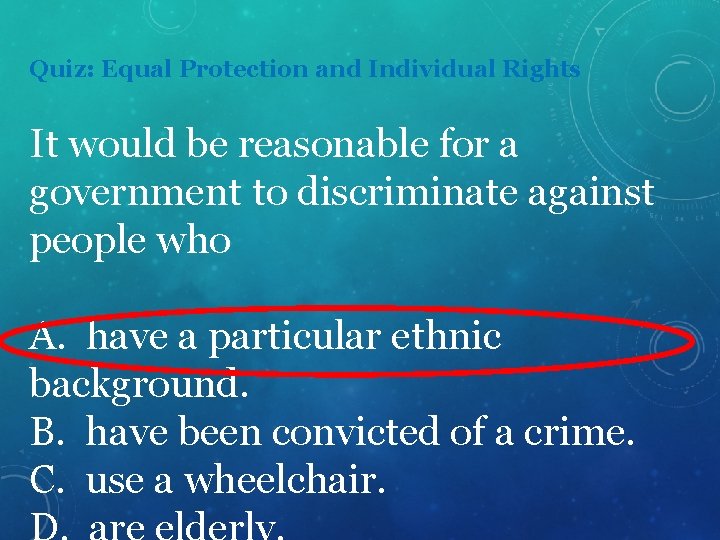
Quiz: Equal Protection and Individual Rights It would be reasonable for a government to discriminate against people who A. have a particular ethnic background. B. have been convicted of a crime. C. use a wheelchair.
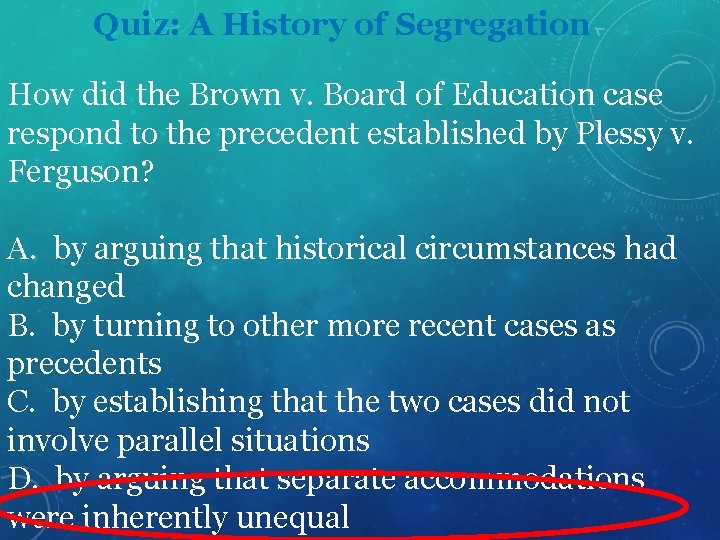
Quiz: A History of Segregation How did the Brown v. Board of Education case respond to the precedent established by Plessy v. Ferguson? A. by arguing that historical circumstances had changed B. by turning to other more recent cases as precedents C. by establishing that the two cases did not involve parallel situations D. by arguing that separate accommodations were inherently unequal
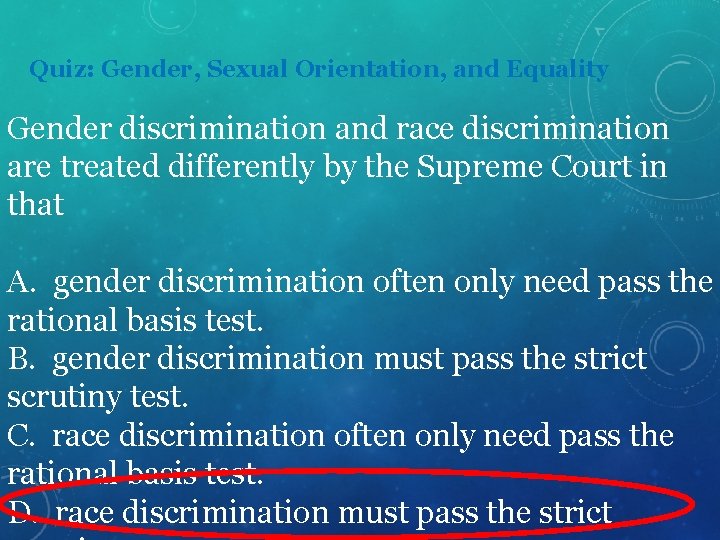
Quiz: Gender, Sexual Orientation, and Equality Gender discrimination and race discrimination are treated differently by the Supreme Court in that A. gender discrimination often only need pass the rational basis test. B. gender discrimination must pass the strict scrutiny test. C. race discrimination often only need pass the rational basis test. D. race discrimination must pass the strict
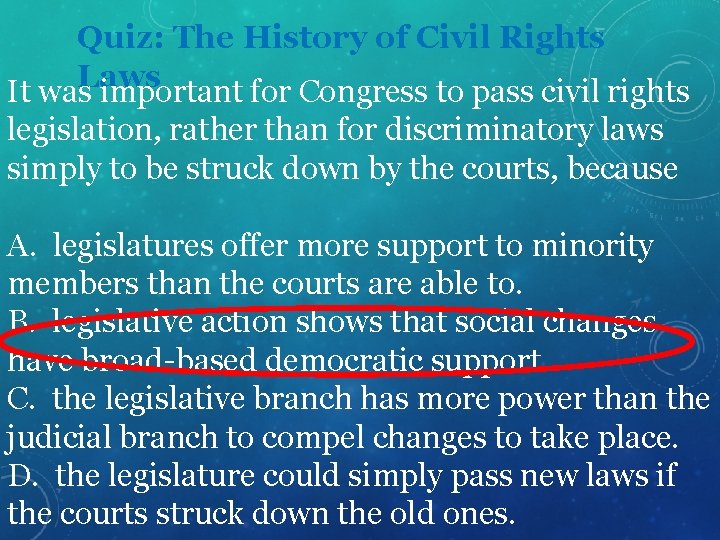
Quiz: The History of Civil Rights Laws It was important for Congress to pass civil rights legislation, rather than for discriminatory laws simply to be struck down by the courts, because A. legislatures offer more support to minority members than the courts are able to. B. legislative action shows that social changes have broad-based democratic support. C. the legislative branch has more power than the judicial branch to compel changes to take place. D. the legislature could simply pass new laws if the courts struck down the old ones.
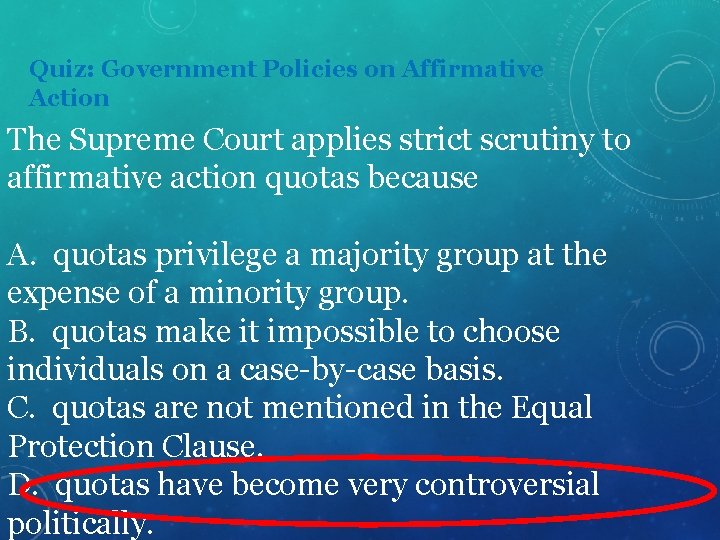
Quiz: Government Policies on Affirmative Action The Supreme Court applies strict scrutiny to affirmative action quotas because A. quotas privilege a majority group at the expense of a minority group. B. quotas make it impossible to choose individuals on a case-by-case basis. C. quotas are not mentioned in the Equal Protection Clause. D. quotas have become very controversial politically.
- Slides: 57