
87 Strontium Optical Lattice Clock with high Accuracy
- Slides: 26
87 -Strontium Optical Lattice Clock with high Accuracy and Stability Jan W. Thomsen, G. K. Campbell, A. D. Ludlow, S. Blatt, M. Swallows, T. Zelevinsky, M. M. Boyd, M. Martin, T. Nicholson and J. Ye JILA, NIST and University of Colorado http: //jilawww. colorado. edu/Ye. Labs From Quantum to Cosmos July 6 - 10 th, 2008 $ Funding $ ONR, NSF, AFOSR, NASA, DOE, NIST
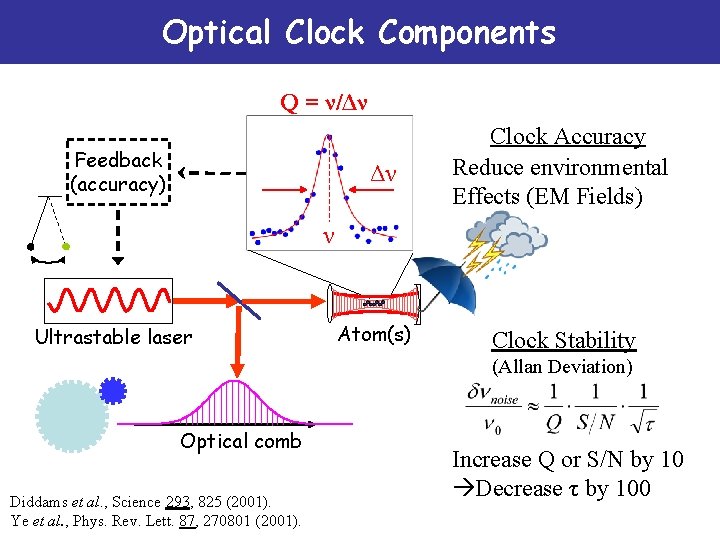
Optical Clock Components Q = ν/Δν Feedback (accuracy) Δν Clock Accuracy Reduce environmental Effects (EM Fields) ν Ultrastable laser Atom(s) Clock Stability (Allan Deviation) Optical comb Diddams et al. , Science 293, 825 (2001). Ye et al. , Phys. Rev. Lett. 87, 270801 (2001). Increase Q or S/N by 10 Decrease τ by 100
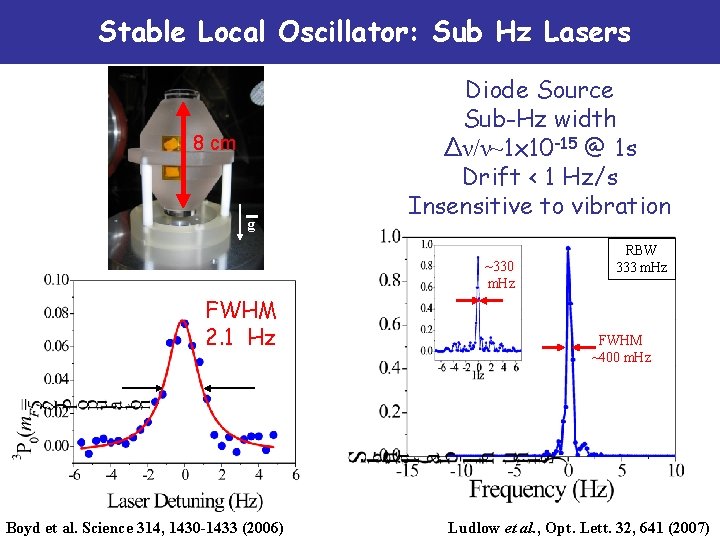
Stable Local Oscillator: Sub Hz Lasers 8 cm g Diode Source Sub-Hz width Δν/ν~1 x 10 -15 @ 1 s Drift < 1 Hz/s Insensitive to vibration ~330 m. Hz FWHM 2. 1 Hz Boyd et al. Science 314, 1430 -1433 (2006) RBW 333 m. Hz FWHM ~400 m. Hz Ludlow et al. , Opt. Lett. 32, 641 (2007)
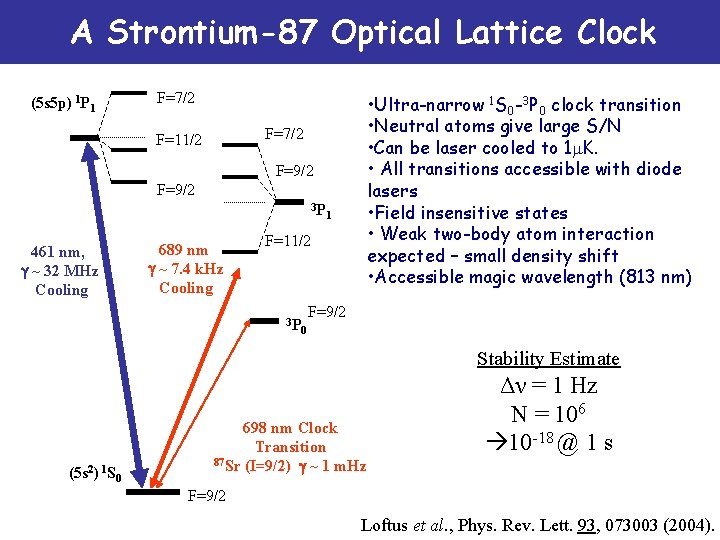
Optical Lattice Clock A Strontium-87 (5 s 5 p) 1 P 1 F=7/2 • Ultra-narrow 1 S 0 -3 P 0 clock transition • Neutral atoms give large S/N • Can be laser cooled to 1 m. K. • All transitions accessible with diode lasers • Field insensitive states • Weak two-body atom interaction expected – small density shift • Accessible magic wavelength (813 nm) F=7/2 F=11/2 F=9/2 3 P 461 nm, g ~ 32 MHz Cooling 689 nm g ~ 7. 4 k. Hz Cooling 1 F=11/2 3 P F=9/2 0 Stability Estimate (5 s 2) 1 S 0 698 nm Clock Transition 87 Sr (I=9/2) g ~ 1 m. Hz Δν = 1 Hz N = 106 10 -18 @ 1 s F=9/2 Loftus et al. , Phys. Rev. Lett. 93, 073003 (2004).
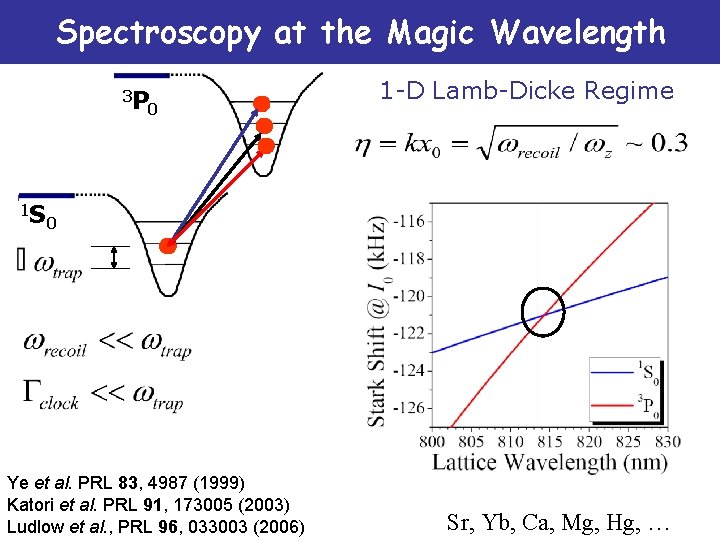
Spectroscopy at the Magic Wavelength 3 P 0 1 -D Lamb-Dicke Regime 1 S 0 Ye et al. PRL 83, 4987 (1999) Katori et al. PRL 91, 173005 (2003) Ludlow et al. , PRL 96, 033003 (2006) Sr, Yb, Ca, Mg, Hg, …
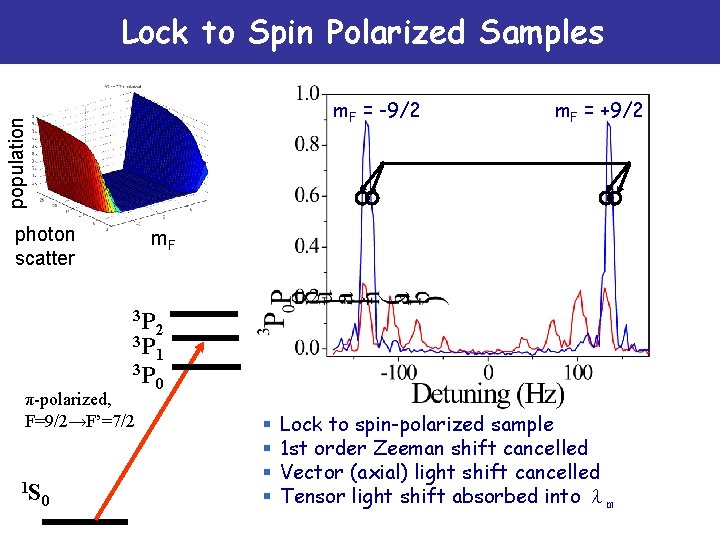
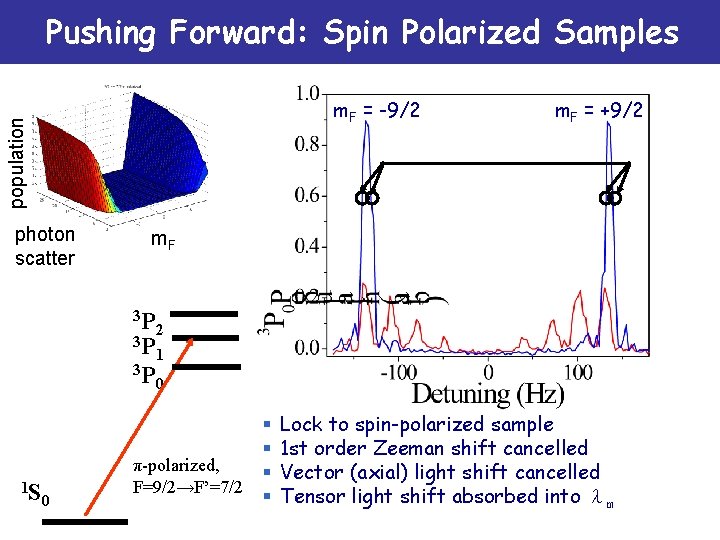
Lock to Spin Polarized Samples population m. F = -9/2 photon scatter m. F 3 P 3 P 3 P π-polarized, F=9/2→F’=7/2 1 S 0 m. F = +9/2 2 1 0 § § Lock to spin-polarized sample 1 st order Zeeman shift cancelled Vector (axial) light shift cancelled Tensor light shift absorbed into λm
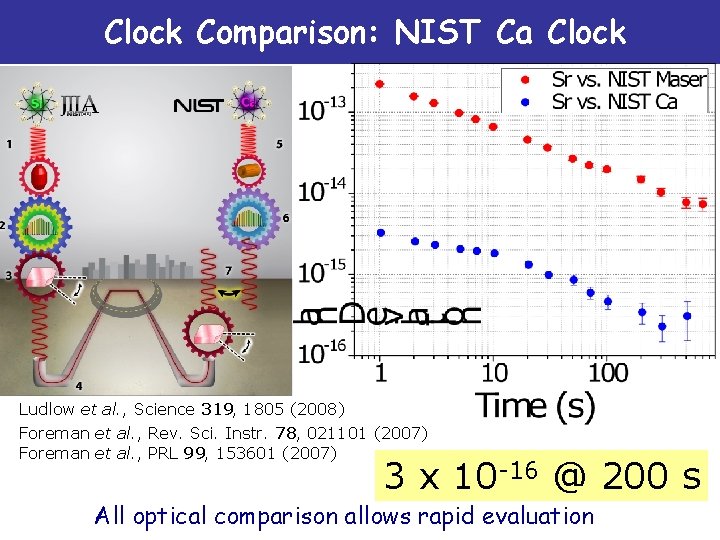
Clock Comparison: NIST Ca Clock Ludlow et al. , Science 319, 1805 (2008) Foreman et al. , Rev. Sci. Instr. 78, 021101 (2007) Foreman et al. , PRL 99, 153601 (2007) 3 x 10 -16 @ 200 s All optical comparison allows rapid evaluation
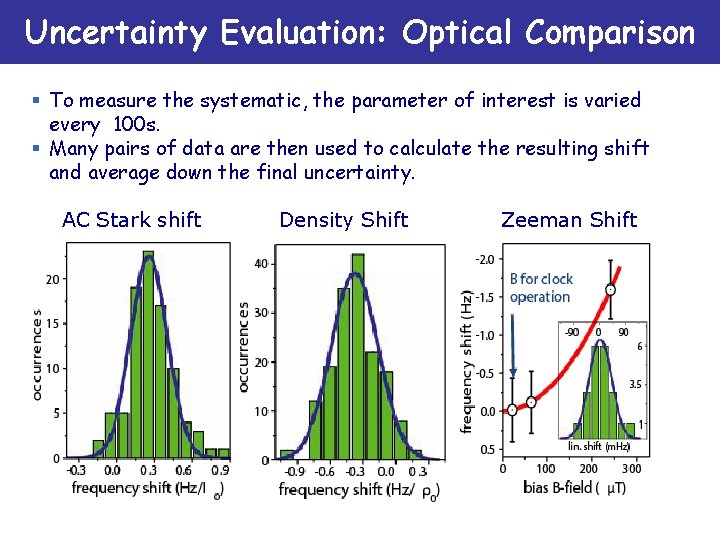
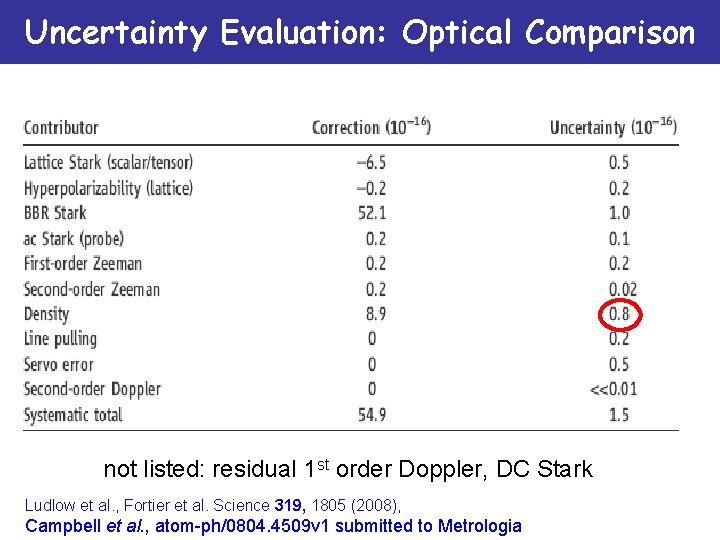
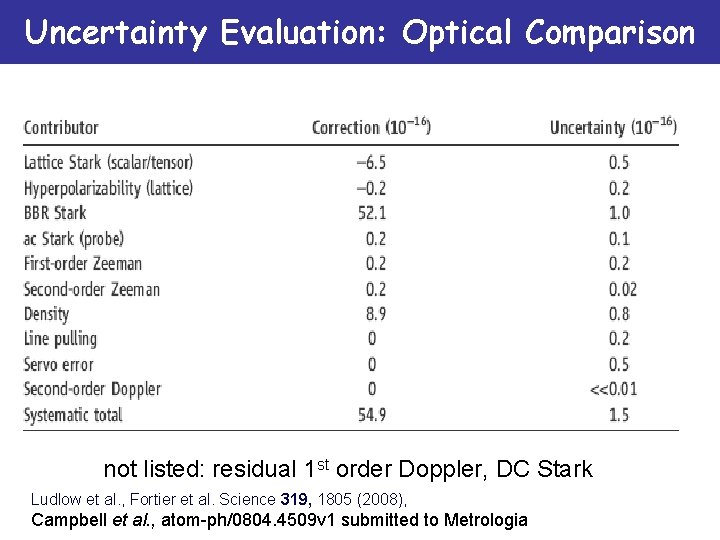
Uncertainty Evaluation: Optical Comparison § To measure the systematic, the parameter of interest is varied every 100 s. § Many pairs of data are then used to calculate the resulting shift and average down the final uncertainty. AC Stark shift Density Shift Zeeman Shift
Uncertainty Evaluation: Optical Comparison not listed: residual 1 st order Doppler, DC Stark Ludlow et al. , Fortier et al. Science 319, 1805 (2008), Campbell et al. , atom-ph/0804. 4509 v 1 submitted to Metrologia
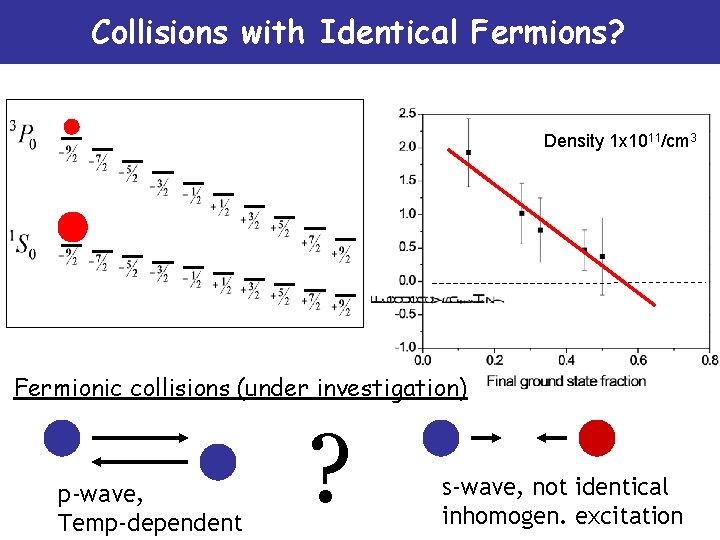
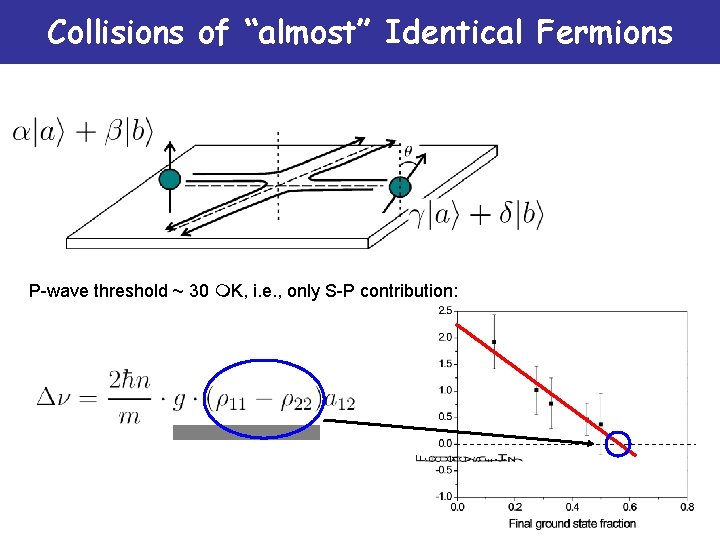
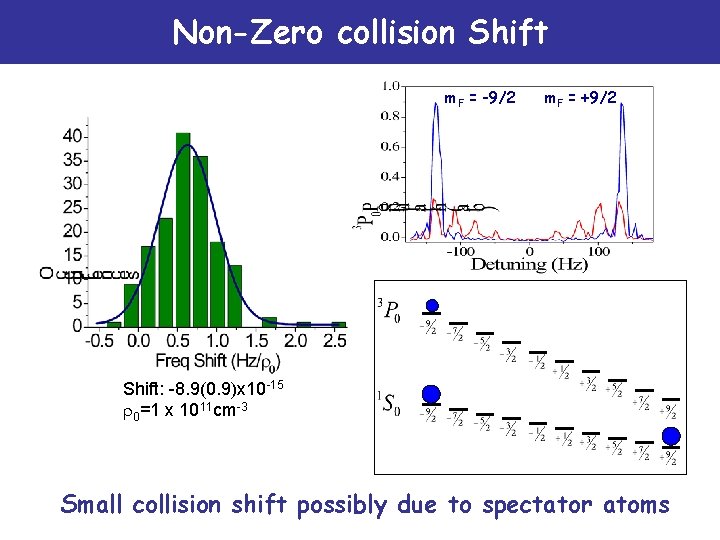
Collisions with Identical Fermions? Density 1 x 10¹¹/cm 3 Fermionic collisions (under investigation) p-wave, Temp-dependent ? s-wave, not identical inhomogen. excitation
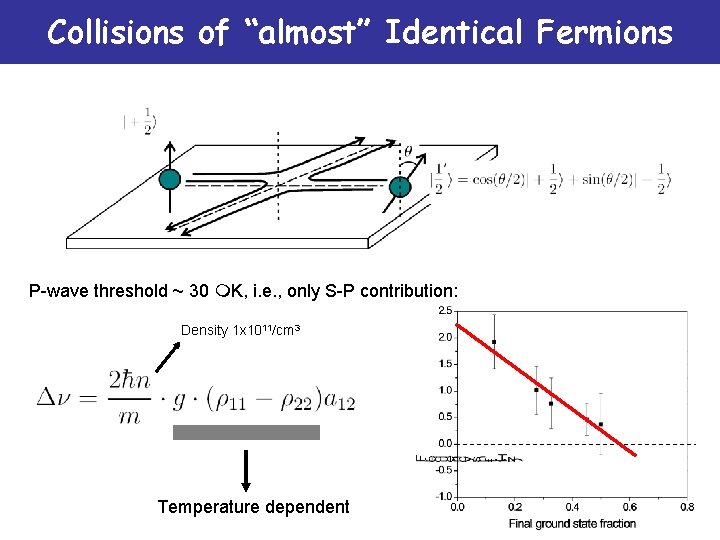
Collisions of “almost” Identical Fermions P-wave threshold ~ 30 m. K, i. e. , only S-P contribution: Density 1 x 10¹¹/cm 3 Temperature dependent
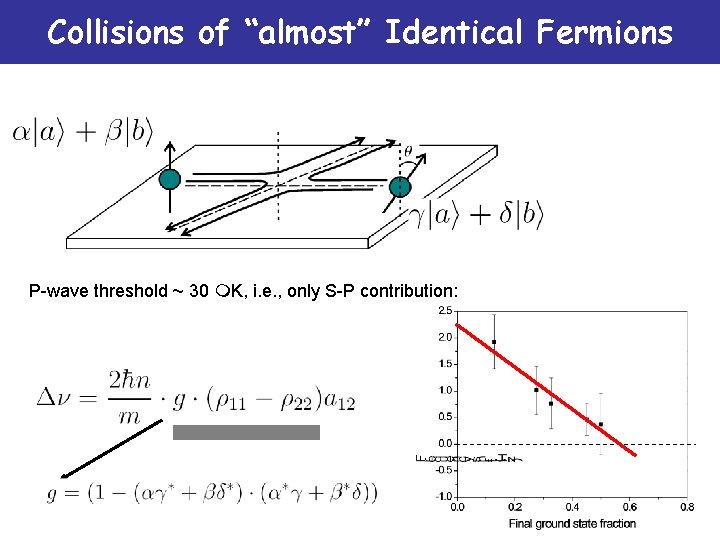
Collisions of “almost” Identical Fermions P-wave threshold ~ 30 m. K, i. e. , only S-P contribution:
Collisions of “almost” Identical Fermions P-wave threshold ~ 30 m. K, i. e. , only S-P contribution:
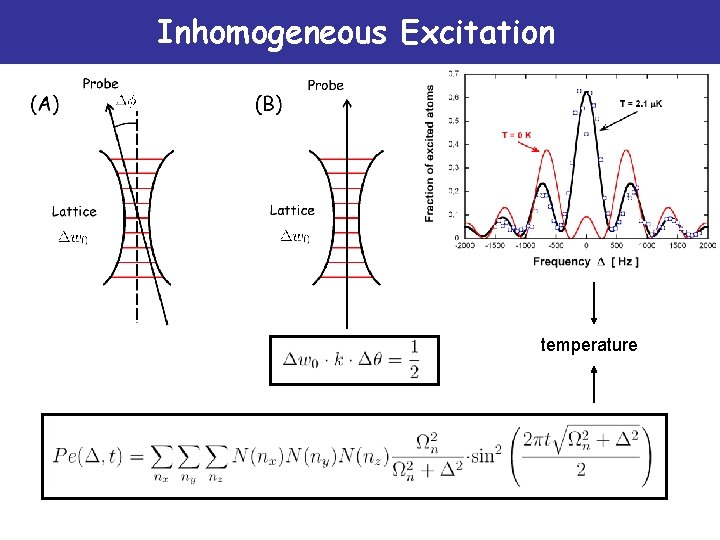
Inhomogeneous Excitation temperature
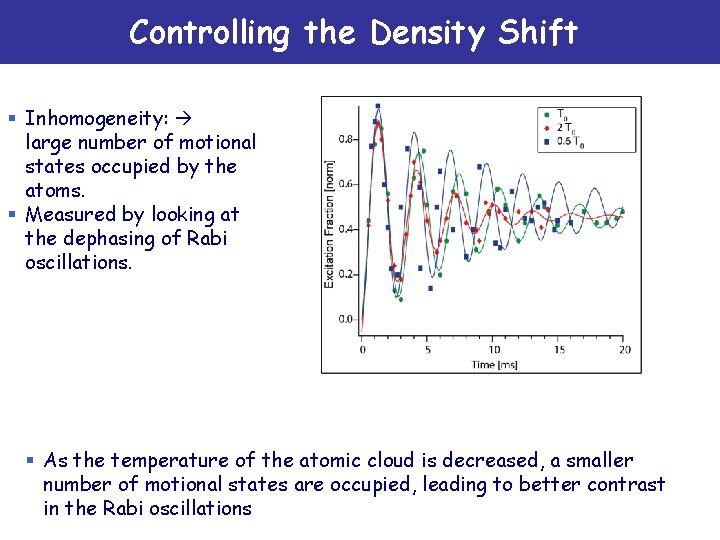
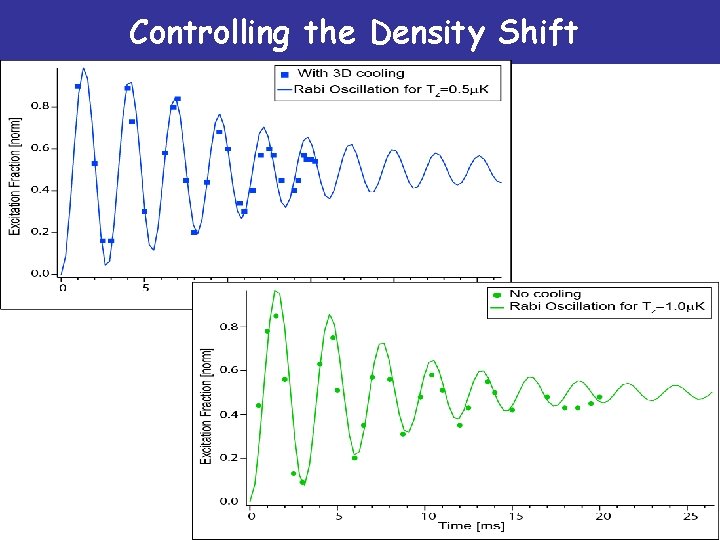
Controlling the Density Shift § Inhomogeneity: large number of motional states occupied by the atoms. § Measured by looking at the dephasing of Rabi oscillations. § As the temperature of the atomic cloud is decreased, a smaller number of motional states are occupied, leading to better contrast in the Rabi oscillations
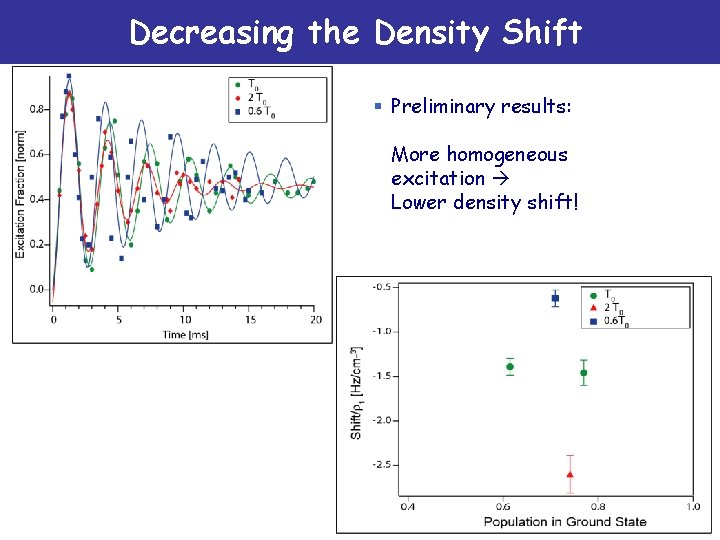
Decreasing the Density Shift § Preliminary results: More homogeneous excitation Lower density shift!
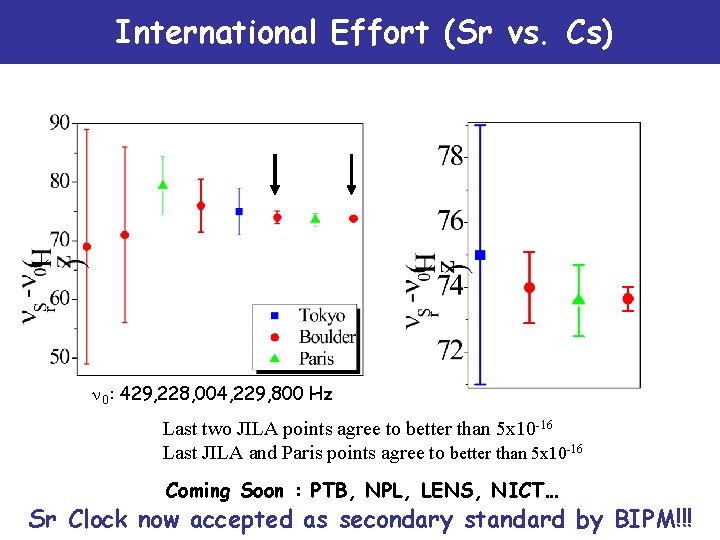
International Effort (Sr vs. Cs) n 0: 429, 228, 004, 229, 800 Hz Last two JILA points agree to better than 5 x 10 -16 Last JILA and Paris points agree to better than 5 x 10 -16 Coming Soon : PTB, NPL, LENS, NICT… Sr Clock now accepted as secondary standard by BIPM!!!
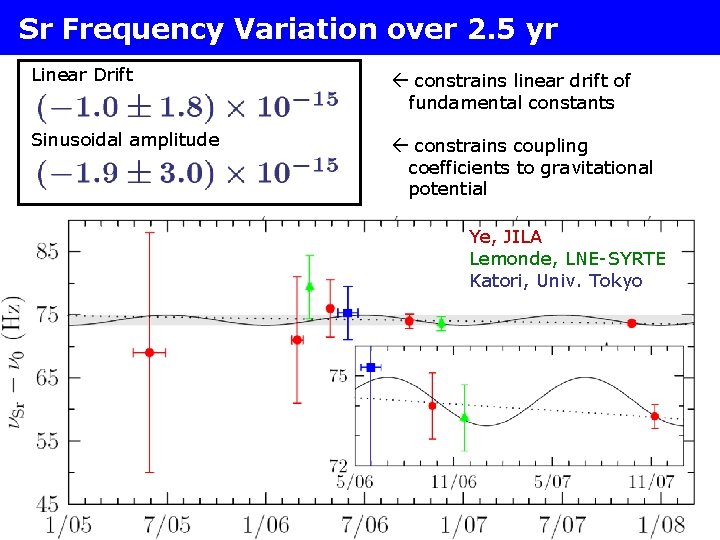
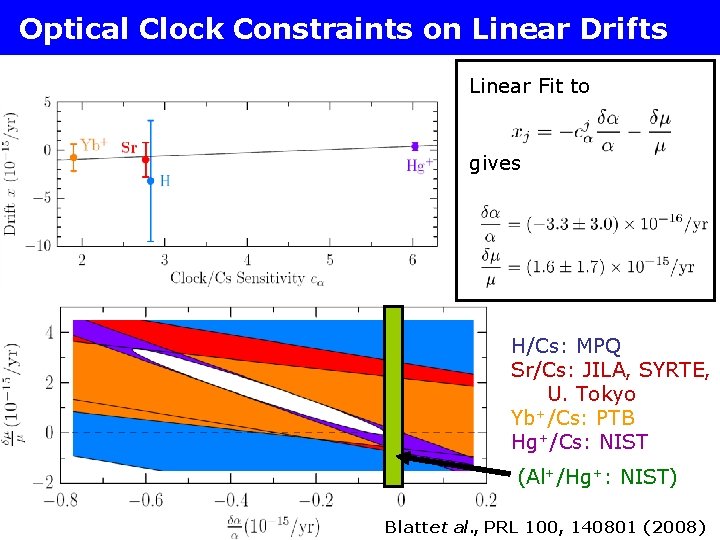
Sr Frequency Variation over 2. 5 yr Linear Drift constrains linear drift of fundamental constants Sinusoidal amplitude constrains coupling coefficients to gravitational potential Ye, JILA Lemonde, LNE-SYRTE Katori, Univ. Tokyo
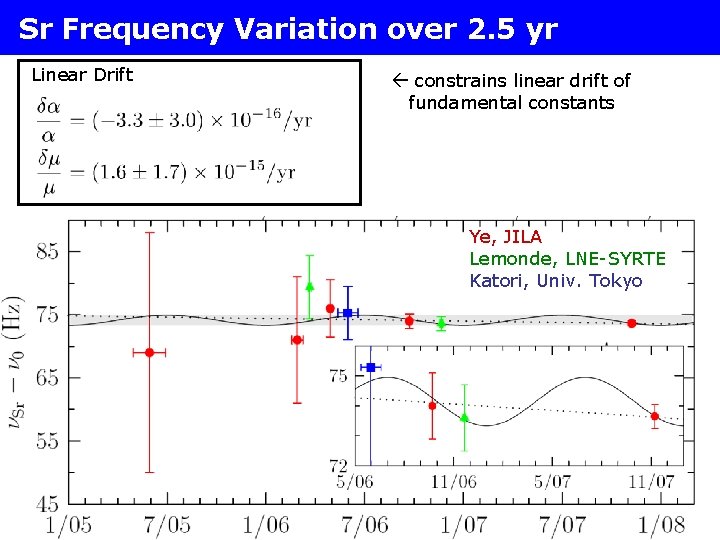
Sr Frequency Variation over 2. 5 yr Linear Drift constrains linear drift of fundamental constants Ye, JILA Lemonde, LNE-SYRTE Katori, Univ. Tokyo
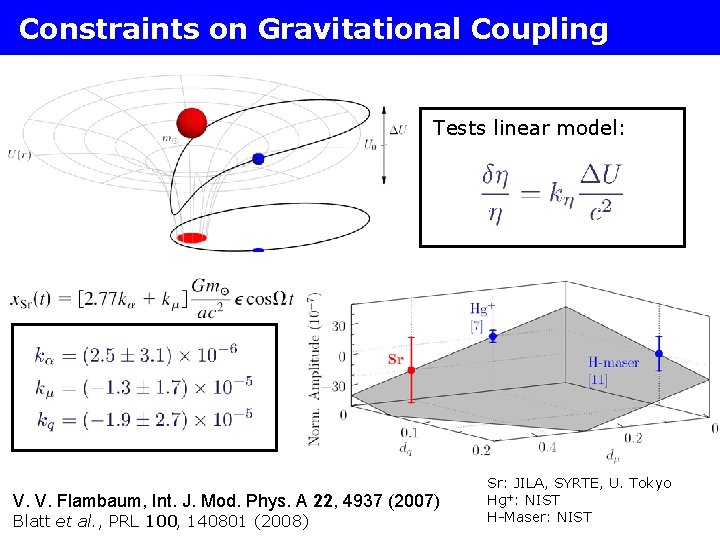
Constraints on Gravitational Coupling Tests linear model: V. V. Flambaum, Int. J. Mod. Phys. A 22, 4937 (2007) Blatt et al. , PRL 100, 140801 (2008) Sr: JILA, SYRTE, U. Tokyo Hg+: NIST H-Maser: NIST
Acknowledgments Optical evaluation of Sr Z. Barber S. Diddams T. Fortier L. Hollberg N. D. Lemke C. Oates N. Poli J. Stalnaker Optical Carrier Transfer S. Foreman J. Bergquist S. Diddams J. Stalnaker Absolute Frequency Measurement S. Diddams T. Heavner L. Hollberg S. Jefferts T. Parker J. Levine Ultracold Collisions K. Gibble S. Kokkelmans P. Julienne P. Naidon
Pushing Forward: Spin Polarized Samples population m. F = -9/2 photon scatter m. F 3 P 3 P 3 P 1 S 0 m. F = +9/2 2 1 0 § § π-polarized, § F=9/2→F’=7/2 § Lock to spin-polarized sample 1 st order Zeeman shift cancelled Vector (axial) light shift cancelled Tensor light shift absorbed into λm
Controlling the Density Shift
Uncertainty Evaluation: Optical Comparison not listed: residual 1 st order Doppler, DC Stark Ludlow et al. , Fortier et al. Science 319, 1805 (2008), Campbell et al. , atom-ph/0804. 4509 v 1 submitted to Metrologia
Non-Zero collision Shift m. F = -9/2 m. F = +9/2 Shift: -8. 9(0. 9)x 10 -15 r 0=1 x 1011 cm-3 Small collision shift possibly due to spectator atoms
Optical Clock Constraints on Linear Drifts Linear Fit to gives H/Cs: MPQ Sr/Cs: JILA, SYRTE, U. Tokyo Yb+/Cs: PTB Hg+/Cs: NIST (Al+/Hg+: NIST) Blatt et al. , PRL 100, 140801 (2008)