
851 0585 04 L Modeling and Simulating Social
- Slides: 42
851 -0585 -04 L – Modeling and Simulating Social Systems with MATLAB Lecture 7 – Continuous Simulations Karsten Donnay and Stefano Balietti Chair of Sociology, in particular of Modeling and Simulation © ETH Zürich | 2011 -04 -04
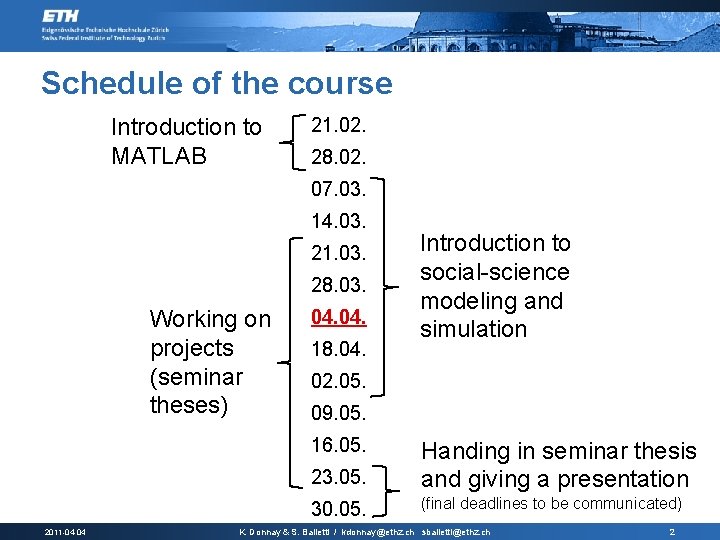
Schedule of the course Introduction to MATLAB 21. 02. 28. 02. 07. 03. 14. 03. 21. 03. 28. 03. Working on projects (seminar theses) 04. 18. 04. 02. 05. 09. 05. 16. 05. 23. 05. 30. 05. 2011 -04 -04 Introduction to social-science modeling and simulation Handing in seminar thesis and giving a presentation (final deadlines to be communicated) K. Donnay & S. Balietti / kdonnay@ethz. ch sbalietti@ethz. ch 2
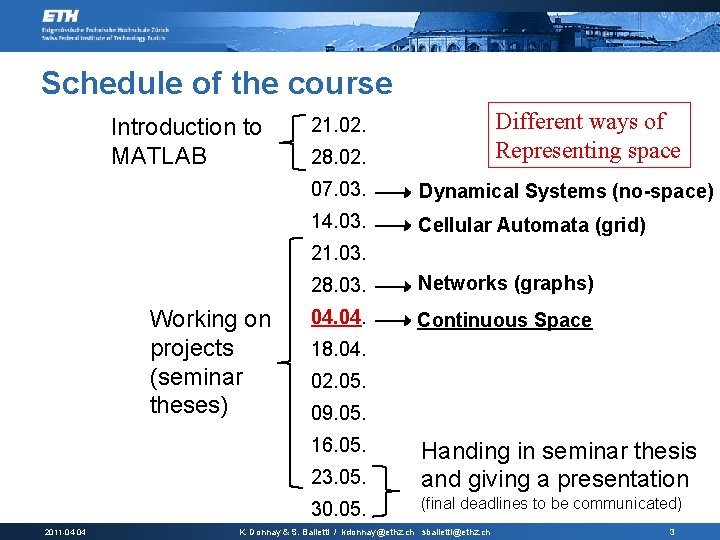
Schedule of the course Introduction to MATLAB Different ways of Representing space 21. 02. 28. 02. 07. 03. Dynamical Systems (no-space) 14. 03. Cellular Automata (grid) 21. 03. Working on projects (seminar theses) 28. 03. Networks (graphs) 04. Continuous Space 18. 04. 02. 05. 09. 05. 16. 05. 23. 05. 30. 05. 2011 -04 -04 Handing in seminar thesis and giving a presentation (final deadlines to be communicated) K. Donnay & S. Balietti / kdonnay@ethz. ch sbalietti@ethz. ch 3
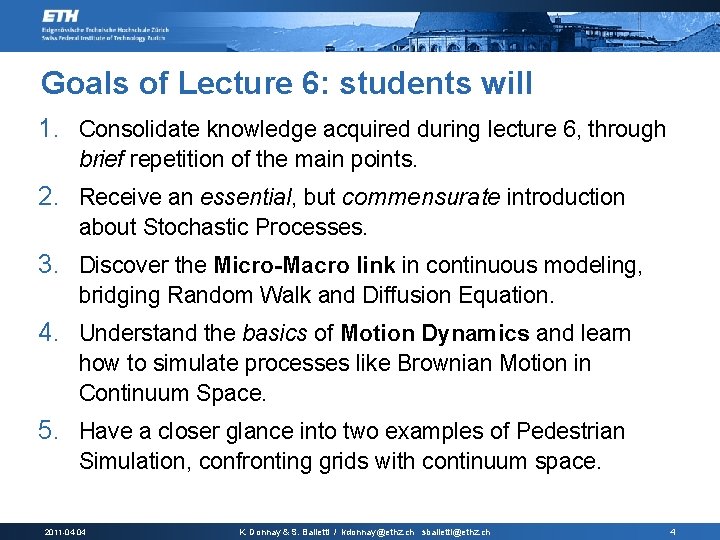
Goals of Lecture 6: students will 1. Consolidate knowledge acquired during lecture 6, through brief repetition of the main points. 2. Receive an essential, but commensurate introduction about Stochastic Processes. 3. Discover the Micro-Macro link in continuous modeling, bridging Random Walk and Diffusion Equation. 4. Understand the basics of Motion Dynamics and learn how to simulate processes like Brownian Motion in Continuum Space. 5. Have a closer glance into two examples of Pedestrian Simulation, confronting grids with continuum space. 2011 -04 -04 K. Donnay & S. Balietti / kdonnay@ethz. ch sbalietti@ethz. ch 4
Repetition § A Graph is defined as G = (N, L), where N is the number of nodes and L their links. § A Graph is enriched with extra information, encoded either in the nodes or in the links, is called Network. § A Graph can be mathematically described at the level of: § § § Nodes: degree, betweeness centrality, … § Graph: degree distribution, connectedness, giant component Network topologies: Random, Scale Free, Small World Generators: Erdos-Renyi, Preferential attachment, Self -similar Generators. 2011 -04 -04 K. Donnay & S. Balietti / kdonnay@ethz. ch sbalietti@ethz. ch 5
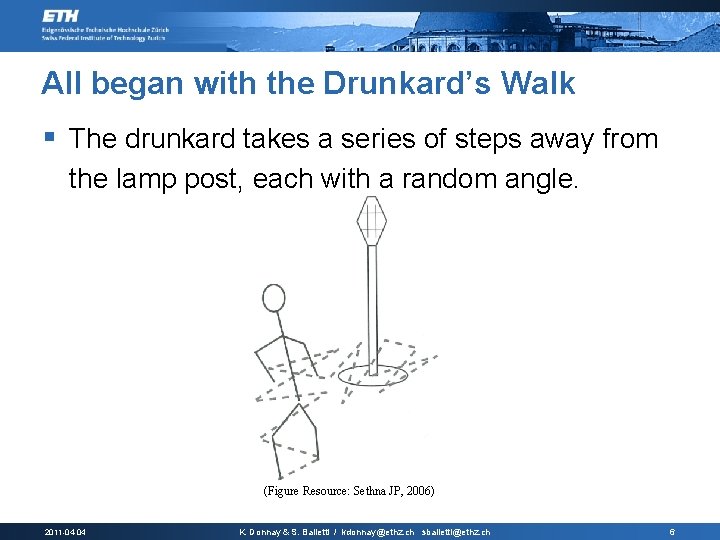
All began with the Drunkard’s Walk § The drunkard takes a series of steps away from the lamp post, each with a random angle. (Figure Resource: Sethna JP, 2006) 2011 -04 -04 K. Donnay & S. Balietti / kdonnay@ethz. ch sbalietti@ethz. ch 6
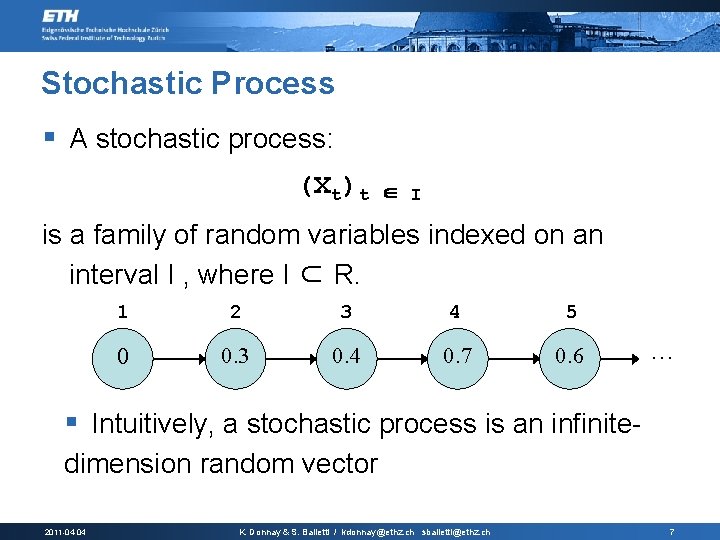
Stochastic Process § A stochastic process: (Xt)t ∈ I is a family of random variables indexed on an interval I , where I ⊂ R. 1 2 3 4 5 0 0. 3 0. 4 0. 7 0. 6 … § Intuitively, a stochastic process is an infinitedimension random vector 2011 -04 -04 K. Donnay & S. Balietti / kdonnay@ethz. ch sbalietti@ethz. ch 7
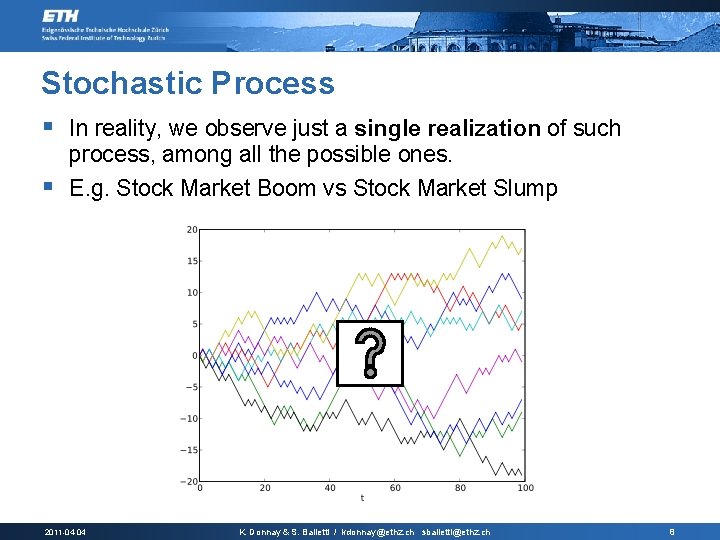
Stochastic Process § In reality, we observe just a single realization of such process, among all the possible ones. § E. g. Stock Market Boom vs Stock Market Slump 2011 -04 -04 K. Donnay & S. Balietti / kdonnay@ethz. ch sbalietti@ethz. ch 8
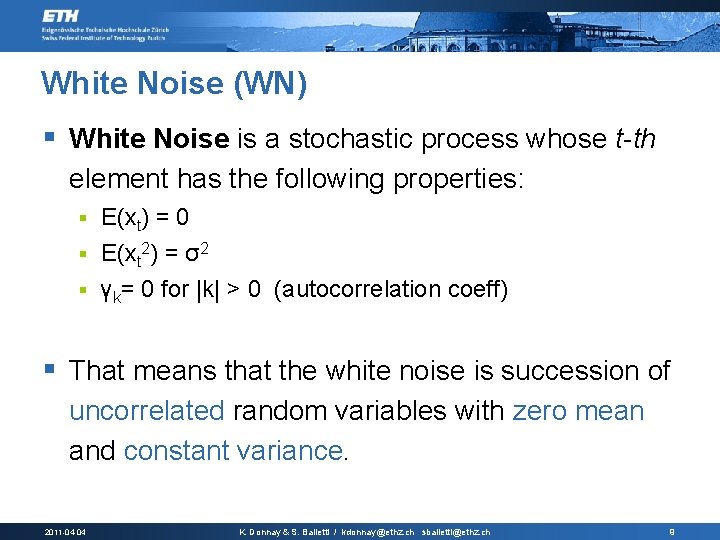
White Noise (WN) § White Noise is a stochastic process whose t-th element has the following properties: E(xt) = 0 § E(xt 2) = σ2 § γk= 0 for |k| > 0 (autocorrelation coeff) § § That means that the white noise is succession of uncorrelated random variables with zero mean and constant variance. 2011 -04 -04 K. Donnay & S. Balietti / kdonnay@ethz. ch sbalietti@ethz. ch 9
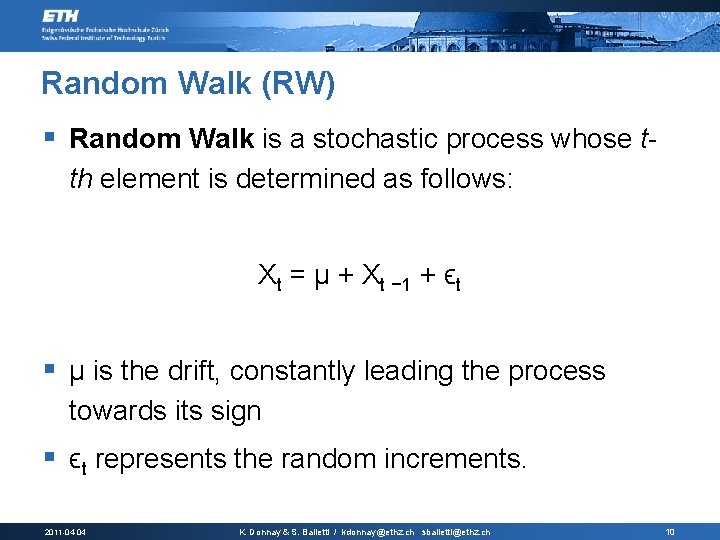
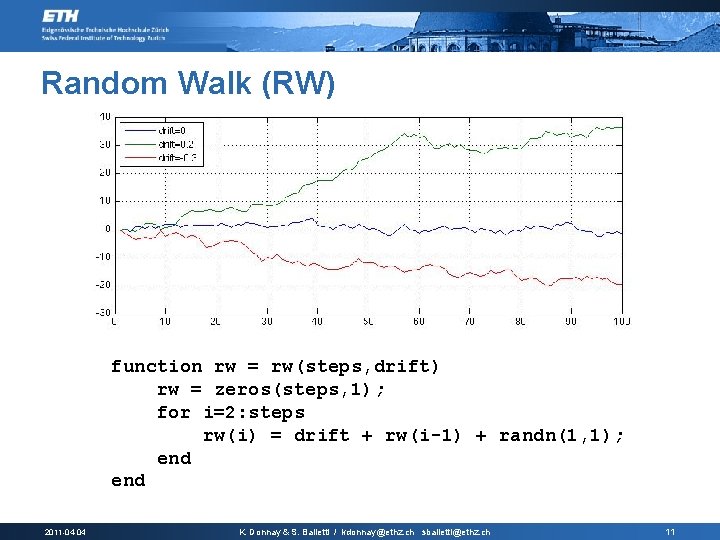
Random Walk (RW) § Random Walk is a stochastic process whose tth element is determined as follows: Xt = µ + Xt − 1 + ϵt § µ is the drift, constantly leading the process towards its sign § ϵt represents the random increments. 2011 -04 -04 K. Donnay & S. Balietti / kdonnay@ethz. ch sbalietti@ethz. ch 10
Random Walk (RW) function rw = rw(steps, drift) rw = zeros(steps, 1); for i=2: steps rw(i) = drift + rw(i-1) + randn(1, 1); end 2011 -04 -04 K. Donnay & S. Balietti / kdonnay@ethz. ch sbalietti@ethz. ch 11
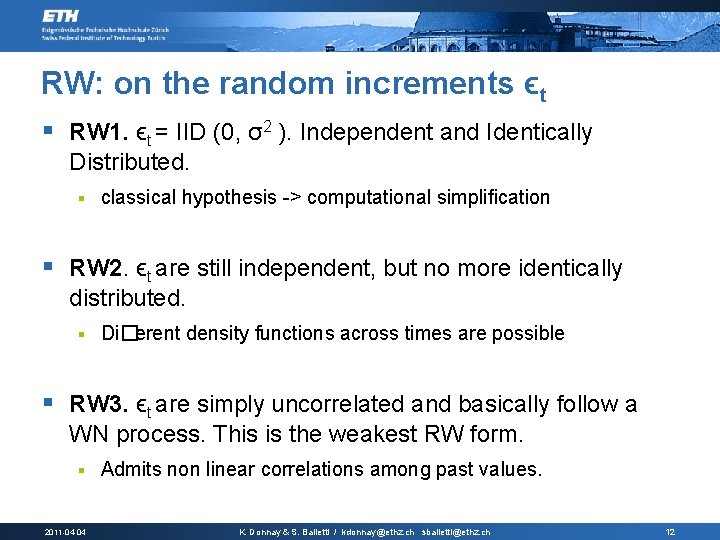
RW: on the random increments ϵt § RW 1. ϵt = IID (0, σ2 ). Independent and Identically Distributed. § classical hypothesis -> computational simplification § RW 2. ϵt are still independent, but no more identically distributed. § Di�erent density functions across times are possible § RW 3. ϵt are simply uncorrelated and basically follow a WN process. This is the weakest RW form. § 2011 -04 -04 Admits non linear correlations among past values. K. Donnay & S. Balietti / kdonnay@ethz. ch sbalietti@ethz. ch 12
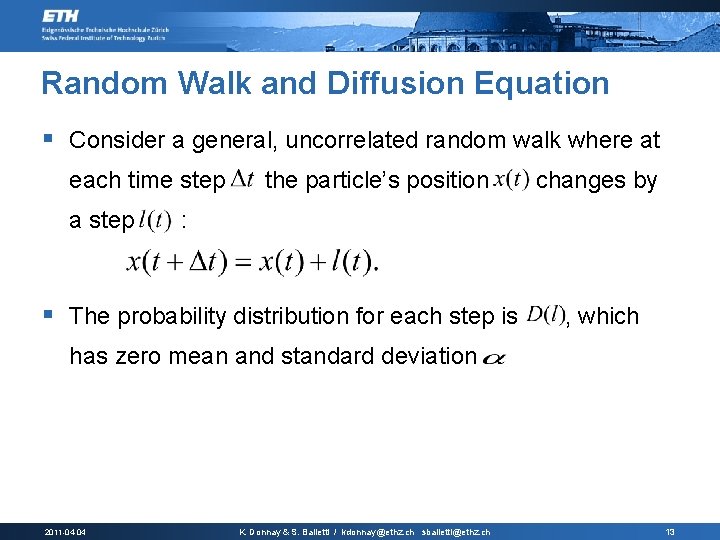
Random Walk and Diffusion Equation § Consider a general, uncorrelated random walk where at each time step a step the particle’s position changes by : § The probability distribution for each step is , which has zero mean and standard deviation. 2011 -04 -04 K. Donnay & S. Balietti / kdonnay@ethz. ch sbalietti@ethz. ch 13
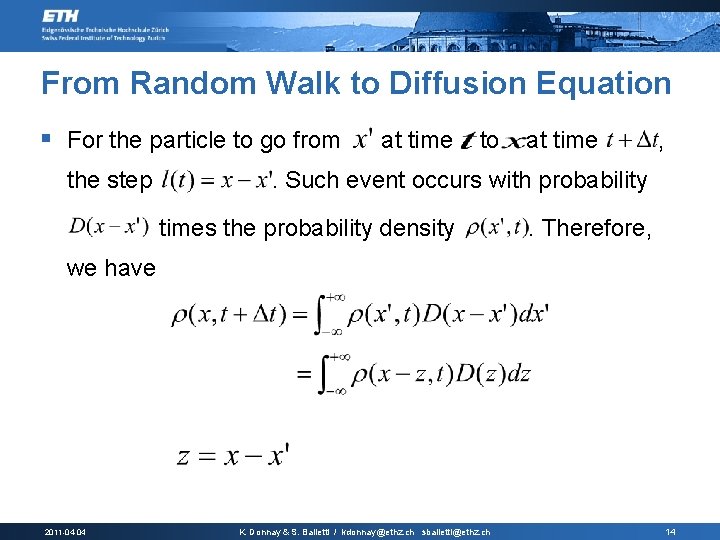
From Random Walk to Diffusion Equation § For the particle to go from the step at time to at time , . Such event occurs with probability times the probability density . Therefore, we have 2011 -04 -04 K. Donnay & S. Balietti / kdonnay@ethz. ch sbalietti@ethz. ch 14
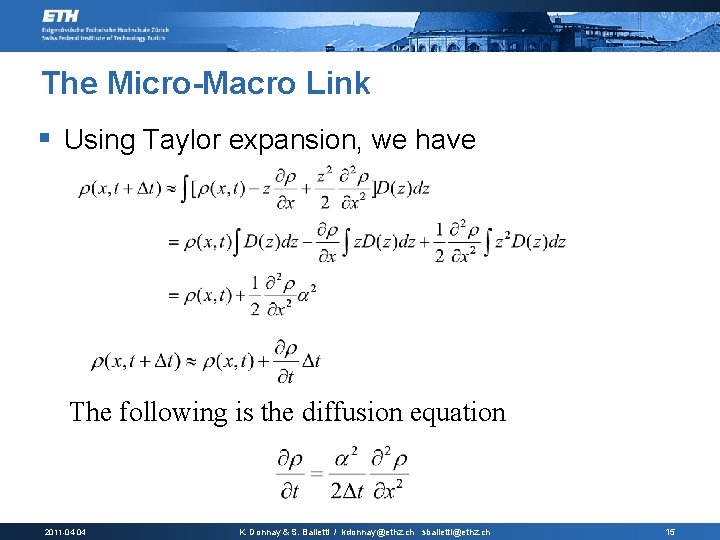
The Micro-Macro Link § Using Taylor expansion, we have The following is the diffusion equation 2011 -04 -04 K. Donnay & S. Balietti / kdonnay@ethz. ch sbalietti@ethz. ch 15
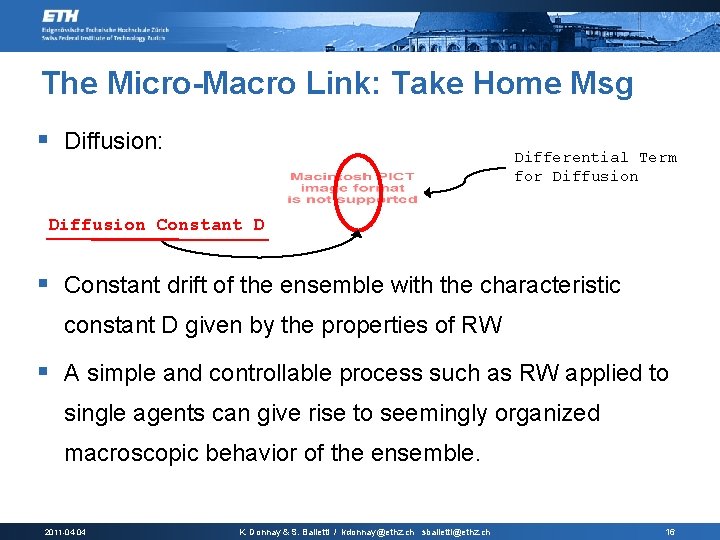
The Micro-Macro Link: Take Home Msg § Diffusion: Differential Term for Diffusion Constant D § Constant drift of the ensemble with the characteristic constant D given by the properties of RW § A simple and controllable process such as RW applied to single agents can give rise to seemingly organized macroscopic behavior of the ensemble. 2011 -04 -04 K. Donnay & S. Balietti / kdonnay@ethz. ch sbalietti@ethz. ch 16
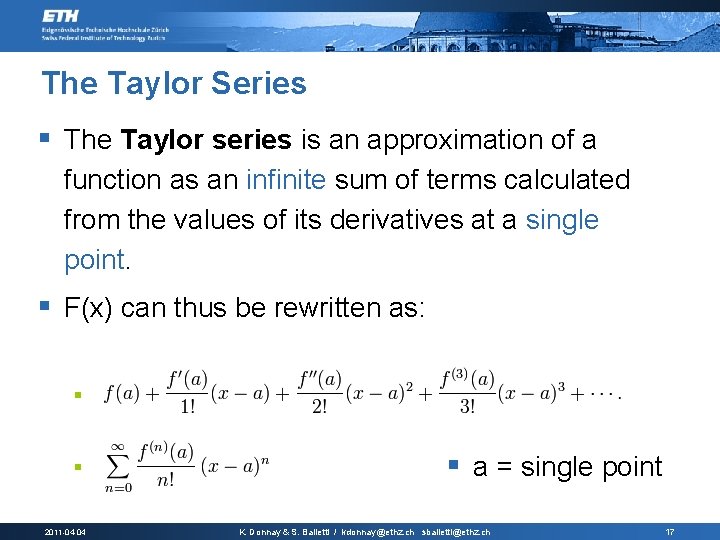
The Taylor Series § The Taylor series is an approximation of a function as an infinite sum of terms calculated from the values of its derivatives at a single point. § F(x) can thus be rewritten as: § § 2011 -04 -04 § a = single point K. Donnay & S. Balietti / kdonnay@ethz. ch sbalietti@ethz. ch 17
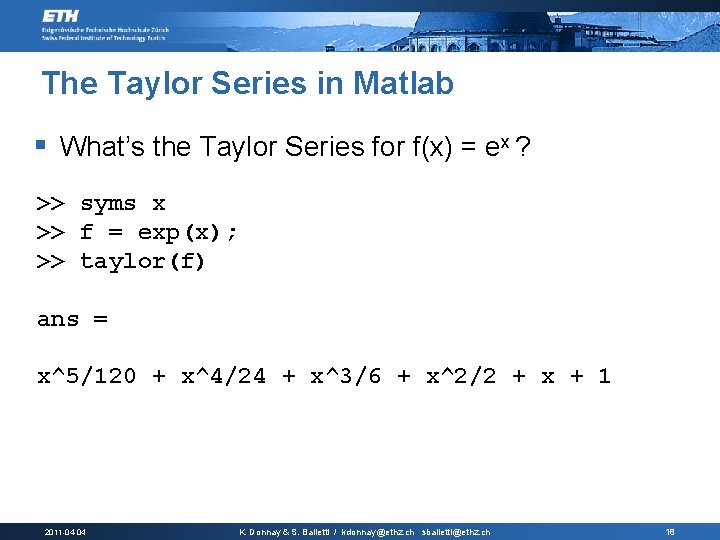
The Taylor Series in Matlab § What’s the Taylor Series for f(x) = ex ? >> syms x >> f = exp(x); >> taylor(f) ans = x^5/120 + x^4/24 + x^3/6 + x^2/2 + x + 1 2011 -04 -04 K. Donnay & S. Balietti / kdonnay@ethz. ch sbalietti@ethz. ch 18
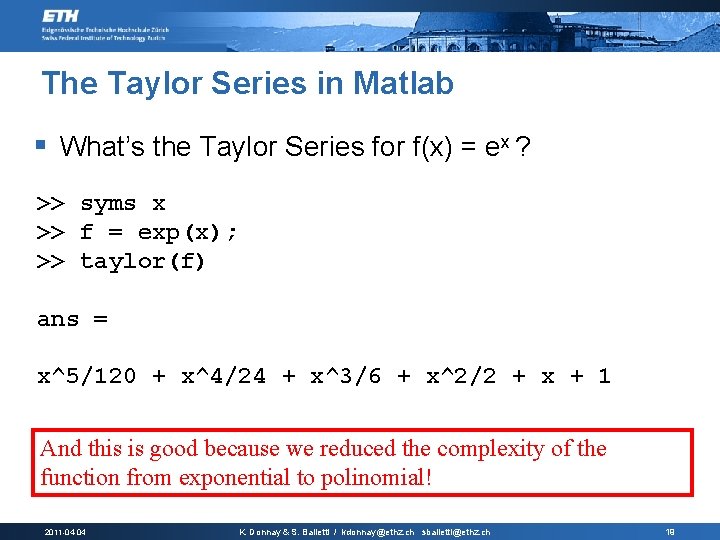
The Taylor Series in Matlab § What’s the Taylor Series for f(x) = ex ? >> syms x >> f = exp(x); >> taylor(f) ans = x^5/120 + x^4/24 + x^3/6 + x^2/2 + x + 1 And this is good because we reduced the complexity of the function from exponential to polinomial! 2011 -04 -04 K. Donnay & S. Balietti / kdonnay@ethz. ch sbalietti@ethz. ch 19
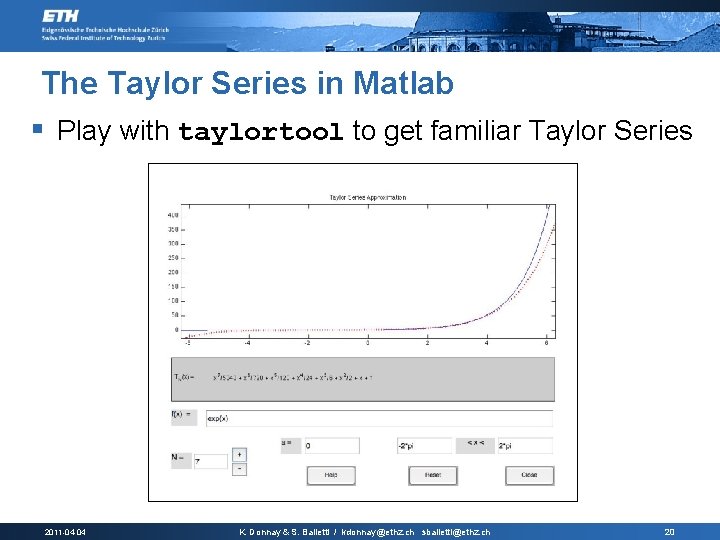
The Taylor Series in Matlab § Play with taylortool to get familiar Taylor Series 2011 -04 -04 K. Donnay & S. Balietti / kdonnay@ethz. ch sbalietti@ethz. ch 20
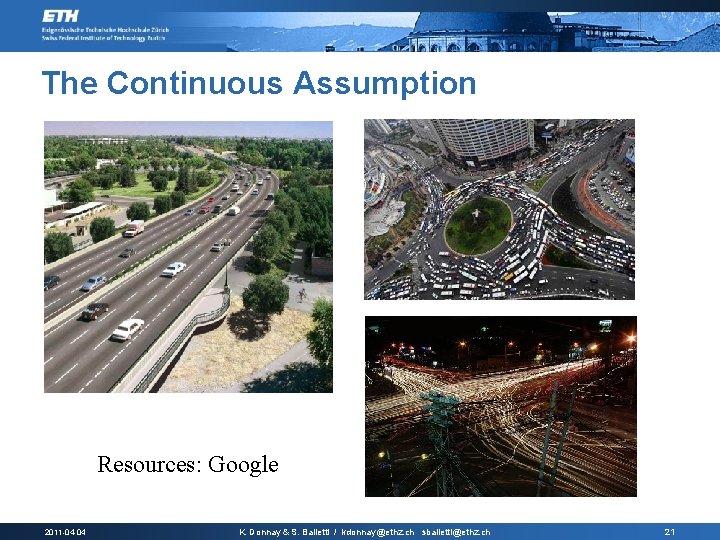
The Continuous Assumption Resources: Google 2011 -04 -04 K. Donnay & S. Balietti / kdonnay@ethz. ch sbalietti@ethz. ch 21
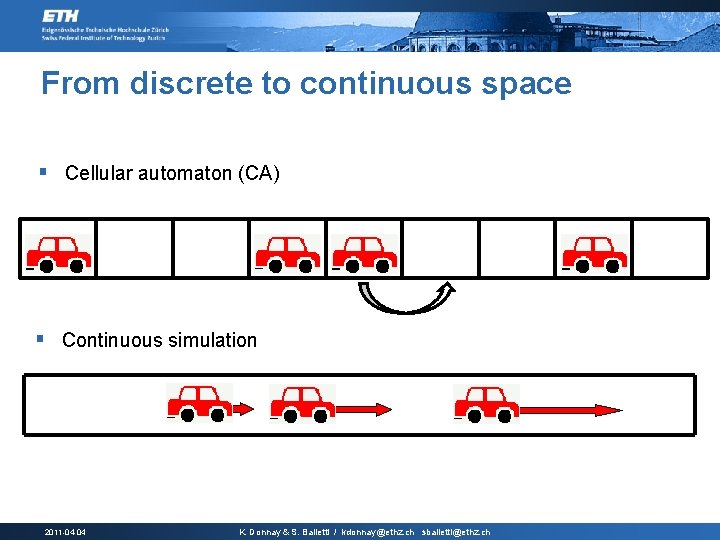
From discrete to continuous space § Cellular automaton (CA) § Continuous simulation 2011 -04 -04 K. Donnay & S. Balietti / kdonnay@ethz. ch sbalietti@ethz. ch
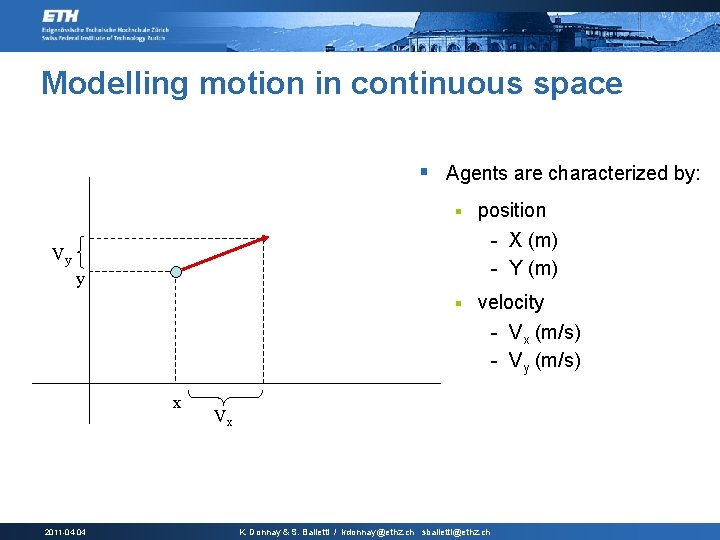
Modelling motion in continuous space § Agents are characterized by: § position - X (m) - Y (m) § velocity - Vx (m/s) - Vy (m/s) Vy y x 2011 -04 -04 Vx K. Donnay & S. Balietti / kdonnay@ethz. ch sbalietti@ethz. ch
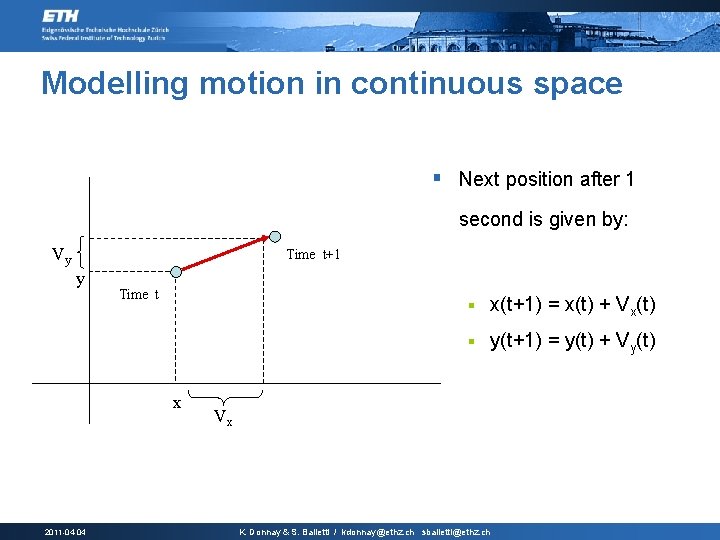
Modelling motion in continuous space § Next position after 1 second is given by: Vy Time t+1 y Time t x 2011 -04 -04 § x(t+1) = x(t) + Vx(t) § y(t+1) = y(t) + Vy(t) Vx K. Donnay & S. Balietti / kdonnay@ethz. ch sbalietti@ethz. ch
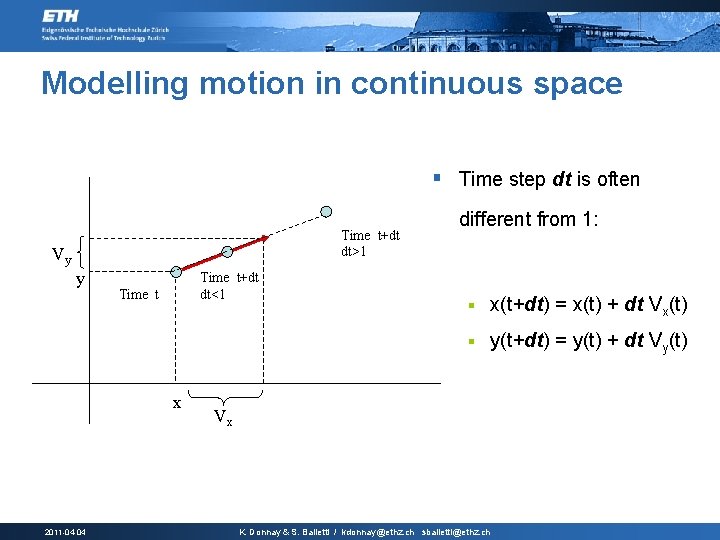
Modelling motion in continuous space § Time step dt is often Time t+dt dt>1 Vy y Time t+dt dt<1 Time t x 2011 -04 -04 different from 1: § x(t+dt) = x(t) + dt Vx(t) § y(t+dt) = y(t) + dt Vy(t) Vx K. Donnay & S. Balietti / kdonnay@ethz. ch sbalietti@ethz. ch
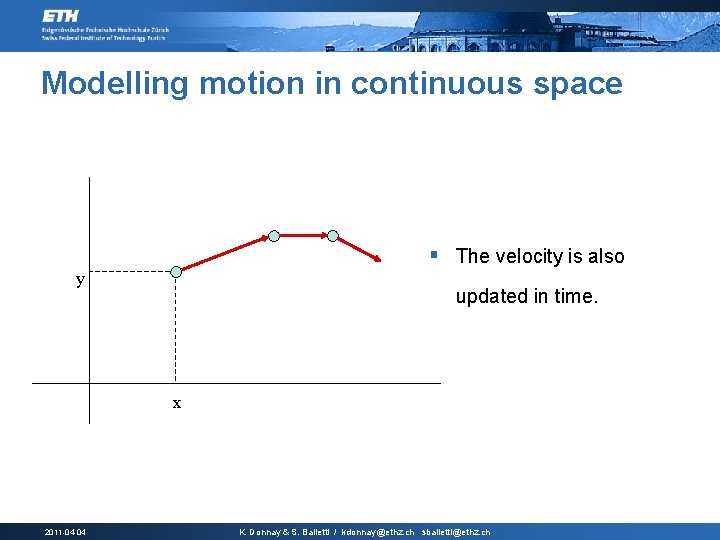
Modelling motion in continuous space § The velocity is also y updated in time. x 2011 -04 -04 K. Donnay & S. Balietti / kdonnay@ethz. ch sbalietti@ethz. ch
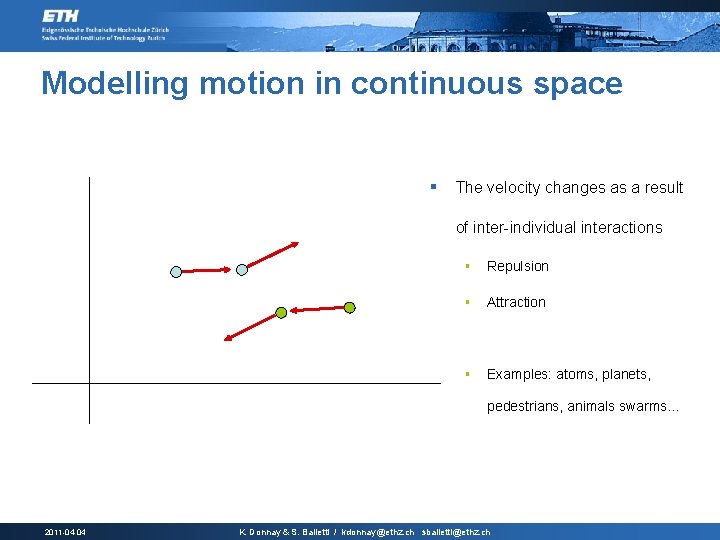
Modelling motion in continuous space § The velocity changes as a result of inter-individual interactions § Repulsion § Attraction § Examples: atoms, planets, pedestrians, animals swarms… 2011 -04 -04 K. Donnay & S. Balietti / kdonnay@ethz. ch sbalietti@ethz. ch
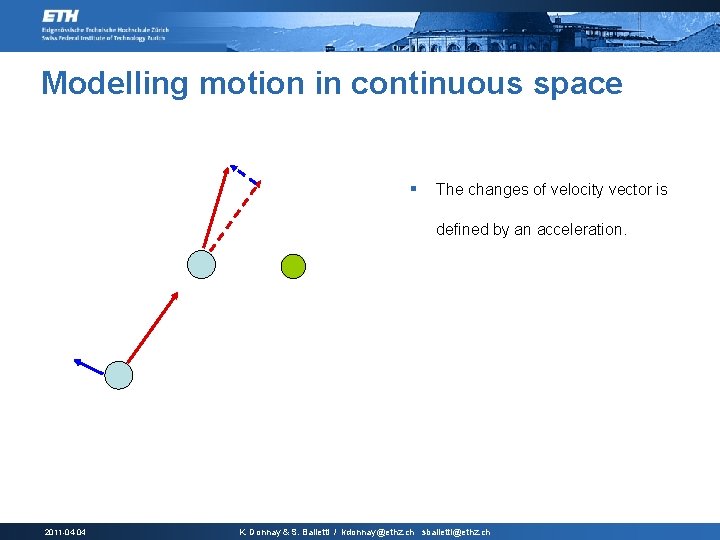
Modelling motion in continuous space § The changes of velocity vector is defined by an acceleration. 2011 -04 -04 K. Donnay & S. Balietti / kdonnay@ethz. ch sbalietti@ethz. ch
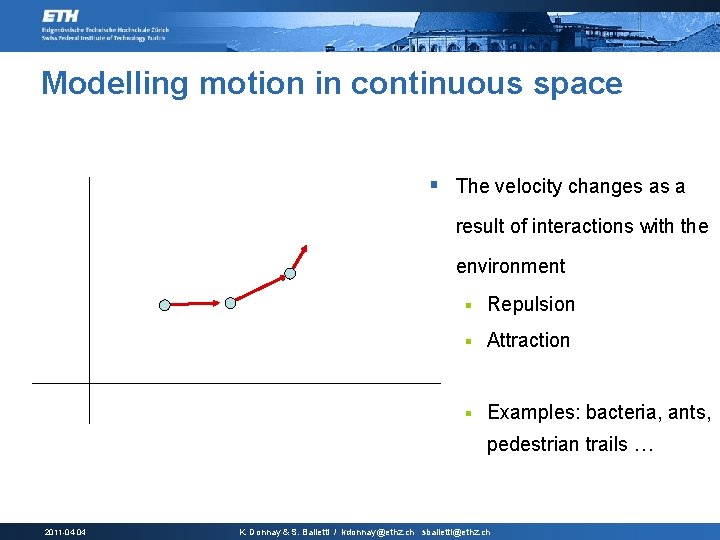
Modelling motion in continuous space § The velocity changes as a result of interactions with the environment § Repulsion § Attraction § Examples: bacteria, ants, pedestrian trails … 2011 -04 -04 K. Donnay & S. Balietti / kdonnay@ethz. ch sbalietti@ethz. ch
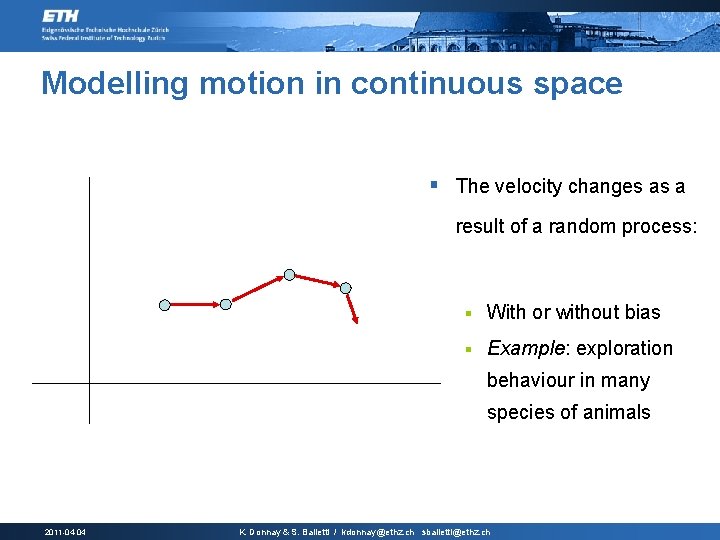
Modelling motion in continuous space § The velocity changes as a result of a random process: § With or without bias § Example: exploration behaviour in many species of animals 2011 -04 -04 K. Donnay & S. Balietti / kdonnay@ethz. ch sbalietti@ethz. ch
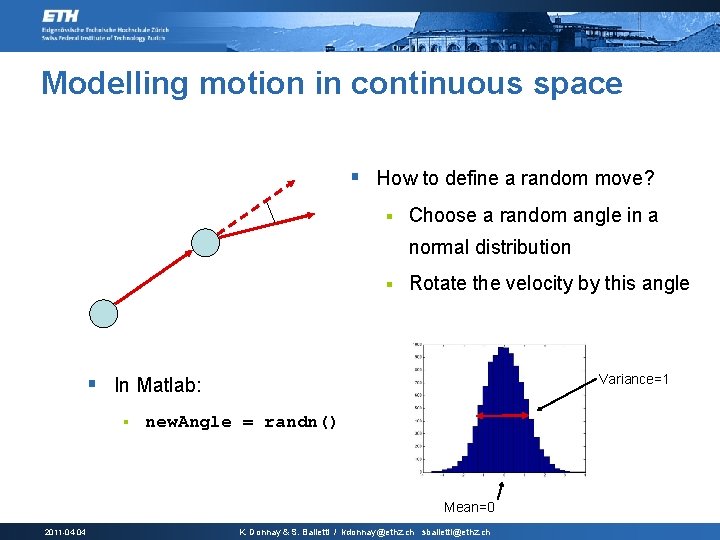
Modelling motion in continuous space § How to define a random move? § Choose a random angle in a normal distribution § Rotate the velocity by this angle Variance=1 § In Matlab: § new. Angle = randn() Mean=0 2011 -04 -04 K. Donnay & S. Balietti / kdonnay@ethz. ch sbalietti@ethz. ch
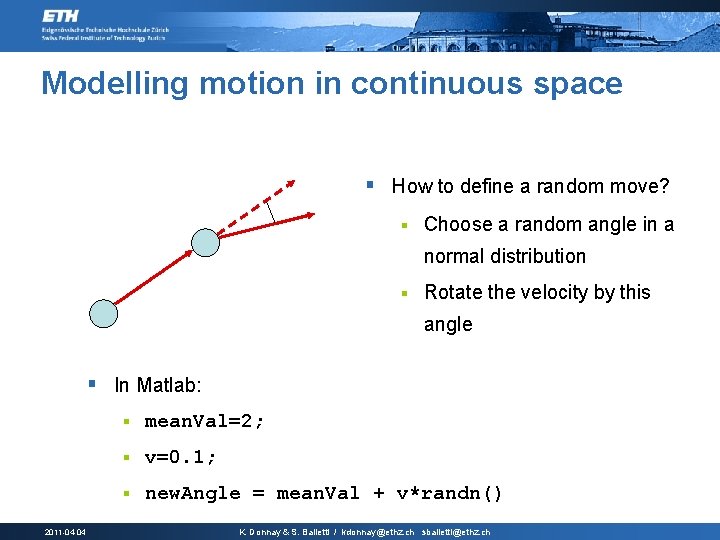
Modelling motion in continuous space § How to define a random move? § Choose a random angle in a normal distribution § Rotate the velocity by this angle § In Matlab: 2011 -04 -04 § mean. Val=2; § v=0. 1; § new. Angle = mean. Val + v*randn() K. Donnay & S. Balietti / kdonnay@ethz. ch sbalietti@ethz. ch
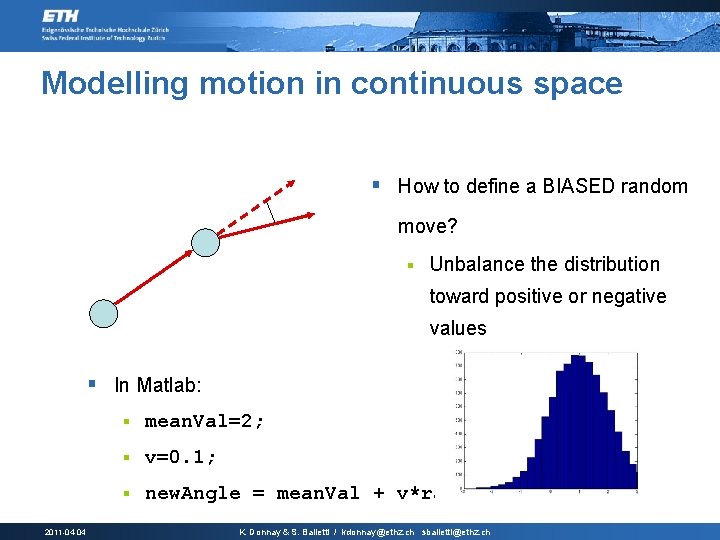
Modelling motion in continuous space § How to define a BIASED random move? § Unbalance the distribution toward positive or negative values § In Matlab: 2011 -04 -04 § mean. Val=2; § v=0. 1; § new. Angle = mean. Val + v*randn() K. Donnay & S. Balietti / kdonnay@ethz. ch sbalietti@ethz. ch
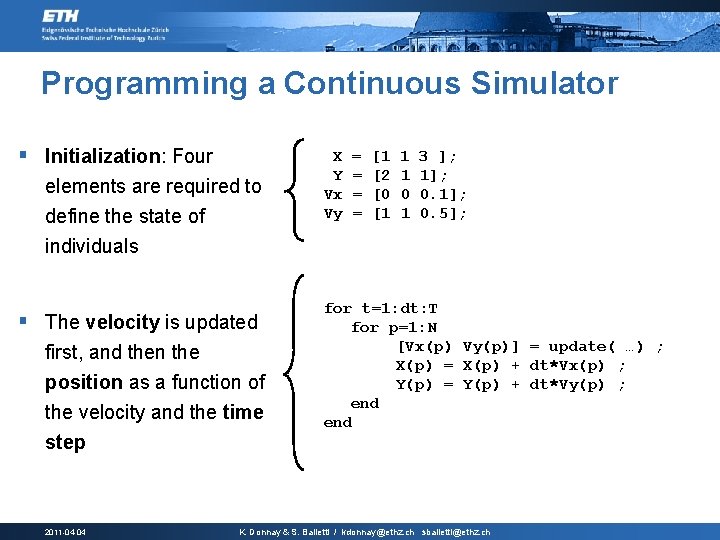
Programming a Continuous Simulator § Initialization: Four elements are required to define the state of individuals § The velocity is updated first, and then the position as a function of the velocity and the time step 2011 -04 -04 X Y Vx Vy = = [1 [2 [0 [1 1 1 0 1 3 ]; 1]; 0. 5]; for t=1: dt: T for p=1: N [Vx(p) Vy(p)] = update( …) ; X(p) = X(p) + dt*Vx(p) ; Y(p) = Y(p) + dt*Vy(p) ; end K. Donnay & S. Balietti / kdonnay@ethz. ch sbalietti@ethz. ch
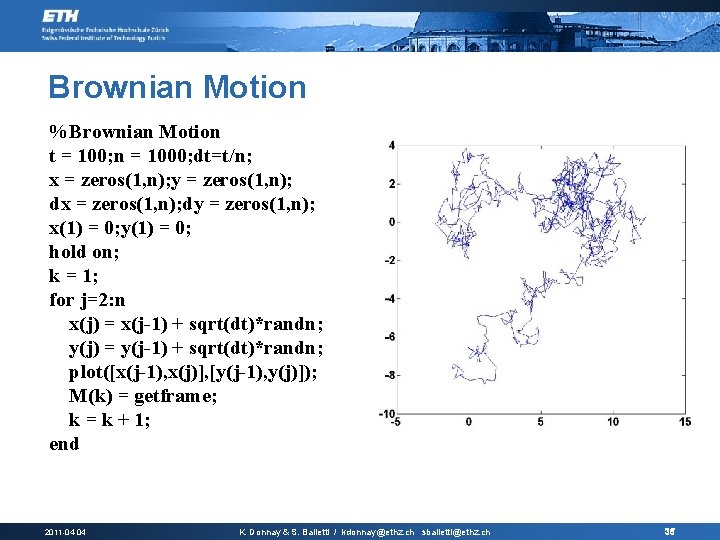
Brownian Motion %Brownian Motion t = 100; n = 1000; dt=t/n; x = zeros(1, n); y = zeros(1, n); dx = zeros(1, n); dy = zeros(1, n); x(1) = 0; y(1) = 0; hold on; k = 1; for j=2: n x(j) = x(j-1) + sqrt(dt)*randn; y(j) = y(j-1) + sqrt(dt)*randn; plot([x(j-1), x(j)], [y(j-1), y(j)]); M(k) = getframe; k = k + 1; end 2011 -04 -04 K. Donnay & S. Balietti / kdonnay@ethz. ch sbalietti@ethz. ch 35
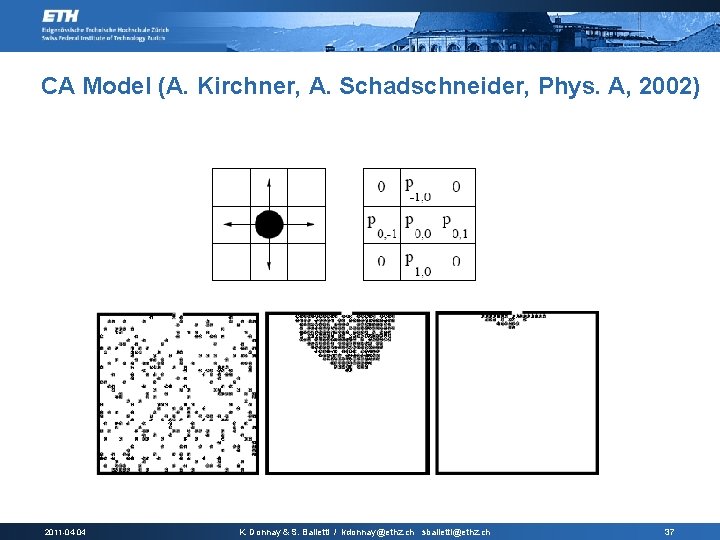
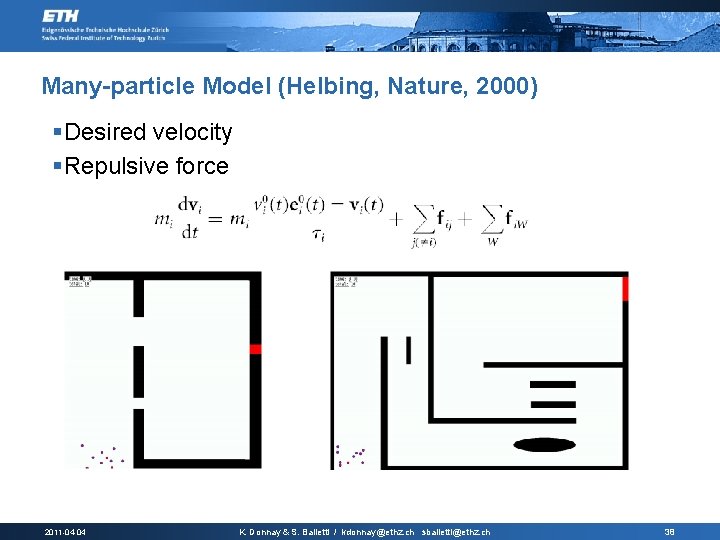
Pedestrian Simulation § CA model § Many-particle model 2011 -04 -04 K. Donnay & S. Balietti / kdonnay@ethz. ch sbalietti@ethz. ch 36
CA Model (A. Kirchner, A. Schadschneider, Phys. A, 2002) 2011 -04 -04 K. Donnay & S. Balietti / kdonnay@ethz. ch sbalietti@ethz. ch 37
Many-particle Model (Helbing, Nature, 2000) §Desired velocity §Repulsive force 2011 -04 -04 K. Donnay & S. Balietti / kdonnay@ethz. ch sbalietti@ethz. ch 38
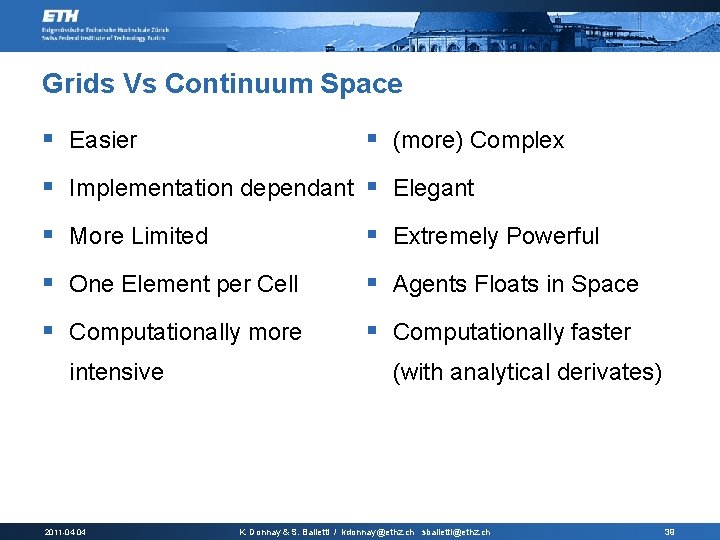
Grids Vs Continuum Space § Easier § (more) Complex § Implementation dependant § Elegant § More Limited § Extremely Powerful § One Element per Cell § Agents Floats in Space § Computationally more § Computationally faster intensive 2011 -04 -04 (with analytical derivates) K. Donnay & S. Balietti / kdonnay@ethz. ch sbalietti@ethz. ch 39
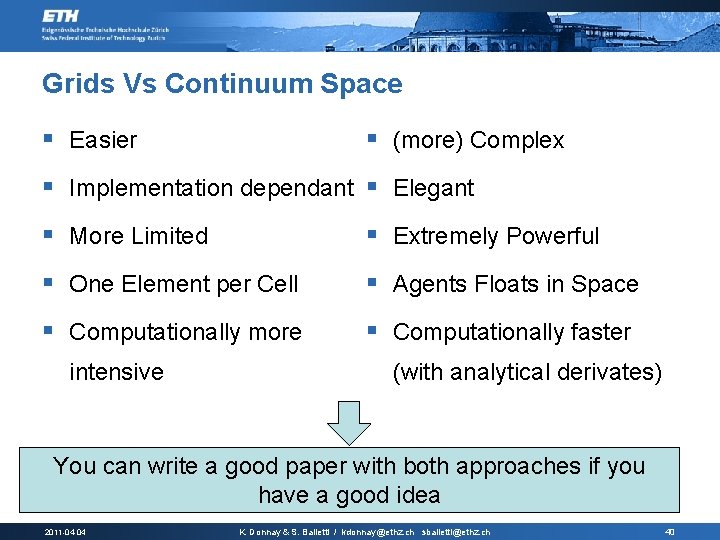
Grids Vs Continuum Space § Easier § (more) Complex § Implementation dependant § Elegant § More Limited § Extremely Powerful § One Element per Cell § Agents Floats in Space § Computationally more § Computationally faster intensive (with analytical derivates) You can write a good paper with both approaches if you have a good idea 2011 -04 -04 K. Donnay & S. Balietti / kdonnay@ethz. ch sbalietti@ethz. ch 40
Projects § Today, there are no exercises. § Please check out the additional material on the website regarding Taylor Series, and stochastic processes. § You can work on your projects and we will supervise you. 2011 -04 -04 K. Donnay & S. Balietti / kdonnay@ethz. ch sbalietti@ethz. ch 41
References § http: //en. wikipedia. org/wiki/Taylor_expansion § http: //en. wikipedia. org/wiki/Random_walk § http: //www. mathworks. com/matlabcentral/fileexc hange/22003 § Nature 407, 487 -490 (2000) Simulating dynamical features of escape panic. Dirk Helbing, Illés Farkas and Tamás Vicsek 2011 -04 -04 K. Donnay & S. Balietti / kdonnay@ethz. ch sbalietti@ethz. ch 42