
8508 Lecture 2 Part 1 1 Electromagnetism Part
- Slides: 19
8/5/08 Lecture 2 Part 1 1
Electromagnetism 전자기학 Part 1 : Electromagnetic induction; Faraday’s Law 전자 유도 Part 2 : Electromagnetic waves 전자기파 8/5/08 Lecture 2 Part 1 2
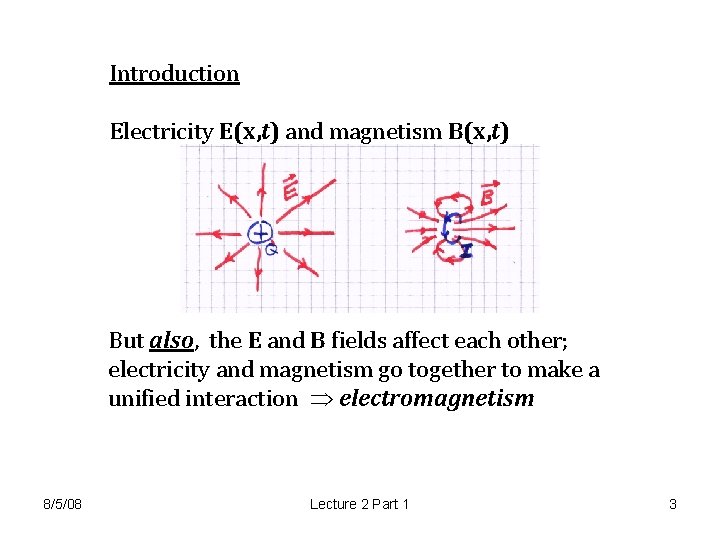
Introduction Electricity E(x, t) and magnetism B(x, t) But also, the E and B fields affect each other; electricity and magnetism go together to make a unified interaction electromagnetism 8/5/08 Lecture 2 Part 1 3
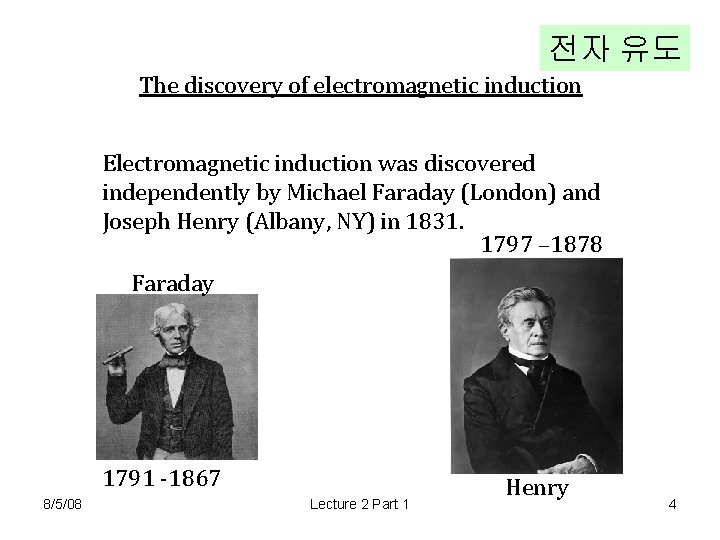
전자 유도 The discovery of electromagnetic induction Electromagnetic induction was discovered independently by Michael Faraday (London) and Joseph Henry (Albany, NY) in 1831. 1797 – 1878 Faraday 1791 -1867 8/5/08 Lecture 2 Part 1 Henry 4
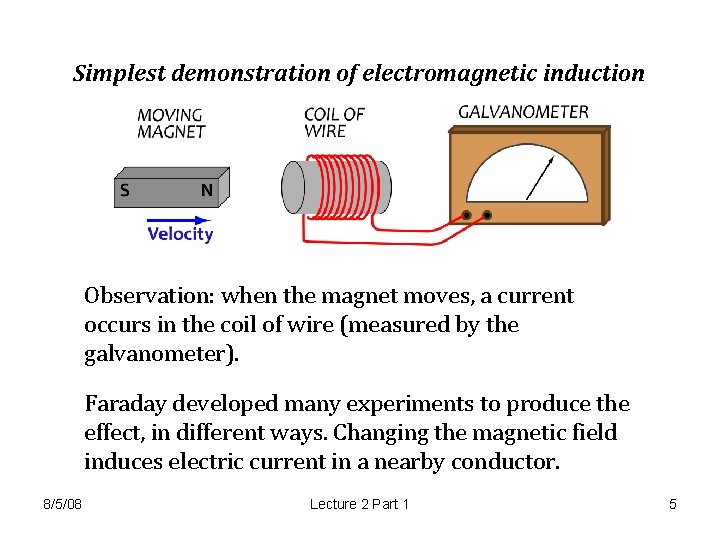
Simplest demonstration of electromagnetic induction Observation: when the magnet moves, a current occurs in the coil of wire (measured by the galvanometer). Faraday developed many experiments to produce the effect, in different ways. Changing the magnetic field induces electric current in a nearby conductor. 8/5/08 Lecture 2 Part 1 5
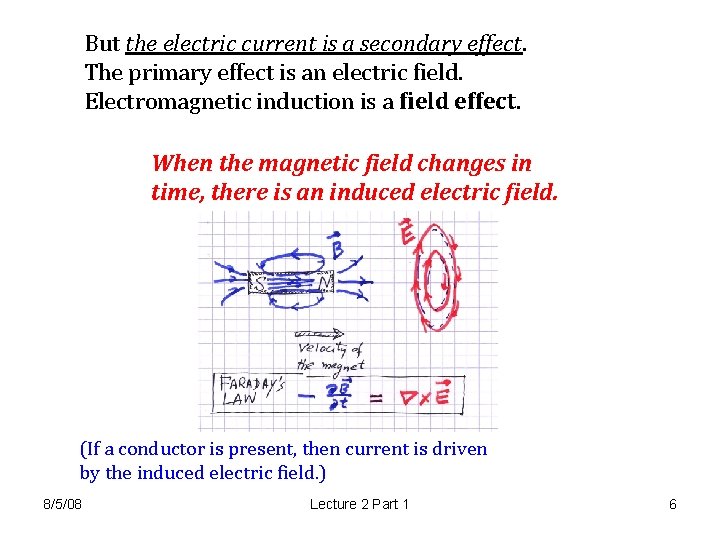
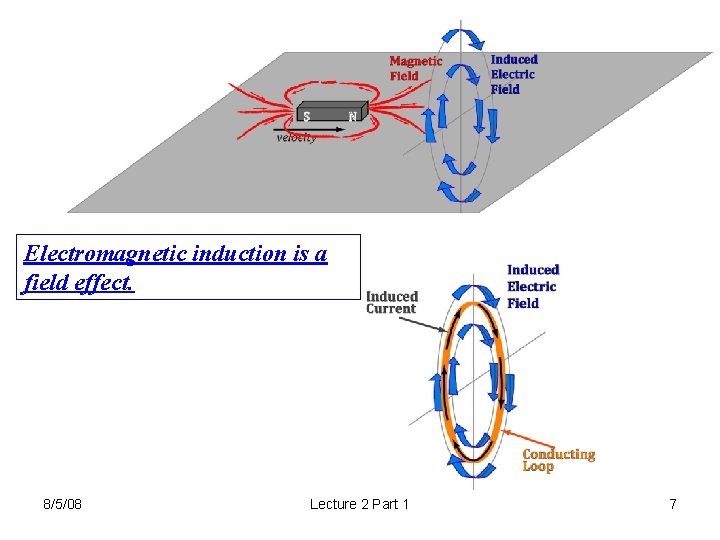
But the electric current is a secondary effect. The primary effect is an electric field. Electromagnetic induction is a field effect. When the magnetic field changes in time, there is an induced electric field. (If a conductor is present, then current is driven by the induced electric field. ) 8/5/08 Lecture 2 Part 1 6
Electromagnetic induction is a field effect. 8/5/08 Lecture 2 Part 1 7
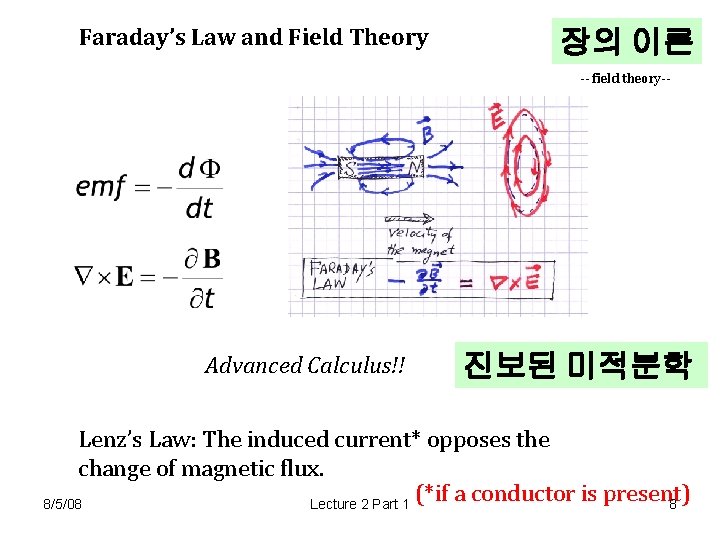
Faraday’s Law and Field Theory 장의 이론 -- field theory-- Advanced Calculus!! 진보된 미적분학 Lenz’s Law: The induced current* opposes the change of magnetic flux. (*if a conductor is present) 8/5/08 Lecture 2 Part 1 8
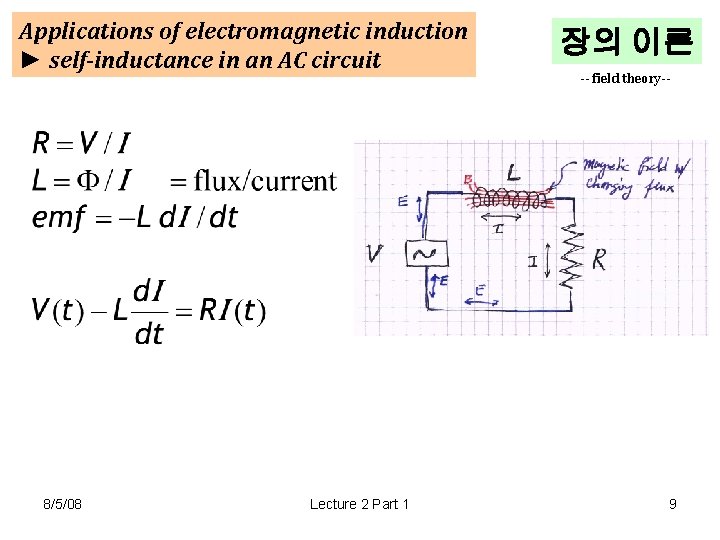
Applications of electromagnetic induction ► self-inductance in an AC circuit 8/5/08 Lecture 2 Part 1 장의 이론 -- field theory-- 9
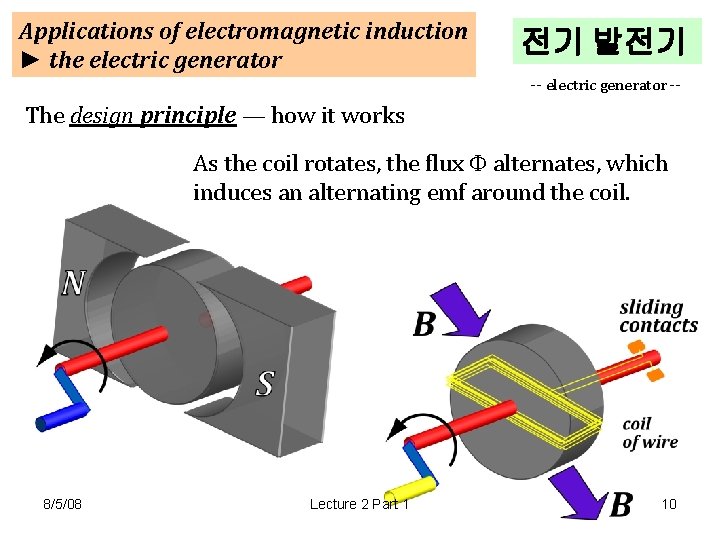
Applications of electromagnetic induction ► the electric generator 전기 발전기 -- electric generator -- The design principle — how it works As the coil rotates, the flux F alternates, which induces an alternating emf around the coil. 8/5/08 Lecture 2 Part 1 10
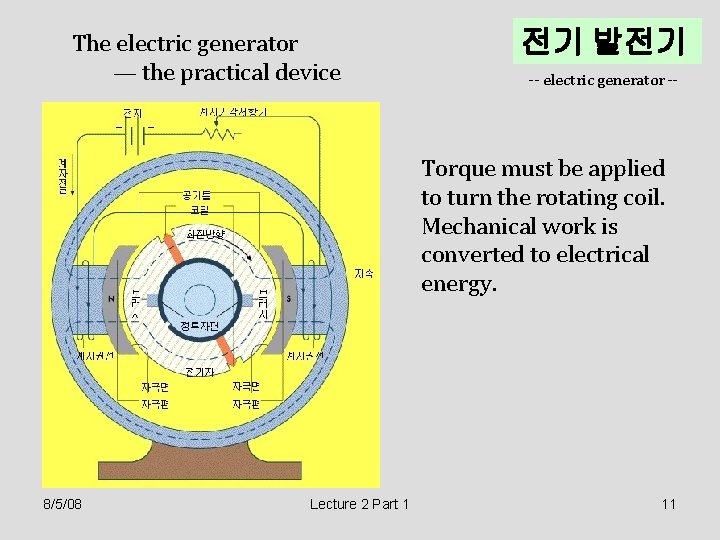
The electric generator — the practical device 전기 발전기 -- electric generator -- Torque must be applied to turn the rotating coil. Mechanical work is converted to electrical energy. 8/5/08 Lecture 2 Part 1 11
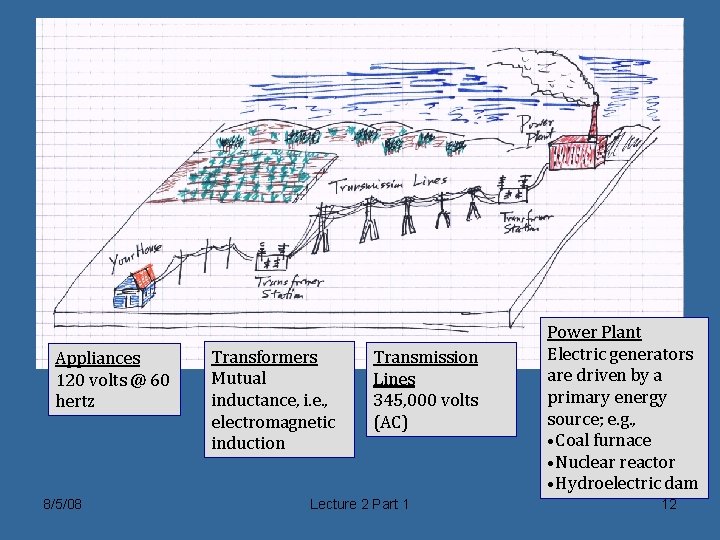
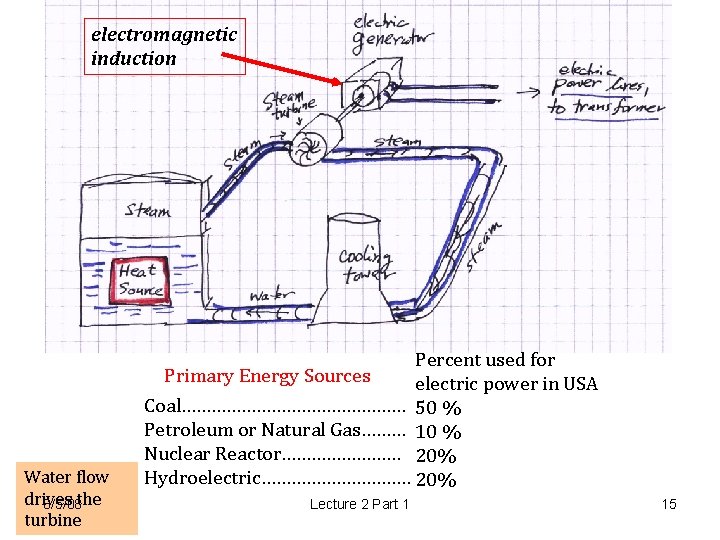
Appliances 120 volts @ 60 hertz 8/5/08 Transformers Mutual inductance, i. e. , electromagnetic induction Transmission Lines 345, 000 volts (AC) Lecture 2 Part 1 Power Plant Electric generators are driven by a primary energy source; e. g. , • Coal furnace • Nuclear reactor • Hydroelectric dam 12
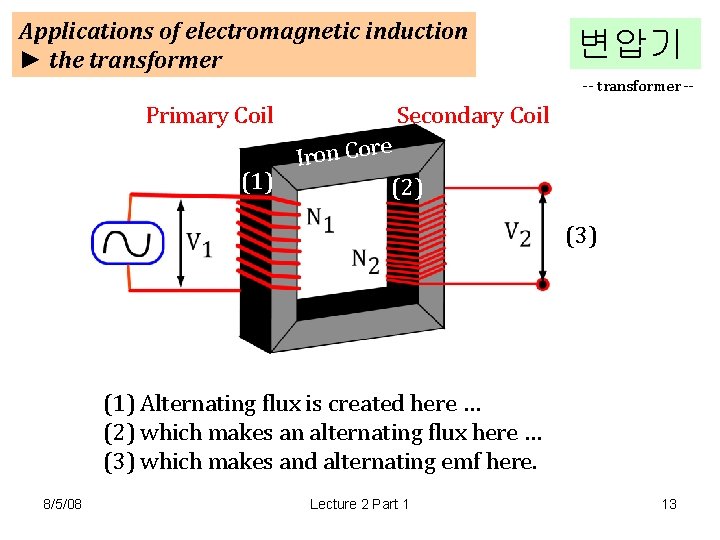
Applications of electromagnetic induction ► the transformer 변압기 -- transformer -- Primary Coil (1) Secondary Coil Iron Core (2) (3) (1) Alternating flux is created here … (2) which makes an alternating flux here … (3) which makes and alternating emf here. 8/5/08 Lecture 2 Part 1 13
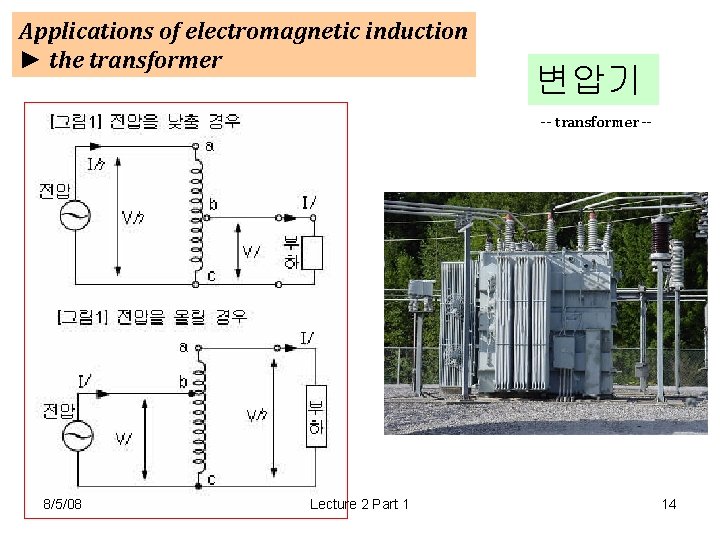
Applications of electromagnetic induction ► the transformer 변압기 -- transformer -- 8/5/08 Lecture 2 Part 1 14
electromagnetic induction Water flow drives 8/5/08 the turbine Percent used for Primary Energy Sources electric power in USA Coal…………………… 50 % Petroleum or Natural Gas……… 10 % Nuclear Reactor………… 20% Hydroelectric…………… 20% Lecture 2 Part 1 15
Alternative Energy Sources ? • renewable • safe for the environment • no carbon dioxide emission • less expensive 양자택일 에너지원 8/5/08 Lecture 2 Part 1 16
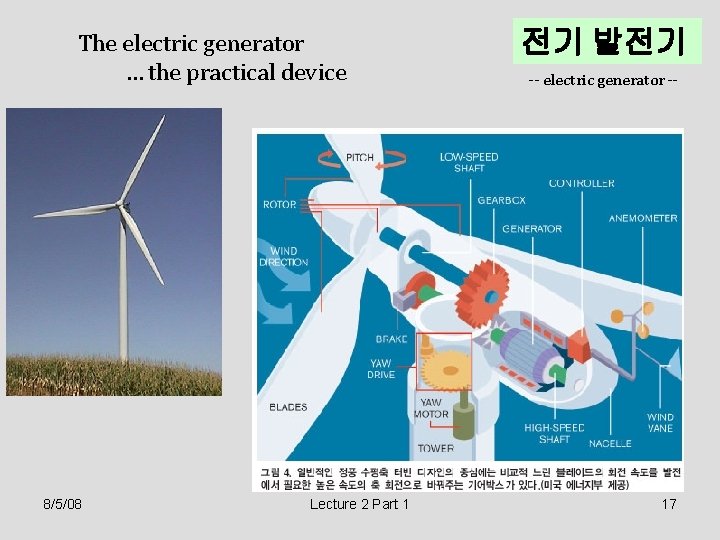
The electric generator … the practical device 8/5/08 Lecture 2 Part 1 전기 발전기 -- electric generator -- 17
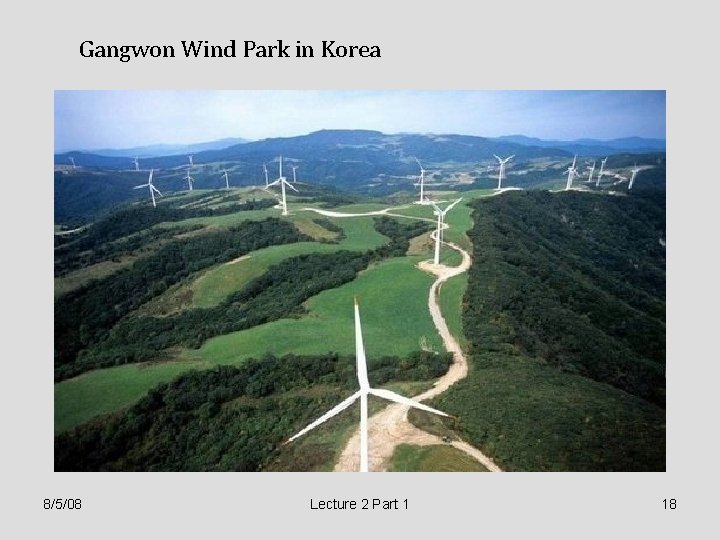
Gangwon Wind Park in Korea 8/5/08 Lecture 2 Part 1 18
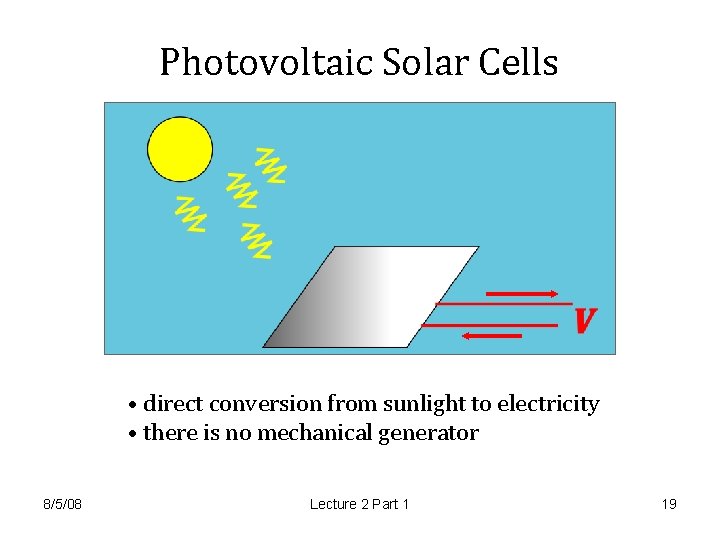
Photovoltaic Solar Cells • direct conversion from sunlight to electricity • there is no mechanical generator 8/5/08 Lecture 2 Part 1 19