
802 11 Presented by Hampton Smith 802 11
802. 11 Presented by Hampton Smith
802. 11 § An IEEE (Institute for Electrical and Electronics Engineers) protocol ratified in 1997 which defines a standard for wireless connectivity. § Now known as 802. 11 Legacy. § Applies to the Physical and Media Access Control layers.
802. 11 Legacy § Allowed for a 1 -2 Mb/s data rate § 3 channels, 2. 4 GHz (ISM) § CSMA/CA, with a random backoff § Security § RC 4 Encryption § Authentication through a list or a shared private key
802. 11 Legacy § Topologies § Ad hoc (on the fly) § Infrastructure § Data Transmission Types: § Direct Sequence Spread Spectrum (DSSS) § Frequency Hopping Spread Spectrum (FHSS) § Infrared Spectrum
DSSS vs FRSS § Both use Spread Spectrum § Spread Spectrum means all devices transmit within the same bandwidth, devices don’t have assigned frequencies.

DSSS vs FHSS § DSSS § § § Reduces peak amplitude Maintains total power Data encoded using “clipping bit” and transferred at an increased data rate over multiple frequencies § Resistant to feedback and temporary noise generators § FHSS § Maintains peak amplitude § “Hops” from frequency to frequency many times per second. § Avoids feedback by not transmitting on any one frequency for long
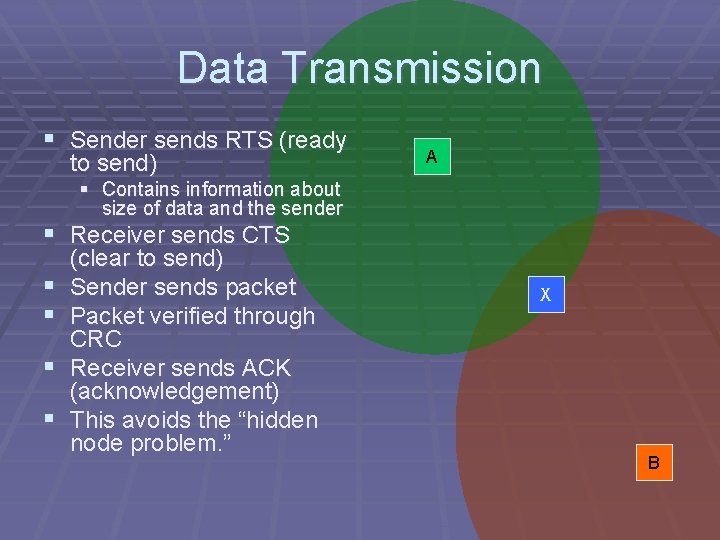
Data Transmission § Sender sends RTS (ready to send) A § Contains information about size of data and the sender § Receiver sends CTS § § (clear to send) Sender sends packet Packet verified through CRC Receiver sends ACK (acknowledgement) This avoids the “hidden node problem. ” X B
Topologies § Ad hoc § Uses Spokesman Election Algorithm (SEA) to determine Master and Slaves § Nodes communicate directly § Infrastructure § Nodes communicate through an Access Point § Access Point relays messages between nodes and between the nodes and the outside
802. 11 b § Eliminates FHSS option § Boosts data rate to a nominal 11 Mb/s (practically about 5 Mb/s) § Does this through voodoo

802. 11 a § Comes after 802. 11 b. Go figure. § Increases theoretical data rate to 54 Mb/s (practical: 27 Mb/s) § Operates on 5 GHz license free band § Limited range (about half of 802. 11 b) § Incompatible with 802. 11 b and 802. 11 legacy. § Most held out for 802. 11 g, which was already in the works.
802. 11 g § Same transfer as 802. 11 a (nominal 54 Mb/s, practical 27 Mb/s). § Operated on original 2. 4 GHz spectrum § Same range as 802. 11 b § Compatible with 802. 11 b and 802. 11 legacy technologies. § Best of both worlds option.
Security § RC 4 older code, still checked out. § Several studies determined that wireless was woefully less secure than wired counterpart. § Drafts of 802. 11 i, but not ratified until 2004. § WPA (Wi-Fi (Wireless Fidelity) Protected Access) Organization.
Problems with 802. 11 § Limited range, commercial and industrial § § § implementations need repeaters and access points in many places. Industrial applications use lots of metal and electric equipment which can reflect, nullify, distort, and broadcast its own signals. Security 2. 4 GHz band not unlicensed everywhere (Italy, for example)
Further Reading § http: //standards. ieee. org/getieee 802/802. 1 1. html § (Google search “IEEE get wireless 802. 11”) § http: //www. computer. org/students/looking/ summer 97/ieee 802. htm § (Google search “IEEE 802. 11 short tutorial”)
- Slides: 14