
8 Thermochemistry 8 2 Calorimetry Explain the technique

- Slides: 8
8. Thermochemistry 8. 2: Calorimetry • Explain the technique of calorimetry • Calculate and interpret heat and related properties using typical calorimetry data Before this section, please check for a Flip exercise! (Posted on the Module 8 page)
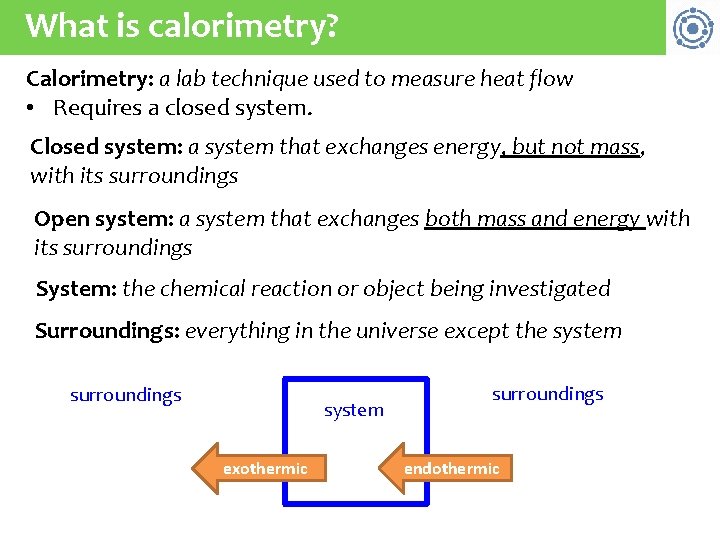
What is calorimetry? Calorimetry: a lab technique used to measure heat flow • Requires a closed system. Closed system: a system that exchanges energy, but not mass, with its surroundings Open system: a system that exchanges both mass and energy with its surroundings System: the chemical reaction or object being investigated Surroundings: everything in the universe except the system surroundings system exothermic surroundings endothermic
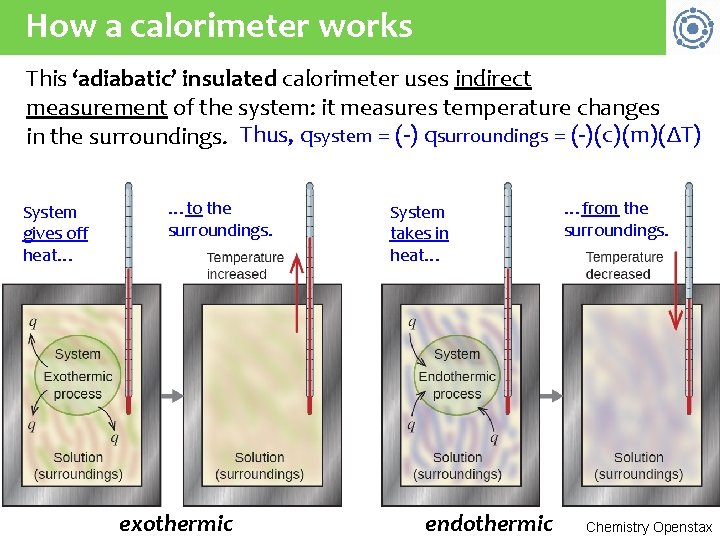
How a calorimeter works This ‘adiabatic’ insulated calorimeter uses indirect measurement of the system: it measures temperature changes in the surroundings. Thus, qsystem = (-) qsurroundings = (-)(c)(m)(ΔT) System gives off heat… …to the surroundings. exothermic System takes in heat… endothermic …from the surroundings. Chemistry Openstax
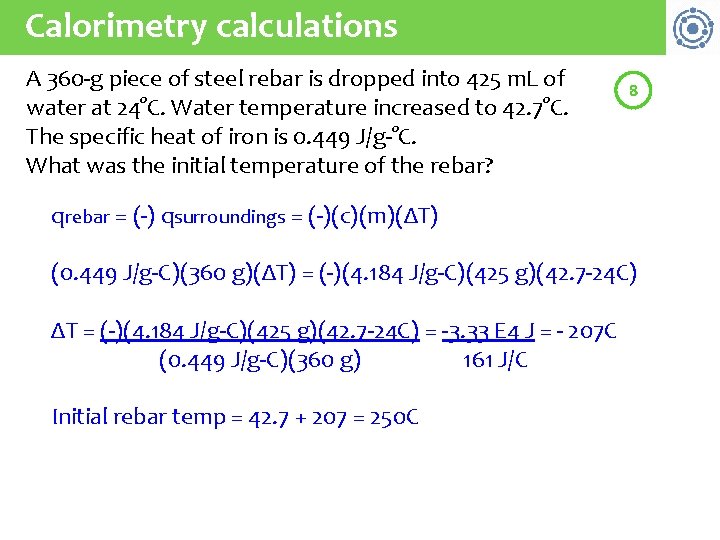
Calorimetry calculations A 360 -g piece of steel rebar is dropped into 425 m. L of water at 24°C. Water temperature increased to 42. 7°C. The specific heat of iron is 0. 449 J/g-°C. What was the initial temperature of the rebar? 8 qrebar = (-) qsurroundings = (-)(c)(m)(ΔT) (0. 449 J/g-C)(360 g)(ΔT) = (-)(4. 184 J/g-C)(425 g)(42. 7 -24 C) ΔT = (-)(4. 184 J/g-C)(425 g)(42. 7 -24 C) = -3. 33 E 4 J = - 207 C (0. 449 J/g-C)(360 g) 161 J/C Initial rebar temp = 42. 7 + 207 = 250 C
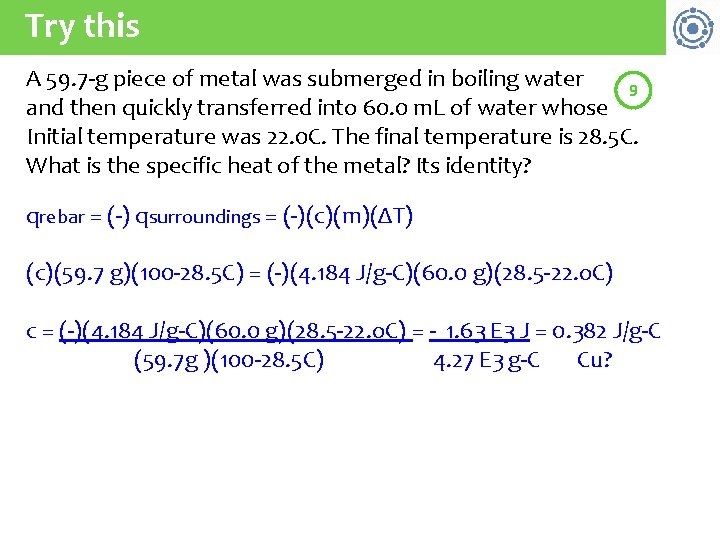
Try this A 59. 7 -g piece of metal was submerged in boiling water 9 and then quickly transferred into 60. 0 m. L of water whose Initial temperature was 22. 0 C. The final temperature is 28. 5 C. What is the specific heat of the metal? Its identity? qrebar = (-) qsurroundings = (-)(c)(m)(ΔT) (c)(59. 7 g)(100 -28. 5 C) = (-)(4. 184 J/g-C)(60. 0 g)(28. 5 -22. o. C) c = (-)(4. 184 J/g-C)(60. 0 g)(28. 5 -22. o. C) = - 1. 63 E 3 J = 0. 382 J/g-C (59. 7 g )(100 -28. 5 C) 4. 27 E 3 g-C Cu?
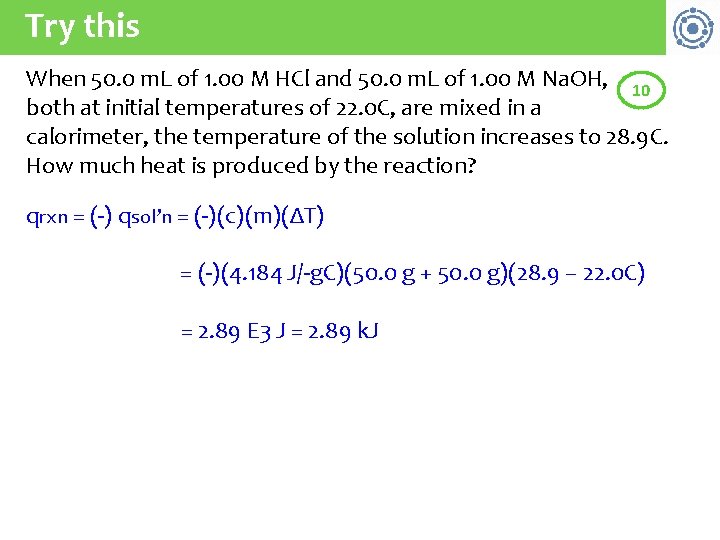
Try this When 50. 0 m. L of 1. 00 M HCl and 50. 0 m. L of 1. 00 M Na. OH, 10 both at initial temperatures of 22. 0 C, are mixed in a calorimeter, the temperature of the solution increases to 28. 9 C. How much heat is produced by the reaction? qrxn = (-) qsol’n = (-)(c)(m)(ΔT) = (-)(4. 184 J/-g. C)(50. 0 g + 50. 0 g)(28. 9 – 22. 0 C) = 2. 89 E 3 J = 2. 89 k. J
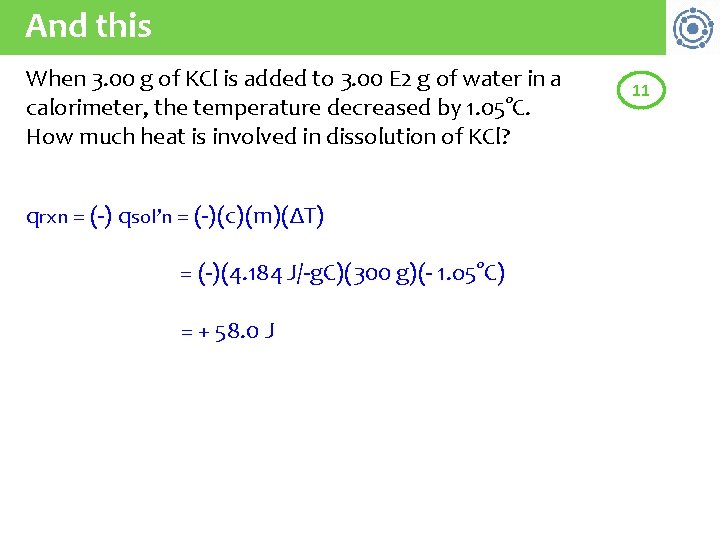
And this When 3. 00 g of KCl is added to 3. 00 E 2 g of water in a calorimeter, the temperature decreased by 1. 05°C. How much heat is involved in dissolution of KCl? qrxn = (-) qsol’n = (-)(c)(m)(ΔT) = (-)(4. 184 J/-g. C)(300 g)(- 1. o 5°C) = + 58. 0 J 11
Can you? (1) Explain the purpose of calorimetry? (2) Explain the difference between open and closed systems? (3) Explain how the terms system and surroundings apply to chemistry? (4) Explain why the heat change (ΔH) of the system is the negative ΔH of the calorimeter? (5) Use the relationships between mass, specific heat, change in temperature and heat change to solve for one variable if given the others.