
8 th grade Bell Work Earth Science 1
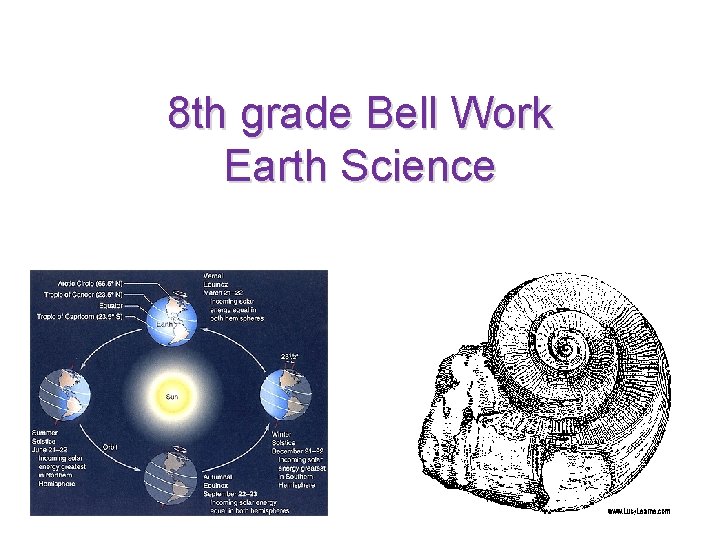
8 th grade Bell Work Earth Science
#1 Bell Work 8 th Grade 1. What galaxy is the Earth a part of? milky way 2. The shape of our galaxy is spiral 3. The unit used in astronomy to measure distance is: light years 4. Remnants from the formation of the universe are called what? nebulas 5. How many centimeters are in 3 kilometers? 100 x 1000 x 3 = 300, 000 cm
8 th Grade: 2 1. How many independent variables should there be? one 2. How many constants should an experiment have? 3. many What is the order of the planets closest to sun then out? Mercury, Venus, Earth, Mars, Jupiter, Saturn, Uranus, Neptune 4. What is the metric prefix that means 100? hecto 5. What is common to the vertebrate group? backbones
#3: 8 th Grade Bell Work 1. What is the metric unit of volume? milliliter 2. The prefix kilo- means ? 1000 3. What is one decameter? 10 meters 4. What action is the Earth taking as it is orbiting around the sun? revolution 5. Does the Earth rotate or revolve as it is traveling around the sun? both
#4 BW: 8 th 1. What is the name of our Galaxy? Milky Way 2. What items in space are made up of dust, gas, billions of stars and have different shapes? Galaxies 3. Which planets are the terrestrial planets? Mars, Earth, Venus, Mercury 4. What are the shapes of galaxies? Elliptical, spiral, and irregular 5. What is the shape of our galaxy? spiral
Bell Work #5 1. ____ observations are numbers (amounts) or measurements including unit label or observations that make relative comparisons, such as more than, all, less than, few, or none. (Quantitative) 2. _______ observations are words or sentences that describe what happens during an experiment. These observations use only the senses and refer to specific properties. (Qualitative) 3. An explanation or interpretation of an observation based on prior experiences or supported by observations made in the investigation is called a (n) ____. (Inference) 4. A(n) ______ is a test to find out something. (Experiment) 5. What are the steps to a controlled scientific investigation? (Identify a testable question, research information about the topic, state the hypothesis as a predicted answer to the question, and design an experiment to test the hypothesis, controlling all variables except the independent variable)
Bell Work # 6 1. A ______ is something that is changed as a result of the independent variable. (Dependent variable) 2. An _______ is something that the experimenter chooses to change. (Independent variable) 3. A ______ is gained by carefully identifying and describing properties using the five senses or scientific tools and can be classified as quantitative or qualitative. (Scientific observation) 4. A _______ is a prediction about the relationship between variables. It can be stated as an “if …. , then…. . ” statement. (Hypothesis) 5. All controlled investigations should have a ______. (hypothesis)
#7 Bell Work 8 th Grade 1. What object exists in space (gas and dust) that are remnants from the formation of the universe? nebulas 2. 3. The nearest large galaxy is called what? Andromeda Where is the sun located in our galaxy? in one of the spiral arms about 2/3’s of the way up 4. What are three shapes of galaxies? elliptical, spiral, irregular 5. How many centimeters are in 3 kilometers? 100 x 1000 x 3 = 300, 000 cm
#8 Bell Work 8 th Grade 1. What part of the Sun is the visible surface that emits the light we see? photosphere 2. What appears as dark spots on the sun’s surface? sunspots 3. What is the corona? the outermost layer of the sun’s atmosphere 4. What are the eras? cenozoic, mesozoic, paleozoic 5. How many bytes are in a megabyte? 1, 000
#9 Bell work 8 th Grade 1. What is the outermost layer of the Sun’s atmosphere? corona 2. What are bright arch-like loops that may erupt from the photosphere into the corona? Prominences 3. What four planets are gaseous? Jupiter, Saturn, Uranus, and Neptune 4. What type of sun feature can disrupt electronic and radio transmissions? solar flares 5. How many meters are in a hectometer? 100
#10 Bell work 8 th Grade 1. What are the four terrestrial planets? Mercury Venus Earth Mars 2. What part of the sun shows light? photosphere 3. What is the first step in technological design? notice a problem 4. After you design a solution, what do you do in a technological design? build it 5. How many liters are in a deciliter? 1/10
- Slides: 11