
8 th Edition Base Code Whats New October
8 th Edition Base Code What’s New? October 4, 2010 Presented by: Rob Anderson – Chief of Inspections - Buildings Don Finocchio – Technical Code Analyst Dana Haagensen, DFS Jacob Nunnemacher, DFS Timothee Rodrique, DFS Tom Riley – Code Development Manager Mike Guigli – Technical Director
8 th Edition Base Code What’s New? Introduction: Rob A. • Code layout and DPS website: Don F. • IBC 09 and amendments vs. 7 th Edition: • • Various presenters • IEBC 09 and amendments vs. 7 th. Edition • Various presenters • Special Regulations 1 to 7: Rob A.
780 CMR Code th 8 Edition Base Disclaimer This presentation attempts to familiarize users with the new 8 th edition and specifically with what’s changed from the 7 th edition. The information provided may have inaccuracies and cannot encompass all of the changes between the two editions of the building code. This training presentation may be found at the DPS website.
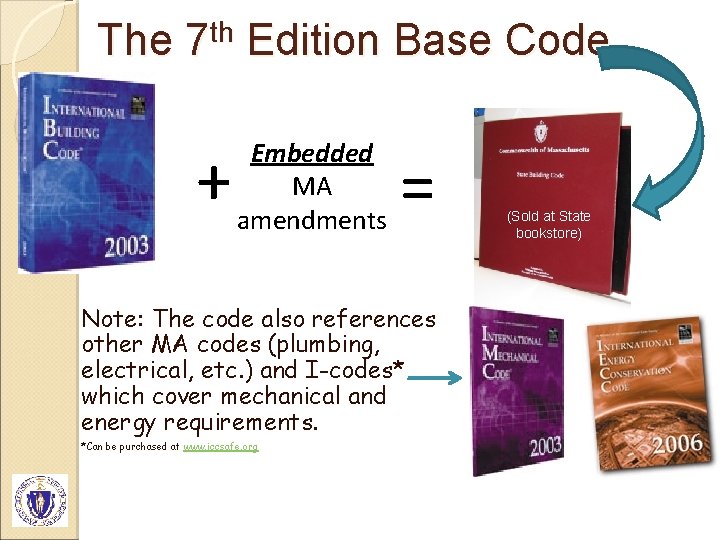
The 7 th Edition Base Code + Embedded MA amendments = Note: The code also references other MA codes (plumbing, electrical, etc. ) and I-codes* which cover mechanical and energy requirements. *Can be purchased at www. iccsafe. org (Sold at State bookstore)
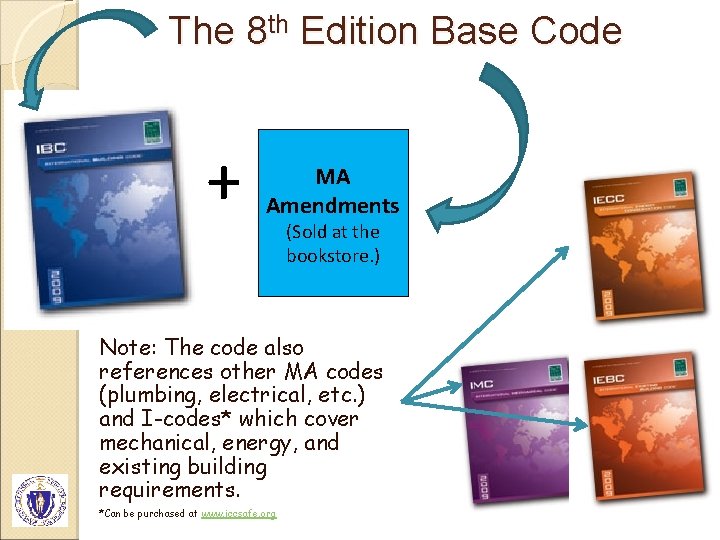
The 8 th Edition Base Code + MA Amendments (Sold at the bookstore. ) Note: The code also references other MA codes (plumbing, electrical, etc. ) and I-codes* which cover mechanical, energy, and existing building requirements. *Can be purchased at www. iccsafe. org
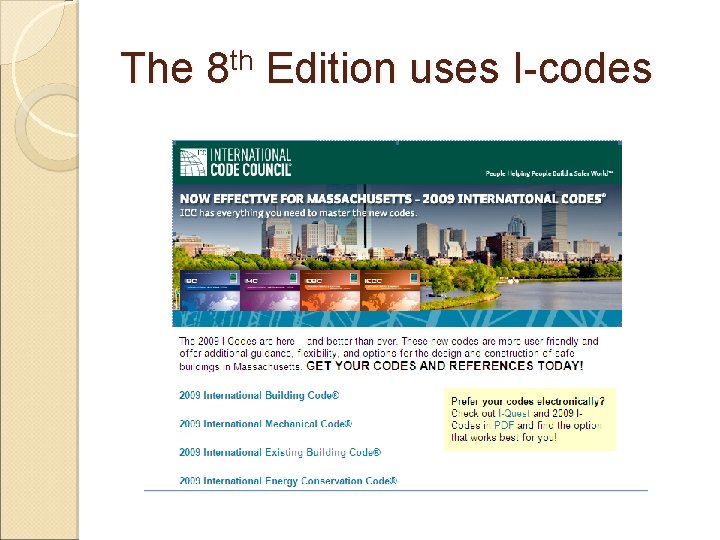
The 8 th Edition uses I-codes
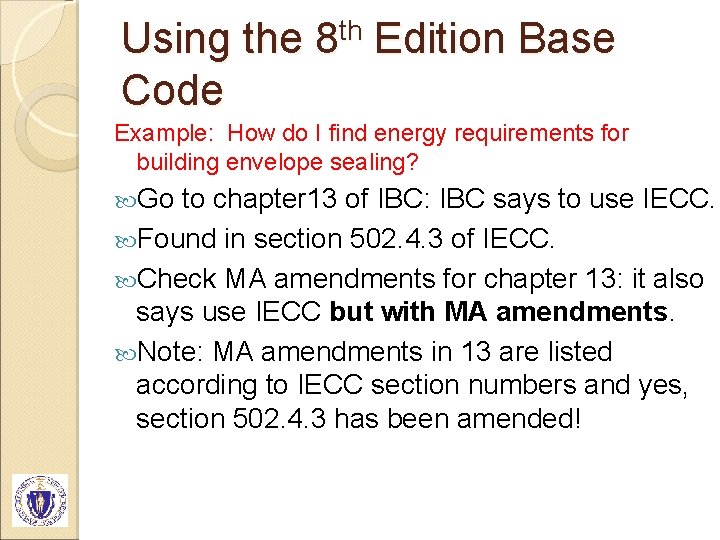
Using the 8 th Edition Base Code Example: How do I find energy requirements for building envelope sealing? Go to chapter 13 of IBC: IBC says to use IECC. Found in section 502. 4. 3 of IECC. Check MA amendments for chapter 13: it also says use IECC but with MA amendments. Note: MA amendments in 13 are listed according to IECC section numbers and yes, section 502. 4. 3 has been amended!
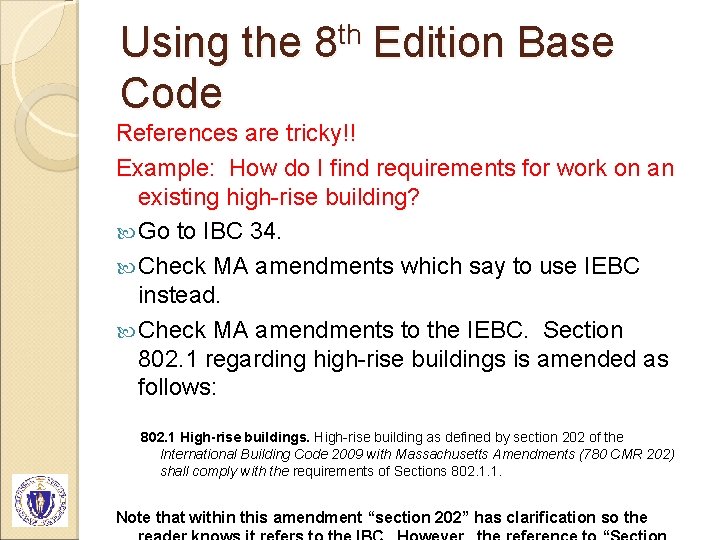
Using the Code th 8 Edition Base References are tricky!! Example: How do I find requirements for work on an existing high-rise building? Go to IBC 34. Check MA amendments which say to use IEBC instead. Check MA amendments to the IEBC. Section 802. 1 regarding high-rise buildings is amended as follows: 802. 1 High-rise buildings. High-rise building as defined by section 202 of the International Building Code 2009 with Massachusetts Amendments (780 CMR 202) shall comply with the requirements of Sections 802. 1. 1. Note that within this amendment “section 202” has clarification so the
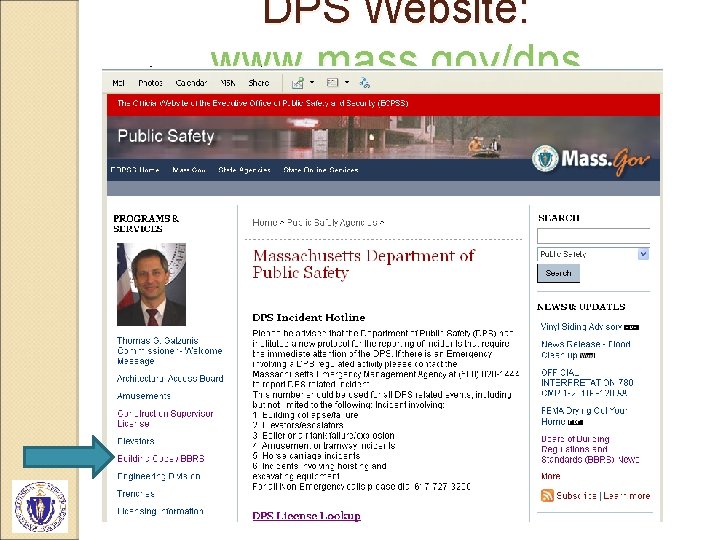
DPS Website: www. mass. gov/dps

DPS Website: Building Code

Chapter 1 Administration Organization How did we get 25 -sections of the 7 th chapter 1 to fit into the 16 -sections of the IBC chapter 1 and keep amendments to a minimum? ◦ Reviewed every section of the 7 th; found its’ corresponding location in 8 th or added amendments if needed. ◦ Deleted several topics not in use (Construction Materials Safety Board, for example) or to be covered outside of the code on the web (advisory committees). ◦ Deleted MGL language; provided web link to MGL’s instead. ◦ Deleted Special Regulations language (CSL, Native Lumber, etc. ); referenced chapter 110 instead.
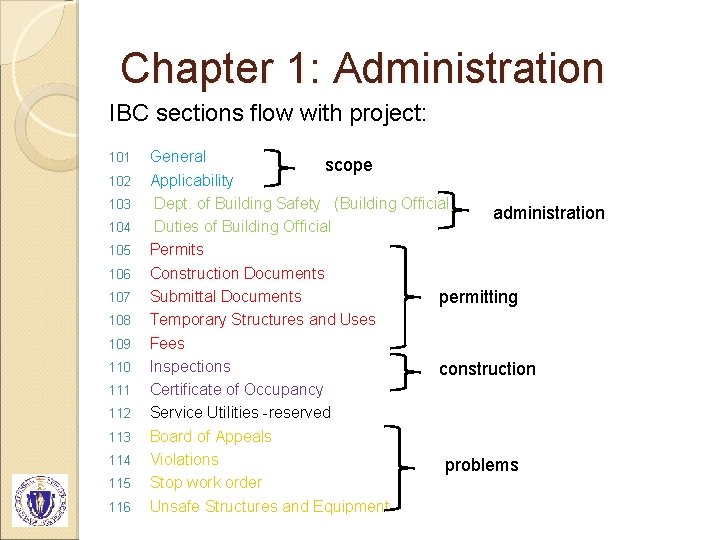
Chapter 1: Administration IBC sections flow with project: 101 102 103 104 105 106 107 108 109 110 111 112 113 114 115 116 General scope Applicability Dept. of Building Safety (Building Official) administration Duties of Building Official Permits Construction Documents Submittal Documents permitting Temporary Structures and Uses Fees Inspections construction Certificate of Occupancy Service Utilities -reserved Board of Appeals Violations problems Stop work order Unsafe Structures and Equipment
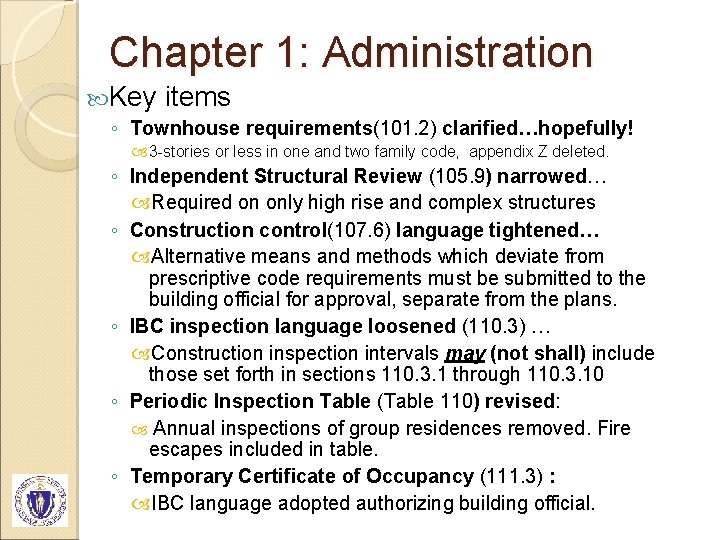
Chapter 1: Administration Key items ◦ Townhouse requirements(101. 2) clarified…hopefully! 3 -stories or less in one and two family code, appendix Z deleted. ◦ Independent Structural Review (105. 9) narrowed… Required on only high rise and complex structures ◦ Construction control(107. 6) language tightened… Alternative means and methods which deviate from prescriptive code requirements must be submitted to the building official for approval, separate from the plans. ◦ IBC inspection language loosened (110. 3) … Construction inspection intervals may (not shall) include those set forth in sections 110. 3. 1 through 110. 3. 10 ◦ Periodic Inspection Table (Table 110) revised: Annual inspections of group residences removed. Fire escapes included in table. ◦ Temporary Certificate of Occupancy (111. 3) : IBC language adopted authorizing building official.
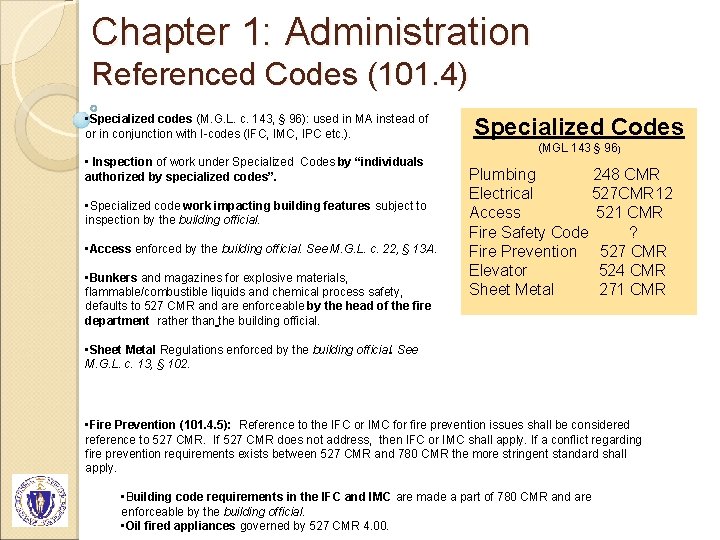
Chapter 1: Administration Referenced Codes (101. 4) • Specialized codes (M. G. L. c. 143, § 96): used in MA instead of or in conjunction with I-codes (IFC, IMC, IPC etc. ). Specialized Codes (MGL 143 § 96) • Inspection of work under Specialized Codes by “individuals authorized by specialized codes”. • Specialized code work impacting building features subject to inspection by the building official. • Access enforced by the building official. See M. G. L. c. 22, § 13 A. • Bunkers and magazines for explosive materials, flammable/combustible liquids and chemical process safety, defaults to 527 CMR and are enforceable by the head of the fire department rather than the building official. Plumbing 248 CMR Electrical 527 CMR 12 Access 521 CMR Fire Safety Code ? Fire Prevention 527 CMR Elevator 524 CMR Sheet Metal 271 CMR • Sheet Metal Regulations enforced by the building official. See M. G. L. c. 13, § 102. • Fire Prevention (101. 4. 5): Reference to the IFC or IMC for fire prevention issues shall be considered reference to 527 CMR. If 527 CMR does not address, then IFC or IMC shall apply. If a conflict regarding fire prevention requirements exists between 527 CMR and 780 CMR the more stringent standard shall apply. • Building code requirements in the IFC and IMC are made a part of 780 CMR and are enforceable by the building official. • Oil fired appliances governed by 527 CMR 4. 00.
Chapter 1: Administration Other items of note: DDS Facilities (102. 2. 1): Additional safety features in one and two family dwellings for group residence do not change the building classification from one and two family. Work exempt from permit (105. 2): Now specifies painting…cabinetry…finish work and playground equipment. Permit application (105. 3): Indicate if licensed by a State care agency. Electronic seal (107. 1. 1): Allowed, see DPL website: www. mass. gov/dpl Inspection intervals (110. 3) : The building official shall conduct inspections…which may include inspections set forth in Sections 110. 3. 1 through 110. 3. 10. Lowest floor in flood zones (110. 3): Certification must be submitted to BO that elevation is in compliance with section 1612. 5 before work above that elevation proceeds Temporary Occupancy (111. 3): Key change is that this IBC section is not amended. Like the 7 th edition the building official has the sole authority to issue a temporary certificate. The 8 th does not require consultation with the fire official (7 th edition language). Unsafe structures (116. 1) : Resurrected 6 th edition language per DFS
Chapter 2: Definitions IBC definitions, some of which don’t exist in the 7 th , were reviewed and retained. MA unique definitions added: ◦ ◦ ◦ ◦ Agriculture: as per MGL Agricultural , Building: Building Official: as per MGL Design Flood: as per DEP/Appendix G Design Flood Elevation: High-Rise Building: 70 for MA vs 75 feet in IBC. Jurisdiction: BBRS Night Club: Ordinance: means same as bylaw Registered Design Professional, RDP: applies to MA PE’s and registered architects. Specialized Codes: Just those listed in MGL 143 § 96 Story Above Grade Plane: Temporary Emergency Uses: Temporary Overnight Shelter:
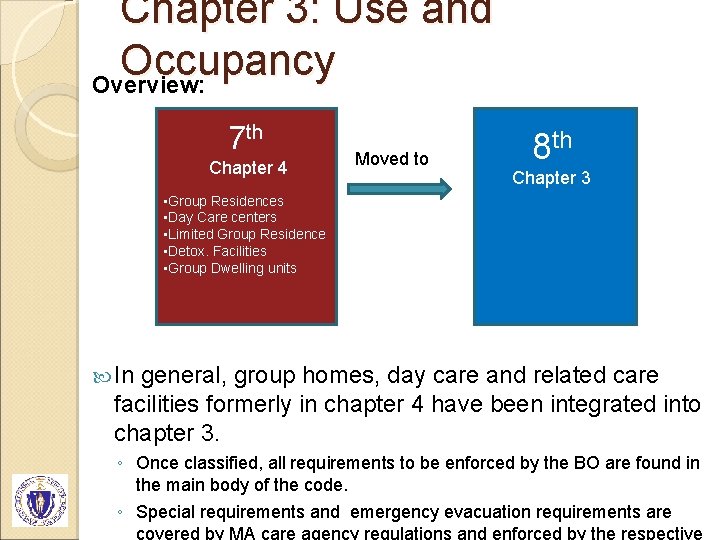
Chapter 3: Use and Occupancy Overview: 7 th Chapter 4 Moved to 8 th Chapter 3 • Group Residences • Day Care centers • Limited Group Residence • Detox. Facilities • Group Dwelling units In general, group homes, day care and related care facilities formerly in chapter 4 have been integrated into chapter 3. ◦ Once classified, all requirements to be enforced by the BO are found in the main body of the code. ◦ Special requirements and emergency evacuation requirements are covered by MA care agency regulations and enforced by the respective
Chapter 3: Use and Occupancy Changes and noted issues: Day care: (305. 2): MA cut-off age 2 9/12 years vs IBC 2 ½ years. Group homes (308. 2): No longer in chapter 4. Caveats retained to ensure one and two family group homes with five or fewer residents are treated strictly as one and two family dwellings. Ability to evacuate during emergencies is care agency’s responsibility - BO only inspects for compliance with the building code. I-2 and Residential care/assisted living facilities: (308. 3) I-2 type facilities with up to 12 residents licensed or operated by DMH may be considered R-4 facilities. Child care vs Day Care (308. 5. 2): To be determined if the term ‘child care’ is in error in this section and 310 of the IBC as these sections discuss care for less than 24 hours which is considered ‘Day Care’ elsewhere. R-1 classification (310. 1): Summer camps listed but requirements still in chapter 4. R-2 classification (310. 1): Includes day care of up to 10 -children in an apartment and DMH licensed or operated units. R-3 classification (310. 1): Day care of up to 10 children allowed in a unit. Townhouses of more than 3 stories added to list with note that height and area and fire protection in accordance with R-2. DDS and DMH group type facilities also noted. Definitions (310. 2): Boarding House references the MGL definition; Congregate Care Facilities – definition added; Residential Care/Assisted Living Facilities – Elder Affairs and DMH MGL’s cited. Summer Camps- definition added.
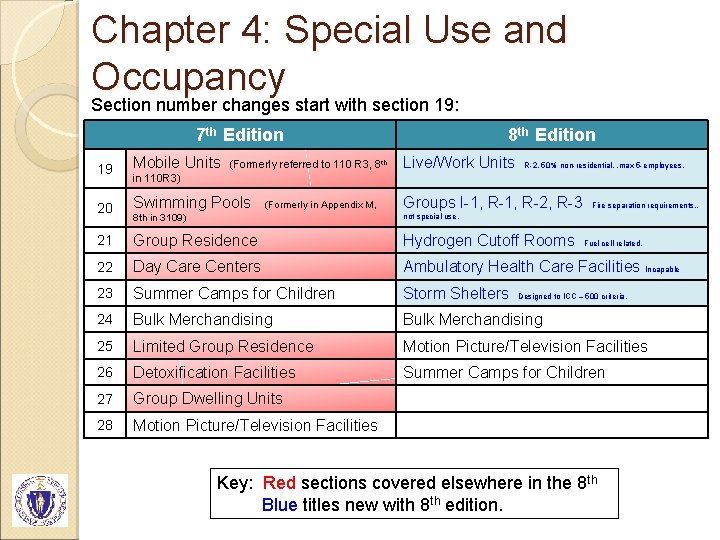
Chapter 4: Special Use and Occupancy Section number changes start with section 19: 7 th Edition 8 th Edition 19 Mobile Units 20 Swimming Pools 8 th in 3109) not special use. 21 Group Residence Hydrogen Cutoff Rooms 22 Day Care Centers Ambulatory Health Care Facilities Incapable 23 Summer Camps for Children Storm Shelters 24 Bulk Merchandising 25 Limited Group Residence Motion Picture/Television Facilities 26 Detoxification Facilities Summer Camps for Children 27 Group Dwelling Units 28 Motion Picture/Television Facilities (Formerly referred to 110 R 3, 8 th Live/Work Units R-2, 50% non-residential, , max 5 -employees. in 110 R 3) (Formerly in Appendix M, Groups I-1, R-2, R-3 Fire separation requirements. , Fuel cell related. Designed to ICC – 500 criteria. Key: Red sections covered elsewhere in the 8 th Blue titles new with 8 th edition.
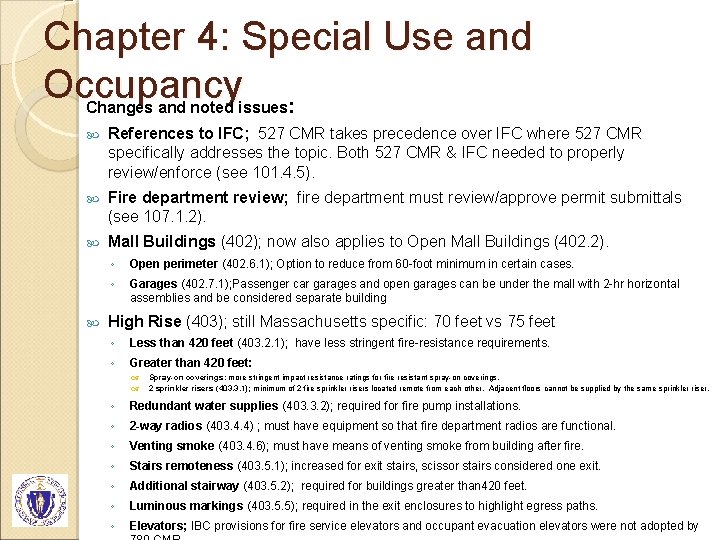
Chapter 4: Special Use and Occupancy : Changes and noted issues References to IFC; 527 CMR takes precedence over IFC where 527 CMR specifically addresses the topic. Both 527 CMR & IFC needed to properly review/enforce (see 101. 4. 5). Fire department review; fire department must review/approve permit submittals (see 107. 1. 2). Mall Buildings (402); now also applies to Open Mall Buildings (402. 2). ◦ Open perimeter (402. 6. 1); Option to reduce from 60 -foot minimum in certain cases. ◦ Garages (402. 7. 1); Passenger car garages and open garages can be under the mall with 2 -hr horizontal assemblies and be considered separate building High Rise (403); still Massachusetts specific: 70 feet vs 75 feet ◦ Less than 420 feet (403. 2. 1); have less stringent fire-resistance requirements. ◦ Greater than 420 feet: Spray-on coverings; more stringent impact resistance ratings for fire resistant spray-on coverings. 2 sprinkler risers (403. 3. 1); minimum of 2 fire sprinkler risers located remote from each other. Adjacent floors cannot be supplied by the same sprinkler riser. ◦ Redundant water supplies (403. 3. 2); required for fire pump installations. ◦ 2 -way radios (403. 4. 4) ; must have equipment so that fire department radios are functional. ◦ Venting smoke (403. 4. 6); must have means of venting smoke from building after fire. ◦ Stairs remoteness (403. 5. 1); increased for exit stairs, scissor stairs considered one exit. ◦ Additional stairway (403. 5. 2); required for buildings greater than 420 feet. ◦ Luminous markings (403. 5. 5); required in the exit enclosures to highlight egress paths. ◦ Elevators; IBC provisions for fire service elevators and occupant evacuation elevators were not adopted by
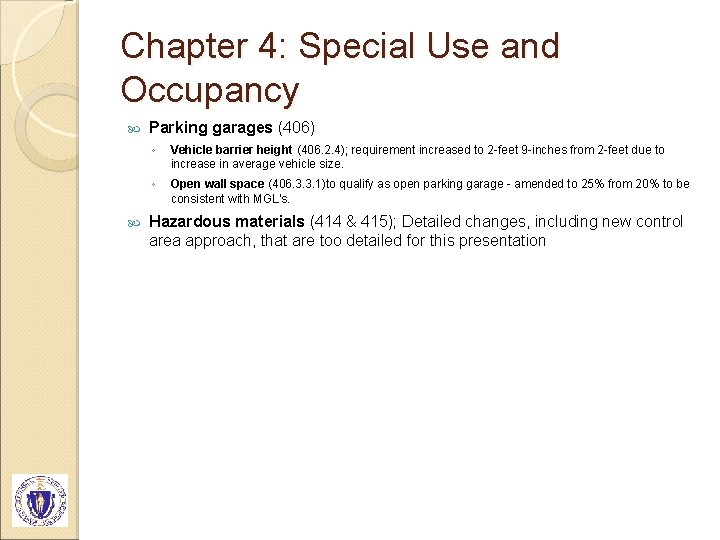
Chapter 4: Special Use and Occupancy Parking garages (406) ◦ Vehicle barrier height (406. 2. 4); requirement increased to 2 -feet 9 -inches from 2 -feet due to increase in average vehicle size. ◦ Open wall space (406. 3. 3. 1)to qualify as open parking garage - amended to 25% from 20% to be consistent with MGL’s. Hazardous materials (414 & 415); Detailed changes, including new control area approach, that are too detailed for this presentation
Chapter 5 General Building Heights and Areas Chapter 5 ◦ is independent of other chapters ◦ controls the size of a building of a particular ‘use’ and ‘construction type’ Special Industrial buildings (503. 1. 1) are exempt from Chapter 5 requirements. Hospital construction (503. 1)– MGL c. 111, § 51 requires hospitals to be of at least TYPE IB construction (see Chapter 6). Exception (504. 1) – 527 CMR 10 gives authority to Fire Services relative to required fire lane size and layout.
Chapter 5 General Building Heights and Areas Automatic Sprinkler system increase (504. 2) / Big Residential buildings in MA get increases using full NFPA 13 systems – i. e. per 903. 3. 1. 1. Unlimited areas buildings (507. 4) of more than 1 story- this section is ‘reserved’. Mixed Use & Occupancy (508) is new to this chapter & addresses requirements for each USE/Separation/Accessory & Incidental Use requirements.
Chapter 9: Fire Protection Systems • Background: • BBRS voted to carry forward 7 th edition Chapter 9 requirements and not lower level of safety from that required by 7 th edition • IBC has ‘enforcement authority’ language that needed to be addressed.
Chapter 9: Basics • Few Technical changes…If you know the 7 th then you’ll have a good start on the 8 th. • IBC makes Numerous references to the International Fire Code 2009 (IFC). • MA State Fire Code (527 CMR) takes precedence over IFC where 527 CMR specifically addresses the topic. • Both 527 CMR & IFC needed to properly review/enforce (901. 1 Note 2)
Chapter 9: Basics (cont. ) • Authority language streamlined: In most cases approval authority lies with either the building official or fire official. • Emergency responder radio coverage required for all new buildings • Required smoke alarms still photoelectric only. • Portable Fire Extinguisher section expanded. • Carbon Monoxide protection clarified…is required for all places with sleeping arrangements, not just where there is parking or fossil fuel burning equipment. • Smoke Proof Enclosures: Unique MA requirement not carried to the 8 th edition.
Chapter 9: Basics (cont. ) • Several MA amendments to NFPA Standards are incorporated: • NFPA 72, Fire Alarm Code: 2010 (not 2007) • NFPA 720, Carbon Monoxide: 2009 (not found in IBC) • NFPA 92 B, Smoke Management Systems: 2009 (not 2005) • NFPA 130, …Transit and Passenger Rail Systems: 2010 (not found in IBC) • also NFPA 140, 15, and 750.
Chapter 9: Fire Protection Systems Changes and noted issues: Submittals (107. 1. 2): Local Fire Department must review/approve fire protection submittals for building permit. Authority (901. 1): Contains multiple changes to enforcement authority, including issuance of a temporary C of O (909. 19). Acceptance Tests (901. 5). Building official and/or fire official (or third party) must witness acceptance tests Sprinkler requirements (Table 903. 2) • Most sprinkler thresholds in Tabular form. Note: fire area concept from IBC of where sprinklers are required is not valid. Sprinklers generally required throughout building when required. • Non-nightclub A-2: sprinklered at 100 occupants; other A-2 triggers remain unchanged. • Ambulatory Health Care: certain facilities sprinklered • Mercantile Use with upholstered furniture: sprinklered Sprinkler Standards • Clarified NFPA 13 R use – cannot be used in a Mixed Use building • Clarified that townhouses require fire sprinkler protection • 13 R not allowed in R-Use when area greater than 12, 000 ft. • Balconies of Type V construction need sprinkler protection when using a 13 R system (903. 3. 1. 2. 1) A-2 Nightclub fire alarm activation(907. 2. 1. 2) : illuminate egress; bring house lights to full; stop audible/visible distractions Use Group E fire alarm system(907. 2. 3): requires voice capabilities Smoke alarms(907. 2. 11): must be photoelectric type Sleeping areas in non-R Use (907. 2. 24): must have fire detection/notification system protecting the sleeping area and its egress– for example a bunk room in a B-Use fire station. Manual Pull Stations (various sections): IBC allows these to be eliminated in certain sprinklered buildings…the 8 th edition (like the 7 th edition) for the most part requires manual pull stations. Independent third party review (909. 2): required for performance-based smoke control systems
Chapter 10: Means of Egress MA-unique requirements of 7 th & 8 th Edition: Fire escapes: Maintenance and certification, etc. MA-Specialized Codes: Express recognition of. B-use locking arrangements: Special MA-allowed locking arrangements for B-USE buildings where 1 tenant occupies an entire floor. Electromagnetic striker lock: Recognition of MGL c. 143 § 3 R. Nightclub egress: Special egress requirements for new construction nightclubs.
Chapter 10: Means of Egress Differences between the 7 th and 8 th: Minimum egress dimensions (1005. 1): New construction minimum required egress dimensions for other than H & I-2 occupancies allowed when such occupancies equipped w/fire sprinklers and voice evacuation. Electrical rooms (1011. 1. 1) : Now required to have additional exit signage no more than 18 inches off of the floor. Exit travel distance increase for F-1 or S-1 Uses (1016. 1) : Allowed exit travel distance increased to 400’ for one story F-1 and S-1 Uses when such buildings equipped throughout w/fire sprinklers and buildings have automatic heat and smoke roof vents. Assembly main exit, (1028. 2 EXCEPTION): For nightclubs w/50 or more occupants, this Exception allowing distributed exits is overridden by the primary main exit requirements for nightclubs.
Chapter 13: Energy Efficiency Overview • What is the Same? • Technical and administrative MA Amendments. • ASHRAE 90. 1 -2007 remains the default design option. • What is different? • Format and Section numbering • No new major requirements; The devil is in the details…
Chapter 13: Energy Efficiency Changes and noted issues: MA Amendments; No technical/administrative differences between 7 th & 8 th Edition. Technical differences ; are between IECC-2006 w/2007 Supplement and IECC 2009. Format/Section numbering changes; exist between IECC-2009 and earlier variant. ASHRAE 90. 1 -2007(C 1); remains the default design option. Administrative criteria (C 1); C 1 of the 8 th overrides the admin. criteria of C 1 of IECC -2009. Vapor retarder (C 4); requirements of IECC-2007 moved to IRC-2009, C 6 & C 11. Prescriptive changes (T 402. 1. 1 and T 402. 1. 3); several numerical changes to R or U Factors. Optional air leak testing (402. 4. 1); allows, as an option, physical air leakage testing (testing is not mandatory as visual inspections allowed). Computer modeling (405); : “SIMULATED PERFORMANCE ALTERNATIVES” has an expanded set of guidance/requirements on how to do such computer modeling. Prescriptive changes (T 502. 1. 2 & T 502. 2(1)); reflect more stringent R and U values and generally require different R and U values for “Commercial” buildings v. “Residential” buildings. Vapor retarder(C 5); requirements of IECC-2006/2007 moved to C 14 of the IBC-2009.
Chapter 13: Energy Efficiency HVAC equipment performance requirements ( 503. 2. 3); the EXCEPTION, now in more detail, addresses water-cooled centrifugal water chilling packages not designed for operation at ARHI Standard conditions. Chiller efficiency (T 503. 2. 3(7)); updated efficiency requirements. Snow melt systems (503. 2. 4. 5); requires auto shutoff controls for heated pavements. Pipe insulation (T 503. 2. 8); has slightly more conservative pipe insulation thicknesses than earlier table versions. Air systems (503. 2. 10): inclusive, addresses air system design and control. Hydronic pump system (503. 4. 3. 3); “Hydronic (water loop) heat pump systems”, inclusive, updated. Lighting in dwelling units (505. 1) ; EXCEPTION, exempts lighting w/in dwelling units where 50% or more of permanently installed interior light fixtures use high-efficacy lamps. Total connected interior lighting power (505. 5. 1); EXCEPTIONS have been expanded. Exterior light zones (T 505. 6. 2(1)); Table has been added. Total building performance (506 inclusive); has an expanded set of guidance/requirements on how to do such computer modeling.
Chapter 16: Structural Design What is the same in the 7 th and 8 th? ◦ Unique Snow and Wind loads ◦ Seismic coefficients same as IBC but values in Table ◦ Unreinforced Masonry (URM) not allowed ◦ Snow Drift Geometries go beyond ASCE-7 ◦ Some analysis methods not permitted SAC* feels these will disappear from the national code soon. *Structural Advisory Committee ◦ ASCE-7 2005 edition still in play Town Houses (3 or less stories) Structural th
Chapter 17 Structural Tests and Special Inspections • 7 th Edition ‘Unique’ Chapter 17 Key Points: – Required a ‘Quality Assurance Plan’ that was the – Responsibility of the ‘Registered Design Professional’ • 8 th Edition MA amendments to IBC: – The owner shall provide for a registered design professional in responsible charge of controlled construction who shall: • Assume BO duties assigned by the IBC • Submit a Test and Inspection Plan • Submit a Final Test and Inspection Report, prior to C o O.
Chapter 17 Structural Tests and Special Inspections (cont. ) 8 th Edition MA amendments to IBC: ◦ The contractor shall provide to the registered design professional and BO a quality control program for the construction regulated by this chapter. ◦ Exceptions to Chapter 17 Special Inspections: Certain fabricators of structural steel, precast concrete cold-formed steel trusses and wood trusses
Chapter 18 Soils and Foundations This chapter is heavy with MA amendments ◦ Essentially functions like 7 th ◦ Broad coverage of various soil types and conditions MA amendment allows Building Official to waive geotech investigation: ◦ Where satisfactory data from adjacent areas is available that demonstrates an investigation is not necessary to meet the requirements of this chapter or, ◦ For unoccupied structures that do not pose a significant risk to public safety in the event of failure; or ◦ For structures used for agricultural purposes.
Chapter 34: The Genesis In Fall 2009 the BBRS: ◦ Endorsed a ‘ 8 th Edition Chapter 34 Committee’ and ◦ Directed this committee to create an ‘existing building code’ BBRS direction was not specific on what this ‘existing building code’ should be modeled on, that is, the Committee had the freedom make this decision. Committee recognized some of the issues with Section 3408 of the 7 th edition…
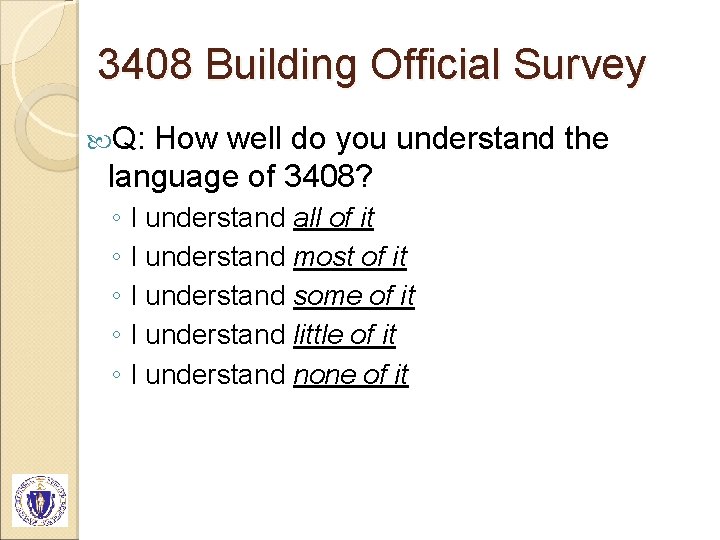
3408 Building Official Survey Q: How well do you understand the language of 3408? ◦ I understand all of it ◦ I understand most of it ◦ I understand some of it ◦ I understand little of it ◦ I understand none of it
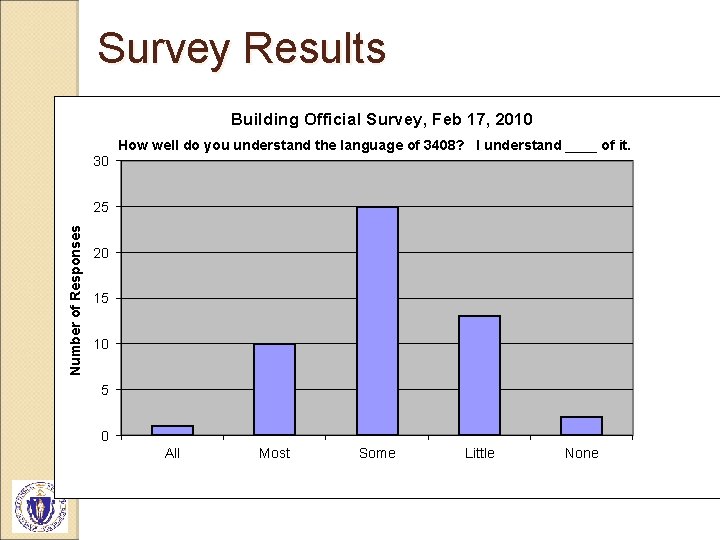
Survey Results Building Official Survey, Feb 17, 2010 How well do you understand the language of 3408? I understand ____ of it. 30 Number of Responses 25 20 15 10 5 0 All Most Some Little None
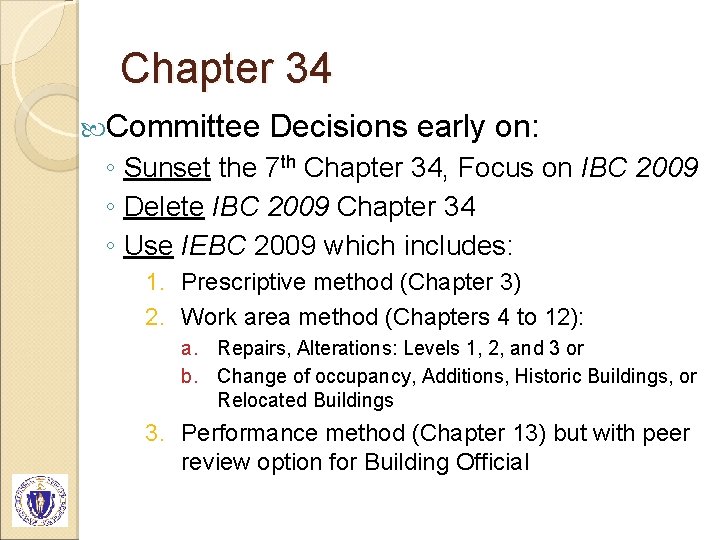
Chapter 34 Committee Decisions early on: ◦ Sunset the 7 th Chapter 34, Focus on IBC 2009 ◦ Delete IBC 2009 Chapter 34 ◦ Use IEBC 2009 which includes: 1. Prescriptive method (Chapter 3) 2. Work area method (Chapters 4 to 12): a. Repairs, Alterations: Levels 1, 2, and 3 or b. Change of occupancy, Additions, Historic Buildings, or Relocated Buildings 3. Performance method (Chapter 13) but with peer review option for Building Official
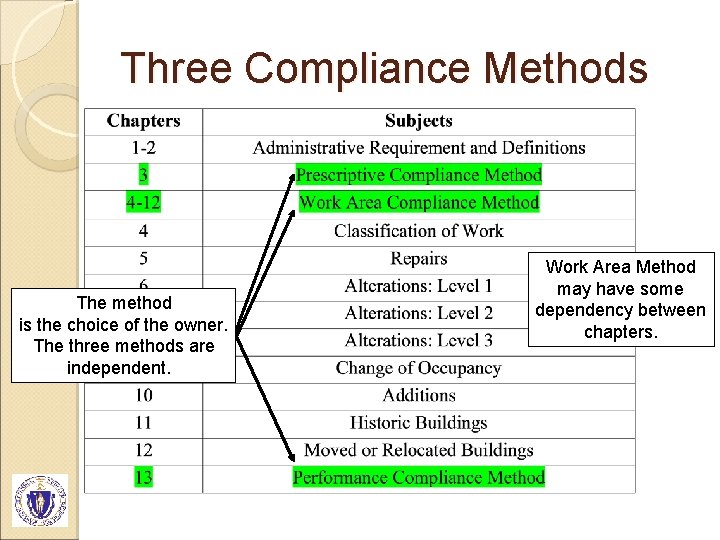
Three Compliance Methods The method is the choice of the owner. The three methods are independent. Work Area Method may have some dependency between chapters.
IEBC 2009: A Brief Overview The ‘Road Map’ of the ‘Work Area Method’ is Chapter 4: ◦ One page long! (see handout) ◦ Outlines ‘Classification of Work’ Repairs Alterations- Level 1 Alterations- Level 2 Alterations- Level 3 Change of Occupancy Additions Historic Buildings Relocated Buildings
Chapter 4: Classification of Work Repairs ◦ includes the patching or restoration or replacement of damaged materials, elements, equipment or fixtures for the purpose of maintaining such components in good or sound condition with respect to existing loads or performance requirements.
Chapter 4: Classification of Work Alterations- Level 1 ◦ include the removal and replacement or the covering of existing materials, elements, equipment, or fixtures using new materials, elements, equipment, or fixtures that serve the same purpose.
Chapter 4: Classification of Work Alterations- Level 2 ◦ includes the reconfiguration of space, the addition or elimination of any door or window, the reconfiguration or extension of any system, or the installation of any additional equipment.
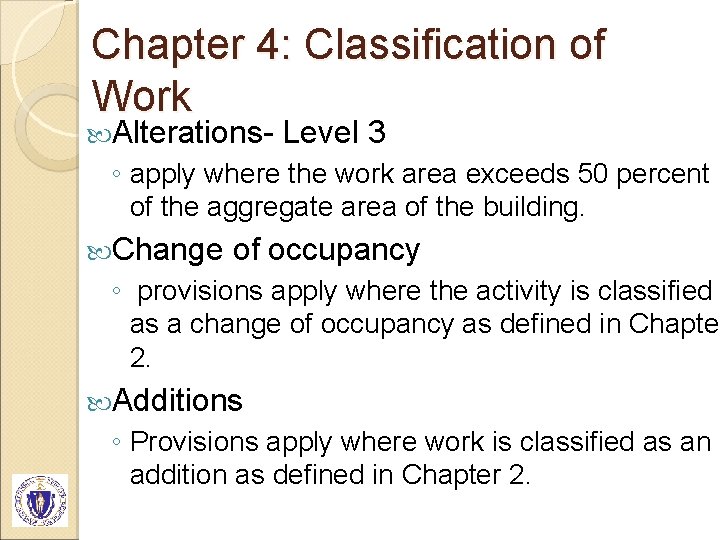
Chapter 4: Classification of Work Alterations- Level 3 ◦ apply where the work area exceeds 50 percent of the aggregate area of the building. Change of occupancy ◦ provisions apply where the activity is classified as a change of occupancy as defined in Chapter 2. Additions ◦ Provisions apply where work is classified as an addition as defined in Chapter 2.
Chapter 4: ‘the test’ Please put on your thinking caps. Let’s review 14 proposed projects ◦ Make clarifying assumptions if you need to ◦ Confer with your neighbor if you so choose ◦ Assign, with your best educated guess, a ‘class’ to each project; Alt 1, Alt 11, Rep, C of O, etc. ◦ You have 5 minutes!! Please keep in mind; ◦ There are no ‘wrong’ answers ◦ Will summarize class results and discuss
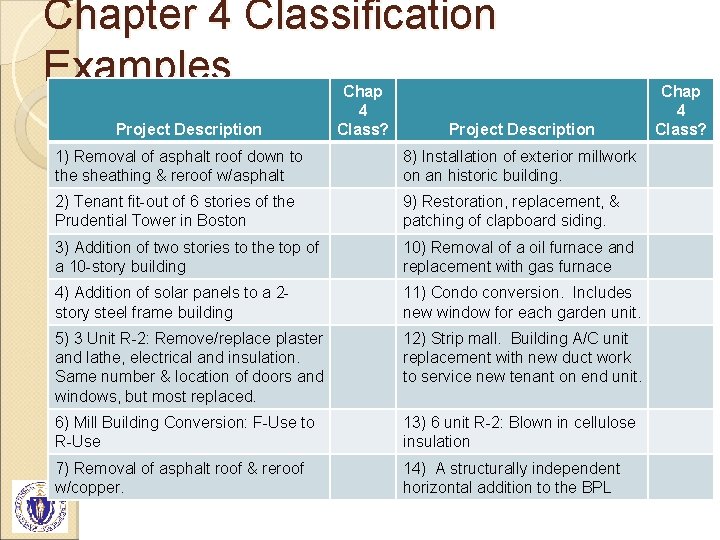
Chapter 4 Classification Examples Project Description Chap 4 Class? Project Description 1) Removal of asphalt roof down to the sheathing & reroof w/asphalt 8) Installation of exterior millwork on an historic building. 2) Tenant fit-out of 6 stories of the Prudential Tower in Boston 9) Restoration, replacement, & patching of clapboard siding. 3) Addition of two stories to the top of a 10 -story building 10) Removal of a oil furnace and replacement with gas furnace 4) Addition of solar panels to a 2 story steel frame building 11) Condo conversion. Includes new window for each garden unit. 5) 3 Unit R-2: Remove/replace plaster and lathe, electrical and insulation. Same number & location of doors and windows, but most replaced. 12) Strip mall. Building A/C unit replacement with new duct work to service new tenant on end unit. 6) Mill Building Conversion: F-Use to R-Use 13) 6 unit R-2: Blown in cellulose insulation 7) Removal of asphalt roof & reroof w/copper. 14) A structurally independent horizontal addition to the BPL Chap 4 Class?
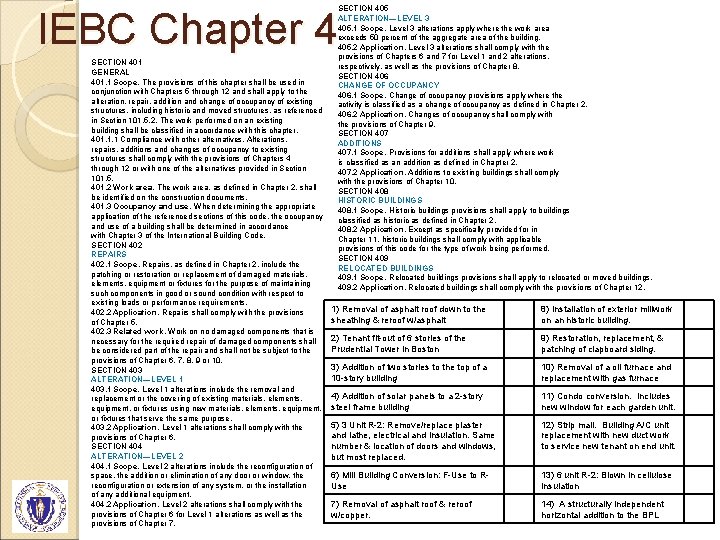
SECTION 405 ALTERATION—LEVEL 3 405. 1 Scope. Level 3 alterations apply where the work area exceeds 50 percent of the aggregate area of the building. 405. 2 Application. Level 3 alterations shall comply with the provisions of Chapters 6 and 7 for Level 1 and 2 alterations, respectively, as well as the provisions of Chapter 8. SECTION 406 CHANGE OF OCCUPANCY 406. 1 Scope. Change of occupancy provisions apply where the activity is classified as a change of occupancy as defined in Chapter 2. 406. 2 Application. Changes of occupancy shall comply with the provisions of Chapter 9. SECTION 407 ADDITIONS 407. 1 Scope. Provisions for additions shall apply where work is classified as an addition as defined in Chapter 2. 407. 2 Application. Additions to existing buildings shall comply with the provisions of Chapter 10. SECTION 408 HISTORIC BUILDINGS 408. 1 Scope. Historic buildings provisions shall apply to buildings classified as historic as defined in Chapter 2. 408. 2 Application. Except as specifically provided for in Chapter 11, historic buildings shall comply with applicable provisions of this code for the type of work being performed. SECTION 409 RELOCATED BUILDINGS 409. 1 Scope. Relocated buildings provisions shall apply to relocated or moved buildings. 409. 2 Application. Relocated buildings shall comply with the provisions of Chapter 12. IEBC Chapter 4 SECTION 401 GENERAL 401. 1 Scope. The provisions of this chapter shall be used in conjunction with Chapters 5 through 12 and shall apply to the alteration, repair, addition and change of occupancy of existing structures, including historic and moved structures, as referenced in Section 101. 5. 2. The work performed on an existing building shall be classified in accordance with this chapter. 401. 1. 1 Compliance with other alternatives. Alterations, repairs, additions and changes of occupancy to existing structures shall comply with the provisions of Chapters 4 through 12 or with one of the alternatives provided in Section 101. 5. 401. 2 Work area. The work area, as defined in Chapter 2, shall be identified on the construction documents. 401. 3 Occupancy and use. When determining the appropriate application of the referenced sections of this code, the occupancy and use of a building shall be determined in accordance with Chapter 3 of the International Building Code. SECTION 402 REPAIRS 402. 1 Scope. Repairs, as defined in Chapter 2, include the patching or restoration or replacement of damaged materials, elements, equipment or fixtures for the purpose of maintaining such components in good or sound condition with respect to existing loads or performance requirements. 402. 2 Application. Repairs shall comply with the provisions of Chapter 5. 402. 3 Related work. Work on no damaged components that is necessary for the required repair of damaged components shall be considered part of the repair and shall not be subject to the provisions of Chapter 6, 7, 8, 9 or 10. SECTION 403 ALTERATION—LEVEL 1 403. 1 Scope. Level 1 alterations include the removal and replacement or the covering of existing materials, elements, equipment, or fixtures using new materials, elements, equipment, or fixtures that serve the same purpose. 403. 2 Application. Level 1 alterations shall comply with the provisions of Chapter 6. SECTION 404 ALTERATION—LEVEL 2 404. 1 Scope. Level 2 alterations include the reconfiguration of space, the addition or elimination of any door or window, the reconfiguration or extension of any system, or the installation of any additional equipment. 404. 2 Application. Level 2 alterations shall comply with the provisions of Chapter 6 for Level 1 alterations as well as the provisions of Chapter 7. 1) Removal of asphalt roof down to the sheathing & reroof w/asphalt 8) Installation of exterior millwork on an historic building. 2) Tenant fit-out of 6 stories of the Prudential Tower in Boston 9) Restoration, replacement, & patching of clapboard siding. 3) Addition of two stories to the top of a 10 -story building 10) Removal of a oil furnace and replacement with gas furnace 4) Addition of solar panels to a 2 -story steel frame building 11) Condo conversion. Includes new window for each garden unit. 5) 3 Unit R-2: Remove/replace plaster and lathe, electrical and insulation. Same number & location of doors and windows, but most replaced. 12) Strip mall. Building A/C unit replacement with new duct work to service new tenant on end unit. 6) Mill Building Conversion: F-Use to RUse 13) 6 unit R-2: Blown in cellulose insulation 7) Removal of asphalt roof & reroof w/copper. 14) A structurally independent horizontal addition to the BPL
IEBC Fire Protection Requirements Key Provisions: ◦ Repairs & Alterations Level 1 shall be done in a manner that maintains the level of fire protection provided. ◦ Buildings undergoing Major Alterations (per M. G. L. C 148 § 26 G) may require automatic sprinkler systems. ◦ In general: The addition of Fire Protection systems pertains to the area being worked. When systems are added the requirements are found in Chapter 9 of the IBC (with MA amendments)
IEBC Fire Protection Requirements Section References: Repairs & Alterations Level 1, etc. (503. 1, 603. 1, ) shall be done in a manner that maintains the level of fire protection provided. Major Alterations (503. 2, 603. 2, 704. 1. 2, 804. 1): Automatic sprinkler systems may be required in building undergoing major alterations per section 102. 2. 1. 1. Scope (704. 1): The requirements of this section shall be limited to work areas in which Level 2 alterations are being performed, and where specified they shall apply throughout the floor on which the work areas are located or otherwise beyond the work area. Corridor ratings (704. 1. 1): Where an approved automatic sprinkler system is installed throughout the story, the required fire-resistance rating for any corridor located on the story shall be permitted to be reduced in accordance with the IBC. In order to be considered for a corridor rating reduction, such system shall provide coverage for the stairwell landings serving the floor and the intermediate landings immediately below. Automatic sprinkler systems (704. 2): Automatic sprinkler systems shall be provided in accordance with the requirements of Sections 704. 2. 1 through 704. 2. 5. Installation requirements shall be in accordance with the IBC. ◦ ◦ 704. 2. 1 -High Rises, 704. 2. 2 -A, B, E, F, etc. and mixed uses, (MA amendment exception pertains to R-2 of three units) 704. 2. 3 - Windowless stories, 704. 2. 4 - Other suppression systems,
IEBC Fire Protection Requirements Section References: Standpipes (704. 3): Where the work area includes exits or corridors shared by more than one tenant and is located more than 50’ above or below the lowest level of fire department access, a standpipe system shall be provided. Standpipes shall have an approved fire department connection with hose connections at each floor level above or below the lowest level of fire department access. Standpipe systems shall be installed in accordance with the IBC. (This section includes 2 exceptions) Fire alarm and detection (704. 4): An approved fire alarm system shall be installed in accordance with Sections 704. 4. 1 through 704. 4. 3. Where automatic sprinkler protection is provided in accordance with Section 704. 2 and is connected to the building fire alarm system, automatic heat detection shall not be required. An approved automatic fire detection system shall be installed in accordance with the provisions of this code and NFPA 72. Devices, combinations of devices, appliances, and equipment shall be approved. The automatic fire detectors shall be smoke detectors, except that an approved alternative type of detector shall be installed in spaces such as boiler rooms, where products of combustion are present during normal operation in sufficient quantity to actuate a smoke detector. ◦ ◦ ◦ 704. 4. 1 - Occupancy requirements 704. 4. 2 - Supplemental fire alarm system requirements. 704. 4. 3 - Smoke alarms
IEBC Fire Protection Requirements Section References: Automatic sprinkler systems (804. 1): Automatic sprinkler systems shall be provided in all work areas when required by Section 704. 2 or this section. ◦ ◦ 804. 1. 1 - High-rise buildings 804. 1. 2 - Rubbish and linen chutes - Fire alarm and detection systems (804. 2): Fire alarm and detection systems complying with Sections 704. 4. 1 and 704. 4. 3 shall be provided throughout the building in accordance with the IBC. ◦ ◦ 804. 2. 1 - Manual fire alarm systems (MA amendment deletes Exception 2) 804. 2. 2 - Automatic fire detection
IEBC Key ‘Structural’ Amendments th th 6 and 7 edition ‘Essential Elements’ brought forward ◦ Investigation and Evaluation (101. 5. 4. 0) Required for ‘Construction Control’ projects ◦ Table of ‘Basic Seismic Force Resisting Systems’(101. 5. 4. 1) ◦ Reduced level of seismic forces permitted for certain projects (101. 5. 4. 2) Modified ‘reduced seismic level force’ requirement to be consistent with the 6 th edition. (IEBC is a fixed 75%)
IEBC Key ‘Structural’ Amendments(cont. ) Added ‘cumulative effects of alterations since original construction’ (various locations) ◦ Inserted a list of triggers to allow minor alterations to proceed with no or minimal structural analysis. (101. 9) Added a requirement for anchorage of unreinforced masonry (101. 10)
IEBC Key ‘Structural’ Amendments(cont. ) Modified parapet bracing requirement to include Seismic zones B and C. (606. 3. 1) ◦ Note that IEBC requires this work only when reroofing is done. ◦ Exception for low height to thickness ratios Relief provided on structural triggers on reroofing (606. 3. 2) ◦ Raised trigger to >105 mph (was > 90 mph) Note this will include much of greater Boston ◦ Only in cases of complete reroofing (was >50%)
IEBC Key ‘Structural’ Amendments(cont. ) Relief provided on vertical additions. IEBC requires compliance to ‘full seismic’. (1003. 3. 1) ◦ Amendment allows for ‘reduced seismic’ ◦ However, no relief on horizontal additions Modified ‘Appendix A 1’ to assign prescribed values of certain masonry properties without testing. ( appendix A 1) IEBC wind loads requirements not changed.
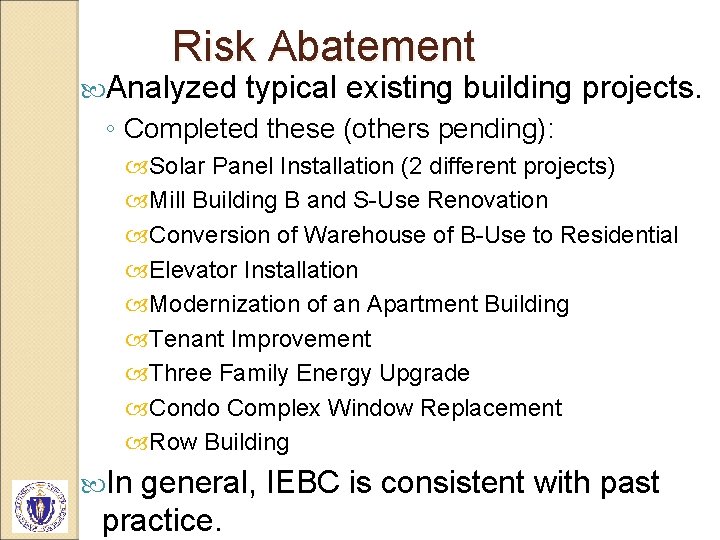
Risk Abatement Analyzed typical existing building projects. ◦ Completed these (others pending): Solar Panel Installation (2 different projects) Mill Building B and S-Use Renovation Conversion of Warehouse of B-Use to Residential Elevator Installation Modernization of an Apartment Building Tenant Improvement Three Family Energy Upgrade Condo Complex Window Replacement Row Building In general, IEBC is consistent with past practice.
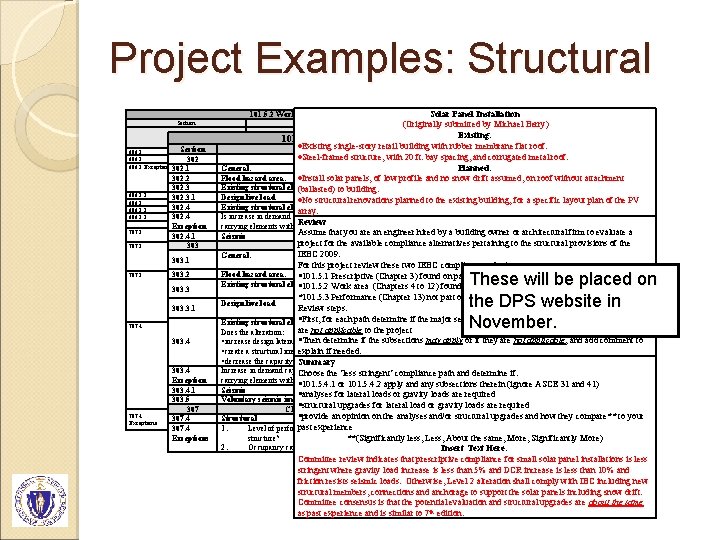
Project Examples: Structural Solar Panel Installation M/Asubmitted or N/A and comments (Originally by Michael Berry) N/A since it is new equipment Existing: ALTERATIONS LEVEL 1 STRUCTURAL and not existing equipment that is 101. 5. 1 Prescriptive Compliance Method Existing. Title single-story retail buildingreplaced. with rubber membrane flatcomments roof. M/A or N/A and General N/A Steel-framed structure, of with 20 ft. bay spacing, corrugated metal Addition or replacement of roofing or replacement equipment N/A, not a replacement ADDITIONS N/A, and no change in floor area roof. Dead load increase < 5%? N/A Planned: General. 1. N/A 2. Conventional light-frame construction and dead load Flood hazard area. N/A drift assumed, on roof without attachment Install solar panels, of low profile and no snow increase < 5%? Second layer of roofing < to 3 psf? Existing 3. structural elements carrying gravity loads. N/A (ballasted) building. Wallload anchors for concrete and masonry buildings N/A Design live N/A building, for a specific layout plan of the PV No structural renovations planned to the existing Additional requirements for reroof permits N/A Existing. Bracing structural elementsmasonry lateral load N/A for unreinforced bearing wall parapets N/A array. carrying Roof resisting wind in high-wind regionslateral load. N/A Is increase indiaphragms demand capacity ratioloads (DCR) of existing Reviewconsidered 2 STRUCTURAL M/A carrying elements. ALTERATIONS with addition LEVEL < 10%? General M/A, by installation of additional Assume that you are an engineer hired a building Seismic N/Apanels) owner or architectural firm to evaluate a equipment (solar project for the available compliance alternatives pertaining to the structural provisions of the New structural members M/A, where new structural ALTERATIONS M/A members, including connections to existing IEBC 2009. General. N/A, alteration and anchorage are required to building no less conforming For this project review these two IEBC compliance support the solar panels paths*: Minimum design loads M/A, inon thispage case Flood hazard area. N/Athe 2 load from 101. 5. 1 Prescriptive (Chapter 3) found the PV array M/A, may be where within the Existing structural elements carrying loads. 101. 5. 2 Workgravity area (Chapters 4 to 12) found on pages 3 gravity and 4 load increase original design loads, for example exceeds 5% existing gravity load if the original roof structure has *101. 5. 3 Performance (Chapter 13) not part of this review. significant capacity. This should Design live load N/A, solar panels do not alter Review steps: be checked for each project. existing structure capacity First, carrying for eachlateral path determine if the major sections (302, 303, 307, 606, 607, etc. ) may apply or Existing structural elements carrying gravity load M/A, If solar. N/A, panels solar do not panels do not alter are not applicable to the project Does the alteration: existing capacity reduce existing capacity, structure that is there will be no or cut outs for are not applicable, and add comment to Thenordetermine if the subsections may apply if they increase design lateral loads electrical conduit etc. then this create a structural irregularity explainorif needed. section may be N/A. If additional decrease the capacity? Summary gravity load is applied as a result alteration (including snow Increase in demand capacity ratiothe (DCR) existing lateral load-of thepath M/A, where DCR increase Choose ‘lessofstringent’ compliance and determine drift) then both exceptions must if: carrying elements with addition considered < 10%? exceeds 10% be checked to see if they are N/A (ignore ASCE 31 and 41) 101. 5. 4. 1 or 101. 5. 4. 2 apply and any subsections therein and if so then. M/A IBC requirements Seismic if friction resists seismic analyses for lateral loads or gravitymust loads are required be met for the existing Voluntary seismic improvements N/A member. structural upgrades for lateral load or gravity loads are required CHANGE OF OCCUPANCY N/A 1. Stress increase < 5%? Exception M/A if stress increase provide an opinion on thelight-frame analysesisand/or structural upgrades and how they compare** to your N/A Structural 2. Group R? Less than 6 units? And conventional ≤ 5% past experience 1. Level of construction? performance and seismic safety equivalent to a new N/A **(Significantly less, Less, About the same, More, Significantly More) structure? 2. Occupancy category I or II to III and SDS< 0. 33? Insert Text Here: Committee review indicates that prescriptive compliance for small solar panel installations is less stringent where gravity load increase is less than 5% and DCR increase is less than 10% and friction resists seismic loads. Otherwise, Level 2 alteration shall comply with IBC including new structural members, connections and anchorage to support the solar panels including snow drift. Committee consensus is that the potential evaluation and structural upgrades are about the same as past experience and is similar to 7 th edition. 101. 5. 2 Work Area Compliance Method Section 606. 1 606. 2 302 606. 2 Exceptions 302. 1 302. 2 302. 3 606. 2. 1 302. 3. 1 606. 3 302. 4 606. 3. 1 606. 3. 2 302. 4 707 Exception 707. 1 302. 4. 1 707. 2 303. 1 707. 3 303. 2 303. 3. 1 707. 4 303. 4 707. 4 Exceptions 303. 4 Exception 303. 4. 1 303. 5 307. 4 Exceptions Title These will be placed on the DPS website in November.
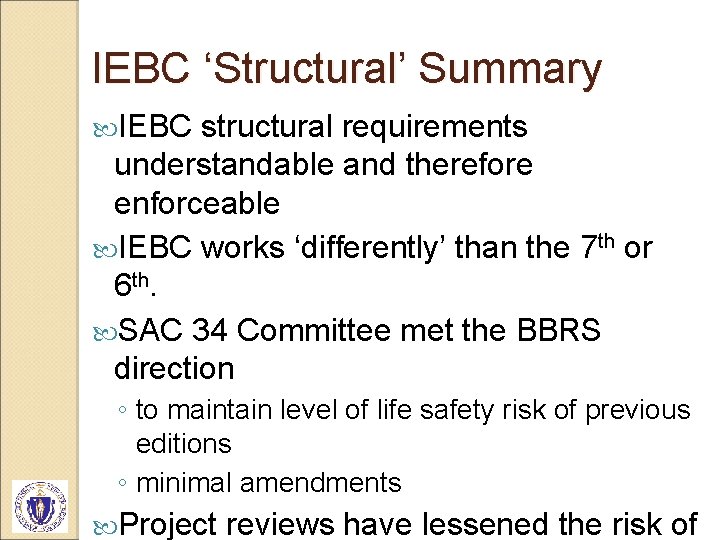
IEBC ‘Structural’ Summary IEBC structural requirements understandable and therefore enforceable IEBC works ‘differently’ than the 7 th or 6 th. SAC 34 Committee met the BBRS direction ◦ to maintain level of life safety risk of previous editions ◦ minimal amendments Project reviews have lessened the risk of
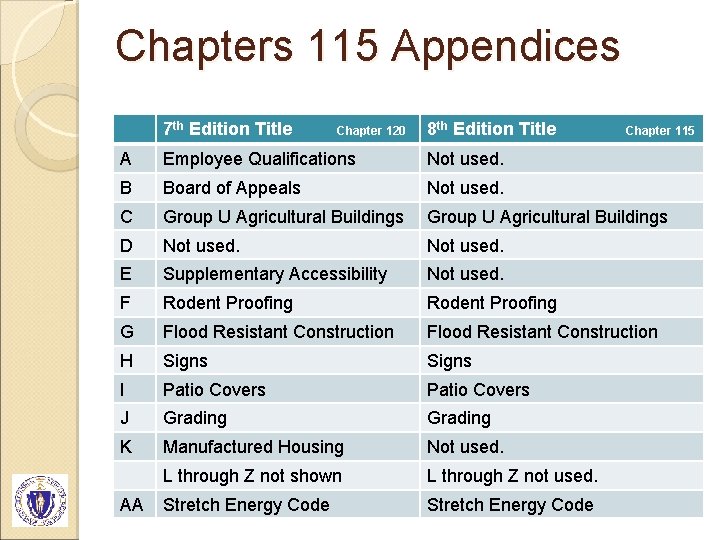
Chapters 115 Appendices 7 th Edition Title Chapter 120 8 th Edition Title Chapter 115 A Employee Qualifications Not used. B Board of Appeals Not used. C Group U Agricultural Buildings D Not used. E Supplementary Accessibility Not used. F Rodent Proofing G Flood Resistant Construction H Signs I Patio Covers J Grading K Manufactured Housing Not used. L through Z not shown L through Z not used. Stretch Energy Code AA
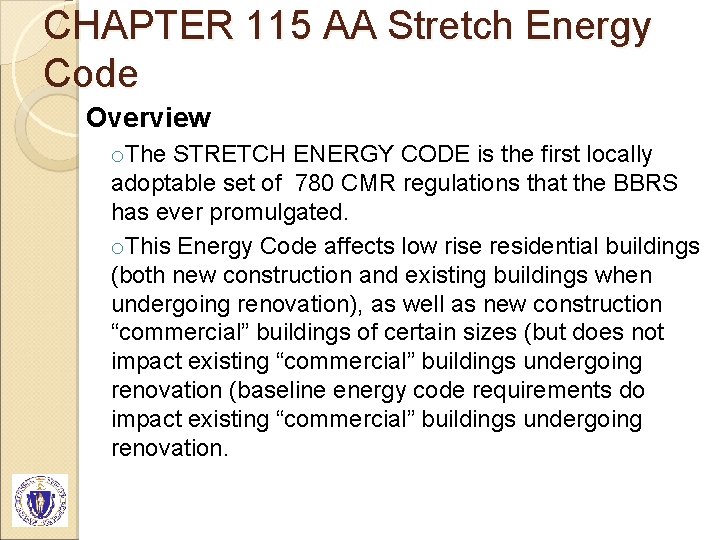
CHAPTER 115 AA Stretch Energy Code Overview o. The STRETCH ENERGY CODE is the first locally adoptable set of 780 CMR regulations that the BBRS has ever promulgated. o. This Energy Code affects low rise residential buildings (both new construction and existing buildings when undergoing renovation), as well as new construction “commercial” buildings of certain sizes (but does not impact existing “commercial” buildings undergoing renovation (baseline energy code requirements do impact existing “commercial” buildings undergoing renovation.
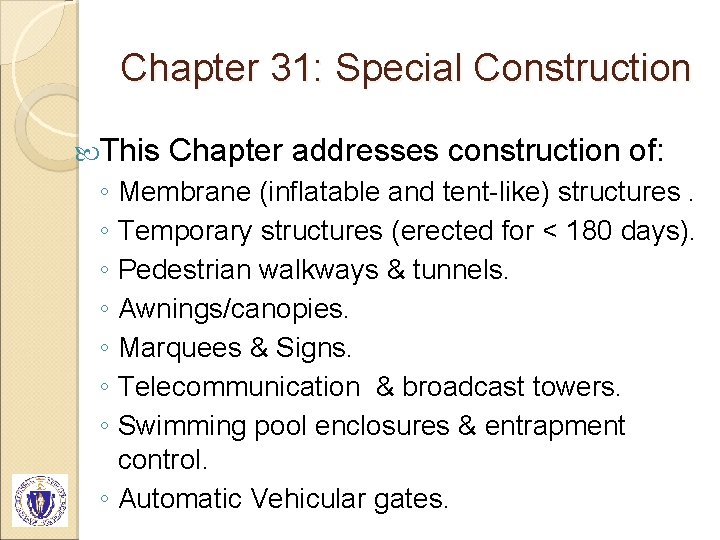
Chapter 31: Special Construction This Chapter addresses construction of: ◦ Membrane (inflatable and tent-like) structures. ◦ Temporary structures (erected for < 180 days). ◦ Pedestrian walkways & tunnels. ◦ Awnings/canopies. ◦ Marquees & Signs. ◦ Telecommunication & broadcast towers. ◦ Swimming pool enclosures & entrapment control. ◦ Automatic Vehicular gates.
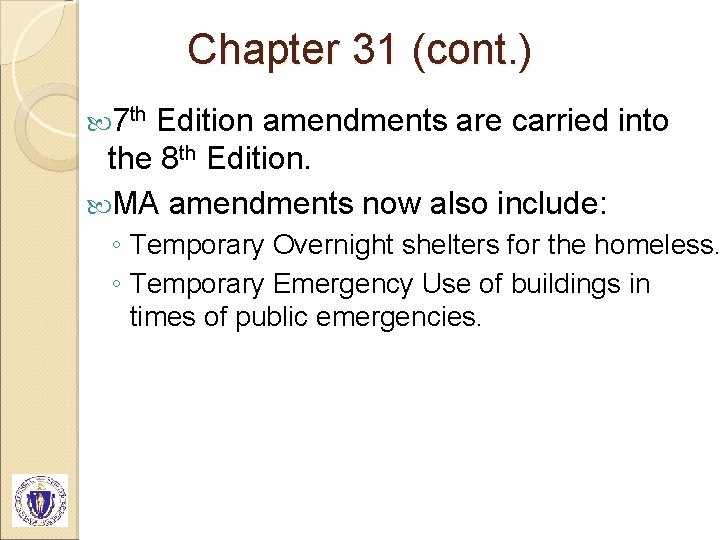
Chapter 31 (cont. ) 7 th Edition amendments are carried into the 8 th Edition. MA amendments now also include: ◦ Temporary Overnight shelters for the homeless. ◦ Temporary Emergency Use of buildings in times of public emergencies.
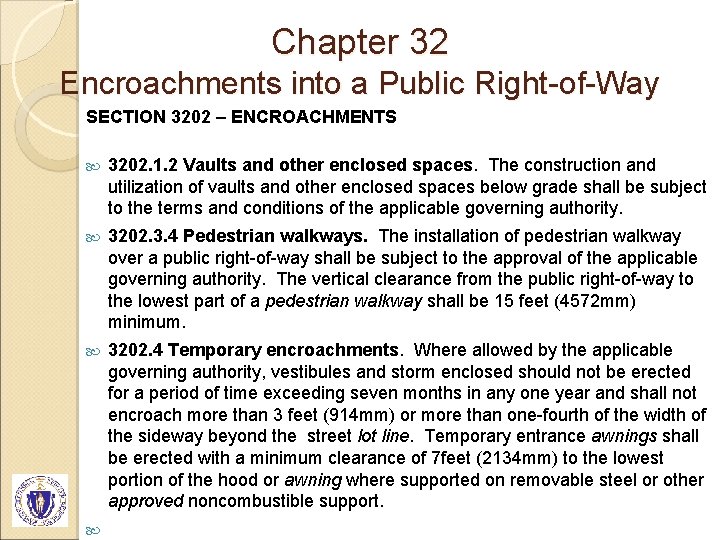
Chapter 32 Encroachments into a Public Right-of-Way SECTION 3202 – ENCROACHMENTS 3202. 1. 2 Vaults and other enclosed spaces. The construction and utilization of vaults and other enclosed spaces below grade shall be subject to the terms and conditions of the applicable governing authority. 3202. 3. 4 Pedestrian walkways. The installation of pedestrian walkway over a public right-of-way shall be subject to the approval of the applicable governing authority. The vertical clearance from the public right-of-way to the lowest part of a pedestrian walkway shall be 15 feet (4572 mm) minimum. 3202. 4 Temporary encroachments. Where allowed by the applicable governing authority, vestibules and storm enclosed should not be erected for a period of time exceeding seven months in any one year and shall not encroach more than 3 feet (914 mm) or more than one-fourth of the width of the sideway beyond the street lot line. Temporary entrance awnings shall be erected with a minimum clearance of 7 feet (2134 mm) to the lowest portion of the hood or awning where supported on removable steel or other approved noncombustible support.
Chapter 33 Safeguards During Construction SECTION 3308 TEMPORARY USE OF STREETS, ALLEYS AND PUBLIC PROPERTY 3308. 1 Storage and handling of materials. The temporary use of streets or public property for the storage or handling of materials or of equipment required for construction or demolition, and the protection provided to the public shall comply with the provisions of the applicable governing authority and this chapter.
Chapter 33 Safeguards During Construction SECTION 3310 MEANS OF EGRESS 3310. 1 Stairways required. Where a building has been constructed to a building height of 50 feet (15 240 mm) or four stories, or where and existing building exceeding 50 feet (15 240 mm)in building height is altered, at least one temporary lighted stairway shall be provided unless one or more of the permanent Stairways are erected as the construction progresses. 3310. 2 Maintenance of means of egress. Required means of egress shall be maintained at all times during construction, demolition, remodeling or alterations and additions to any building. Exception: Approved temporary means of egress systems and facilities.
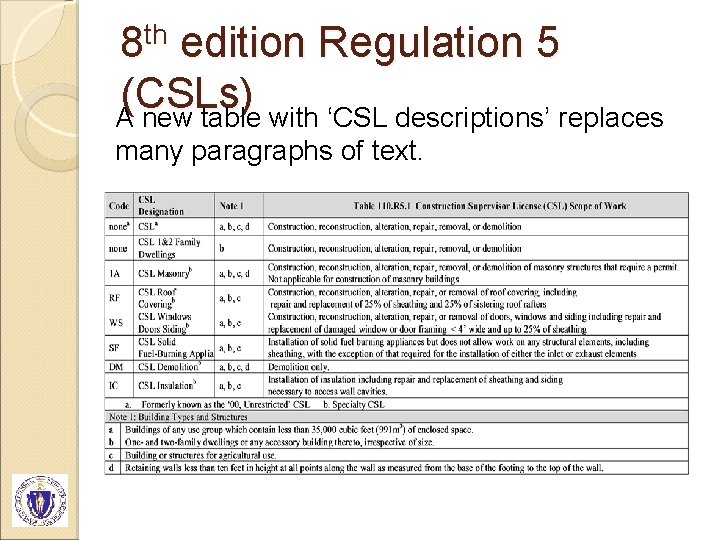
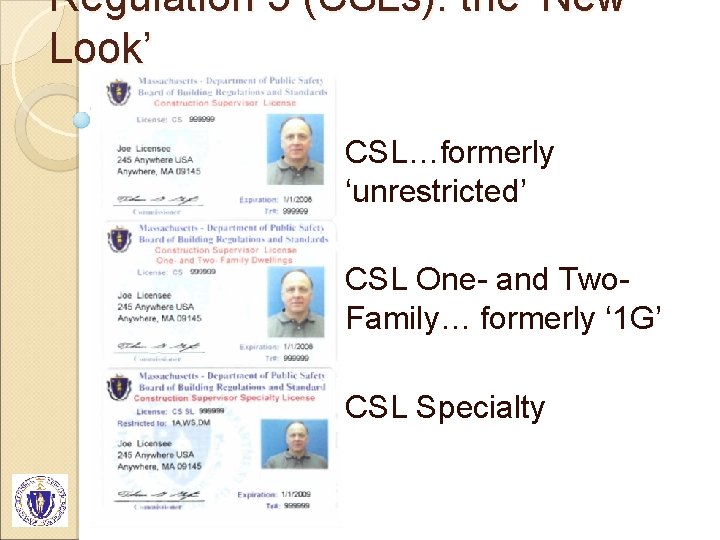
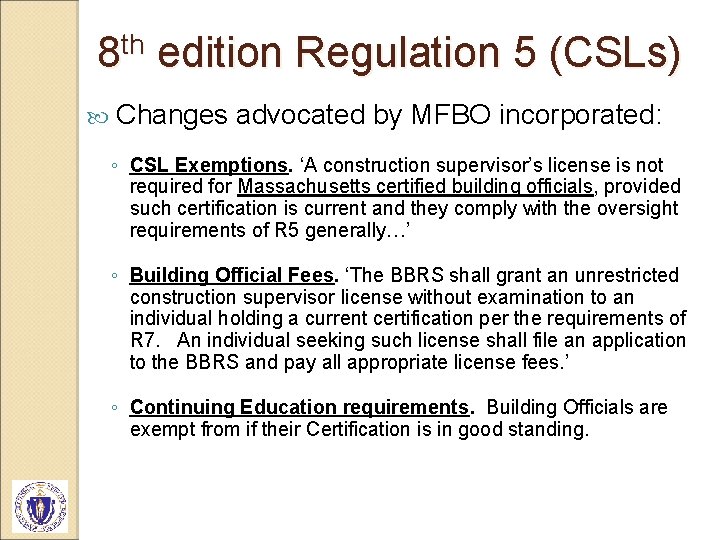
8 th Edition Special Regs 1 to 7 R 1: Concrete Test Labs…only cleaned up R 2: Concrete Test Techs…only cleaned up R 3: Manuf. Buildings…no change R 4: Native Lumber…only cleaned up R 5: ◦ Cleaned up ◦ Continuing Education incorporated (per M. G. L. ) ◦ Building Officials may obtain a CSL by paying fee use their BO certification to pull a permit
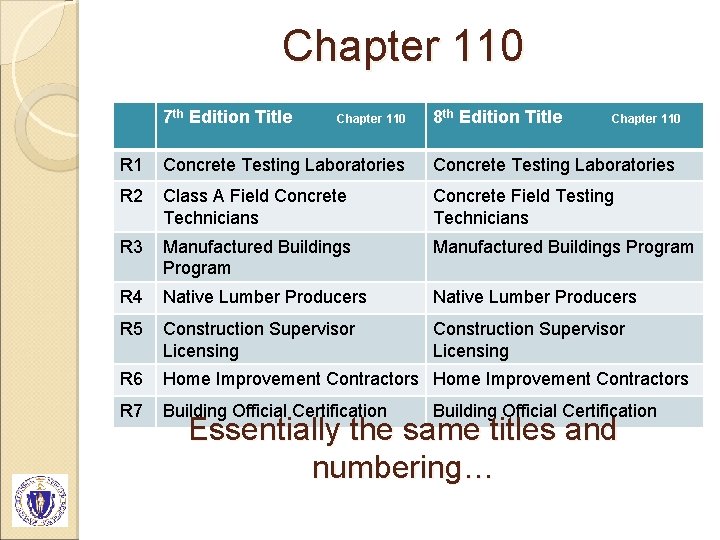
Chapter 110 7 th Edition Title Chapter 110 8 th Edition Title Chapter 110 R 1 Concrete Testing Laboratories R 2 Class A Field Concrete Technicians Concrete Field Testing Technicians R 3 Manufactured Buildings Program R 4 Native Lumber Producers R 5 Construction Supervisor Licensing R 6 Home Improvement Contractors R 7 Building Official Certification Essentially the same titles and numbering…
R 1 - Concrete Test Labs Clean-up American Society of Testing and Materials Standard E 329 advances to the 2007 version. The Seventh and earlier editions of the code reference 1972 version.
R 1 - Concrete Test Labs A proprietorship, corporation, partnership or agency which conforms to the requirements of ASTM E 329. Standard Specification for Agencies Engaged in Construction Inspection and/or Testing - This specification defines the minimum requirements for inspection agency personnel or testing agency laboratory personnel, or both, and the minimum technical requirements for equipment and procedures utilized in the testing and inspection of construction. . .
R 2 – Concrete Field Testing Technicians Cleaned-up Previously referred to as a Class A Field Concrete Technicians License. Test offered by Massachusetts Construction Industry Board (MCIB). Now it’s called a Concrete Field Testing Technicians License.
R 2 – Concrete Field Testing Technicians License Acquired through the American Concrete Institute (ACI). Must have a Grade 1 License. Definition A Concrete Field Testing Technician - Grade I is an individual who has demonstrated the knowledge and ability to properly perform and record the results of seven basic field tests on freshly mixed concrete.
R 2 – Concrete Field Testing Technicians The program requires a working knowledge of the following ASTM Standards: C 1064 Temperature of Freshly Mixed Portland-Cement Concrete C 172 Sampling Freshly Mixed Concrete C 143 Slump of Hydraulic Cement Concrete C 138 Unit Weight, Yield, and Air Content (Gravimetric) of Concrete C 231 Air Content of Freshly Mixed Concrete by the Pressure Method C 173 Air Content of Freshly Mixed Concrete by the Volumetric Method C 31 Making and Curing Concrete Test Specimens in the Field http: //www. concrete. org/general/home. asp
R 3 – Manufactured Buildings Program There are no changes to the Seventh Edition Regulations at this time. However, there is an on-going review of the regulation by: ◦ DPS ◦ BBRS ◦ DFS, and ◦ DPL Significant program changes are expected sometime during the coming year.
R 3 – Manufactured Buildings Program Steve Kennealy ◦ Manufactured Buildings Program Director Linda Shea ◦ Program Assistant 1380 Bay Street Taunton, MA 02780 508 880 -4930
R 4 – Native Lumber Producers Cleaned up. Native lumber is wood processed in the Commonwealth of Massachusetts by a mill registered in accordance with the regulations of the BBRS. Such wood is ungraded but is stamped or certified in accordance with the requirements of the Code, 780 CMR. For the purpose this definition, native lumber shall be restricted to use in one-and two-story dwellings, barns, sheds, agricultural and accessory buildings and structures and other uses as permitted by the code.

R 4 – Native Lumber Producers For information about the Native Lumber Program contact: ◦ Ms. Bonnie Davis, Program Coordinator Department of Public Safety Mc. Cormack State Office Building One Ashburton Place – Room 1301 Boston, MA 02108 ◦ Phone 617 -826 -5208 Fax 617 -227 -1754 ◦ E-Mail Bonnie. Davis@state. ma. us
th 8 edition Regulation 5 (CSLs) A new table with ‘CSL descriptions’ replaces many paragraphs of text.
Regulation 5 (CSLs): the ‘New Look’ CSL…formerly ‘unrestricted’ CSL One- and Two. Family… formerly ‘ 1 G’ CSL Specialty
8 th edition Regulation 5 (CSLs) Changes advocated by MFBO incorporated: ◦ CSL Exemptions. ‘A construction supervisor’s license is not required for Massachusetts certified building officials, provided such certification is current and they comply with the oversight requirements of R 5 generally…’ ◦ Building Official Fees. ‘The BBRS shall grant an unrestricted construction supervisor license without examination to an individual holding a current certification per the requirements of R 7. An individual seeking such license shall file an application to the BBRS and pay all appropriate license fees. ’ ◦ Continuing Education requirements. Building Officials are exempt from if their Certification is in good standing.
8 th edition Regulation 5 (CSLs) Continuing Education requirements Licensed construction supervisors must acquire a certain number of continuing education hours each 2 year renewal period based upon license category as identified below. Unrestricted Construction Supervisors License 12 Hours Restricted Construction Supervisors License 10 Hours Specialty Construction Supervisors License 6 Hours Masonry Roofing Windows / Siding Demolition Burning Fuel
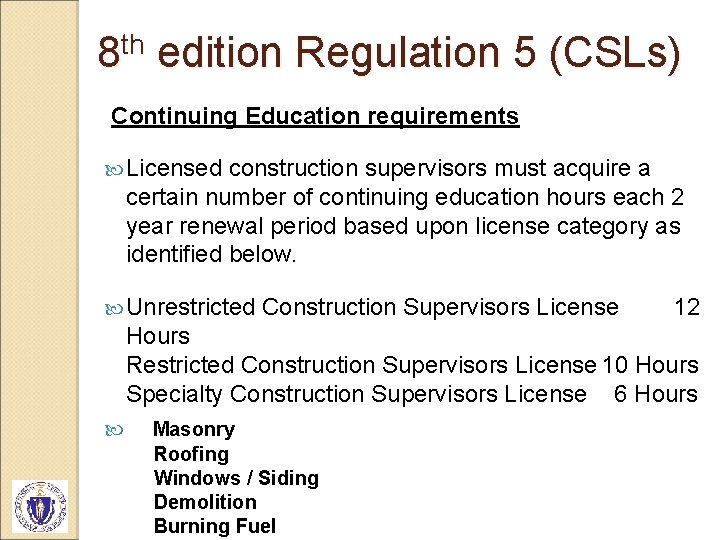
8 th edition Regulation 5 (CSLs) Continuing Education requirements Courses, instructors and course coordinators are required to be approved by the BBRS in order to convene continuing education classes. A licensee will have a host of methods available to choose from to achieve compliance. A local technical college, for example, may apply for and receive approval to act as a course coordinator, then provide varied courses presented by instructors approved by the program regulations as part of their ongoing continuing education program. Home builder associations may also apply for and receive approval as a coordinator and then hire approved instructors to present material as part of their regular monthly meetings as a service to their membership. This is just a taste of what is intended by the proposed
8 th edition Regulation 6 (HIC) HOME IMPROVEMENT CONTRACTOR PROGRAM For information including but not limited to registrations, renewals, and filing of complaints against a home improvement contractor (HIC), please contact the Office of Consumer Affairs and Business Regulation, which now administers this program. Also see M. G. L. c. 142 A for statutory requirements pertaining to HIC. Please note that licensing of construction supervisors per 780 CMR 110. R 5 is administered by the Department of Public Safety. The requirements of what is needed, a license or HIC registration, or both, to perform building construction, remains unchanged with 780 CMR, eighth edition. Office of Consumer Affairs Website: www. mass. gov/oca
8 th edition Regulation 7 (BOCC*) 7 th Edition Language Cleaned up. MFBO advocated for a ‘higher standard’ for conditional appointments. BBRS approved this language: ◦ Any individual conditionally appointed as an inspector of buildings/building commissioner shall first be certified as a local inspector. ◦ Energy training is required on a three year cycle…as if you haven’t had enough of it already!! (*BOCC: Building Official Certification Committee)
8 th edition ‘What’s New? ’ Q and A
- Slides: 87