
8 Testing a Claim Lesson 8 2 Significance
- Slides: 14
8 Testing a Claim Lesson 8. 2 Significance Tests and Decision Making Statistics and Probability with Applications, 3 rd Edition Starnes & Tabor Bedford Freeman Worth Publishers
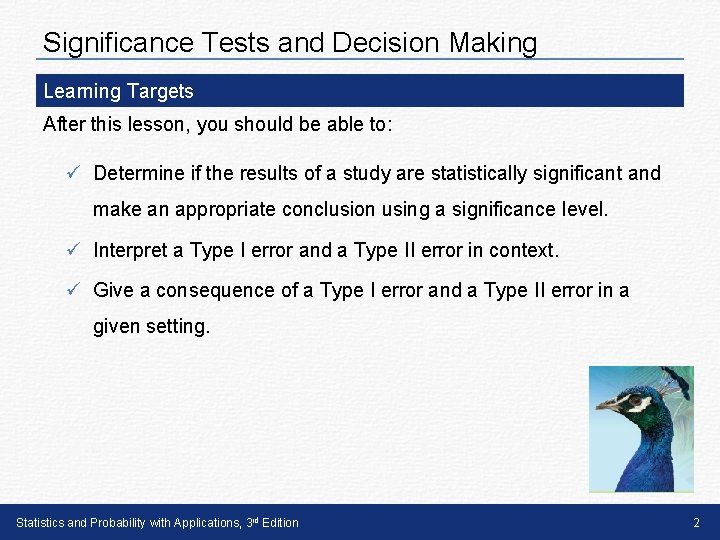
Significance Tests and Decision Making Learning Targets After this lesson, you should be able to: ü Determine if the results of a study are statistically significant and make an appropriate conclusion using a significance level. ü Interpret a Type I error and a Type II error in context. ü Give a consequence of a Type I error and a Type II error in a given setting. Statistics and Probability with Applications, 3 rd Edition 2
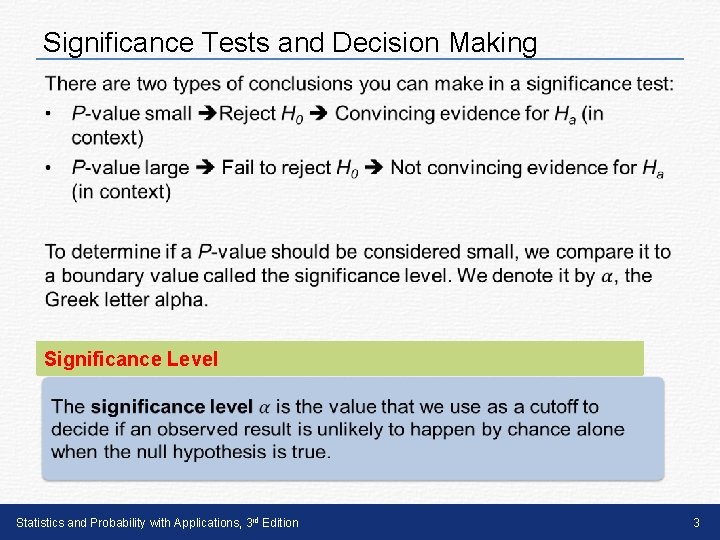
Significance Tests and Decision Making Significance Level Statistics and Probability with Applications, 3 rd Edition 3
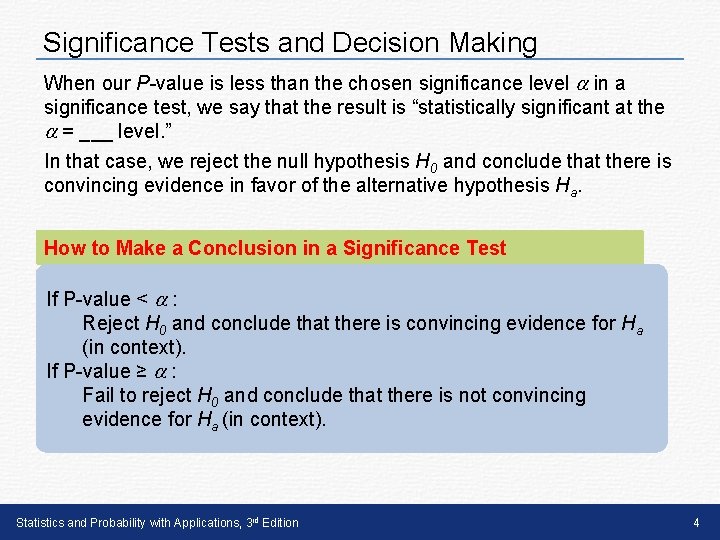
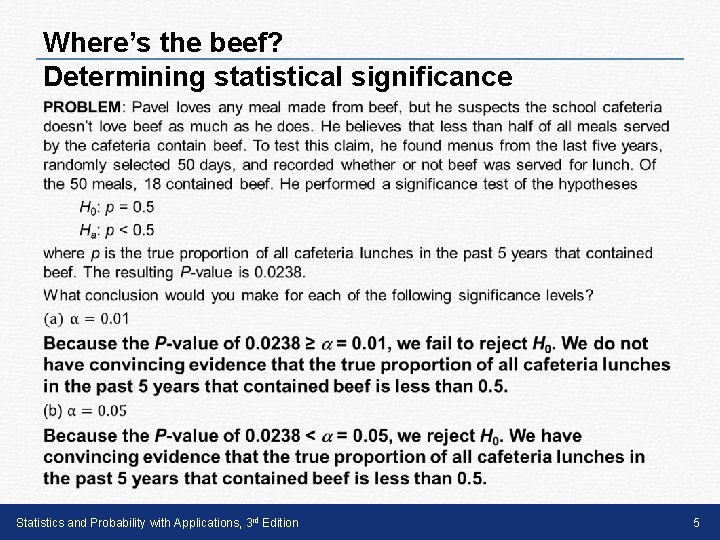
Significance Tests and Decision Making When our P-value is less than the chosen significance level in a significance test, we say that the result is “statistically significant at the = ___ level. ” In that case, we reject the null hypothesis H 0 and conclude that there is convincing evidence in favor of the alternative hypothesis Ha. How to Make a Conclusion in a Significance Test If P-value < : Reject H 0 and conclude that there is convincing evidence for Ha (in context). If P-value ≥ : Fail to reject H 0 and conclude that there is not convincing evidence for Ha (in context). Statistics and Probability with Applications, 3 rd Edition 4
Where’s the beef? Determining statistical significance • Statistics and Probability with Applications, 3 rd Edition 5
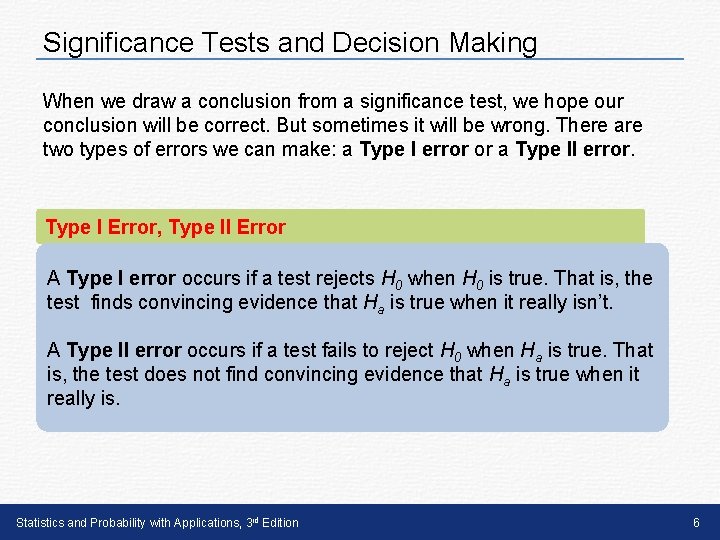
Significance Tests and Decision Making When we draw a conclusion from a significance test, we hope our conclusion will be correct. But sometimes it will be wrong. There are two types of errors we can make: a Type I error or a Type II error. Type I Error, Type II Error A Type I error occurs if a test rejects H 0 when H 0 is true. That is, the test finds convincing evidence that Ha is true when it really isn’t. A Type II error occurs if a test fails to reject H 0 when Ha is true. That is, the test does not find convincing evidence that Ha is true when it really is. Statistics and Probability with Applications, 3 rd Edition 6
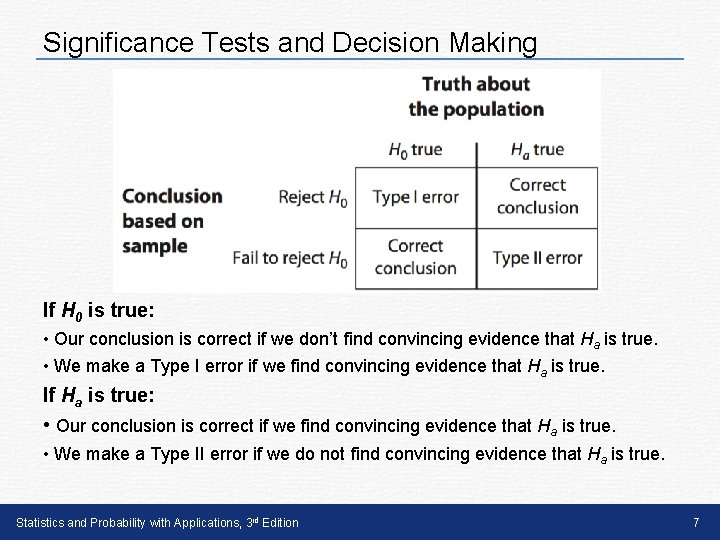
Significance Tests and Decision Making If H 0 is true: • Our conclusion is correct if we don’t find convincing evidence that Ha is true. • We make a Type I error if we find convincing evidence that Ha is true. If Ha is true: • Our conclusion is correct if we find convincing evidence that Ha is true. • We make a Type II error if we do not find convincing evidence that Ha is true. Statistics and Probability with Applications, 3 rd Edition 7
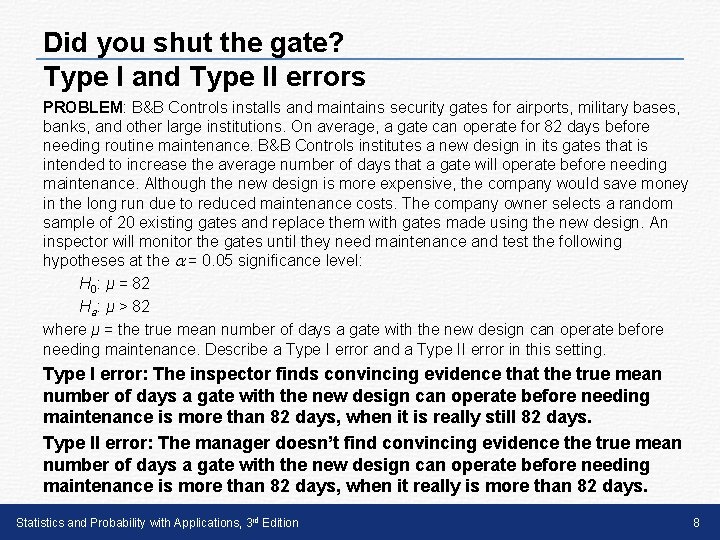
Did you shut the gate? Type I and Type II errors PROBLEM: B&B Controls installs and maintains security gates for airports, military bases, banks, and other large institutions. On average, a gate can operate for 82 days before needing routine maintenance. B&B Controls institutes a new design in its gates that is intended to increase the average number of days that a gate will operate before needing maintenance. Although the new design is more expensive, the company would save money in the long run due to reduced maintenance costs. The company owner selects a random sample of 20 existing gates and replace them with gates made using the new design. An inspector will monitor the gates until they need maintenance and test the following hypotheses at the = 0. 05 significance level: H 0: μ = 82 Ha: μ > 82 where μ = the true mean number of days a gate with the new design can operate before needing maintenance. Describe a Type I error and a Type II error in this setting. Type I error: The inspector finds convincing evidence that the true mean number of days a gate with the new design can operate before needing maintenance is more than 82 days, when it is really still 82 days. Type II error: The manager doesn’t find convincing evidence the true mean number of days a gate with the new design can operate before needing maintenance is more than 82 days, when it really is more than 82 days. Statistics and Probability with Applications, 3 rd Edition 8
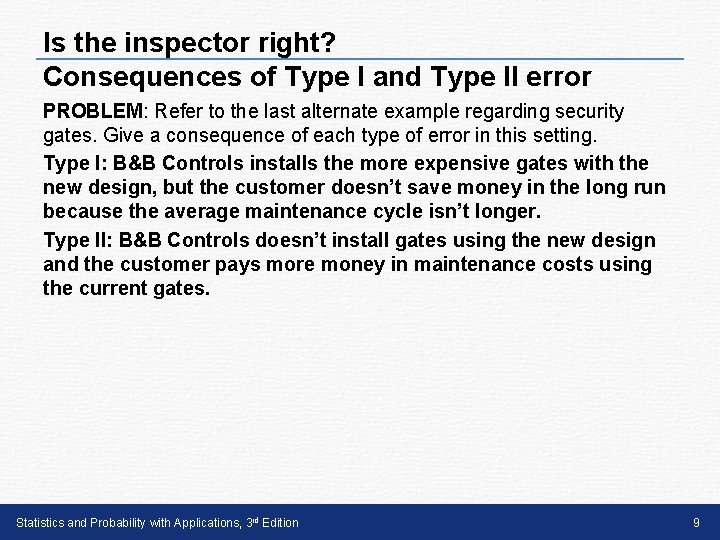
Is the inspector right? Consequences of Type I and Type II error PROBLEM: Refer to the last alternate example regarding security gates. Give a consequence of each type of error in this setting. Type I: B&B Controls installs the more expensive gates with the new design, but the customer doesn’t save money in the long run because the average maintenance cycle isn’t longer. Type II: B&B Controls doesn’t install gates using the new design and the customer pays more money in maintenance costs using the current gates. Statistics and Probability with Applications, 3 rd Edition 9
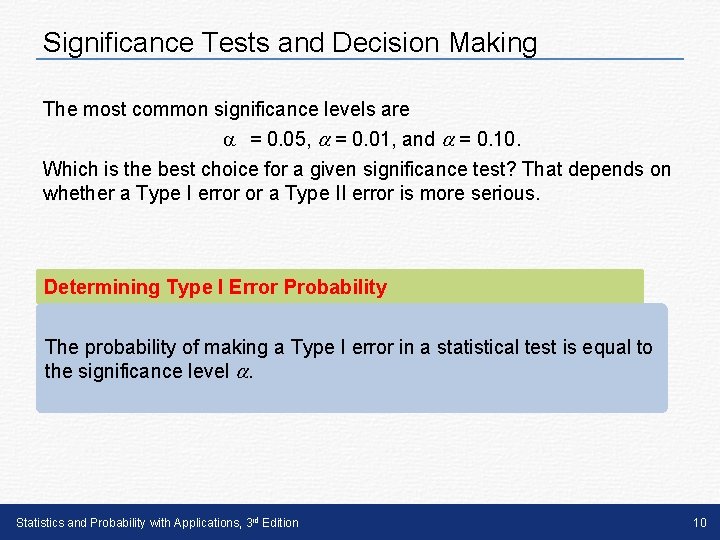
Significance Tests and Decision Making The most common significance levels are a = 0. 05, = 0. 01, and = 0. 10. Which is the best choice for a given significance test? That depends on whether a Type I error or a Type II error is more serious. Determining Type I Error Probability The probability of making a Type I error in a statistical test is equal to the significance level . Statistics and Probability with Applications, 3 rd Edition 10
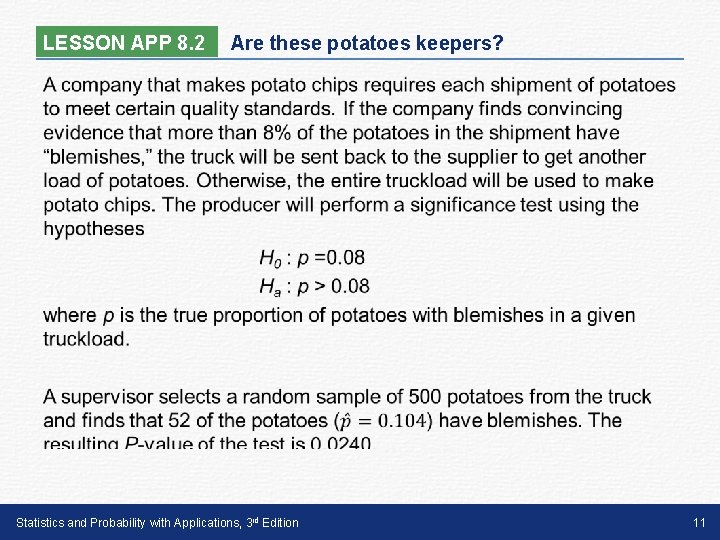
LESSON APP 8. 2 Are these potatoes keepers? Statistics and Probability with Applications, 3 rd Edition 11
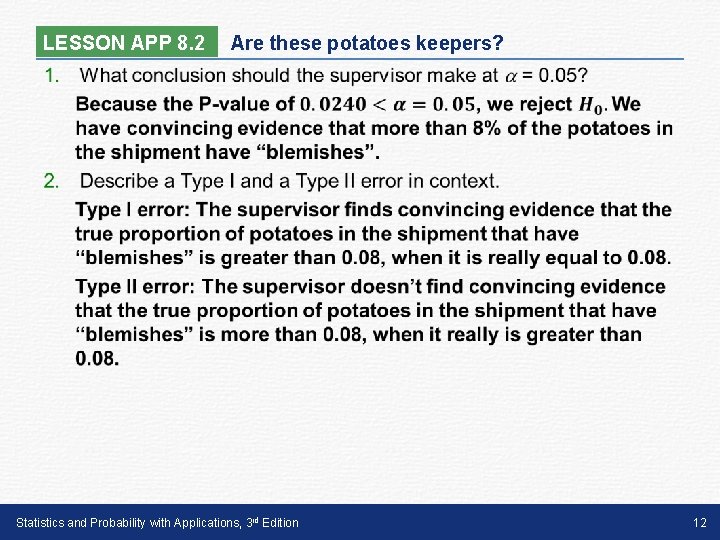
LESSON APP 8. 2 Are these potatoes keepers? Statistics and Probability with Applications, 3 rd Edition 12
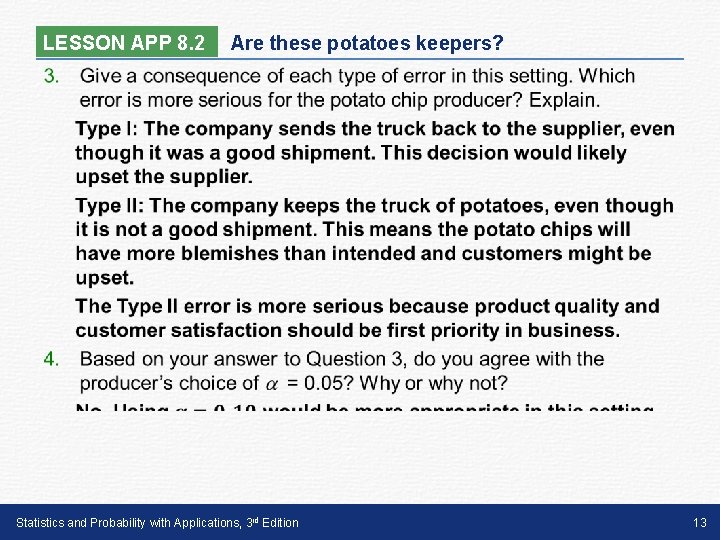
LESSON APP 8. 2 Are these potatoes keepers? Statistics and Probability with Applications, 3 rd Edition 13
Significance Tests and Decision Making Learning Targets After this lesson, you should be able to: ü Determine if the results of a study are statistically significant and make an appropriate conclusion using a significance level. ü Interpret a Type I error and a Type II error in context. ü Give a consequence of a Type I error and a Type II error in a given setting. Statistics and Probability with Applications, 3 rd Edition 14