
8 Momentum 8 4 Conservation of Momentum The


- Slides: 27
8 Momentum 8. 4 Conservation of Momentum The law of conservation of momentum states that, in the absence of an external force, the momentum of a system remains unchanged.
8 Momentum 8. 4 Conservation of Momentum The force or impulse that changes momentum must be exerted on the object by something outside the object. • Molecular forces within a basketball have no effect on the momentum of the basketball. • A push against the dashboard from inside does not affect the momentum of a car. These are internal forces. They come in balanced pairs that cancel within the object.
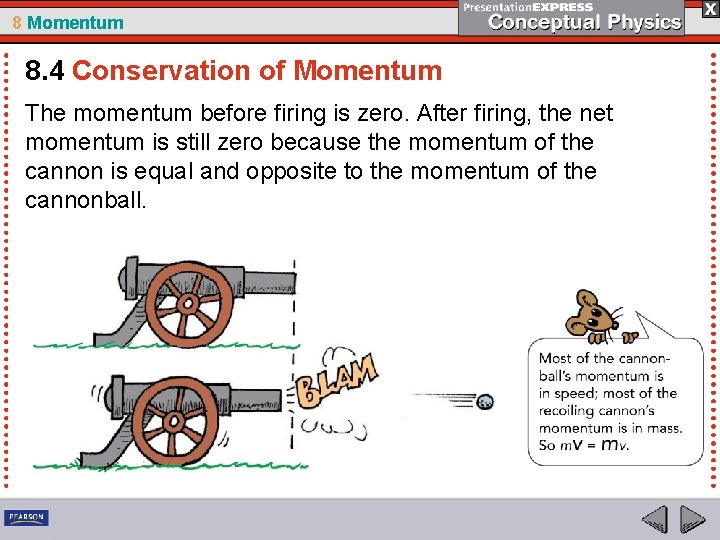
8 Momentum 8. 4 Conservation of Momentum The momentum before firing is zero. After firing, the net momentum is still zero because the momentum of the cannon is equal and opposite to the momentum of the cannonball.
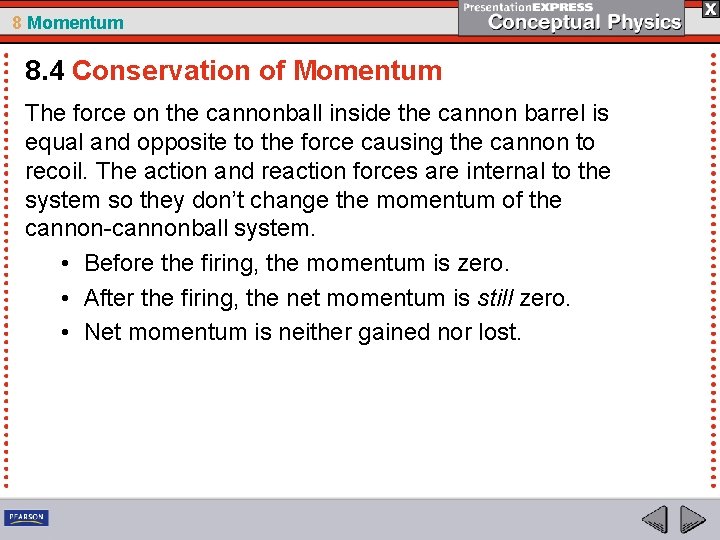
8 Momentum 8. 4 Conservation of Momentum The force on the cannonball inside the cannon barrel is equal and opposite to the force causing the cannon to recoil. The action and reaction forces are internal to the system so they don’t change the momentum of the cannon-cannonball system. • Before the firing, the momentum is zero. • After the firing, the net momentum is still zero. • Net momentum is neither gained nor lost.
8 Momentum 8. 4 Conservation of Momentum has both direction and magnitude. It is a vector quantity. • The cannonball gains momentum and the recoiling cannon gains momentum in the opposite direction. • The cannon-cannonball system gains none. • The momenta of the cannonball and the cannon are equal in magnitude and opposite in direction. • No net force acts on the system so there is no net impulse on the system and there is no net change in the momentum.
8 Momentum is conserved for all collisions as long as external forces don’t interfere.
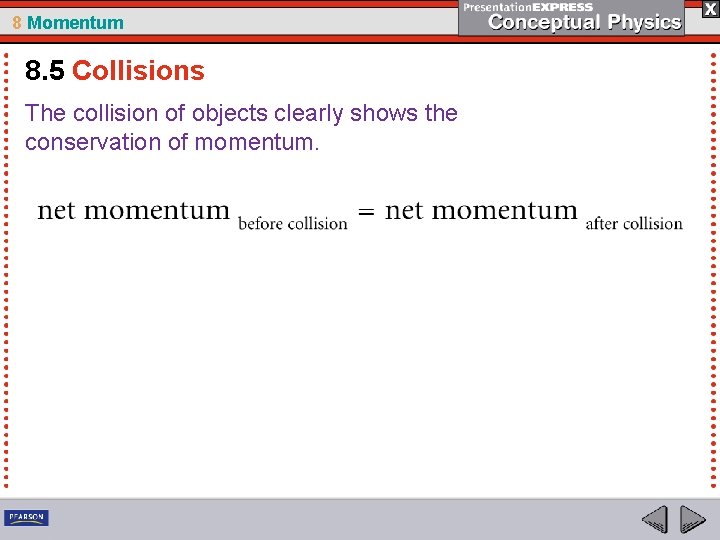
8 Momentum 8. 5 Collisions Whenever objects collide in the absence of external forces, the net momentum of the objects before the collision equals the net momentum of the objects after the collision.
8 Momentum 8. 5 Collisions The collision of objects clearly shows the conservation of momentum.
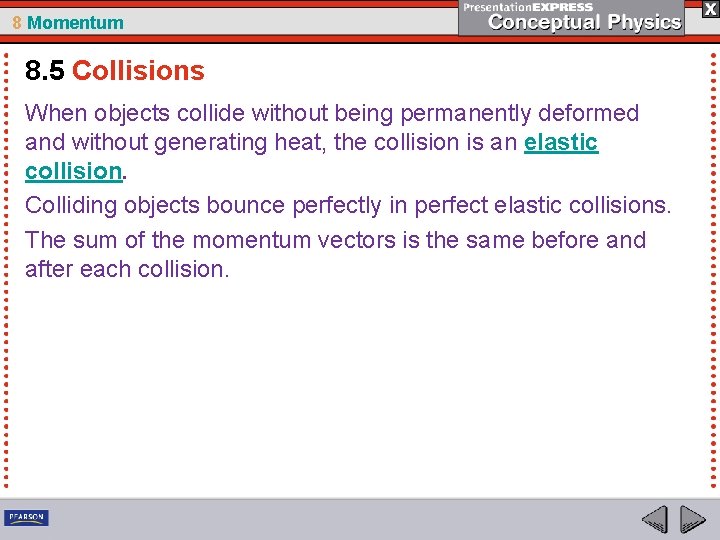
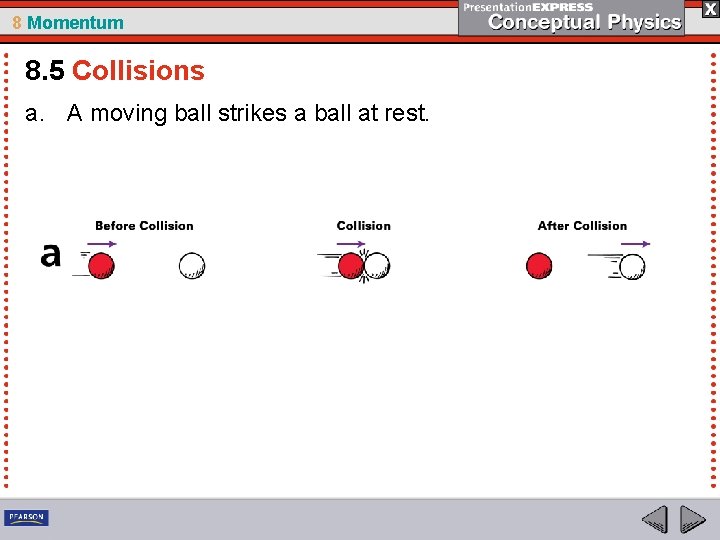
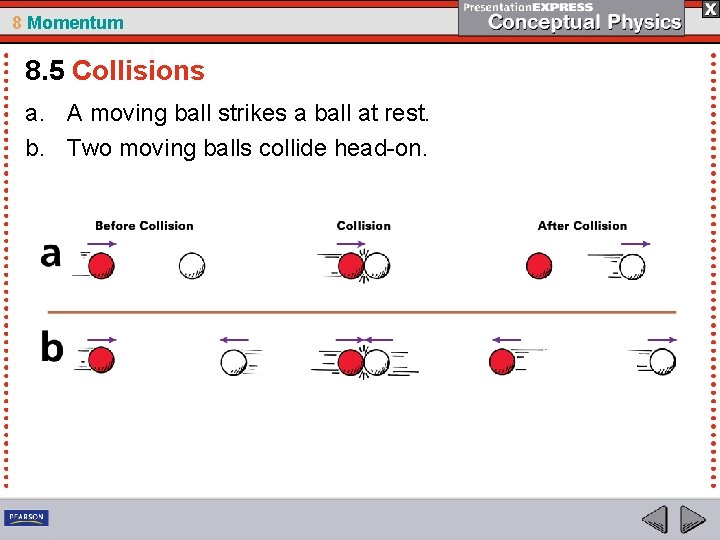
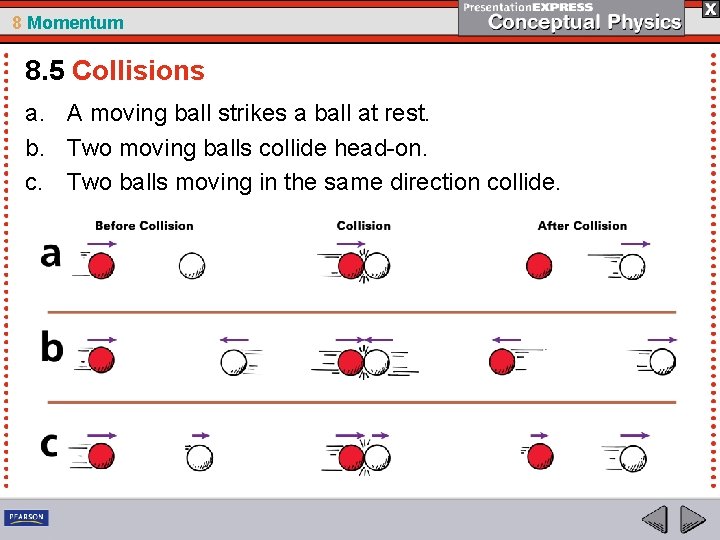
8 Momentum 8. 5 Collisions Elastic Collisions When a moving billiard ball collides head-on with a ball at rest, the first ball comes to rest and the second ball moves away with a velocity equal to the initial velocity of the first ball. Momentum is transferred from the first ball to the second ball.
8 Momentum 8. 5 Collisions When objects collide without being permanently deformed and without generating heat, the collision is an elastic collision. Colliding objects bounce perfectly in perfect elastic collisions. The sum of the momentum vectors is the same before and after each collision.
8 Momentum 8. 5 Collisions a. A moving ball strikes a ball at rest.
8 Momentum 8. 5 Collisions a. A moving ball strikes a ball at rest. b. Two moving balls collide head-on.
8 Momentum 8. 5 Collisions a. A moving ball strikes a ball at rest. b. Two moving balls collide head-on. c. Two balls moving in the same direction collide.
8 Momentum 8. 5 Collisions Inelastic Collisions A collision in which the colliding objects become distorted and generate heat during the collision is an inelastic collision. Momentum conservation holds true even in inelastic collisions. Whenever colliding objects become tangled or couple together, a totally inelastic collision occurs.
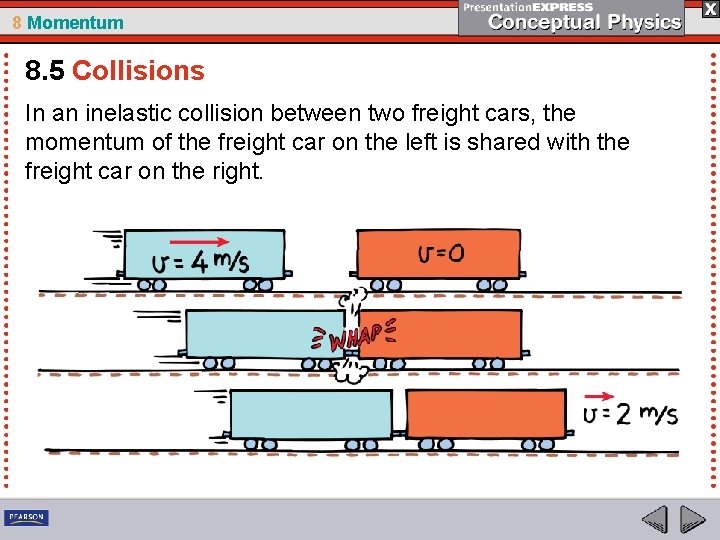
8 Momentum 8. 5 Collisions In an inelastic collision between two freight cars, the momentum of the freight car on the left is shared with the freight car on the right.
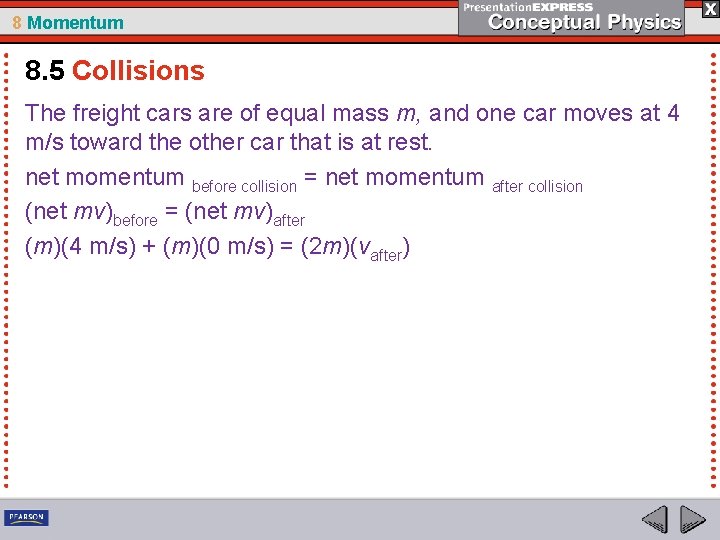
8 Momentum 8. 5 Collisions The freight cars are of equal mass m, and one car moves at 4 m/s toward the other car that is at rest. net momentum before collision = net momentum after collision (net mv)before = (net mv)after (m)(4 m/s) + (m)(0 m/s) = (2 m)(vafter)
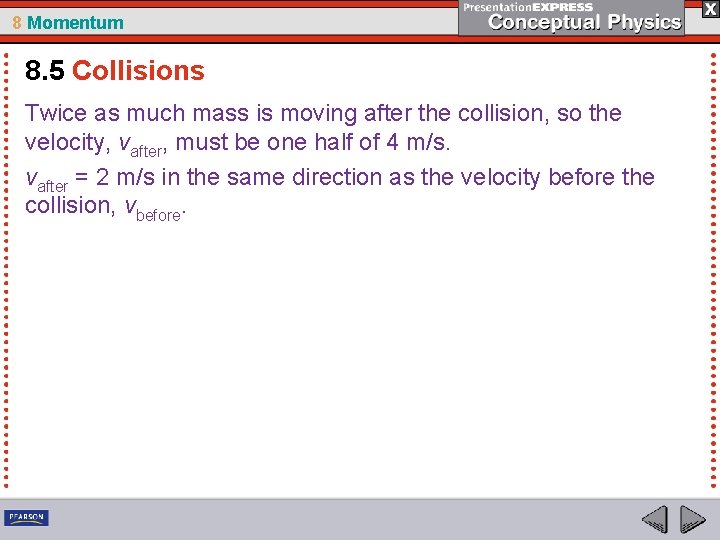
8 Momentum 8. 5 Collisions Twice as much mass is moving after the collision, so the velocity, vafter, must be one half of 4 m/s. vafter = 2 m/s in the same direction as the velocity before the collision, vbefore.
8 Momentum 8. 5 Collisions The initial momentum is shared by both cars without loss or gain. Momentum is conserved. External forces are usually negligible during the collision, so the net momentum does not change during collision.
8 Momentum 8. 5 Collisions External forces may have an effect after the collision: • Billiard balls encounter friction with the table and the air. • After a collision of two trucks, the combined wreck slides along the pavement and friction decreases its momentum. • Two space vehicles docking in orbit have the same net momentum just before and just after contact. Since there is no air resistance in space, the combined momentum is then changed only by gravity.
8 Momentum 8. 5 Collisions Perfectly elastic collisions are not common in the everyday world. Drop a ball and after it bounces from the floor, both the ball and the floor are a bit warmer. At the microscopic level, however, perfectly elastic collisions are commonplace. For example, electrically charged particles bounce off one another without generating heat; they don’t even touch in the classic sense of the word.
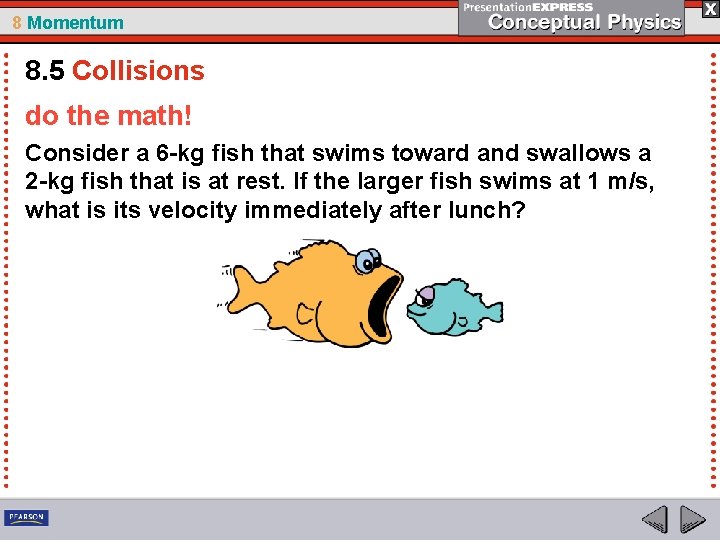
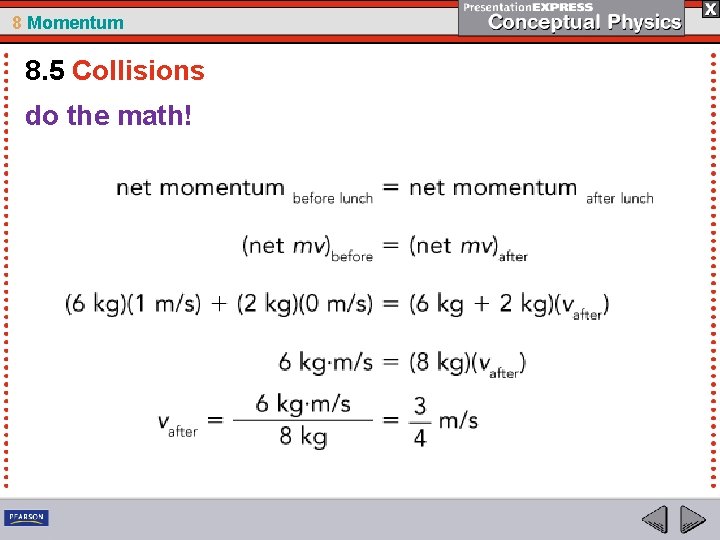
8 Momentum 8. 5 Collisions do the math! Consider a 6 -kg fish that swims toward and swallows a 2 -kg fish that is at rest. If the larger fish swims at 1 m/s, what is its velocity immediately after lunch?
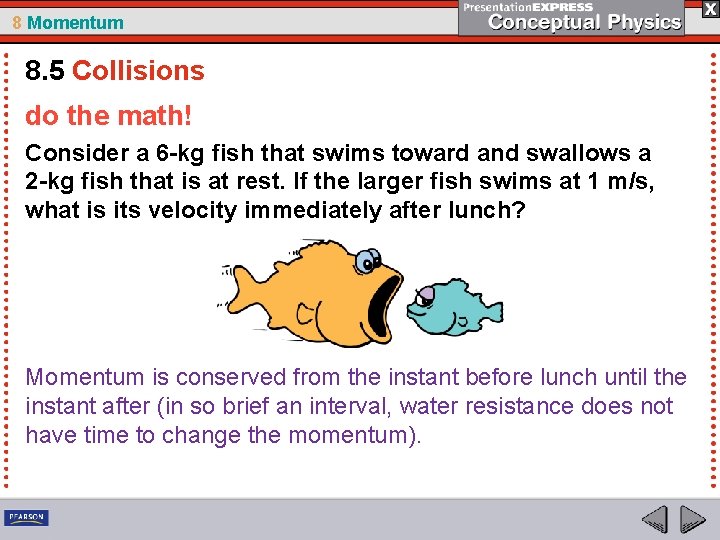
8 Momentum 8. 5 Collisions do the math! Consider a 6 -kg fish that swims toward and swallows a 2 -kg fish that is at rest. If the larger fish swims at 1 m/s, what is its velocity immediately after lunch? Momentum is conserved from the instant before lunch until the instant after (in so brief an interval, water resistance does not have time to change the momentum).
8 Momentum 8. 5 Collisions do the math!
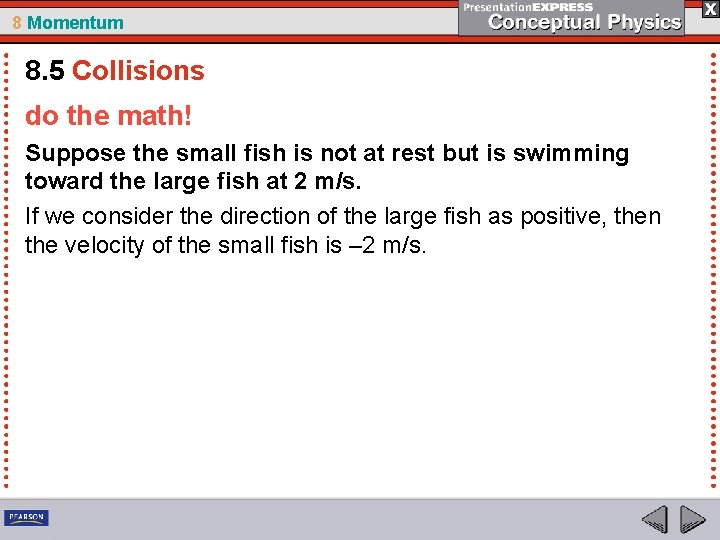
8 Momentum 8. 5 Collisions do the math! Suppose the small fish is not at rest but is swimming toward the large fish at 2 m/s.
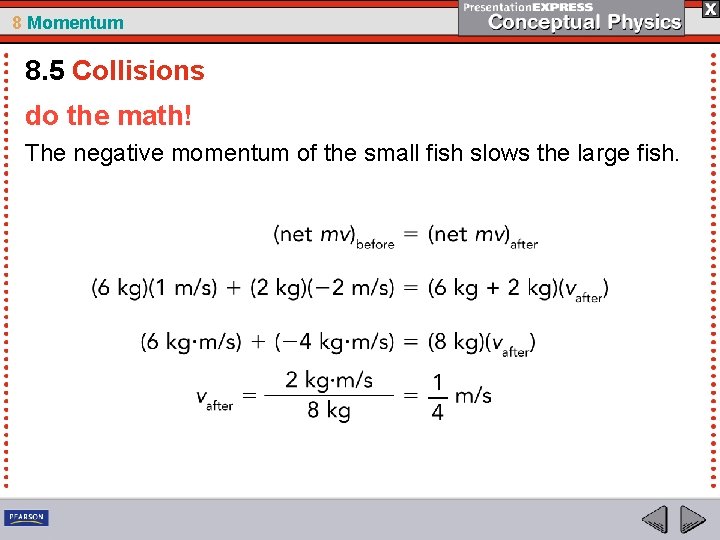
8 Momentum 8. 5 Collisions do the math! Suppose the small fish is not at rest but is swimming toward the large fish at 2 m/s. If we consider the direction of the large fish as positive, then the velocity of the small fish is – 2 m/s.
8 Momentum 8. 5 Collisions do the math! The negative momentum of the small fish slows the large fish.
8 Momentum 8. 5 Collisions do the math! At what speed could the small fish swim and cause the large fish to stop moving after the meal? • – 3 m/s