
8 Human Needs and Human Development 1 Identify

- Slides: 77
8 Human Needs and Human Development 1. Identify basic human needs Define the following term: psychosocial needs that involve social interaction, emotions, intellect, and spirituality.
8 Human Needs and Human Development 1. Identify basic human needs Human beings have the following basic physical needs: • Food and water • Protection and shelter • Activity • Sleep and rest • Comfort, freedom from pain
8 Human Needs and Human Development 1. Identify basic human needs Think about this question: Which NA tasks address residents’ physical needs?
8 Human Needs and Human Development 1. Identify basic human needs Human beings have the following psychosocial needs: • Love and affection • Acceptance by others • Safety and security • Self-reliance and independence in daily living • Contact with other people • Success and self-esteem
8 Human Needs and Human Development 1. Identify basic human needs When psychosocial needs are not met, people may experience the following: • Frustration • Stress • Fear • Anxiety • Anger • Aggression • Withdrawal • Depression
8 Human Needs and Human Development 1. Identify basic human needs Think about this question: How could the negative feelings listed on the previous slide interfere with a resident’s health?
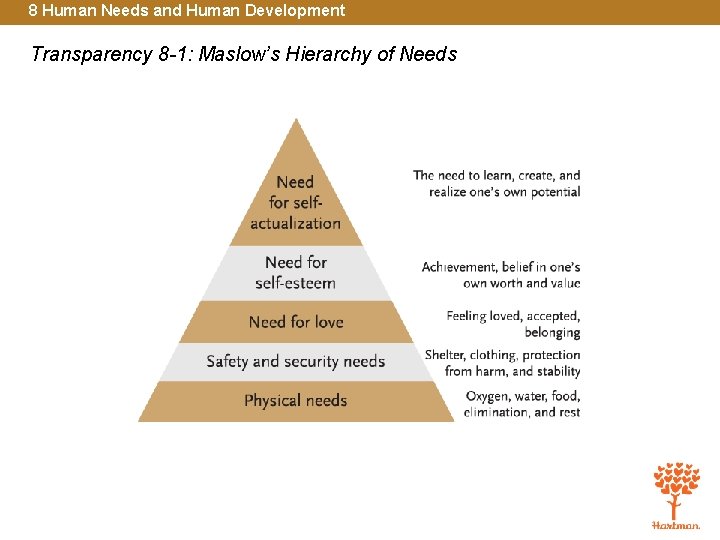
8 Human Needs and Human Development Transparency 8 -1: Maslow’s Hierarchy of Needs
8 Human Needs and Human Development 1. Identify basic human needs Think about this question: What do self-esteem and self-actualization mean for you?
8 Human Needs and Human Development 1. Identify basic human needs Think about these questions: Which of the needs in Maslow’s Hierarchy are physical? Which are psychosocial? Is one need dependent on the others? Are any needs more important than the others?
8 Human Needs and Human Development 2. Define holistic care and explain its importance in health care Define the following term: holistic care a type of care that involves caring for the whole person—the mind as well as the body.
8 Human Needs and Human Development 2. Define holistic care and explain its importance in health care Think about this question: How does the term holistic apply to caregiving and what does it mean for an NA to care for the whole person?
8 Human Needs and Human Development 3. Explain why independence and self-care important Residents in an LTCF may be experiencing any or all of these losses: • Loss of spouse, family, or friends • Loss of workplace and its relationships • Loss of ability to go places • Loss of ability to attend religious services and meetings • Loss of home and personal possessions • Loss of health and ability to care for themselves • Loss of ability to move freely • Loss of pets
8 Human Needs and Human Development 3. Explain why independence and self-care important Loss of independence may cause the following difficulties for residents: • Poor self-image • Anger • Feelings of helplessness, sadness, and hopelessness • Feelings of uselessness • Increased dependence • Depression
8 Human Needs and Human Development 3. Explain why independence and self-care important NAs can assist residents by promoting independence in these ways: • Encourage residents to do as much as possible for themselves, no matter how long it takes. • Be patient. • Allow residents to make choices.
8 Human Needs and Human Development 3. Explain why independence and self-care important REMEMBER: NAs must never treat residents like children. They must respect the fact that residents can make their own choices, and always encourage residents to care for themselves.
8 Human Needs and Human Development 4. Respect different forms of sexual identity and explain ways to accommodate sexual needs Define the following terms: masturbation to touch or rub sexual organs in order to give oneself or another person sexual pleasure. heterosexual (straight) a person whose sexual preference is for people of the opposite sex. homosexual (gay and lesbian) a person whose sexual preference is for people of the same sex.
8 Human Needs and Human Development 4. Respect different forms of sexual identity and explain ways to accommodate sexual needs Define the following terms: bisexual a person who is sexually attracted to both men and women. transsexual 1. one who wishes to be accepted by society as a member of the opposite sex; 2. one who has undergone a sex change operation. transgender a person whose gender identify conflicts with his or her birth sex (sex assigned at birth due to anatomy). transitioning the process of changing genders.
8 Human Needs and Human Development 4. Respect different forms of sexual identity and explain ways to accommodate sexual needs REMEMBER: No matter what an NA’s feelings about LGBT people may be, they must respect all residents and their choices.
8 Human Needs and Human Development 4. Respect different forms of sexual identity and explain ways to accommodate sexual needs Think about this question: How can an NA respect residents’ sexual identities? Why is this important?
8 Human Needs and Human Development 4. Respect different forms of sexual identity and explain ways to accommodate sexual needs NAs must respect residents’ sexual needs, remembering these points: • People continue to have sexual needs throughout their lives. • Humans express their sexuality through different behaviors. • Knock and wait for a response before entering residents’ rooms. • Provide privacy if you encounter a sexual situation between consenting adults. Remove the resident from an unsafe situation and notify the nurse immediately if sexual abuse is observed. • Be open and nonjudgmental. • Honor “Do Not Disturb” signs.
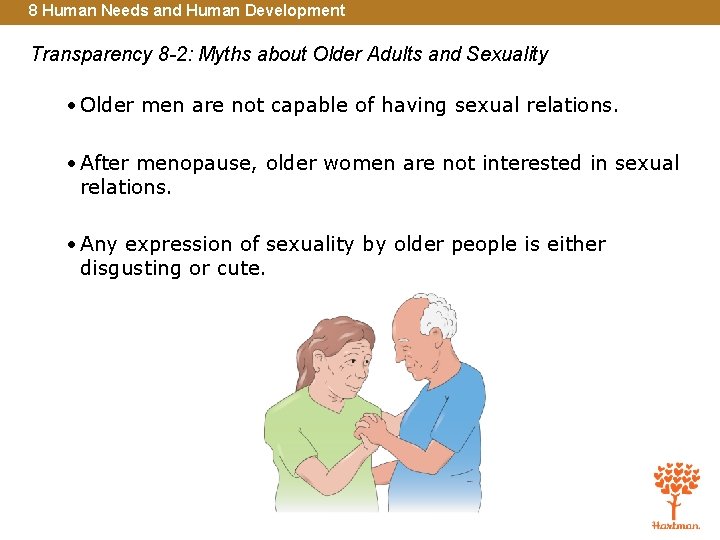
8 Human Needs and Human Development Transparency 8 -2: Myths about Older Adults and Sexuality • Older men are not capable of having sexual relations. • After menopause, older women are not interested in sexual relations. • Any expression of sexuality by older people is either disgusting or cute.
8 Human Needs and Human Development 4. Respect different forms of sexual identity and explain ways to accommodate sexual needs Think about this question: Can you think of examples of these myths in the media and popular culture?
8 Human Needs and Human Development 5. Identify ways to help residents meet their spiritual needs Define the following term: spiritual of, or relating to, the spirit or soul.
8 Human Needs and Human Development 5. Identify ways to help residents meet their spiritual needs NAs can help residents meet their spiritual needs in these ways: • Learn about their religion. • Respect residents’ decisions to participate in, or refrain from, food-related rituals. Assist with practices as requested (never make judgments). • Encourage participation in religious services for residents who are religious. • Respect all religious items. • Report requests to see clergy to nurse. • Get to know resident’s priest, rabbi, or minister. • Allow privacy for clergy visits. • If asked, read religious materials aloud. • Refer resident to spiritual resources if requested.
8 Human Needs and Human Development Transparency 8 -3: Not Permitted Nursing assistants should never: • Try to change someone’s religion • Tell residents their belief or religion is wrong • Express judgments about a religious group • Insist that residents join religious activities • Interfere with religious practices
8 Human Needs and Human Development 5. Identify ways to help residents meet their spiritual needs Think about these questions: • Why should an NA not be judgmental about other people’s beliefs? • Why should an NA not impose his beliefs on residents? • Would an NA’s political ideas be appropriate topics of conversation with residents or their families? • What are some appropriate topics of conversation with residents and their families?
8 Human Needs and Human Development 6. Identify ways to accommodate cultural and religious differences Define the following terms: reincarnation a belief that some part of a living being survives death to be reborn in a new body. karma the belief that all past and present deeds affect one’s future and future lives. yarmulke a small skullcap worn by Jewish men as a sign of their faith.
8 Human Needs and Human Development 6. Identify ways to accommodate cultural and religious differences Define the following terms: rabbi religious leader of the Jewish faith. dietary restrictions rules about what and when individuals can eat. fasting not eating food or eating very little food.
8 Human Needs and Human Development 6. Identify ways to accommodate cultural and religious differences Define the following terms: vegetarians people who do not eat meat, fish, or poultry and may or may not eat eggs and dairy products. vegans people who do not eat any animals or animal products; vegans may also not use or wear any animal products.
8 Human Needs and Human Development 6. Identify ways to accommodate cultural and religious differences The following religions and beliefs may be practiced by residents: • Buddhism • Christianity • Hinduism • Islam • Judaism • Spirituality • Native American spiritual traditions
8 Human Needs and Human Development 6. Identify ways to accommodate cultural and religious differences Think about these questions: Do you practice any of the religions/beliefs listed on the previous slide? If an NA and a resident do not share the same religious or cultural beliefs, how might this affect their relationship?
8 Human Needs and Human Development 6. Identify ways to accommodate cultural and religious differences Define the following terms: agnostics people who believe that they do not know or cannot know if God exists. atheists people who believe that there is no God and actively deny the existence of God.
8 Human Needs and Human Development 6. Identify ways to accommodate cultural and religious differences Think about these questions: How might cultural and religious practices relate to residents’ diets? Do you have any dietary practices that relate to your faith or culture?
8 Human Needs and Human Development 7. Describe the need for activity The following are positive effects of physical activity: • Lessens risk of illnesses • Relieves symptoms of depression • Improves mood and concentration • Improves body function • Lowers risk of falls • Improves sleep • Improves ability to cope with stress • Increases energy • Increases appetite
8 Human Needs and Human Development 7. Describe the need for activity Inactivity may cause the following problems: • Loss of self-esteem • Depression • Boredom • Pneumonia • Urinary tract infection • Constipation • Blood clots • Dulling of senses
8 Human Needs and Human Development 8. Discuss family roles and their significance in health care NAs may encounter residents and family members from any of the following family types: • Nuclear families • Single-parent families • Married or committed couples of the same sex or opposite sex • Extended families • Blended families
8 Human Needs and Human Development 8. Discuss family roles and their significance in health care REMEMBER: A resident must never be denied the right to have the people he loves around him. Families of all descriptions make residents’ lives more meaningful and caregivers should always make residents’ families feel welcome.
8 Human Needs and Human Development 8. Discuss family roles and their significance in health care Residents’ families may perform these functions in the care of the residents: • Helping to make care decisions • Communicating with care team • Giving support and encouragement • Connecting to outside world • Giving assurance to dying residents
8 Human Needs and Human Development 8. Discuss family roles and their significance in health care Families of LTCF residents are likely experiencing significant and challenging adjustments, including the following: • Accepting the resident’s illness/disability and its consequences • Finding money to pay for hospitalization, long-term care, or home care • Dealing with paperwork • Taking care of tasks residents cannot handle • Understanding medical information and making care decisions • Caring for children while also caring for an elderly loved one
8 Human Needs and Human Development 9. List ways to respond to emotional needs of residents and their families NAs should remember the following three ways to respond to residents and families: • Listen • Offer support and encouragement • Refer the problem to a social worker or your supervisor
8 Human Needs and Human Development 9. List ways to respond to emotional needs of residents and their families Think about these questions: • What are clichés? Give some examples. • What should the NA say to the resident when there is a need to refer him or her to the nurse? • What are some examples of encouraging remarks NAs can offer to residents? How about to families?
8 Human Needs and Human Development 10. Describe the stages of human growth and development and identify common disorders for each stage NAs should be familiar with the following information regarding infancy (birth to 12 months): • Period of rapid growth and development • Development is from head down • Common disorders include the following: • Prematurity • Low birth weight • Birth defects • Viral or bacterial infections • Sudden infant death syndrome (SIDS)
8 Human Needs and Human Development 10. Describe the stages of human growth and development and identify common disorders for each stage NAs should be familiar with the following information regarding toddlerhood (ages 1 - 3): • Formerly dependent, now gaining independence and body control • Learn to speak, gain coordination and bladder and bowel control • May have tantrums or whine to get their way
8 Human Needs and Human Development 10. Describe the stages of human growth and development and identify common disorders for each stage NAs should be familiar with the following information regarding the preschool years (ages 3 - 6): • More social relationships • Play cooperatively and learn language • Learn right from wrong
8 Human Needs and Human Development 10. Describe the stages of human growth and development and identify common disorders for each stage NAs should be familiar with the following information regarding the school-age years (ages 6 - 10): • Strong focus on cognitive development (thinking and learning) • Learn to get along with others in peer group • Develop a conscience and self-esteem
8 Human Needs and Human Development 10. Describe the stages of human growth and development and identify common disorders for each stage Common disorders of childhood (toddlerhood through school age) include the following: • Chickenpox • Viral or bacterial infections • Leukemia • Child abuse or neglect • Vaccine-preventable illnesses (no longer common in developed countries): • Measles • Mumps • Rubella
8 Human Needs and Human Development 10. Describe the stages of human growth and development and identify common disorders for each stage Common disorders of childhood (cont’d): • Vaccine-preventable illnesses (cont’d): • Diphtheria • Smallpox • Whooping cough • Polio
8 Human Needs and Human Development 10. Describe the stages of human growth and development and identify common disorders for each stage NAs should be familiar with the following information regarding the preadolescent years (ages 10 - 13): • Growing sense of self-identity • Strongly identify with peers • Relatively calm period • Imaginary fears give way to fears based in real world
8 Human Needs and Human Development 10. Describe the stages of human growth and development and identify common disorders for each stage NAs should be familiar with the following information regarding the adolescent years (ages 13 - 19): • Marked by onset of puberty (age range is approximate) • Secondary sex characteristics appear • Reproductive organs begin to function • Concern for body and peer acceptance • Changing moods • Common disorders include the following: • Eating disorders (anorexia, bulimia) • STIs
8 Human Needs and Human Development 10. Describe the stages of human growth and development and identify common disorders for each stage NAs should be familiar with the following information regarding the adolescent years (cont’d): • Common disorders (cont’d): • Pregnancy • Depression • Trauma due to auto accidents or sports injuries
8 Human Needs and Human Development 10. Describe the stages of human growth and development and identify common disorders for each stage The following are the tasks associated with young adulthood (ages 19 - 40): • Select an education • Select a career • Select and live with a mate • Raise children • Develop a satisfying sex life
8 Human Needs and Human Development 10. Describe the stages of human growth and development and identify common disorders for each stage The following are typical events of middle adulthood (ages 40 65): • More comfortable and stable • May have “mid-life crisis” • Physical changes related to aging occur
8 Human Needs and Human Development 10. Describe the stages of human growth and development and identify common disorders for each stage The following may occur in late adulthood (65 years and older): • Many physical and psychosocial changes • Loss of physical health • Loss of friends and jobs • Common disorders: • Arthritis • Alzheimer’s disease • Cancer • Diabetes • Stroke
8 Human Needs and Human Development 11. Distinguish between what is true and what is not true about the aging process Define the following terms: geriatrics the study of health, wellness, and disease later in life. gerontology the study of the aging process in people from mid-life through old ageism prejudice toward, stereotyping of, and/or discrimination against older persons or the elderly.
8 Human Needs and Human Development Transparency 8 -4: True or False? 1. People over 80 years old cannot live by themselves. 2. Most older adults are lonely and depressed. 3. Older adults are not able to adjust to changes. 4. Most older adults are ill or disabled in some way. 5. Older adults can stay active by pursuing favorite hobbies. 6. Good health can help older adults live independently. 7. Normal changes of aging do not include diseases, disabilities, or dependence on others.
8 Human Needs and Human Development 11. Distinguish between what is true and what is not true about the aging process NAs should know the following facts about aging: • Older adults have many different capabilities. • Stereotypes are false. • Older persons are usually active. • Aging is a normal process, not a disease. • Aging persons need to adjust to change. • They do not need to be dependent.
8 Human Needs and Human Development 11. Distinguish between what is true and what is not true about the aging process Normal changes of aging include the following: • Thinner, drier, more fragile, and less elastic skin • Weaker muscles • Bones more brittle and lose density • Decreased sensitivity of nerve endings in skin • Slower responses and reflexes • Short-term memory loss • Changes in senses
8 Human Needs and Human Development 11. Distinguish between what is true and what is not true about the aging process Normal changes of aging (cont’d): • Less efficient heart • Decreased oxygen in blood • Decreased appetite • More frequent elimination • Changes in hormone production • Weakened immunity • Change in lifestyle
8 Human Needs and Human Development 11. Distinguish between what is true and what is not true about the aging process The following are not considered normal changes of aging: • Depression • Inability to think logically • Poor nutrition • Shortness of breath • Incontinence
8 Human Needs and Human Development 12. Explain developmental disabilities and list care guidelines Define the following terms: developmental disabilities that are present at birth or emerge during childhood that restrict physical or mental ability.
8 Human Needs and Human Development 12. Explain developmental disabilities and list care guidelines Think about this question: What is the role of the NA/HHA in supporting residents/clients with the following disabilities? (see pp. 123 -125 in text) • Intellectual disabilities • Down syndrome • Cerebral palsy • Spina bifida • Autism
8 Human Needs and Human Development 13. Identify community resources available to help the elderly Think about this question: What services are available to elderly people in this community? How would a person go about finding them?
8 Human Needs and Human Development Exam Multiple Choice. Choose the correct answer. 1. Which of the following is a physical need? (A) The need for social interaction (B) The need for water (C) The need for self-esteem (D) The need for independence 2. Which of the following is an example of a psychosocial need? (A) The need for food (B) The need for sleep (C) The need for activity (D) The need for acceptance
8 Human Needs and Human Development Exam 1. What is one way a nursing assistant can promote a resident’s independence? (A) Finishing a resident’s task if he takes a long time to complete it (B) Allowing a resident to do a task by himself no matter how long it takes him (C) Deciding where a resident should sit in the dining room (D) Deciding what a resident should wear for the day 2. Activities of daily living (ADLs) include (A) Reading (B) Taking part in facility activities (C) Attending a worship service (D) Brushing teeth
8 Human Needs and Human Development Exam 1. Mrs. Goldman, a resident, begins to tell her nursing assistant, Gene, about the last religious service she attended. Gene does not believe in God. Gene’s best response is to (A) Listen quietly to Mrs. Goldman (B) Tell Mrs. Goldman that he does not believe in God and would prefer not to discuss it (C) Tell Mrs. Goldman that her beliefs are wrong (D) Ask Mrs. Goldman what makes her think that there is a God 2. Which of the following statements is true of spiritual needs? (A) Residents will believe in God. (B) Residents will be Christians. (C) Residents will have different spiritual needs and beliefs. (D) Residents will not believe in God or a higher power.
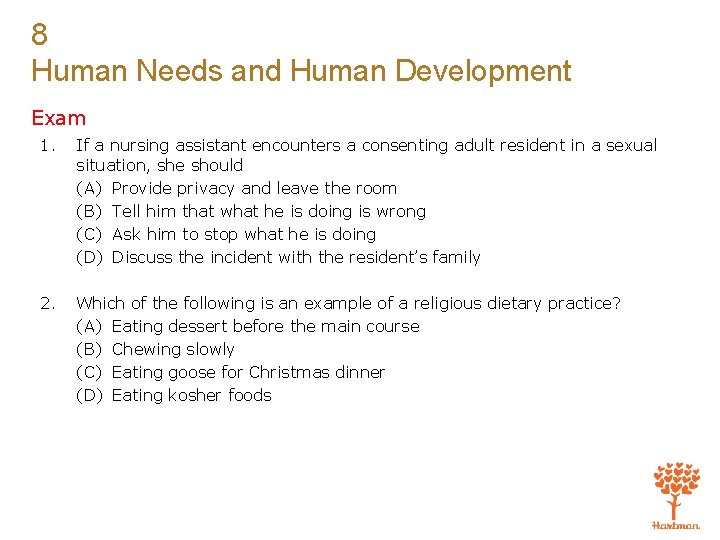
8 Human Needs and Human Development Exam 1. If a nursing assistant encounters a consenting adult resident in a sexual situation, she should (A) Provide privacy and leave the room (B) Tell him that what he is doing is wrong (C) Ask him to stop what he is doing (D) Discuss the incident with the resident’s family 2. Which of the following is an example of a religious dietary practice? (A) Eating dessert before the main course (B) Chewing slowly (C) Eating goose for Christmas dinner (D) Eating kosher foods
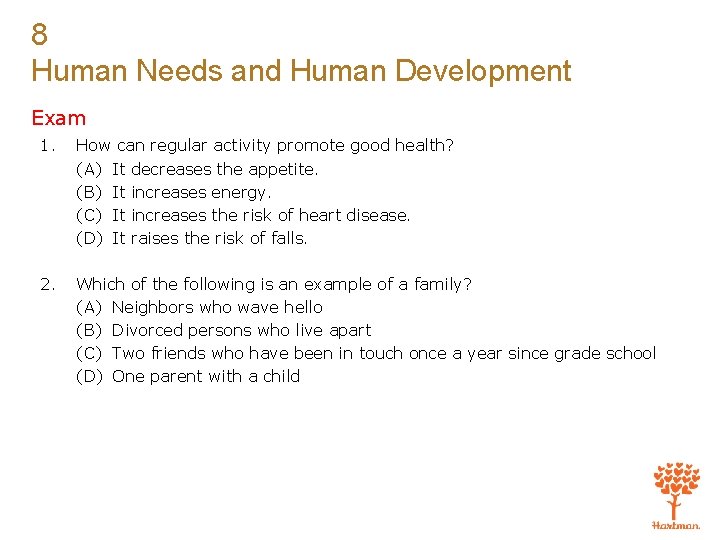
8 Human Needs and Human Development Exam 1. How can regular activity promote good health? (A) It decreases the appetite. (B) It increases energy. (C) It increases the risk of heart disease. (D) It raises the risk of falls. 2. Which of the following is an example of a family? (A) Neighbors who wave hello (B) Divorced persons who live apart (C) Two friends who have been in touch once a year since grade school (D) One parent with a child
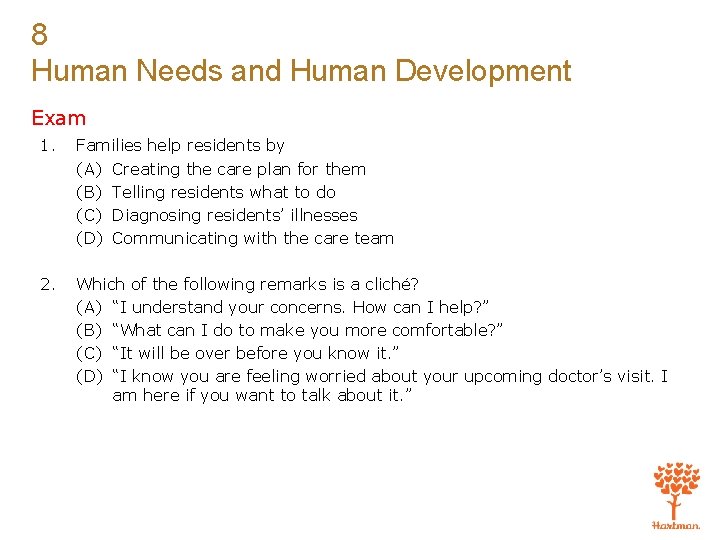
8 Human Needs and Human Development Exam 1. Families help residents by (A) Creating the care plan for them (B) Telling residents what to do (C) Diagnosing residents’ illnesses (D) Communicating with the care team 2. Which of the following remarks is a cliché? (A) “I understand your concerns. How can I help? ” (B) “What can I do to make you more comfortable? ” (C) “It will be over before you know it. ” (D) “I know you are feeling worried about your upcoming doctor’s visit. I am here if you want to talk about it. ”
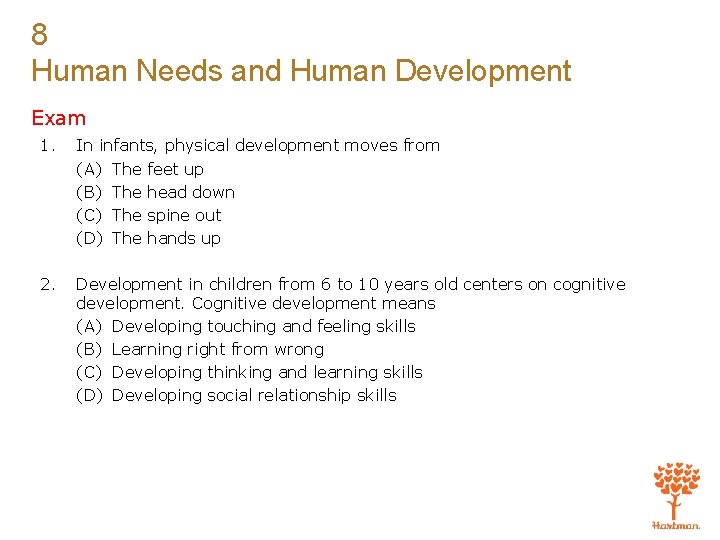
8 Human Needs and Human Development Exam 1. In infants, physical development moves from (A) The feet up (B) The head down (C) The spine out (D) The hands up 2. Development in children from 6 to 10 years old centers on cognitive development. Cognitive development means (A) Developing touching and feeling skills (B) Learning right from wrong (C) Developing thinking and learning skills (D) Developing social relationship skills
8 Human Needs and Human Development Exam 1. Eating disorders that adolescents may develop include (A) Trauma and injury (B) Viral and bacterial infections (C) Pregnancy and binge eating (D) Anorexia and bulimia 2. Children in their ______ years develop vocabulary/language skills, learn to play cooperatively in groups, and begin to learn right from wrong. (A) School-age (ages 6 to 10) (B) Toddler (ages 1 to 3) (C) Adolescent (ages 12 to 19) (D) Preschool (ages 3 to 6)
8 Human Needs and Human Development Exam 1. Which of the following stages of child development involves children learning to speak, gaining coordination of their limbs, and gaining control over their bladders and bowels? (A) Preschool (ages 3 to 6) (B) Toddler (ages 1 to 3) (C) Infancy (birth to 12 months) (D) School-age (ages 6 to 10) 2. Which of the following statements is true of the normal aging process? (A) Most elderly people are entirely dependent on others. (B) Most elderly people are disabled and cannot walk. (C) Most elderly people are active and engaged in activities. (D) Most elderly people cannot manage their own money.
8 Human Needs and Human Development Exam 1. Normal changes of aging include (A) Depression (B) Thinner, drier skin (C) Significant weight loss (D) Incontinence 2. Which of the following is true of developmental disabilities? (A) Developmental disabilities are temporary. (B) Developmental disabilities restrict physical and/or mental ability. (C) Developmental disabilities are a form of mental illness. (D) People with developmental disabilities can never live or work independently.
8 Human Needs and Human Development Exam 1. The (A) (B) (C) (D) 2. Which of the following statements is true of autism? (A) Surgery is the first course of treatment for autism. (B) When it is detected early, the chances of curing it are greater. (C) Children normally outgrow it. (D) Boys are more often affected than girls. most common developmental disability is Parkinson’s disease Intellectual disability Muscular dystrophy Cerebral palsy
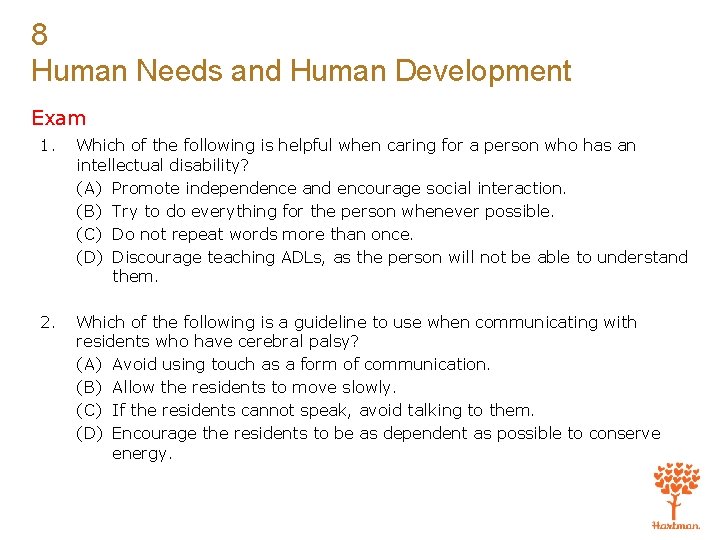
8 Human Needs and Human Development Exam 1. Which of the following is helpful when caring for a person who has an intellectual disability? (A) Promote independence and encourage social interaction. (B) Try to do everything for the person whenever possible. (C) Do not repeat words more than once. (D) Discourage teaching ADLs, as the person will not be able to understand them. 2. Which of the following is a guideline to use when communicating with residents who have cerebral palsy? (A) Avoid using touch as a form of communication. (B) Allow the residents to move slowly. (C) If the residents cannot speak, avoid talking to them. (D) Encourage the residents to be as dependent as possible to conserve energy.
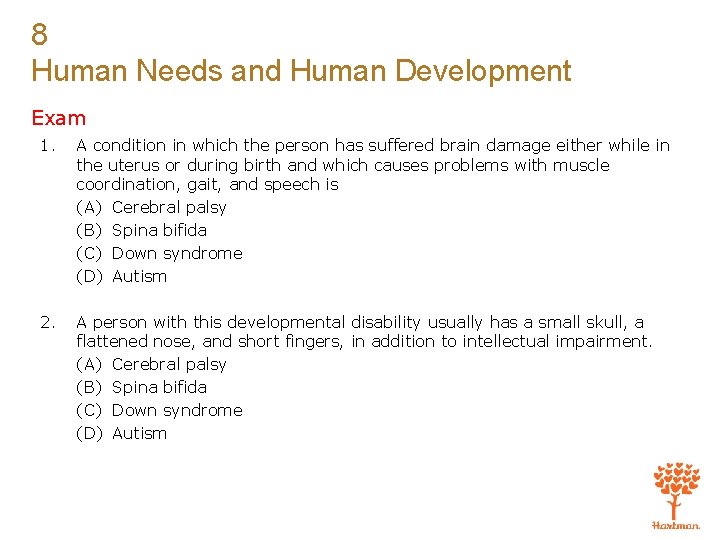
8 Human Needs and Human Development Exam 1. A condition in which the person has suffered brain damage either while in the uterus or during birth and which causes problems with muscle coordination, gait, and speech is (A) Cerebral palsy (B) Spina bifida (C) Down syndrome (D) Autism 2. A person with this developmental disability usually has a small skull, a flattened nose, and short fingers, in addition to intellectual impairment. (A) Cerebral palsy (B) Spina bifida (C) Down syndrome (D) Autism
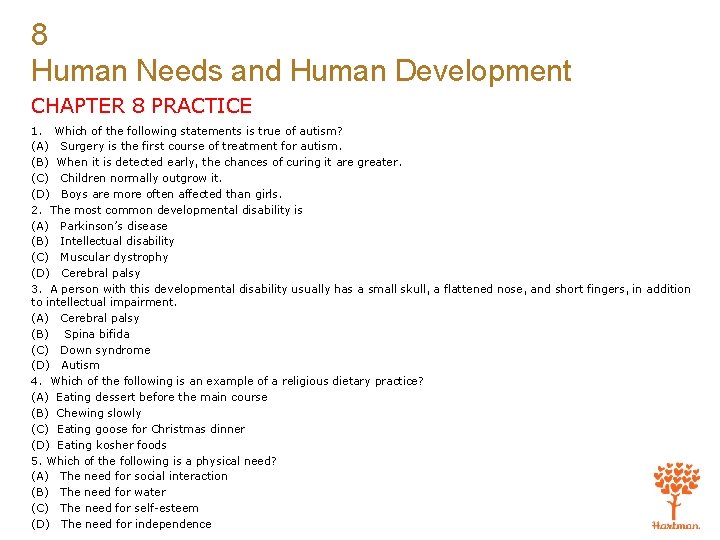
8 Human Needs and Human Development CHAPTER 8 PRACTICE 1. Which of the following statements is true of autism? (A) Surgery is the first course of treatment for autism. (B) When it is detected early, the chances of curing it are greater. (C) Children normally outgrow it. (D) Boys are more often affected than girls. 2. The most common developmental disability is (A) Parkinson’s disease (B) Intellectual disability (C) Muscular dystrophy (D) Cerebral palsy 3. A person with this developmental disability usually has a small skull, a flattened nose, and short fingers, in addition to intellectual impairment. (A) Cerebral palsy (B) Spina bifida (C) Down syndrome (D) Autism 4. Which of the following is an example of a religious dietary practice? (A) Eating dessert before the main course (B) Chewing slowly (C) Eating goose for Christmas dinner (D) Eating kosher foods 5. Which of the following is a physical need? (A) The need for social interaction (B) The need for water (C) The need for self-esteem (D) The need for independence
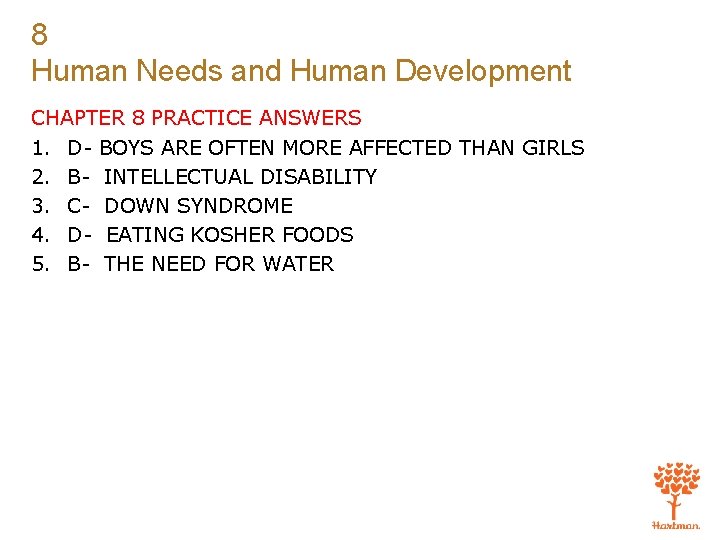
8 Human Needs and Human Development CHAPTER 8 PRACTICE ANSWERS 1. 2. 3. 4. 5. DBCDB- BOYS ARE OFTEN MORE AFFECTED THAN GIRLS INTELLECTUAL DISABILITY DOWN SYNDROME EATING KOSHER FOODS THE NEED FOR WATER