
8 Futurism 2 Visions of the Future Vision

- Slides: 18
8 Futurism
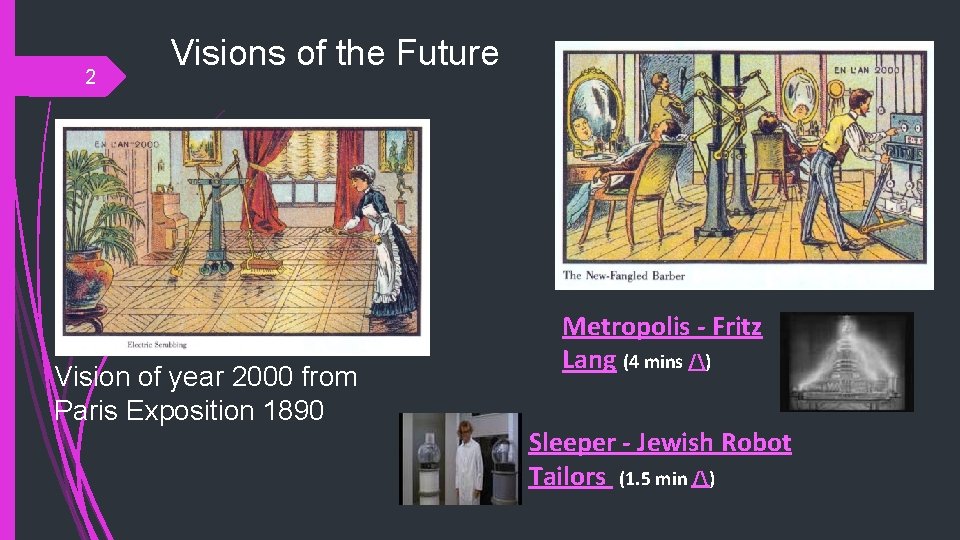
2 Visions of the Future Vision of year 2000 from Paris Exposition 1890 Metropolis - Fritz Lang (4 mins /) Sleeper - Jewish Robot Tailors (1. 5 min /)
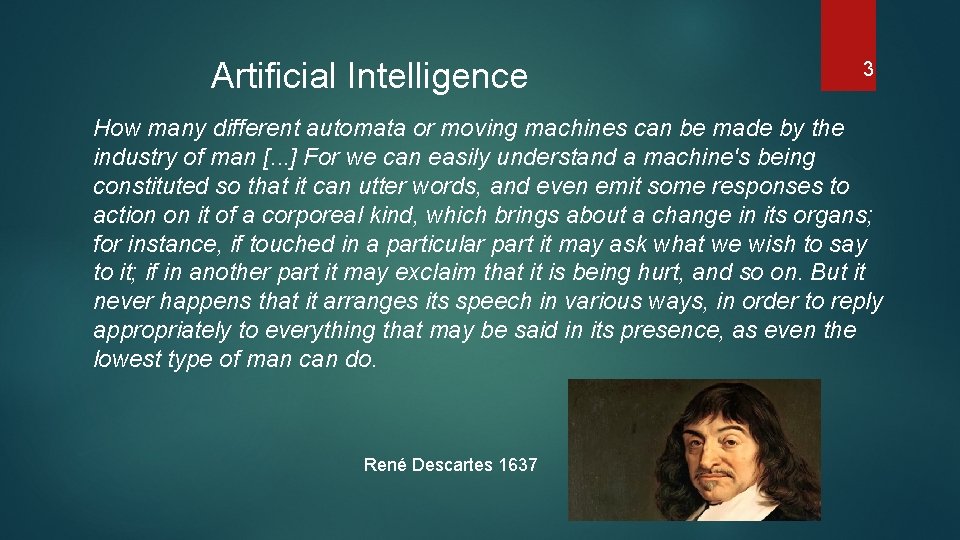
Artificial Intelligence 3 How many different automata or moving machines can be made by the industry of man [. . . ] For we can easily understand a machine's being constituted so that it can utter words, and even emit some responses to action on it of a corporeal kind, which brings about a change in its organs; for instance, if touched in a particular part it may ask what we wish to say to it; if in another part it may exclaim that it is being hurt, and so on. But it never happens that it arranges its speech in various ways, in order to reply appropriately to everything that may be said in its presence, as even the lowest type of man can do. René Descartes 1637
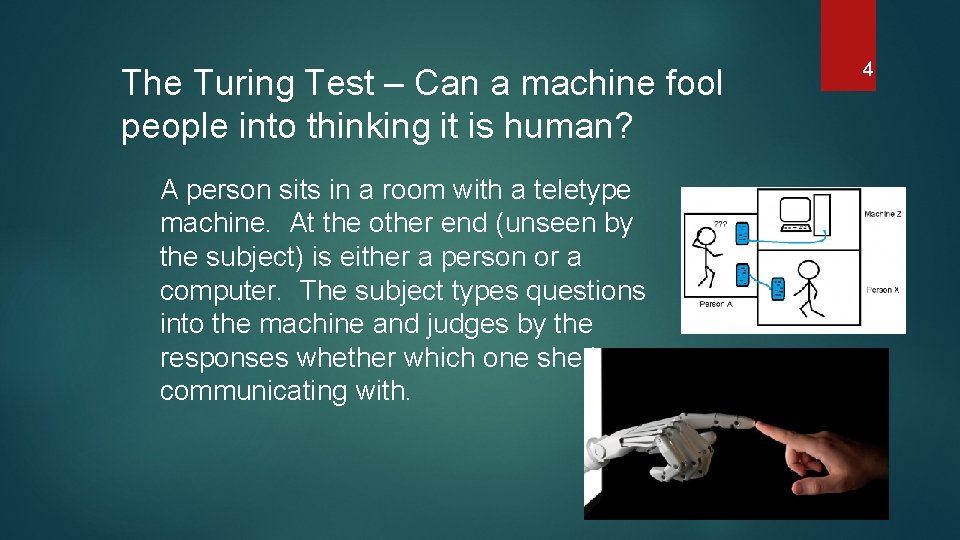
The Turing Test – Can a machine fool people into thinking it is human? A person sits in a room with a teletype machine. At the other end (unseen by the subject) is either a person or a computer. The subject types questions into the machine and judges by the responses whether which one she is communicating with. 4
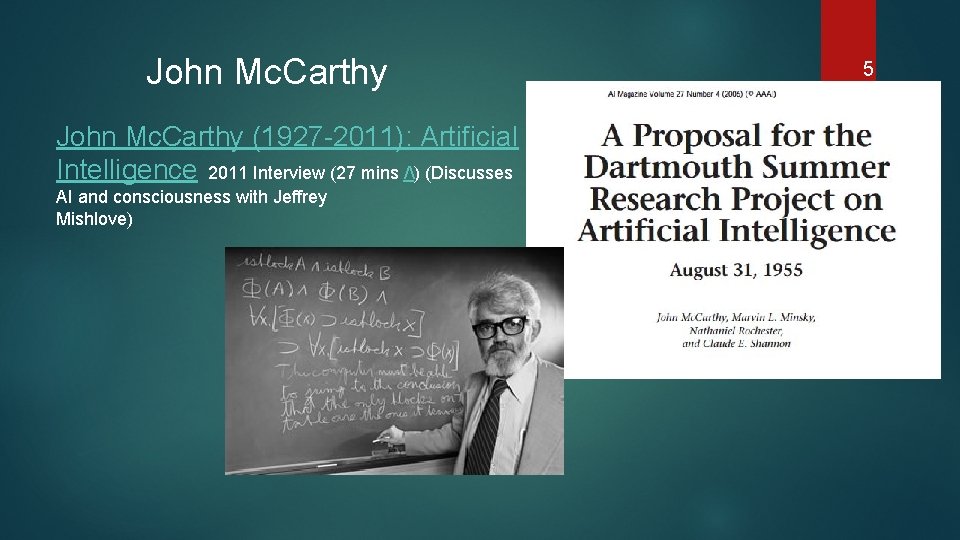
John Mc. Carthy (1927 -2011): Artificial Intelligence 2011 Interview (27 mins /) (Discusses AI and consciousness with Jeffrey Mishlove) 5
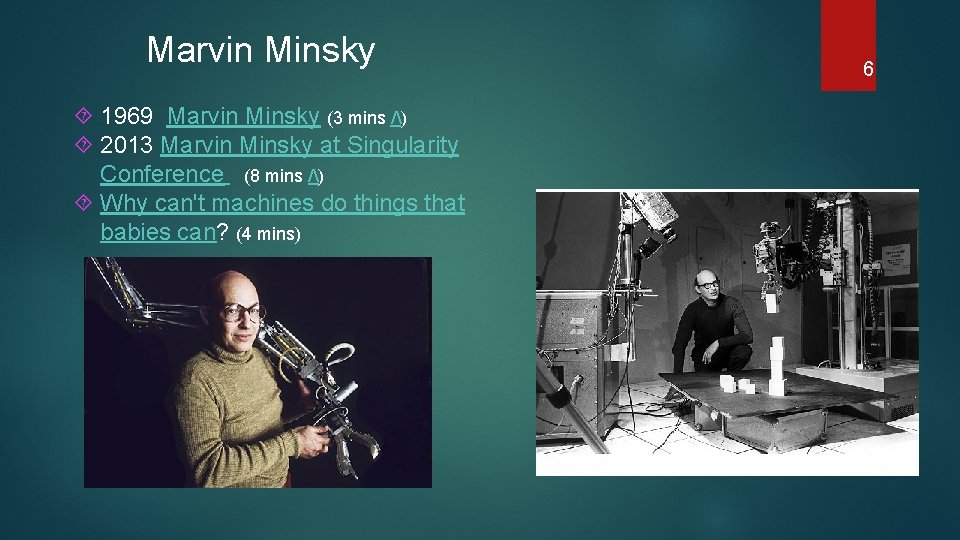
Marvin Minsky 1969 Marvin Minsky (3 mins /) 2013 Marvin Minsky at Singularity Conference (8 mins /) Why can't machines do things that babies can? (4 mins) 6
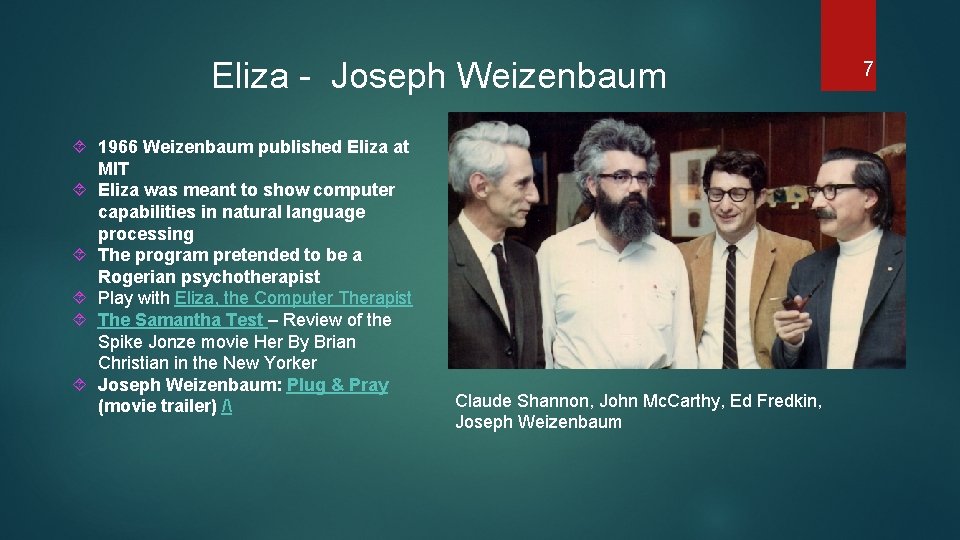
Eliza - Joseph Weizenbaum 1966 Weizenbaum published Eliza at MIT Eliza was meant to show computer capabilities in natural language processing The program pretended to be a Rogerian psychotherapist Play with Eliza, the Computer Therapist The Samantha Test – Review of the Spike Jonze movie Her By Brian Christian in the New Yorker Joseph Weizenbaum: Plug & Pray (movie trailer) / Claude Shannon, John Mc. Carthy, Ed Fredkin, Joseph Weizenbaum 7
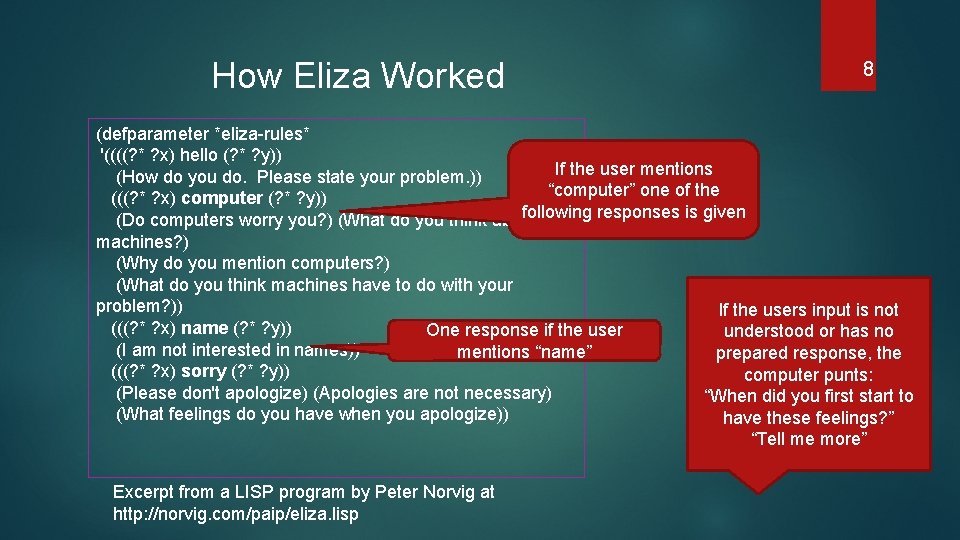
How Eliza Worked 8 (defparameter *eliza-rules* '((((? * ? x) hello (? * ? y)) If the user mentions (How do you do. Please state your problem. )) “computer” one of the (((? * ? x) computer (? * ? y)) following responses is given (Do computers worry you? ) (What do you think about machines? ) (Why do you mention computers? ) (What do you think machines have to do with your problem? )) If the users input is not (((? * ? x) name (? * ? y)) One response if the user understood or has no (I am not interested in names)) mentions “name” prepared response, the (((? * ? x) sorry (? * ? y)) computer punts: (Please don't apologize) (Apologies are not necessary) “When did you first start to (What feelings do you have when you apologize)) have these feelings? ” “Tell me more” Excerpt from a LISP program by Peter Norvig at http: //norvig. com/paip/eliza. lisp
Consciousness Leibniz’ Mill (from section 17 of the Monadology) Moreover, we must confess that perception, and what depends on it, is inexplicable in terms of mechanical reasons, that is, through shapes and motions. If we imagine that there is a machine whose structure makes it think, sense, and have perceptions, we could conceive it enlarged, keeping the same proportions, so that we could enter into it, as one enters into a mill. Assuming that, when inspecting its interior, we will only find parts that push one another, and we will never find anything to explain a perception. And so, we should seek perception in the simple substance and not in the composite or in the machine. 9
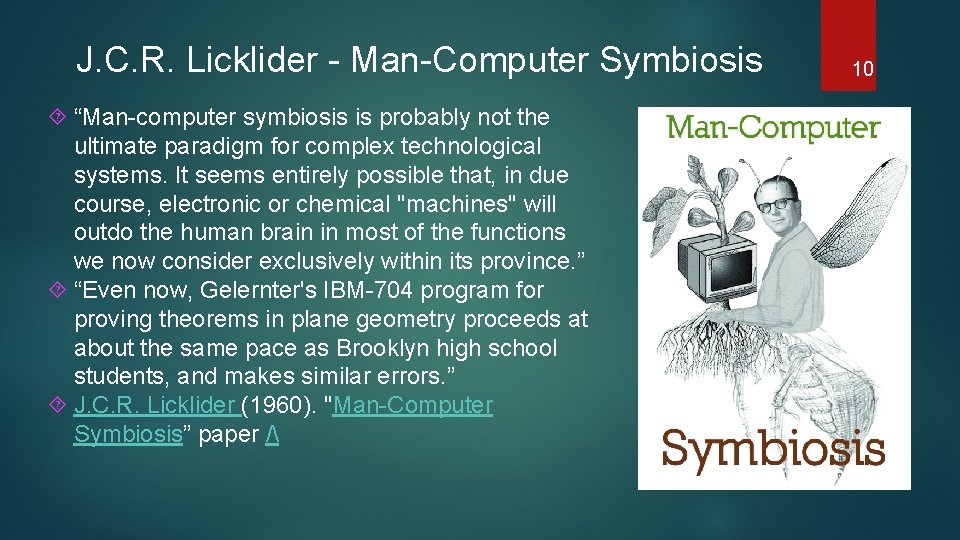
J. C. R. Licklider - Man-Computer Symbiosis “Man-computer symbiosis is probably not the ultimate paradigm for complex technological systems. It seems entirely possible that, in due course, electronic or chemical "machines" will outdo the human brain in most of the functions we now consider exclusively within its province. ” “Even now, Gelernter's IBM-704 program for proving theorems in plane geometry proceeds at about the same pace as Brooklyn high school students, and makes similar errors. ” J. C. R. Licklider (1960). "Man-Computer Symbiosis” paper / 10
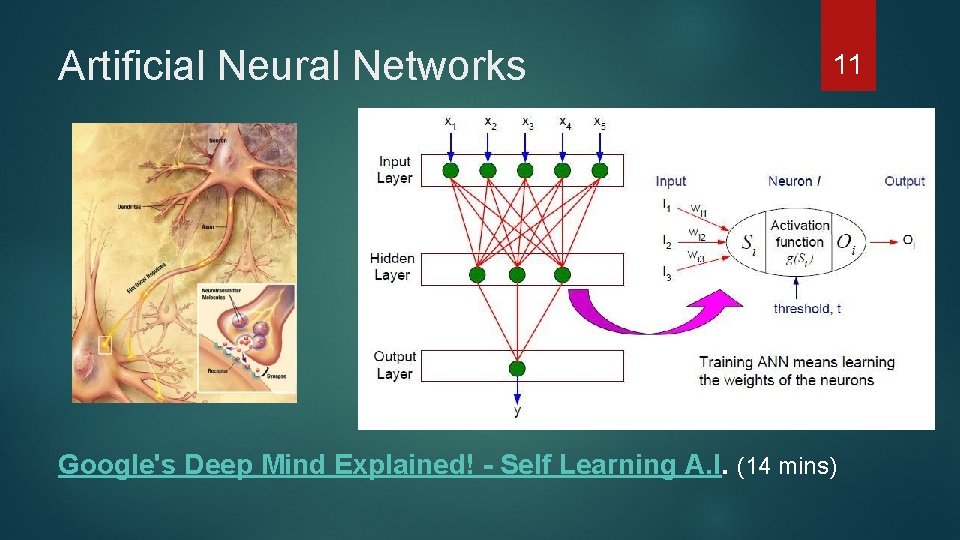
Artificial Neural Networks 11 Google's Deep Mind Explained! - Self Learning A. I. (14 mins)
Elon Musk and Neuralink We are already cyborgs (5 mins /) 12
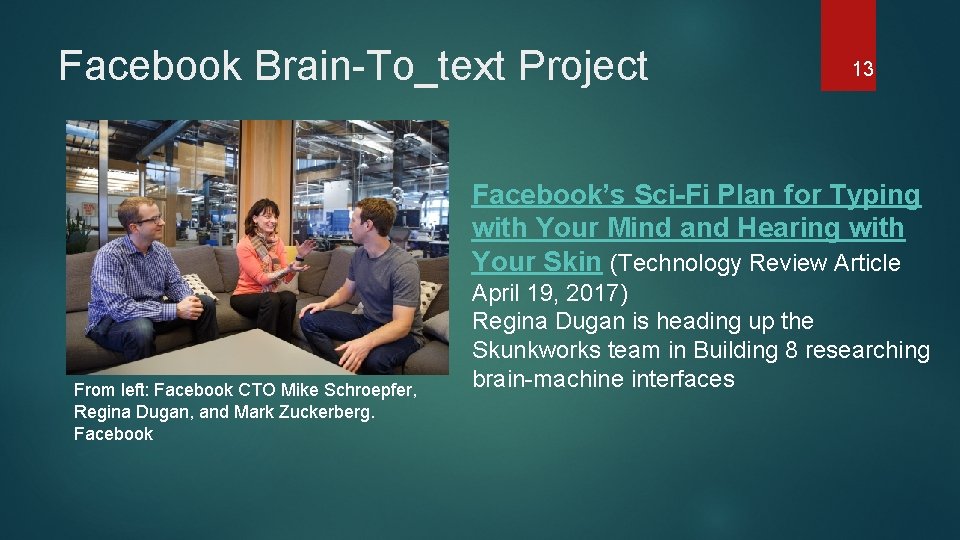
Facebook Brain-To_text Project 13 Facebook’s Sci-Fi Plan for Typing with Your Mind and Hearing with Your Skin (Technology Review Article From left: Facebook CTO Mike Schroepfer, Regina Dugan, and Mark Zuckerberg. Facebook April 19, 2017) Regina Dugan is heading up the Skunkworks team in Building 8 researching brain-machine interfaces
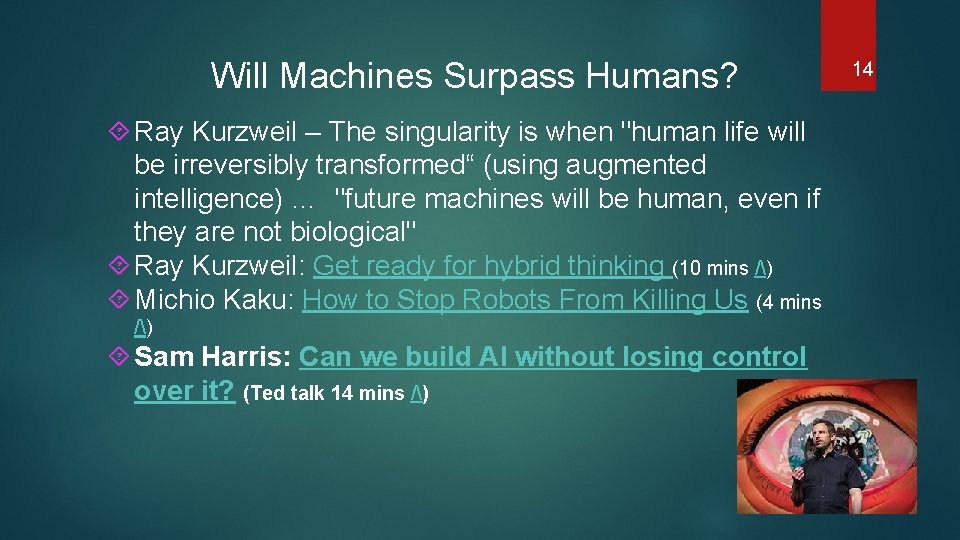
Will Machines Surpass Humans? Ray Kurzweil – The singularity is when "human life will be irreversibly transformed“ (using augmented intelligence) … "future machines will be human, even if they are not biological" Ray Kurzweil: Get ready for hybrid thinking (10 mins /) Michio Kaku: How to Stop Robots From Killing Us (4 mins /) Sam Harris: Can we build AI without losing control over it? (Ted talk 14 mins /) 14
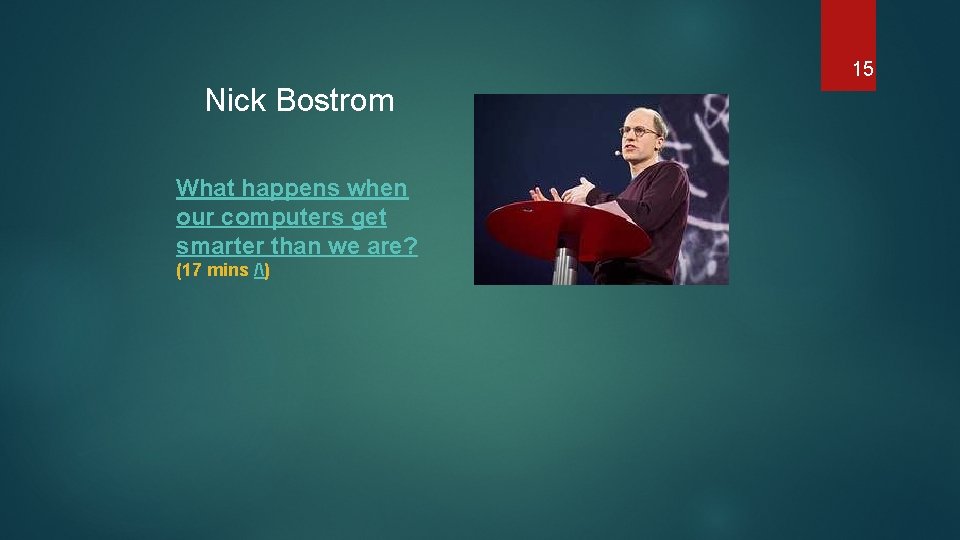
15 Nick Bostrom What happens when our computers get smarter than we are? (17 mins /)
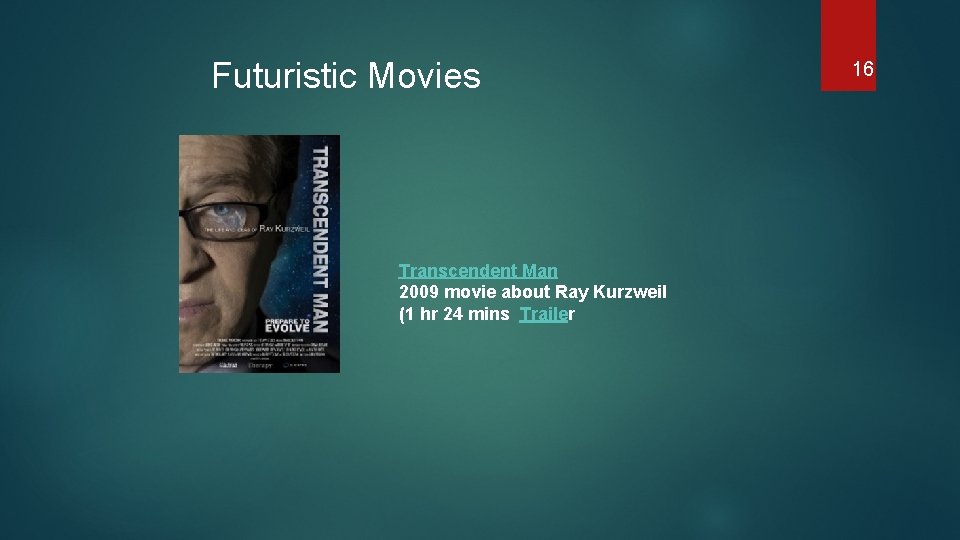
Futuristic Movies Transcendent Man 2009 movie about Ray Kurzweil (1 hr 24 mins Trailer 16
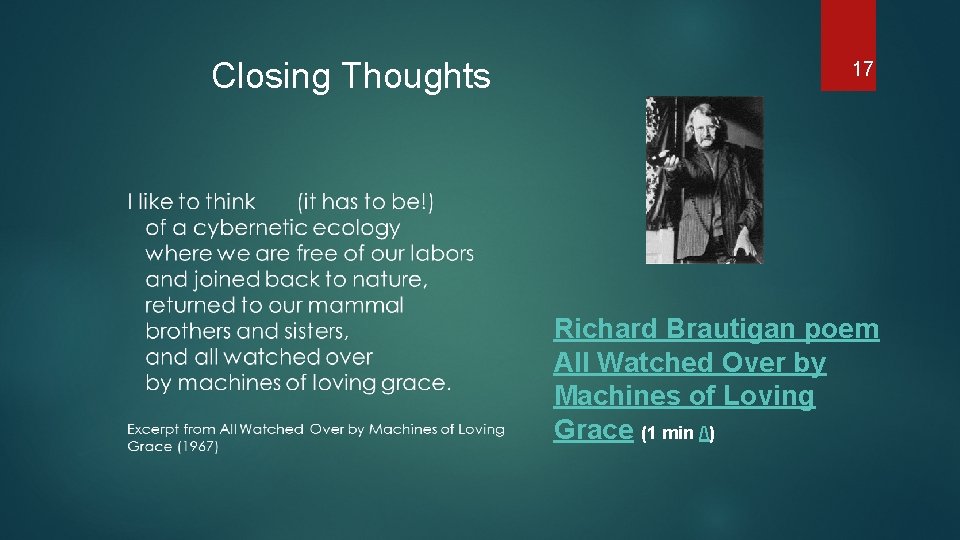
Closing Thoughts 17 Richard Brautigan poem All Watched Over by Machines of Loving Grace (1 min /)
Summing Up 18 1. Early computers 2. Personal computers and the Internet 3. Modeling the World 4. Knowledge for all 5. The Internet of things 6. Kiss privacy goodbye 7. Mavericks and Hacking 8. Artificial Intelligence and Futurism