
8 Chapter Eight The Law of the Conflict



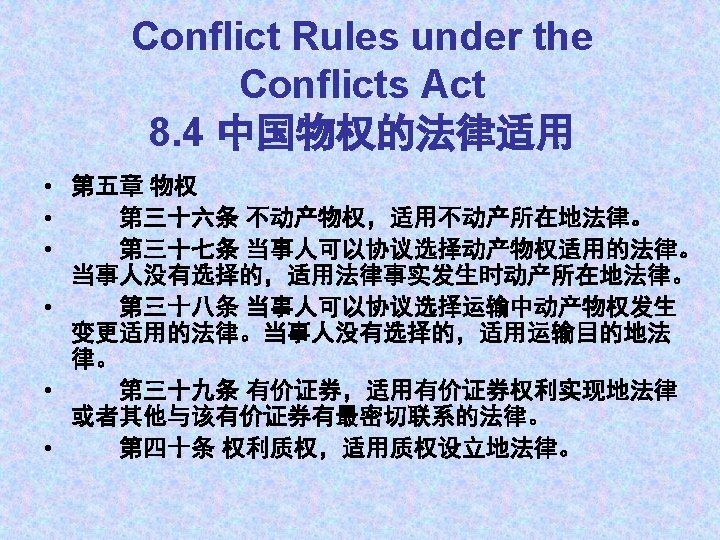
- Slides: 35
第 8讲 物权的法律冲突法 Chapter Eight The Law of the Conflict of Laws for Real Rights
Case study • P owned works of art which were stolen from him in England. They were taken to Italy and sold to X, who was unaware that they were stolen. X sent them to D Co. auctioneers, in England, to sell on his behalf. P brought proceedings against D Co. and X for detinue and conversion.
• X claimed that under the lex situs rule, the validity of the transfer of movable property was governed by the law of the country where the goods were situated, and Italian law should apply to decide the question of ownership as between X and P.
Case study • P argued that there has been no disposition from P to X, that because the case had so close a connection with England, English law should be treated as the lex situs, and that an exception should be made to the lex situs rule on the grounds of public policy where property was stolen.
• The court held that there was no exception to the lex situs rule in these circumstances, and there was a binding disposition according to the lex situs, which was therefore binding everywhere, and the court would not introduce a wholly fictional English situs merely because there were a number of English connecting factors.
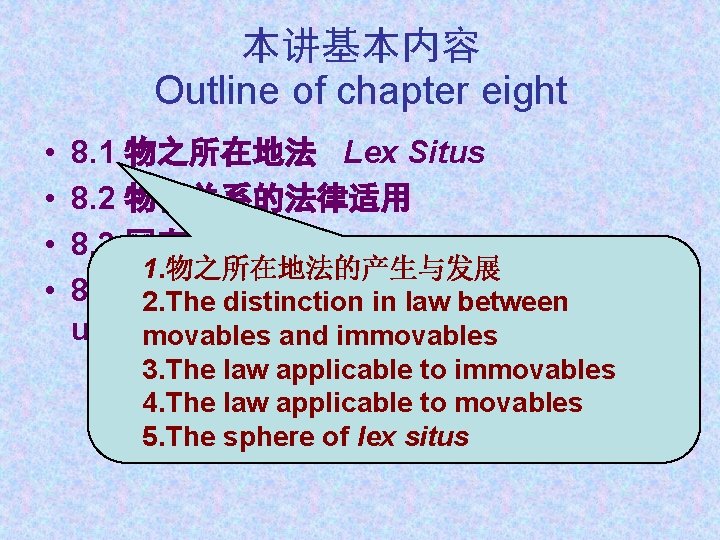
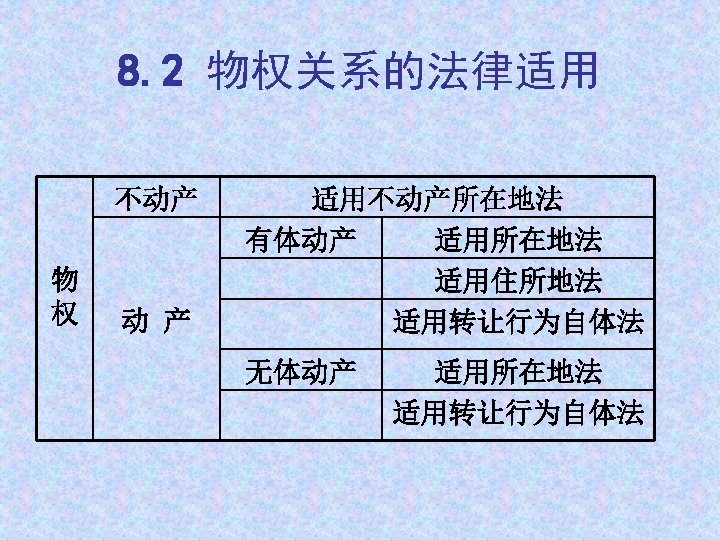
本讲基本内容 Outline of chapter eight • • 8. 1 物之所在地法 Lex Situs 8. 2 物权关系的法律适用 8. 3 国有化问题 1. 物之所在地法的产生与发展 8. 4 中国物权的法律适用 2. The distinction in law. Conflict between. Rules under Chineseand Law movables immovables 3. The law applicable to immovables 4. The law applicable to movables 5. The sphere of lex situs
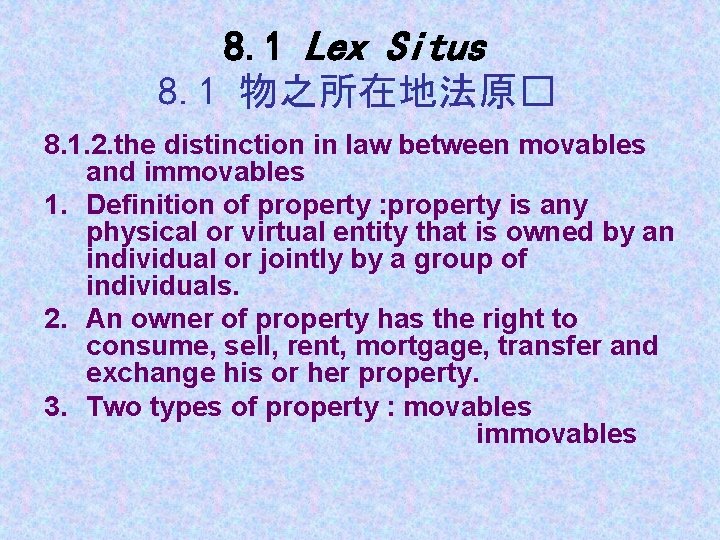
8. 1 Lex Situs 8. 1 物之所在地法原� 8. 1. 2. the distinction in law between movables and immovables 1. Definition of property : property is any physical or virtual entity that is owned by an individual or jointly by a group of individuals. 2. An owner of property has the right to consume, sell, rent, mortgage, transfer and exchange his or her property. 3. Two types of property : movables immovables
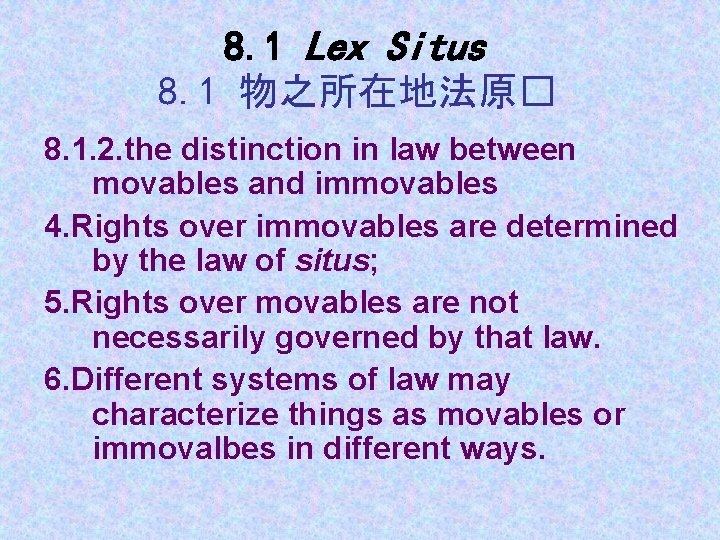
8. 1 Lex Situs 8. 1 物之所在地法原� 8. 1. 2. the distinction in law between movables and immovables 4. Rights over immovables are determined by the law of situs; 5. Rights over movables are not necessarily governed by that law. 6. Different systems of law may characterize things as movables or immovalbes in different ways.
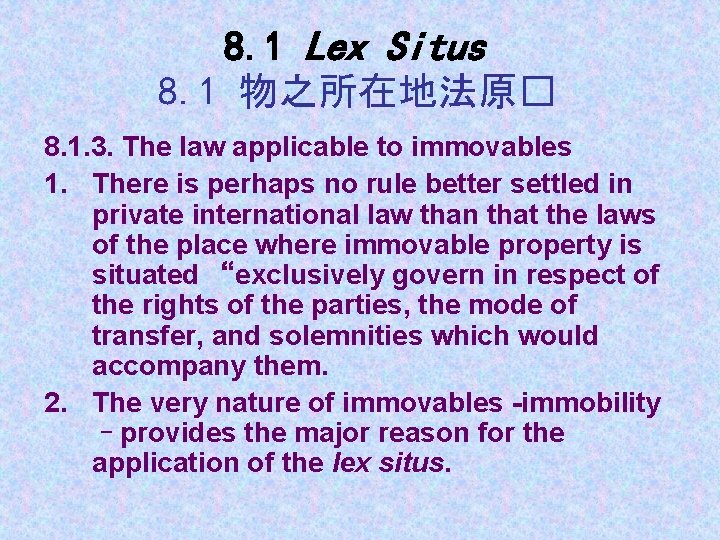
8. 1 Lex Situs 8. 1 物之所在地法原� 8. 1. 3. The law applicable to immovables 1. There is perhaps no rule better settled in private international law than that the laws of the place where immovable property is situated “exclusively govern in respect of the rights of the parties, the mode of transfer, and solemnities which would accompany them. 2. The very nature of immovables -immobility –provides the major reason for the application of the lex situs.
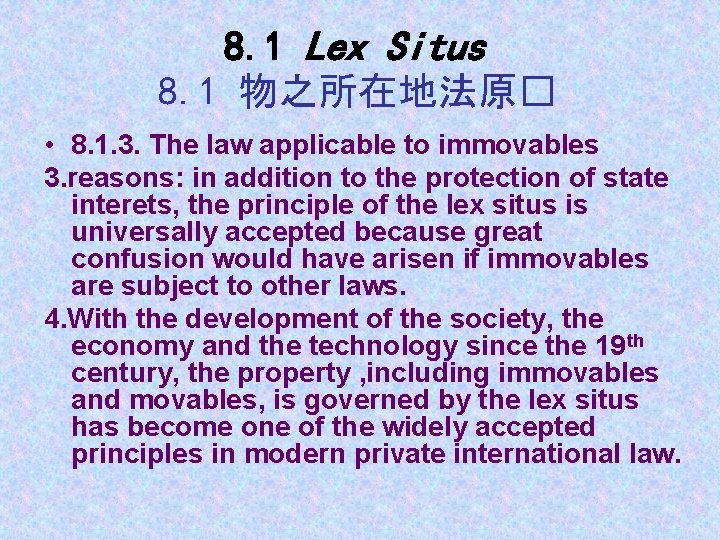
8. 1 Lex Situs 8. 1 物之所在地法原� • 8. 1. 3. The law applicable to immovables 3. reasons: in addition to the protection of state interets, the principle of the lex situs is universally accepted because great confusion would have arisen if immovables are subject to other laws. 4. With the development of the society, the economy and the technology since the 19 th century, the property , including immovables and movables, is governed by the lex situs has become one of the widely accepted principles in modern private international law.
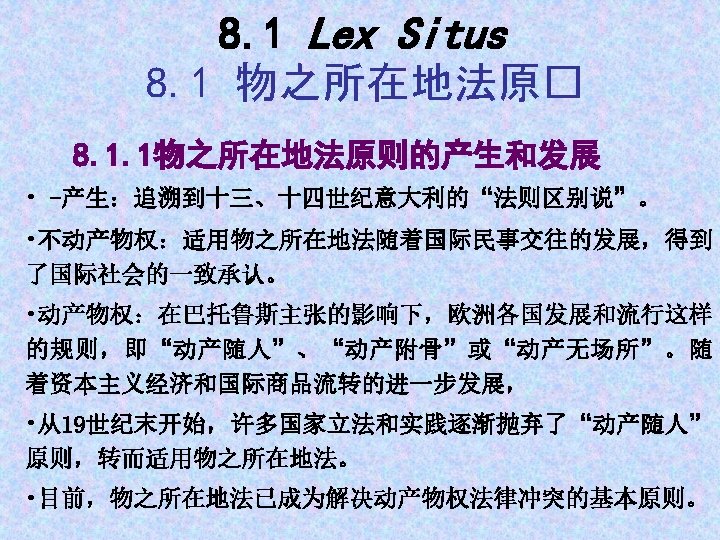
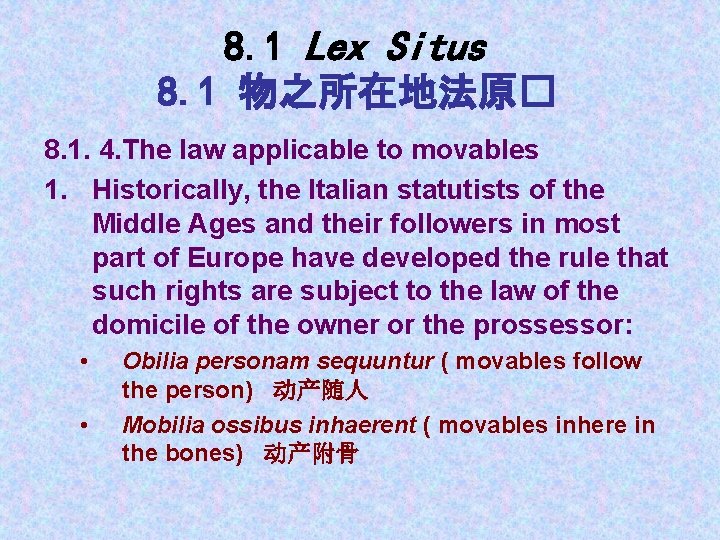
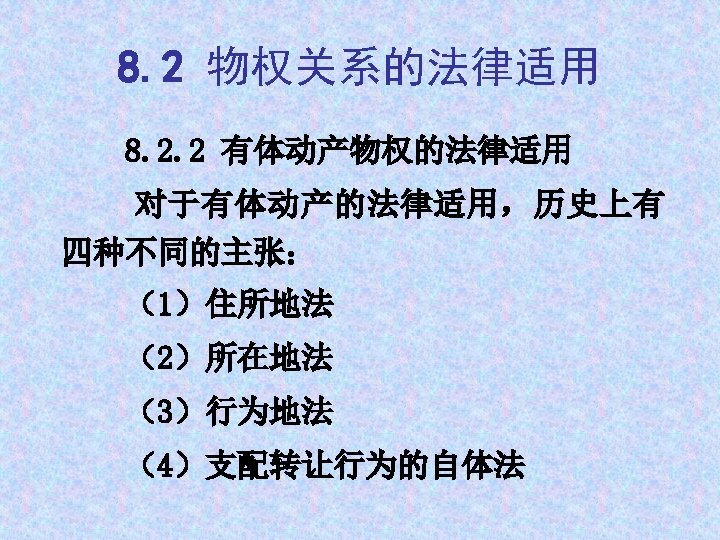
8. 1 Lex Situs 8. 1 物之所在地法原� 8. 1. 4. The law applicable to movables 1. Historically, the Italian statutists of the Middle Ages and their followers in most part of Europe have developed the rule that such rights are subject to the law of the domicile of the owner or the prossessor: • • Obilia personam sequuntur ( movables follow the person) 动产随人 Mobilia ossibus inhaerent ( movables inhere in the bones) 动产附骨
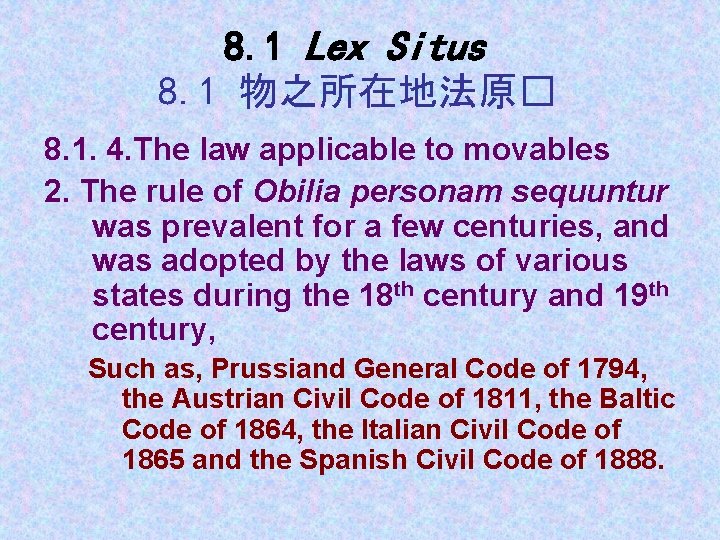
8. 1 Lex Situs 8. 1 物之所在地法原� 8. 1. 4. The law applicable to movables 2. The rule of Obilia personam sequuntur was prevalent for a few centuries, and was adopted by the laws of various states during the 18 th century and 19 th century, Such as, Prussiand General Code of 1794, the Austrian Civil Code of 1811, the Baltic Code of 1864, the Italian Civil Code of 1865 and the Spanish Civil Code of 1888.
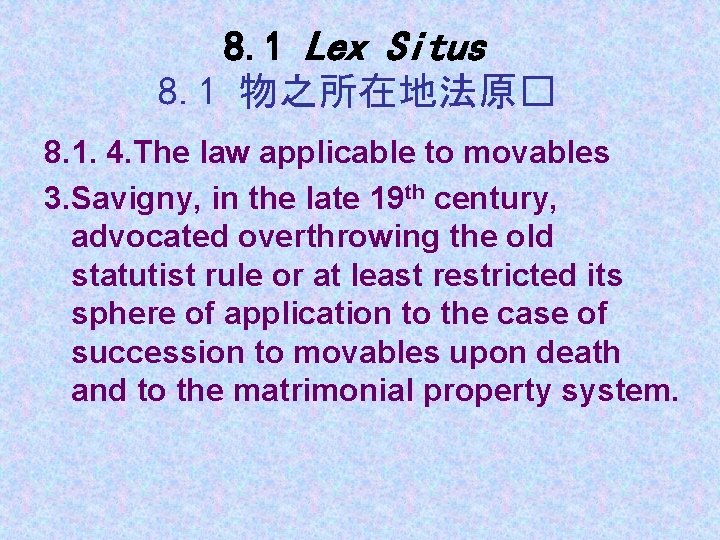
8. 1 Lex Situs 8. 1 物之所在地法原� 8. 1. 4. The law applicable to movables 3. Savigny, in the late 19 th century, advocated overthrowing the old statutist rule or at least restricted its sphere of application to the case of succession to movables upon death and to the matrimonial property system.
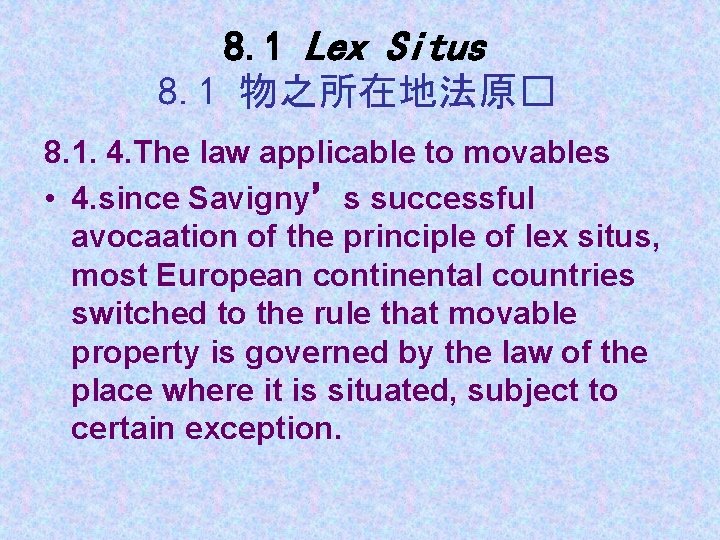
8. 1 Lex Situs 8. 1 物之所在地法原� 8. 1. 4. The law applicable to movables • 4. since Savigny’s successful avocaation of the principle of lex situs, most European continental countries switched to the rule that movable property is governed by the law of the place where it is situated, subject to certain exception.
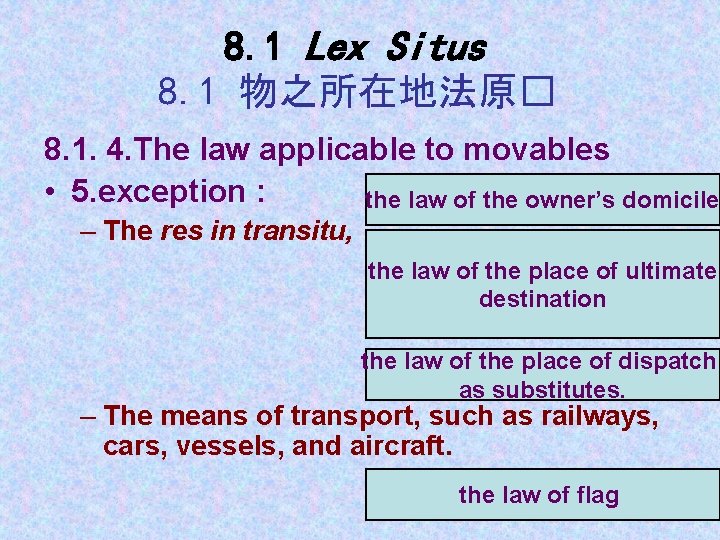
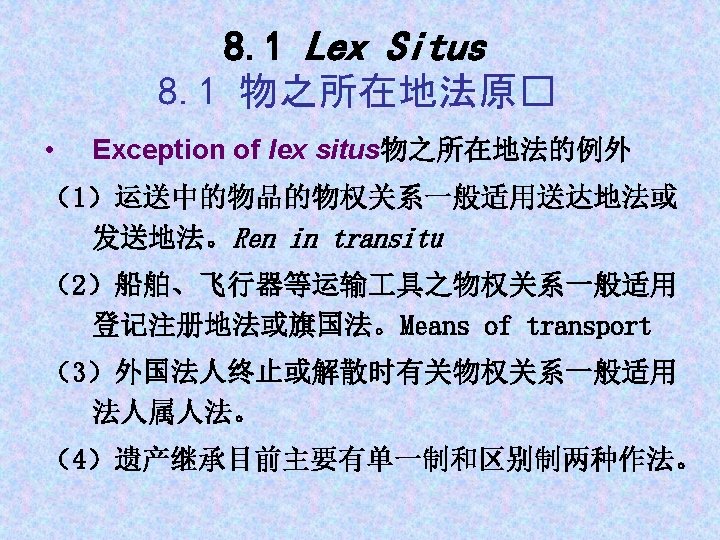
8. 1 Lex Situs 8. 1 物之所在地法原� 8. 1. 4. The law applicable to movables • 5. exception : the law of the owner’s domicile – The res in transitu, the law of the place of ultimate destination the law of the place of dispatch as substitutes. – The means of transport, such as railways, cars, vessels, and aircraft. the law of flag
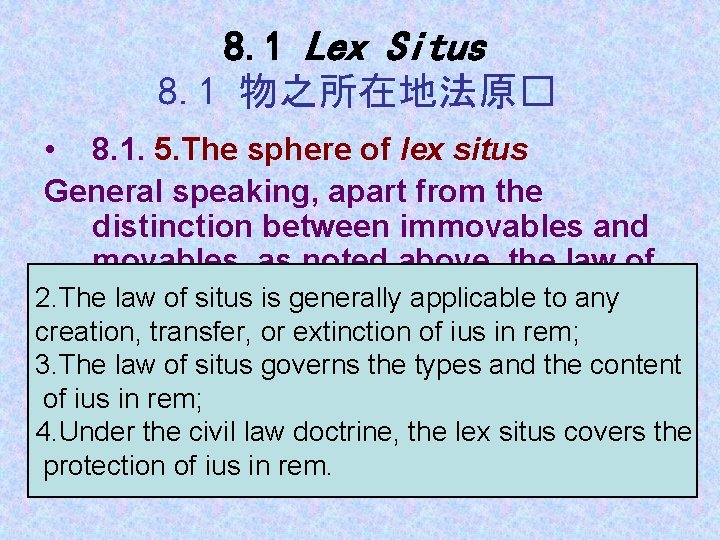
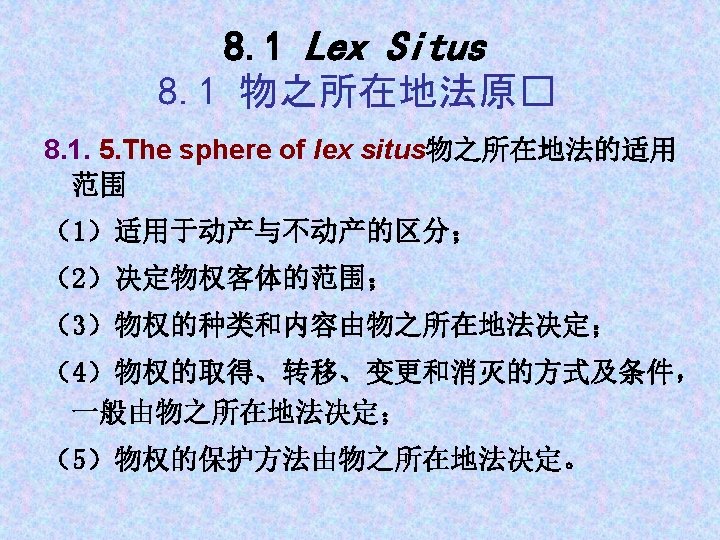
8. 1 Lex Situs 8. 1 物之所在地法原� • 8. 1. 5. The sphere of lex situs General speaking, apart from the distinction between immovables and movables, as noted above, the law of situs whole field oftoius 2. The law ofcovers situs is the generally applicable anyin rem, transfer, which or may be analyzed as creation, extinction of ius in rem; 3. The law of situs governs the types and the content follows: of ius rem; 1. in The law of situs decides the specific 4. Underrange the civil law doctrine, lex situs covers of rights as the objects of ius in the rem; of ius in rem. protection
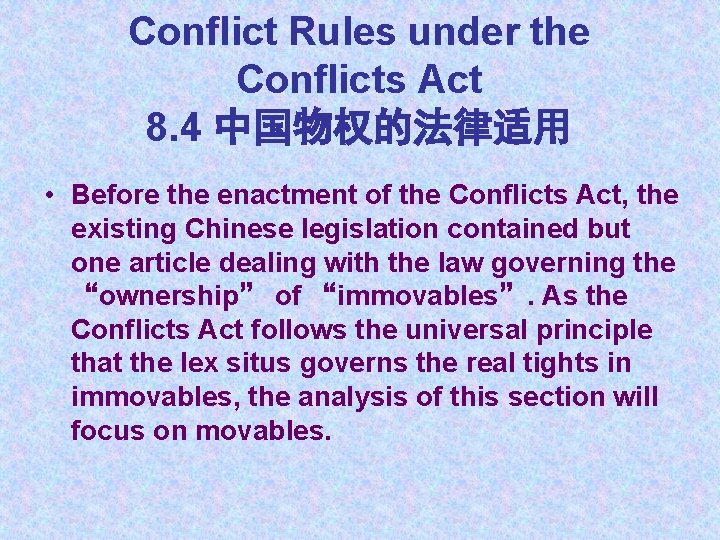
Conflict Rules under the Conflicts Act 8. 4 中国物权的法律适用 • Before the enactment of the Conflicts Act, the existing Chinese legislation contained but one article dealing with the law governing the “ownership” of “immovables”. As the Conflicts Act follows the universal principle that the lex situs governs the real tights in immovables, the analysis of this section will focus on movables.
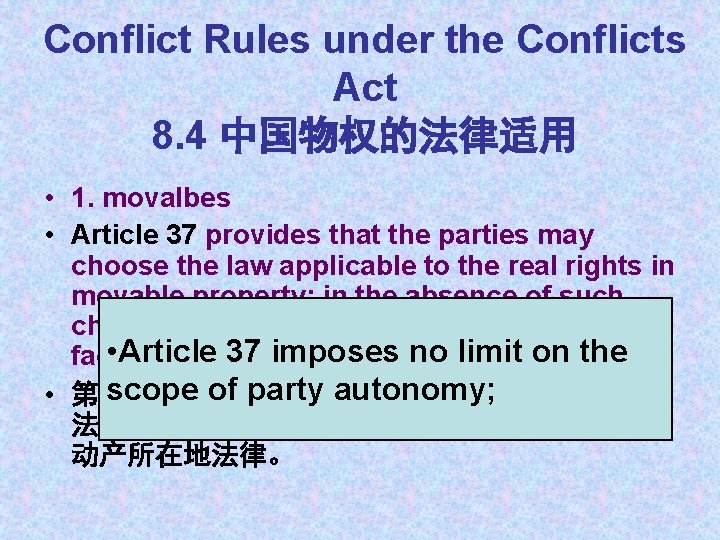
Conflict Rules under the Conflicts Act 8. 4 中国物权的法律适用 • 1. movalbes • Article 37 provides that the parties may choose the law applicable to the real rights in movable property; in the absence of such choice, the lex situs at the time that the legal • Article 37 applies. imposes no limit on the fact occurred scope of party autonomy; • 第三十七条 当事人可以协议选择动产物权适用的 法律。当事人没有选择的,适用法律事实发生时 动产所在地法律。
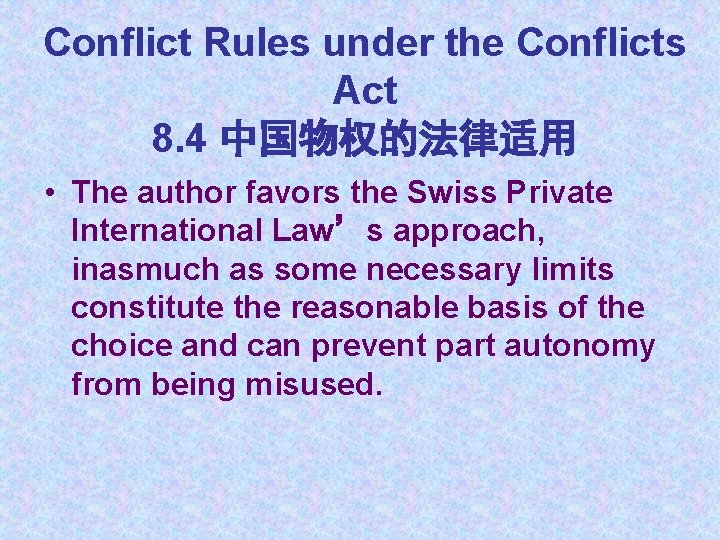
Conflict Rules under the Conflicts Act 8. 4 中国物权的法律适用 • The author favors the Swiss Private International Law’s approach, inasmuch as some necessary limits constitute the reasonable basis of the choice and can prevent part autonomy from being misused.
Conflict Rules under the Conflicts Act 8. 4 中国物权的法律适用 • Swiss approach spells out the limits of the parties choice. – – – the paries cannot choose a law that has no substantial relationship with the property of the underlying legal transaction. Swiss law specifies that the extent and the exercise of interests in movable property shall be governed by the lex situs. Swiss law states unambiguously that the choice of law shall not be applied against a third party.
Conflict Rules under the Conflicts Act 8. 4 中国物权的法律适用 • 2. res in transitu and commercail securities • When goods in transit are at issue, the parties are entitled to choose the law applicable to the change of real tights; in absence of parties choice; the law of the country of destination shall apply.
Conflict Rules under the Conflicts Act 8. 4 中国物权的法律适用 • The Conflicts Act provides conflict rules for commercial securities under which such securities shall be governed by the law of the place where the rights are to be exercised or the law which is most closely connected with the securities.
Conflict Rules under the Conflicts Act 8. 中国物权的法律适用