
8 Applications of Trigonometry Sections 8 5 8
- Slides: 72
8 Applications of Trigonometry Sections 8. 5– 8. 8 © 2008 Pearson Addison-Wesley. All rights reserved
8 Applications of Trigonometry 8. 5 Trigonometric (Polar) Form of Complex Numbers; Products and Quotients 8. 6 De Moivre’s Theorem; Powers and Roots of Complex Numbers 8. 7 Polar Equations and Graphs 8. 8 Parametric Equations, Graphs, and Applications 63 Copyright © 2008 Pearson Addison-Wesley. All rights reserved.
8. 5 Trigonometric (Polar) Form of Complex Numbers; Products and Quotients The Complex Plane and Vector Representation ▪ Trigonometric (Polar) Form ▪ Fractals ▪ Products of Complex Numbers in Trigonometric Form ▪ Quotients of Complex Numbers in Trigonometric Form 64 Copyright © 2008 Pearson Addison-Wesley. All rights reserved.
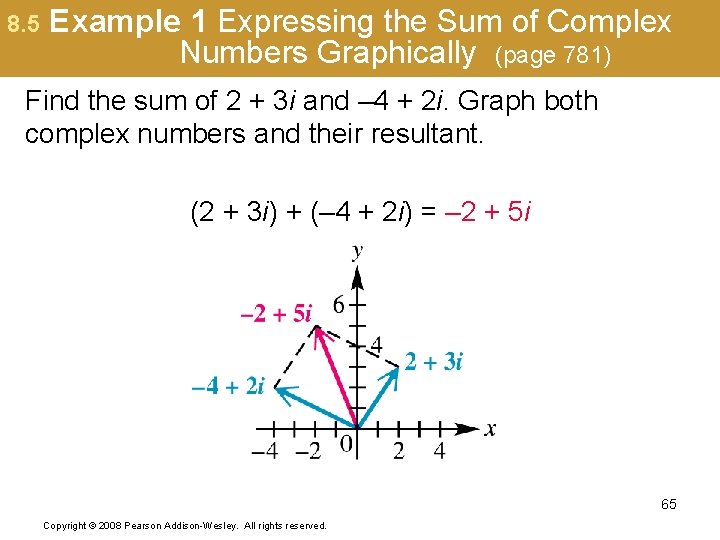
8. 5 Example 1 Expressing the Sum of Complex Numbers Graphically (page 781) Find the sum of 2 + 3 i and – 4 + 2 i. Graph both complex numbers and their resultant. (2 + 3 i) + (– 4 + 2 i) = – 2 + 5 i 65 Copyright © 2008 Pearson Addison-Wesley. All rights reserved.
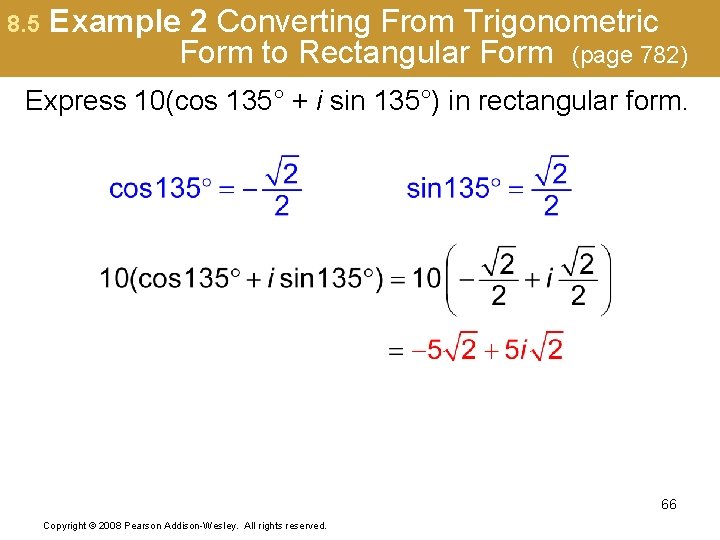
8. 5 Example 2 Converting From Trigonometric Form to Rectangular Form (page 782) Express 10(cos 135° + i sin 135°) in rectangular form. 66 Copyright © 2008 Pearson Addison-Wesley. All rights reserved.
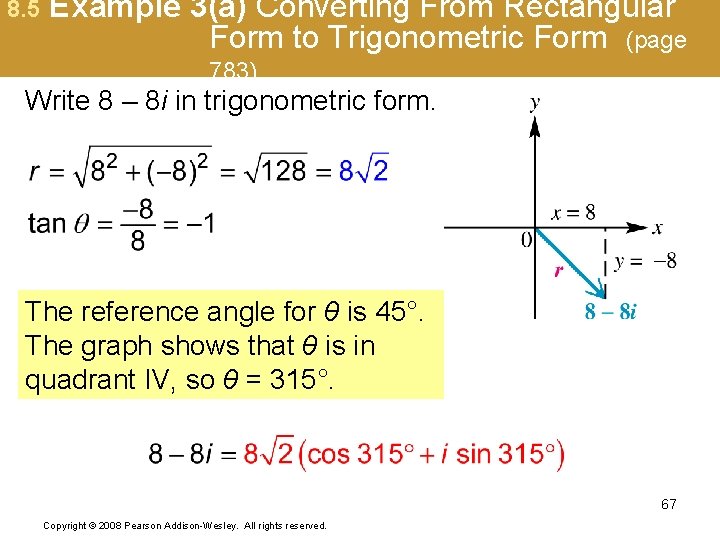
8. 5 Example 3(a) Converting From Rectangular Form to Trigonometric Form (page 783) Write 8 – 8 i in trigonometric form. The reference angle for θ is 45°. The graph shows that θ is in quadrant IV, so θ = 315°. 67 Copyright © 2008 Pearson Addison-Wesley. All rights reserved.
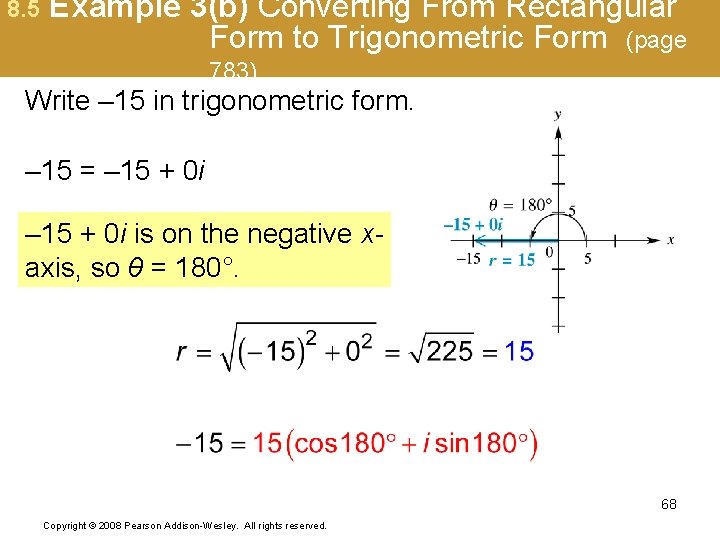
8. 5 Example 3(b) Converting From Rectangular Form to Trigonometric Form (page 783) Write – 15 in trigonometric form. – 15 = – 15 + 0 i is on the negative xaxis, so θ = 180°. 68 Copyright © 2008 Pearson Addison-Wesley. All rights reserved.
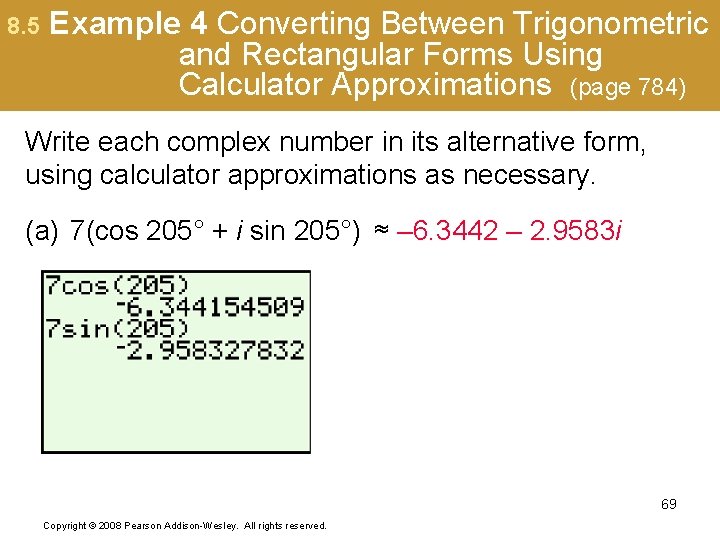
8. 5 Example 4 Converting Between Trigonometric and Rectangular Forms Using Calculator Approximations (page 784) Write each complex number in its alternative form, using calculator approximations as necessary. (a) 7(cos 205° + i sin 205°) ≈ – 6. 3442 – 2. 9583 i 69 Copyright © 2008 Pearson Addison-Wesley. All rights reserved.
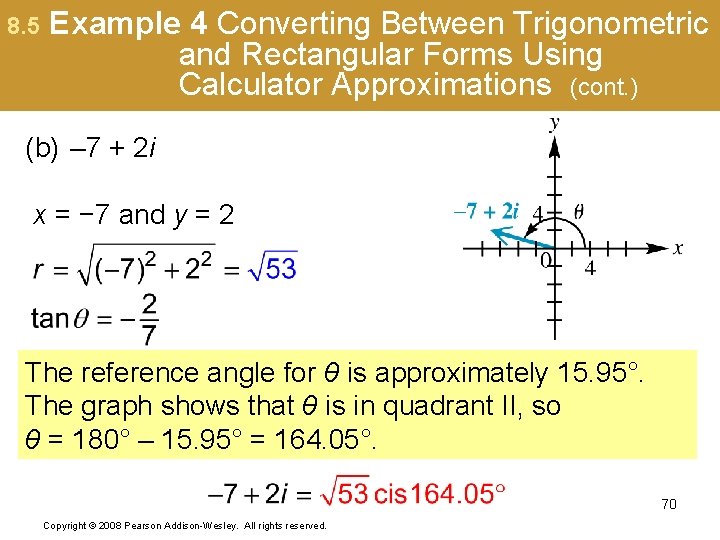
8. 5 Example 4 Converting Between Trigonometric and Rectangular Forms Using Calculator Approximations (cont. ) (b) – 7 + 2 i x = − 7 and y = 2 The reference angle for θ is approximately 15. 95°. The graph shows that θ is in quadrant II, so θ = 180° – 15. 95° = 164. 05°. 70 Copyright © 2008 Pearson Addison-Wesley. All rights reserved.
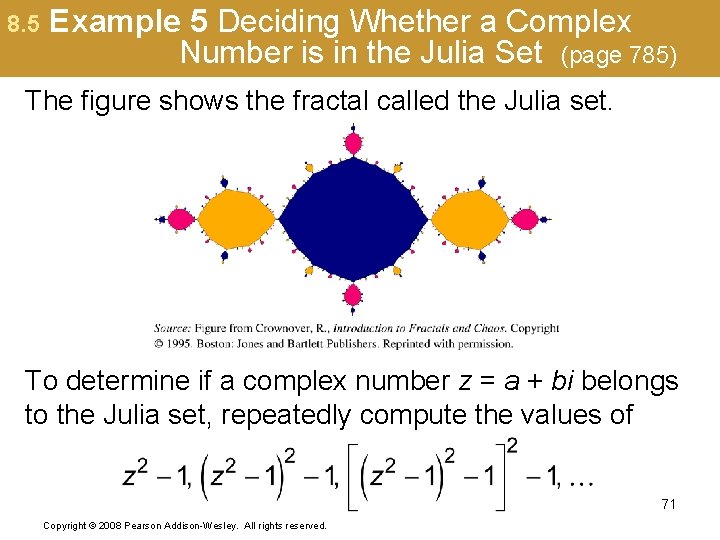
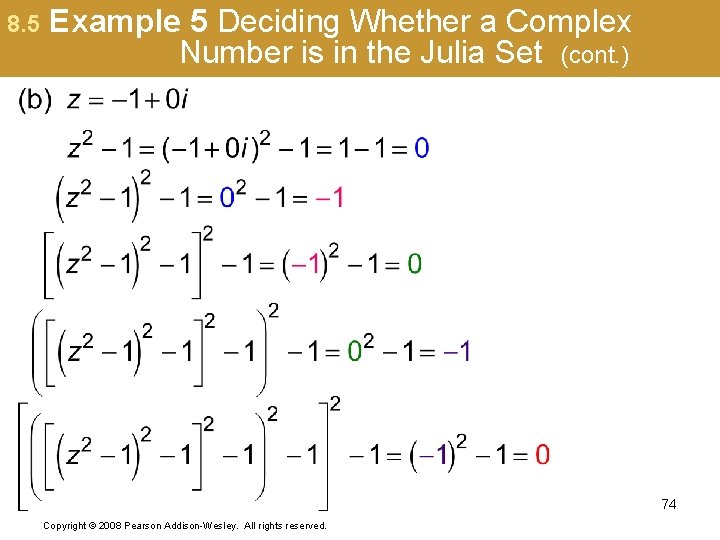
8. 5 Example 5 Deciding Whether a Complex Number is in the Julia Set (page 785) The figure shows the fractal called the Julia set. To determine if a complex number z = a + bi belongs to the Julia set, repeatedly compute the values of 71 Copyright © 2008 Pearson Addison-Wesley. All rights reserved.
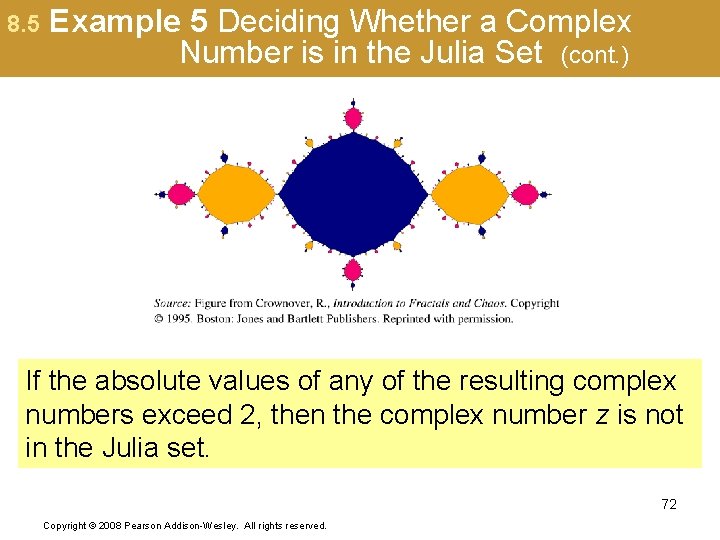
8. 5 Example 5 Deciding Whether a Complex Number is in the Julia Set (cont. ) If the absolute values of any of the resulting complex numbers exceed 2, then the complex number z is not in the Julia set. 72 Copyright © 2008 Pearson Addison-Wesley. All rights reserved.
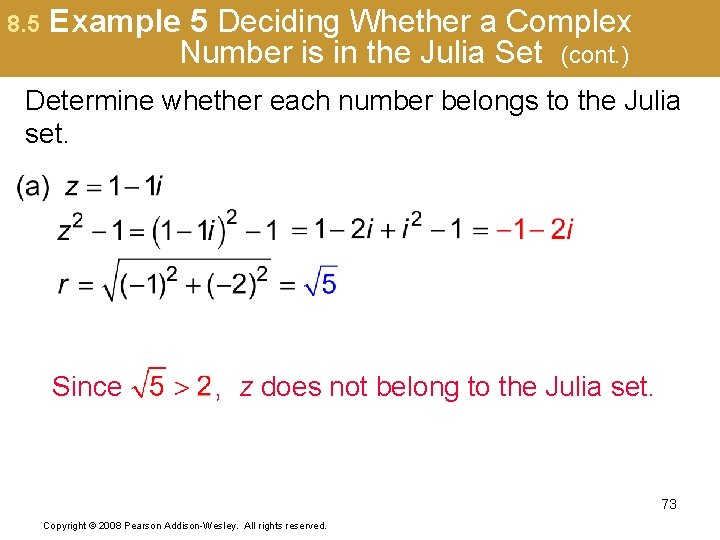
8. 5 Example 5 Deciding Whether a Complex Number is in the Julia Set (cont. ) Determine whether each number belongs to the Julia set. Since , z does not belong to the Julia set. 73 Copyright © 2008 Pearson Addison-Wesley. All rights reserved.
8. 5 Example 5 Deciding Whether a Complex Number is in the Julia Set (cont. ) 74 Copyright © 2008 Pearson Addison-Wesley. All rights reserved.
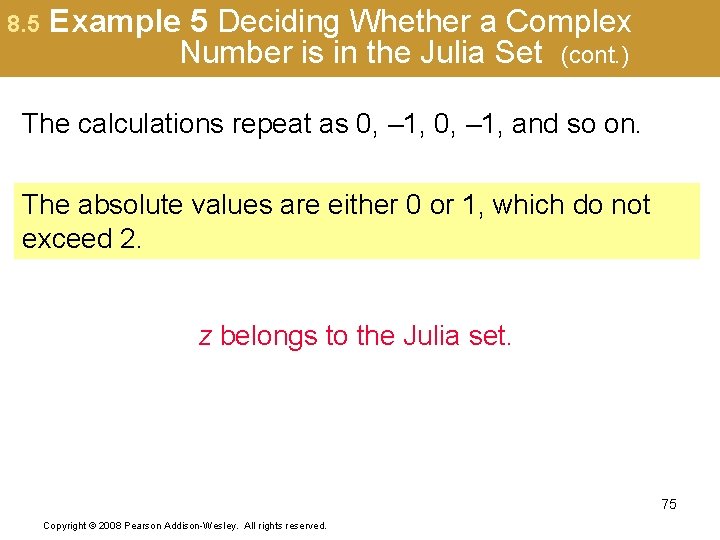
8. 5 Example 5 Deciding Whether a Complex Number is in the Julia Set (cont. ) The calculations repeat as 0, – 1, and so on. The absolute values are either 0 or 1, which do not exceed 2. z belongs to the Julia set. 75 Copyright © 2008 Pearson Addison-Wesley. All rights reserved.
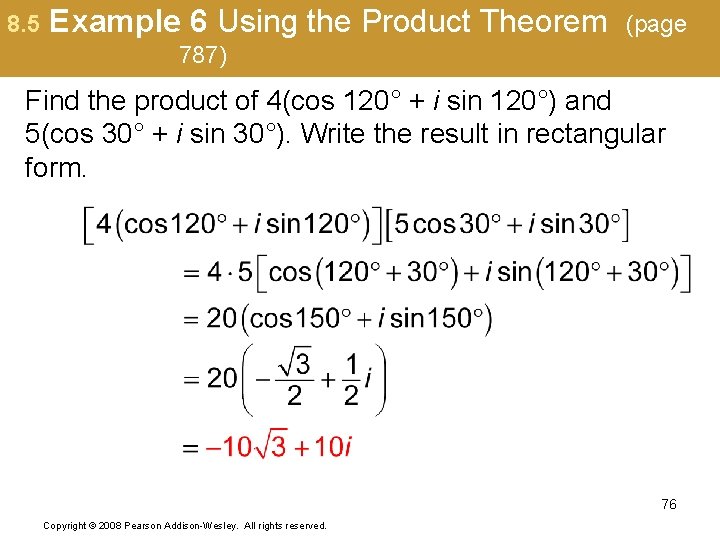
8. 5 Example 6 Using the Product Theorem (page 787) Find the product of 4(cos 120° + i sin 120°) and 5(cos 30° + i sin 30°). Write the result in rectangular form. 76 Copyright © 2008 Pearson Addison-Wesley. All rights reserved.
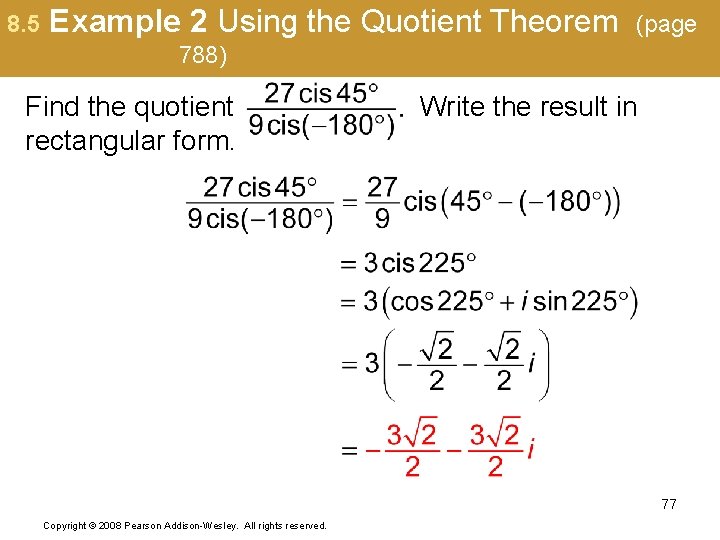
8. 5 Example 2 Using the Quotient Theorem (page 788) Find the quotient rectangular form. Write the result in 77 Copyright © 2008 Pearson Addison-Wesley. All rights reserved.
8. 6 De Moivre’s Theorem; Powers and Roots of Complex Numbers Powers of Complex Numbers (De Moivre’s Theorem) ▪ Roots of Complex Numbers 78 Copyright © 2008 Pearson Addison-Wesley. All rights reserved.
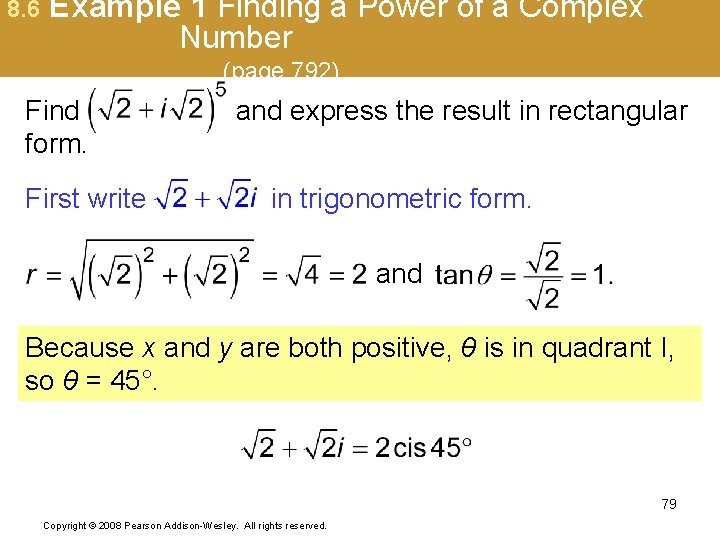
8. 6 Example 1 Finding a Power of a Complex Number (page 792) Find form. First write and express the result in rectangular in trigonometric form. and Because x and y are both positive, θ is in quadrant I, so θ = 45°. 79 Copyright © 2008 Pearson Addison-Wesley. All rights reserved.
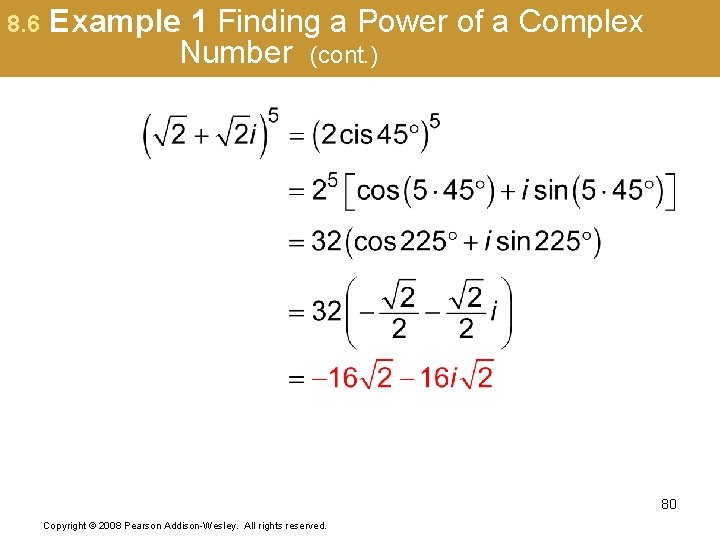
8. 6 Example 1 Finding a Power of a Complex Number (cont. ) 80 Copyright © 2008 Pearson Addison-Wesley. All rights reserved.
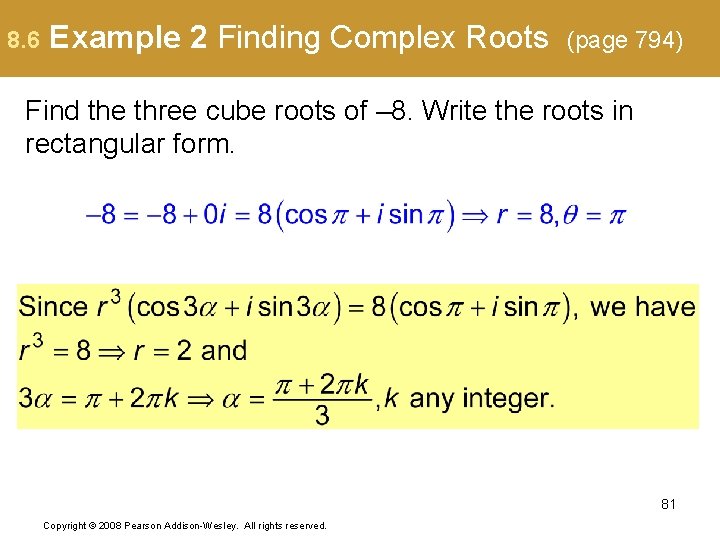
8. 6 Example 2 Finding Complex Roots (page 794) Find the three cube roots of – 8. Write the roots in rectangular form. 81 Copyright © 2008 Pearson Addison-Wesley. All rights reserved.
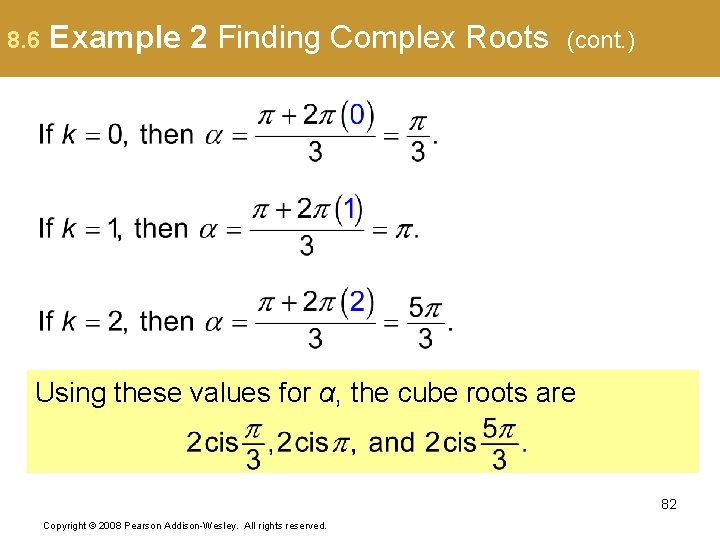
8. 6 Example 2 Finding Complex Roots (cont. ) Using these values for α, the cube roots are 82 Copyright © 2008 Pearson Addison-Wesley. All rights reserved.
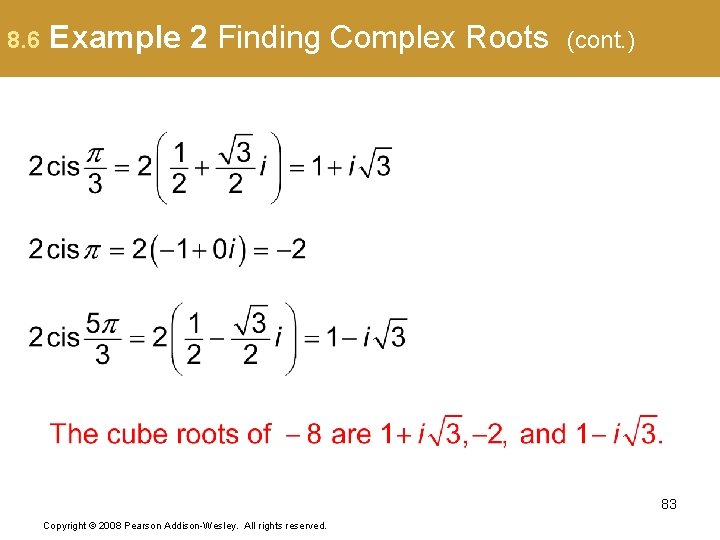
8. 6 Example 2 Finding Complex Roots (cont. ) 83 Copyright © 2008 Pearson Addison-Wesley. All rights reserved.
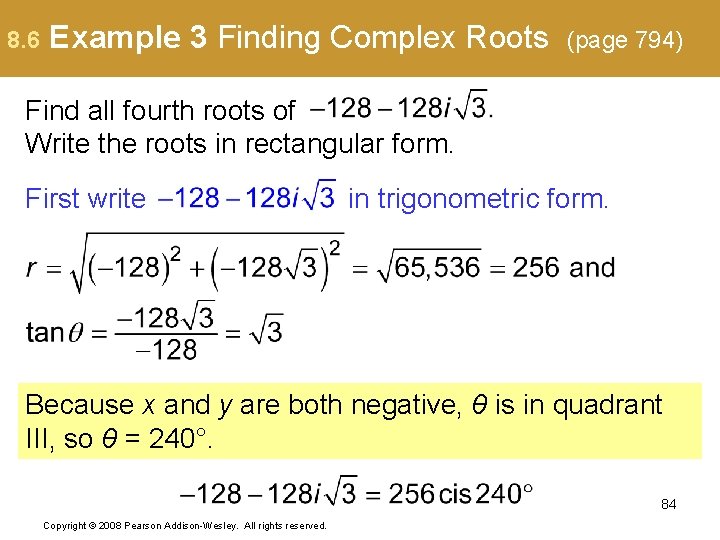
8. 6 Example 3 Finding Complex Roots (page 794) Find all fourth roots of Write the roots in rectangular form. First write in trigonometric form. Because x and y are both negative, θ is in quadrant III, so θ = 240°. 84 Copyright © 2008 Pearson Addison-Wesley. All rights reserved.
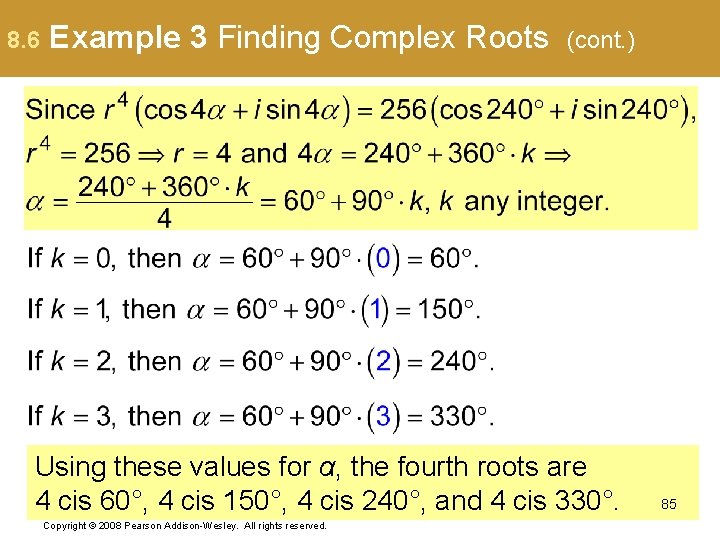
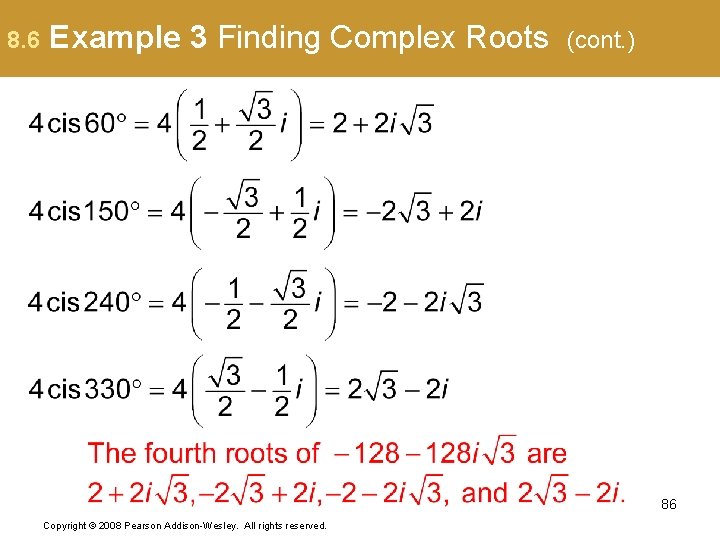
8. 6 Example 3 Finding Complex Roots (cont. ) Using these values for α, the fourth roots are 4 cis 60°, 4 cis 150°, 4 cis 240°, and 4 cis 330°. Copyright © 2008 Pearson Addison-Wesley. All rights reserved. 85
8. 6 Example 3 Finding Complex Roots (cont. ) 86 Copyright © 2008 Pearson Addison-Wesley. All rights reserved.
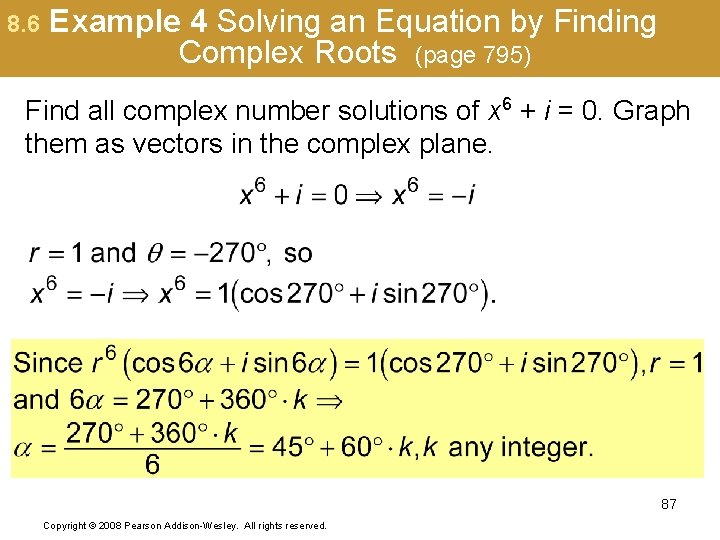
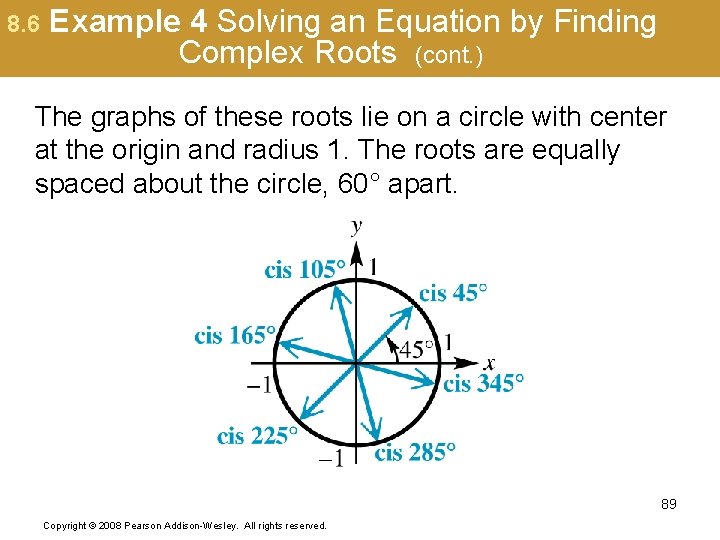
8. 6 Example 4 Solving an Equation by Finding Complex Roots (page 795) Find all complex number solutions of x 6 + i = 0. Graph them as vectors in the complex plane. 87 Copyright © 2008 Pearson Addison-Wesley. All rights reserved.
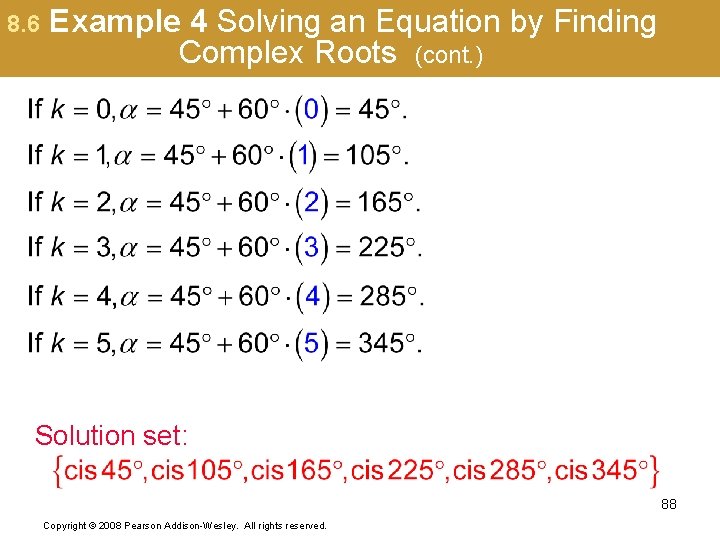
8. 6 Example 4 Solving an Equation by Finding Complex Roots (cont. ) Solution set: 88 Copyright © 2008 Pearson Addison-Wesley. All rights reserved.
8. 6 Example 4 Solving an Equation by Finding Complex Roots (cont. ) The graphs of these roots lie on a circle with center at the origin and radius 1. The roots are equally spaced about the circle, 60° apart. 89 Copyright © 2008 Pearson Addison-Wesley. All rights reserved.
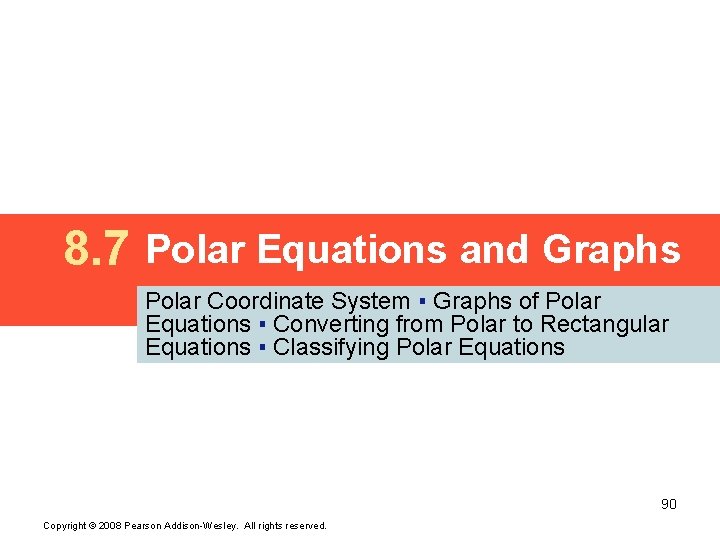
8. 7 Polar Equations and Graphs Polar Coordinate System ▪ Graphs of Polar Equations ▪ Converting from Polar to Rectangular Equations ▪ Classifying Polar Equations 90 Copyright © 2008 Pearson Addison-Wesley. All rights reserved.
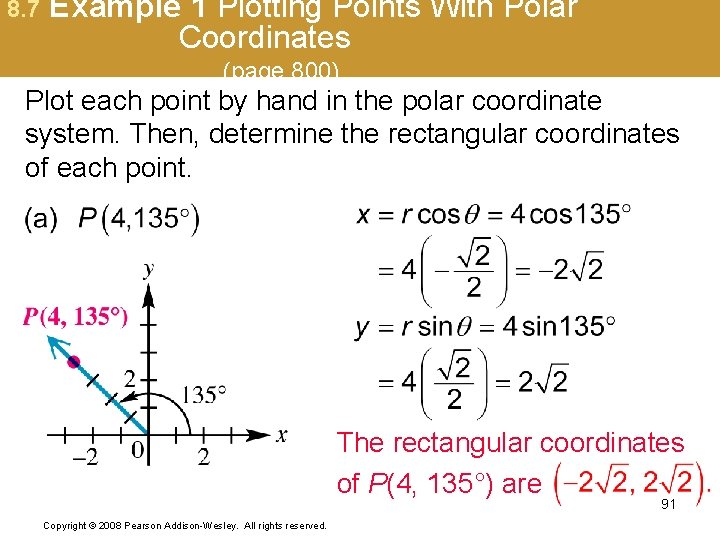
8. 7 Example 1 Plotting Points With Polar Coordinates (page 800) Plot each point by hand in the polar coordinate system. Then, determine the rectangular coordinates of each point. The rectangular coordinates of P(4, 135°) are 91 Copyright © 2008 Pearson Addison-Wesley. All rights reserved.
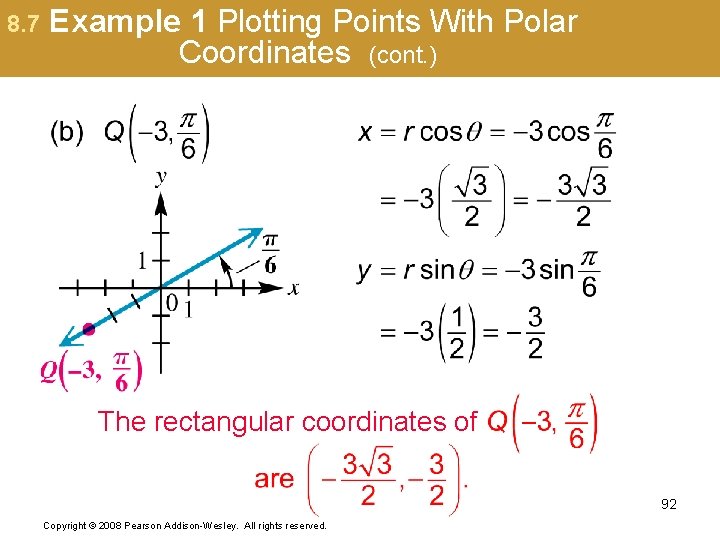
8. 7 Example 1 Plotting Points With Polar Coordinates (cont. ) The rectangular coordinates of 92 Copyright © 2008 Pearson Addison-Wesley. All rights reserved.
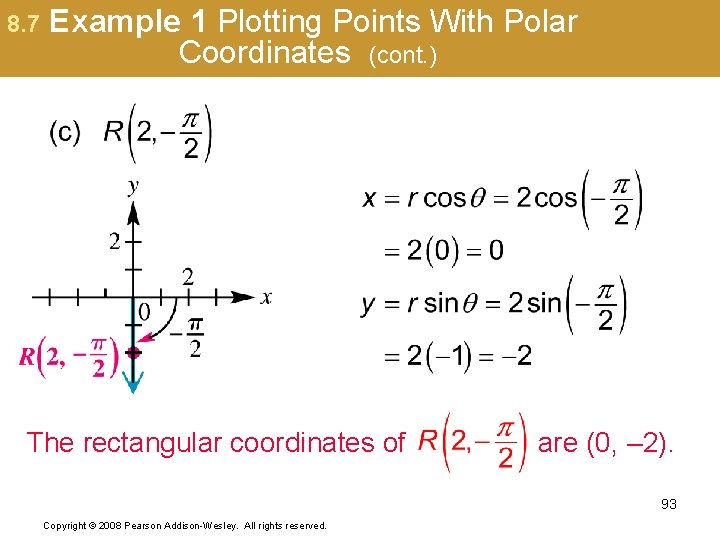
8. 7 Example 1 Plotting Points With Polar Coordinates (cont. ) The rectangular coordinates of are (0, – 2). 93 Copyright © 2008 Pearson Addison-Wesley. All rights reserved.
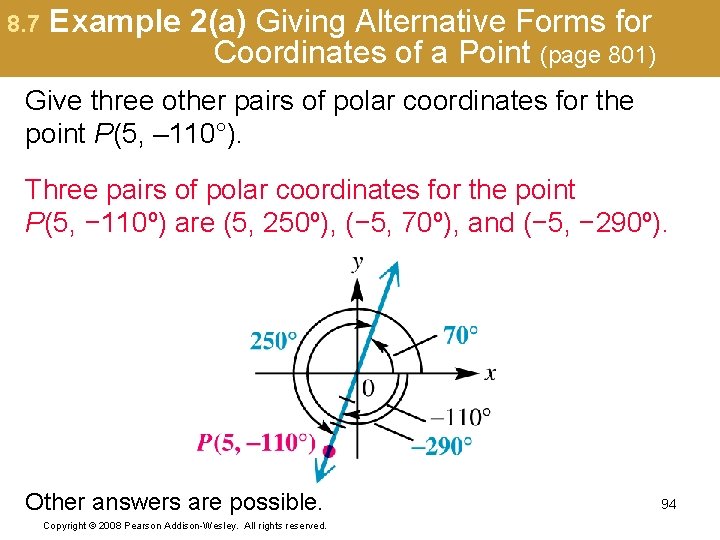
8. 7 Example 2(a) Giving Alternative Forms for Coordinates of a Point (page 801) Give three other pairs of polar coordinates for the point P(5, – 110°). Three pairs of polar coordinates for the point P(5, − 110º) are (5, 250º), (− 5, 70º), and (− 5, − 290º). Other answers are possible. Copyright © 2008 Pearson Addison-Wesley. All rights reserved. 94
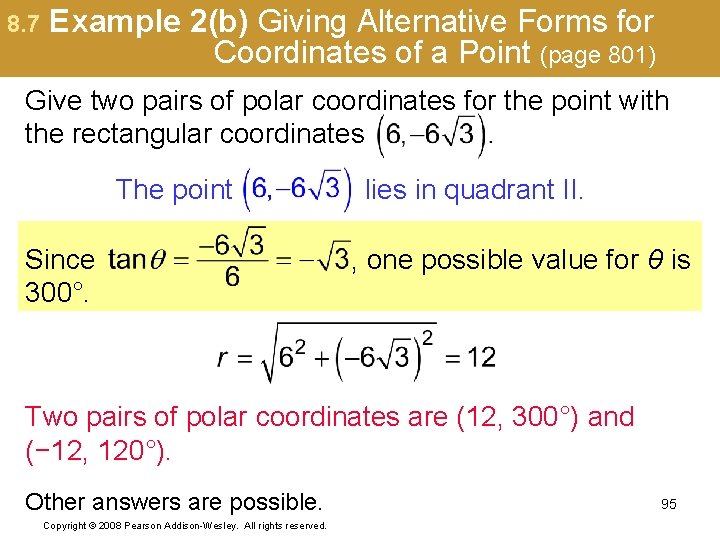
8. 7 Example 2(b) Giving Alternative Forms for Coordinates of a Point (page 801) Give two pairs of polar coordinates for the point with the rectangular coordinates The point Since 300°. lies in quadrant II. , one possible value for θ is Two pairs of polar coordinates are (12, 300°) and (− 12, 120°). Other answers are possible. Copyright © 2008 Pearson Addison-Wesley. All rights reserved. 95
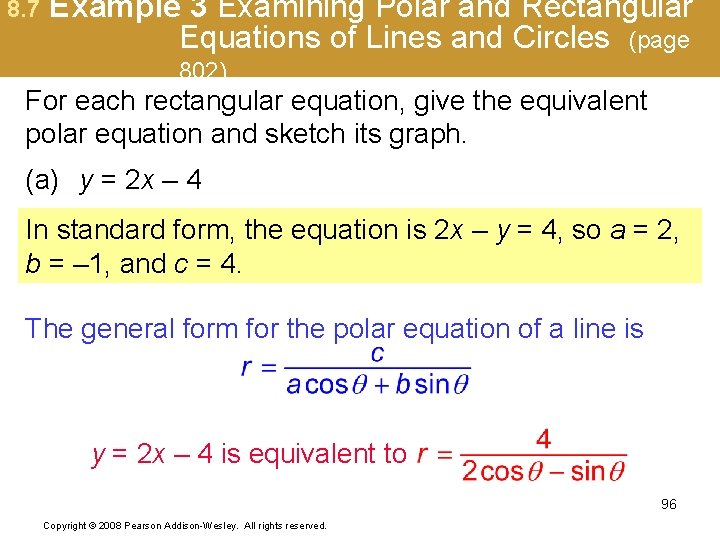
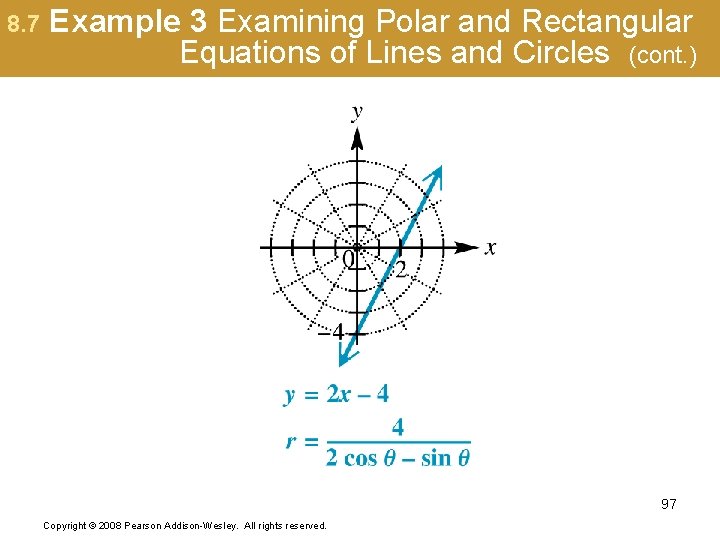
8. 7 Example 3 Examining Polar and Rectangular Equations of Lines and Circles (page 802) For each rectangular equation, give the equivalent polar equation and sketch its graph. (a) y = 2 x – 4 In standard form, the equation is 2 x – y = 4, so a = 2, b = – 1, and c = 4. The general form for the polar equation of a line is y = 2 x – 4 is equivalent to 96 Copyright © 2008 Pearson Addison-Wesley. All rights reserved.
8. 7 Example 3 Examining Polar and Rectangular Equations of Lines and Circles (cont. ) 97 Copyright © 2008 Pearson Addison-Wesley. All rights reserved.
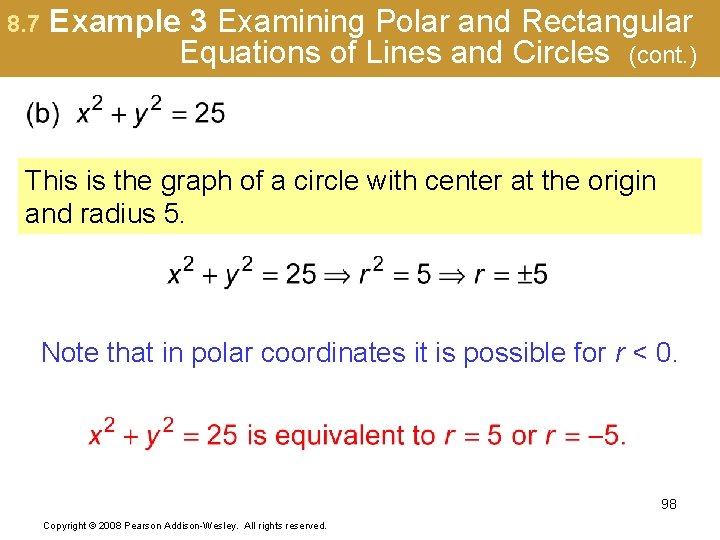
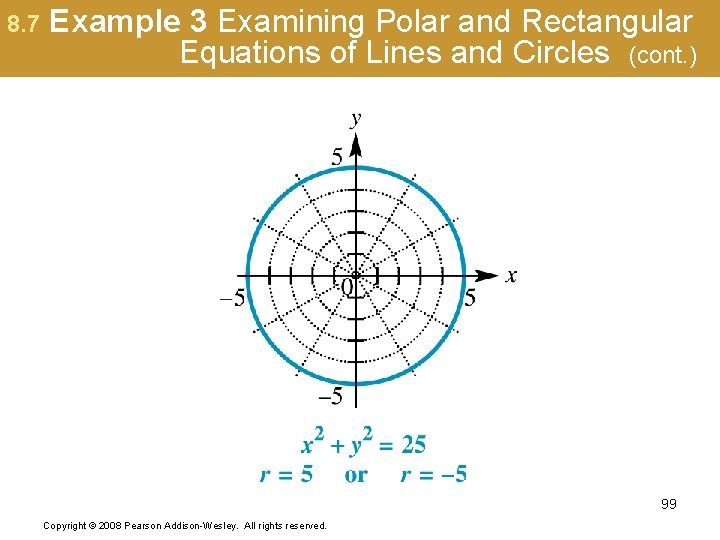
8. 7 Example 3 Examining Polar and Rectangular Equations of Lines and Circles (cont. ) This is the graph of a circle with center at the origin and radius 5. Note that in polar coordinates it is possible for r < 0. 98 Copyright © 2008 Pearson Addison-Wesley. All rights reserved.
8. 7 Example 3 Examining Polar and Rectangular Equations of Lines and Circles (cont. ) 99 Copyright © 2008 Pearson Addison-Wesley. All rights reserved.
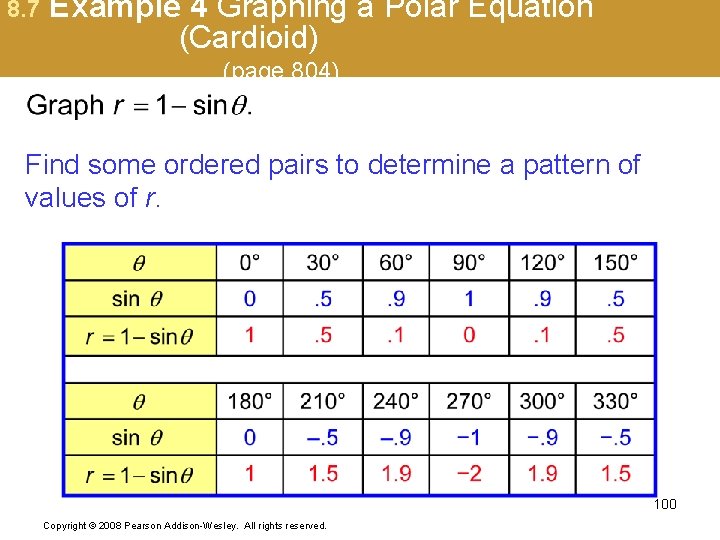
8. 7 Example 4 Graphing a Polar Equation (Cardioid) (page 804) Find some ordered pairs to determine a pattern of values of r. 100 Copyright © 2008 Pearson Addison-Wesley. All rights reserved.
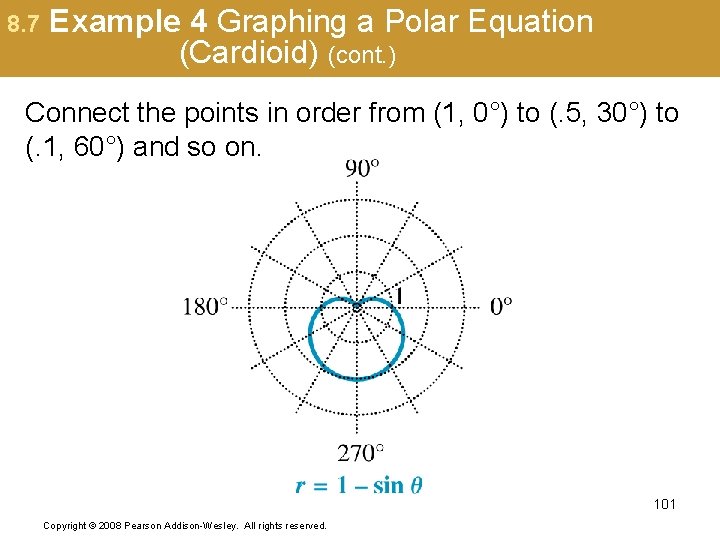
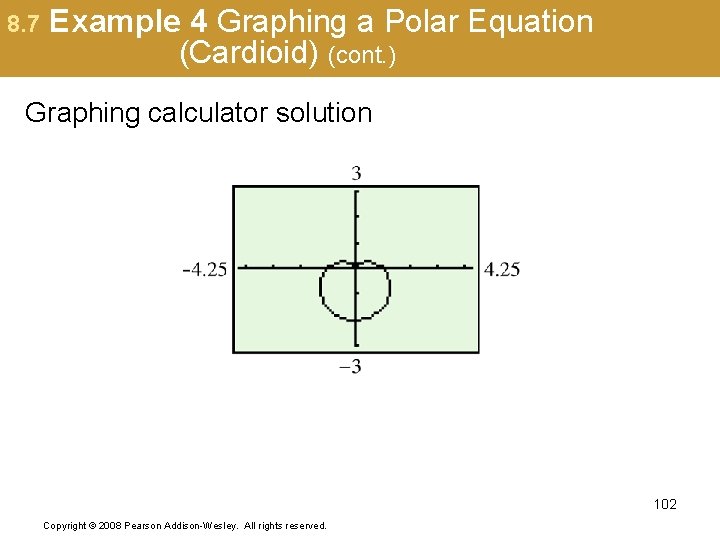
8. 7 Example 4 Graphing a Polar Equation (Cardioid) (cont. ) Connect the points in order from (1, 0°) to (. 5, 30°) to (. 1, 60°) and so on. 101 Copyright © 2008 Pearson Addison-Wesley. All rights reserved.
8. 7 Example 4 Graphing a Polar Equation (Cardioid) (cont. ) Graphing calculator solution 102 Copyright © 2008 Pearson Addison-Wesley. All rights reserved.
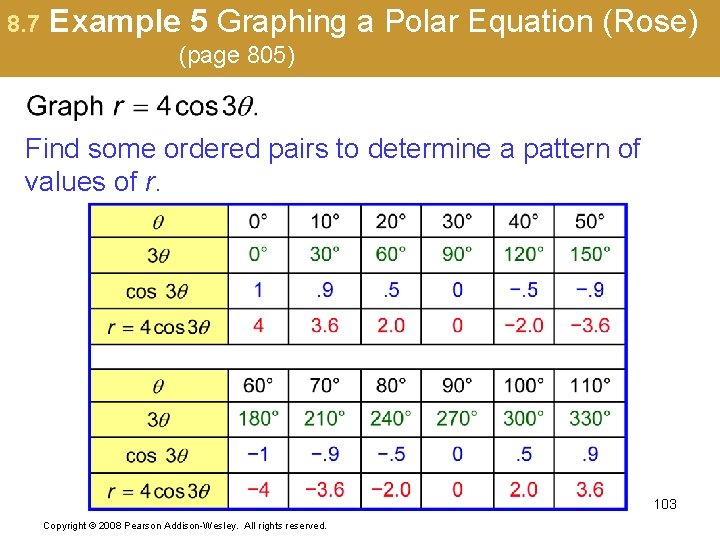
8. 7 Example 5 Graphing a Polar Equation (Rose) (page 805) Find some ordered pairs to determine a pattern of values of r. 103 Copyright © 2008 Pearson Addison-Wesley. All rights reserved.
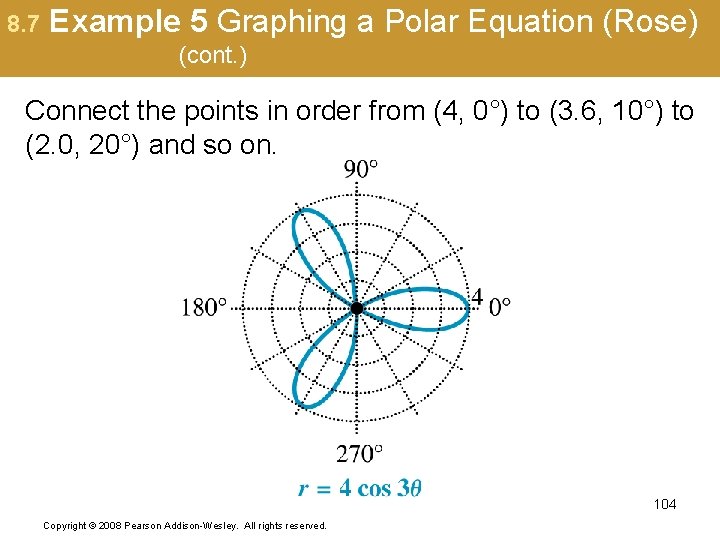
8. 7 Example 5 Graphing a Polar Equation (Rose) (cont. ) Connect the points in order from (4, 0°) to (3. 6, 10°) to (2. 0, 20°) and so on. 104 Copyright © 2008 Pearson Addison-Wesley. All rights reserved.
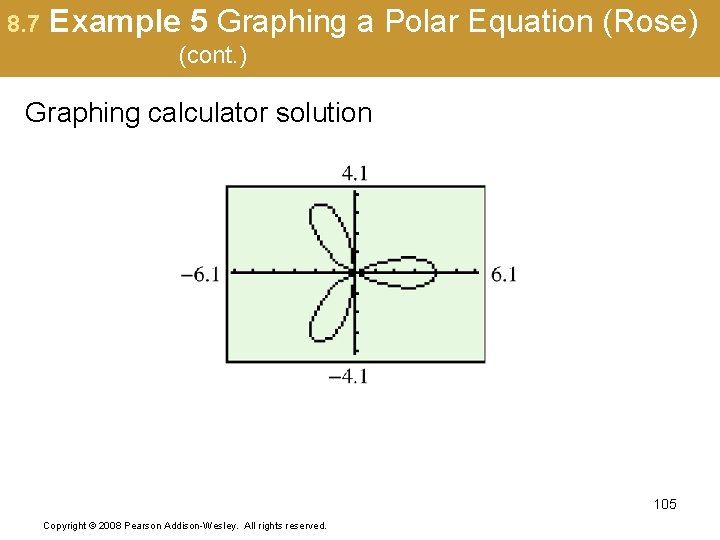
8. 7 Example 5 Graphing a Polar Equation (Rose) (cont. ) Graphing calculator solution 105 Copyright © 2008 Pearson Addison-Wesley. All rights reserved.
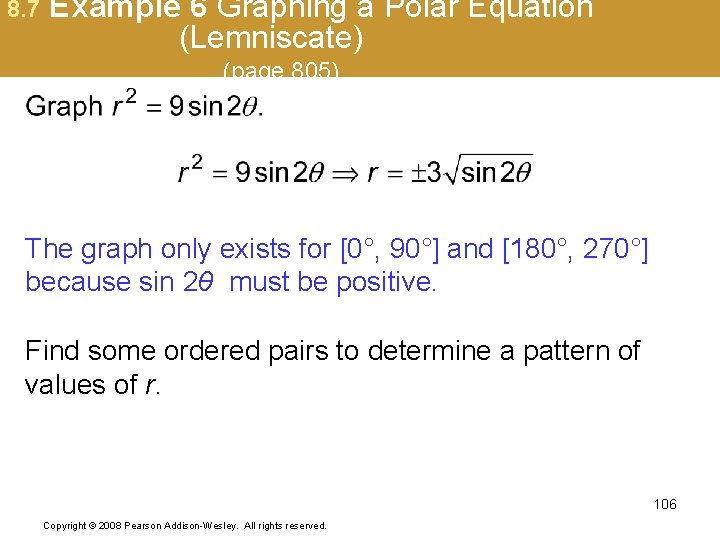
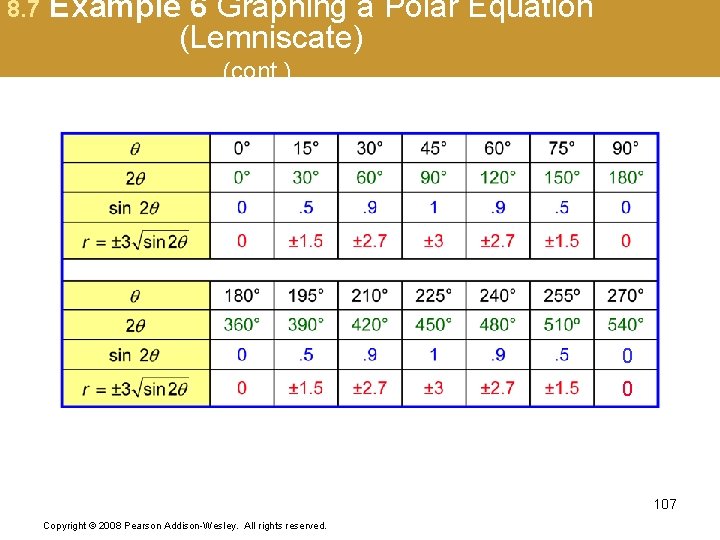
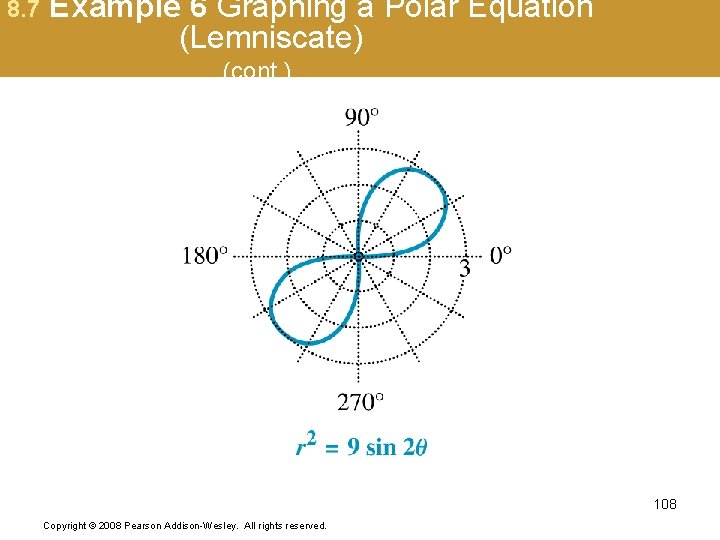
8. 7 Example 6 Graphing a Polar Equation (Lemniscate) (page 805) The graph only exists for [0°, 90°] and [180°, 270°] because sin 2θ must be positive. Find some ordered pairs to determine a pattern of values of r. 106 Copyright © 2008 Pearson Addison-Wesley. All rights reserved.
8. 7 Example 6 Graphing a Polar Equation (Lemniscate) (cont. ) 0 0 107 Copyright © 2008 Pearson Addison-Wesley. All rights reserved.
8. 7 Example 6 Graphing a Polar Equation (Lemniscate) (cont. ) 108 Copyright © 2008 Pearson Addison-Wesley. All rights reserved.
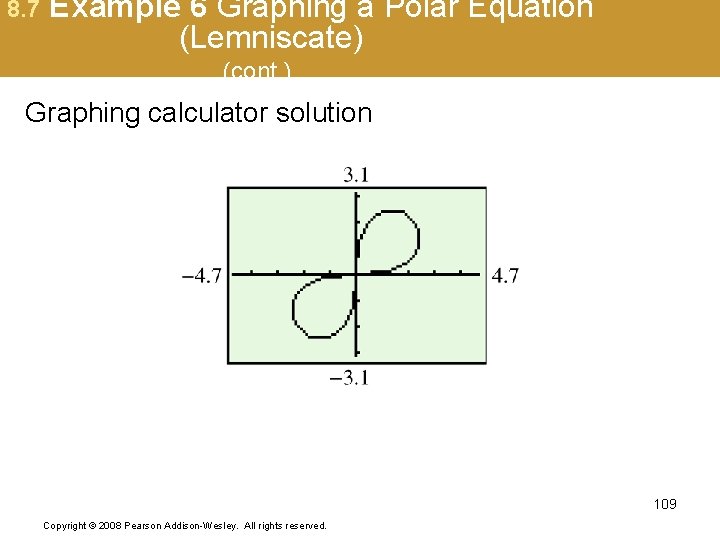
8. 7 Example 6 Graphing a Polar Equation (Lemniscate) (cont. ) Graphing calculator solution 109 Copyright © 2008 Pearson Addison-Wesley. All rights reserved.
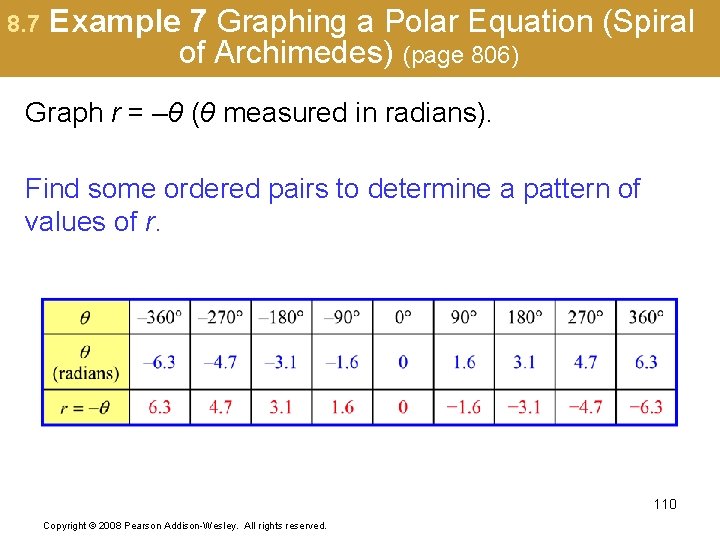
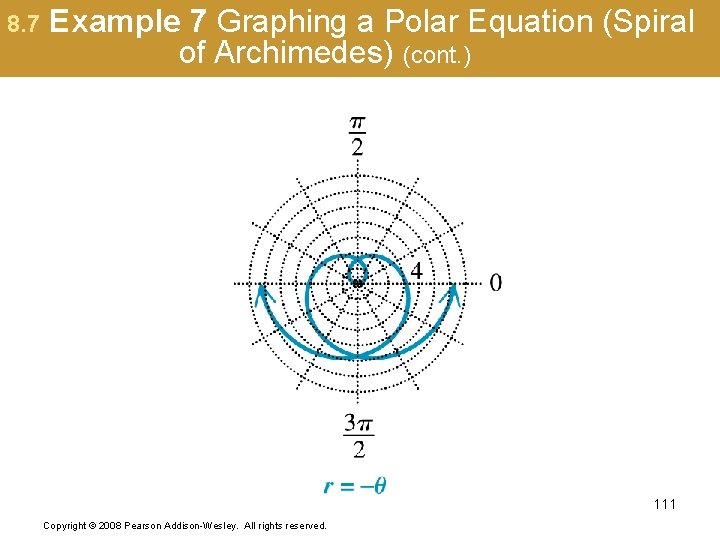
8. 7 Example 7 Graphing a Polar Equation (Spiral of Archimedes) (page 806) Graph r = –θ (θ measured in radians). Find some ordered pairs to determine a pattern of values of r. 110 Copyright © 2008 Pearson Addison-Wesley. All rights reserved.
8. 7 Example 7 Graphing a Polar Equation (Spiral of Archimedes) (cont. ) 111 Copyright © 2008 Pearson Addison-Wesley. All rights reserved.
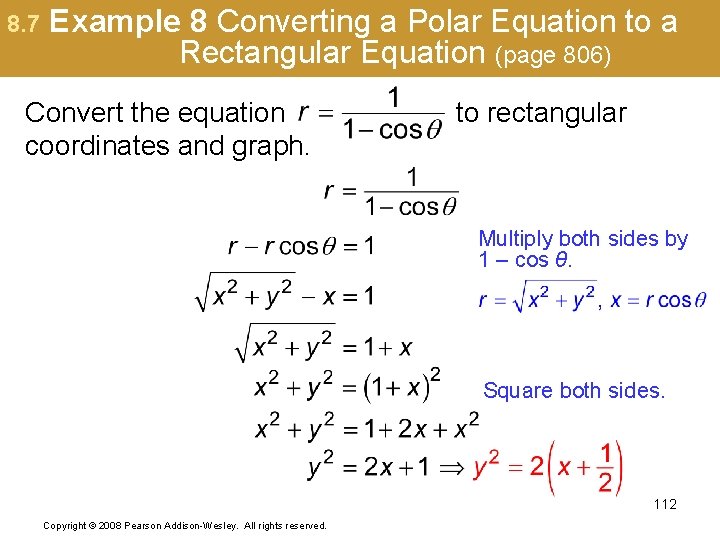
8. 7 Example 8 Converting a Polar Equation to a Rectangular Equation (page 806) Convert the equation coordinates and graph. to rectangular Multiply both sides by 1 – cos θ. Square both sides. 112 Copyright © 2008 Pearson Addison-Wesley. All rights reserved.
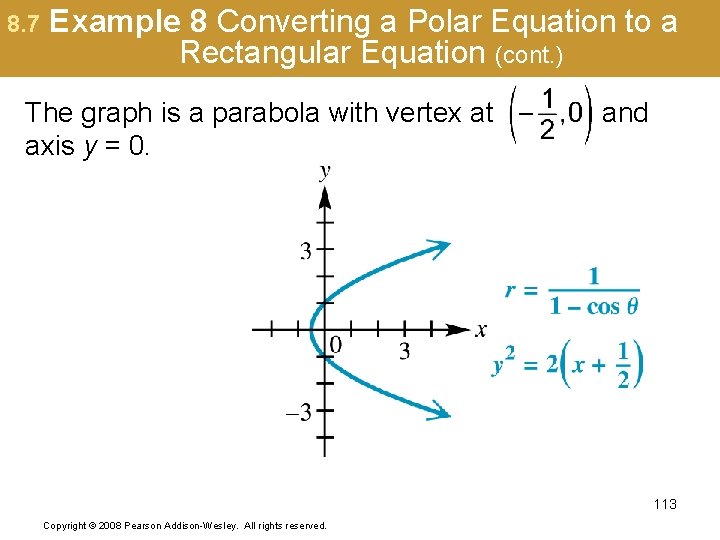
8. 7 Example 8 Converting a Polar Equation to a Rectangular Equation (cont. ) The graph is a parabola with vertex at axis y = 0. and 113 Copyright © 2008 Pearson Addison-Wesley. All rights reserved.
8. 8 Basic Concepts ▪ Parametric Graphs and Their Rectangular Equivalents ▪ The Cycloid ▪ Applications of Parametric Equations 114 Copyright © 2008 Pearson Addison-Wesley. All rights reserved.
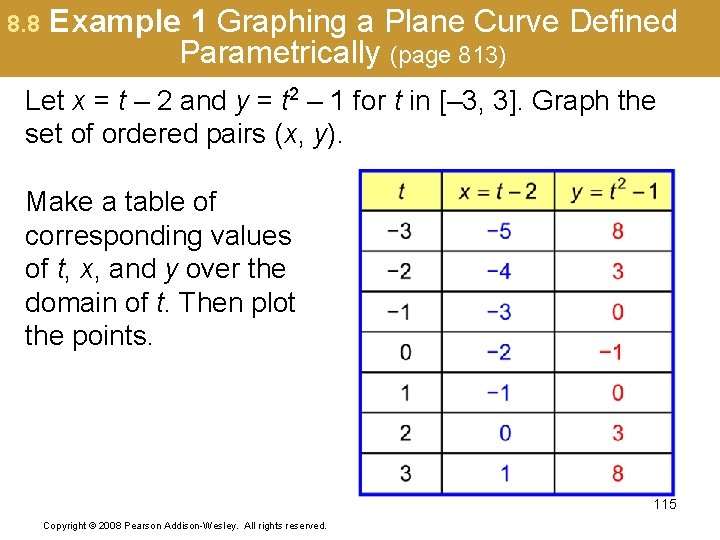
8. 8 Example 1 Graphing a Plane Curve Defined Parametrically (page 813) Let x = t – 2 and y = t 2 – 1 for t in [– 3, 3]. Graph the set of ordered pairs (x, y). Make a table of corresponding values of t, x, and y over the domain of t. Then plot the points. 115 Copyright © 2008 Pearson Addison-Wesley. All rights reserved.
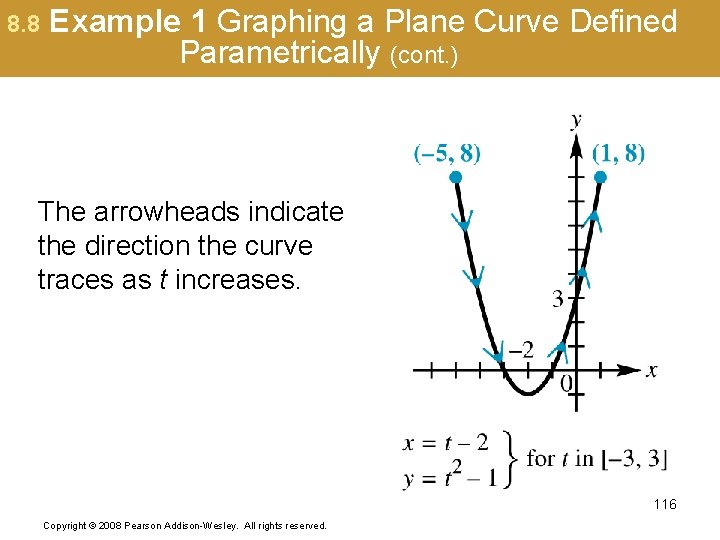
8. 8 Example 1 Graphing a Plane Curve Defined Parametrically (cont. ) The arrowheads indicate the direction the curve traces as t increases. 116 Copyright © 2008 Pearson Addison-Wesley. All rights reserved.
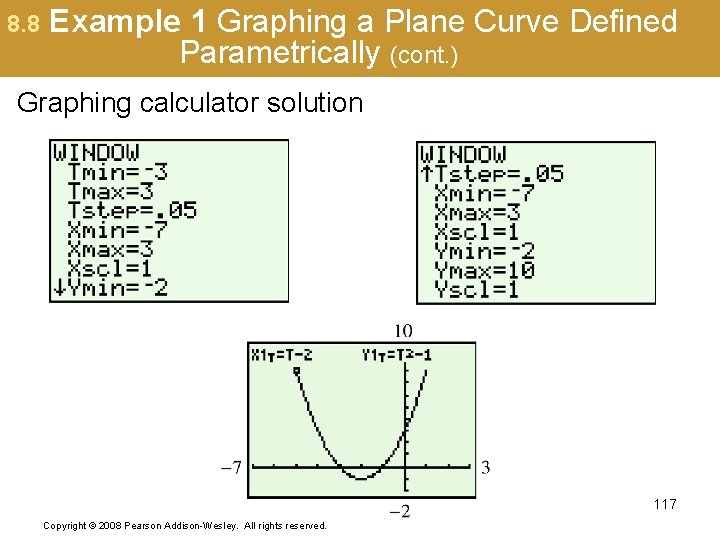
8. 8 Example 1 Graphing a Plane Curve Defined Parametrically (cont. ) Graphing calculator solution 117 Copyright © 2008 Pearson Addison-Wesley. All rights reserved.
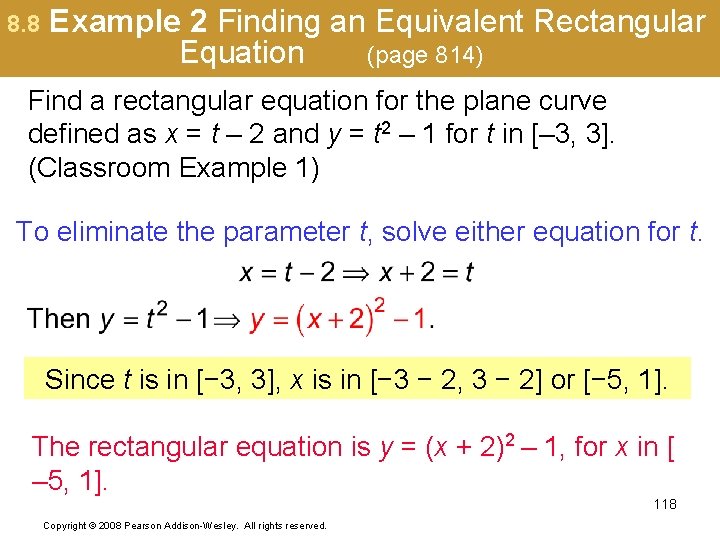
8. 8 Example 2 Finding an Equivalent Rectangular Equation (page 814) Find a rectangular equation for the plane curve defined as x = t – 2 and y = t 2 – 1 for t in [– 3, 3]. (Classroom Example 1) To eliminate the parameter t, solve either equation for t. Since t is in [− 3, 3], x is in [− 3 − 2, 3 − 2] or [− 5, 1]. The rectangular equation is y = (x + 2)2 – 1, for x in [ – 5, 1]. 118 Copyright © 2008 Pearson Addison-Wesley. All rights reserved.
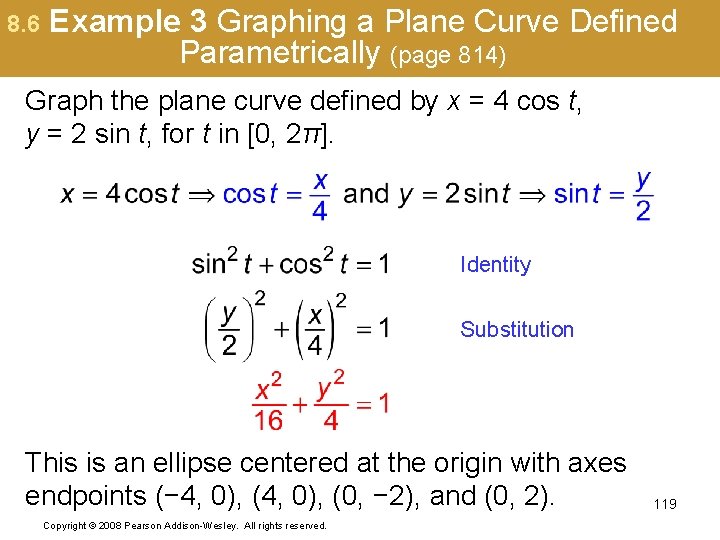
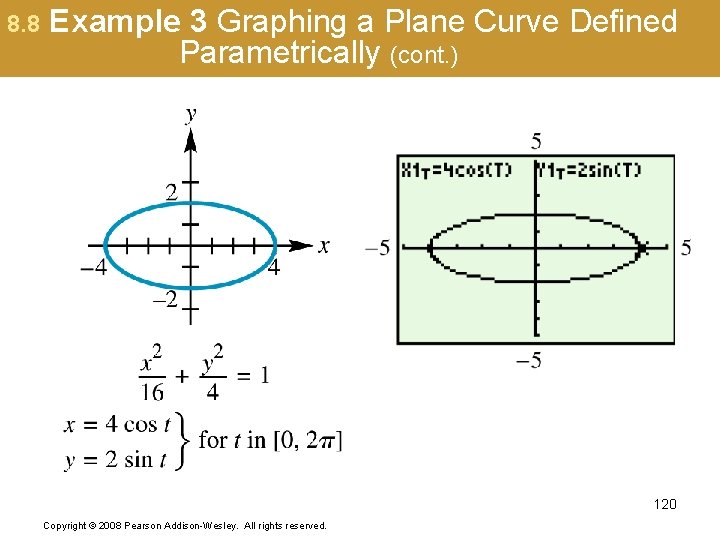
8. 6 Example 3 Graphing a Plane Curve Defined Parametrically (page 814) Graph the plane curve defined by x = 4 cos t, y = 2 sin t, for t in [0, 2π]. Identity Substitution This is an ellipse centered at the origin with axes endpoints (− 4, 0), (0, − 2), and (0, 2). Copyright © 2008 Pearson Addison-Wesley. All rights reserved. 119
8. 8 Example 3 Graphing a Plane Curve Defined Parametrically (cont. ) 120 Copyright © 2008 Pearson Addison-Wesley. All rights reserved.
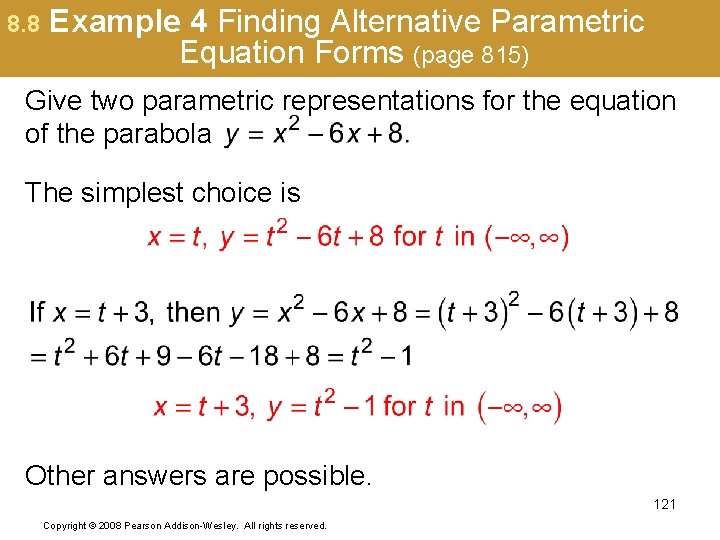
8. 8 Example 4 Finding Alternative Parametric Equation Forms (page 815) Give two parametric representations for the equation of the parabola The simplest choice is Other answers are possible. 121 Copyright © 2008 Pearson Addison-Wesley. All rights reserved.
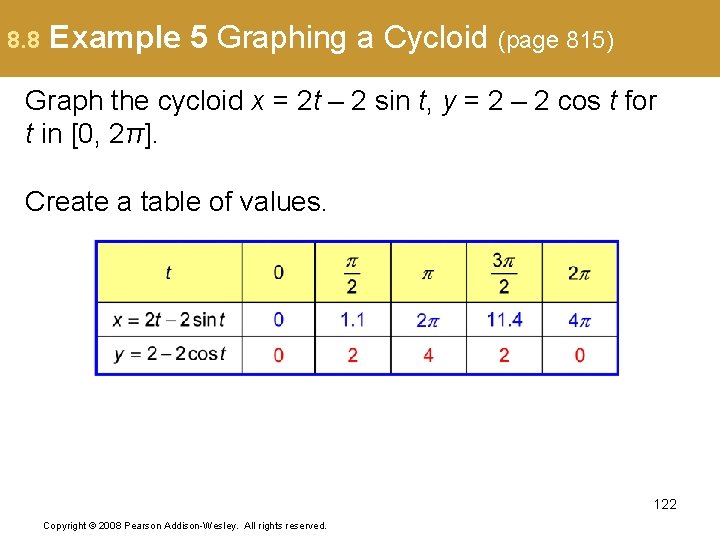
8. 8 Example 5 Graphing a Cycloid (page 815) Graph the cycloid x = 2 t – 2 sin t, y = 2 – 2 cos t for t in [0, 2π]. Create a table of values. 122 Copyright © 2008 Pearson Addison-Wesley. All rights reserved.
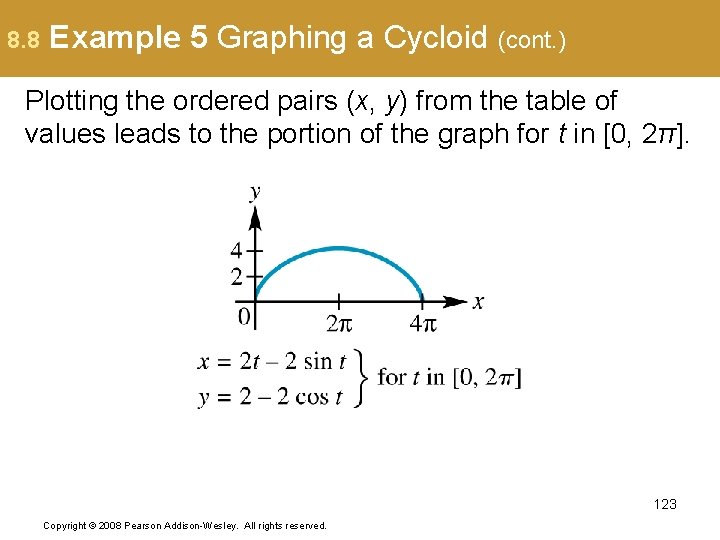
8. 8 Example 5 Graphing a Cycloid (cont. ) Plotting the ordered pairs (x, y) from the table of values leads to the portion of the graph for t in [0, 2π]. 123 Copyright © 2008 Pearson Addison-Wesley. All rights reserved.
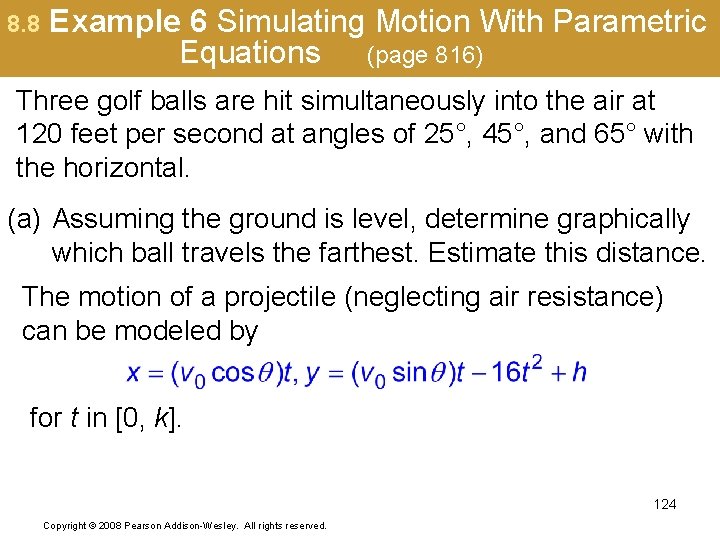
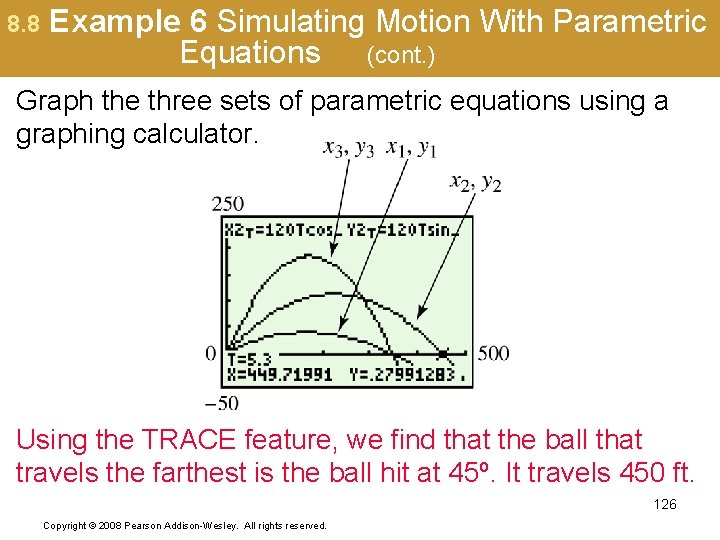
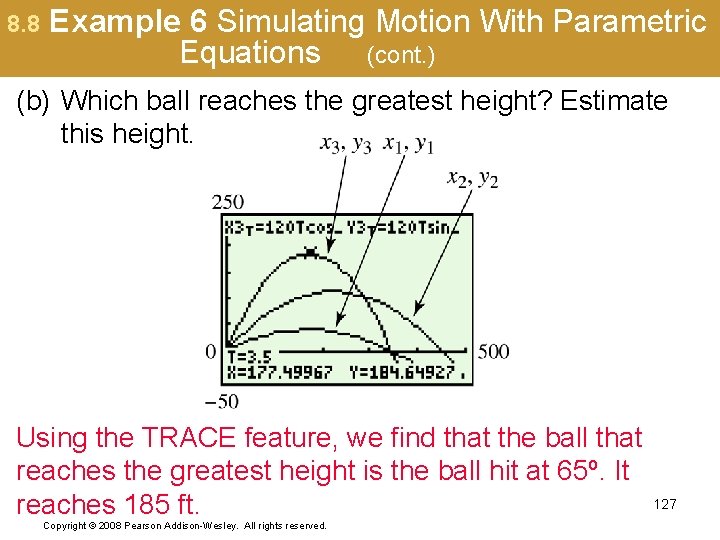
8. 8 Example 6 Simulating Motion With Parametric Equations (page 816) Three golf balls are hit simultaneously into the air at 120 feet per second at angles of 25°, 45°, and 65° with the horizontal. (a) Assuming the ground is level, determine graphically which ball travels the farthest. Estimate this distance. The motion of a projectile (neglecting air resistance) can be modeled by for t in [0, k]. 124 Copyright © 2008 Pearson Addison-Wesley. All rights reserved.
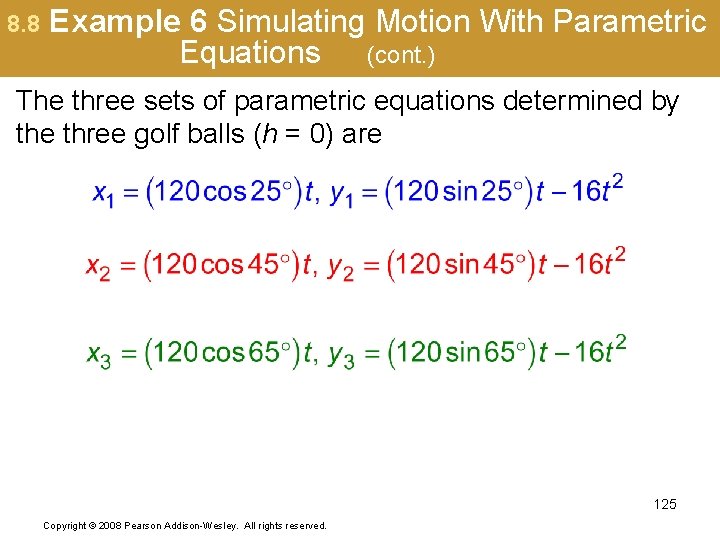
8. 8 Example 6 Simulating Motion With Parametric Equations (cont. ) The three sets of parametric equations determined by the three golf balls (h = 0) are 125 Copyright © 2008 Pearson Addison-Wesley. All rights reserved.
8. 8 Example 6 Simulating Motion With Parametric Equations (cont. ) Graph the three sets of parametric equations using a graphing calculator. Using the TRACE feature, we find that the ball that travels the farthest is the ball hit at 45º. It travels 450 ft. 126 Copyright © 2008 Pearson Addison-Wesley. All rights reserved.
8. 8 Example 6 Simulating Motion With Parametric Equations (cont. ) (b) Which ball reaches the greatest height? Estimate this height. Using the TRACE feature, we find that the ball that reaches the greatest height is the ball hit at 65º. It reaches 185 ft. Copyright © 2008 Pearson Addison-Wesley. All rights reserved. 127
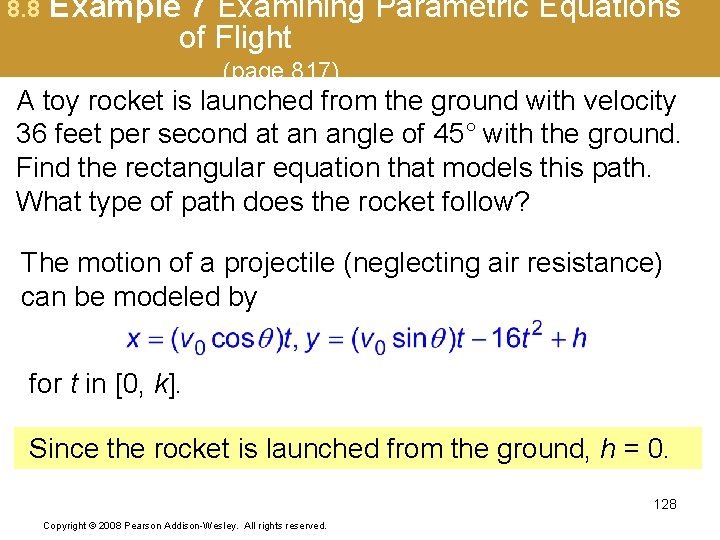
8. 8 Example 7 Examining Parametric Equations of Flight (page 817) A toy rocket is launched from the ground with velocity 36 feet per second at an angle of 45° with the ground. Find the rectangular equation that models this path. What type of path does the rocket follow? The motion of a projectile (neglecting air resistance) can be modeled by for t in [0, k]. Since the rocket is launched from the ground, h = 0. 128 Copyright © 2008 Pearson Addison-Wesley. All rights reserved.
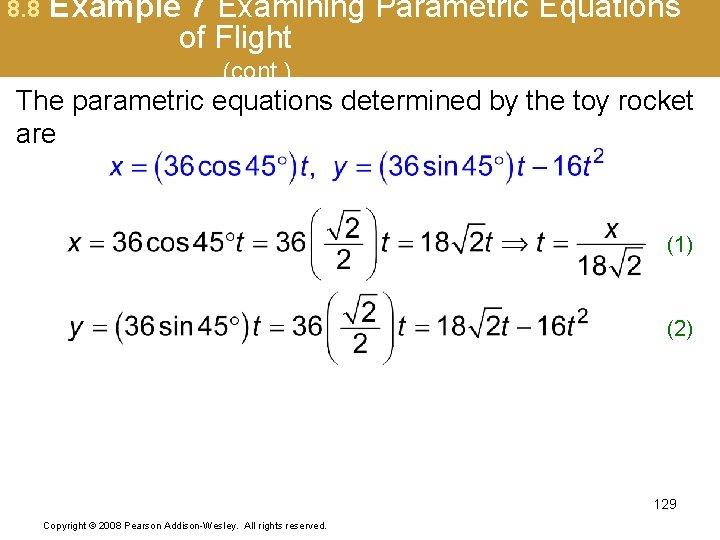
8. 8 Example 7 Examining Parametric Equations of Flight (cont. ) The parametric equations determined by the toy rocket are (1) (2) 129 Copyright © 2008 Pearson Addison-Wesley. All rights reserved.
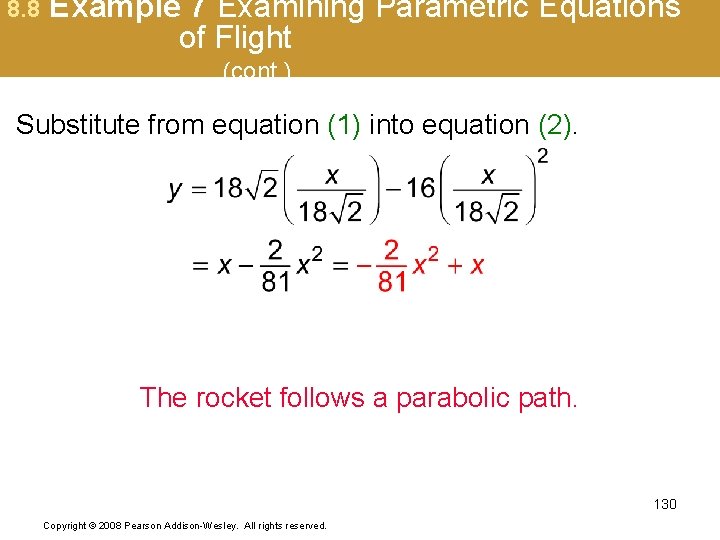
8. 8 Example 7 Examining Parametric Equations of Flight (cont. ) Substitute from equation (1) into equation (2). The rocket follows a parabolic path. 130 Copyright © 2008 Pearson Addison-Wesley. All rights reserved.
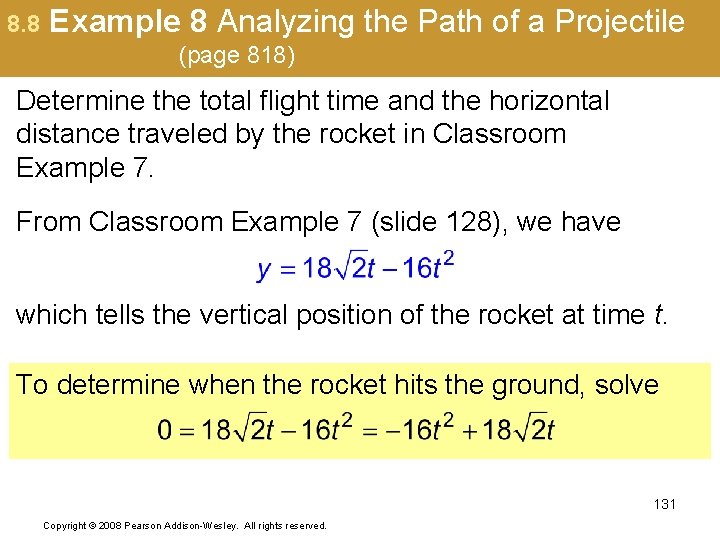
8. 8 Example 8 Analyzing the Path of a Projectile (page 818) Determine the total flight time and the horizontal distance traveled by the rocket in Classroom Example 7. From Classroom Example 7 (slide 128), we have which tells the vertical position of the rocket at time t. To determine when the rocket hits the ground, solve 131 Copyright © 2008 Pearson Addison-Wesley. All rights reserved.
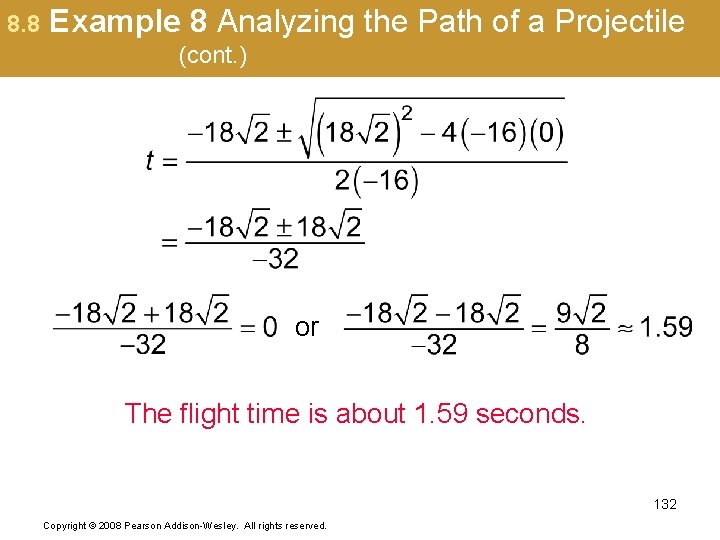
8. 8 Example 8 Analyzing the Path of a Projectile (cont. ) or The flight time is about 1. 59 seconds. 132 Copyright © 2008 Pearson Addison-Wesley. All rights reserved.
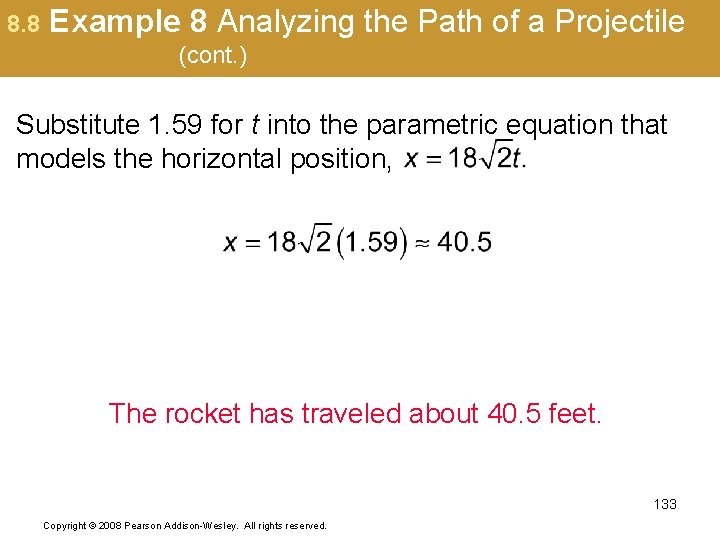
8. 8 Example 8 Analyzing the Path of a Projectile (cont. ) Substitute 1. 59 for t into the parametric equation that models the horizontal position, The rocket has traveled about 40. 5 feet. 133 Copyright © 2008 Pearson Addison-Wesley. All rights reserved.