
8 7 Polygons Warm Up True or false
- Slides: 20
8 -7 Polygons Warm Up True or false? 1. Some trapezoids are parallelograms. false 2. Some figures with 4 right angles are squares. true 3. Some quadrilaterals have only one right angle. true
8 -7 Polygons Learn to identify regular and not regular polygons and to find the angle measures of regular polygons.
8 -7 Polygons Vocabulary polygon regular polygon diagonal
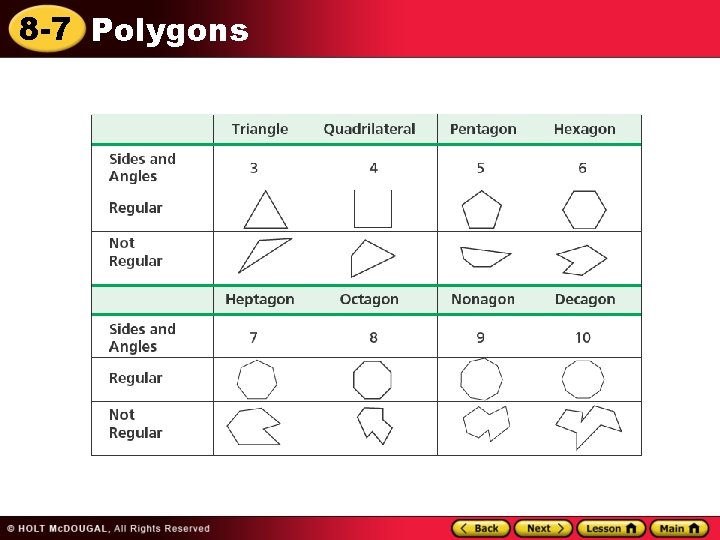
8 -7 Polygons A polygon is a closed plane figure formed by three or more line segments. A regular polygon is a polygon in which all sides are congruent and all angles are congruent. Polygons are named by the number of their sides and angles.
8 -7 Polygons
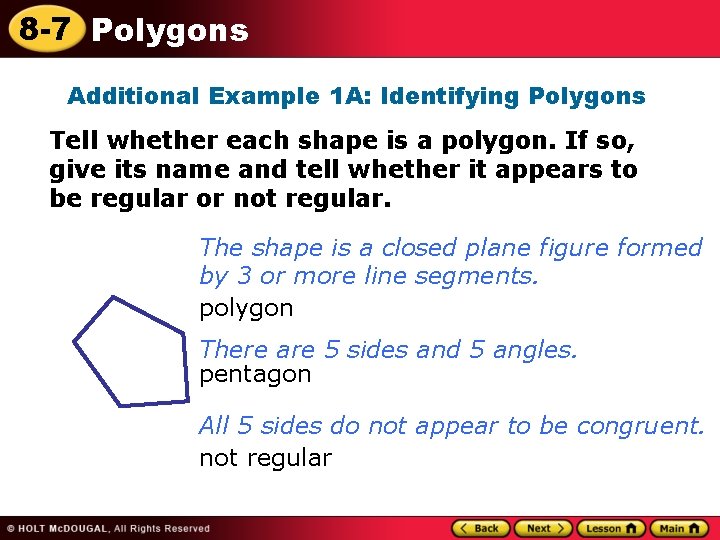
8 -7 Polygons Additional Example 1 A: Identifying Polygons Tell whether each shape is a polygon. If so, give its name and tell whether it appears to be regular or not regular. The shape is a closed plane figure formed by 3 or more line segments. polygon There are 5 sides and 5 angles. pentagon All 5 sides do not appear to be congruent. not regular
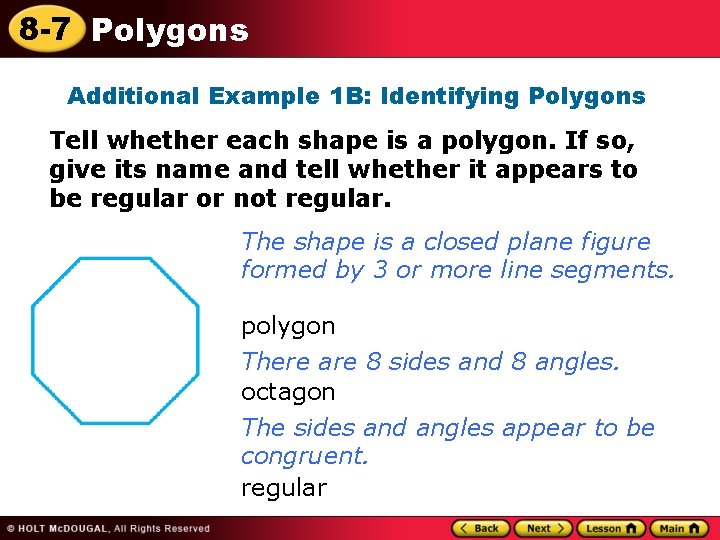
8 -7 Polygons Additional Example 1 B: Identifying Polygons Tell whether each shape is a polygon. If so, give its name and tell whether it appears to be regular or not regular. The shape is a closed plane figure formed by 3 or more line segments. polygon There are 8 sides and 8 angles. octagon The sides and angles appear to be congruent. regular
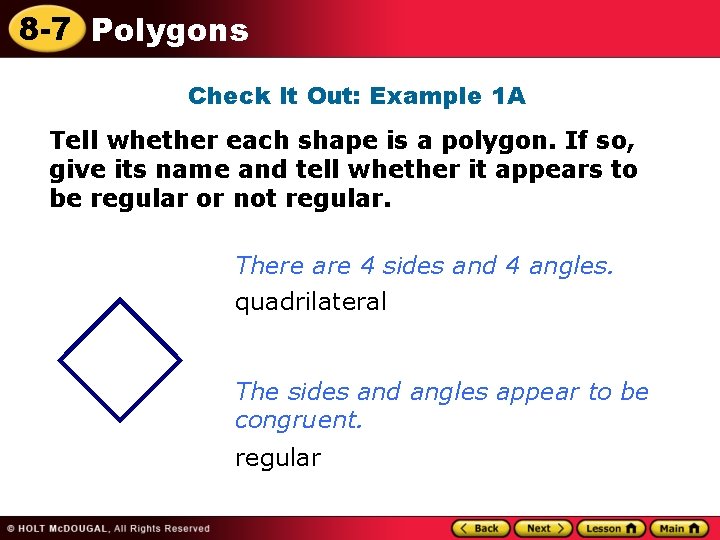
8 -7 Polygons Check It Out: Example 1 A Tell whether each shape is a polygon. If so, give its name and tell whether it appears to be regular or not regular. There are 4 sides and 4 angles. quadrilateral The sides and angles appear to be congruent. regular
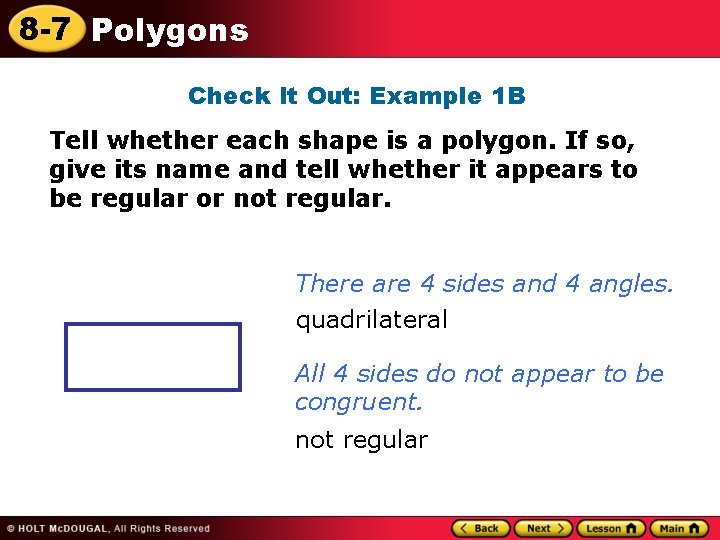
8 -7 Polygons Check It Out: Example 1 B Tell whether each shape is a polygon. If so, give its name and tell whether it appears to be regular or not regular. There are 4 sides and 4 angles. quadrilateral All 4 sides do not appear to be congruent. not regular
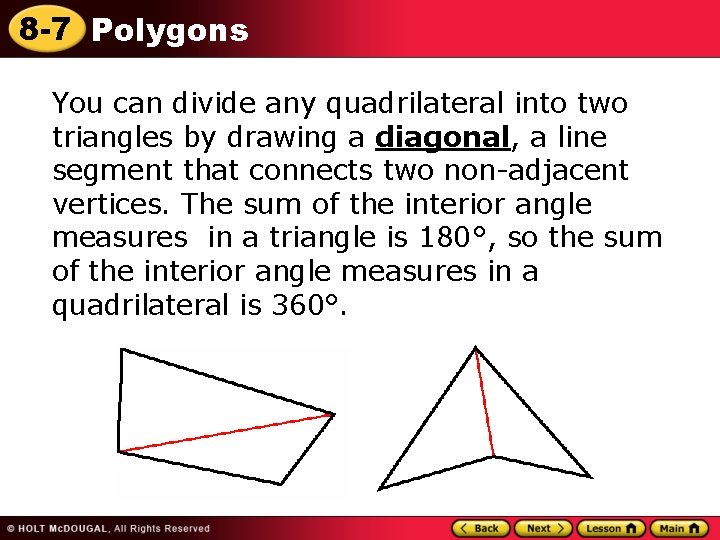
8 -7 Polygons You can divide any quadrilateral into two triangles by drawing a diagonal, a line segment that connects two non-adjacent vertices. The sum of the interior angle measures in a triangle is 180°, so the sum of the interior angle measures in a quadrilateral is 360°.
8 -7 Polygons Additional Example 2: Problem Solving Application Malcolm designed a wall hanging that was a regular 9 -sided polygon (called a nonagon). What is the measure of each angle of the nonagon? 1 Understand the Problem The answer will be the measure of each angle in a nonagon. List the important information: • A regular nonagon has 9 congruent sides and t 9 congruent angles.
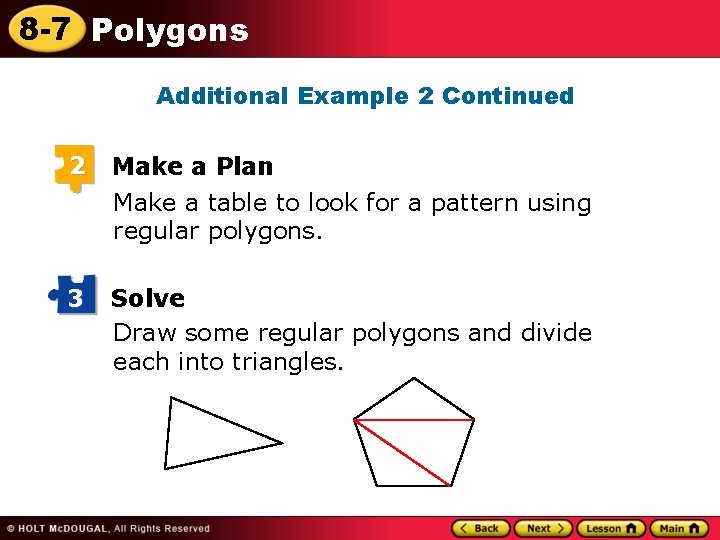
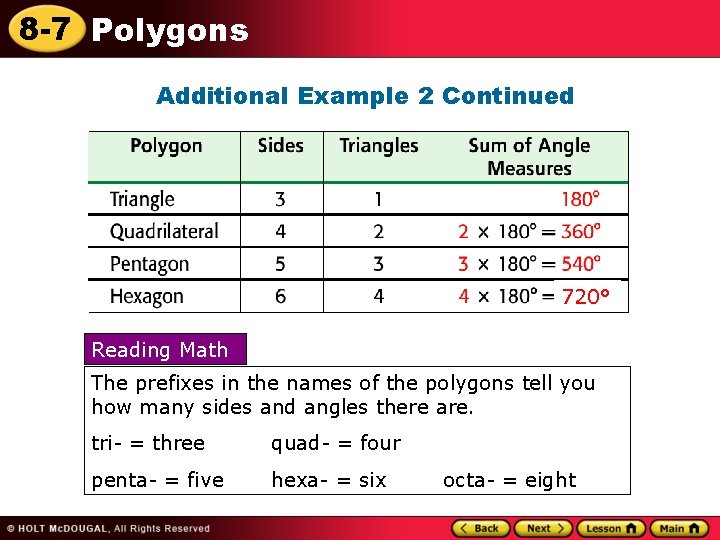
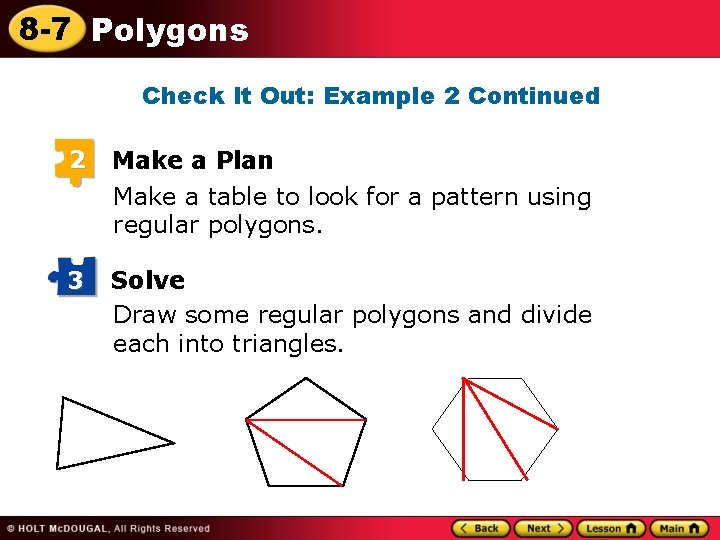
8 -7 Polygons Additional Example 2 Continued 2 Make a Plan Make a table to look for a pattern using regular polygons. 3 Solve Draw some regular polygons and divide each into triangles.
8 -7 Polygons Additional Example 2 Continued 720° Reading Math The prefixes in the names of the polygons tell you how many sides and angles there are. tri- = three quad- = four penta- = five hexa- = six octa- = eight
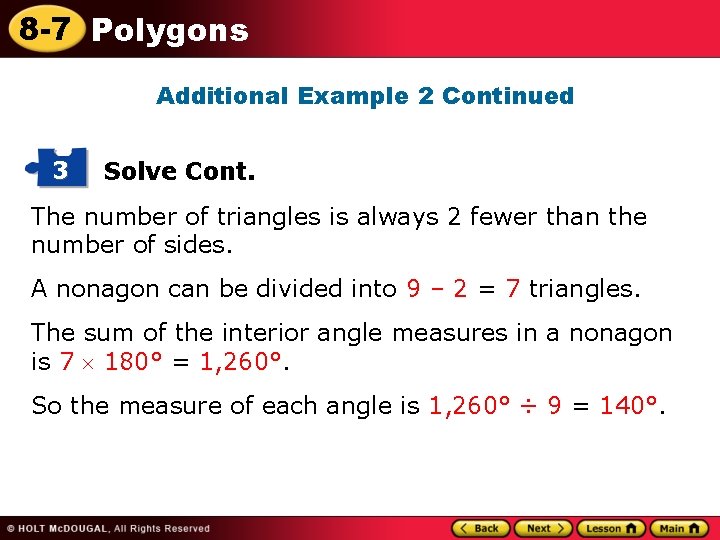
8 -7 Polygons Additional Example 2 Continued 3 Solve Cont. The number of triangles is always 2 fewer than the number of sides. A nonagon can be divided into 9 – 2 = 7 triangles. The sum of the interior angle measures in a nonagon is 7 180° = 1, 260°. So the measure of each angle is 1, 260° ÷ 9 = 140°.
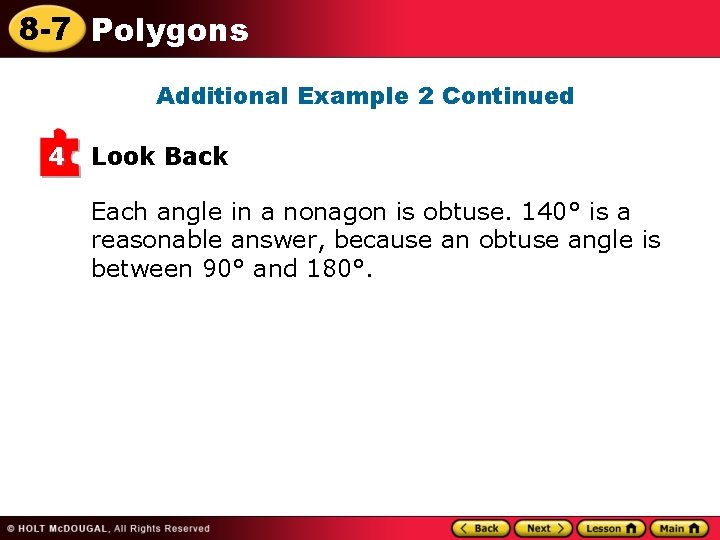
8 -7 Polygons Additional Example 2 Continued 4 Look Back Each angle in a nonagon is obtuse. 140° is a reasonable answer, because an obtuse angle is between 90° and 180°.
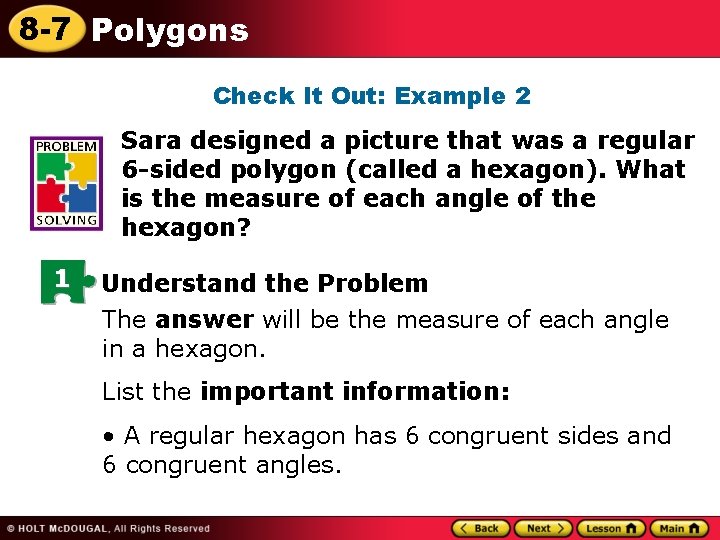
8 -7 Polygons Check It Out: Example 2 Sara designed a picture that was a regular 6 -sided polygon (called a hexagon). What is the measure of each angle of the hexagon? 1 Understand the Problem The answer will be the measure of each angle in a hexagon. List the important information: • A regular hexagon has 6 congruent sides and 6 congruent angles.
8 -7 Polygons Check It Out: Example 2 Continued 2 Make a Plan Make a table to look for a pattern using regular polygons. 3 Solve Draw some regular polygons and divide each into triangles.
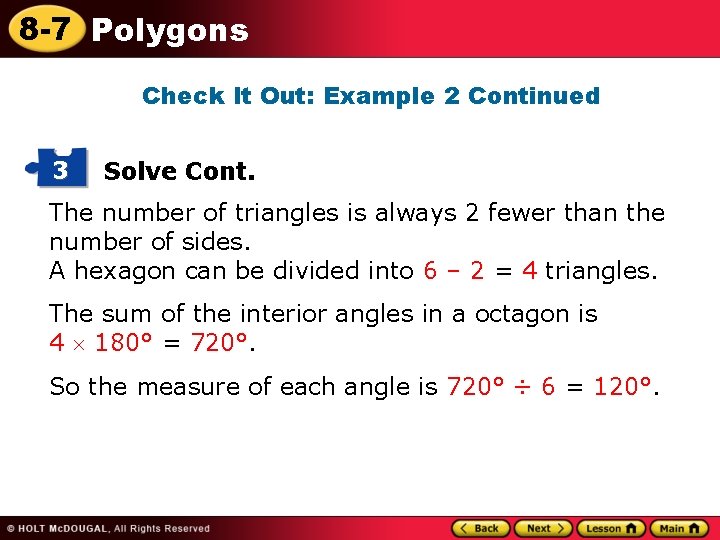
8 -7 Polygons Check It Out: Example 2 Continued 3 Solve Cont. The number of triangles is always 2 fewer than the number of sides. A hexagon can be divided into 6 – 2 = 4 triangles. The sum of the interior angles in a octagon is 4 180° = 720°. So the measure of each angle is 720° ÷ 6 = 120°.
8 -7 Polygons Check It Out: Example 2 Continued 4 Look Back Each angle in a hexagon is obtuse. 120° is a reasonable answer, because an obtuse angle is between 90° and 180°.
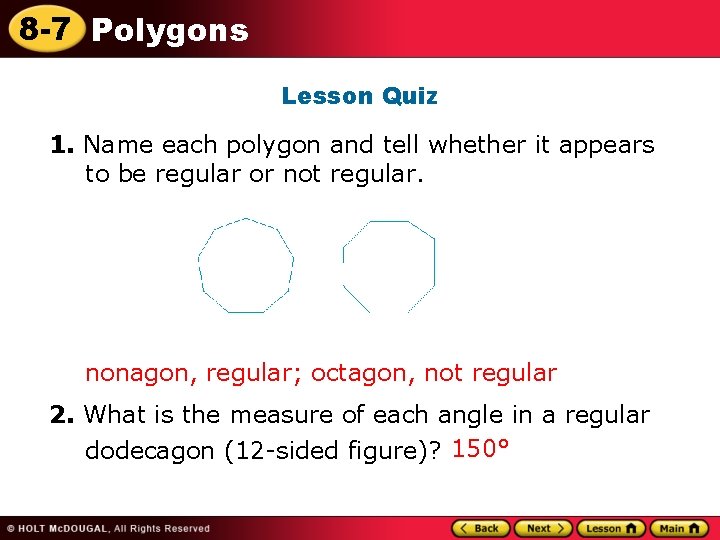
8 -7 Polygons Lesson Quiz 1. Name each polygon and tell whether it appears to be regular or not regular. nonagon, regular; octagon, not regular 2. What is the measure of each angle in a regular dodecagon (12 -sided figure)? 150°