
8 4 Training and Developing Employees Learning Objectives
8 4 - Training and Developing Employees
Learning Objectives 1. Summarize the purpose and process of employee orientation. 42. List and briefly explain each of the steps in the training process. 3. Explain how to use five training techniques.
Learning Objectives 4. List and briefly discuss four management development methods. 5. List and briefly discuss the importance of the 4 - steps in leading organizational change.
WHAT IS ORIENTATION ? Employee Orientation: A procedure for providing new employees with basic background information about the firm. • Purpose of Employee orientation programs provide new employees with the basic background information required to perform their jobs satisfactorily. Orientation programs today are moving away from routine discussion of company rules to emphasizing the company’s mission and the employee’s role in that mission, onboarding them early as a key member of the team. • The Orientation Process– Employees should receive print or Internet-based employee handbooks outlining benefits, policies and safety measures.
Summarize the purpose and process of employee 4 orientation
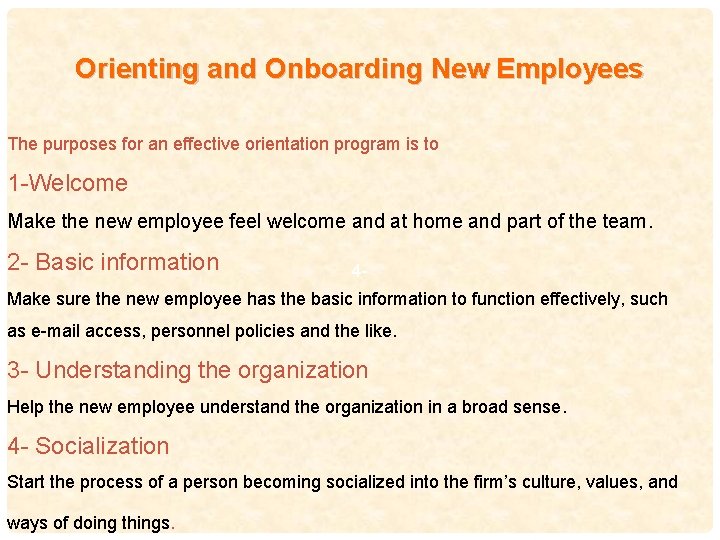
Orienting and Onboarding New Employees The purposes for an effective orientation program is to 1 -Welcome Make the new employee feel welcome and at home and part of the team. 2 - Basic information 4 - Make sure the new employee has the basic information to function effectively, such as e-mail access, personnel policies and the like. 3 - Understanding the organization Help the new employee understand the organization in a broad sense. 4 - Socialization Start the process of a person becoming socialized into the firm’s culture, values, and ways of doing things.
The Orientation Process • Employee handbook • Orientation technology 4 -
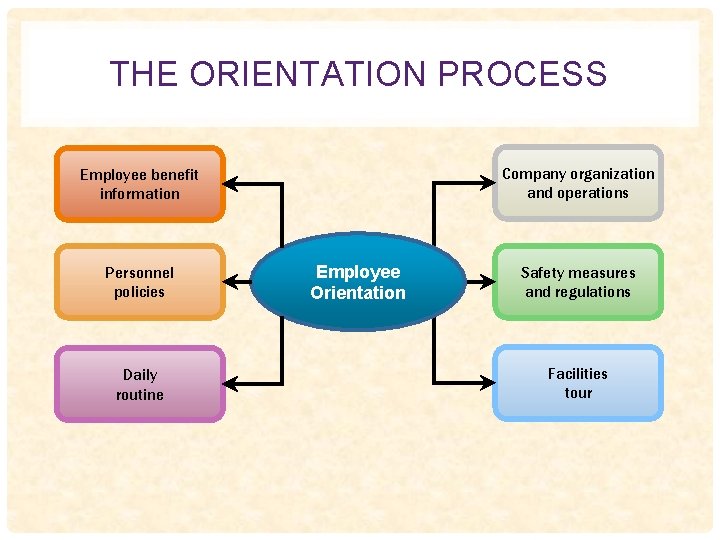
THE ORIENTATION PROCESS Company organization and operations Employee benefit information Personnel policies Daily routine Employee Orientation Safety measures and regulations Facilities tour
THE TRAINING PROCESS Training • Is the process of teaching new or current employees the basic skills they need to perform their jobs • Is a trait of good management • Training today plays a key role in the performance management process, which is a key process for employers to ensure employees are working toward organizational goals. • Reduces an employer’s exposure to negligent training liability • training has a fairly impressive record of influencing organizational effectiveness Training’s Strategic Context • The aims of firm’s training programs must make sense in terms of the company’s strategic goals. • Training fosters employee learning, which results in enhanced organizational performance.
REVISION OF DEFINITIONS • Employee orientation: A procedure for providing new employees with basic background information about the firm. • Training: The process of teaching new or current employees the basic skills they need to perform their jobs. • Performance management: The process employers use to make sure employees are working toward organizational goals. • Negligent Training: a situation where an employer fails to train adequately and the employee subsequently harms a third party • Cross training : training employees to do different tasks or jobs than their own , going so facilitates flexibility and job rotation.
OVERVIEW OF THE TRAINING PROCESS • Aligning strategy and training goals. Identify strategic goals and objectives and the skills and knowledge needed to achieve them. The employer’s strategic plan should govern it’s training goals.
Training and Performance • Ensure training translates into improved performance • Define training purpose 4 • Have company strategies drive the training • Check with mangers on the training success

The ADDIE Five-Step Training Process • Analyze (Analyzing the training need) • Design (Designing the overall training program) 4 • Develop (Developing the course) • Implement (Implementing training by actually training the targeted employee group) • Evaluate (Evaluating the effectiveness of the course)
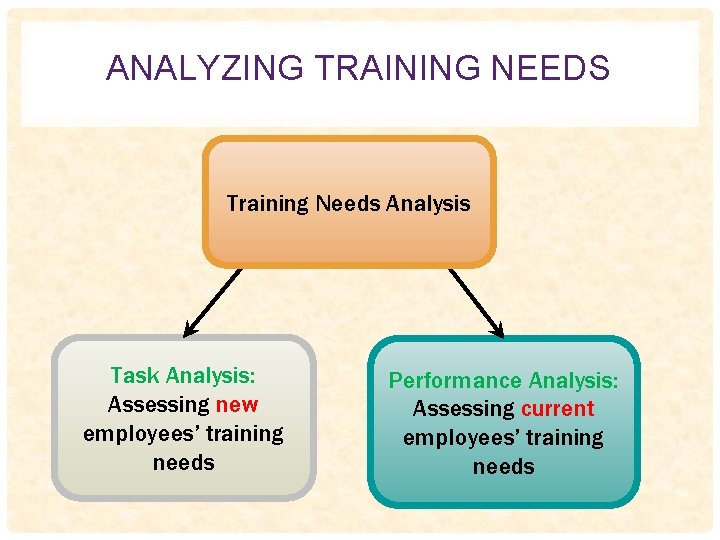
ANALYZING TRAINING NEEDS Training Needs Analysis Task Analysis: Assessing new employees’ training needs Performance Analysis: Assessing current employees’ training needs
ANALYZING TRAINING NEEDS Two main ways to identify training needs are: 1. Task analysis (an analysis of the job’s requirements). 2. Performance analysis (an analysis to verify if there is a performance deficiency. ) Analyzing current employees training needs is more complex than new employees, Why? Because performance maybe down because of the unclear standards or the employee is not motivated.
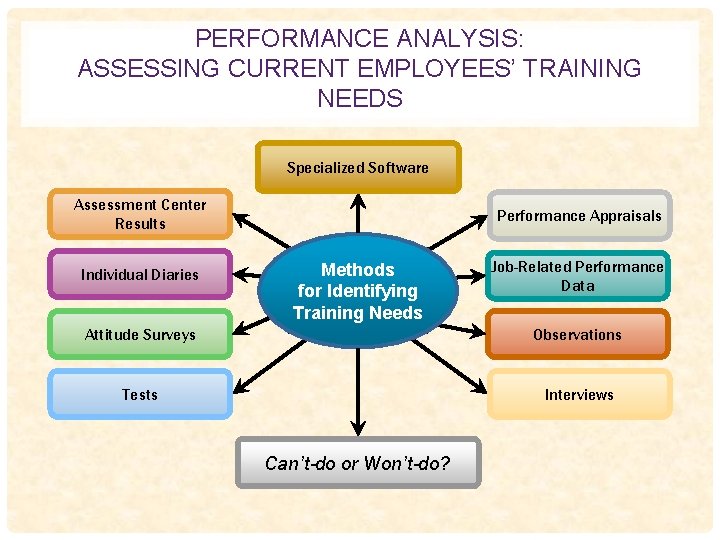
PERFORMANCE ANALYSIS: ASSESSING CURRENT EMPLOYEES’ TRAINING NEEDS Specialized Software Assessment Center Results Individual Diaries Performance Appraisals Methods for Identifying Training Needs Job-Related Performance Data Attitude Surveys Observations Tests Interviews Can’t-do or Won’t-do?
CAN`T DO/WON`T DO CAN` T DO/WON`T DO Ferreting out why performance is down is the heart of performance analysis. Why spend time training inefficient employees when the problem isn`t training, but weak motivation? The manager s aim is thus to distinguish between can` t-do and won` t-do problems. First, determine whether it is a can` tdo problem and, if so. For example , The employees don` t know what to do or what your standards are; there are obstacles in the system such as lack of tools or supplies. On the other hand, it might be a won t-do problem. Here employees could do a good job if they wanted, the solution may be to change the reward system.
DESIGNING THE TRAINING PROGRAM ØSETTING LEARNING OBJECTIVES ØCREATING A MOTIVATIONAL LEARNING ENVIRONMENT ØMAKING THE LEARNING MEANINGFUL ØMAKING SKILLS TRANSFER OBVIOUS AND EASY ØREINFORCING THE LEARNING ØENSURING TRANSFER OF LEARNING TO THE JOB
IMPLEMENTING TRAINING PROGRAMS TRAINING METHODS (BIG PICTURE) • On-the-Job Training • Apprenticeship Training • Computer-Based Training (CBT) • Informal Learning • Internet-Based Training • Job Instruction Training • Lectures • Programmed Learning • Audiovisual-Based Training • Vestibule Training • Teletraining and Videoconferencing
THE OJT TRAINING METHOD • On-the-Job Training (OJT) • Having a person learn a job by actually doing the job. • Types of On-the-Job Training • Coaching or understudy • Job rotation • Special assignments • Advantages • Inexpensive • Learn by doing • Immediate feedback
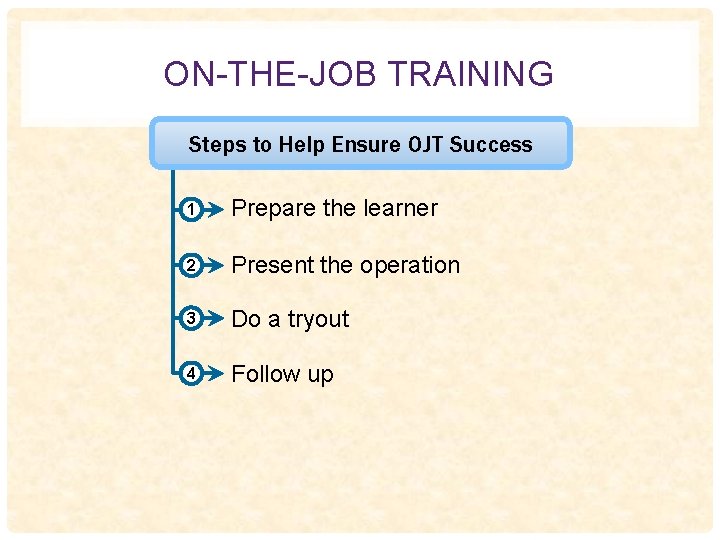
ON-THE-JOB TRAINING Steps to Help Ensure OJT Success 1 Prepare the learner 2 Present the operation 3 Do a tryout 4 Follow up
TRAINING METHODS A. On-the-Job Training (OJT) – means having a person learn a job by actually doing it, and involves the following: preparing the learner; presenting the operation; doing a tryout; and follow-up. B. Apprenticeship Training – is a structured process by which people become skilled workers through a combination of classroom instruction and on-the-job training. C. Informal Learning – involves learning through day-to-day unplanned interactions between the new worker and his/her colleagues. D. Job Instruction Training – refers to teaching a new employee the logical sequence of steps in a job step-by-step.
TRAINING METHODS – CONT’D E. Lectures – quick and simple way to provide knowledge to large groups. F. Programmed Learning – is a step-by-step self-learning method 1) presenting questions, facts, or problems to the learner 2) allowing the person to respond 3) providing feedback on the accuracy of the answers • Advantages • Reduced training time • Self-paced learning • Immediate feedback • Reduced risk of error for learner G. Audiovisual Based Training – Tools include: films, Power. Point presentations, video conferencing, audiotapes, and videotapes. H. Vestibule Training – is a method in which trainees learn on the actual or simulated equipment they will use on the job, but are actually trained off-the job.
TRAINING METHODS- CONT’D Computer-Based Training – is where the trainee uses computer-based and/or DVD systems to increase his/her knowledge or skills. CBT programs have real advantages: • Reducing learning time. • Cost effectiveness once designed and produced. • Instructional consistency. • Mastery of learning. • Increased retention, . • Increased trainee motivation.
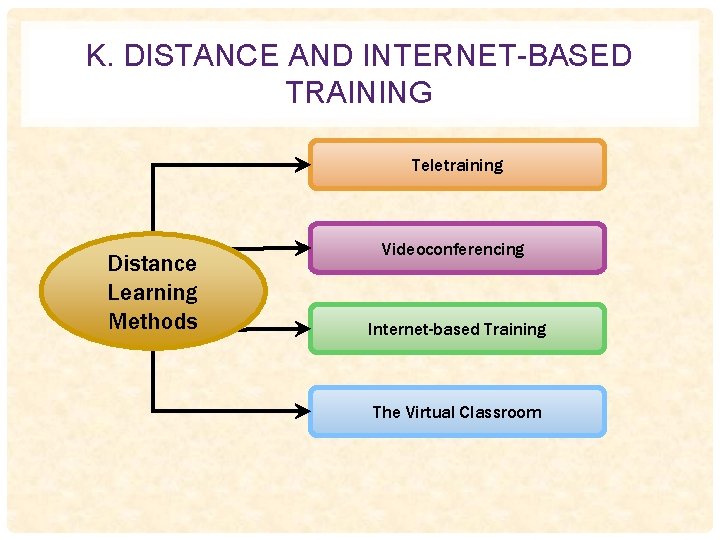
K. DISTANCE AND INTERNET-BASED TRAINING Teletraining Distance Learning Methods Videoconferencing Internet-based Training The Virtual Classroom
TRAINING METHODS- CONT’D K. Distance and Internet-Based Training – Distance learning methods include traditional paper-and-pencil correspondence courses, as well as teletraining, videoconferencing, and Internet-based classes. 1. Teletraining – where a trainer in a central location teaches groups of employees at remote locations via television hookups. 2. Videoconferencing – allows people in one location to communicate live via a combination of audio and visual equipment with people in different locations–another city or country or with groups in several cities.
K. DISTANCE AND INTERNET-BASED TRAININGCONT’D 3. Internet-based Training – is increasingly popular. Some companies simply let their employees take online courses offered by online course providers while others use their intranets to facilitate computer-based training. Programs like Blackboard and Web CT support online training. ØEffectiveness – In general, Web-based instruction was a bit more effective than classroom instruction for memorizing facts and principles and equally effective for teaching procedures. Employees are able to control their own pace and selection of content. 4. The Virtual Classroom – uses special collaboration software to enable multiple remote learners to use their PCs or laptops to participate in live discussions.
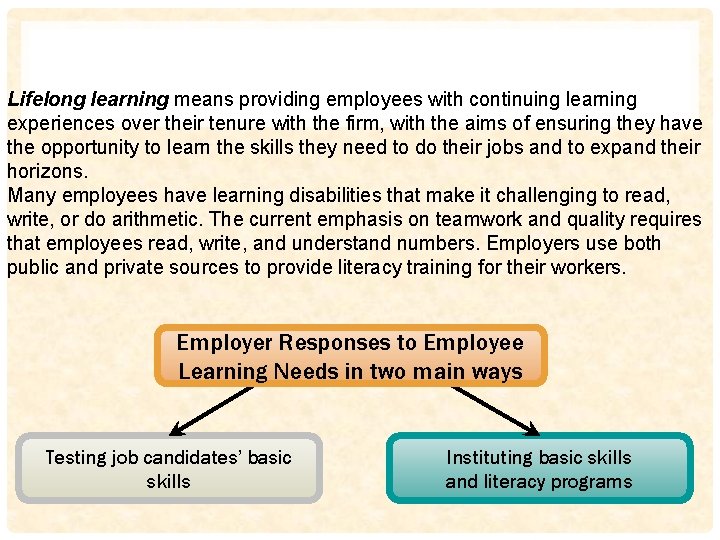
Lifelong learning means providing employees with continuing learning experiences over their tenure with the firm, with the aims of ensuring they have the opportunity to learn the skills they need to do their jobs and to expand their horizons. Many employees have learning disabilities that make it challenging to read, write, or do arithmetic. The current emphasis on teamwork and quality requires that employees read, write, and understand numbers. Employers use both public and private sources to provide literacy training for their workers. Employer Responses to Employee Learning Needs in two main ways Testing job candidates’ basic skills Instituting basic skills and literacy programs
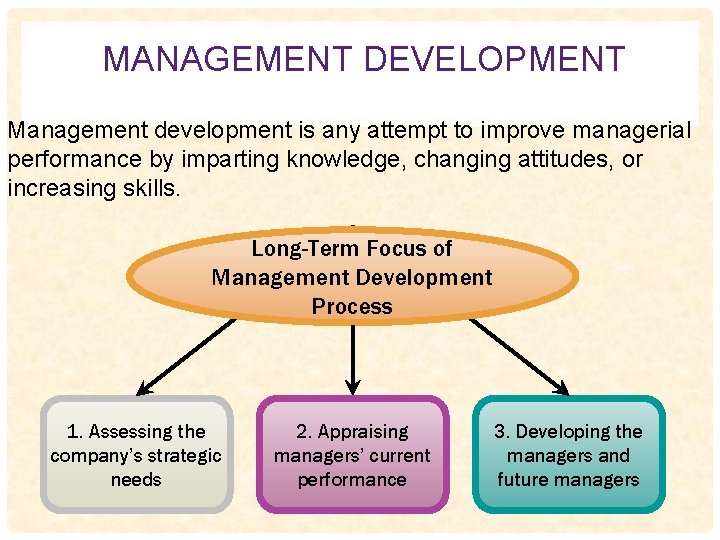
MANAGEMENT DEVELOPMENT Management development is any attempt to improve managerial performance by imparting knowledge, changing attitudes, or increasing skills. Long-Term Focus of Management Development Process 1. Assessing the company’s strategic needs 2. Appraising managers’ current performance 3. Developing the managers and future managers
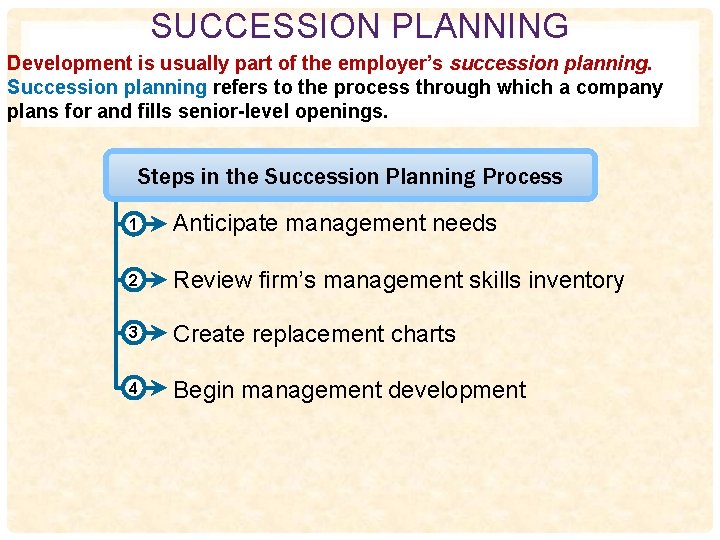
SUCCESSION PLANNING Development is usually part of the employer’s succession planning. Succession planning refers to the process through which a company plans for and fills senior-level openings. Steps in the Succession Planning Process 1 Anticipate management needs 2 Review firm’s management skills inventory 3 Create replacement charts 4 Begin management development
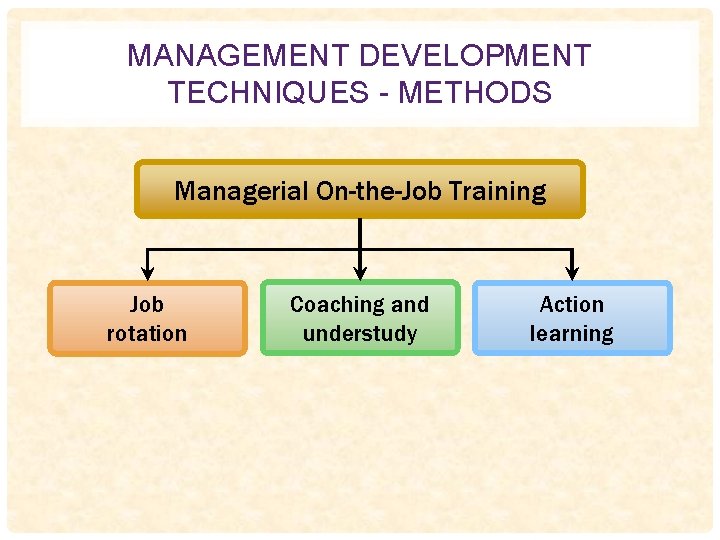
MANAGEMENT DEVELOPMENT TECHNIQUES - METHODS Managerial On-the-Job Training Job rotation Coaching and understudy Action learning
MANAGERIAL ON-THE-JOB TRAINING 1. Job Rotation – moving management trainees from department to broaden their understanding of all parts of the business. 2. Coaching/Understudy Approach – where a trainee works directly with a senior manager or with the person he/she is to replace, and the latter is responsible for coaching the trainee. 3. Action Learning – programs give managers and others released time to work full-time on projects to analyze and solve problems in departments other than their own. Research Insight – Some research suggest that in addition to shattering the glass ceiling for women for equity sake, women may make better managers than men these days.
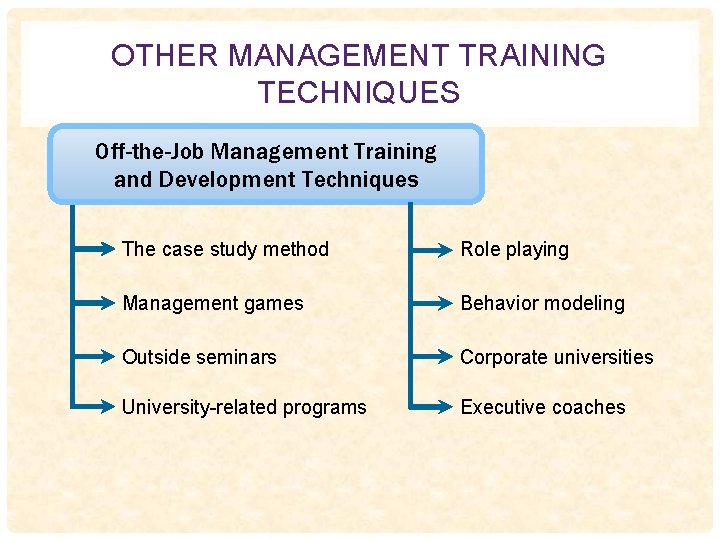
OTHER MANAGEMENT TRAINING TECHNIQUES Off-the-Job Management Training and Development Techniques The case study method Role playing Management games Behavior modeling Outside seminars Corporate universities University-related programs Executive coaches
OFF-THE-JOB MANAGEMENT TRAINING & DEVELOPMENT TECHNIQUES 1. The Case Study Method – presents a trainee with a written description of an organizational problem. 2. Management Games – computerized management games allow for the trainees to be involved. 3. Outside Seminars – offered by many companies and universities. 4. University- Related Programs: provide executive education and continuing education programs in leadership, supervision, and the like.
CONT’D 5. Role Playing is aimed at creating a realistic situation and then having the trainee assume the parts (roles) of specific persons in that situation. 6. Behavior Modeling involves showing the trainee the correct way to do something, letting the trainee practice the correct way, and giving the trainee feedback on his/her performance. Behavior modeling is one of the most widely-used 7. Corporate Universities - In-house development centers have been established by many companies to expose prospective managers to realistic exercises to develop improved management skills. 8. Executive Coaches are being used by firms to improve their top managers’ effectiveness. An executive coach is an outside consultant who questions the executive’s boss, peers, subordinates, and sometimes, family, in order to identify strengths and weaknesses, and to counsel the executive so he or she can capitalize on those strengths and overcome the weaknesses.
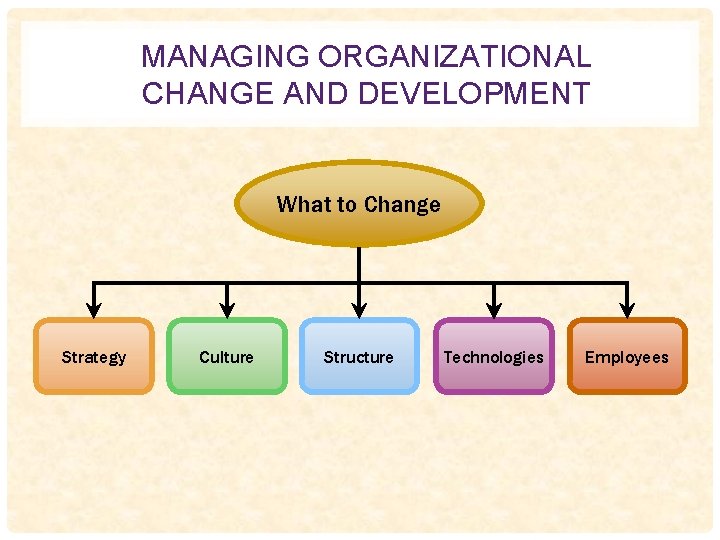
MANAGING ORGANIZATIONAL CHANGE AND DEVELOPMENT What to Change Strategy Culture Structure Technologies Employees
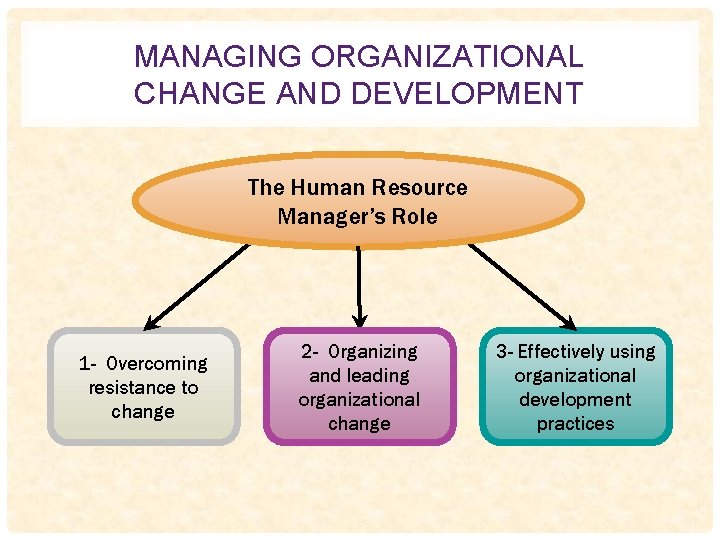
MANAGING ORGANIZATIONAL CHANGE AND DEVELOPMENT The Human Resource Manager’s Role 1 - Overcoming resistance to change 2 - Organizing and leading organizational change 3 - Effectively using organizational development practices
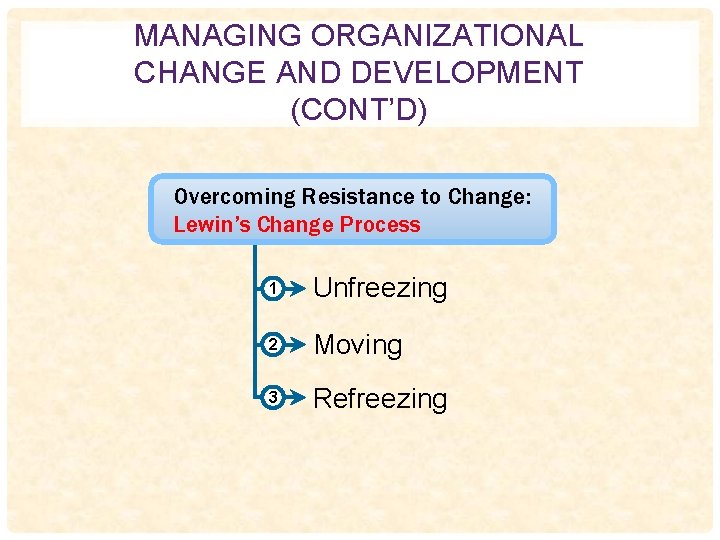
MANAGING ORGANIZATIONAL CHANGE AND DEVELOPMENT (CONT’D) Overcoming Resistance to Change: Lewin’s Change Process 1 Unfreezing 2 Moving 3 Refreezing
HOW TO LEAD THE CHANGE • Unfreezing Stage 1. Establish a sense of urgency (need for change). 2. Mobilize commitment to solving problems, through joint diagnosis of problem. • Moving Stage 3. 4. 5. 6. Create a guiding coalition. Develop and communicate a shared vision. (Check next slide) Help employees to make the change. Consolidate gains and produce more change, generate short term wins • Refreezing Stage 7. Reinforce new ways of doing things in the company culture. 8. Finally , the leader must monitor and assess progress.
KEY ELEMENTS IN COMMUNICATING THE VISION • Keep it simple. Eliminate all jargon and wasted words. • Use multiple forums. Try to use every channel possible, big meetings and small, memos and newspapers, formal and informal interaction – to spread the word. • Use repetition. “Repetition Brings Remembrance” • Lead by example. Managers’ behaviors and decisions have to be consistent with the vision.
USING ORGANIZATIONAL DEVELOPMENT Organizational development (OD): Organizational Development is a special approach to organizational change in which the employees themselves formulate the change required and implement it, often with the assistance of a trained consultant.
EVALUATING THE TRAINING EFFORT Two basic issues to address when evaluating training programs: 1. Designing the Evaluation Study • Time series design , take a series of measures before and after the training program. • Controlled experimentation. The evaluation process of choice is controlled experimentation, which uses both a training group and a control group (one that receives no training) to assess before and after performance to determine the extent to which performance in the training group resulted from the training itself rather than some organization-wide change. In practice, few firms use this method, preferring to simply measure trainees’ reactions, or to measure trainee job performance before and after the training.
EVALUATING THE TRAINING EFFORTCONT’D The second issue is of “What should we measure? ” and involves choosing which training outcomes to assess. 2. Choosing Which Training Effects to Measure Four basic categories of training outcomes can be measured • Reaction of trainees to the program. • Learning that actually took place. • Behavior that changed on the job. • Results achieved as a result of the training.
- Slides: 44