
8 4 Human population carrying capacity Human Population
- Slides: 27
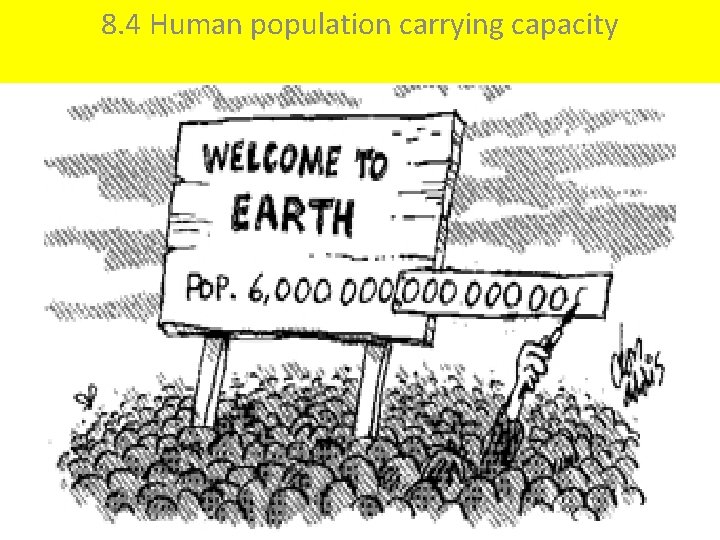
8. 4 Human population carrying capacity
Human Population Growth • Carrying Capacity – The maximum number of individuals of a species that can be sustainably supported within a habitat. It occurs when birth rate is equal to death rate But does this really apply to human populations? • Do human populations actually have a carrying capacity? • Well, there are many examples of direct and indirect effects of drought, famine and war which act to reduce populations when they grow too large
Human Population Growth Size of population isn’t the only factor which impacts on natural resources • Other factors include: – Wealth (MEDC or LEDC) – Resource desire – Resource need (or use) – Age distribution – Rural or urban populations – Time (it is dynamic) 80% of the world’s population lives in MEDCs where birth rate is falling (or negative, e. g. Japan) 20% of the world’s population lives in LEDCs where birth rate is increasing
Human Population Growth It is very difficult to assess a carrying capacity for a human population (or even if one exists): – We produce non-biodegradable waste which can cause environmental degradation and reduce the ability of an area to provide resources – The resources we use are far more varied and there are necessities and luxuries to take into account – Human populations have the capacity to move goods around the world – we can import food from another region if there isn’t enough where we live – We employ technology to change the environment.
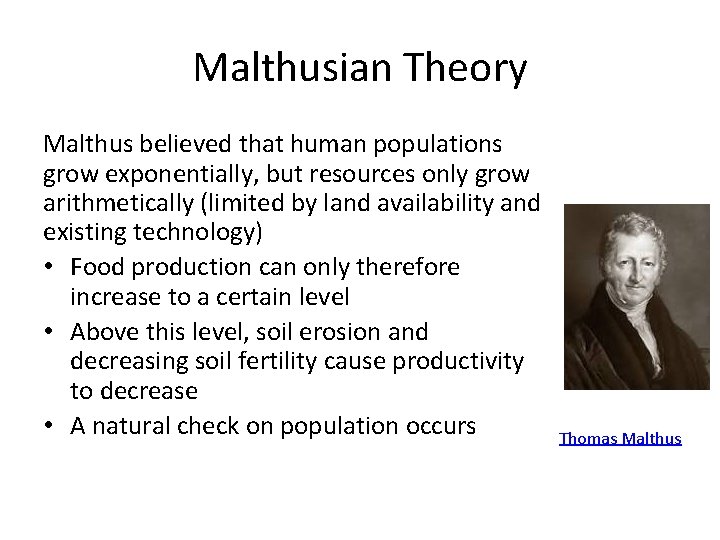
Malthusian Theory Malthus believed that human populations grow exponentially, but resources only grow arithmetically (limited by land availability and existing technology) • Food production can only therefore increase to a certain level • Above this level, soil erosion and decreasing soil fertility cause productivity to decrease • A natural check on population occurs Thomas Malthus
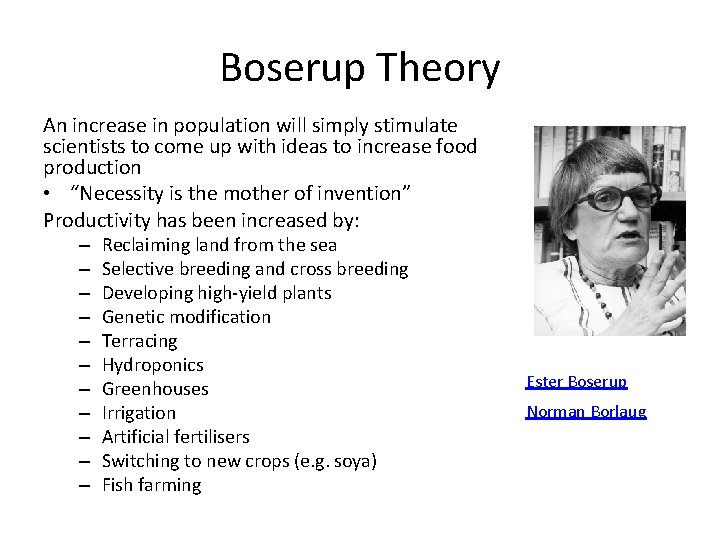
Boserup Theory An increase in population will simply stimulate scientists to come up with ideas to increase food production • “Necessity is the mother of invention” Productivity has been increased by: – – – Reclaiming land from the sea Selective breeding and cross breeding Developing high-yield plants Genetic modification Terracing Hydroponics Greenhouses Irrigation Artificial fertilisers Switching to new crops (e. g. soya) Fish farming Ester Boserup Norman Borlaug
Environmental Demands of Human Populations • An ecological footprint (EF) is the hypothetical area of land needed by an individual, group or society to fulfil its resource needs and assimilate all waste • An ecological footprint is not necessarily sustainable. It may refer to an unstable equilibrium
Ecological Footprint • A country with a total ecological footprint greater than its available land is in theory living beyond its means (It has an ecological deficit)
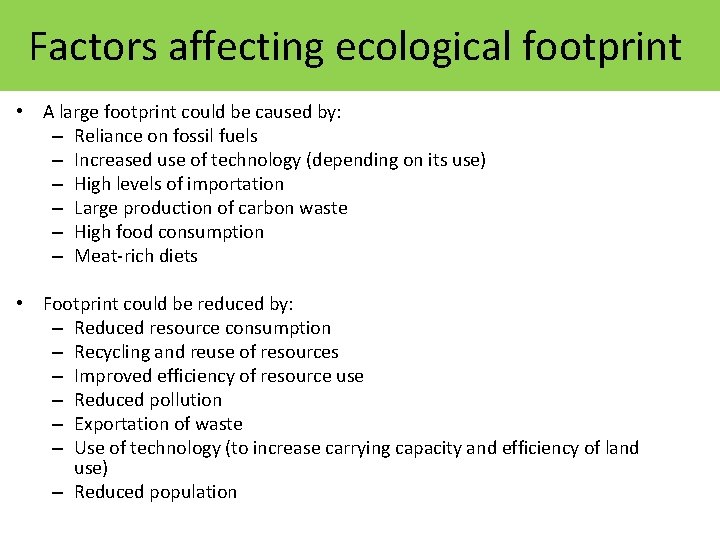
Factors affecting ecological footprint • A large footprint could be caused by: – Reliance on fossil fuels – Increased use of technology (depending on its use) – High levels of importation – Large production of carbon waste – High food consumption – Meat-rich diets • Footprint could be reduced by: – Reduced resource consumption – Recycling and reuse of resources – Improved efficiency of resource use – Reduced pollution – Exportation of waste – Use of technology (to increase carrying capacity and efficiency of land use) – Reduced population
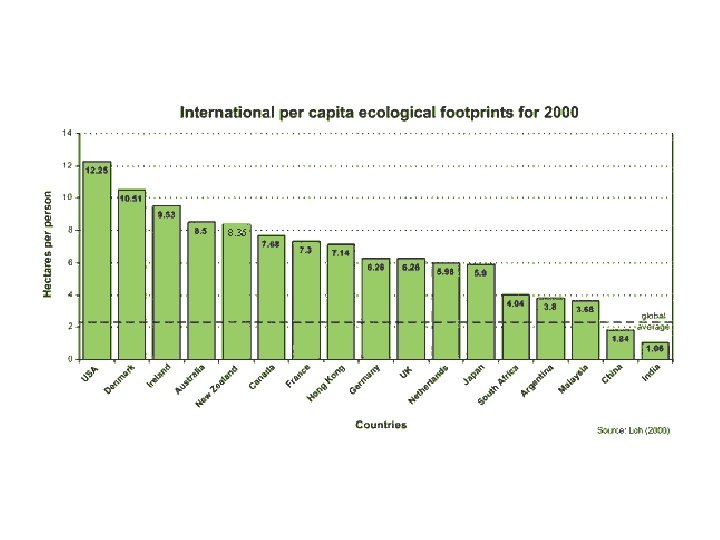
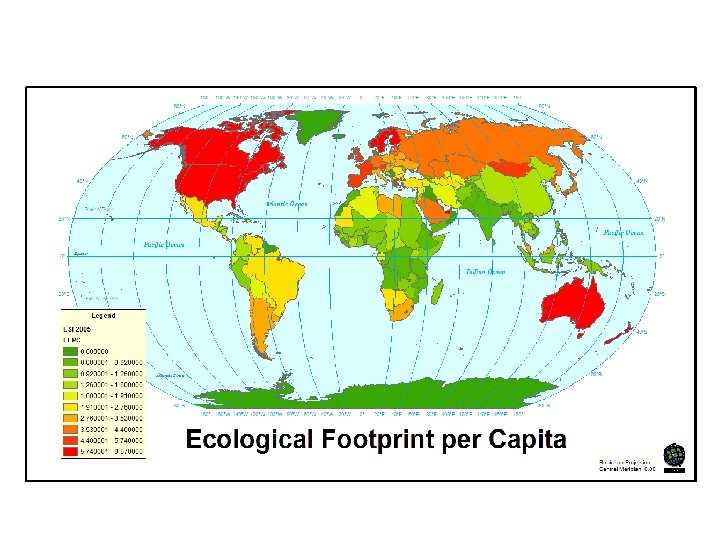
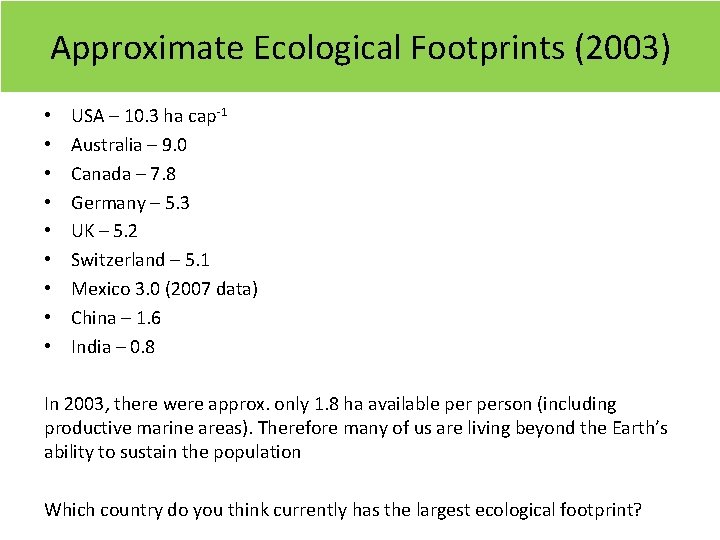
Approximate Ecological Footprints (2003) • • • USA – 10. 3 ha cap-1 Australia – 9. 0 Canada – 7. 8 Germany – 5. 3 UK – 5. 2 Switzerland – 5. 1 Mexico 3. 0 (2007 data) China – 1. 6 India – 0. 8 In 2003, there were approx. only 1. 8 ha available person (including productive marine areas). Therefore many of us are living beyond the Earth’s ability to sustain the population Which country do you think currently has the largest ecological footprint?
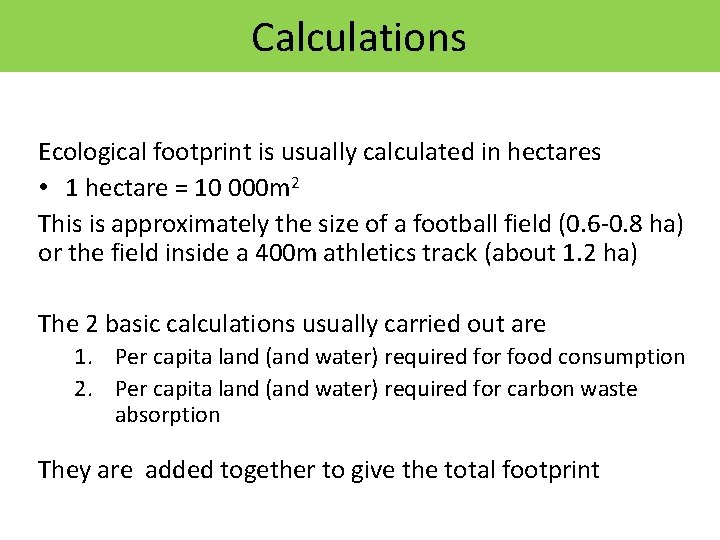
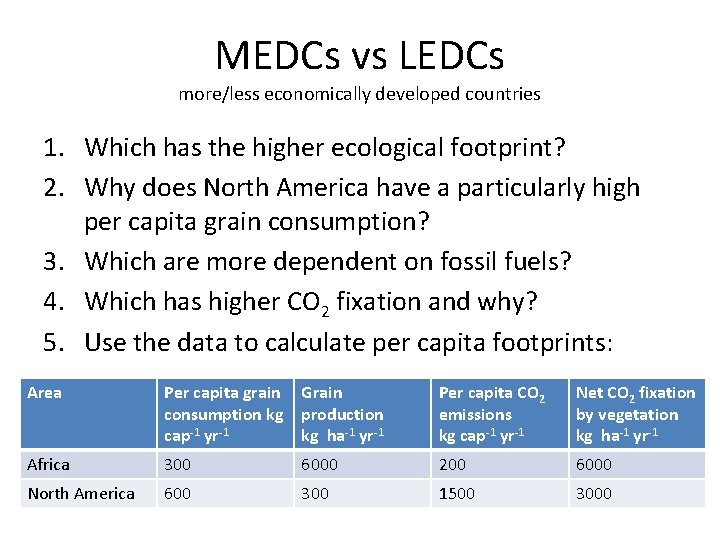
Calculations Ecological footprint is usually calculated in hectares • 1 hectare = 10 000 m 2 This is approximately the size of a football field (0. 6 -0. 8 ha) or the field inside a 400 m athletics track (about 1. 2 ha) The 2 basic calculations usually carried out are 1. Per capita land (and water) required for food consumption 2. Per capita land (and water) required for carbon waste absorption They are added together to give the total footprint
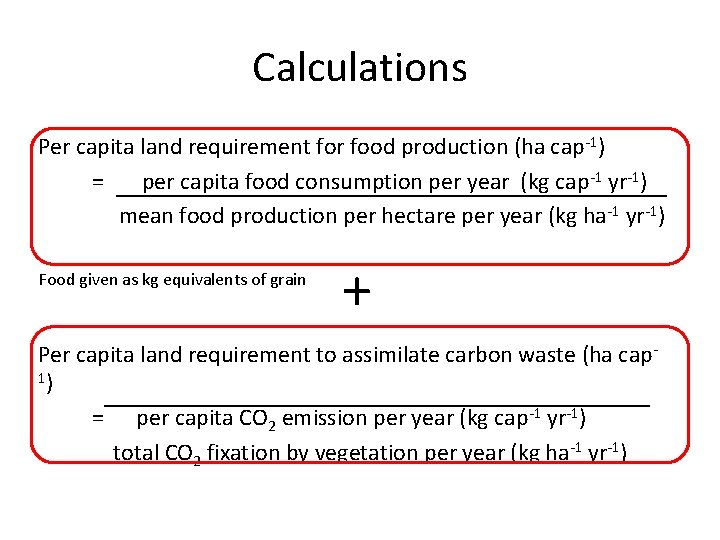
Calculations Per capita land requirement for food production (ha cap-1) = per capita food consumption per year (kg cap-1 yr-1) mean food production per hectare per year (kg ha-1 yr-1) Food given as kg equivalents of grain + Per capita land requirement to assimilate carbon waste (ha cap 1) = per capita CO 2 emission per year (kg cap-1 yr-1) total CO 2 fixation by vegetation per year (kg ha-1 yr-1)
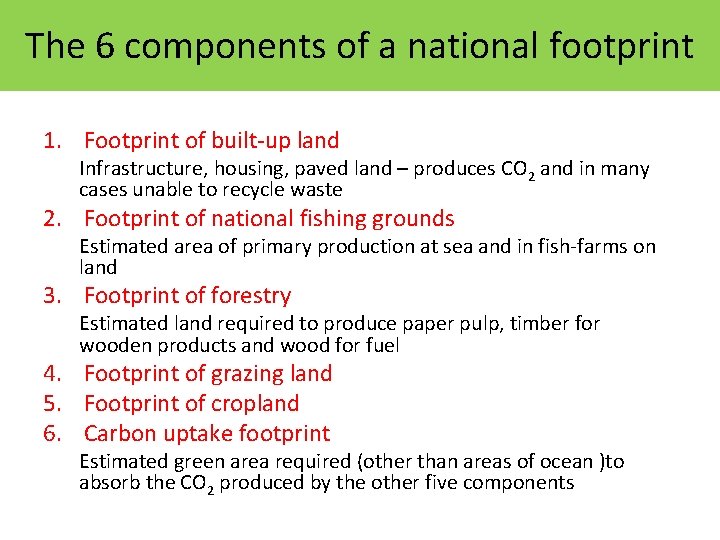
The 6 components of a national footprint 1. Footprint of built-up land Infrastructure, housing, paved land – produces CO 2 and in many cases unable to recycle waste 2. Footprint of national fishing grounds Estimated area of primary production at sea and in fish-farms on land 3. Footprint of forestry Estimated land required to produce paper pulp, timber for wooden products and wood for fuel 4. Footprint of grazing land 5. Footprint of cropland 6. Carbon uptake footprint Estimated green area required (other than areas of ocean )to absorb the CO 2 produced by the other five components
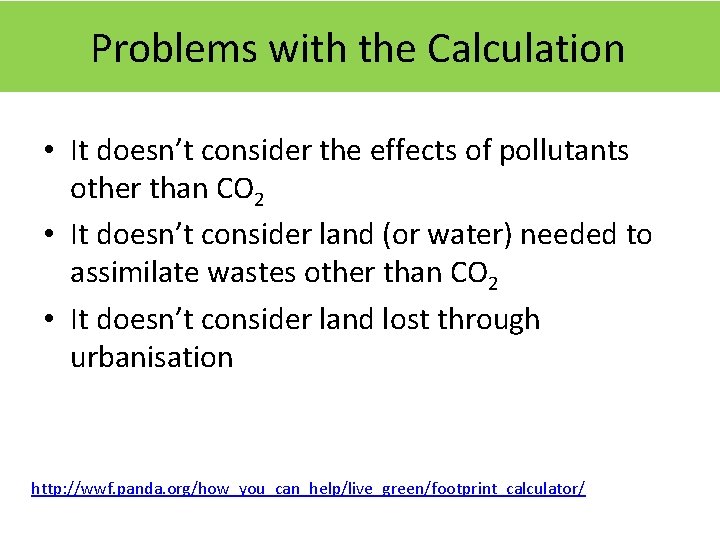
Problems with the Calculation • It doesn’t consider the effects of pollutants other than CO 2 • It doesn’t consider land (or water) needed to assimilate wastes other than CO 2 • It doesn’t consider land lost through urbanisation http: //wwf. panda. org/how_you_can_help/live_green/footprint_calculator/
MEDCs vs LEDCs more/less economically developed countries 1. Which has the higher ecological footprint? 2. Why does North America have a particularly high per capita grain consumption? 3. Which are more dependent on fossil fuels? 4. Which has higher CO 2 fixation and why? 5. Use the data to calculate per capita footprints: Area Per capita grain consumption kg cap-1 yr-1 Grain production kg ha-1 yr-1 Per capita CO 2 emissions kg cap-1 yr-1 Net CO 2 fixation by vegetation kg ha-1 yr-1 Africa 300 6000 200 6000 North America 600 300 1500 3000
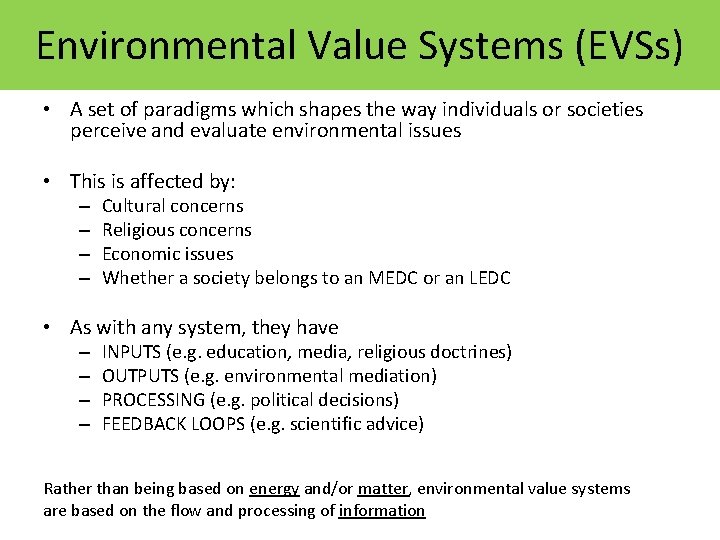
Environmental Value Systems (EVSs) • A set of paradigms which shapes the way individuals or societies perceive and evaluate environmental issues • This is affected by: – – Cultural concerns Religious concerns Economic issues Whether a society belongs to an MEDC or an LEDC • As with any system, they have – – INPUTS (e. g. education, media, religious doctrines) OUTPUTS (e. g. environmental mediation) PROCESSING (e. g. political decisions) FEEDBACK LOOPS (e. g. scientific advice) Rather than being based on energy and/or matter, environmental value systems are based on the flow and processing of information
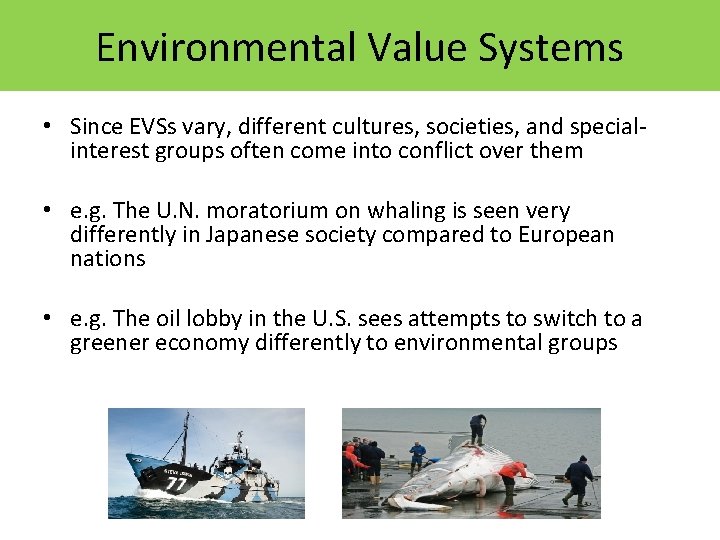
Environmental Value Systems • Since EVSs vary, different cultures, societies, and specialinterest groups often come into conflict over them • e. g. The U. N. moratorium on whaling is seen very differently in Japanese society compared to European nations • e. g. The oil lobby in the U. S. sees attempts to switch to a greener economy differently to environmental groups
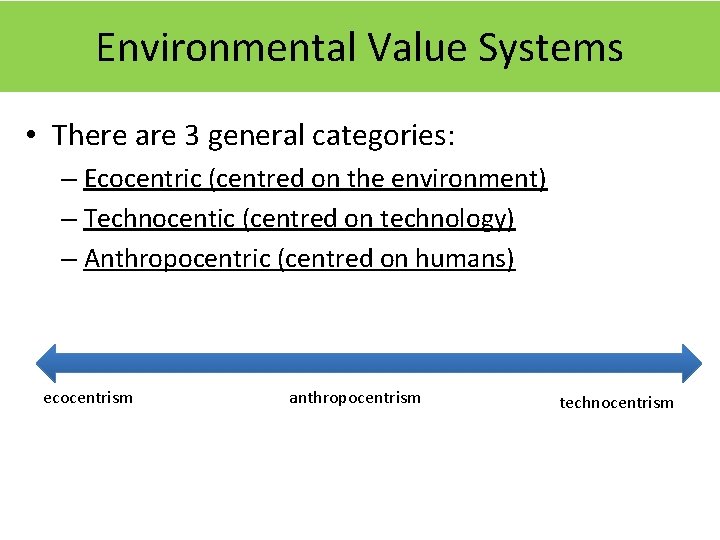
Environmental Value Systems • There are 3 general categories: – Ecocentric (centred on the environment) – Technocentic (centred on technology) – Anthropocentric (centred on humans) ecocentrism anthropocentrism technocentrism
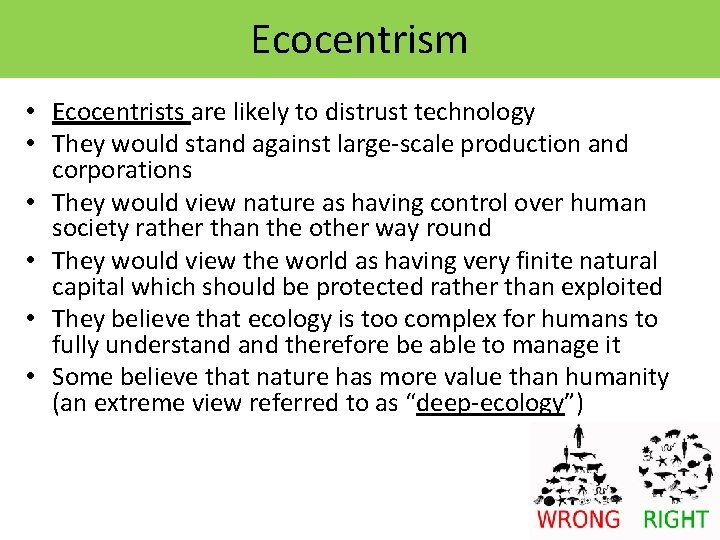
Ecocentrism • Ecocentrists are likely to distrust technology • They would stand against large-scale production and corporations • They would view nature as having control over human society rather than the other way round • They would view the world as having very finite natural capital which should be protected rather than exploited • They believe that ecology is too complex for humans to fully understand therefore be able to manage it • Some believe that nature has more value than humanity (an extreme view referred to as “deep-ecology”)
Technocentrism • Technocentrists trust in technological advances to solve environmental problems • They trust in the resourcefulness of humans • They believe that humans are able to control nature • They believe that scientific thinking and scientific research is important in making public policy • Extreme technocentrists are referred to as ‘cornucopians’. They believe that the world has infinite resources to support a growing population and that this is achievable through a free-market and reliance on technology
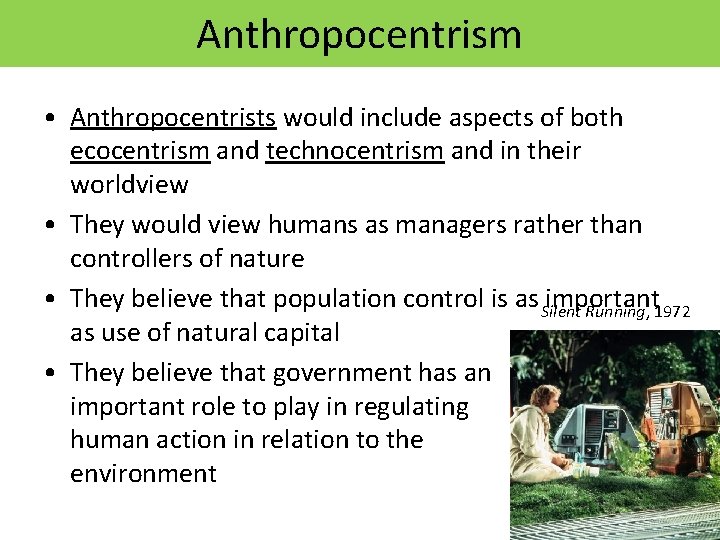
Anthropocentrism • Anthropocentrists would include aspects of both ecocentrism and technocentrism and in their worldview • They would view humans as managers rather than controllers of nature • They believe that population control is as Silent important Running, 1972 as use of natural capital • They believe that government has an important role to play in regulating human action in relation to the environment
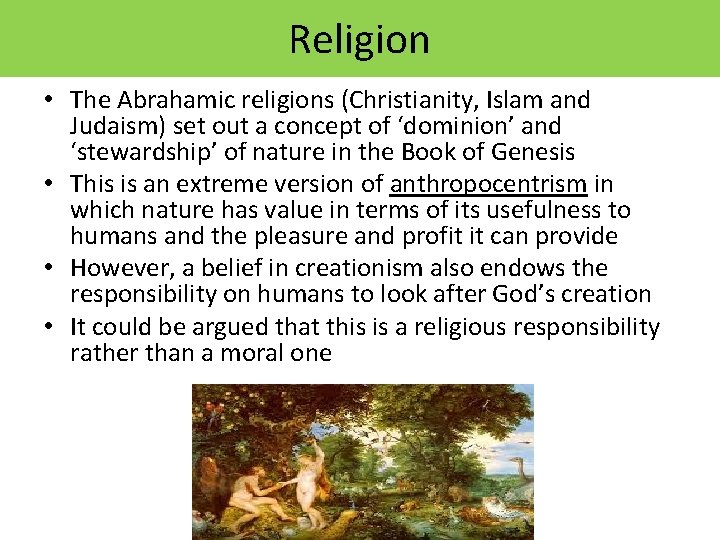
Religion • The Abrahamic religions (Christianity, Islam and Judaism) set out a concept of ‘dominion’ and ‘stewardship’ of nature in the Book of Genesis • This is an extreme version of anthropocentrism in which nature has value in terms of its usefulness to humans and the pleasure and profit it can provide • However, a belief in creationism also endows the responsibility on humans to look after God’s creation • It could be argued that this is a religious responsibility rather than a moral one
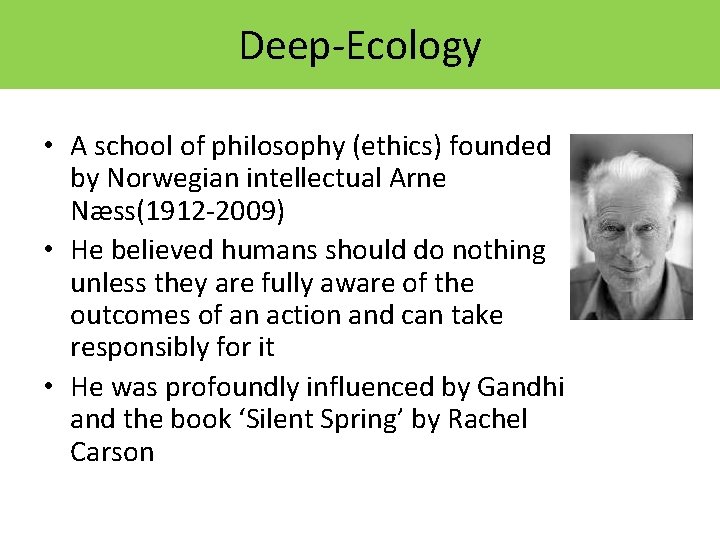
Deep-Ecology • A school of philosophy (ethics) founded by Norwegian intellectual Arne Næss(1912 -2009) • He believed humans should do nothing unless they are fully aware of the outcomes of an action and can take responsibly for it • He was profoundly influenced by Gandhi and the book ‘Silent Spring’ by Rachel Carson
Deep-Ecology • The tenets of deep-ecology are: – The well being of human and non-human life has no value in itself which is independent of the usefulness of the non-human world to humans – The richness and diversity of life contributes to these values – Humans have no right to reduce this richness and diversity except to satisfy vital needs – For human (and non-human) life to flourish a substantial reduction in human population is required – Human interference with the non-human world is excessive – A substantial change in world policy is needed in terms of economics, technology and ideology – Humans should appreciate the quality of life rather than aspire towards higher standards of living – People with ecocentric views need to constantly work to make these changes to improve the well-being of the Earth
Can Carrying Capacity Change? If we cut down on our use of natural resources • It may be achieved by: – Recycling (reprocessing materials into new products) – Re-use (returning materials to the manufacturer of processor, or finding new uses ourselves) – Reduction (using less energy or resources) – Substitution (switching to renewable resources from non-renewable) https: //www. youtube. com/watch? v=E 8 dk. WQVFAo. A