
8 3 Resistance and the Flow of Electrons
- Slides: 14
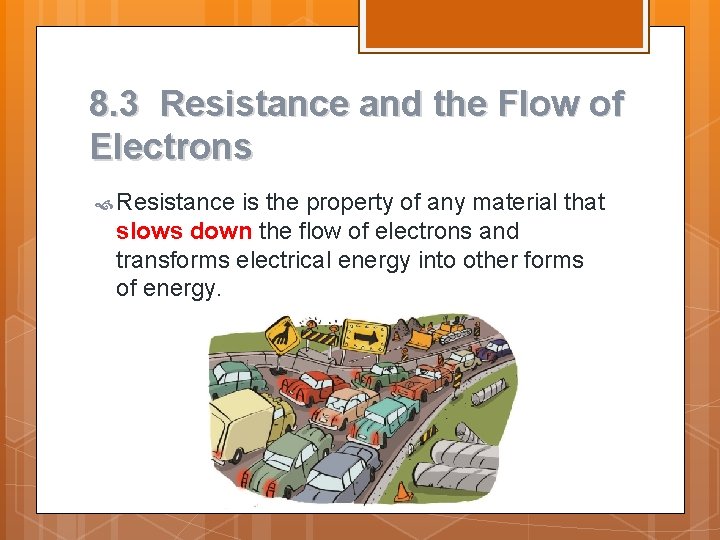
8. 3 Resistance and the Flow of Electrons Resistance is the property of any material that slows down the flow of electrons and transforms electrical energy into other forms of energy.
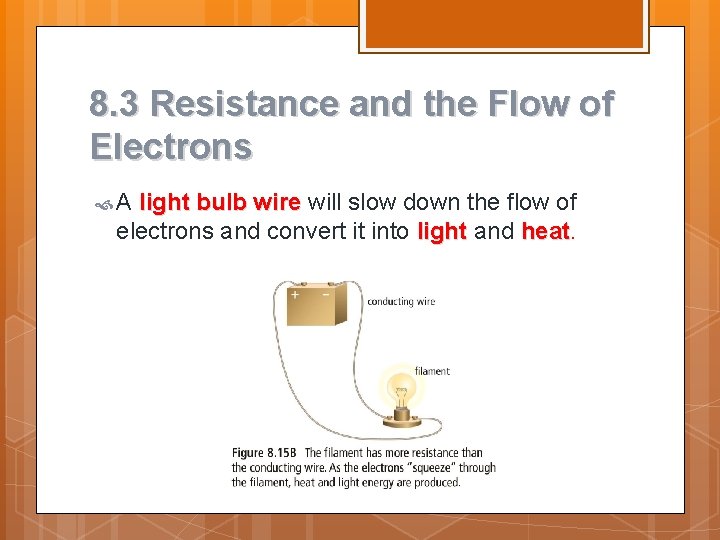
8. 3 Resistance and the Flow of Electrons A light bulb wire will slow down the flow of electrons and convert it into light and heat
8. 3 Resistance and Current Voltage If is directly proportional to current a battery is connected to an electric circuit that has a large resistance, less current will flow than if the same battery is connected to a lower resistance circuit.
8. 3 Ohm’s Law Electrical resistance is the ratio of the voltage to the current The unit of measurement for electrical resistance is the ohm. Ohm’s law is written R = V I Ohm’s law is more commonly written as : V = IR
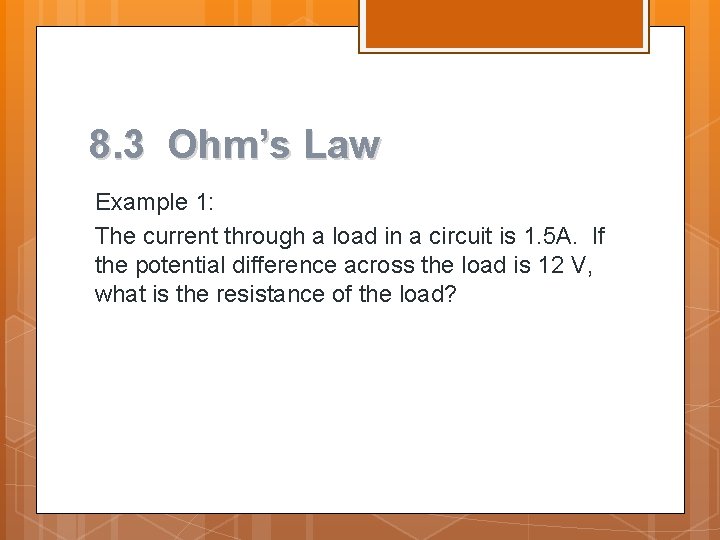
8. 3 Ohm’s Law Example 1: The current through a load in a circuit is 1. 5 A. If the potential difference across the load is 12 V, what is the resistance of the load?
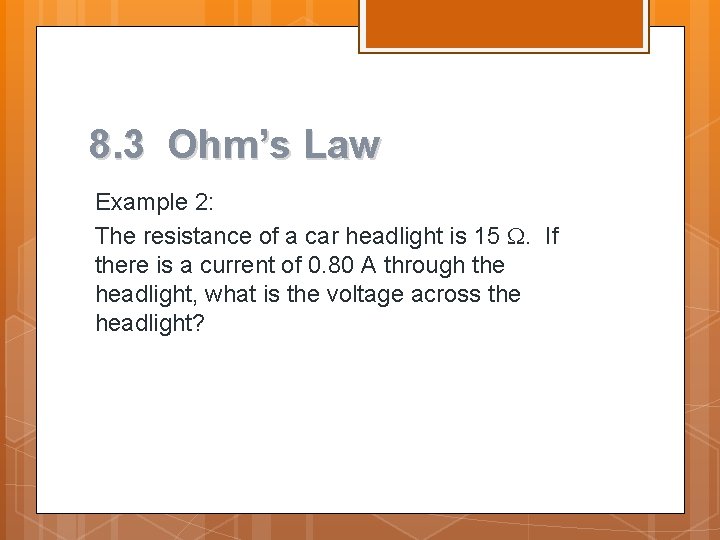
8. 3 Ohm’s Law Example 2: The resistance of a car headlight is 15 . If there is a current of 0. 80 A through the headlight, what is the voltage across the headlight?
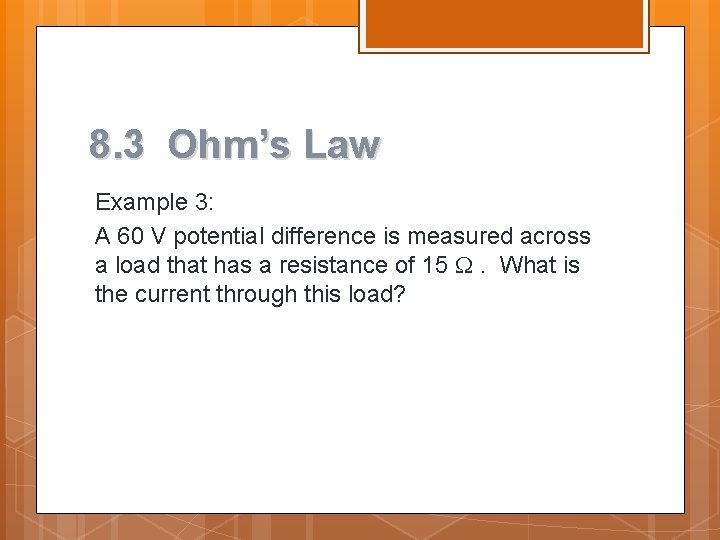
8. 3 Ohm’s Law Example 3: A 60 V potential difference is measured across a load that has a resistance of 15 . What is the current through this load?
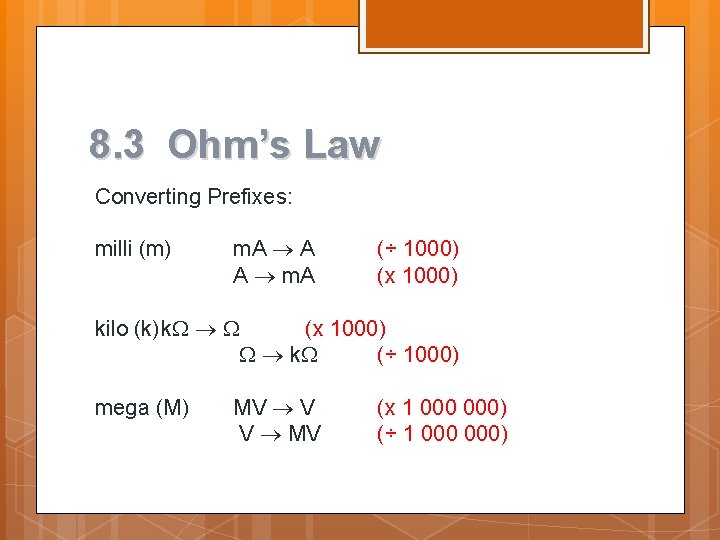
8. 3 Ohm’s Law Converting Prefixes: milli (m) m. A A A m. A (÷ 1000) (x 1000) kilo (k)k (x 1000) k (÷ 1000) mega (M) MV V V MV (x 1 000) (÷ 1 000)
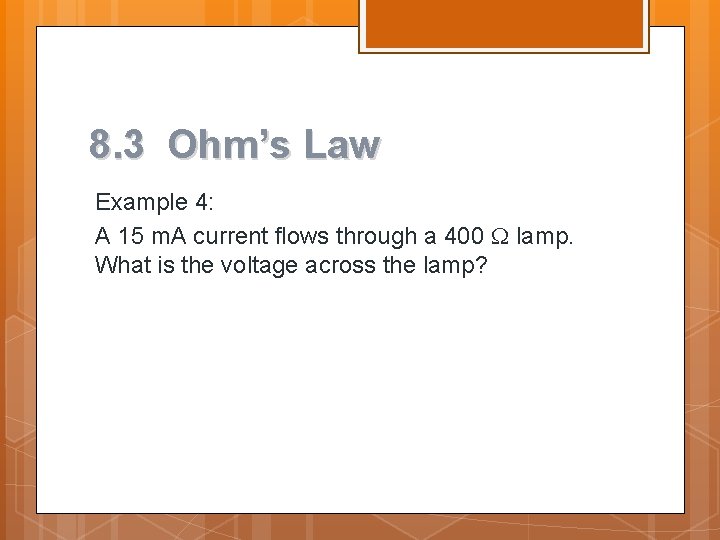
8. 3 Ohm’s Law Example 4: A 15 m. A current flows through a 400 lamp. What is the voltage across the lamp?
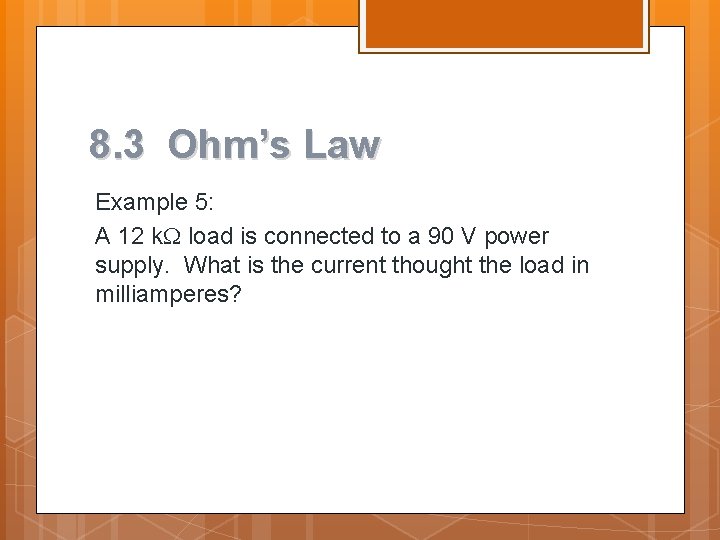
8. 3 Ohm’s Law Example 5: A 12 k load is connected to a 90 V power supply. What is the current thought the load in milliamperes?
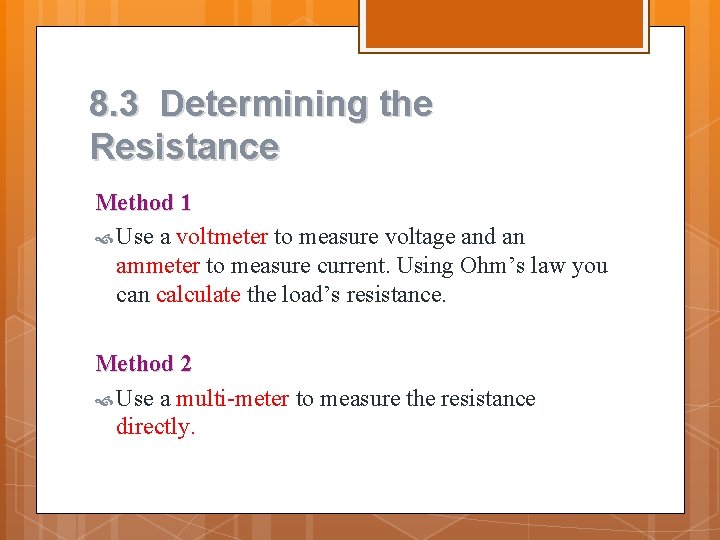
8. 3 Determining the Resistance Method 1 Use a voltmeter to measure voltage and an ammeter to measure current. Using Ohm’s law you can calculate the load’s resistance. Method 2 Use a multi-meter to measure the resistance directly.
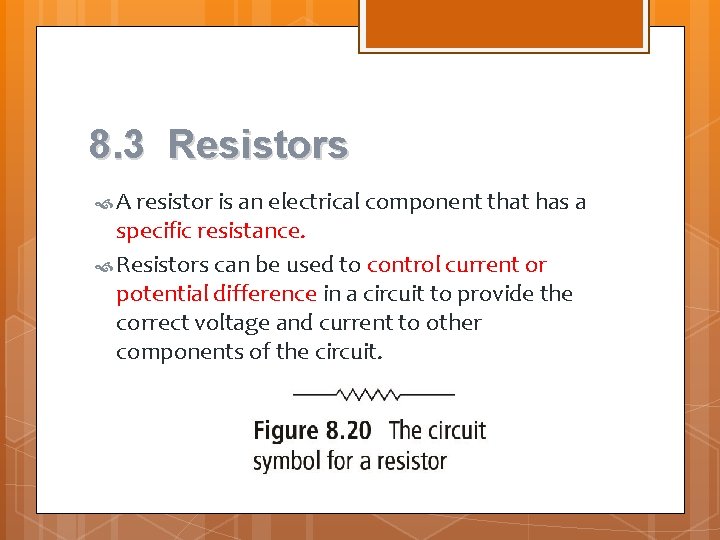
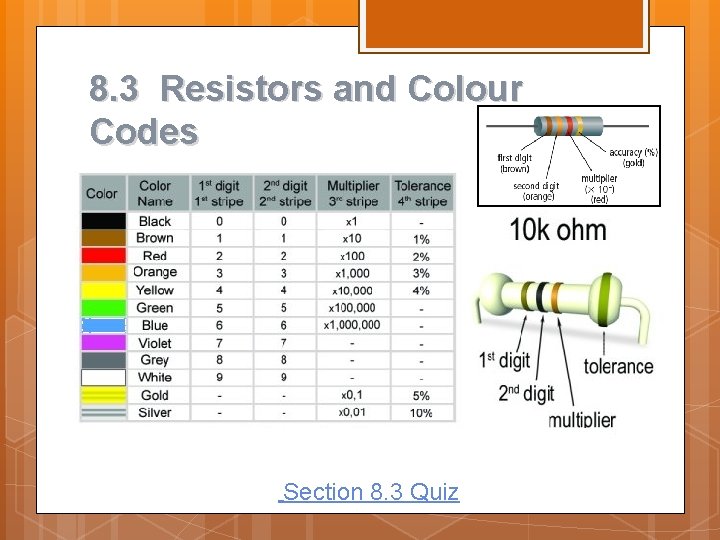
8. 3 Resistors A resistor is an electrical component that has a specific resistance. Resistors can be used to control current or potential difference in a circuit to provide the correct voltage and current to other components of the circuit.
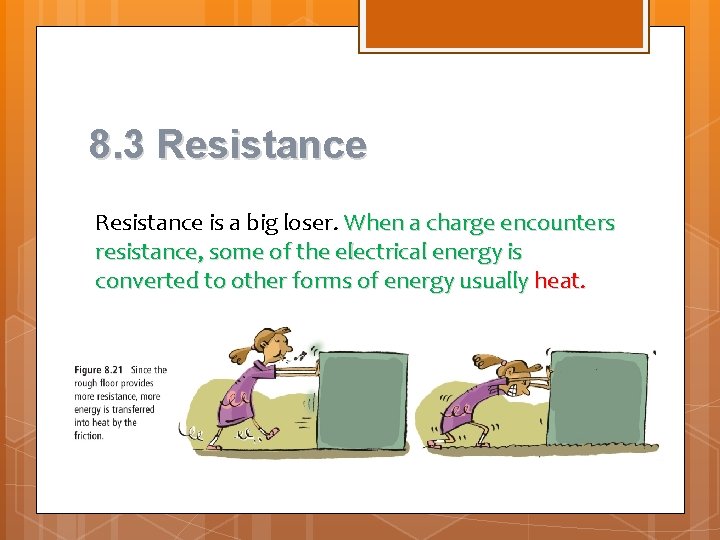
8. 3 Resistance is a big loser. When a charge encounters resistance, some of the electrical energy is converted to other forms of energy usually heat.
8. 3 Resistors and Colour Codes Section 8. 3 Quiz