
8 3 NOTES 8 3 Membrane Receptor Proteins

8. 3 NOTES
8. 3 Membrane Receptor Proteins • Cells must be able to communicate and distinguish between important and unimportant information • Cell communicate by sending chemical signals • Signaling cell- produces a signal (molecule) • Target cell- cell that receives the signal (molecule) because it has the correct surface protein • Hormones and nerve cells send signals over long distances
Receiving signals • Cells are bombarded by hundreds of signals but only responds to the few signals that relate to its function • Receptor proteins- in membrane, determine which signals cell responds to • Only responds to signals that match the specific shape of its binding site • When a signal does bind the receptor protein changes shape which passes the information into the cell
Membrane Receptor Proteins Responses to Signals • Functions: • 1. Changes in Permeability - binding of a signal molecule to the receptor protein causes an ion channel to open and allows specific ions to cross membrane. • 2. Second Messengers - receptor protein may cause the formation of a second messenger inside the cell. The second messenger acts as a signal molecule and amplifies the signal of the first messenger—that is, the original signal molecule. • 3. Enzyme action - receptor protein may act as an enzyme. When binding occurs, receptor protein may speed up chemical reactions inside cell.
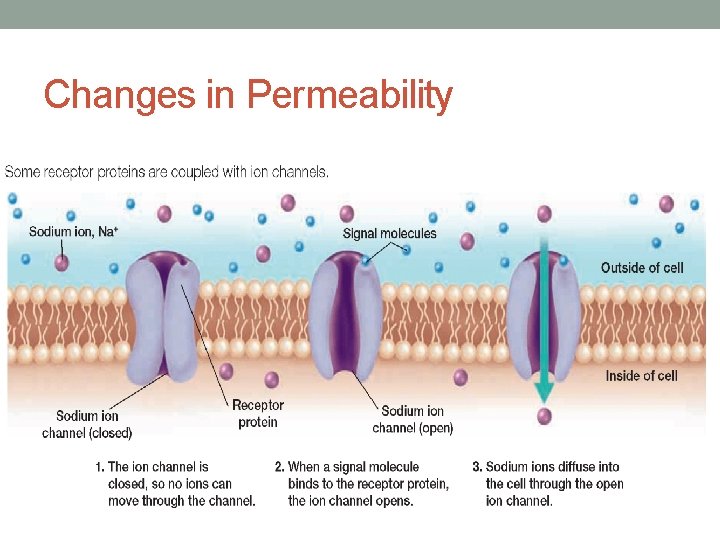
Changes in Permeability
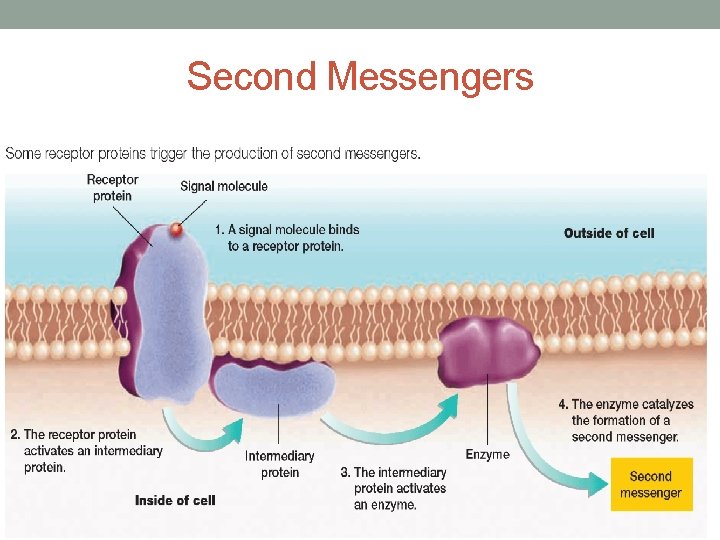
Second Messengers
- Slides: 6