
8 3 Colligative Properties Objective S 3 Chemistry
8. 3 Colligative Properties Objective S 3 Chemistry
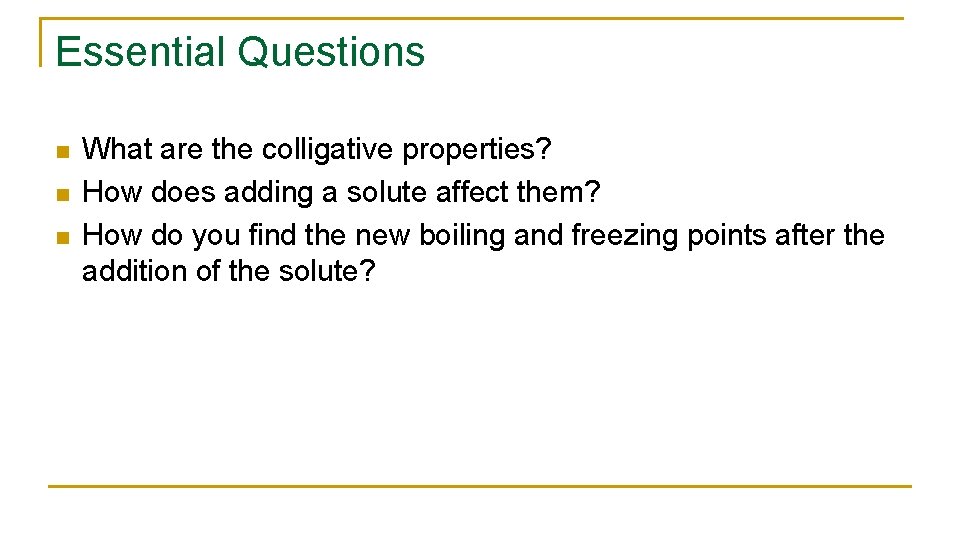
Essential Questions n n n What are the colligative properties? How does adding a solute affect them? How do you find the new boiling and freezing points after the addition of the solute?
Colligative Properties n Physical properties that are affected by the concentration of the solute in the solution q q q Vapor Pressure Reduction Boiling Point Elevation Freezing point depression
Vapor Pressure Reduction n n In a liquid, molecules are constantly moving from the liquid phase to the gas phase and back again Vapor pressure is the pressure of the gas “pushing” on the liquid
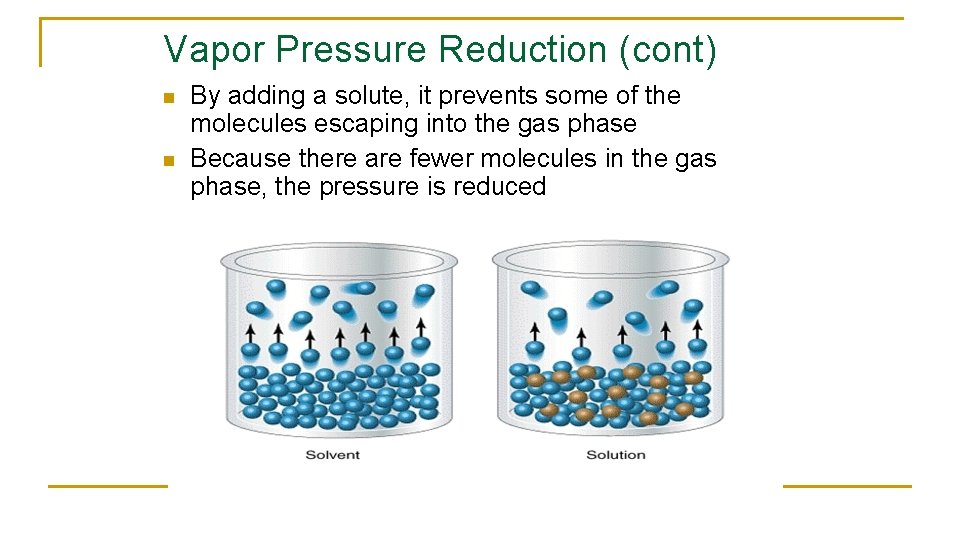
Vapor Pressure Reduction (cont) n n By adding a solute, it prevents some of the molecules escaping into the gas phase Because there are fewer molecules in the gas phase, the pressure is reduced
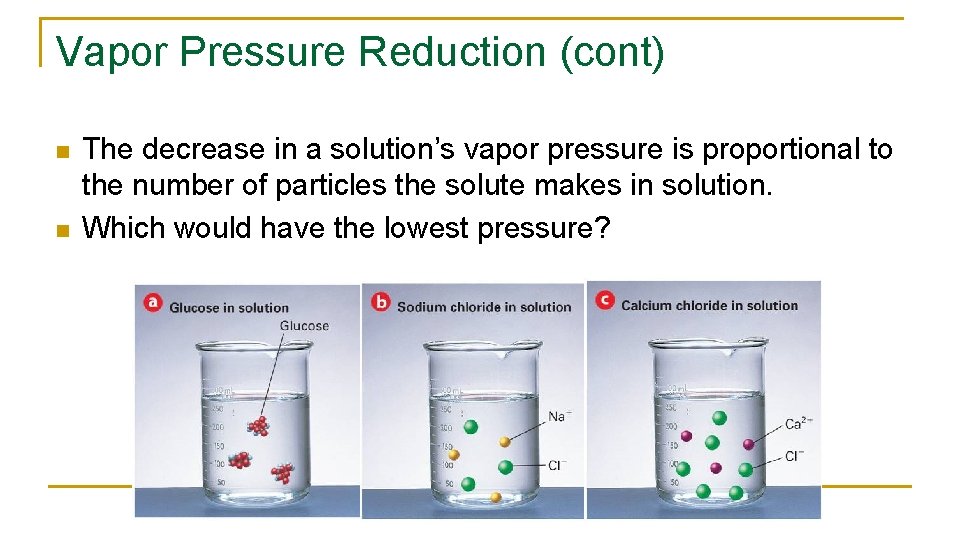
Vapor Pressure Reduction (cont) n n The decrease in a solution’s vapor pressure is proportional to the number of particles the solute makes in solution. Which would have the lowest pressure?
Boiling Point Elevation n A liquid boils when its vapor pressure is equal to the external pressure because at this point the molecules can escape into the gas phase Adding a solute reduces vapor pressure and increases the energy needed for the vapor pressure to equal the external pressure The increase in energy results in the boiling point increasing which is called Boiling Point Elevation
Boiling Point Elevation (cont) n n Boiling point elevation (ΔTb) is proportional to the molality of the solution ΔTb=Kbm Where: q q q n Kb is the molal boiling point constant (every solvent has a different Kb value) m is the molality of the solution ΔTb is the elevation of the boiling point For soluble ionic compounds m is multiplied by the number of ions formed
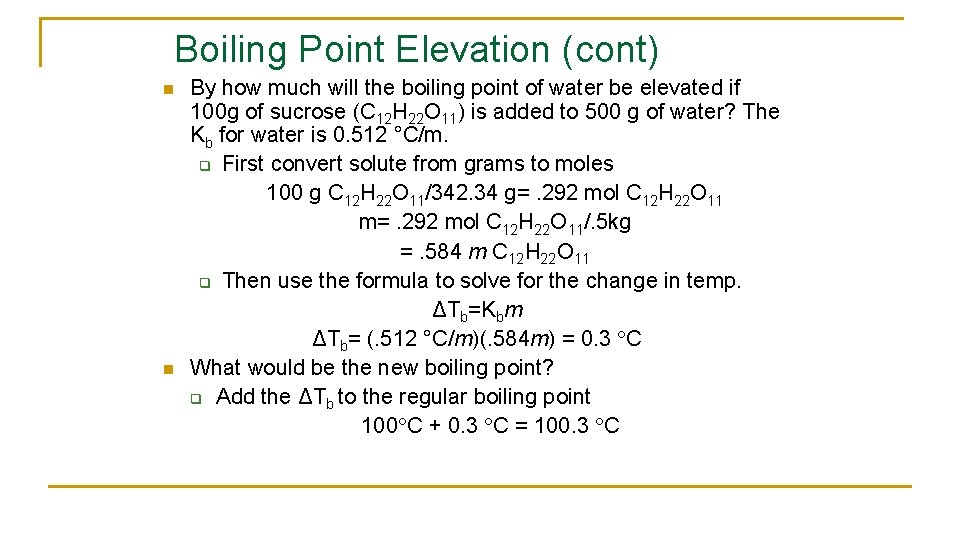
Boiling Point Elevation (cont) n n By how much will the boiling point of water be elevated if 100 g of sucrose (C 12 H 22 O 11) is added to 500 g of water? The Kb for water is 0. 512 °C/m. q First convert solute from grams to moles 100 g C 12 H 22 O 11/342. 34 g=. 292 mol C 12 H 22 O 11 m=. 292 mol C 12 H 22 O 11/. 5 kg =. 584 m C 12 H 22 O 11 q Then use the formula to solve for the change in temp. ΔTb=Kbm ΔTb= (. 512 °C/m)(. 584 m) = 0. 3 C What would be the new boiling point? q Add the ΔTb to the regular boiling point 100 C + 0. 3 C = 100. 3 C
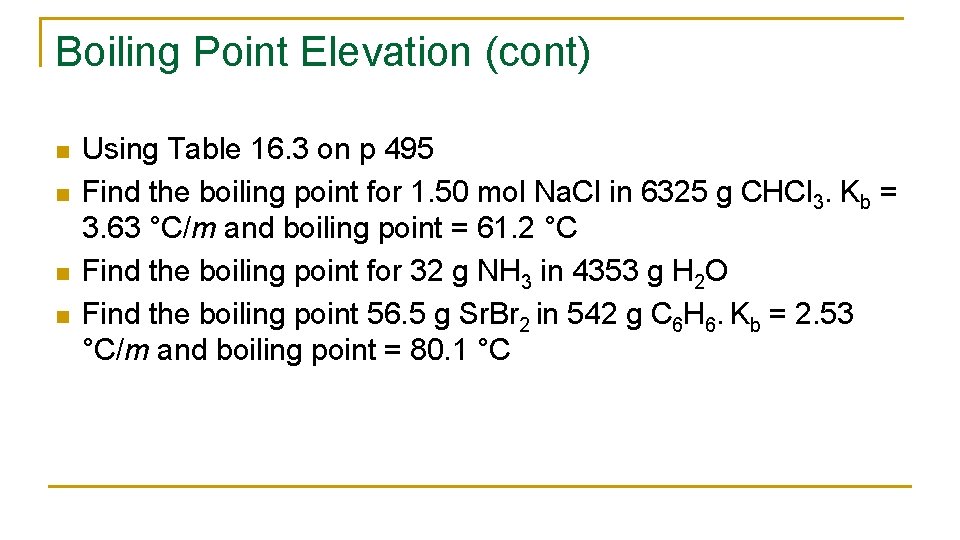
Boiling Point Elevation (cont) n n Using Table 16. 3 on p 495 Find the boiling point for 1. 50 mol Na. Cl in 6325 g CHCl 3. Kb = 3. 63 °C/m and boiling point = 61. 2 °C Find the boiling point for 32 g NH 3 in 4353 g H 2 O Find the boiling point 56. 5 g Sr. Br 2 in 542 g C 6 H 6. Kb = 2. 53 °C/m and boiling point = 80. 1 °C
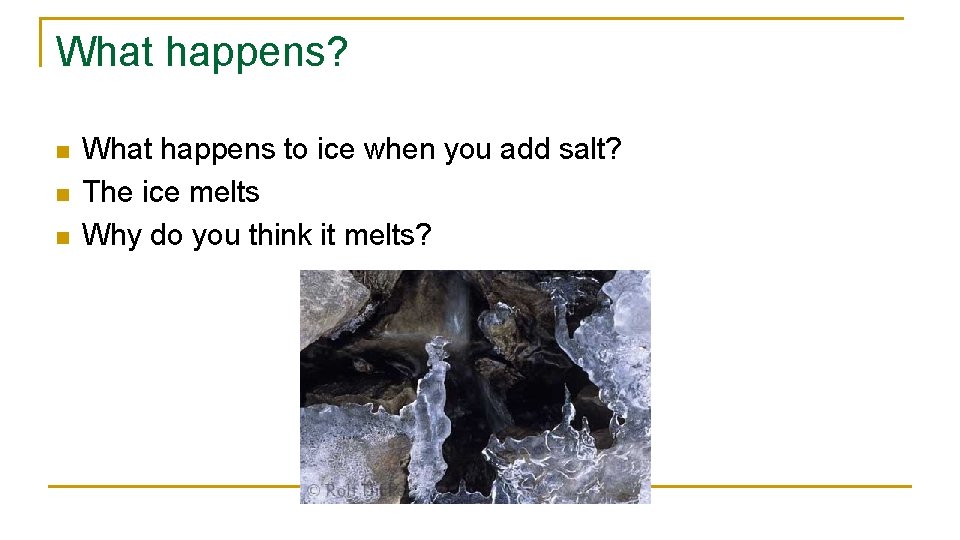
What happens? n n n What happens to ice when you add salt? The ice melts Why do you think it melts?
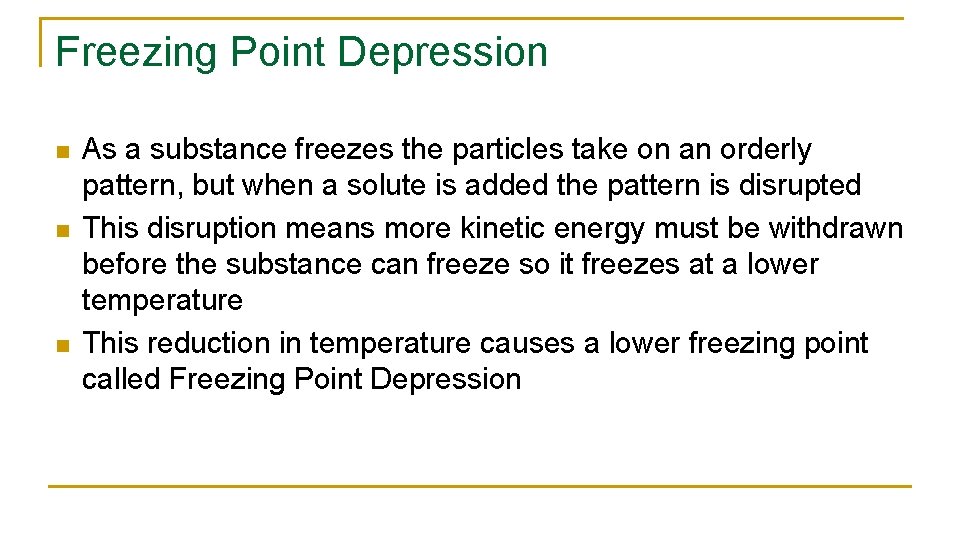
Freezing Point Depression n As a substance freezes the particles take on an orderly pattern, but when a solute is added the pattern is disrupted This disruption means more kinetic energy must be withdrawn before the substance can freeze so it freezes at a lower temperature This reduction in temperature causes a lower freezing point called Freezing Point Depression
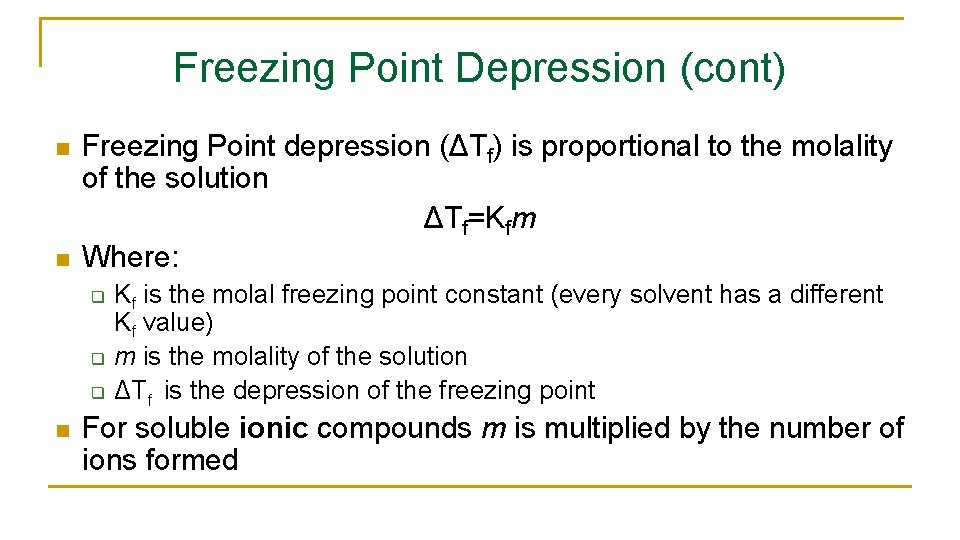
Freezing Point Depression (cont) n n Freezing Point depression (ΔTf) is proportional to the molality of the solution ΔTf=Kfm Where: q q q n Kf is the molal freezing point constant (every solvent has a different Kf value) m is the molality of the solution ΔTf is the depression of the freezing point For soluble ionic compounds m is multiplied by the number of ions formed
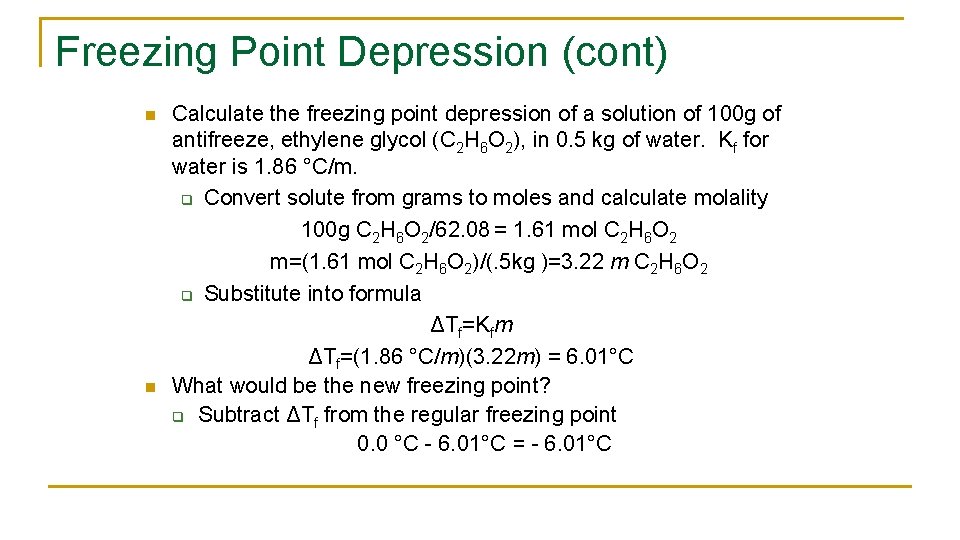
Freezing Point Depression (cont) n n Calculate the freezing point depression of a solution of 100 g of antifreeze, ethylene glycol (C 2 H 6 O 2), in 0. 5 kg of water. Kf for water is 1. 86 °C/m. q Convert solute from grams to moles and calculate molality 100 g C 2 H 6 O 2/62. 08 = 1. 61 mol C 2 H 6 O 2 m=(1. 61 mol C 2 H 6 O 2)/(. 5 kg )=3. 22 m C 2 H 6 O 2 q Substitute into formula ΔTf=Kfm ΔTf=(1. 86 °C/m)(3. 22 m) = 6. 01°C What would be the new freezing point? q Subtract ΔTf from the regular freezing point 0. 0 °C - 6. 01°C = - 6. 01°C
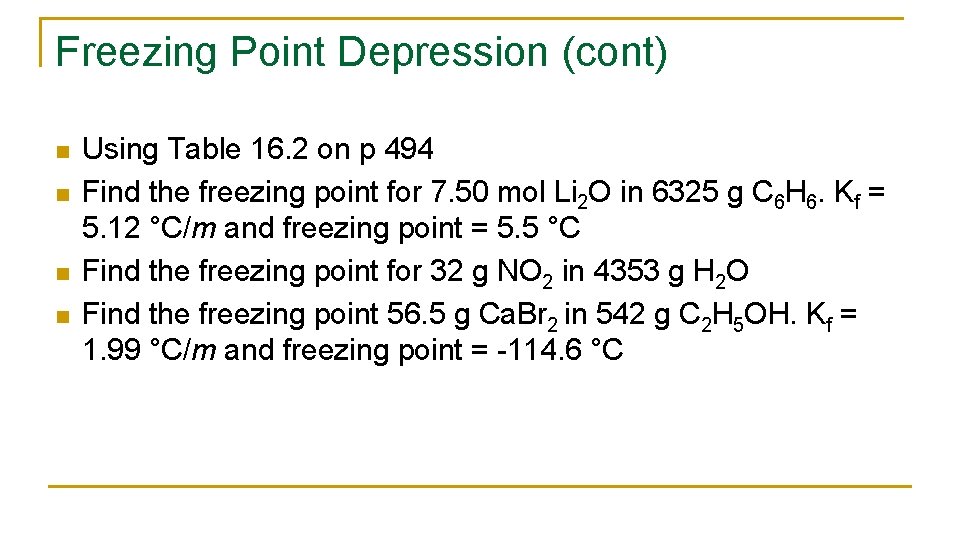
Freezing Point Depression (cont) n n Using Table 16. 2 on p 494 Find the freezing point for 7. 50 mol Li 2 O in 6325 g C 6 H 6. Kf = 5. 12 °C/m and freezing point = 5. 5 °C Find the freezing point for 32 g NO 2 in 4353 g H 2 O Find the freezing point 56. 5 g Ca. Br 2 in 542 g C 2 H 5 OH. Kf = 1. 99 °C/m and freezing point = -114. 6 °C
Essential Questions n n n What are the colligative properties? How does adding a solute affect them? How do you find the new boiling and freezing points after the addition of the solute?
8. 3 Tracked Assignment n n n P 490 #25 -28 P 496 #38, 41 P 499 #56, 57, 59, 63 -65, 74, 76
- Slides: 17