
8 3 Acids and Bases Objectives 3 5
8. 3 Acids and Bases Objectives 3 -5 Chemistry
Essential Questions What are the properties of acids and bases? What is an acid? What is a base? What makes an acid/base weak or strong? What is an amphoteric compound? How do the H+ and OH- concentrations compare for acidic, basic, and neutral solutions? What is p. H and how is it used to identify if something is an acid or base? What is a neutralization reaction? What are titrations and how are titrations used to find out concentration/volume of an unknown?
Properties of Acids and Bases Acids: Aqueous solutions of acids have a sour taste. Acids react with metals to release hydrogen gas. Turns litmus paper red Bases: Aqueous solutions of bases taste bitter. Dilute aqueous solutions of bases feel slippery. Turn litmus paper blue Both conduct electricity in solution
Industrial Acids (don’t write down) Sulfuric acid used in the production of paints, papers, dyes, detergents and automobile batteries. Nitric acid used to make explosives, rubber, plastics and pharmaceuticals. Phosphoric acid used for manufacturing fertilizers and animal feed.
Commonly used bases (don’t write down) Ammonia, used as a household cleaner. Sodium hydroxide commonly called lye. Sodium hydrogen carbonate, baking soda. Most other cleaning products.
Bronsted-Lowry Acids and Bases Bronsted-Lowry independently defined an acid as a molecule or ion that is a proton donor. A base is a molecule or ion that is a proton acceptor. Proton = H+
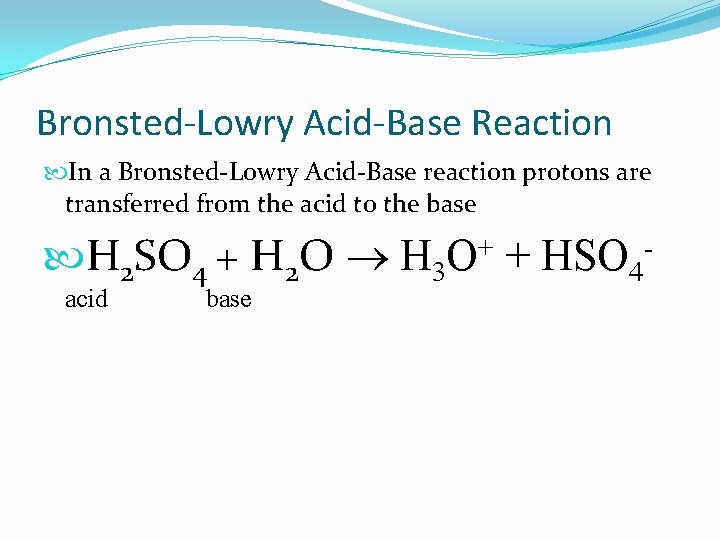
Bronsted-Lowry Acid-Base Reaction In a Bronsted-Lowry Acid-Base reaction protons are transferred from the acid to the base H 2 SO 4 + H 2 O H 3 O+ + HSO 4 acid base
Strong Acids and Bases What makes something a strong acid or base? ionizes (breaks apart into ions) completely in aqueous solutions. What makes something a weak acid or base? Do NOT completely ionize
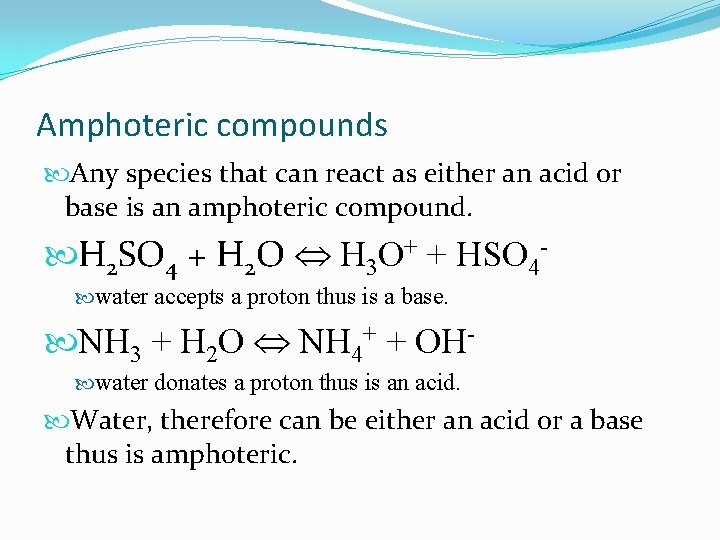
Amphoteric compounds Any species that can react as either an acid or base is an amphoteric compound. H 2 SO 4 + H 2 O H 3 O+ + HSO 4 water accepts a proton thus is a base. NH 3 + H 2 O NH 4+ + OH water donates a proton thus is an acid. Water, therefore can be either an acid or a base thus is amphoteric.
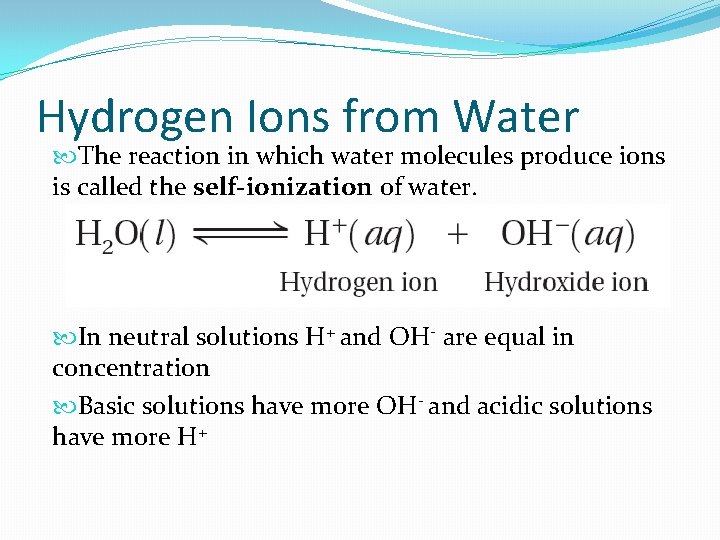
Hydrogen Ions from Water The reaction in which water molecules produce ions is called the self-ionization of water. In neutral solutions H+ and OH- are equal in concentration Basic solutions have more OH- and acidic solutions have more H+
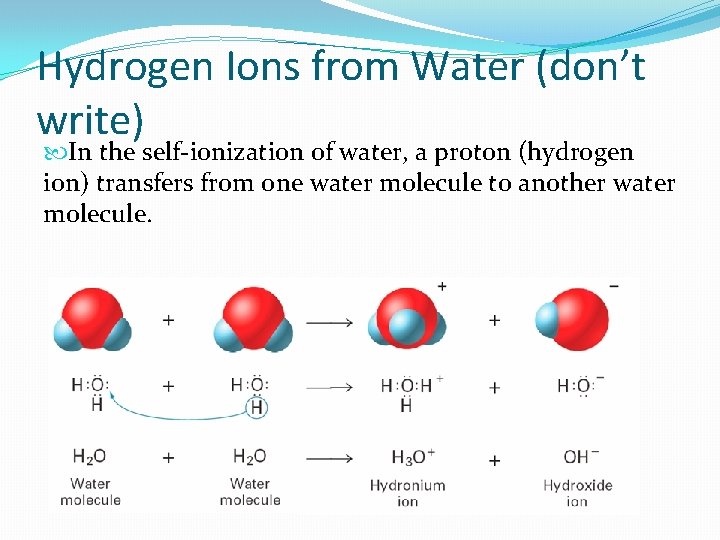
Hydrogen Ions from Water (don’t write) In the self-ionization of water, a proton (hydrogen ion) transfers from one water molecule to another water molecule.
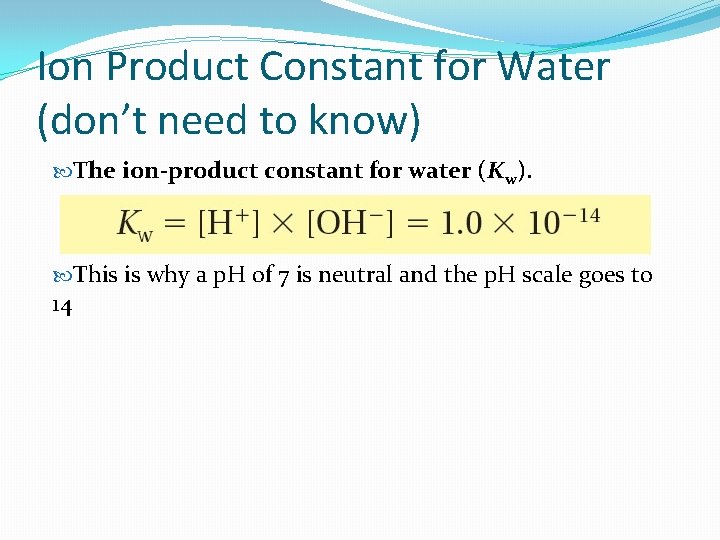
Ion Product Constant for Water (don’t need to know) The ion-product constant for water (Kw). This is why a p. H of 7 is neutral and the p. H scale goes to 14
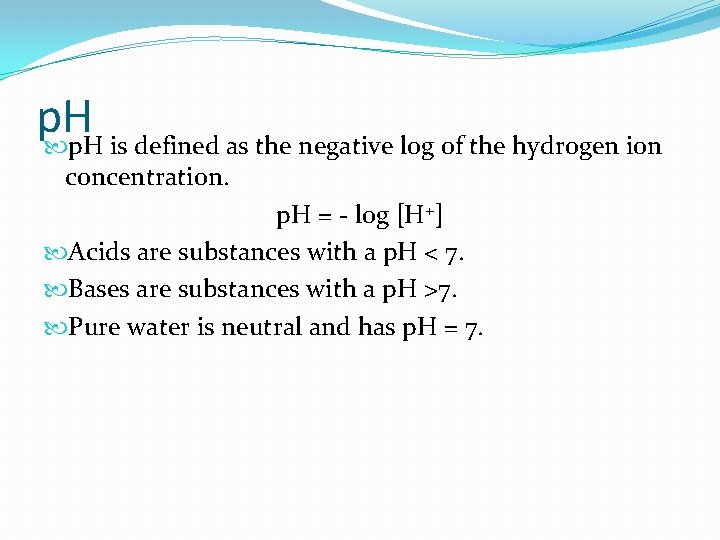
p. H is defined as the negative log of the hydrogen ion concentration. p. H = - log [H+] Acids are substances with a p. H < 7. Bases are substances with a p. H >7. Pure water is neutral and has p. H = 7.
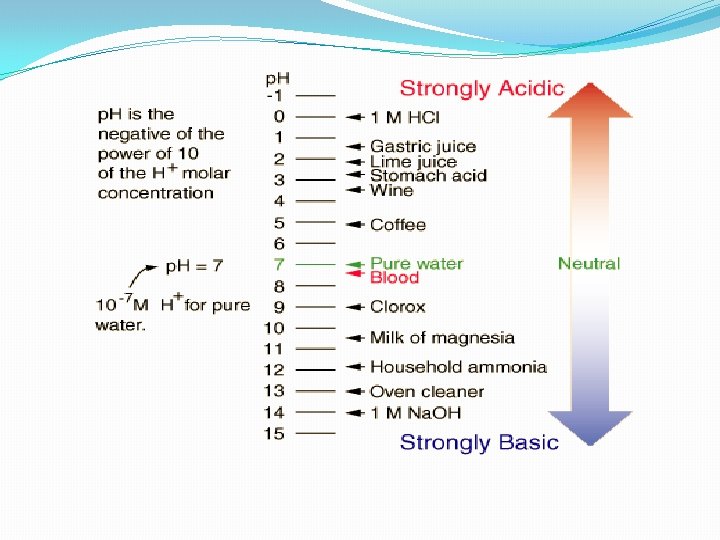
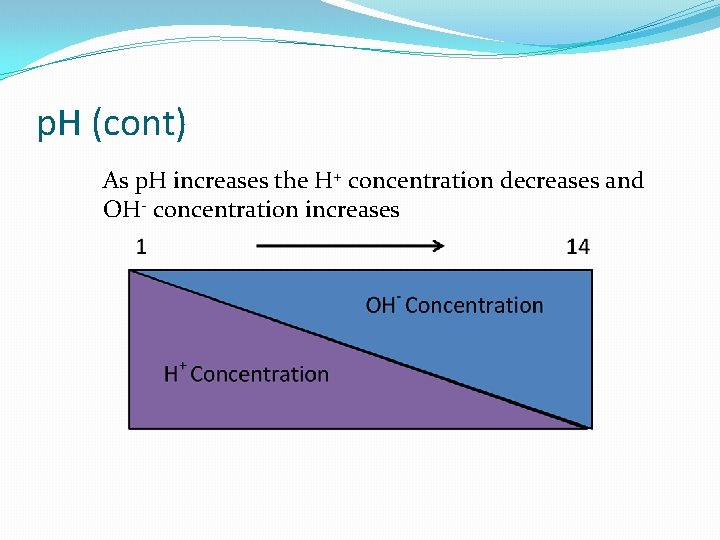
p. H (cont) As p. H increases the H+ concentration decreases and OH- concentration increases
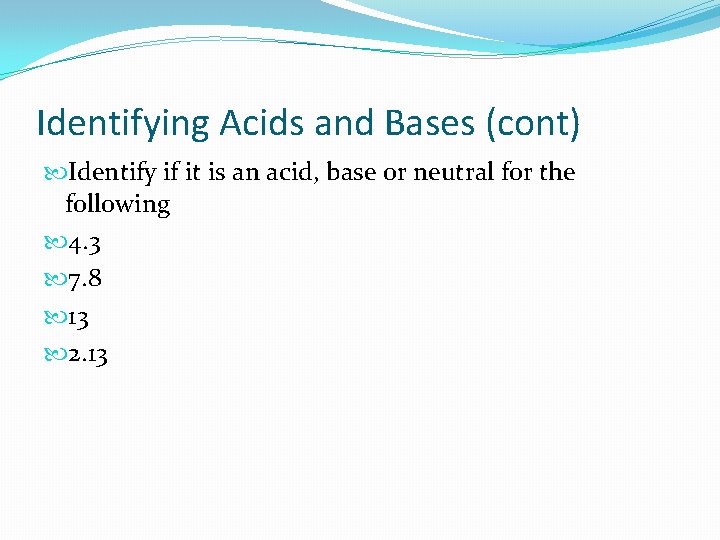
Identifying Acids and Bases (cont) Identify if it is an acid, base or neutral for the following 4. 3 7. 8 13 2. 13
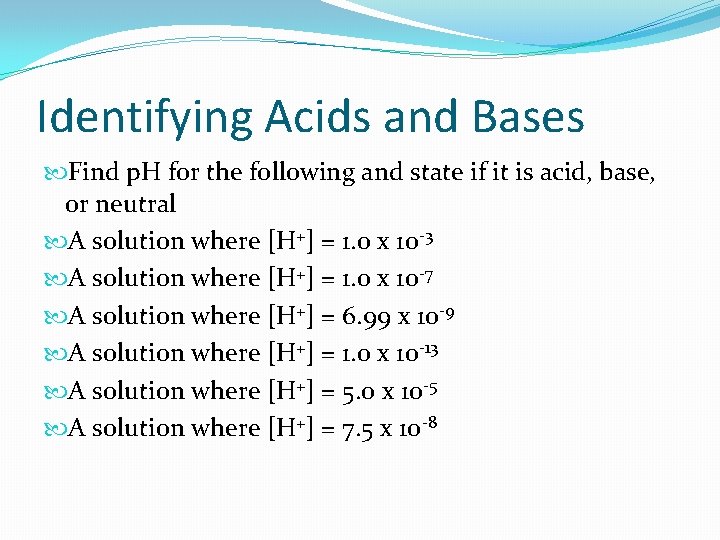
Identifying Acids and Bases Find p. H for the following and state if it is acid, base, or neutral A solution where [H+] = 1. 0 x 10 -3 A solution where [H+] = 1. 0 x 10 -7 A solution where [H+] = 6. 99 x 10 -9 A solution where [H+] = 1. 0 x 10 -13 A solution where [H+] = 5. 0 x 10 -5 A solution where [H+] = 7. 5 x 10 -8
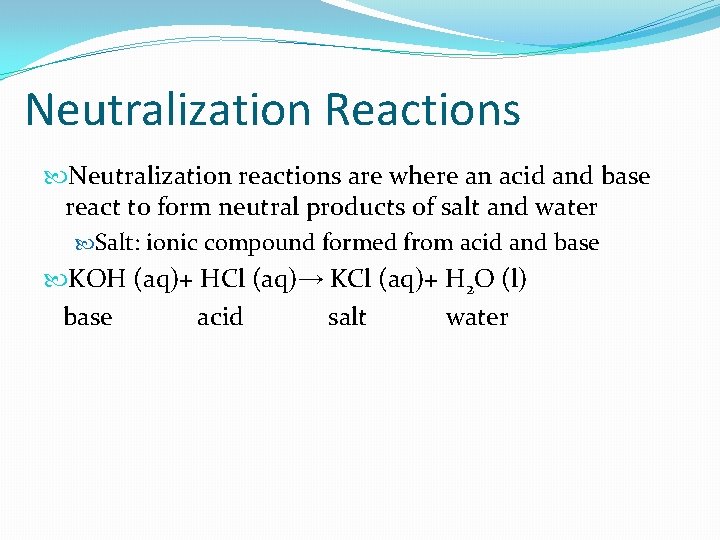
Neutralization Reactions Neutralization reactions are where an acid and base react to form neutral products of salt and water Salt: ionic compound formed from acid and base KOH (aq)+ HCl (aq)→ KCl (aq)+ H 2 O (l) base acid salt water
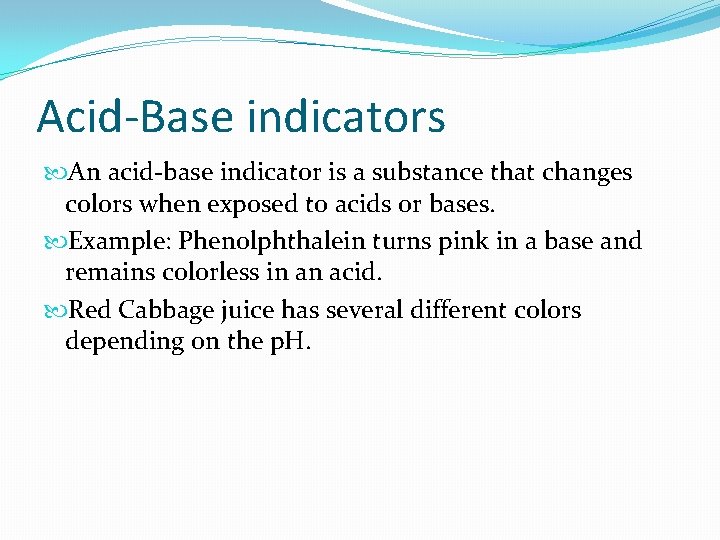
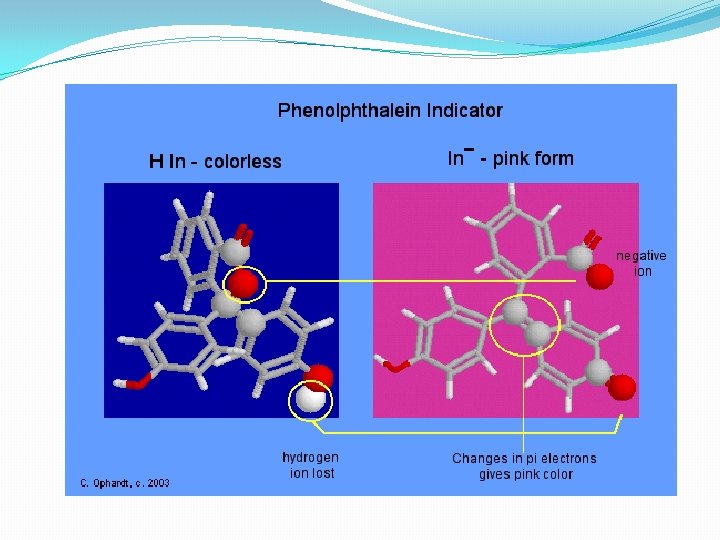
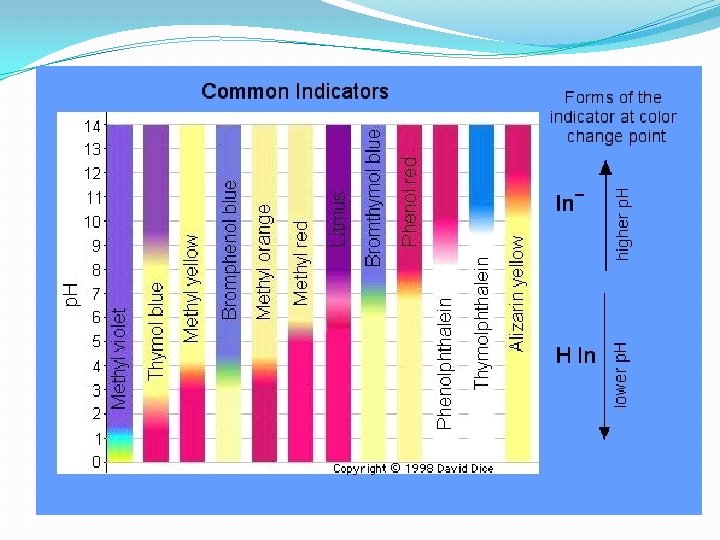
Acid-Base indicators An acid-base indicator is a substance that changes colors when exposed to acids or bases. Example: Phenolphthalein turns pink in a base and remains colorless in an acid. Red Cabbage juice has several different colors depending on the p. H.
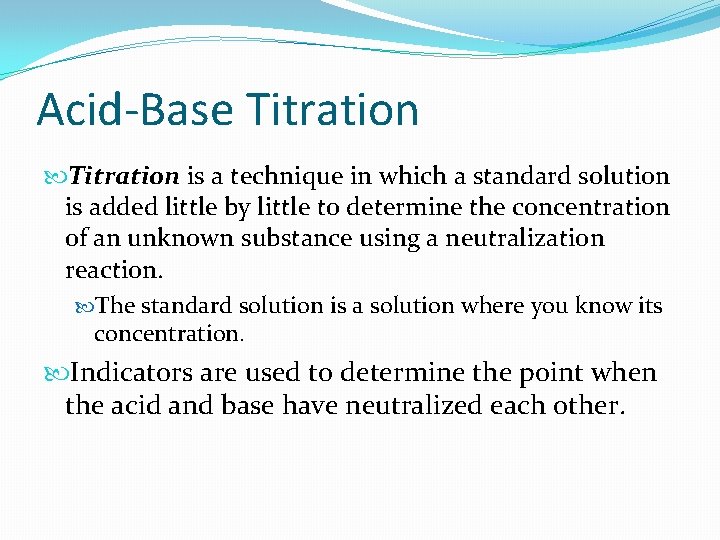
Acid-Base Titration is a technique in which a standard solution is added little by little to determine the concentration of an unknown substance using a neutralization reaction. The standard solution is a solution where you know its concentration. Indicators are used to determine the point when the acid and base have neutralized each other.
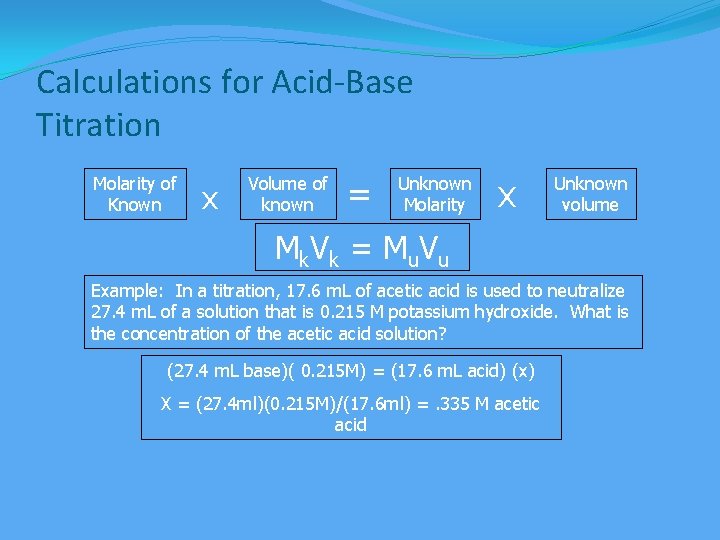
Calculations for Acid-Base Titration Molarity of Known x Volume of known = Unknown Molarity x Unknown volume M k. V k = M u V u Example: In a titration, 17. 6 m. L of acetic acid is used to neutralize 27. 4 m. L of a solution that is 0. 215 M potassium hydroxide. What is the concentration of the acetic acid solution? (27. 4 m. L base)( 0. 215 M) = (17. 6 m. L acid) (x) X = (27. 4 ml)(0. 215 M)/(17. 6 ml) =. 335 M acetic acid
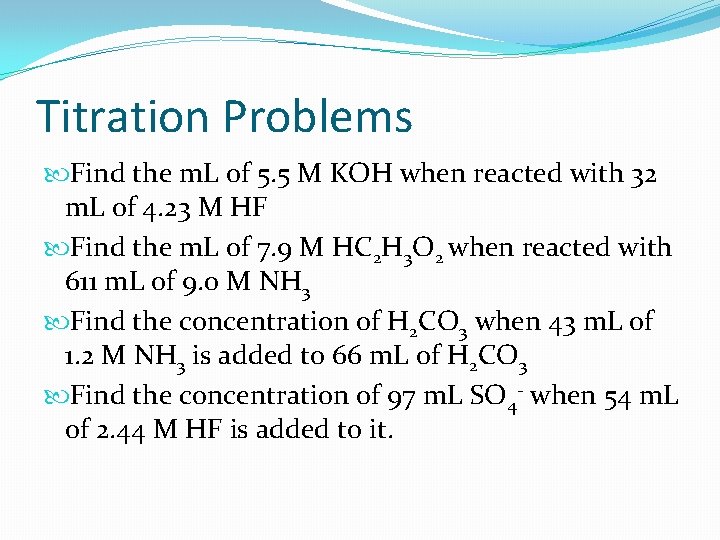
Titration Problems Find the m. L of 5. 5 M KOH when reacted with 32 m. L of 4. 23 M HF Find the m. L of 7. 9 M HC 2 H 3 O 2 when reacted with 611 m. L of 9. 0 M NH 3 Find the concentration of H 2 CO 3 when 43 m. L of 1. 2 M NH 3 is added to 66 m. L of H 2 CO 3 Find the concentration of 97 m. L SO 4 - when 54 m. L of 2. 44 M HF is added to it.
Essential Questions How do the H+ and OH- concentrations compare for acidic, basic, and neutral solutions? What is p. H and how is it used to identify if something is an acid or base? What is a neutralization reaction? What are indicators? What are titrations? How are titrations used to find out concentration or volume of an unknown?

8. 3 Tracked Assignment worksheet
- Slides: 26