
8 1 Studying Inheritance The Structure of DNA
- Slides: 31
8. 1 Studying Inheritance
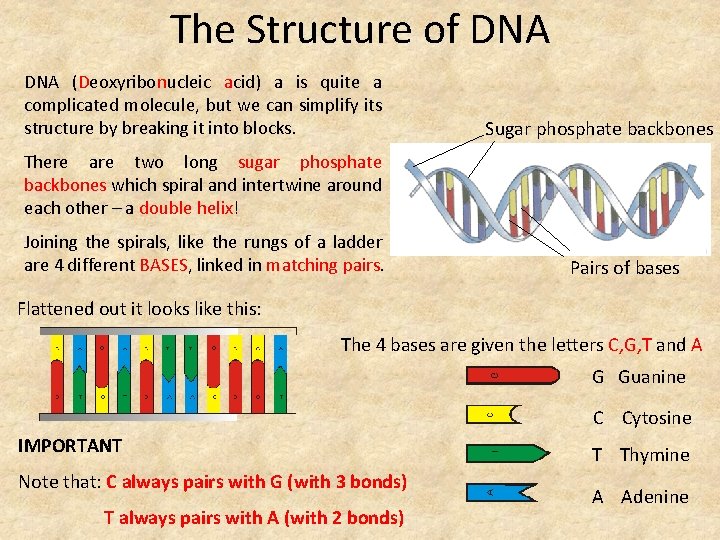
The Structure of DNA (Deoxyribonucleic acid) a is quite a complicated molecule, but we can simplify its structure by breaking it into blocks. Sugar phosphate backbones There are two long sugar phosphate backbones which spiral and intertwine around each other – a double helix! Joining the spirals, like the rungs of a ladder are 4 different BASES, linked in matching pairs. Pairs of bases Flattened out it looks like this: The 4 bases are given the letters C, G, T and A G Guanine C Cytosine IMPORTANT Note that: C always pairs with G (with 3 bonds) T always pairs with A (with 2 bonds) T Thymine A Adenine
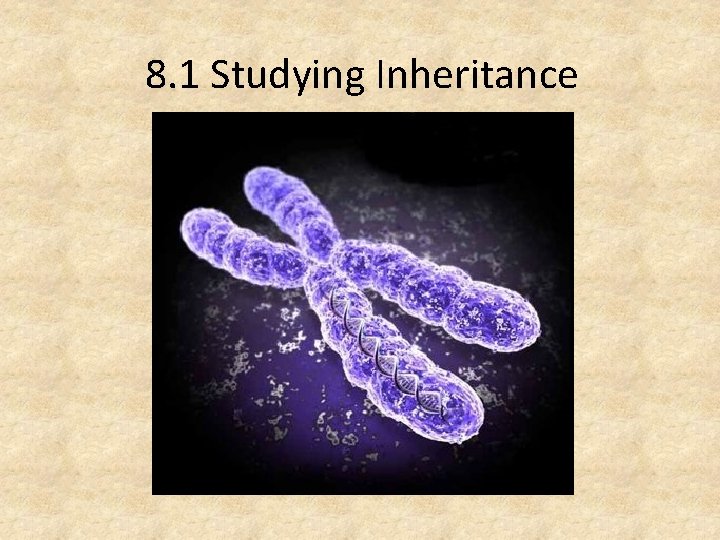
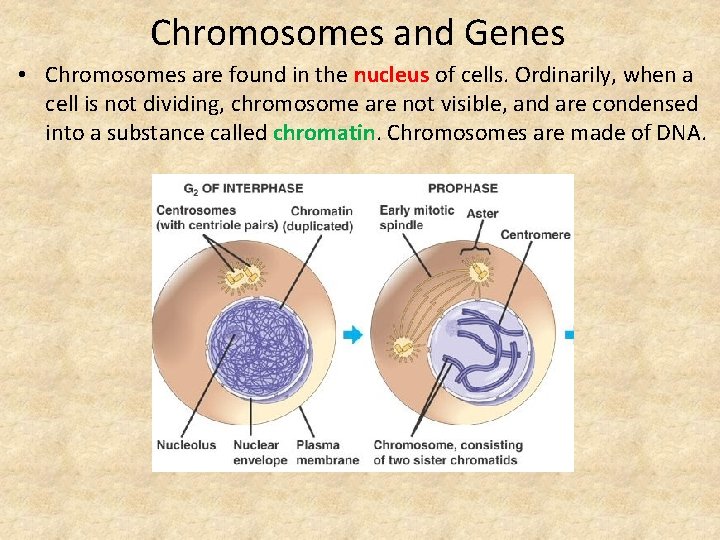
Chromosomes and Genes • Chromosomes are found in the nucleus of cells. Ordinarily, when a cell is not dividing, chromosome are not visible, and are condensed into a substance called chromatin. Chromosomes are made of DNA.
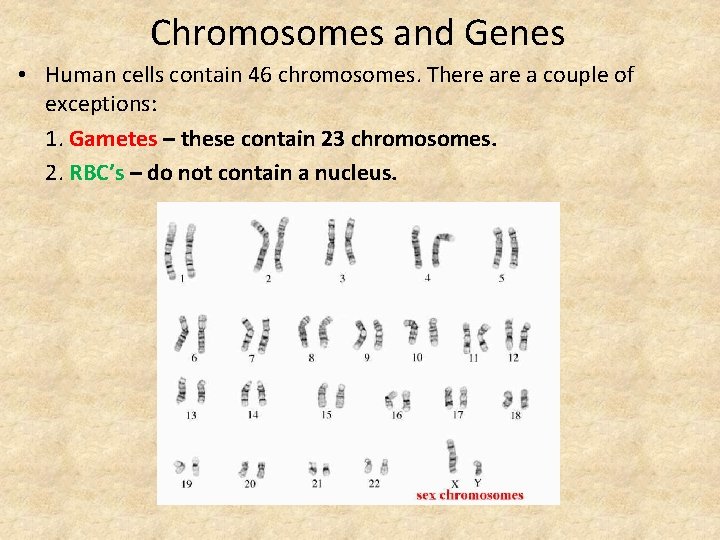
Chromosomes and Genes • Human cells contain 46 chromosomes. There a couple of exceptions: 1. Gametes – these contain 23 chromosomes. 2. RBC’s – do not contain a nucleus.
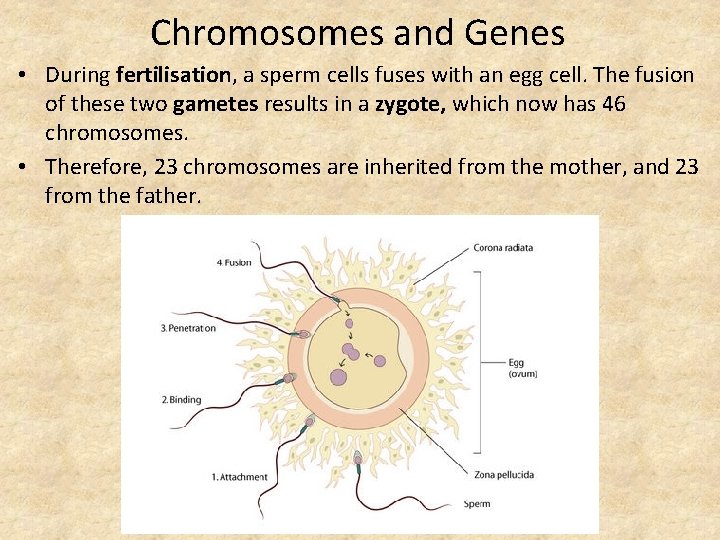
Chromosomes and Genes • During fertilisation, a sperm cells fuses with an egg cell. The fusion of these two gametes results in a zygote, which now has 46 chromosomes. • Therefore, 23 chromosomes are inherited from the mother, and 23 from the father.
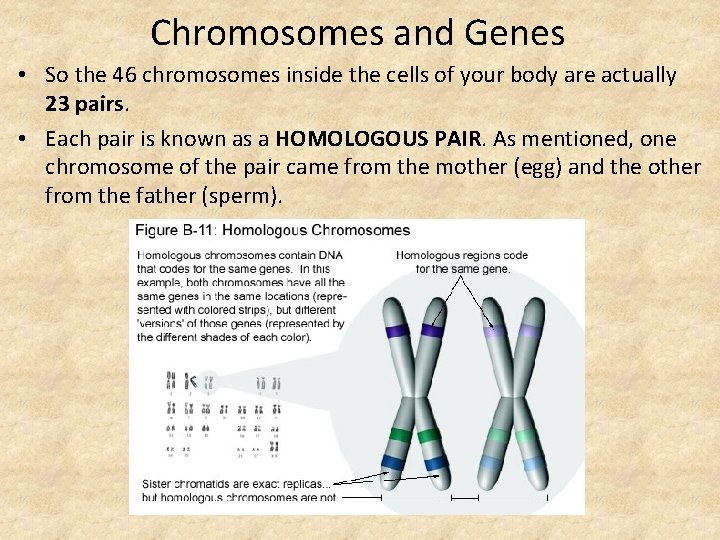
Chromosomes and Genes • So the 46 chromosomes inside the cells of your body are actually 23 pairs. • Each pair is known as a HOMOLOGOUS PAIR. As mentioned, one chromosome of the pair came from the mother (egg) and the other from the father (sperm).
Revision of key terms Write down definitions if you can for the following terms; 1) Gene 2) Allele 3) Genotype 4) Phenotype 5) Homozygous 6) Heterozygous
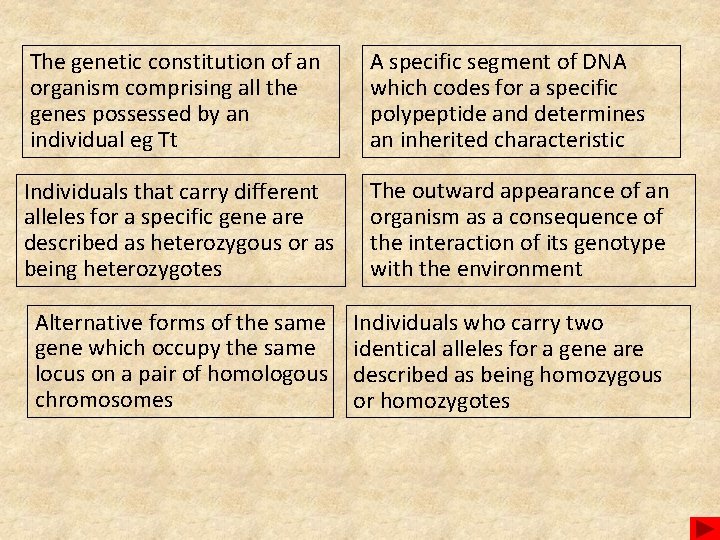
The genetic constitution of an organism comprising all the genes possessed by an individual eg Tt A specific segment of DNA which codes for a specific polypeptide and determines an inherited characteristic Individuals that carry different alleles for a specific gene are described as heterozygous or as being heterozygotes The outward appearance of an organism as a consequence of the interaction of its genotype with the environment Alternative forms of the same gene which occupy the same locus on a pair of homologous chromosomes Individuals who carry two identical alleles for a gene are described as being homozygous or homozygotes
H/W Essay Question 1) a) Describe the structure of DNA (4) b) What is the genetic code? (4) c) Give an illustrated account of how meiosis creates genetic variation (8) TOTAL MARKS 16
Lesson 2: Monohybrid Inheritance Essential Terms 1. Use the term gene or allele to complete the phrases: a) the ……. . For brown hair b) the ………. for hair colour. 2. Which of the following human phenotypic feature result from i) the effects of the genotype ii) the effects of the environment or iii) the combined effects of both? a) A missing top finger joint after an accident b) Polydactyly (more than five digits on the hands or feet) c) the size of the person 3. Seed colour in peas may be green or yellow. Are the nucleic acid codes controlling these alternative gene colours a) loci b) genes or c) alleles? Explain your answer.
Alleles Alternative forms of a particular gene are called: ALLELES • E. g. In humans, one of the 23 pairs of chromosomes will of course contain a gene for eye colour. • More than one type of eye colour is present in humans. Therefore, there must be alternative genes that result in different eye colours. • The particular sequence of bases making up a gene. Gene for eye colour: alternative forms: blue brown green ALLELES
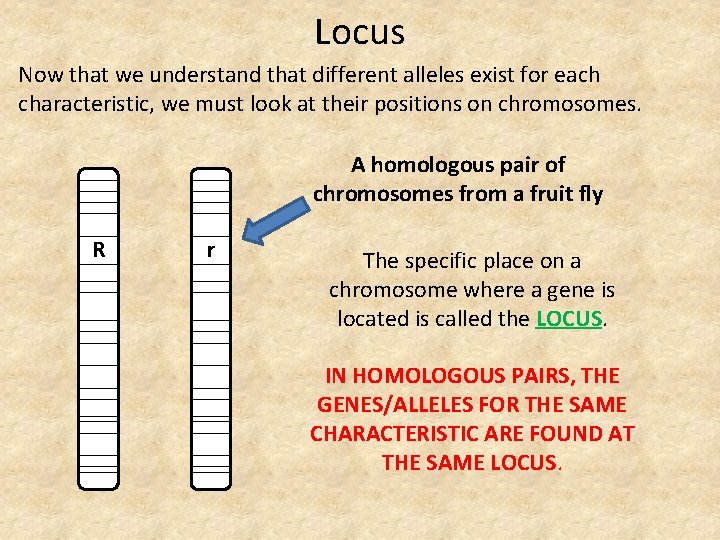
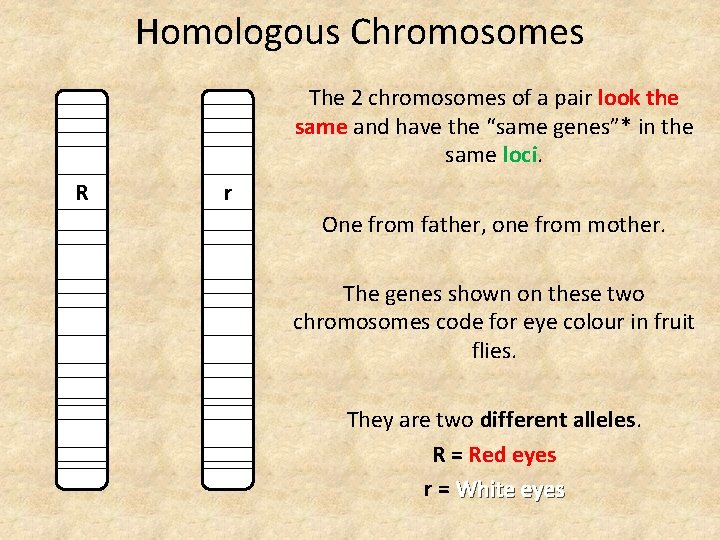
Locus Now that we understand that different alleles exist for each characteristic, we must look at their positions on chromosomes. A homologous pair of chromosomes from a fruit fly R r The specific place on a chromosome where a gene is located is called the LOCUS. IN HOMOLOGOUS PAIRS, THE GENES/ALLELES FOR THE SAME CHARACTERISTIC ARE FOUND AT THE SAME LOCUS.
Homologous Chromosomes The 2 chromosomes of a pair look the same and have the “same genes”* in the same loci. R r One from father, one from mother. The genes shown on these two chromosomes code for eye colour in fruit flies. They are two different alleles. R = Red eyes r = White eyes
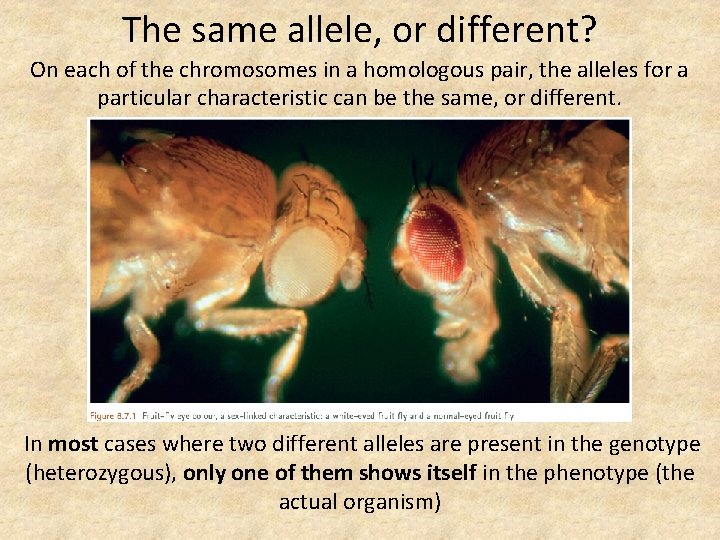
The same allele, or different? On each of the chromosomes in a homologous pair, the alleles for a particular characteristic can be the same, or different. In most cases where two different alleles are present in the genotype (heterozygous), only one of them shows itself in the phenotype (the actual organism)
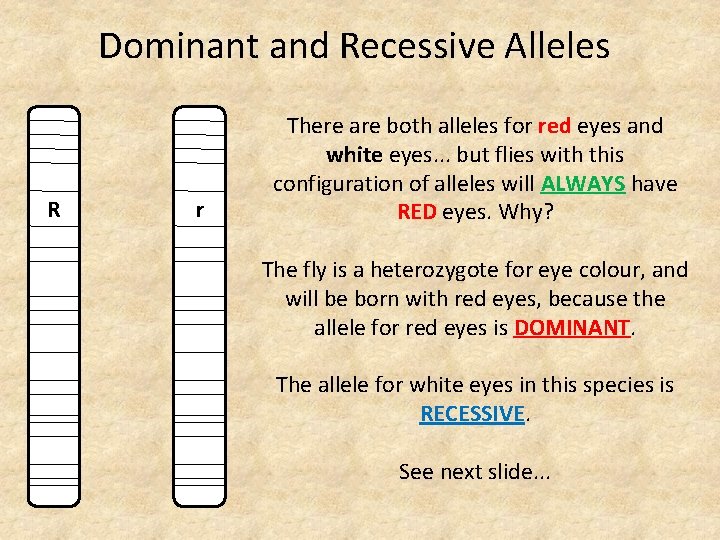
Dominant and Recessive Alleles R r There are both alleles for red eyes and white eyes. . . but flies with this configuration of alleles will ALWAYS have RED eyes. Why? The fly is a heterozygote for eye colour, and will be born with red eyes, because the allele for red eyes is DOMINANT. The allele for white eyes in this species is RECESSIVE. See next slide. . .
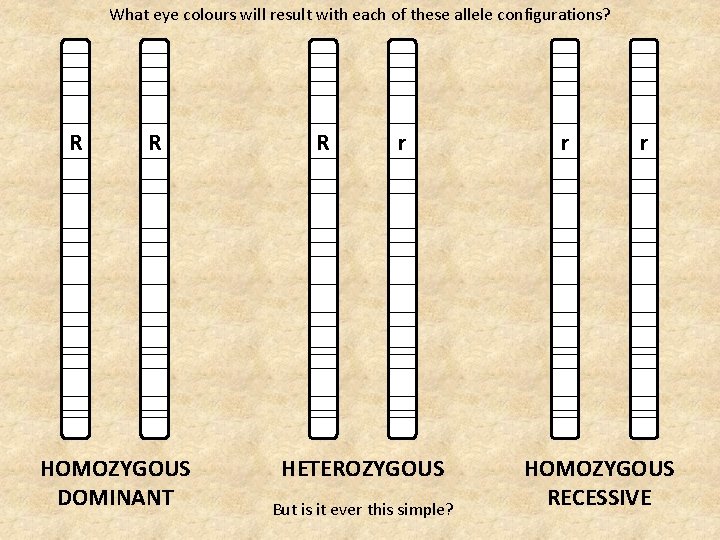
What eye colours will result with each of these allele configurations? R R HOMOZYGOUS DOMINANT R r HETEROZYGOUS But is it ever this simple? r r HOMOZYGOUS RECESSIVE
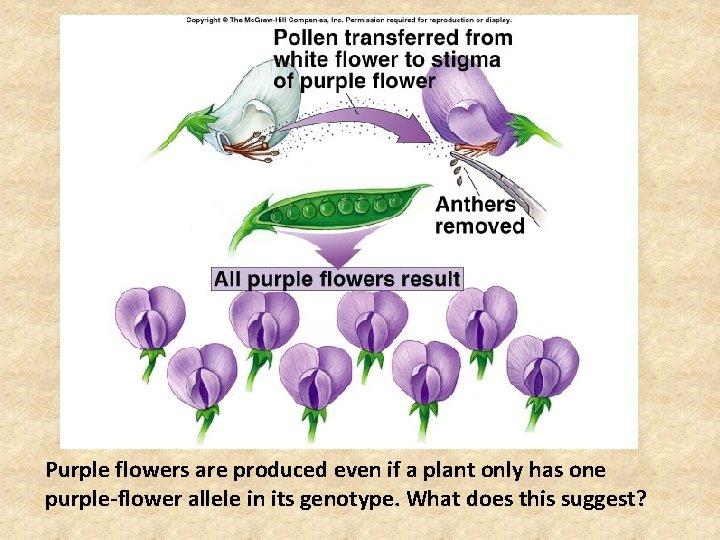
Monohybrid Inheritance The inheritance of characteristics which are controlled by different alleles of a single gene. e. g. Flower colour in peas One allele for flower colour carries a DNA code for a particular enzyme which causes a biochemical reaction in the pea flowers which causes a purple pigment to be produced. It can be called the purple-flower allele. A second allele of this gene carries a different DNA code. This code does not produce the enzyme which leads to the production of a purple pigment. The flowers produced are white. It can be called the white-flower allele.
Purple flowers are produced even if a plant only has one purple-flower allele in its genotype. What does this suggest?
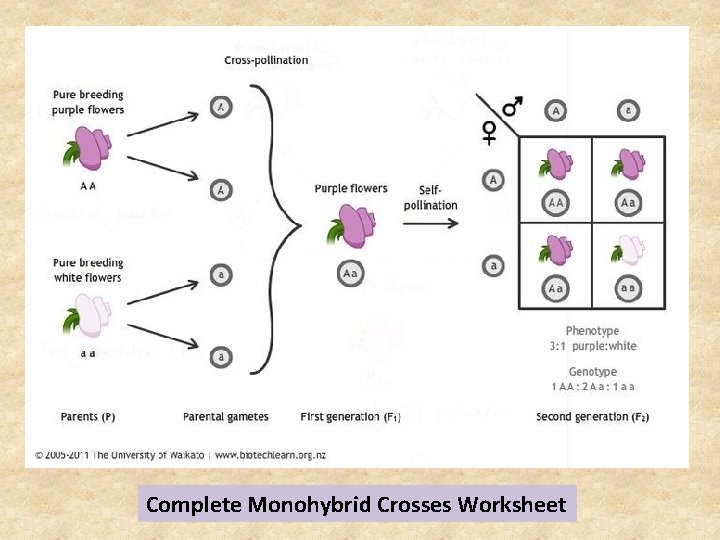
Complete Monohybrid Crosses Worksheet
Lesson 3 Codominance and Multiple Alleles STARTER: Complete worksheet questions on Monohybrid Inheritance.
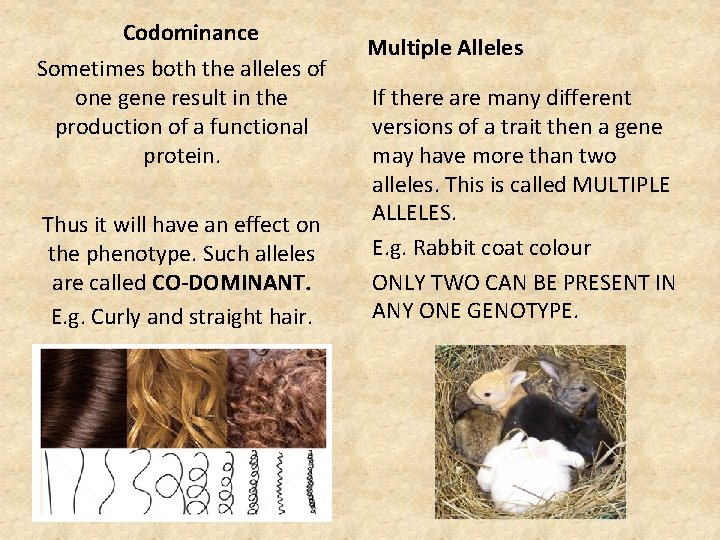
Codominance Sometimes both the alleles of one gene result in the production of a functional protein. Thus it will have an effect on the phenotype. Such alleles are called CO-DOMINANT. E. g. Curly and straight hair. Multiple Alleles If there are many different versions of a trait then a gene may have more than two alleles. This is called MULTIPLE ALLELES. E. g. Rabbit coat colour ONLY TWO CAN BE PRESENT IN ANY ONE GENOTYPE.
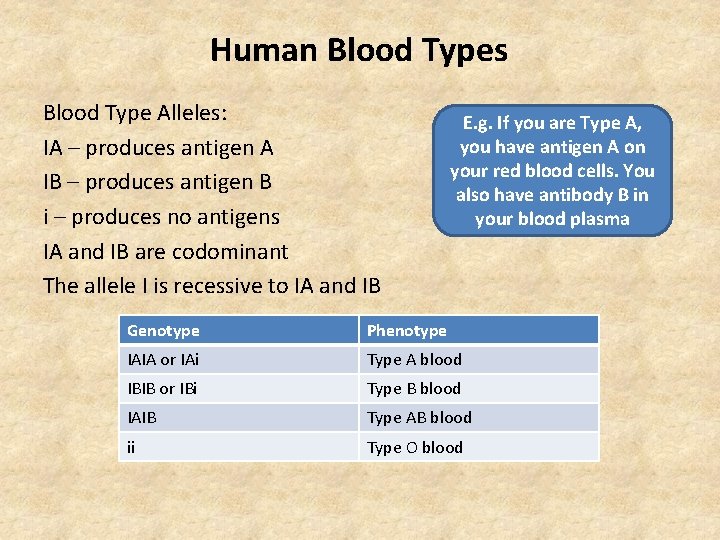
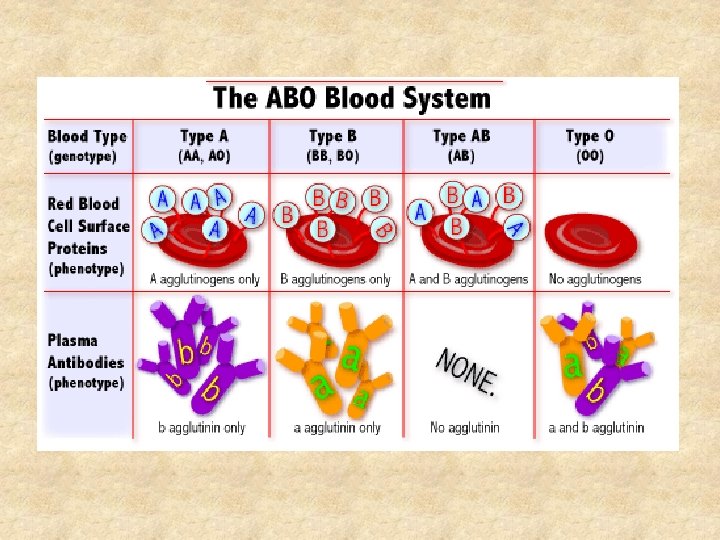
Human Blood Types Blood Type Alleles: IA – produces antigen A IB – produces antigen B i – produces no antigens IA and IB are codominant The allele I is recessive to IA and IB E. g. If you are Type A, you have antigen A on your red blood cells. You also have antibody B in your blood plasma Genotype Phenotype IAIA or IAi Type A blood IBIB or IBi Type B blood IAIB Type AB blood ii Type O blood
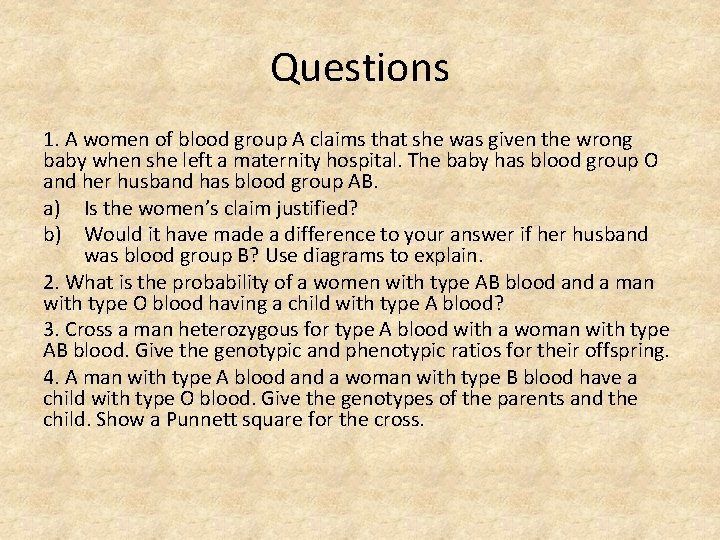
Questions 1. A women of blood group A claims that she was given the wrong baby when she left a maternity hospital. The baby has blood group O and her husband has blood group AB. a) Is the women’s claim justified? b) Would it have made a difference to your answer if her husband was blood group B? Use diagrams to explain. 2. What is the probability of a women with type AB blood and a man with type O blood having a child with type A blood? 3. Cross a man heterozygous for type A blood with a woman with type AB blood. Give the genotypic and phenotypic ratios for their offspring. 4. A man with type A blood and a woman with type B blood have a child with type O blood. Give the genotypes of the parents and the child. Show a Punnett square for the cross.
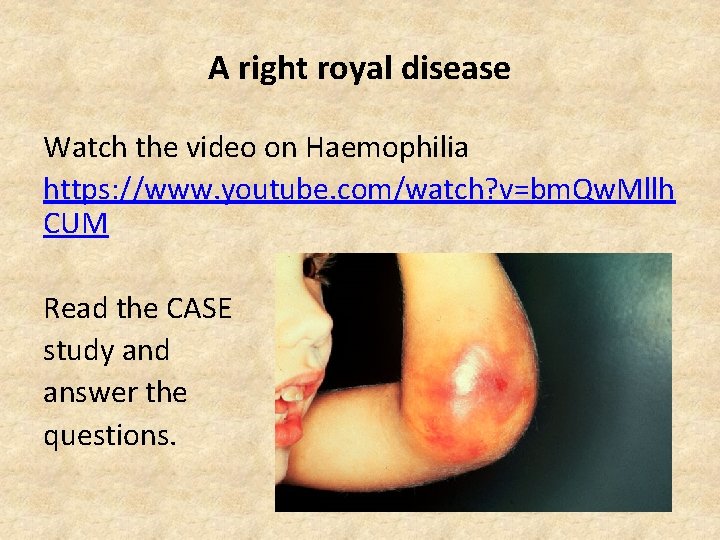
A right royal disease Watch the video on Haemophilia https: //www. youtube. com/watch? v=bm. Qw. Mllh CUM Read the CASE study and answer the questions.
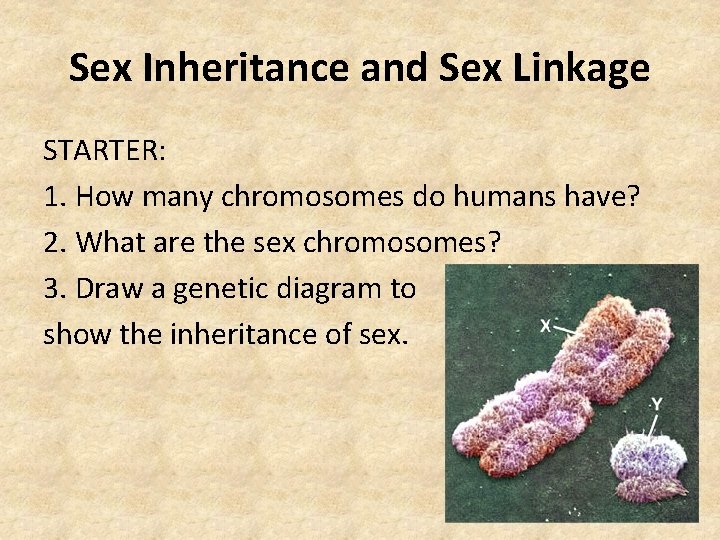
Sex Inheritance and Sex Linkage STARTER: 1. How many chromosomes do humans have? 2. What are the sex chromosomes? 3. Draw a genetic diagram to show the inheritance of sex.
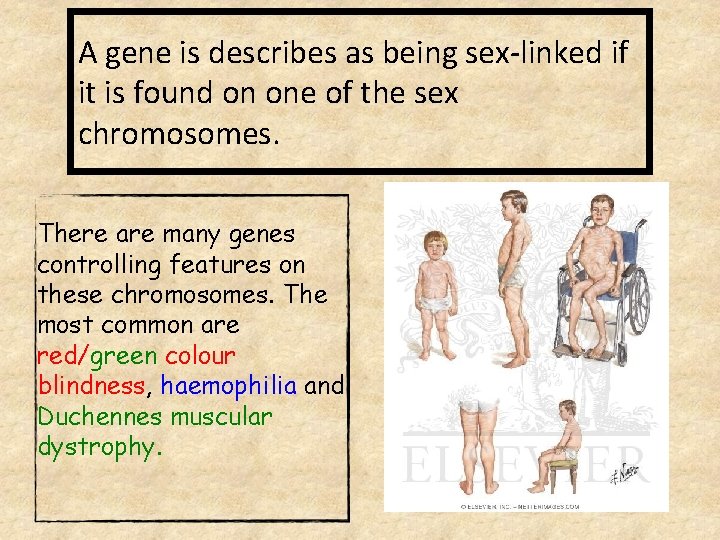
A gene is describes as being sex-linked if it is found on one of the sex chromosomes. There are many genes controlling features on these chromosomes. The most common are red/green colour blindness, haemophilia and Duchennes muscular dystrophy.
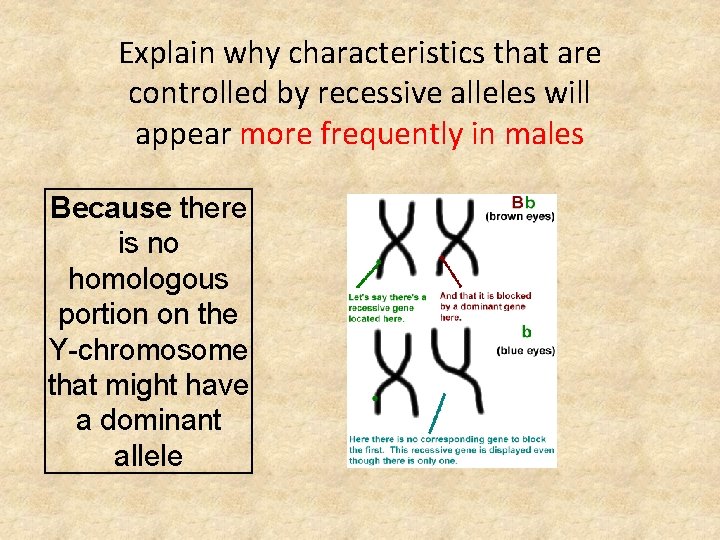
Explain why characteristics that are controlled by recessive alleles will appear more frequently in males Because there is no homologous portion on the Y-chromosome that might have a dominant allele
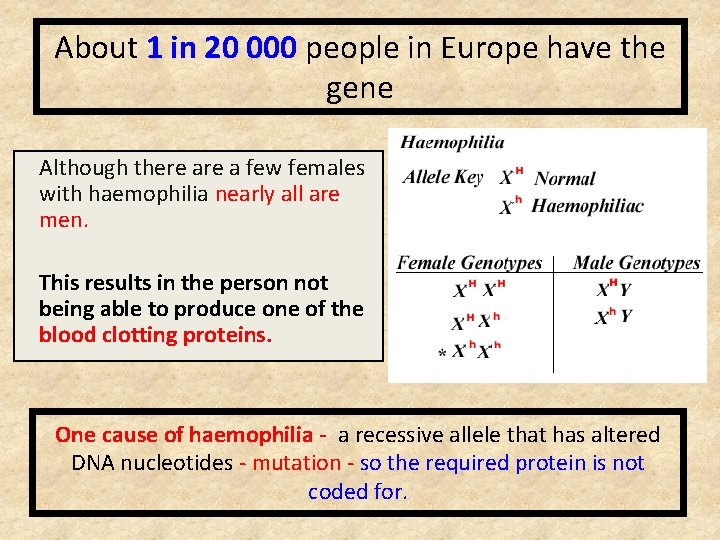
About 1 in 20 000 people in Europe have the gene Although there a few females with haemophilia nearly all are men. This results in the person not being able to produce one of the blood clotting proteins. One cause of haemophilia - a recessive allele that has altered DNA nucleotides - mutation - so the required protein is not coded for.
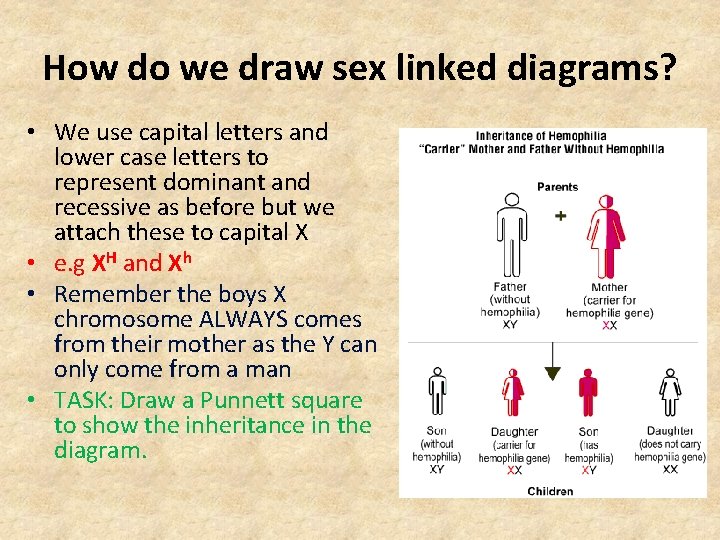
How do we draw sex linked diagrams? • We use capital letters and lower case letters to represent dominant and recessive as before but we attach these to capital X • e. g XH and Xh • Remember the boys X chromosome ALWAYS comes from their mother as the Y can only come from a man • TASK: Draw a Punnett square to show the inheritance in the diagram.
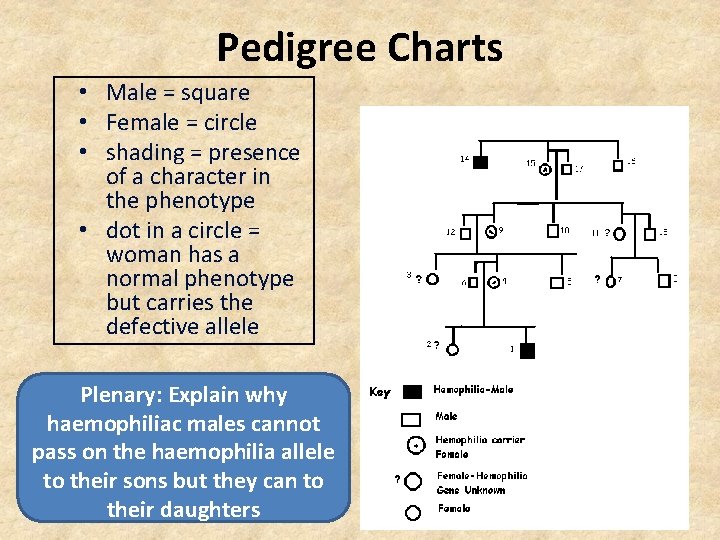
Pedigree Charts • Male = square • Female = circle • shading = presence of a character in the phenotype • dot in a circle = woman has a normal phenotype but carries the defective allele Plenary: Explain why haemophiliac males cannot pass on the haemophilia allele to their sons but they can to their daughters