
8 1 Pythagorean Theorem Converse Essential Question How
- Slides: 13
8. 1 Pythagorean Theorem & Converse Essential Question: How do you use the Pythagorean Theorem and its converse?
• The Pythagorean Theorem is named for Pythagoras, a Greek mathematician who lived in the sixth century B. C. • We now know that the Babylonians, Egyptians, and Chinese were aware of this relationship before its discovery by Pythagoras. • There are many proofs of this theorem. • Pythagoras created a school.
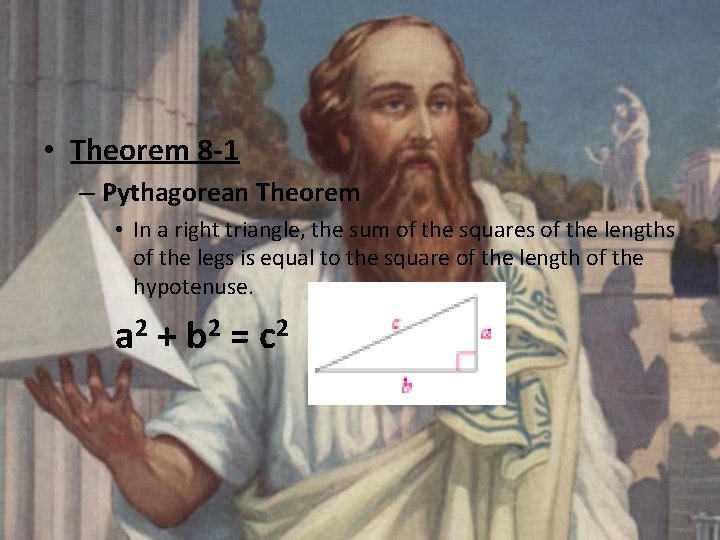
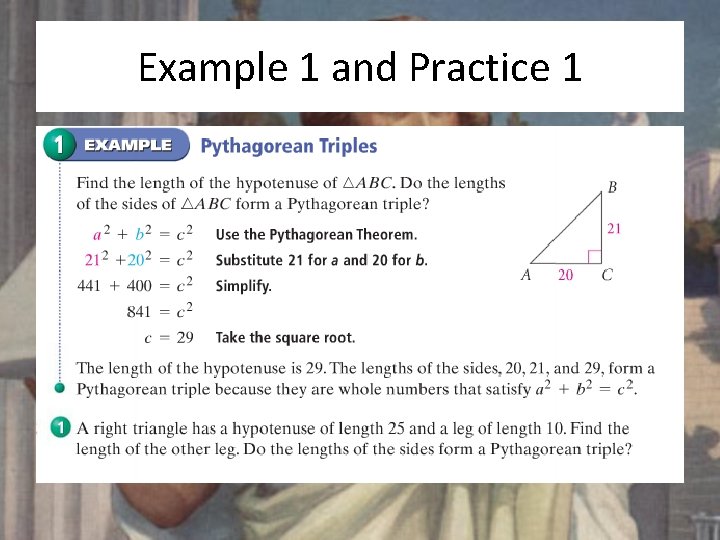
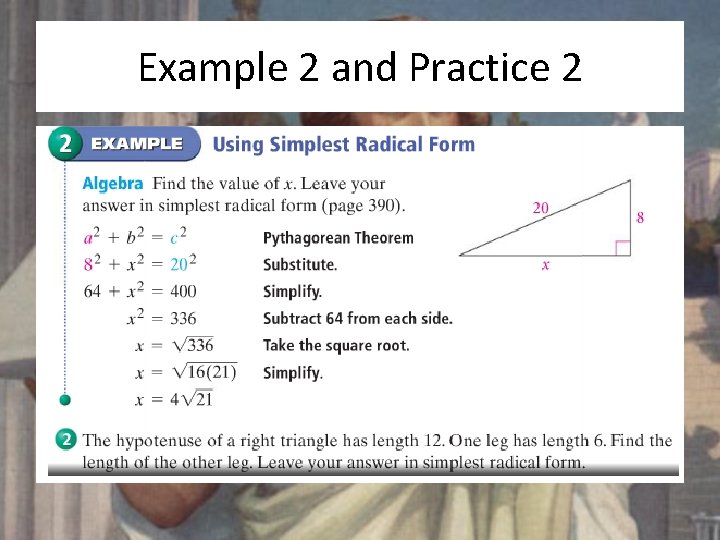
• Theorem 8 -1 – Pythagorean Theorem • In a right triangle, the sum of the squares of the lengths of the legs is equal to the square of the length of the hypotenuse. a 2 + b 2 = c 2
• A Pythagorean triple is a set of nonzero whole numbers a, b, and c that satisfy the equation a 2 + b 2 = c 2. – These can help you solve problems faster, so be on the lookout for triples! • Here are some: – 3, 4, 5 – 5, 12, 13 – 8, 15, 17 – 7, 24, 25
Example 1 and Practice 1
Example 2 and Practice 2
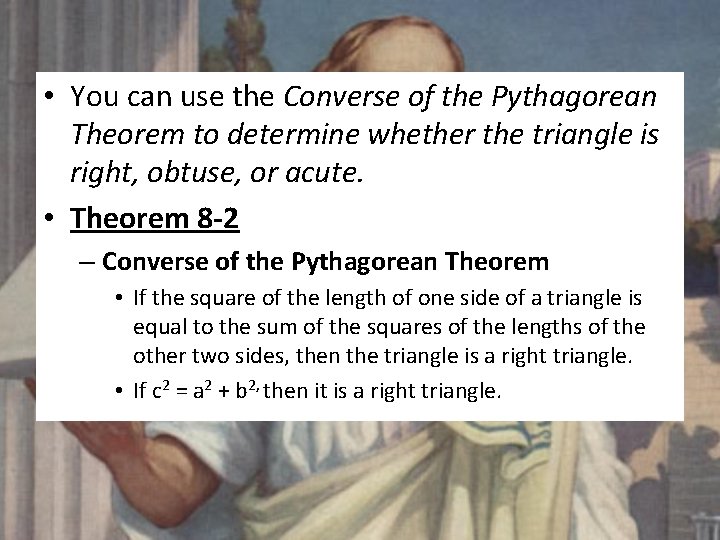
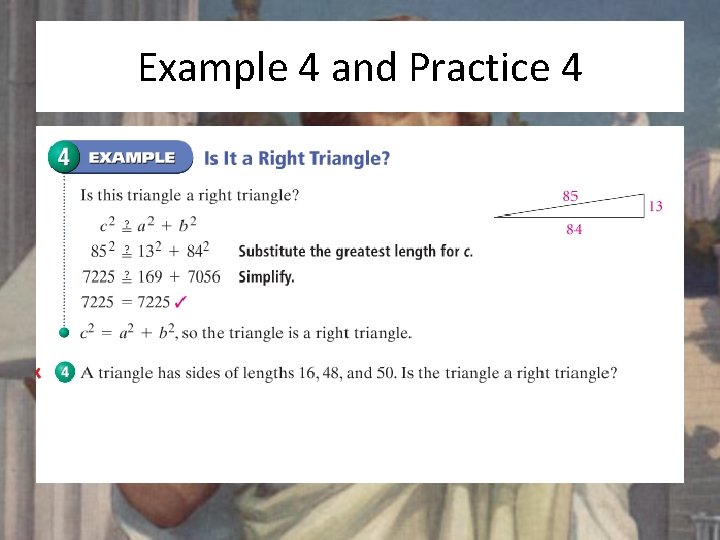
• You can use the Converse of the Pythagorean Theorem to determine whether the triangle is right, obtuse, or acute. • Theorem 8 -2 – Converse of the Pythagorean Theorem • If the square of the length of one side of a triangle is equal to the sum of the squares of the lengths of the other two sides, then the triangle is a right triangle. • If c 2 = a 2 + b 2, then it is a right triangle.
Example 4 and Practice 4
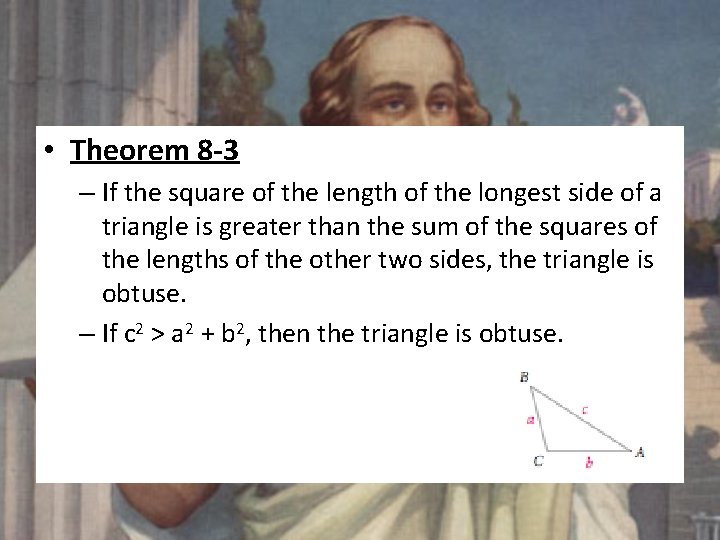
• Theorem 8 -3 – If the square of the length of the longest side of a triangle is greater than the sum of the squares of the lengths of the other two sides, the triangle is obtuse. – If c 2 > a 2 + b 2, then the triangle is obtuse.
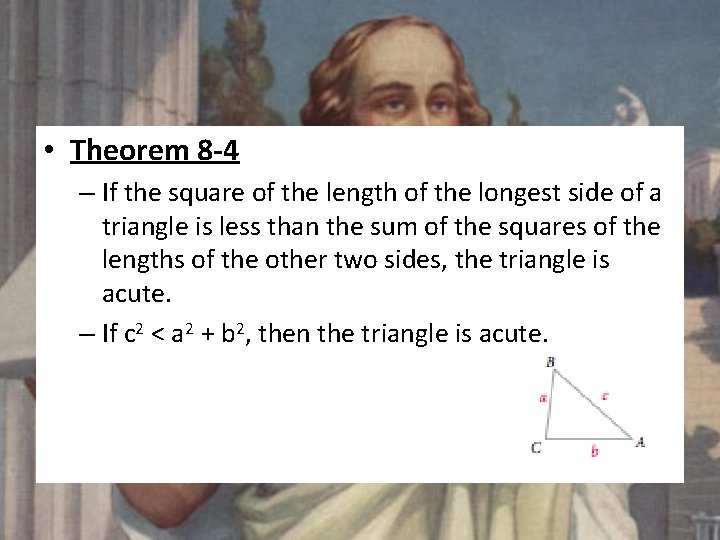
• Theorem 8 -4 – If the square of the length of the longest side of a triangle is less than the sum of the squares of the lengths of the other two sides, the triangle is acute. – If c 2 < a 2 + b 2, then the triangle is acute.
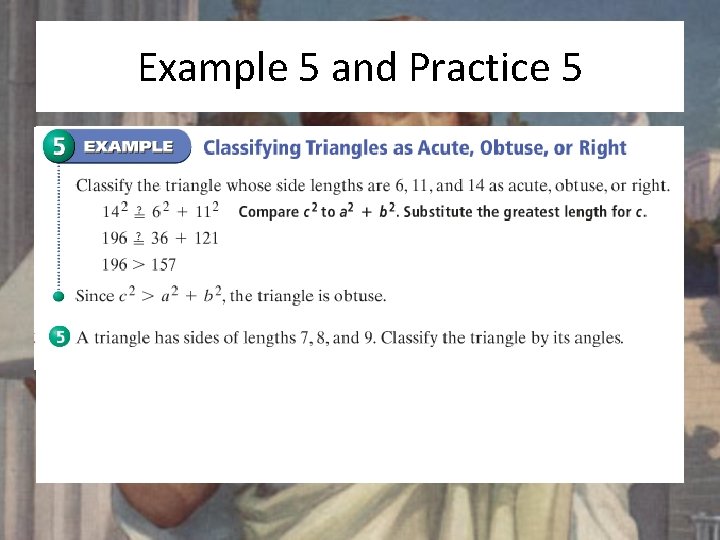
Example 5 and Practice 5
Reflection • As we learned, Pythagoras was a philosopher as well as a mathematician. • Remember philosophy is the study of knowledge, reality, and existence. • It was common for mathematicians to also dive into the field of philosophy. • Why do you think this happened?
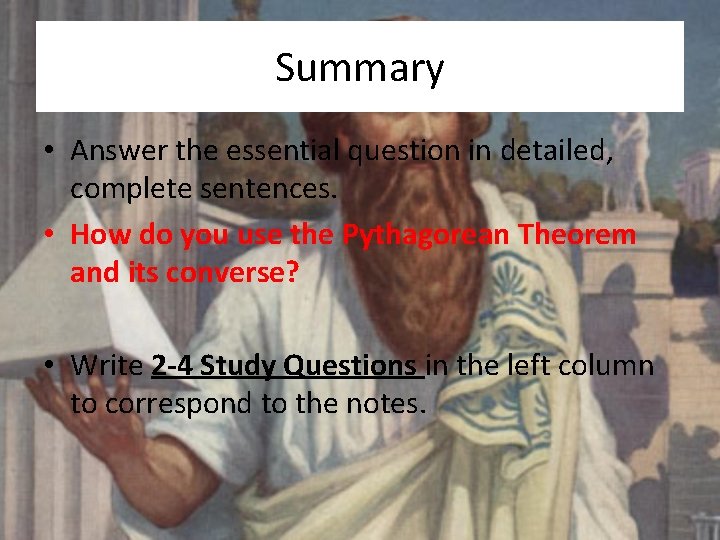
Summary • Answer the essential question in detailed, complete sentences. • How do you use the Pythagorean Theorem and its converse? • Write 2 -4 Study Questions in the left column to correspond to the notes.