
8 1 Financial Planning and Pro Forma Statements
- Slides: 38
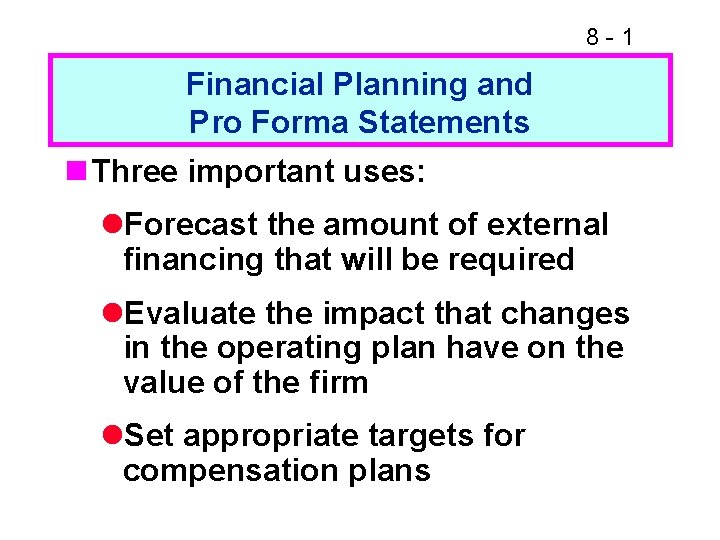
8 -1 Financial Planning and Pro Forma Statements n Three important uses: l. Forecast the amount of external financing that will be required l. Evaluate the impact that changes in the operating plan have on the value of the firm l. Set appropriate targets for compensation plans
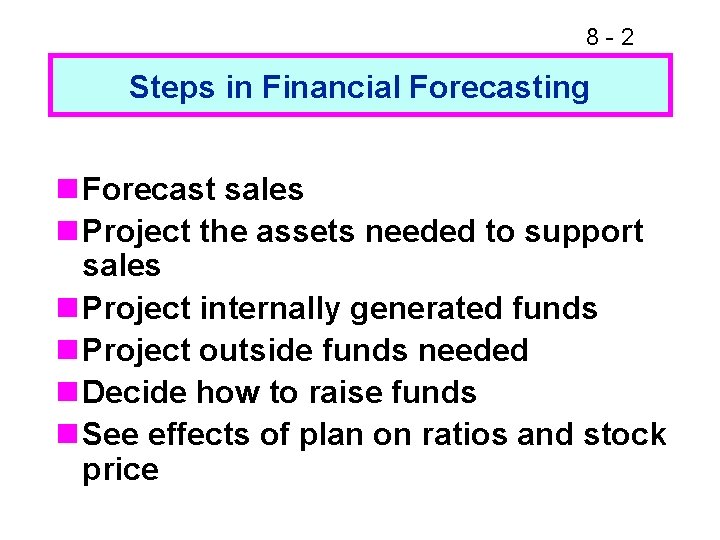
8 -2 Steps in Financial Forecasting n Forecast sales n Project the assets needed to support sales n Project internally generated funds n Project outside funds needed n Decide how to raise funds n See effects of plan on ratios and stock price
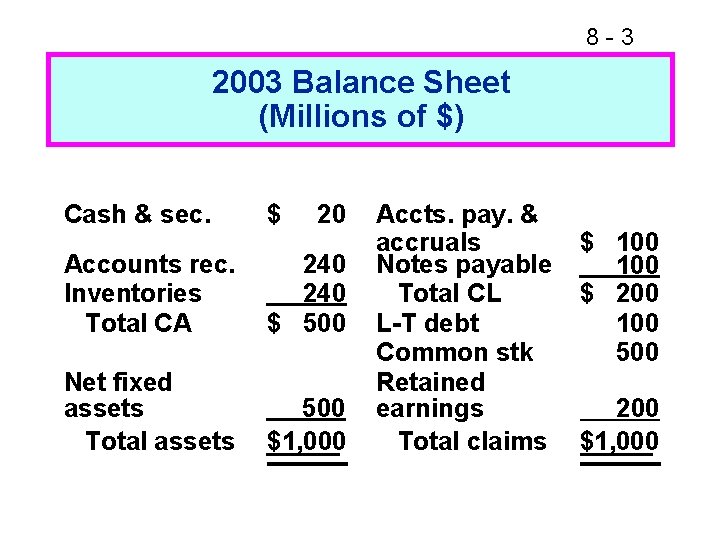
8 -3 2003 Balance Sheet (Millions of $) Cash & sec. $ 20 Accounts rec. Inventories Total CA 240 $ 500 Net fixed assets Total assets 500 $1, 000 Accts. pay. & accruals Notes payable Total CL L-T debt Common stk Retained earnings Total claims $ 100 $ 200 100 500 200 $1, 000
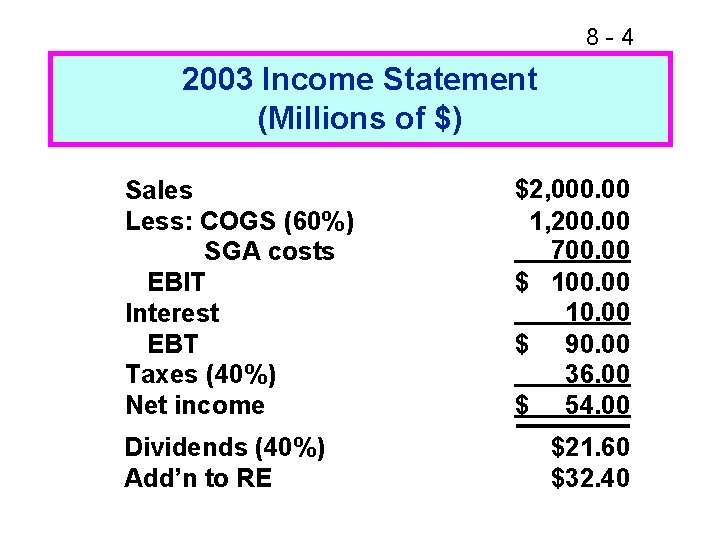
8 -4 2003 Income Statement (Millions of $) Sales Less: COGS (60%) SGA costs EBIT Interest EBT Taxes (40%) Net income Dividends (40%) Add’n to RE $2, 000. 00 1, 200. 00 700. 00 $ 100. 00 10. 00 $ 90. 00 36. 00 $ 54. 00 $21. 60 $32. 40
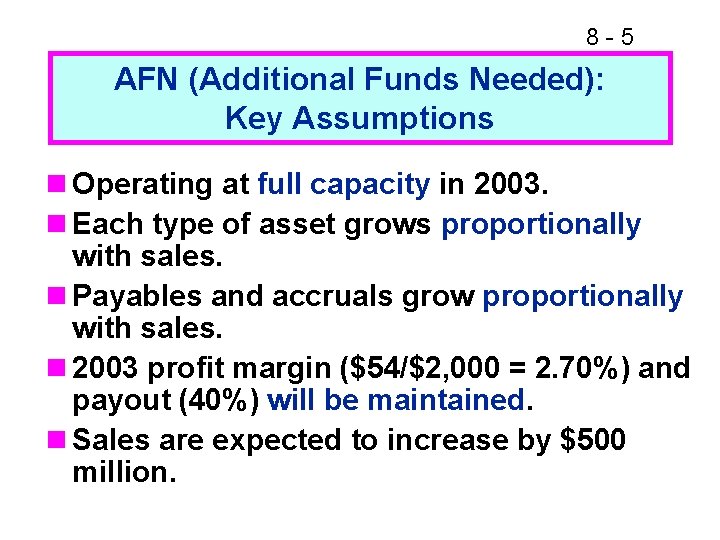
8 -5 AFN (Additional Funds Needed): Key Assumptions n Operating at full capacity in 2003. n Each type of asset grows proportionally with sales. n Payables and accruals grow proportionally with sales. n 2003 profit margin ($54/$2, 000 = 2. 70%) and payout (40%) will be maintained. n Sales are expected to increase by $500 million.
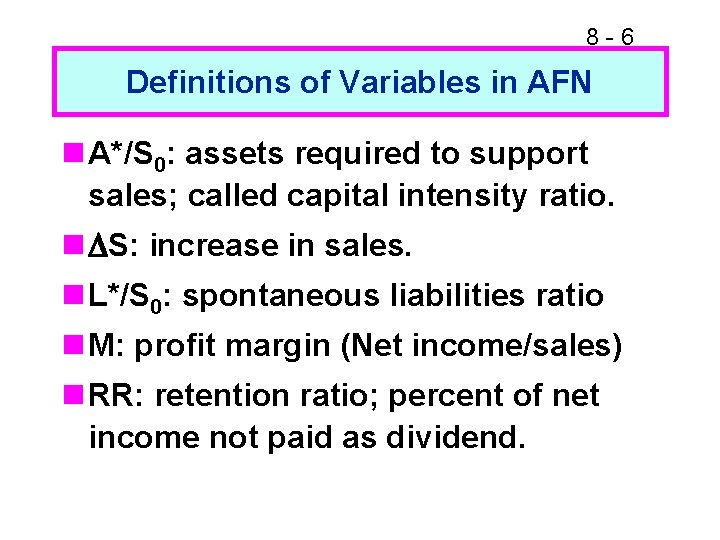
8 -6 Definitions of Variables in AFN n A*/S 0: assets required to support sales; called capital intensity ratio. n S: increase in sales. n L*/S 0: spontaneous liabilities ratio n M: profit margin (Net income/sales) n RR: retention ratio; percent of net income not paid as dividend.
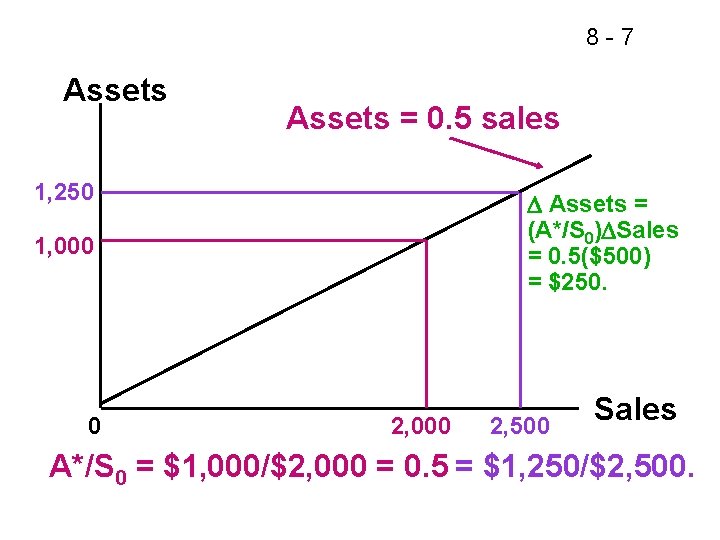
8 -7 Assets = 0. 5 sales 1, 250 Assets = (A*/S 0) Sales = 0. 5($500) = $250. 1, 000 0 2, 000 2, 500 Sales A*/S 0 = $1, 000/$2, 000 = 0. 5 = $1, 250/$2, 500.
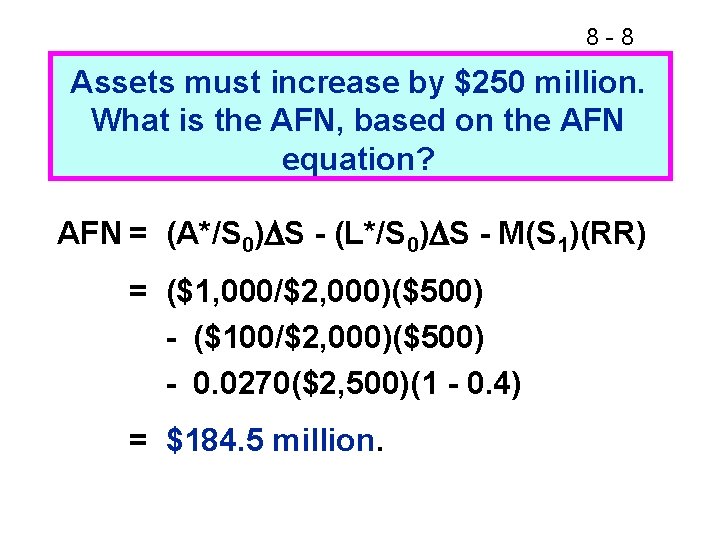
8 -8 Assets must increase by $250 million. What is the AFN, based on the AFN equation? AFN = (A*/S 0) S - (L*/S 0) S - M(S 1)(RR) = ($1, 000/$2, 000)($500) - ($100/$2, 000)($500) - 0. 0270($2, 500)(1 - 0. 4) = $184. 5 million.
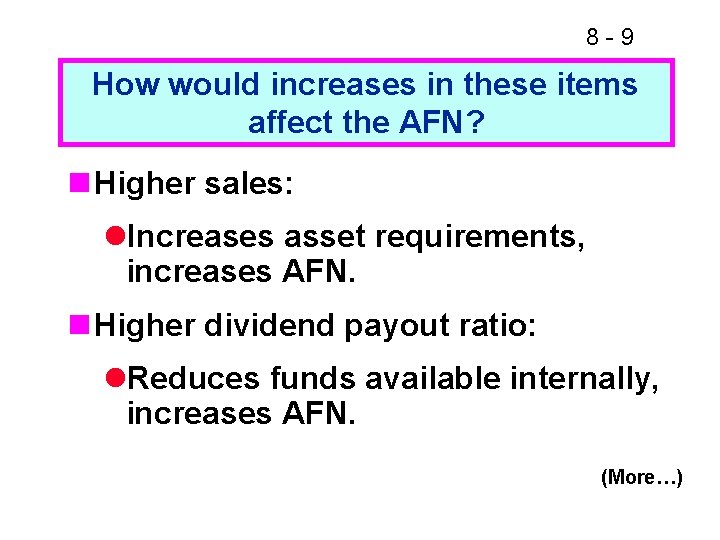
8 -9 How would increases in these items affect the AFN? n Higher sales: l. Increases asset requirements, increases AFN. n Higher dividend payout ratio: l. Reduces funds available internally, increases AFN. (More…)
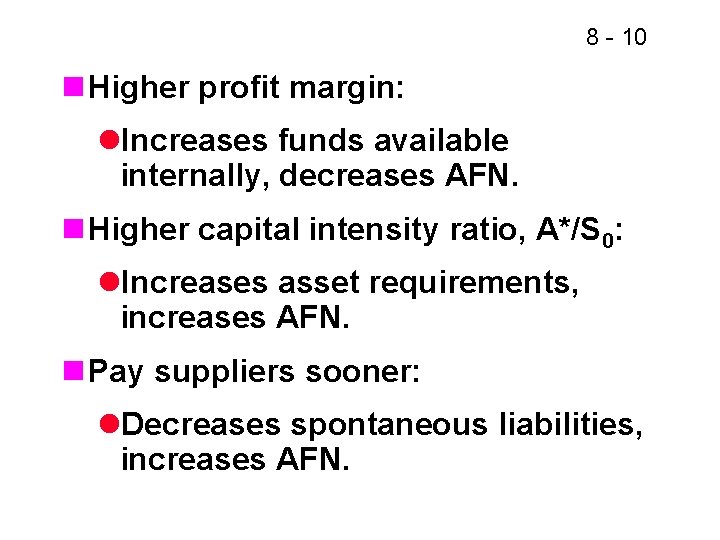
8 - 10 n Higher profit margin: l. Increases funds available internally, decreases AFN. n Higher capital intensity ratio, A*/S 0: l. Increases asset requirements, increases AFN. n Pay suppliers sooner: l. Decreases spontaneous liabilities, increases AFN.
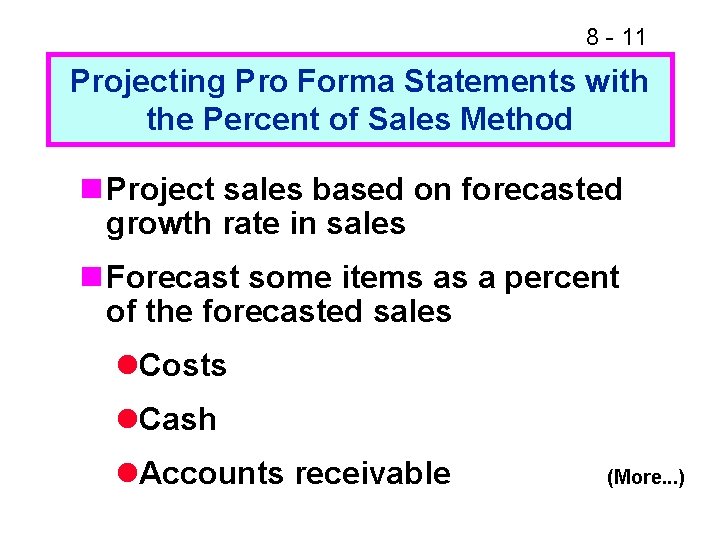
8 - 11 Projecting Pro Forma Statements with the Percent of Sales Method n Project sales based on forecasted growth rate in sales n Forecast some items as a percent of the forecasted sales l. Costs l. Cash l. Accounts receivable (More. . . )
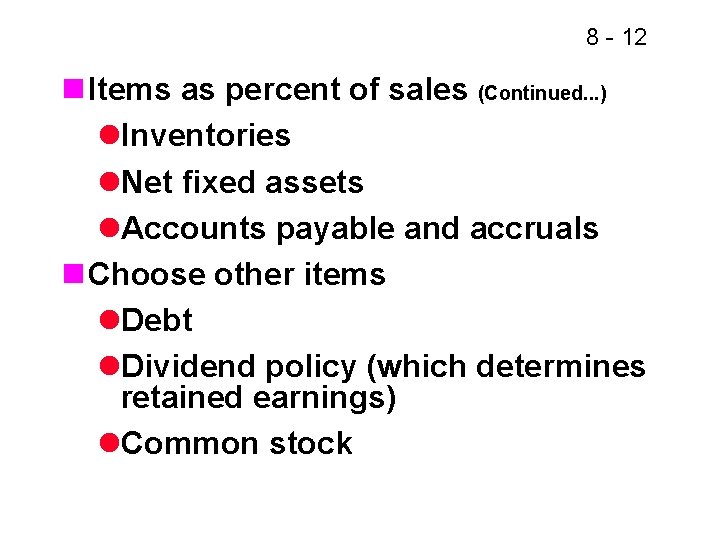
8 - 12 n Items as percent of sales (Continued. . . ) l. Inventories l. Net fixed assets l. Accounts payable and accruals n Choose other items l. Debt l. Dividend policy (which determines retained earnings) l. Common stock
8 - 13 Sources of Financing Needed to Support Asset Requirements n Given the previous assumptions and choices, we can estimate: l. Required assets to support sales l. Specified sources of financing n Additional funds needed (AFN) is: l. Required assets minus specified sources of financing
8 - 14 Implications of AFN n If AFN is positive, then you must secure additional financing. n If AFN is negative, then you have more financing than is needed. l. Pay off debt. l. Buy back stock. l. Buy short-term investments.
8 - 15 How to Forecast Interest Expense n Interest expense is actually based on the daily balance of debt during the year. n There are three ways to approximate interest expense. Base it on: l. Debt at end of year l. Debt at beginning of year l. Average of beginning and ending debt More…
8 - 16 Basing Interest Expense on Debt at End of Year n Will over-estimate interest expense if debt is added throughout the year instead of all on January 1. n Causes circularity called financial feedback: more debt causes more interest, which reduces net income, which reduces retained earnings, which causes more debt, etc. More…
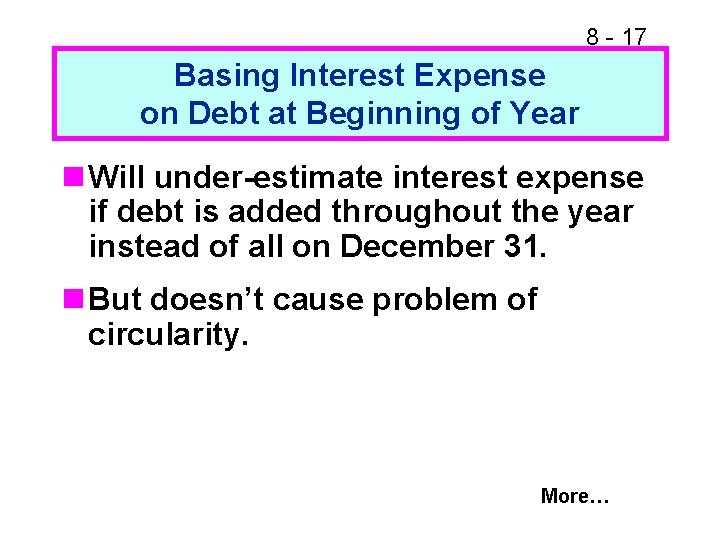
8 - 17 Basing Interest Expense on Debt at Beginning of Year n Will under-estimate interest expense if debt is added throughout the year instead of all on December 31. n But doesn’t cause problem of circularity. More…
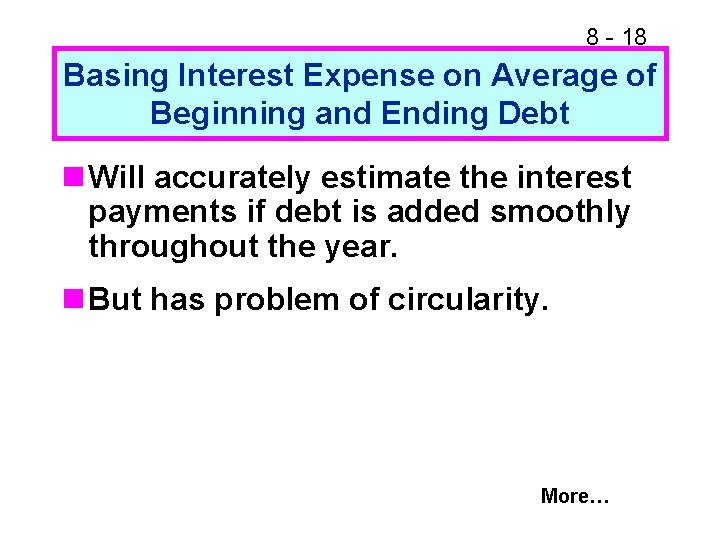
8 - 18 Basing Interest Expense on Average of Beginning and Ending Debt n Will accurately estimate the interest payments if debt is added smoothly throughout the year. n But has problem of circularity. More…
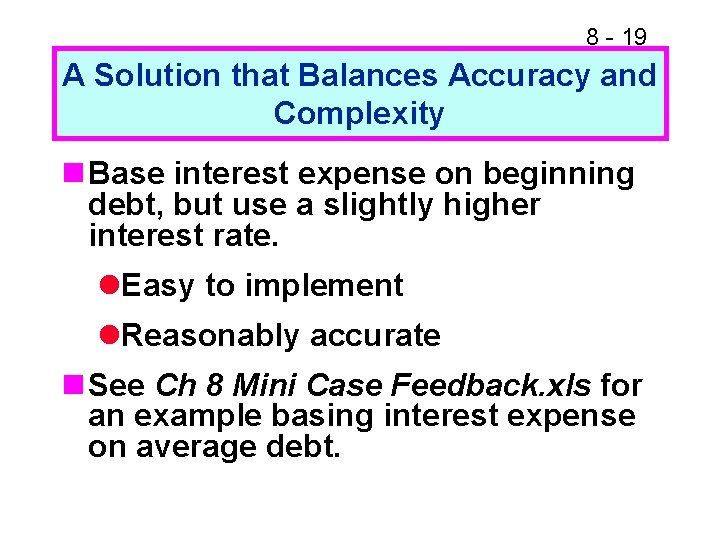
8 - 19 A Solution that Balances Accuracy and Complexity n Base interest expense on beginning debt, but use a slightly higher interest rate. l. Easy to implement l. Reasonably accurate n See Ch 8 Mini Case Feedback. xls for an example basing interest expense on average debt.
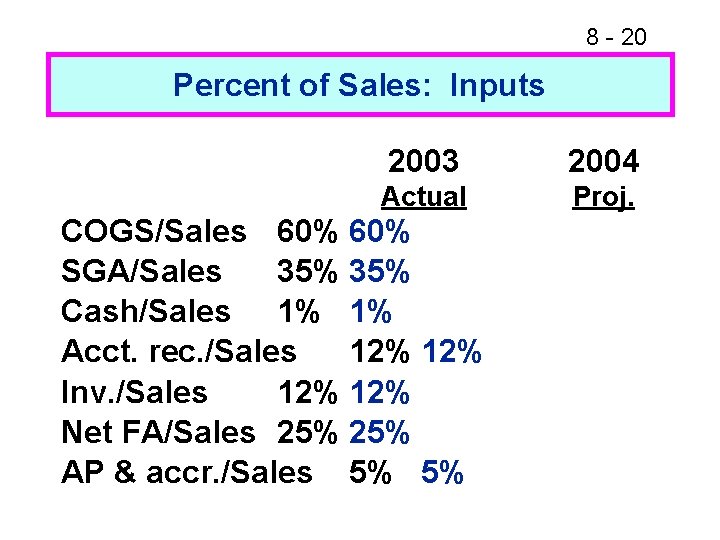
8 - 20 Percent of Sales: Inputs 2003 2004 Actual Proj. COGS/Sales 60% SGA/Sales 35% Cash/Sales 1% 1% Acct. rec. /Sales 12% Inv. /Sales 12% Net FA/Sales 25% AP & accr. /Sales 5% 5%
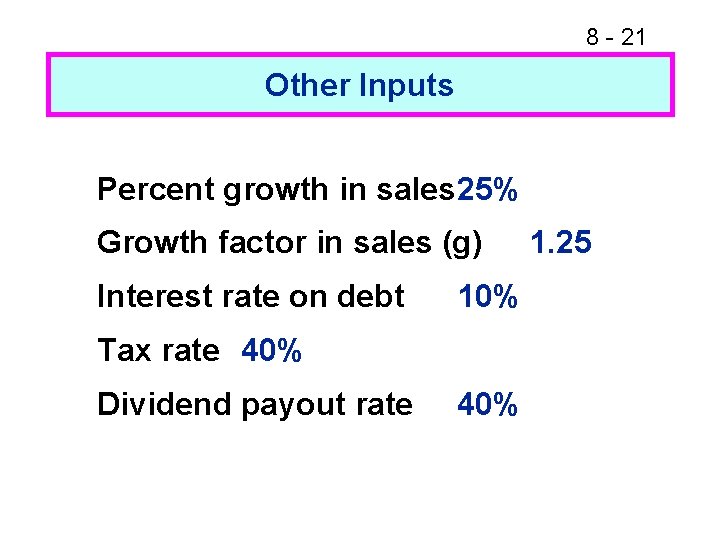
8 - 21 Other Inputs Percent growth in sales 25% Growth factor in sales (g) Interest rate on debt 10% Tax rate 40% Dividend payout rate 40% 1. 25
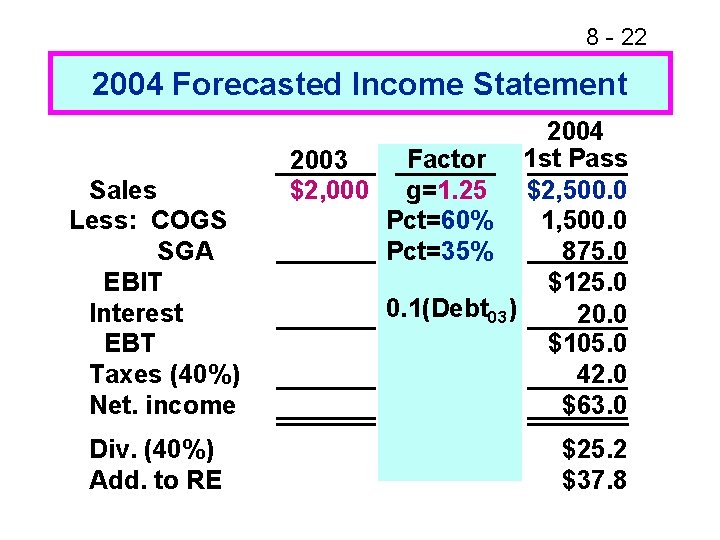
8 - 22 2004 Forecasted Income Statement Sales Less: COGS SGA EBIT Interest EBT Taxes (40%) Net. income Div. (40%) Add. to RE 2004 Factor 1 st Pass 2003 $2, 000 g=1. 25 $2, 500. 0 Pct=60% 1, 500. 0 Pct=35% 875. 0 $125. 0 0. 1(Debt 03) 20. 0 $105. 0 42. 0 $63. 0 $25. 2 $37. 8
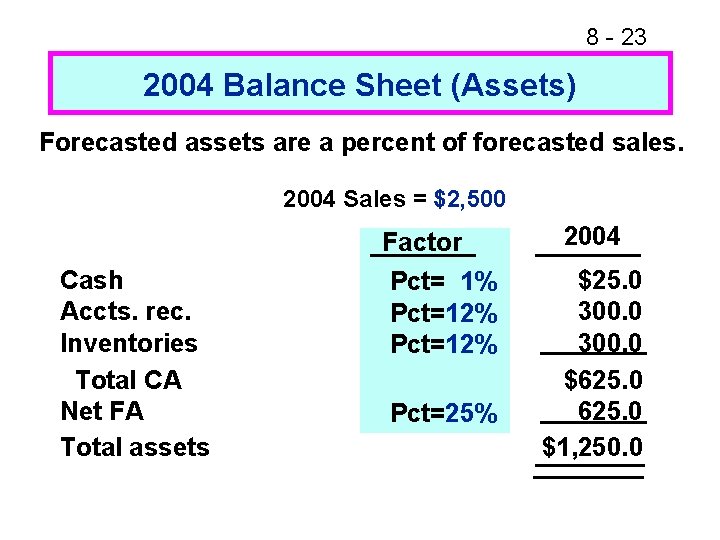
8 - 23 2004 Balance Sheet (Assets) Forecasted assets are a percent of forecasted sales. 2004 Sales = $2, 500 Factor Cash Accts. rec. Inventories Total CA Net FA Total assets Pct= 1% Pct=12% Pct=25% 2004 $25. 0 300. 0 $625. 0 $1, 250. 0
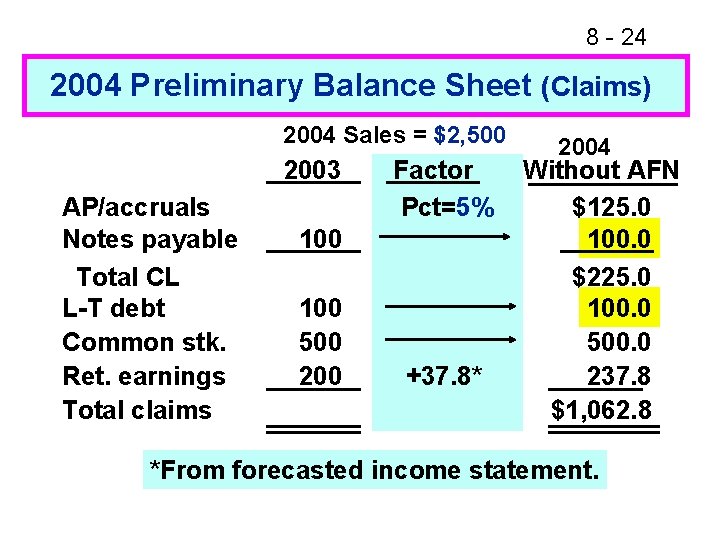
8 - 24 2004 Preliminary Balance Sheet (Claims) 2004 Sales = $2, 500 2003 AP/accruals Notes payable Total CL L-T debt Common stk. Ret. earnings Total claims Factor Pct=5% 100 500 200 +37. 8* 2004 Without AFN $125. 0 100. 0 $225. 0 100. 0 500. 0 237. 8 $1, 062. 8 *From forecasted income statement.
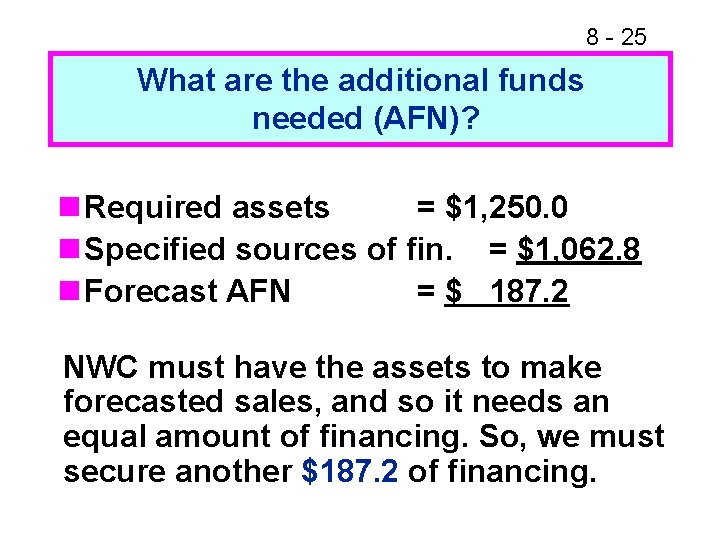
8 - 25 What are the additional funds needed (AFN)? n Required assets = $1, 250. 0 n Specified sources of fin. = $1, 062. 8 n Forecast AFN = $ 187. 2 NWC must have the assets to make forecasted sales, and so it needs an equal amount of financing. So, we must secure another $187. 2 of financing.
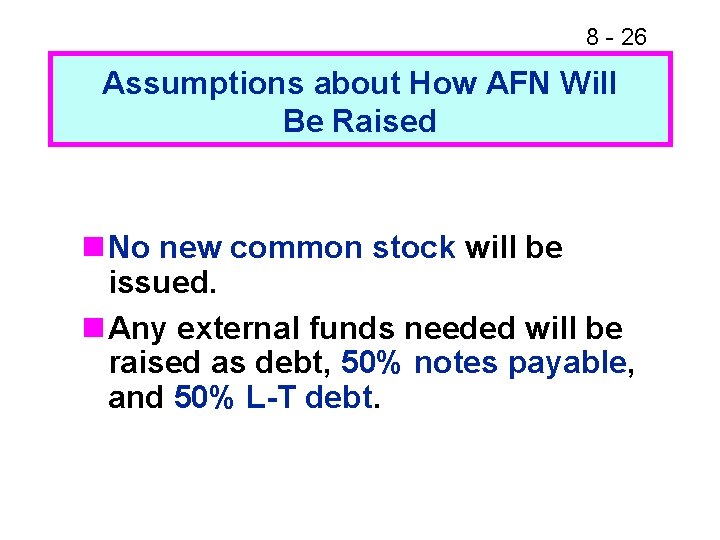
8 - 26 Assumptions about How AFN Will Be Raised n No new common stock will be issued. n Any external funds needed will be raised as debt, 50% notes payable, and 50% L-T debt.
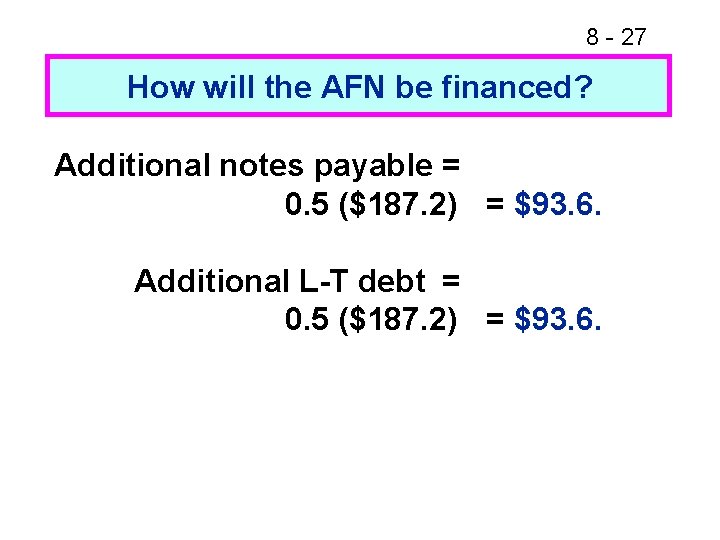
8 - 27 How will the AFN be financed? Additional notes payable = 0. 5 ($187. 2) = $93. 6. Additional L-T debt = 0. 5 ($187. 2) = $93. 6.
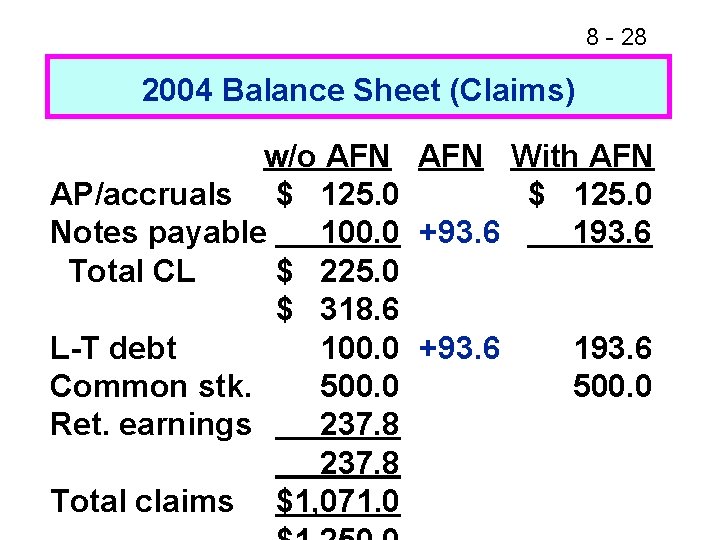
8 - 28 2004 Balance Sheet (Claims) w/o AFN With AFN AP/accruals $ 125. 0 Notes payable 100. 0 +93. 6 193. 6 Total CL $ 225. 0 $ 318. 6 L-T debt 100. 0 +93. 6 193. 6 Common stk. 500. 0 Ret. earnings 237. 8 Total claims $1, 071. 0
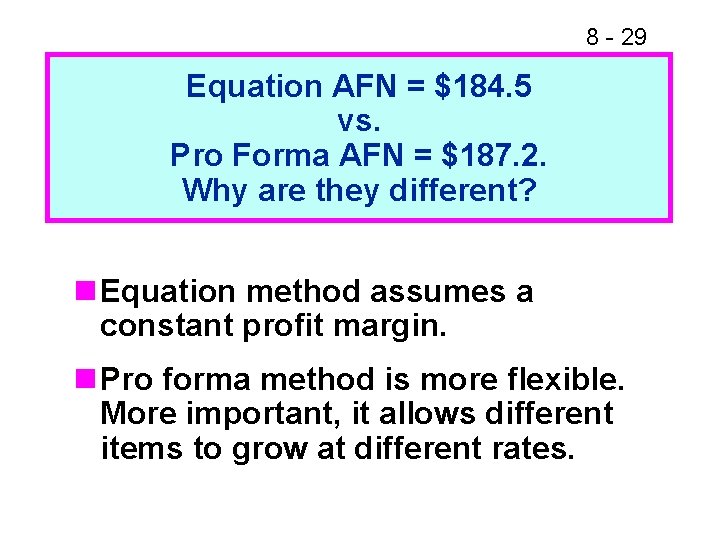
8 - 29 Equation AFN = $184. 5 vs. Pro Forma AFN = $187. 2. Why are they different? n Equation method assumes a constant profit margin. n Pro forma method is more flexible. More important, it allows different items to grow at different rates.
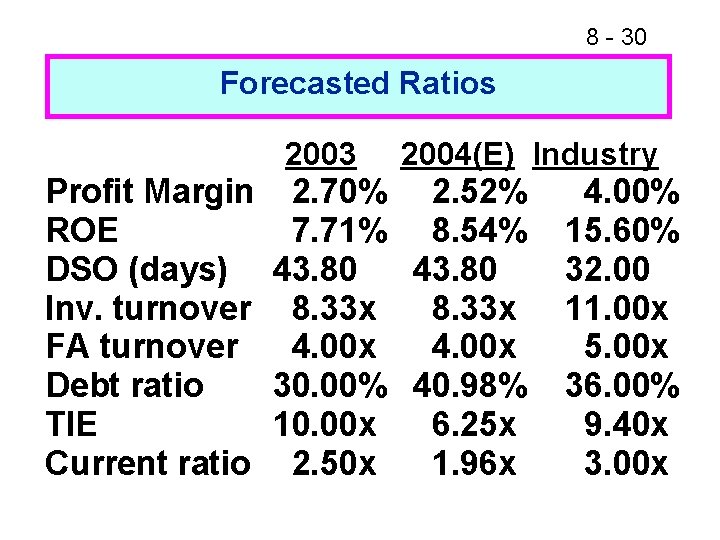
8 - 30 Forecasted Ratios 2003 2004(E) Industry Profit Margin 2. 70% 2. 52% ROE 7. 71% 8. 54% DSO (days) 43. 80 Inv. turnover 8. 33 x FA turnover 4. 00 x Debt ratio 30. 00% 40. 98% TIE 10. 00 x 6. 25 x Current ratio 2. 50 x 1. 96 x 4. 00% 15. 60% 32. 00 11. 00 x 5. 00 x 36. 00% 9. 40 x 3. 00 x
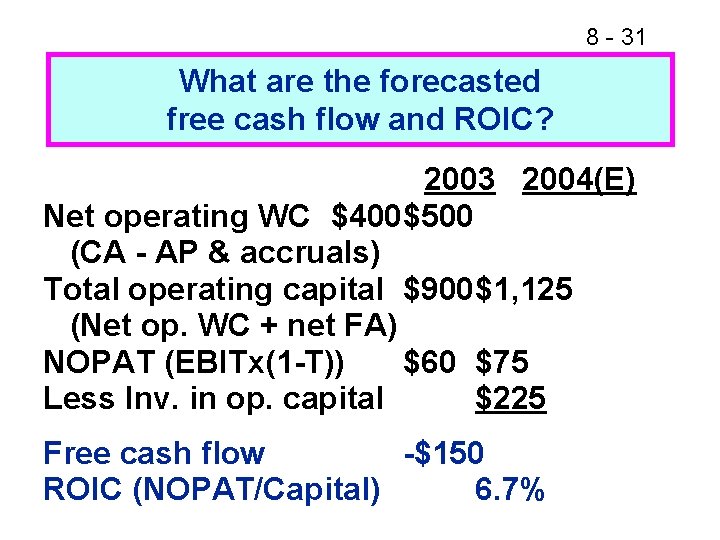
8 - 31 What are the forecasted free cash flow and ROIC? 2003 2004(E) Net operating WC $400$500 (CA - AP & accruals) Total operating capital $900$1, 125 (Net op. WC + net FA) NOPAT (EBITx(1 -T)) $60 $75 Less Inv. in op. capital $225 Free cash flow -$150 ROIC (NOPAT/Capital) 6. 7%
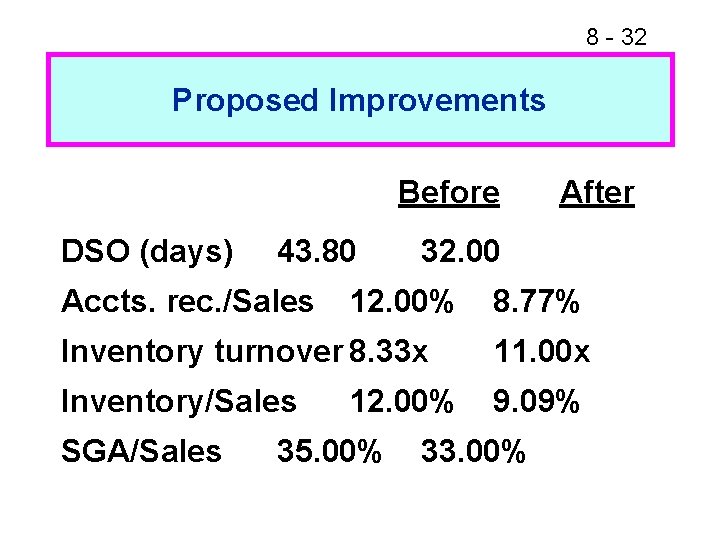
8 - 32 Proposed Improvements Before DSO (days) 43. 80 Accts. rec. /Sales After 32. 00 12. 00% 8. 77% Inventory turnover 8. 33 x 11. 00 x Inventory/Sales 9. 09% SGA/Sales 12. 00% 35. 00% 33. 00%
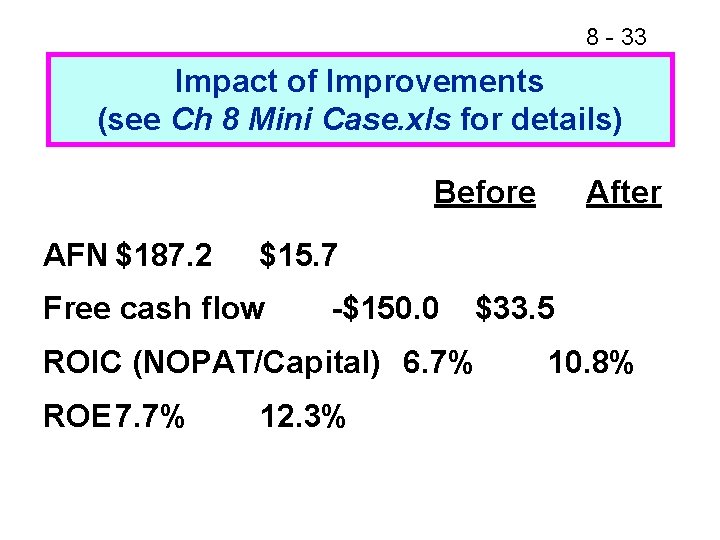
8 - 33 Impact of Improvements (see Ch 8 Mini Case. xls for details) Before AFN $187. 2 $15. 7 Free cash flow -$150. 0 $33. 5 ROIC (NOPAT/Capital) 6. 7% ROE 7. 7% After 12. 3% 10. 8%
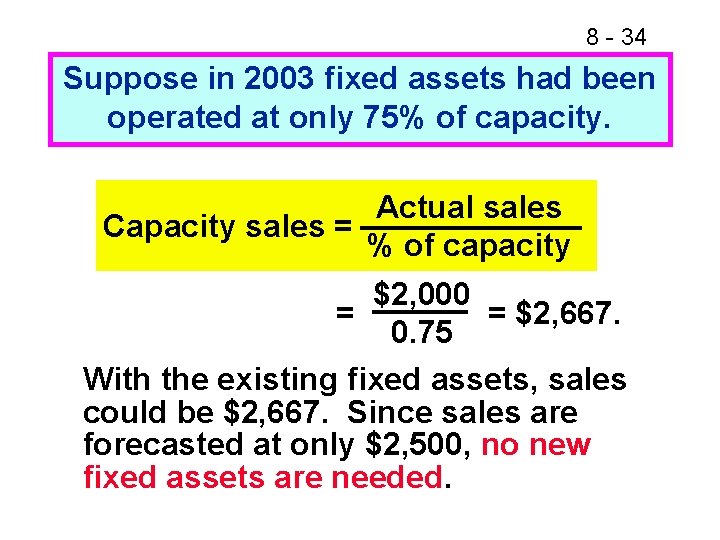
8 - 34 Suppose in 2003 fixed assets had been operated at only 75% of capacity. Actual sales Capacity sales = % of capacity $2, 000 = = $2, 667. 0. 75 With the existing fixed assets, sales could be $2, 667. Since sales are forecasted at only $2, 500, no new fixed assets are needed.
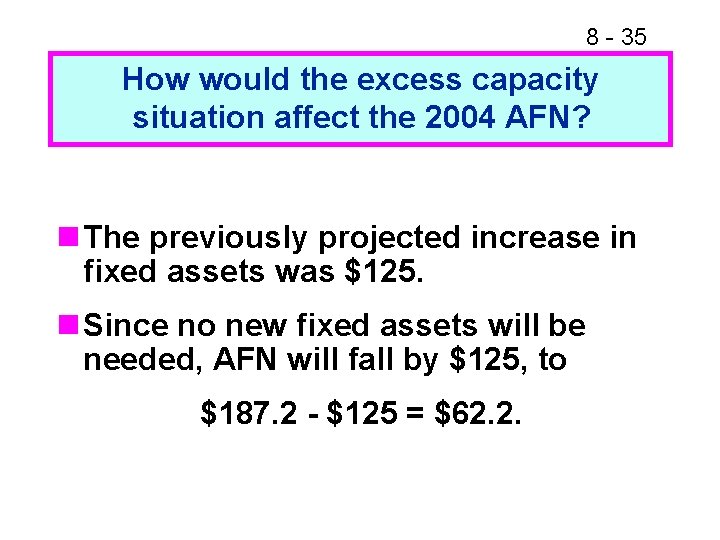
8 - 35 How would the excess capacity situation affect the 2004 AFN? n The previously projected increase in fixed assets was $125. n Since no new fixed assets will be needed, AFN will fall by $125, to $187. 2 - $125 = $62. 2.
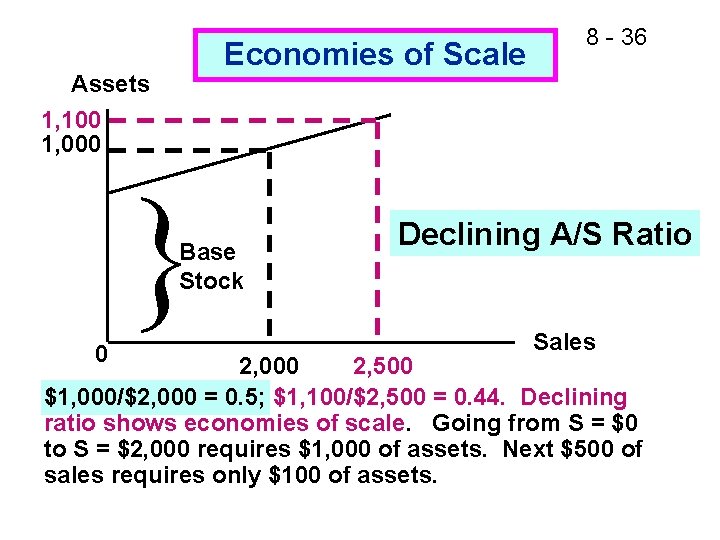
Assets 1, 100 1, 000 Economies of Scale Base Stock 0 8 - 36 Declining A/S Ratio Sales 2, 000 2, 500 $1, 000/$2, 000 = 0. 5; $1, 100/$2, 500 = 0. 44. Declining ratio shows economies of scale. Going from S = $0 to S = $2, 000 requires $1, 000 of assets. Next $500 of sales requires only $100 of assets.
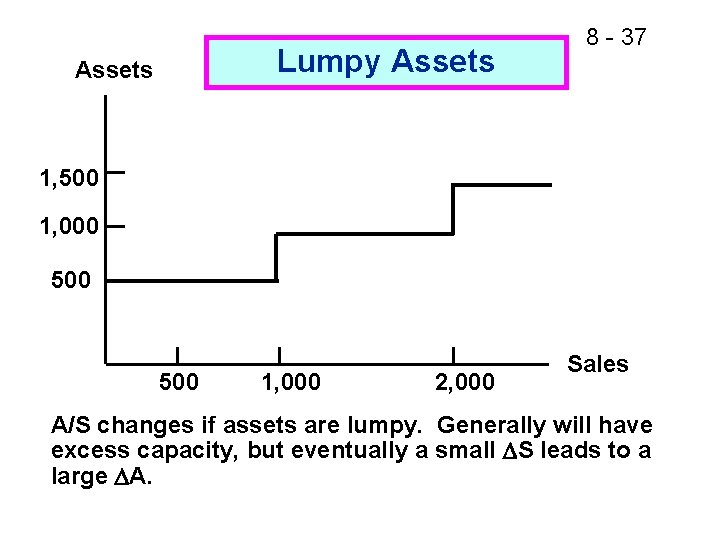
Lumpy Assets 8 - 37 1, 500 1, 000 2, 000 Sales A/S changes if assets are lumpy. Generally will have excess capacity, but eventually a small S leads to a large A.
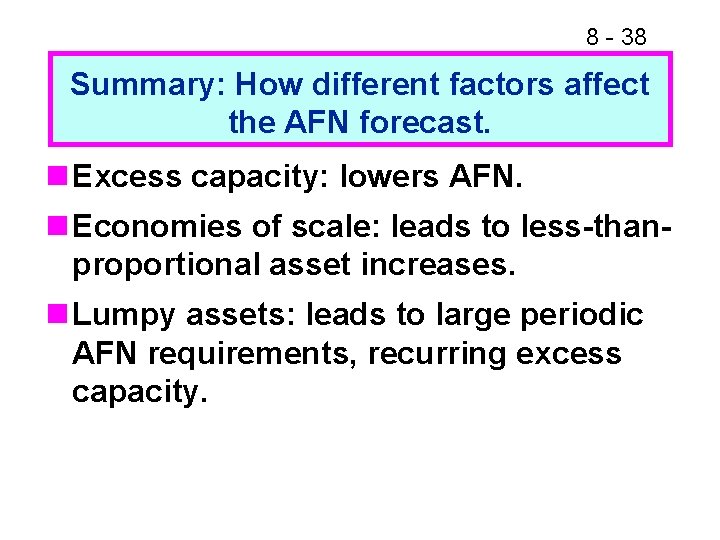
8 - 38 Summary: How different factors affect the AFN forecast. n Excess capacity: lowers AFN. n Economies of scale: leads to less-thanproportional asset increases. n Lumpy assets: leads to large periodic AFN requirements, recurring excess capacity.