
8 1 Chapter 8 Database Information Systems 8
8 -1
Chapter 8 Database & Information Systems 8. 1 Managing Files: Basic Concepts 8. 2 Database Management Systems 8. 3 Database Models 8. 4 Data Mining 8. 5 Databases & The Digital Economy 8. 6 Using Databases to Help Make Decisions 8. 7 Artificial Intelligence 8. 8 The Ethics of Using Databases Mc. Graw-Hill/Irwin © 2007 The Mc. Graw-Hill Companies, Inc. All rights reserved.
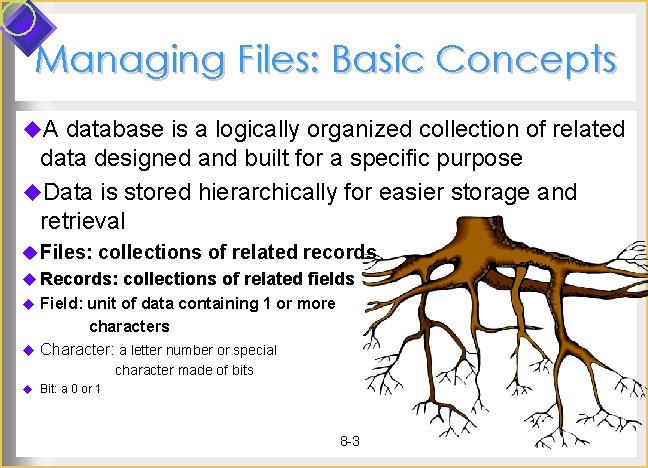
Managing Files: Basic Concepts u. A database is a logically organized collection of related data designed and built for a specific purpose u. Data is stored hierarchically for easier storage and retrieval u Files: collections of related records u Records: collections of related fields u Field: unit of data containing 1 or more characters u Character: a letter number or special character made of bits u Bit: a 0 or 1 8 -3
Managing Files: Basic Concepts u. Key Field – the field that identifies a record u Often an identifying number, such as social security number u Primary keys must be unique u Keys are used to pick records out of a database u Unique keys make records stand out from each other u If two records had the same key, then you might not pick the correct one u Nonprimary keys are used to sort records in different ways u Foreign keys are fields that appear in two different tables and are used to relate one table to another 8 -4
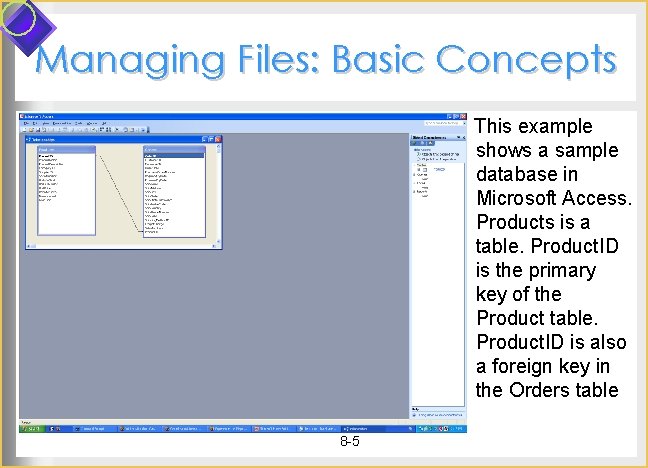
Managing Files: Basic Concepts This example shows a sample database in Microsoft Access. Products is a table. Product. ID is the primary key of the Product table. Product. ID is also a foreign key in the Orders table 8 -5

Managing Files: Basic Concepts u. Program files are files containing software instructions u Source program files are written by the software developer in the programming language u Double-clicking on them won’t run them u They have file extensions like. cpp, . jav, . bas u Executable files are program files translated so they can be executed on the computer u Double-clicking on them will cause them to run u They have file extensions like. exe or. com 8 -6
Managing Files: Basic Concepts u. Data files are files that contain data such as words, numbers, pictures, or sounds u These are the files that are used in databases u They have extensions such as. txt. mdb, and. xls u Graphics files have extensions like. tiff, . jpeg, and. png u Audio files have extensions such as. mp 3, . wav, and. mid u Animation/video files have extensions such as. qt, . mpg, . avi, and. rm u. Data files are often compressed to save space and transmit them faster u Compression removes repetitive elements from a file 8 -7
Database Management Systems u. Software written specifically to control the structure of a database and access to the data u Reduced data redundancy u Redundant data is stored in multiple places, which causes problems keeping all the copies current u Improved u Means data integrity the data is accurate, consistent, and up to date u Increased u Limits u Ease security who can create, read, update, and delete the data of data maintenance u Offer validation checks, backup utilities, and procedures for data inserting, updating, and deletion 8 -8
Database Management Systems 3 Principal Components u. Data Dictionary u. A repository that stores the data definitions and descriptions of the structure of the data and the database u. DBMS Utilities u Programs that allow you to maintain the database by creating, editing, deleting data, records, and files u Also include automated backup and recovery u. Report Generator u Program for producing an on-screen or printed document form all or part of a database 8 -9
Database Management Systems Database Administrator u. Database Administrator (DBA) u. A high-paid, responsible position within an organization u Coordinates all related activities and needs for an organization’s database u Ensures the database’s Discussion Question: Did you know that 93% of companies that lost their data center for 10 days or more due to a disaster filed for bankruptcy within a year? u Recoverability u Integrity u Security u Availability u Reliability u Performance 8 -10
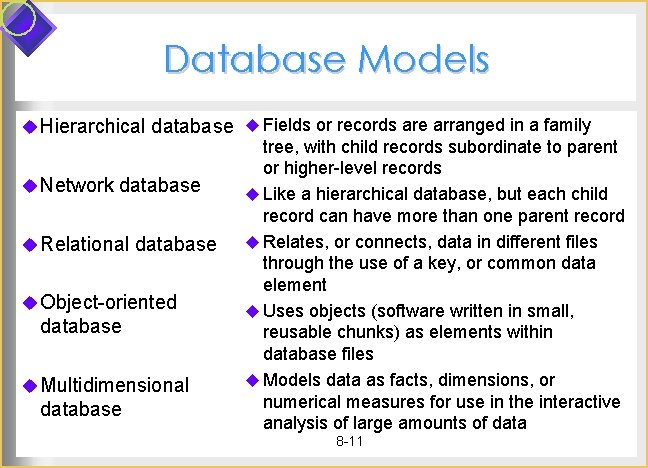
Database Models u Hierarchical database u Fields or records are arranged in a family tree, with child records subordinate to parent or higher-level records u Network database u Like a hierarchical database, but each child record can have more than one parent record u Relates, or connects, data in different files u Relational database through the use of a key, or common data element u Object-oriented u Uses objects (software written in small, database reusable chunks) as elements within database files u Models data as facts, dimensions, or u Multidimensional numerical measures for use in the interactive database analysis of large amounts of data 8 -11
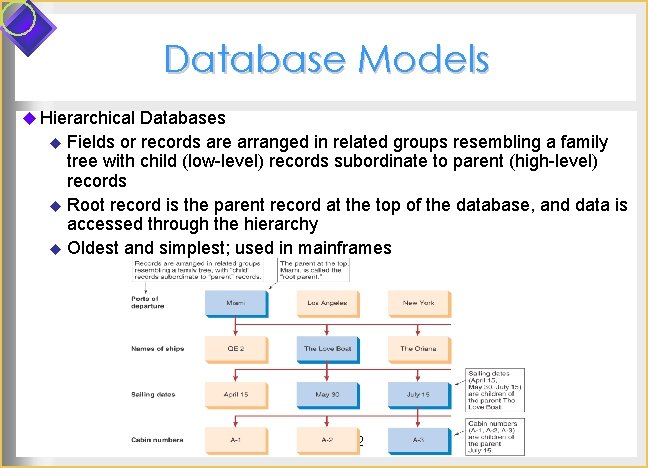
Database Models u Hierarchical Databases u Fields or records are arranged in related groups resembling a family tree with child (low-level) records subordinate to parent (high-level) records u Root record is the parent record at the top of the database, and data is accessed through the hierarchy u Oldest and simplest; used in mainframes 8 -12
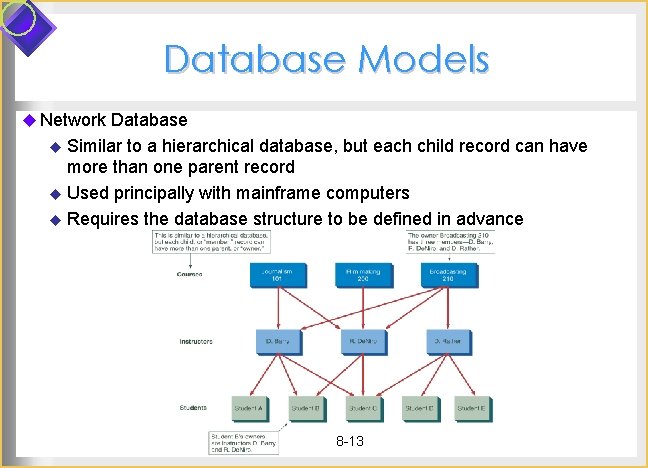
Database Models u Network Database u Similar to a hierarchical database, but each child record can have more than one parent record u Used principally with mainframe computers u Requires the database structure to be defined in advance 8 -13
Database Models u. Relational Database u Relates or connects data in different files through the use of a key, or common data element u Examples are Oracle, Informix, Sybase u Data exists independently of how it is physically stored u Users don’t need to know data structure to use the database u Uses SQL (structured query language) to create, modify, maintain, and query the data u Query by Example uses sample records or forms to allow users to define the qualifications for choosing records 8 -14
Database Models u. Object-oriented Databases u Use “objects”, software written in small, manageable chunks, as elements within data files u An object consists of u Data in any form, including audio, graphics, and video u Instructions on the action to be taken with the data u Examples include Fast. Objects, Gem. Stone, Objectivity DB, Jasmine Object Database, and KE Express u Types include u Web database u Hypermedia database 8 -15
Database Models u. Multidimensional Database u Models data as facts, dimensions, or numerical answers for use in the interactive analysis of large amounts of data for decision-making purposes u Allows users to ask questions in colloquial English u Use OLAP (Online Analytical Processing) software to provide answers to complex database queries 8 -16
- Slides: 16