
8 022 EM Lecture 4 Topics More applications

- Slides: 25
8. 022 (E&M) – Lecture 4 Topics: More applications of vector calculus to electrostatics: Laplacian: Poisson and Laplace equation Curl: concept and applications to electrostatics Introduction to conductors 1
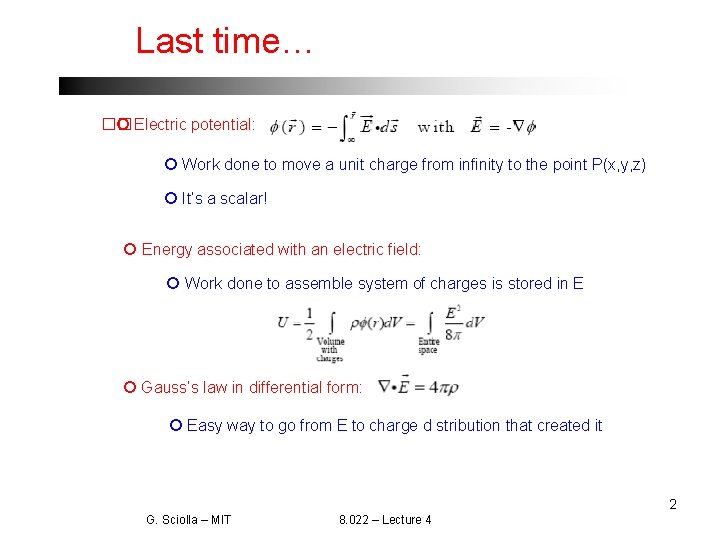
Last time… �� Electric potential: Work done to move a unit charge from infinity to the point P(x, y, z) It’s a scalar! Energy associated with an electric field: Work done to assemble system of charges is stored in E Gauss’s law in differential form: Easy way to go from E to charge d stribution that created it 2 G. Sciolla – MIT 8. 022 – Lecture 4
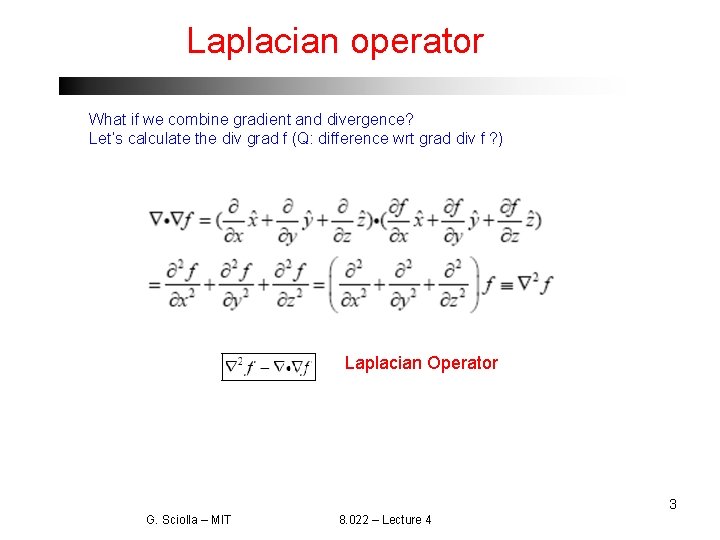
Laplacian operator What if we combine gradient and divergence? Let’s calculate the div grad f (Q: difference wrt grad div f ? ) Laplacian Operator 3 G. Sciolla – MIT 8. 022 – Lecture 4
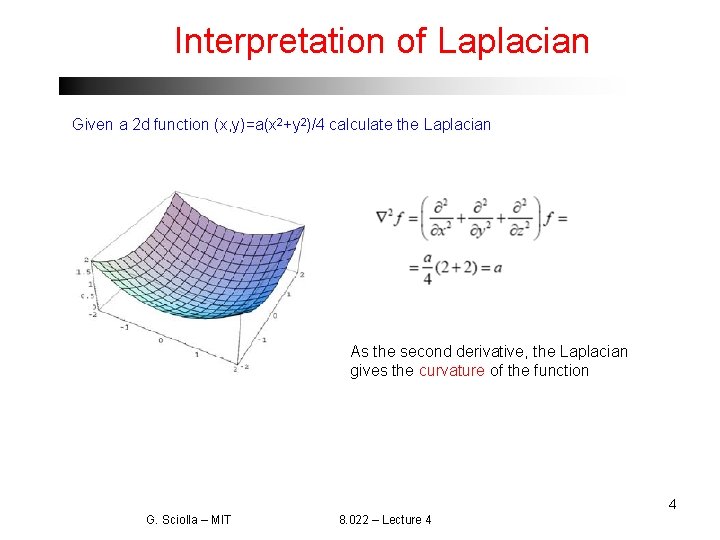
Interpretation of Laplacian Given a 2 d function (x, y)=a(x 2+y 2)/4 calculate the Laplacian As the second derivative, the Laplacian gives the curvature of the function 4 G. Sciolla – MIT 8. 022 – Lecture 4
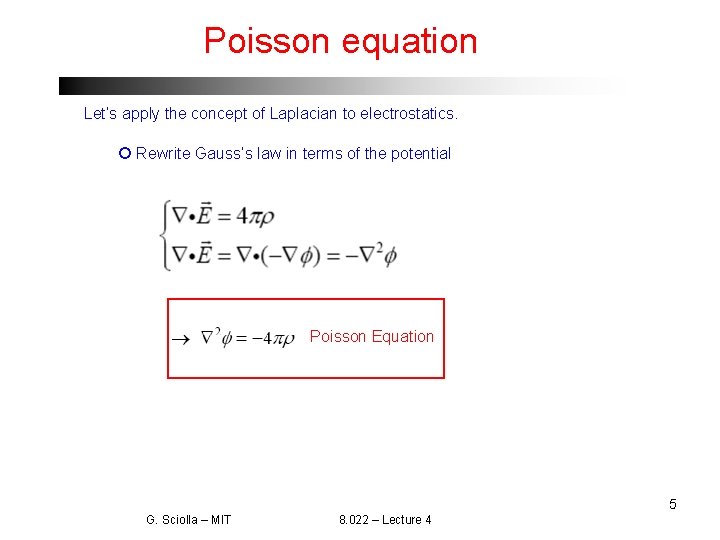
Poisson equation Let’s apply the concept of Laplacian to electrostatics. Rewrite Gauss’s law in terms of the potential Poisson Equation 5 G. Sciolla – MIT 8. 022 – Lecture 4
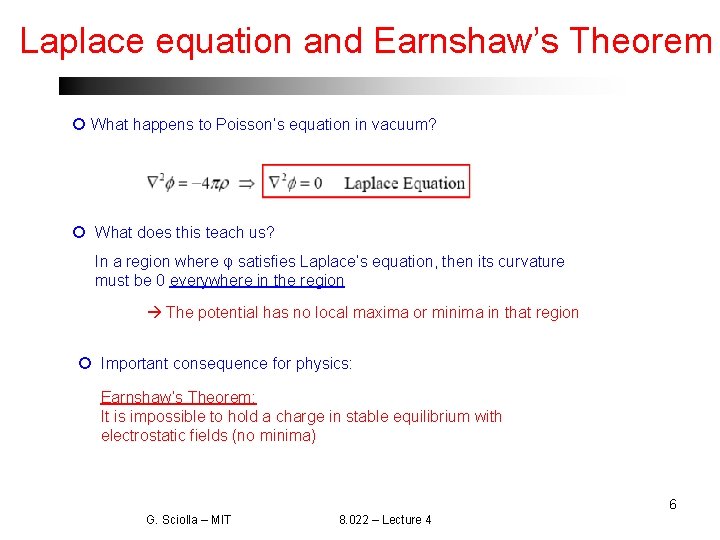
Laplace equation and Earnshaw’s Theorem What happens to Poisson’s equation in vacuum? What does this teach us? In a region where φ satisfies Laplace’s equation, then its curvature must be 0 everywhere in the region The potential has no local maxima or minima in that region Important consequence for physics: Earnshaw’s Theorem: It is impossible to hold a charge in stable equilibrium with electrostatic fields (no minima) 6 G. Sciolla – MIT 8. 022 – Lecture 4
Application of Earnshaw’s Theorem 8 charges on a cube and one free in the middle. Is the equilibrium stable? No! (does the question sound familiar? ) 7 G. Sciolla – MIT 8. 022 – Lecture 4
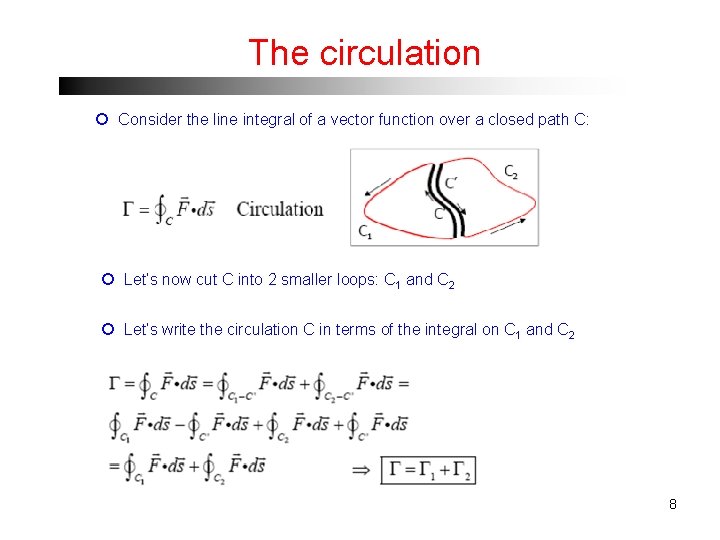
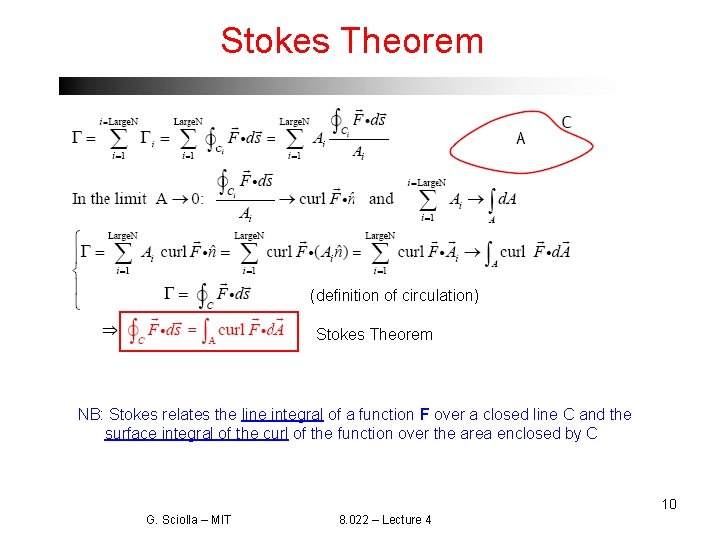
The circulation Consider the line integral of a vector function over a closed path C: Let’s now cut C into 2 smaller loops: C 1 and C 2 Let’s write the circulation C in terms of the integral on C 1 and C 2 8
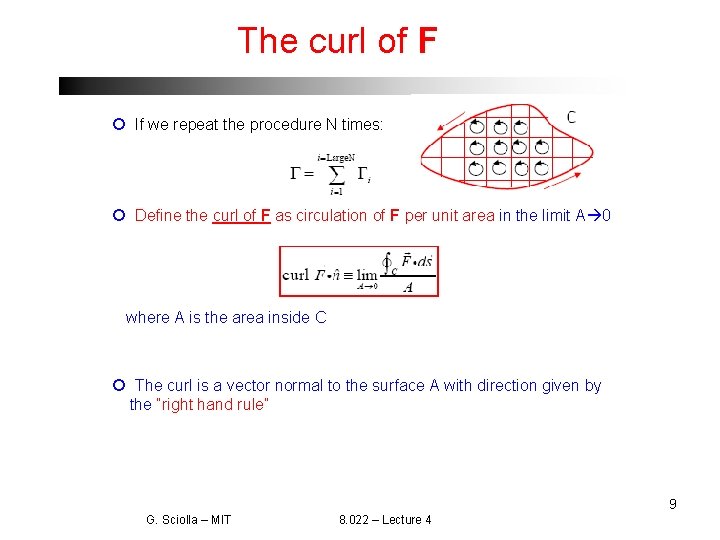
The curl of F If we repeat the procedure N times: Define the curl of F as circulation of F per unit area in the limit A 0 where A is the area inside C The curl is a vector normal to the surface A with direction given by the “right hand rule” 9 G. Sciolla – MIT 8. 022 – Lecture 4
Stokes Theorem (definition of circulation) Stokes Theorem NB: Stokes relates the line integral of a function F over a closed line C and the surface integral of the curl of the function over the area enclosed by C 10 G. Sciolla – MIT 8. 022 – Lecture 4
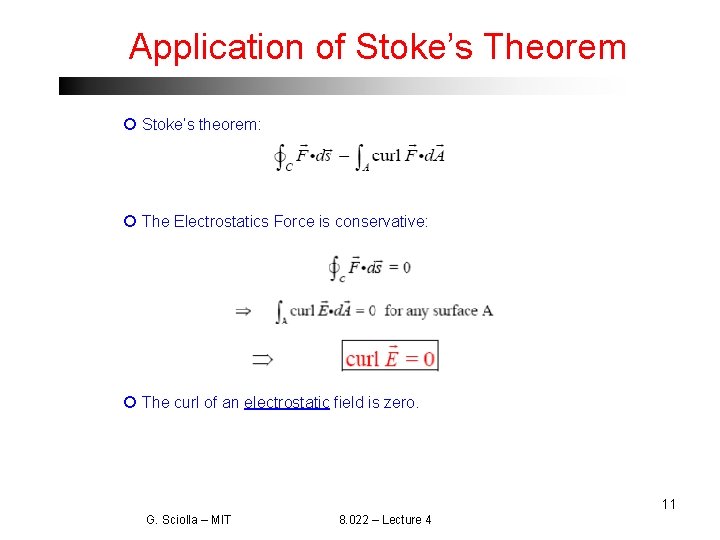
Application of Stoke’s Theorem Stoke’s theorem: The Electrostatics Force is conservative: The curl of an electrostatic field is zero. 11 G. Sciolla – MIT 8. 022 – Lecture 4
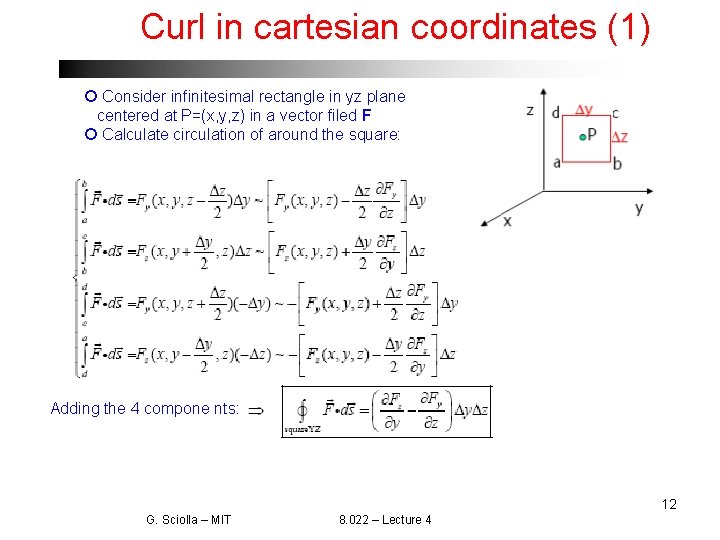
Curl in cartesian coordinates (1) Consider infinitesimal rectangle in yz plane centered at P=(x, y, z) in a vector filed F Calculate circulation of around the square: Adding the 4 compone nts: 12 G. Sciolla – MIT 8. 022 – Lecture 4
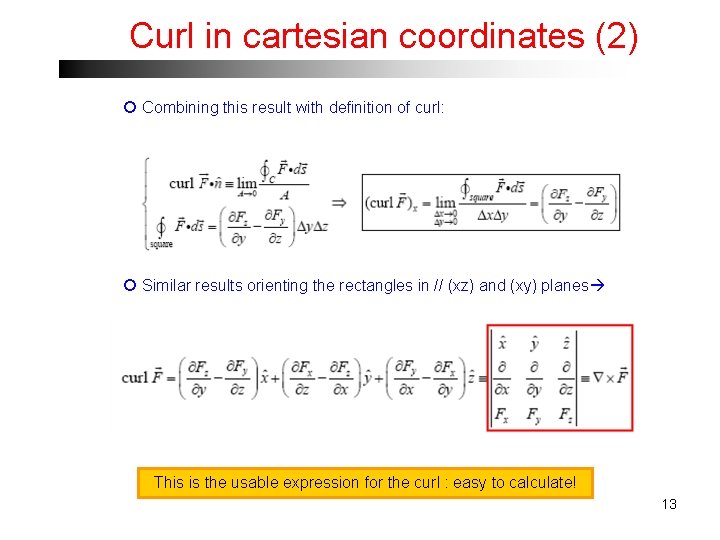
Curl in cartesian coordinates (2) Combining this result with definition of curl: Similar results orienting the rectangles in // (xz) and (xy) planes This is the usable expression for the curl : easy to calculate! 13
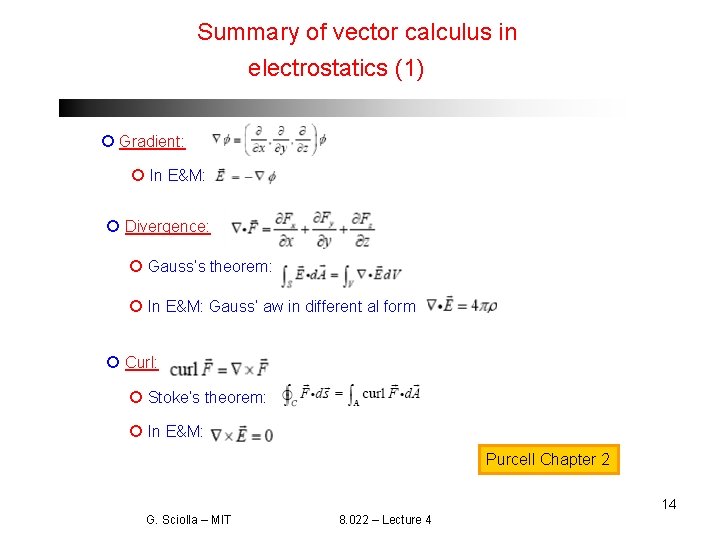
Summary of vector calculus in electrostatics (1) Gradient: In E&M: Divergence: Gauss’s theorem: In E&M: Gauss’ aw in different al form Curl: Stoke’s theorem: In E&M: Purcell Chapter 2 14 G. Sciolla – MIT 8. 022 – Lecture 4
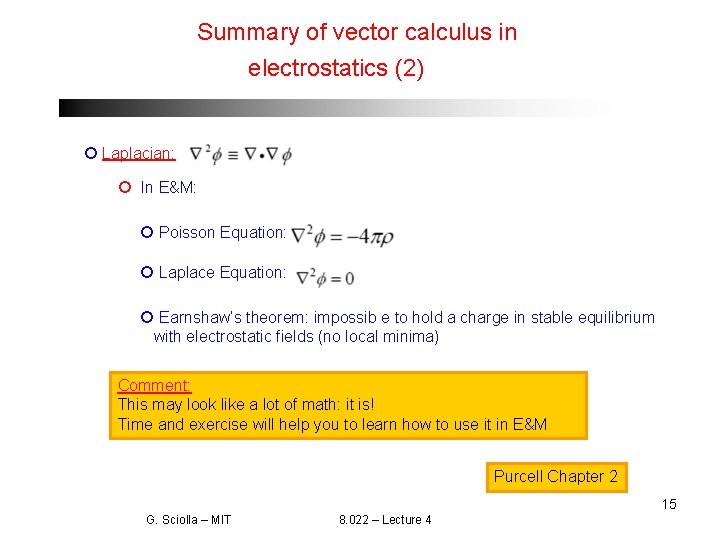
Summary of vector calculus in electrostatics (2) Laplacian: In E&M: Poisson Equation: Laplace Equation: Earnshaw’s theorem: impossib e to hold a charge in stable equilibrium with electrostatic fields (no local minima) Comment: This may look like a lot of math: it is! Time and exercise will help you to learn how to use it in E&M Purcell Chapter 2 15 G. Sciolla – MIT 8. 022 – Lecture 4
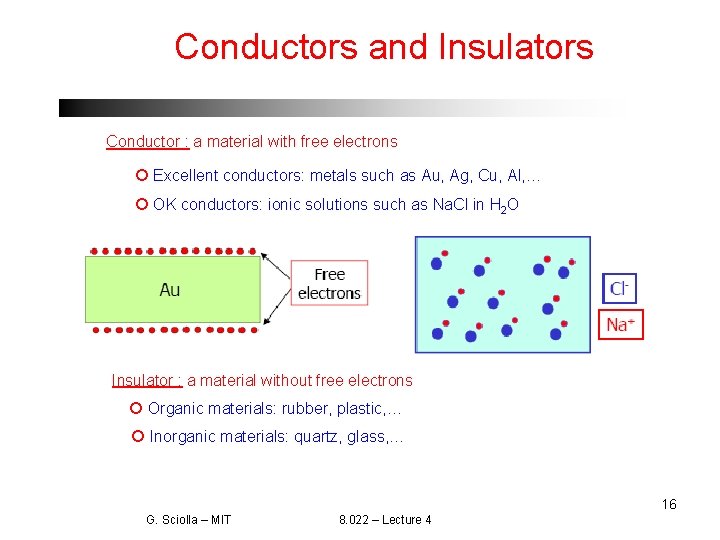
Conductors and Insulators Conductor : a material with free electrons Excellent conductors: metals such as Au, Ag, Cu, Al, … OK conductors: ionic solutions such as Na. Cl in H 2 O Insulator : a material without free electrons Organic materials: rubber, plastic, … Inorganic materials: quartz, glass, … 16 G. Sciolla – MIT 8. 022 – Lecture 4
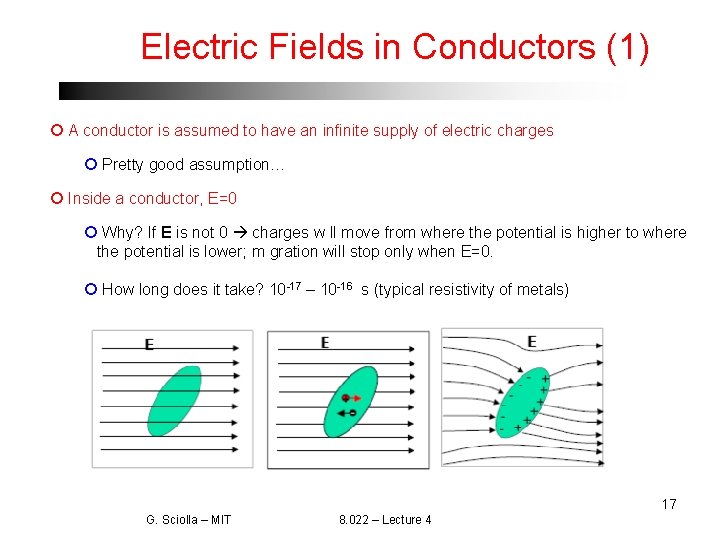
Electric Fields in Conductors (1) A conductor is assumed to have an infinite supply of electric charges Pretty good assumption… Inside a conductor, E=0 Why? If E is not 0 charges w ll move from where the potential is higher to where the potential is lower; m gration will stop only when E=0. How long does it take? 10 -17 – 10 -16 s (typical resistivity of metals) 17 G. Sciolla – MIT 8. 022 – Lecture 4
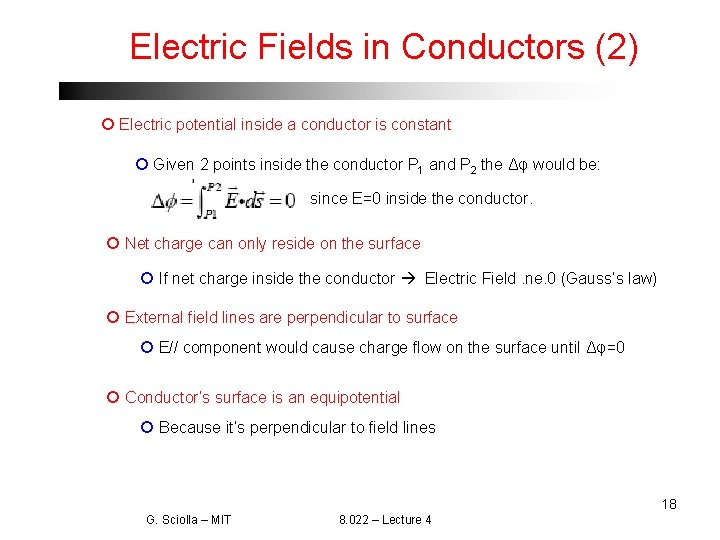
Electric Fields in Conductors (2) Electric potential inside a conductor is constant Given 2 points inside the conductor P 1 and P 2 the Δφ would be: since E=0 inside the conductor. Net charge can only reside on the surface If net charge inside the conductor Electric Field. ne. 0 (Gauss’s law) External field lines are perpendicular to surface E// component would cause charge flow on the surface until Δφ=0 Conductor’s surface is an equipotential Because it’s perpendicular to field lines 18 G. Sciolla – MIT 8. 022 – Lecture 4
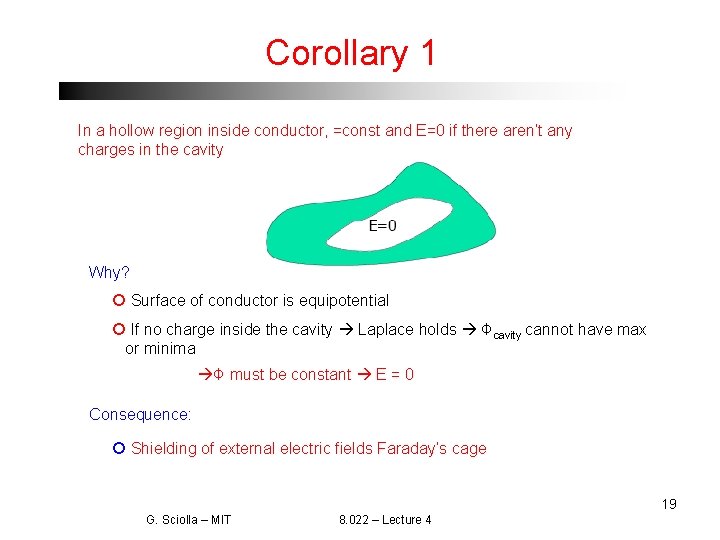
Corollary 1 In a hollow region inside conductor, =const and E=0 if there aren’t any charges in the cavity Why? Surface of conductor is equipotential If no charge inside the cavity Laplace holds Φcavity cannot have max or minima Φ must be constant E = 0 Consequence: Shielding of external electric fields Faraday’s cage 19 G. Sciolla – MIT 8. 022 – Lecture 4
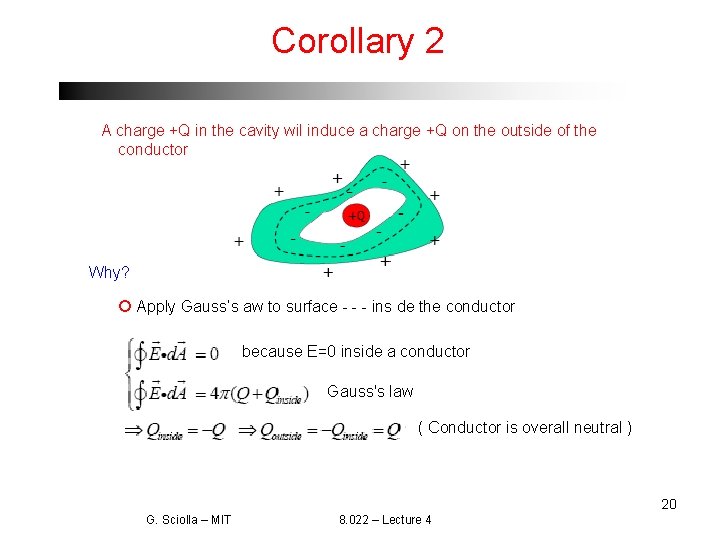
Corollary 2 A charge +Q in the cavity wil induce a charge +Q on the outside of the conductor Why? Apply Gauss’s aw to surface - - - ins de the conductor because E=0 inside a conductor Gauss's law ( Conductor is overall neutral ) 20 G. Sciolla – MIT 8. 022 – Lecture 4
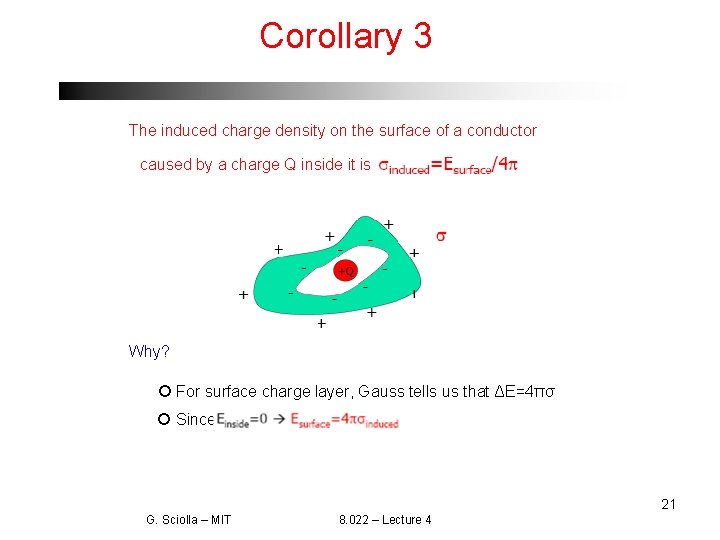
Corollary 3 The induced charge density on the surface of a conductor caused by a charge Q inside it is Why? For surface charge layer, Gauss tells us that ΔE=4πσ Since 21 G. Sciolla – MIT 8. 022 – Lecture 4
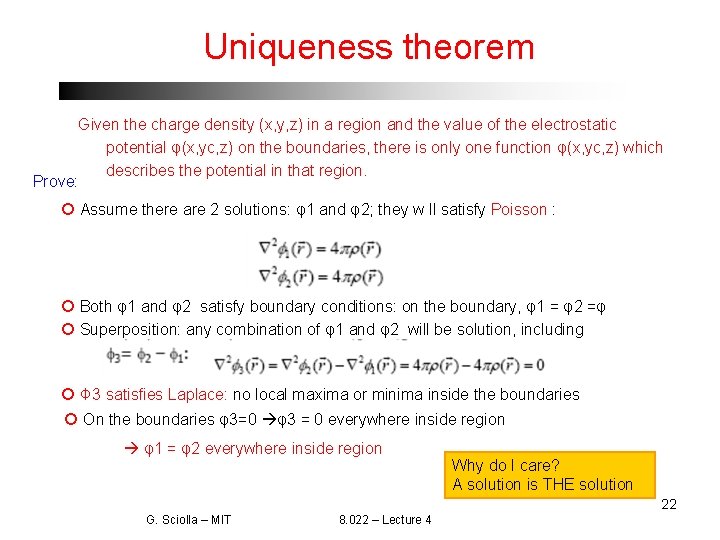
Uniqueness theorem Given the charge density (x, y, z) in a region and the value of the electrostatic potential φ(x, yc, z) on the boundaries, there is only one function φ(x, yc, z) which describes the potential in that region. Prove: Assume there are 2 solutions: φ1 and φ2; they w ll satisfy Poisson : Both φ1 and φ2 satisfy boundary conditions: on the boundary, φ1 = φ2 =φ Superposition: any combination of φ1 and φ2 will be solution, including Φ 3 satisfies Laplace: no local maxima or minima inside the boundaries On the boundaries φ3=0 φ3 = 0 everywhere inside region φ1 = φ2 everywhere inside region Why do I care? A solution is THE solution 22 G. Sciolla – MIT 8. 022 – Lecture 4
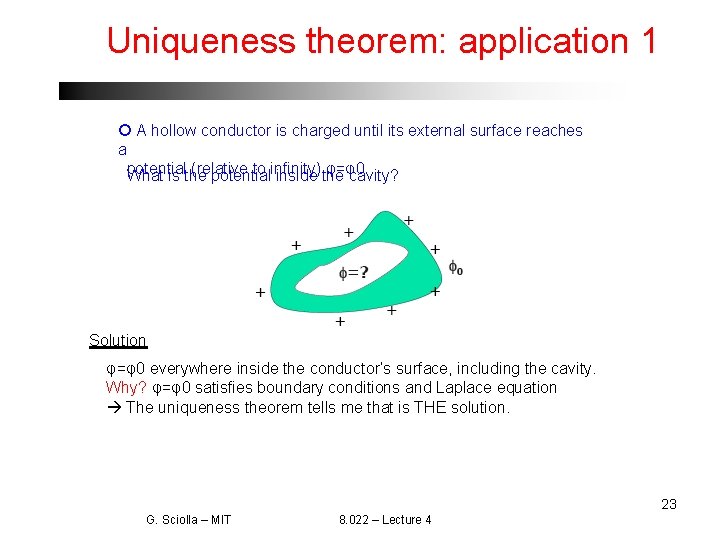
Uniqueness theorem: application 1 A hollow conductor is charged until its external surface reaches a potential (relative to infinity) φ=φ0. What is the potential inside the cavity? Solution φ=φ0 everywhere inside the conductor’s surface, including the cavity. Why? φ=φ0 satisfies boundary conditions and Laplace equation The uniqueness theorem tells me that is THE solution. 23 G. Sciolla – MIT 8. 022 – Lecture 4
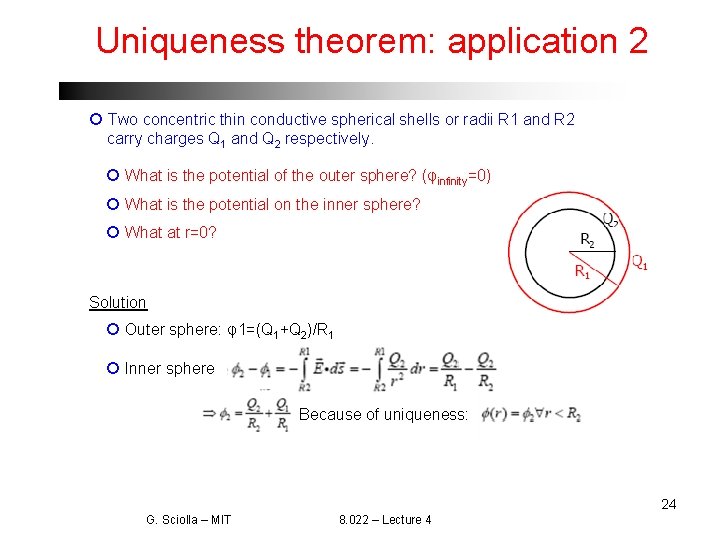
Uniqueness theorem: application 2 Two concentric thin conductive spherical shells or radii R 1 and R 2 carry charges Q 1 and Q 2 respectively. What is the potential of the outer sphere? (φinfinity=0) What is the potential on the inner sphere? What at r=0? Solution Outer sphere: φ1=(Q 1+Q 2)/R 1 Inner sphere Because of uniqueness: 24 G. Sciolla – MIT 8. 022 – Lecture 4
Next time… More on Conductors in Electrostatics Capacitors NB: All these topics are included in Quiz 1 scheduled for Tue October 5: just 2 weeks from now!!! Reminders: Lab 1 is scheduled for Tomorrow 5 -8 pm Pset 2 is due THIS Fri Sep 24 25 G. Sciolla – MIT 8. 022 – Lecture 4