
8 0 RECOMBINANT DNA TECHNOLOGY BY NUR HIDAYAH
8. 0 RECOMBINANT DNA TECHNOLOGY BY: NUR HIDAYAH MUHAMAD SALEH 8. 1 RECOMBINANT DNA TECHNOLOGY 8. 2 METHODS IN GENE CLONING 8. 3 APPLICATION OF RECOMBINANT DNA TECHNOLOGY Alba turns green 8. 4 ISOLATING when. DNAexposed to blue light Experiments 1
8. 1 RECOMBINANT DNA TECHNOLOGY At the end of this lesson, students should be able to: a) Define recombinant DNA technology b) Define and explain the tools used in recombinant DNA technology: target DNA (gene of interest), restriction enzyme, DNA cloning vector, host cell and modifying enzymes (DNA ligase). 2
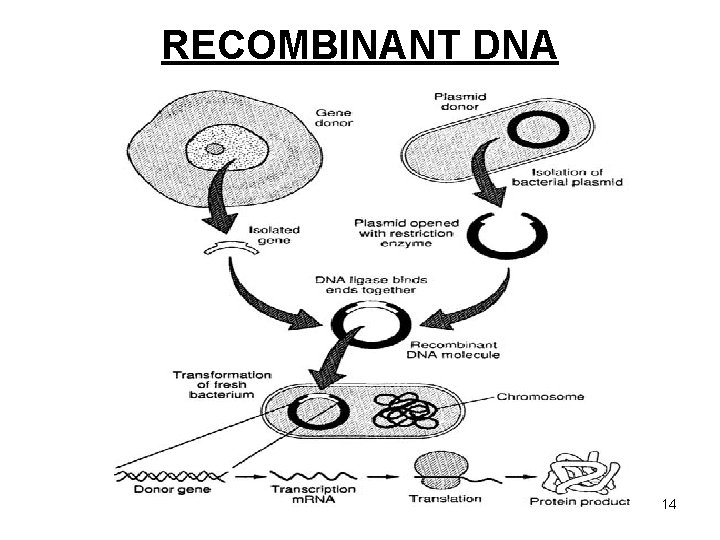
RECOMBINANT DNA (r. DNA) {Recombinant DNA refers to DNA which has been altered by joining together segments of DNA from two different sources, generally a different species. {It usually involves putting a gene from one organism into the genome of a different organism to produce new genetic combination that has commercial value or medical purpose. {Formed through laboratory method/ in vitro. {Organism that have had a foreign gene 3
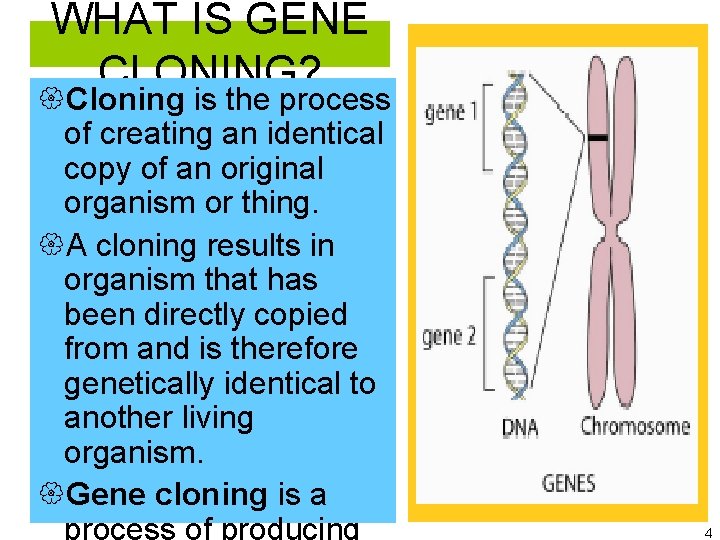
WHAT IS GENE CLONING? {Cloning is the process of creating an identical copy of an original organism or thing. {A cloning results in organism that has been directly copied from and is therefore genetically identical to another living organism. {Gene cloning is a process of producing 4
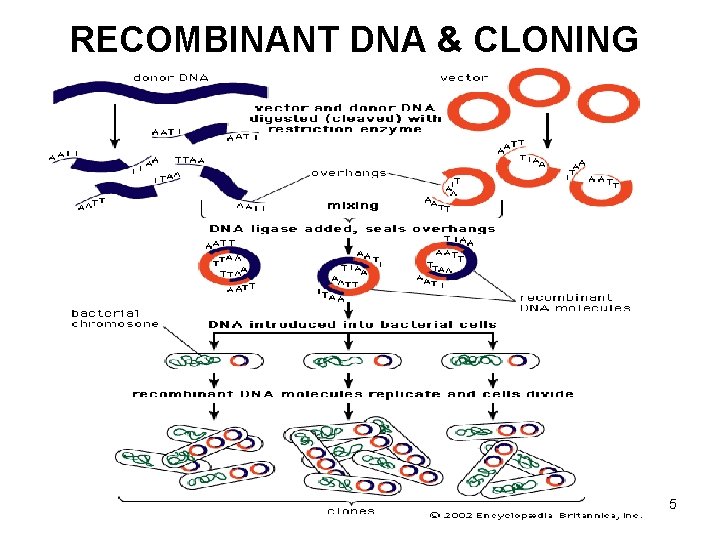
RECOMBINANT DNA & CLONING 5
TOOLS IN RECOMBINANT DNA TECHNOLOGY 1) Target DNA (gene of interest) 2) Restriction enzymes 3) DNA cloning vector – Plasmid 4) Host cell – E. coli 5) Modifying enyzmes –DNA ligase 6
1) TARGET DNA • Target DNA containing gene of interest • The gene encode for the desired product or introduce desirable traits into an organism 7
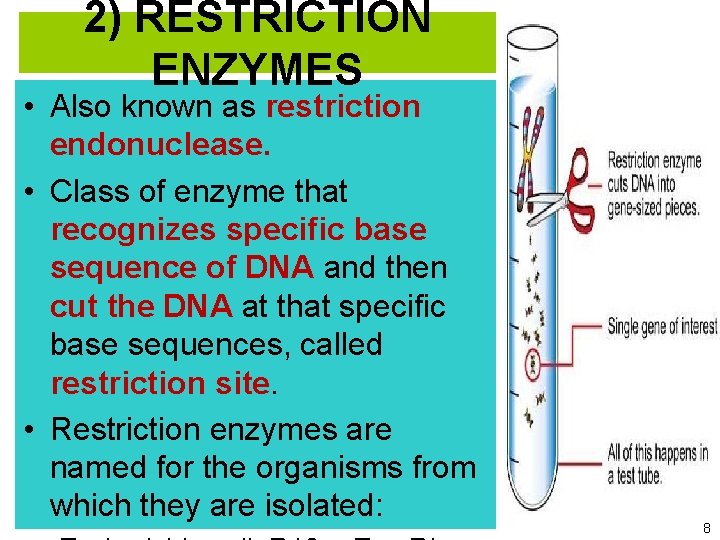
2) RESTRICTION ENZYMES • Also known as restriction endonuclease. • Class of enzyme that recognizes specific base sequence of DNA and then cut the DNA at that specific base sequences, called restriction site. • Restriction enzymes are named for the organisms from which they are isolated: 8
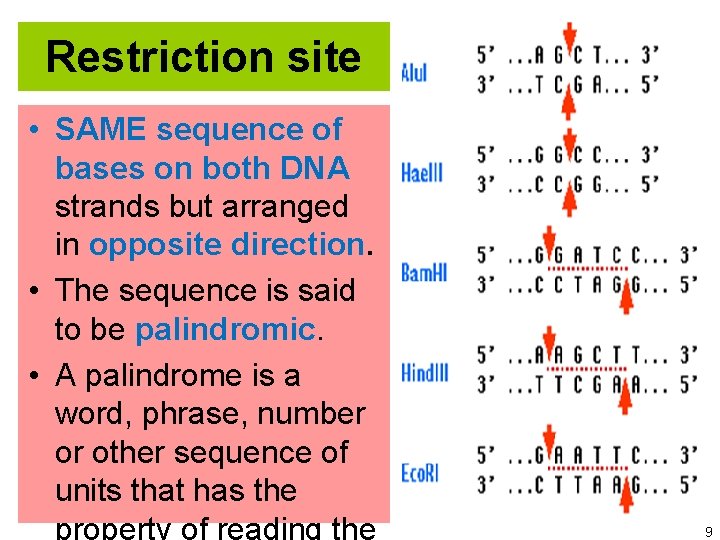
Restriction site • SAME sequence of bases on both DNA strands but arranged in opposite direction. • The sequence is said to be palindromic. • A palindrome is a word, phrase, number or other sequence of units that has the property of reading the 9
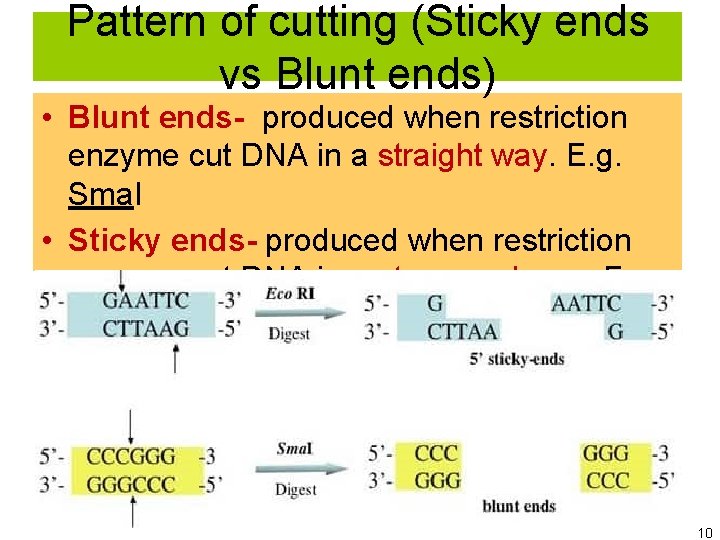
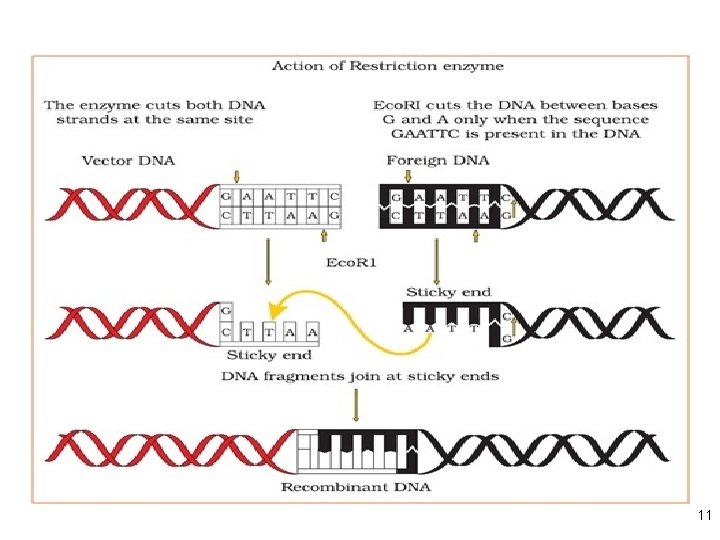
Pattern of cutting (Sticky ends vs Blunt ends) • Blunt ends- produced when restriction enzyme cut DNA in a straight way. E. g. Sma. I • Sticky ends- produced when restriction enzyme cut DNA in a staggered way. E. g. Eco. R 1 10
11
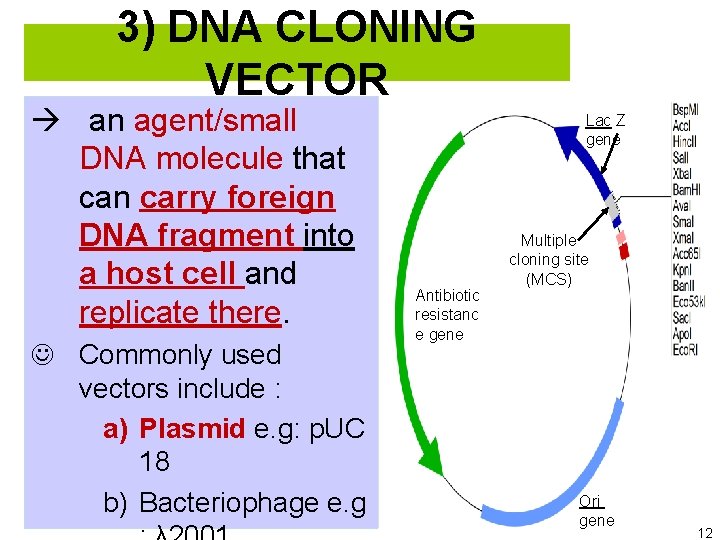
3) DNA CLONING VECTOR an agent/small DNA molecule that can carry foreign DNA fragment into a host cell and replicate there. J Commonly used vectors include : a) Plasmid e. g: p. UC 18 b) Bacteriophage e. g Lac Z gene Antibiotic resistanc e gene Multiple cloning site (MCS) Ori gene 12
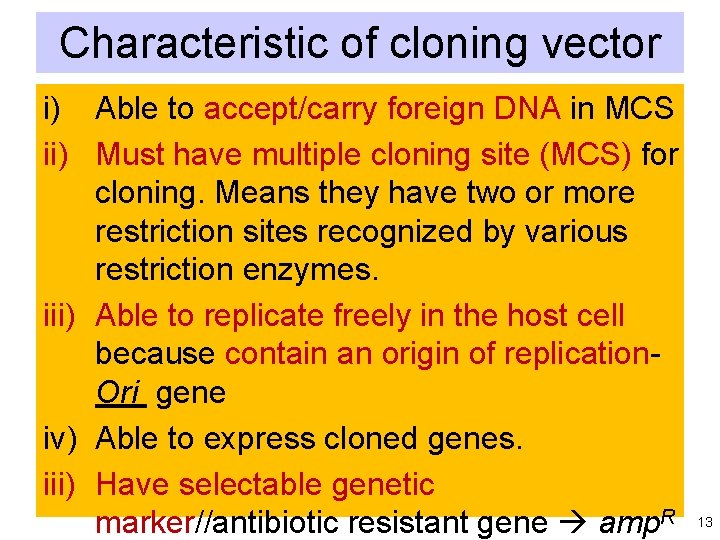
Characteristic of cloning vector i) Able to accept/carry foreign DNA in MCS ii) Must have multiple cloning site (MCS) for cloning. Means they have two or more restriction sites recognized by various restriction enzymes. iii) Able to replicate freely in the host cell because contain an origin of replication. Ori gene iv) Able to express cloned genes. iii) Have selectable genetic marker//antibiotic resistant gene amp. R 13
RECOMBINANT DNA 14
4) Host cell • An organism that can serve as living host for replication and expression of recombinant DNA (r. DNA). • The organism that can act for this function is bacteria (E. coli ), animal, plant cell, yeast. • Must able to accept foreign DNA, that is the cloning vectors carrying the target gene, and allows the vectors to multiply. 15
CHARACTERISTICS OF HOST CELL BACTERIA i) iii) iv) v) vi) Able to receive recombinant DNA through the transformation process Able to maintain the structure of recombinant DNA from one generation to the next generation. Able to amplify/ multiply the gene product from recombinant DNA. Able to express the gene of interest Relatively larger than DNA cloning vector Antibiotic sensitive 16
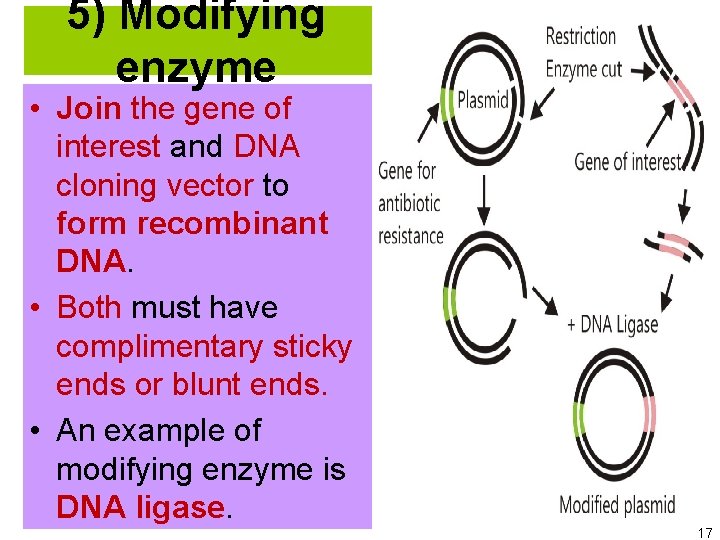
5) Modifying enzyme • Join the gene of interest and DNA cloning vector to form recombinant DNA. • Both must have complimentary sticky ends or blunt ends. • An example of modifying enzyme is DNA ligase. 17
8. 2 METHODS IN GENE CLONING At the end of this lesson, students should be able to: • Overview using diagram to show the steps in gene cloning by using plasmid as the vector. 18
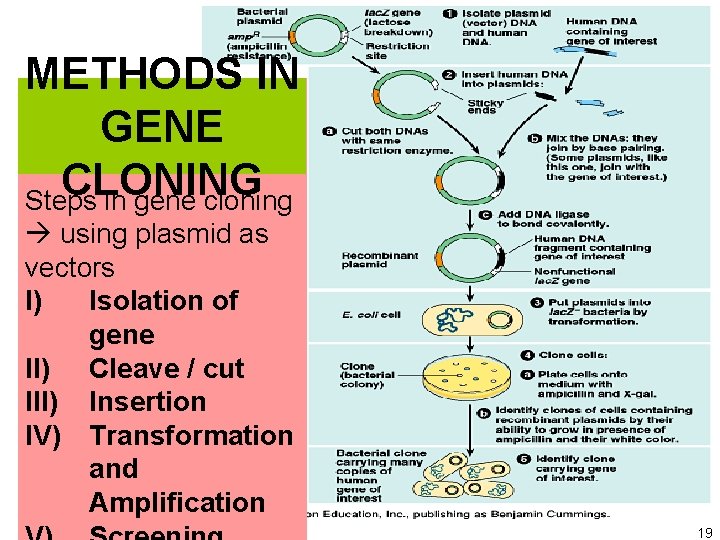
METHODS IN GENE CLONING Steps in gene cloning using plasmid as vectors I) Isolation of gene II) Cleave / cut III) Insertion IV) Transformation and Amplification 19
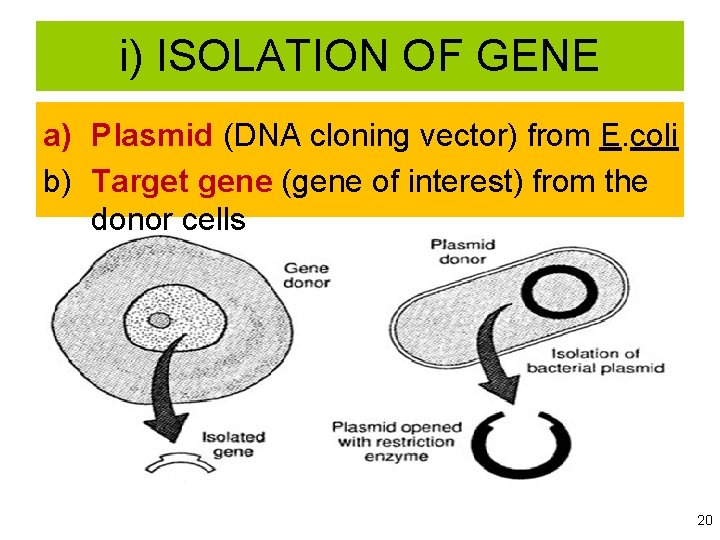
i) ISOLATION OF GENE a) Plasmid (DNA cloning vector) from E. coli b) Target gene (gene of interest) from the donor cells 20
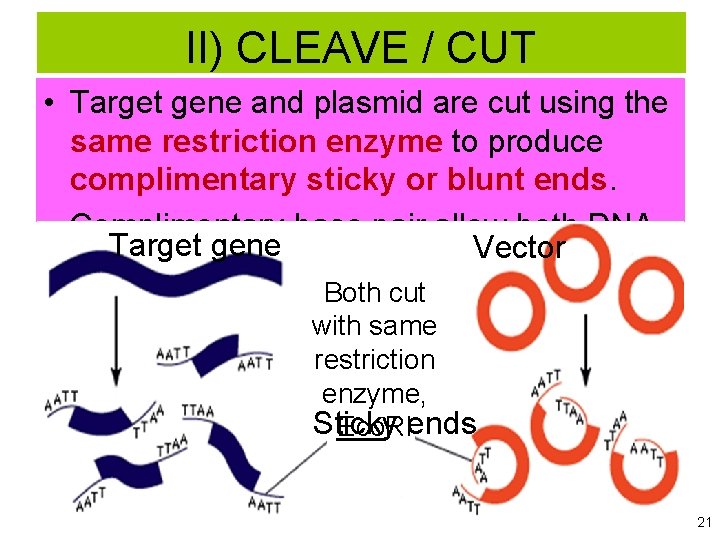
II) CLEAVE / CUT • Target gene and plasmid are cut using the same restriction enzyme to produce complimentary sticky or blunt ends. • Complimentary base pair allow both DNA Target gene Vector to ligate/ join. Both cut with same restriction enzyme, Sticky Eco. RIends 21
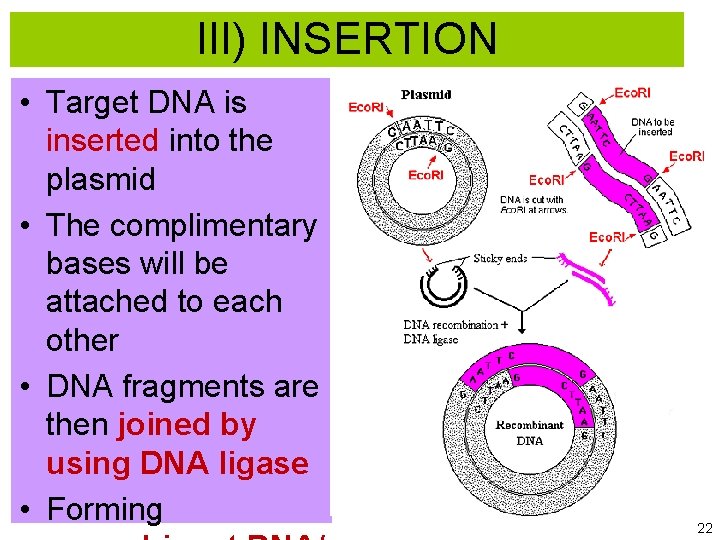
III) INSERTION • Target DNA is inserted into the plasmid • The complimentary bases will be attached to each other • DNA fragments are then joined by using DNA ligase • Forming 22
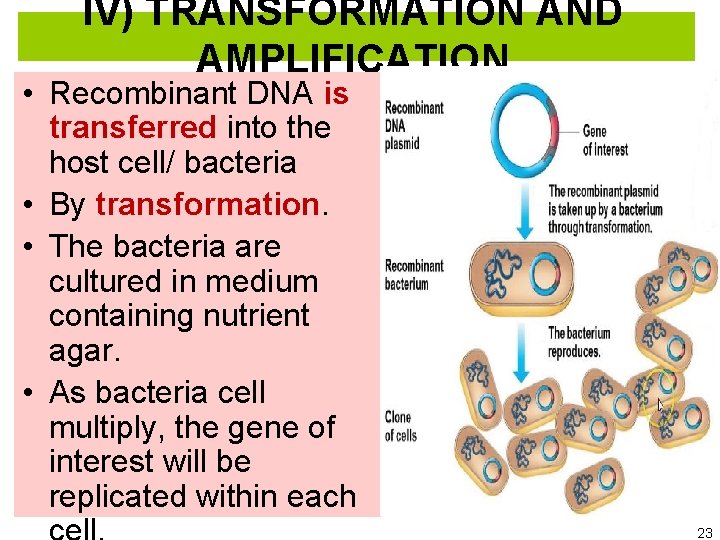
IV) TRANSFORMATION AND AMPLIFICATION • Recombinant DNA is transferred into the host cell/ bacteria • By transformation. • The bacteria are cultured in medium containing nutrient agar. • As bacteria cell multiply, the gene of interest will be replicated within each 23
IV) TRANSFORMATION AND AMPLIFICATION SOMEHOW. . • Not all the plasmids will have taken up the intended foreign DNA • Not all the bacteria will have taken in plasmid There are 3 possible types of bacteria: i. Bacteria that do not take up any plasmid ii. Bacteria that take up non recombinant plasmid iii. Bacteria that take up recombinant plasmid 24
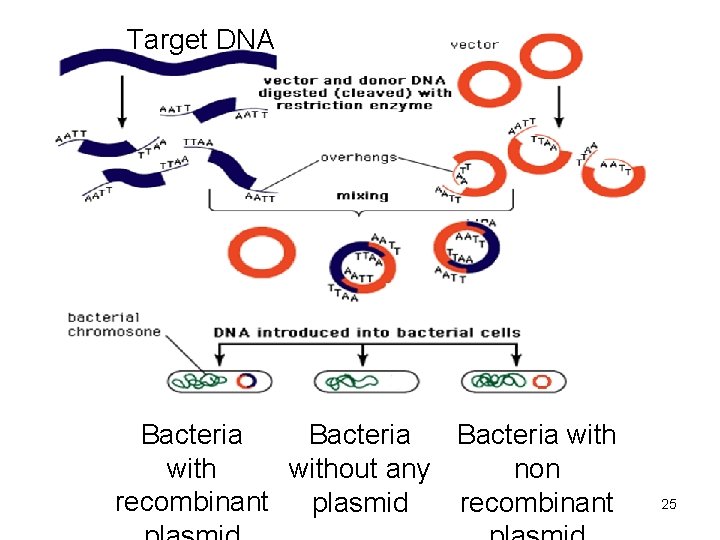
Target DNA Bacteria without any non recombinant plasmid recombinant 25
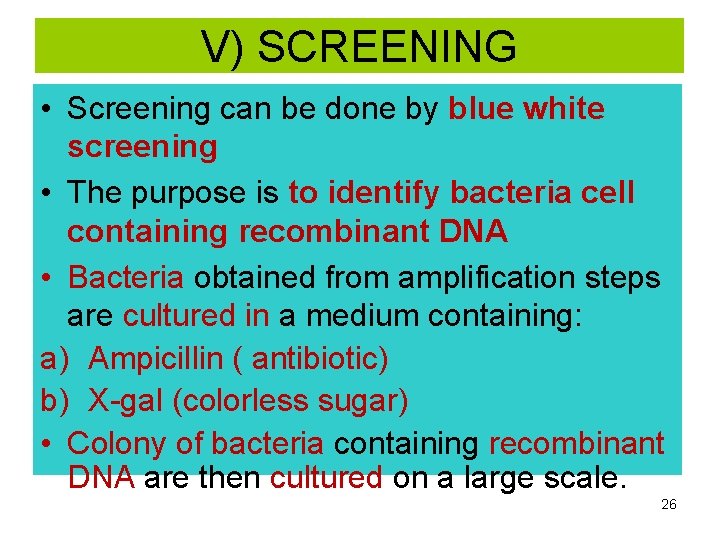
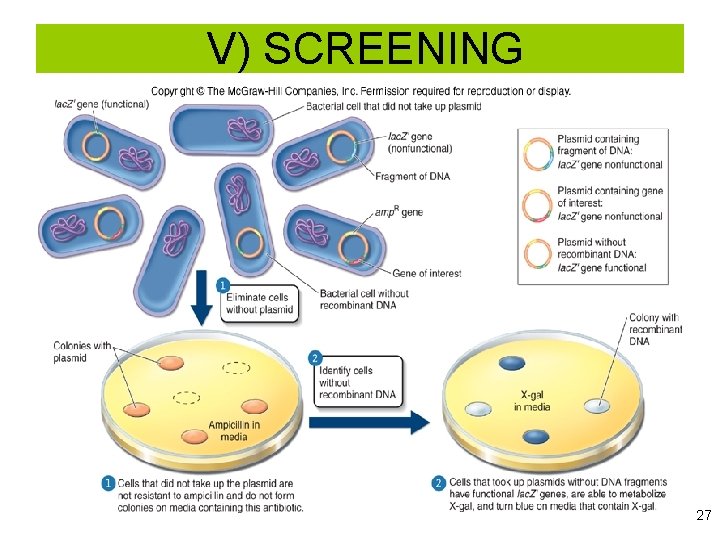
V) SCREENING • Screening can be done by blue white screening • The purpose is to identify bacteria cell containing recombinant DNA • Bacteria obtained from amplification steps are cultured in a medium containing: a) Ampicillin ( antibiotic) b) X-gal (colorless sugar) • Colony of bacteria containing recombinant DNA are then cultured on a large scale. 26
V) SCREENING 27
BLUE/WHITE SCREENING WHY AMPICILLIN? - Antibiotic that normally kills the bacteria - Bacteria that take up plasmid will be able to grow and form colonies on the medium because plasmid have ampicillin resistant gene. WHY X-GAL? - The bacteria that contain plasmids with intact lac. Z gene (do not carry target gene) are able to produce β- galactosidase which can hydrolyze X-gal, produce a compound which make colony blue. 28

Plasmid before and after insertion of target DNA 29
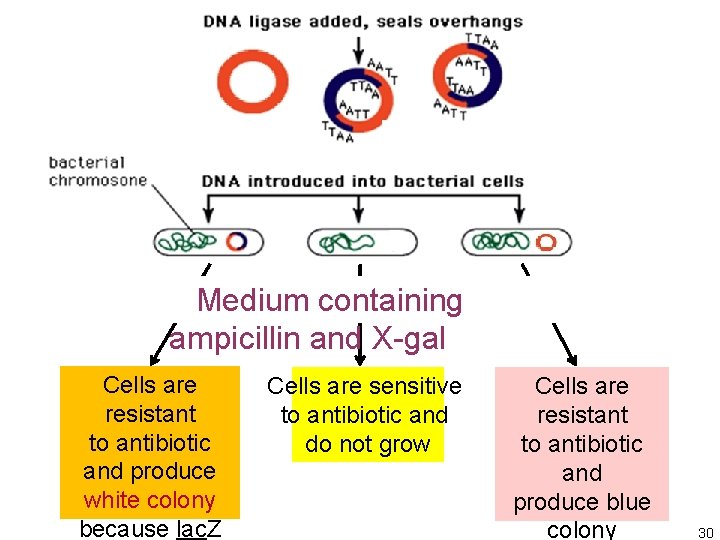
Medium containing ampicillin and X-gal Cells are resistant to antibiotic and produce white colony because lac. Z Cells are sensitive to antibiotic and do not grow Cells are resistant to antibiotic and produce blue colony 30

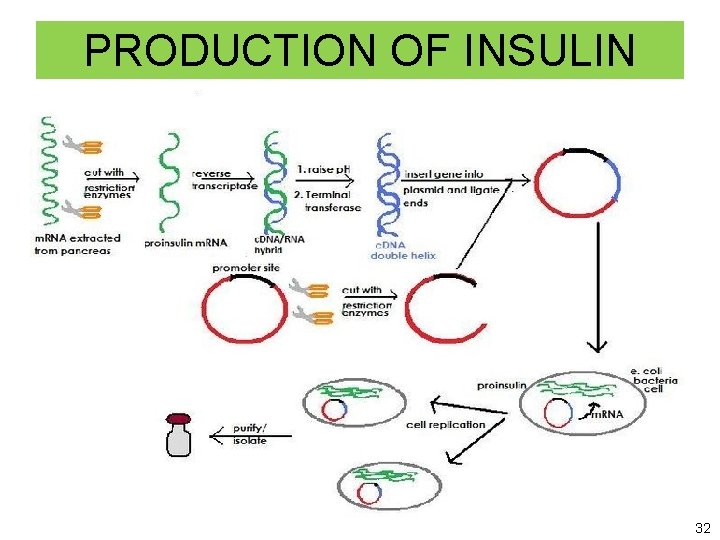
8. 3 APPLICATION OF RECOMBINANT DNA TECHNOLOGY At the end of this lesson, students should be able to: • Briefly explain applications of recombinant DNA technology in mass production of insulin using c. DNA. 31
PRODUCTION OF INSULIN 32
REVERSE TRANSCRIPTION 33
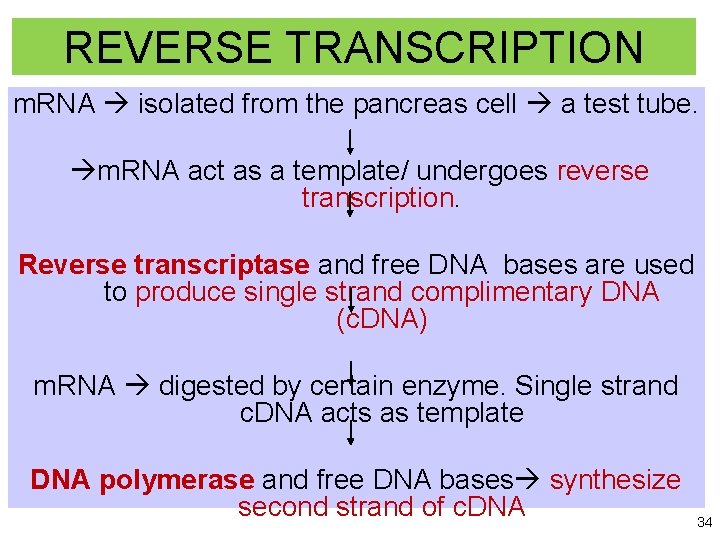
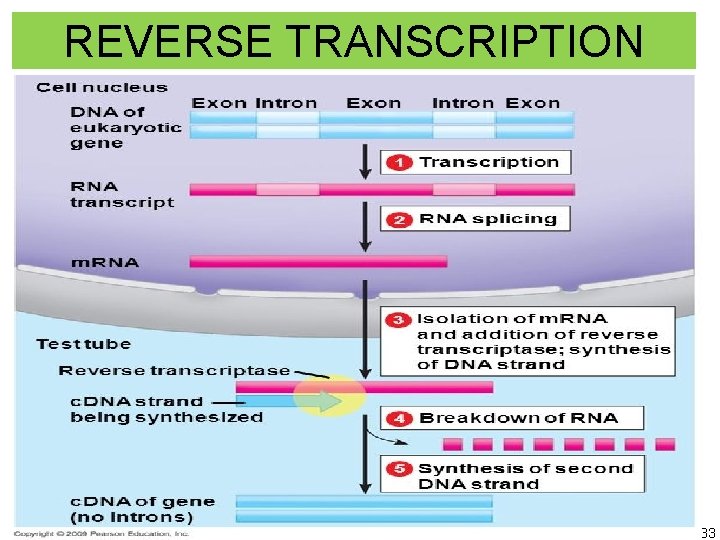
REVERSE TRANSCRIPTION m. RNA isolated from the pancreas cell a test tube. m. RNA act as a template/ undergoes reverse transcription. Reverse transcriptase and free DNA bases are used to produce single strand complimentary DNA (c. DNA) m. RNA digested by certain enzyme. Single strand c. DNA acts as template DNA polymerase and free DNA bases synthesize second strand of c. DNA 34
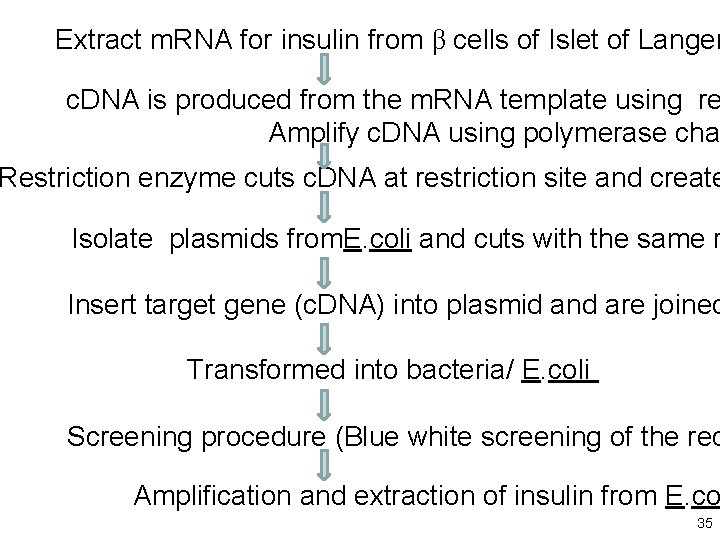
Extract m. RNA for insulin from β cells of Islet of Langer c. DNA is produced from the m. RNA template using re Amplify c. DNA using polymerase cha Restriction enzyme cuts c. DNA at restriction site and create Isolate plasmids from. E. coli and cuts with the same r Insert target gene (c. DNA) into plasmid and are joined Transformed into bacteria/ E. coli Screening procedure (Blue white screening of the rec Amplification and extraction of insulin from E. co 35
- Slides: 35