
7e 77e 7e Power Point Author Catherine Lumbattis
7/e 77/e /7/e Power. Point Author: Catherine Lumbattis COPYRIGHT © 2011 South-Western/Cengage Learning 1
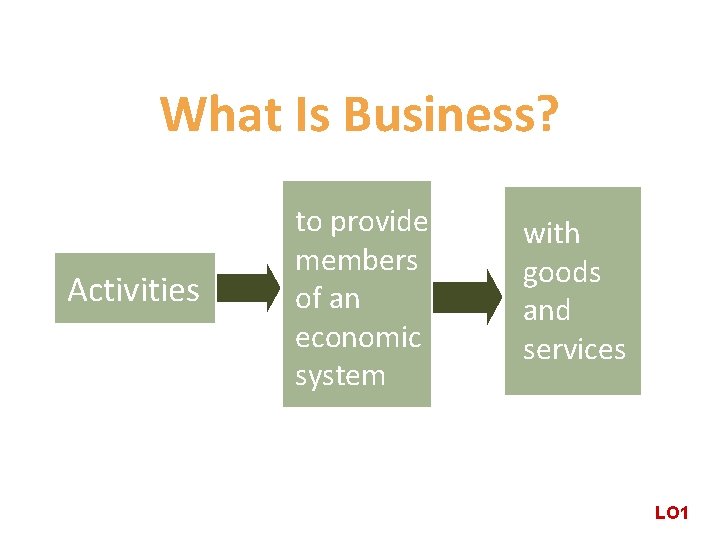
What Is Business? Activities to provide members of an economic system with goods and services LO 1
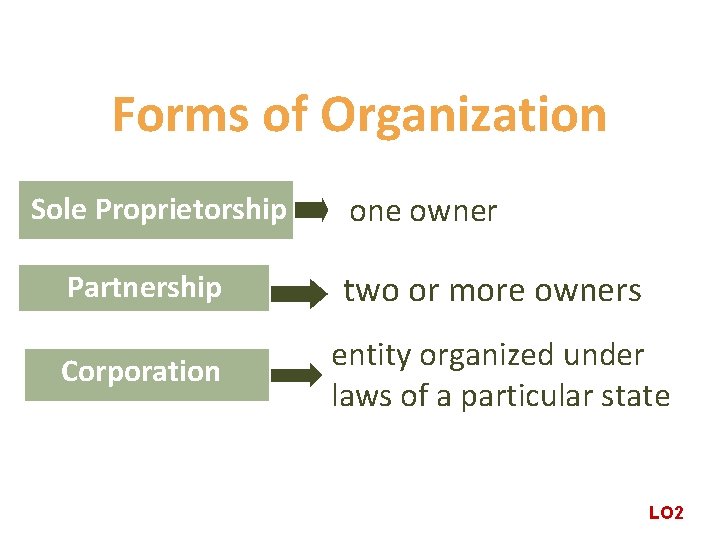
Forms of Organization Sole Proprietorship one owner Partnership two or more owners Corporation entity organized under laws of a particular state LO 2
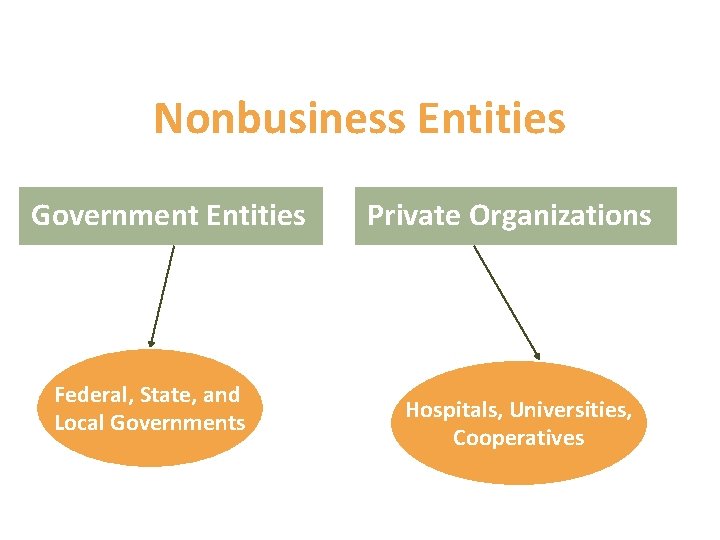
Nonbusiness Entities Government Entities Federal, State, and Local Governments Private Organizations Hospitals, Universities, Cooperatives

The Nature of Business Activity Financing Activities Investing Activities Operating Activities Examples: • borrowing • sale of stock • purchase of assets • sale of products/services • costs incurred to operate business LO 3
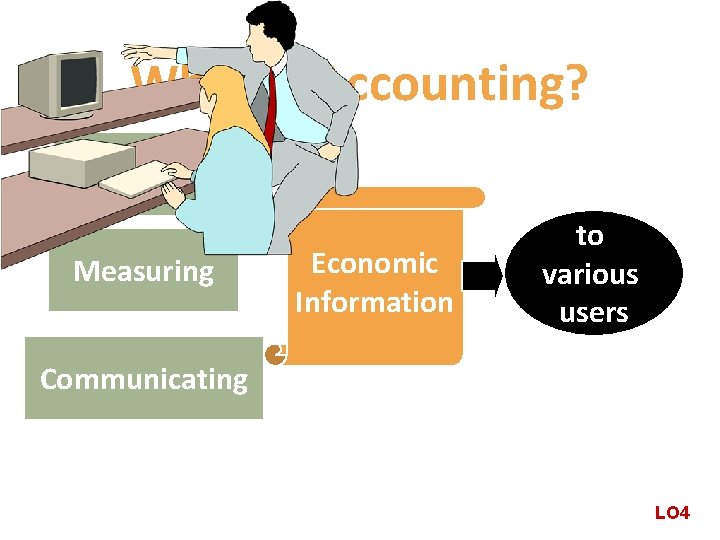
What Is Accounting? Identifying Measuring Economic Information to various users Communicating LO 4
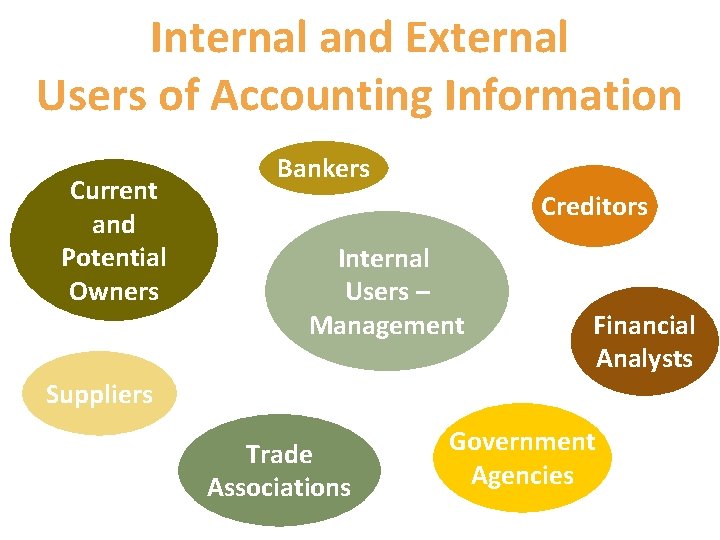
Internal and External Users of Accounting Information Current and Potential Owners Bankers Creditors Internal Users – Management Financial Analysts Suppliers Trade Associations Government Agencies
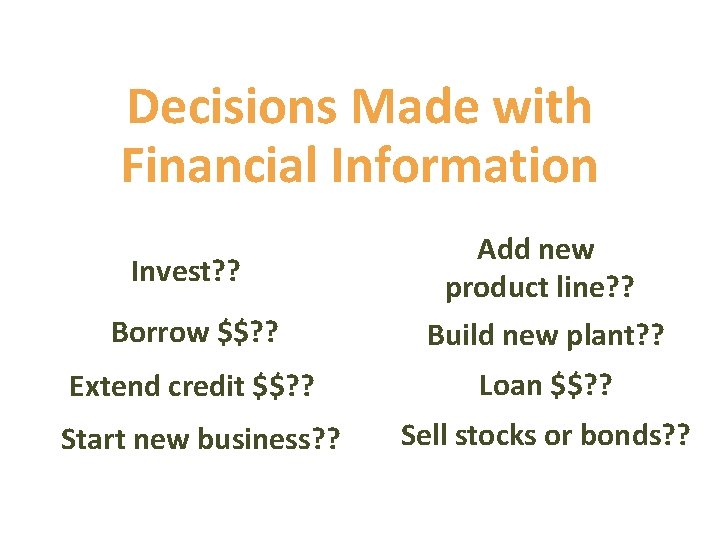
Decisions Made with Financial Information Invest? ? Add new product line? ? Borrow $$? ? Build new plant? ? Extend credit $$? ? Loan $$? ? Start new business? ? Sell stocks or bonds? ?
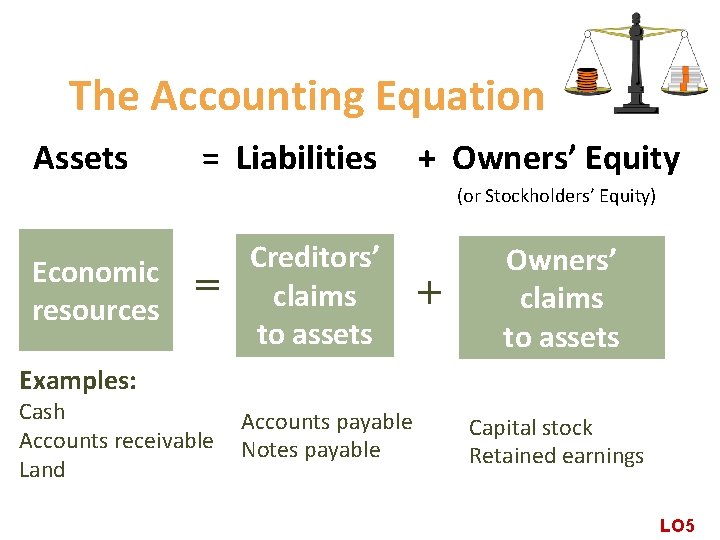
The Accounting Equation Assets = Liabilities + Owners’ Equity (or Stockholders’ Equity) Economic resources = Creditors’ claims to assets + Owners’ claims to assets Examples: Cash Accounts receivable Land Accounts payable Notes payable Capital stock Retained earnings LO 5
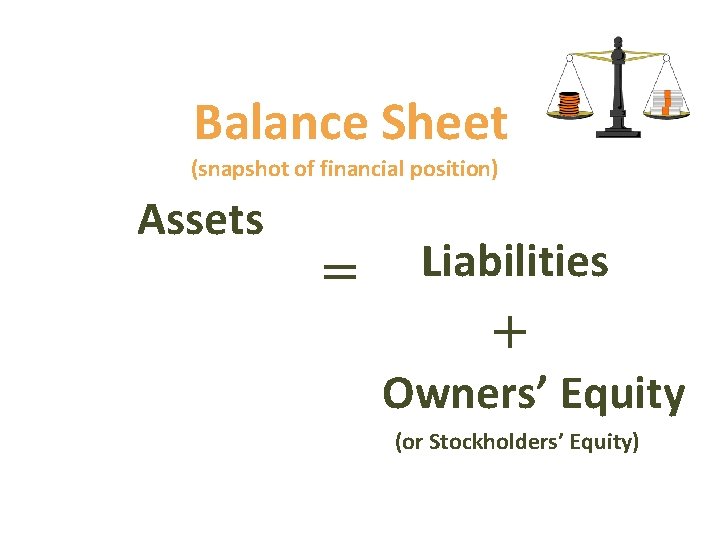
Balance Sheet (snapshot of financial position) Assets = Liabilities + Owners’ Equity (or Stockholders’ Equity)
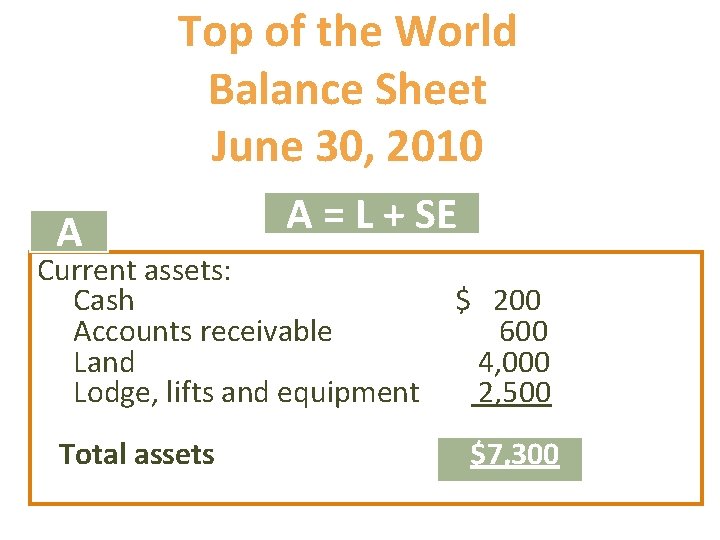
Top of the World Balance Sheet June 30, 2010 A A = L + SE Current assets: Cash Accounts receivable Land Lodge, lifts and equipment Total assets $ 200 600 4, 000 2, 500 $7, 300
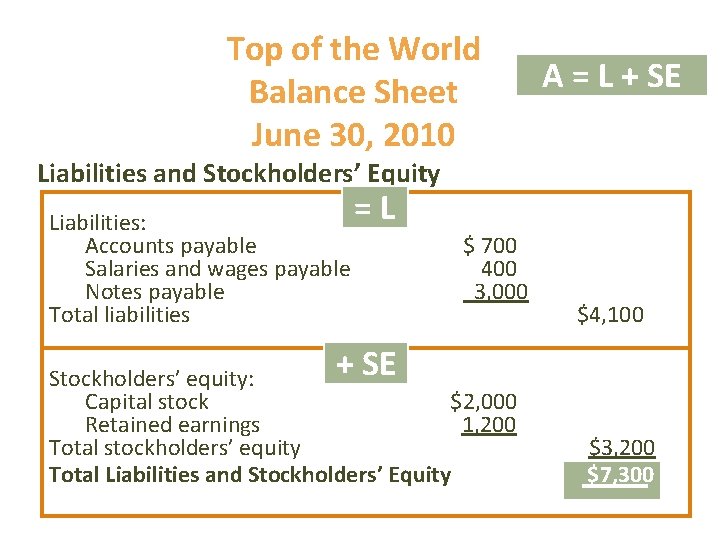
Top of the World Balance Sheet June 30, 2010 A = L + SE Liabilities and Stockholders’ Equity = Liabilities: Accounts payable Salaries and wages payable Notes payable Total liabilities L $ 700 400 3, 000 + SE Stockholders’ equity: Capital stock $2, 000 Retained earnings 1, 200 Total stockholders’ equity Total Liabilities and Stockholders’ Equity $4, 100 $3, 200 $7, 300
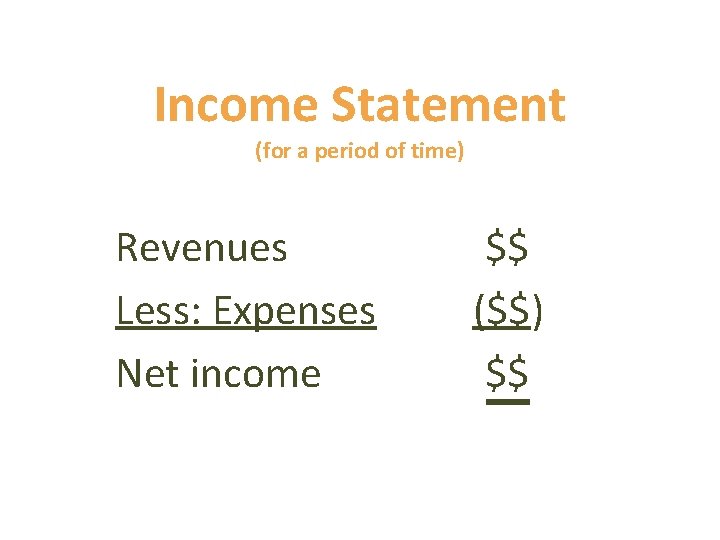
Income Statement (for a period of time) Revenues Less: Expenses Net income $$ ($$) $$
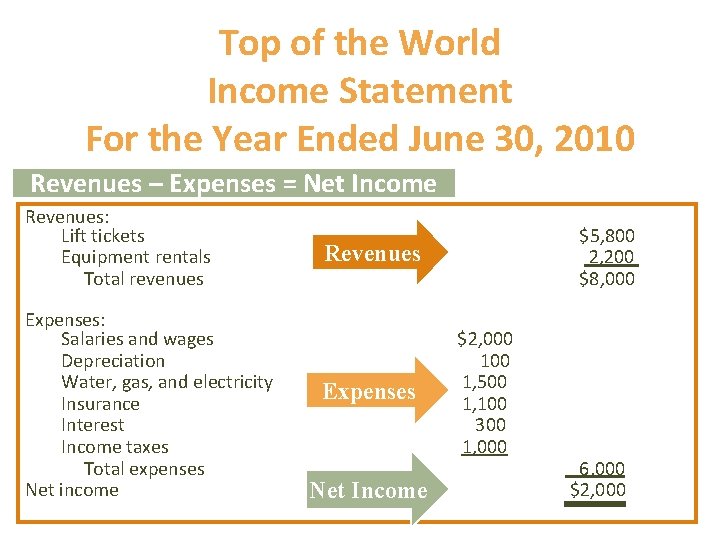
Top of the World Income Statement For the Year Ended June 30, 2010 Revenues – Expenses = Net Income Revenues: Lift tickets Equipment rentals Total revenues Expenses: Salaries and wages Depreciation Water, gas, and electricity Insurance Interest Income taxes Total expenses Net income $5, 800 2, 200 $8, 000 Revenues Expenses Net Income $2, 000 1, 500 1, 100 300 1, 000 6, 000 $2, 000
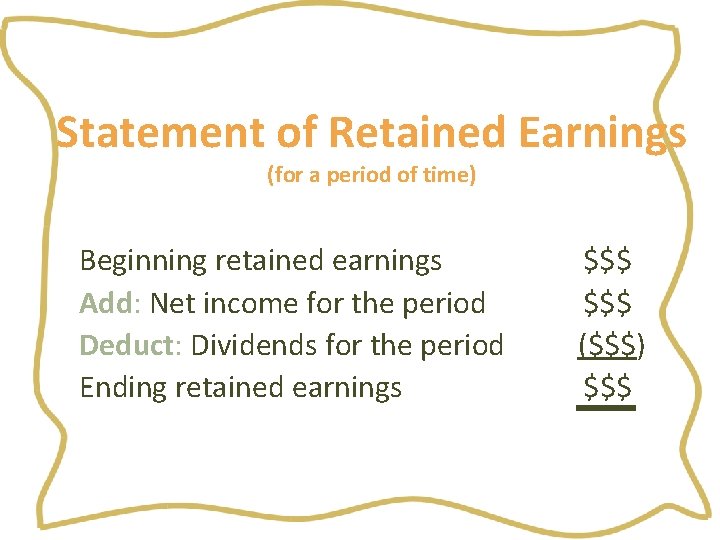
Statement of Retained Earnings (for a period of time) Beginning retained earnings Add: Net income for the period Deduct: Dividends for the period Ending retained earnings $$$ ($$$) $$$
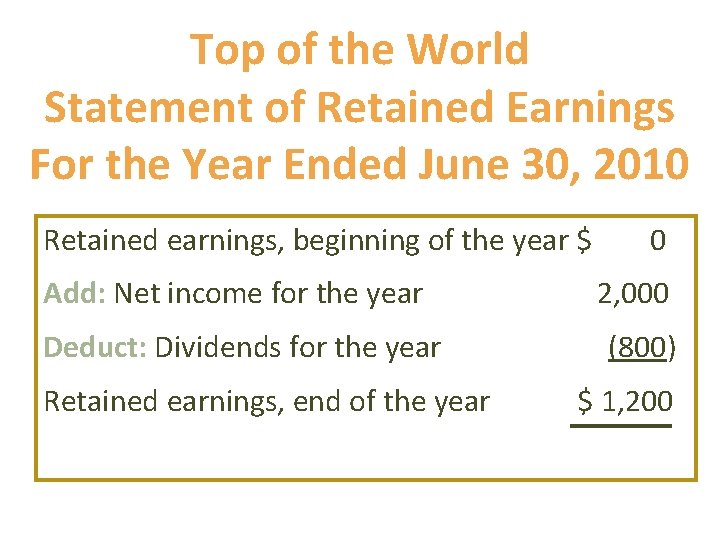
Top of the World Statement of Retained Earnings For the Year Ended June 30, 2010 Retained earnings, beginning of the year $ 0 Add: Net income for the year 2, 000 Deduct: Dividends for the year (800) Retained earnings, end of the year $ 1, 200
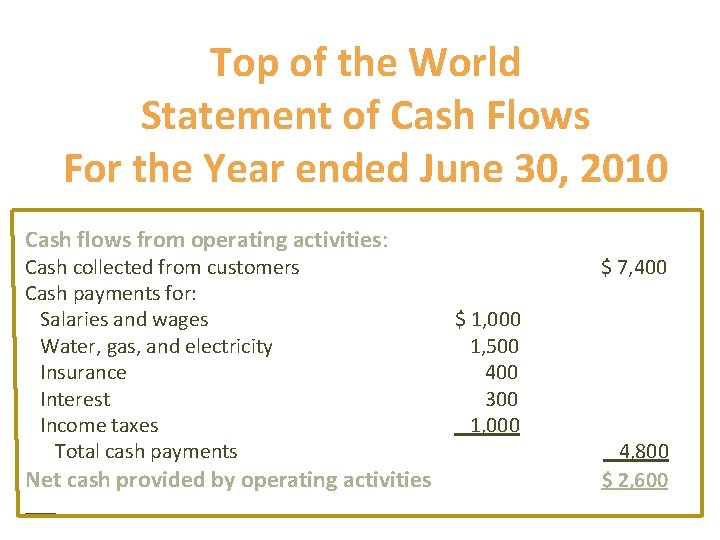
Top of the World Statement of Cash Flows For the Year ended June 30, 2010 Cash flows from operating activities: Cash collected from customers Cash payments for: Salaries and wages Water, gas, and electricity Insurance Interest Income taxes Total cash payments Net cash provided by operating activities $ 7, 400 $ 1, 000 1, 500 400 300 1, 000 4, 800 $ 2, 600
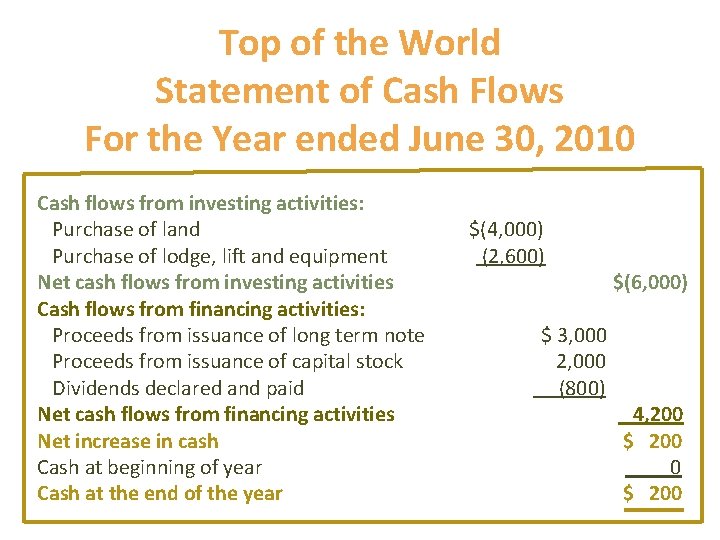
Top of the World Statement of Cash Flows For the Year ended June 30, 2010 Cash flows from investing activities: Purchase of land Purchase of lodge, lift and equipment Net cash flows from investing activities Cash flows from financing activities: Proceeds from issuance of long term note Proceeds from issuance of capital stock Dividends declared and paid Net cash flows from financing activities Net increase in cash Cash at beginning of year Cash at the end of the year $(4, 000) (2, 600) $ 3, 000 2, 000 (800) $(6, 000) 4, 200 $ 200
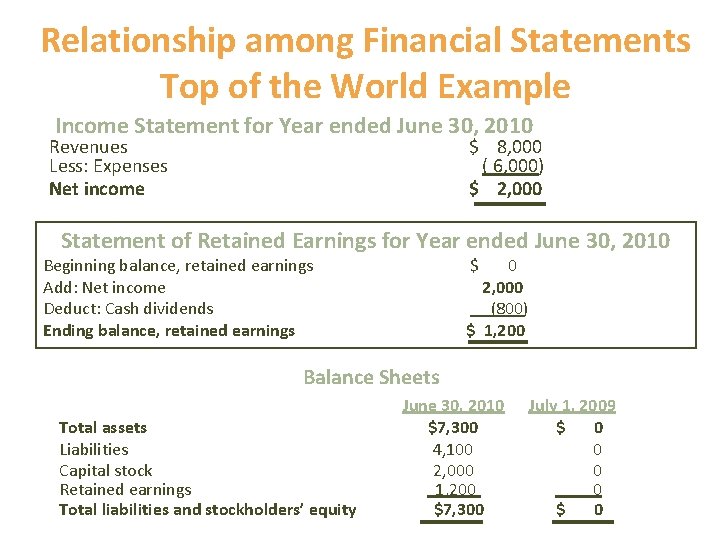
Relationship among Financial Statements Top of the World Example Income Statement for Year ended June 30, 2010 Revenues Less: Expenses Net income $ 8, 000 ( 6, 000) $ 2, 000 Statement of Retained Earnings for Year ended June 30, 2010 Beginning balance, retained earnings Add: Net income Deduct: Cash dividends Ending balance, retained earnings $ 0 2, 000 (800) $ 1, 200 Balance Sheets Total assets Liabilities Capital stock Retained earnings Total liabilities and stockholders’ equity June 30, 2010 $7, 300 4, 100 2, 000 1, 200 $7, 300 July 1, 2009 $ 0 0 $ 0
The Conceptual Framework: Foundation for Financial Statements v Aids accountants in their role as interpreters and communicators of relevant information v Acts as a foundation for the specific principles and standards needed by the profession LO 6
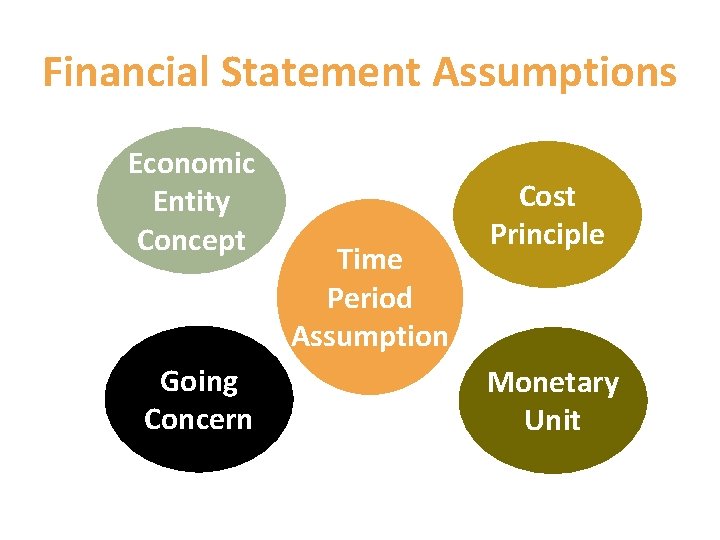
Financial Statement Assumptions Economic Entity Concept Going Concern Time Period Assumption Cost Principle Monetary Unit
Economic Entity Concept v Each entity has its own books, records, and financial statements that are separate from owners v No intermingling of personal and business assets and liabilities or income and expenses
Cost Principle v. Record assets at cost paid to acquire them v. Continue to value assets at historical cost until sold v. More objective than market value
Going Concern v. Assume business will continue indefinitely into the future v. Justifies use of historical cost
Monetary Unit v How we measure amounts in the financial statements (e. g. , U. S. dollar, Japanese yen, Mexican peso, etc. ) v Assumes economic measure is relatively stable; no adjustment for inflation made in financial statements
Generally Accepted Accounting Principles v The various methods, rules, practices and other procedures that have evolved over time that regulates the preparation of financial statements
Accounting as a Social Science v Accounting is a service activity v Accounting is a social science, not a physical science v Accounting principles develop in response to changing business conditions
The Rules of the Game v The rules Þ GAAP v The rule makers Þ FASB v The rule enforcers Þ SEC v The CPA regulators Þ AICPA LO 7
International Accounting Standards v. International Accounting Standards Board was created in 2001 v. There may be significant differences between U. S. and international standards
Auditing v. Financial statements are prepared by and are the responsibility of the company’s management v. External auditors performs tests and procedures to render an opinion as to the financial statements are fairly presented
Ethics in Accounting 1. Identify the ethical dilemma 2. Analyze key elements 3. Determine the alternatives 4. Resolve by selecting ethical alternative LO 8
The Changing Face of the Accounting Profession A “financial reporting crisis” caused by: v Enron: the omission of entities from the financial statements v World. Com: treating costs as assets rather than expenses causing higher net income
Sarbanes-Oxley Act Provisions of the act: v Established the Public Company Accounting Oversight Board v Required external auditors to report directly to the company’s audit committee v Prohibits external auditors from providing other services compromising independence

End of Chapter 1
- Slides: 34