
74 419 Artificial Intelligence 2004 Speech Natural Language

- Slides: 30
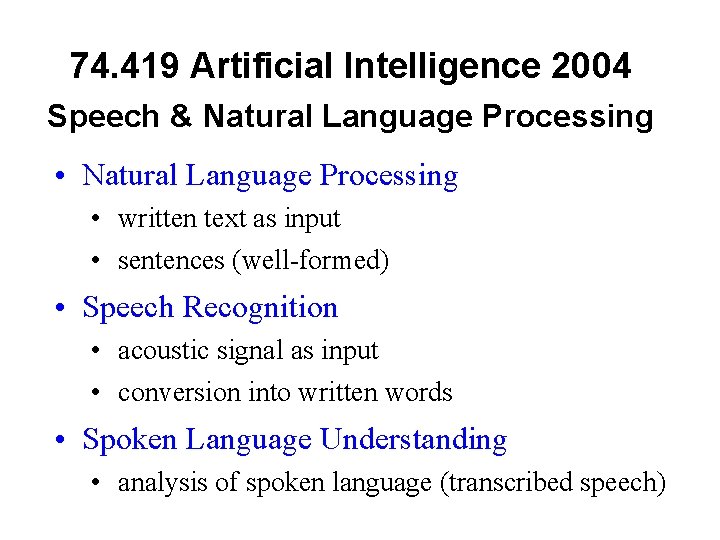
74. 419 Artificial Intelligence 2004 Speech & Natural Language Processing • Natural Language Processing • written text as input • sentences (well-formed) • Speech Recognition • acoustic signal as input • conversion into written words • Spoken Language Understanding • analysis of spoken language (transcribed speech)
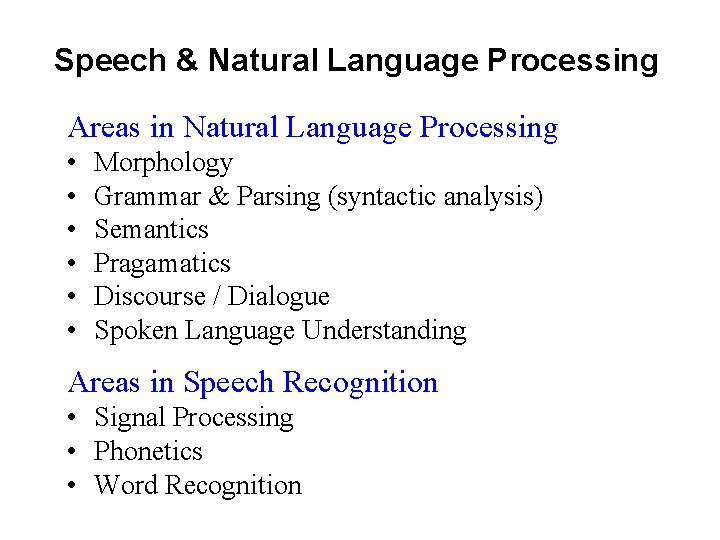
Speech & Natural Language Processing Areas in Natural Language Processing • • • Morphology Grammar & Parsing (syntactic analysis) Semantics Pragamatics Discourse / Dialogue Spoken Language Understanding Areas in Speech Recognition • Signal Processing • Phonetics • Word Recognition
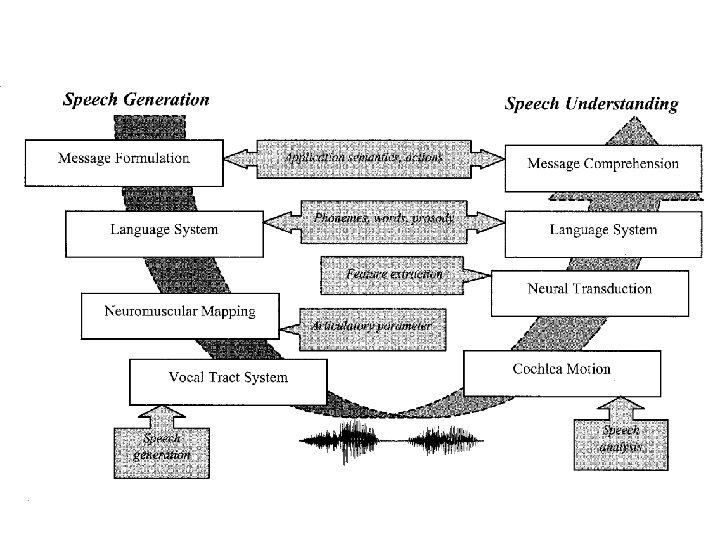
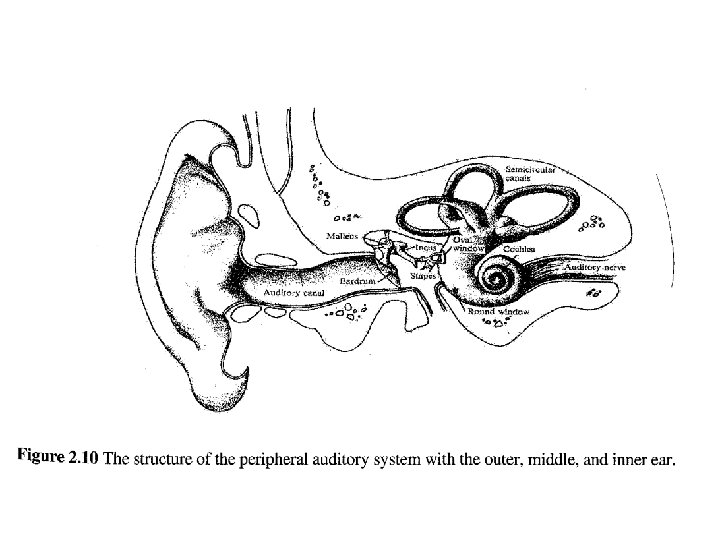
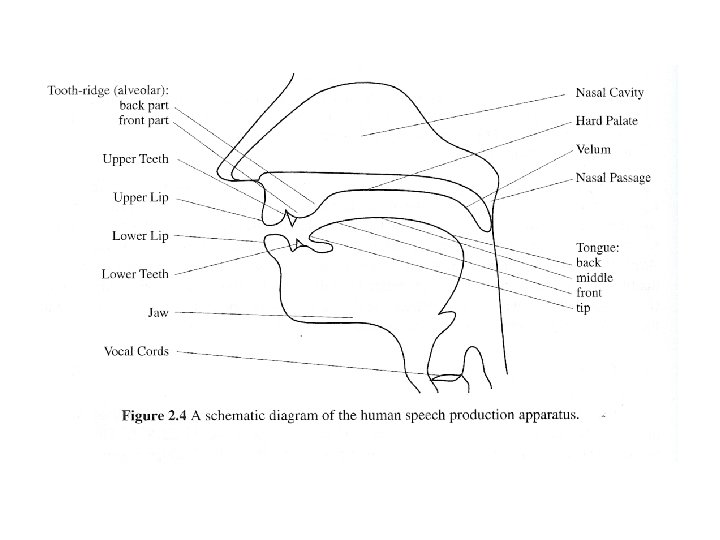
Speech Production & Reception Sound and Hearing • change in air pressure sound wave • reception through inner ear membrane / microphone • break-up into frequency components: receptors in cochlea / mathematical frequency analysis (e. g. Fast-Fourier Transform FFT) Frequency Spectrum • perception/recognition of phonemes and subsequently words (e. g. Neural Networks, Hidden-Markov Models)
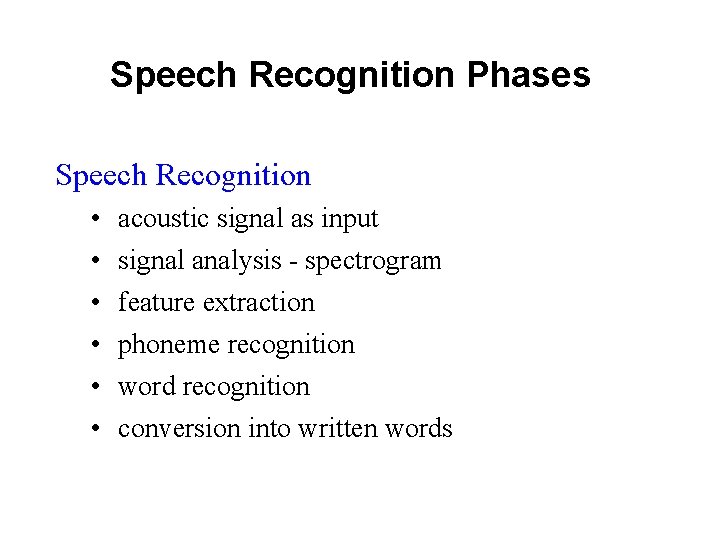
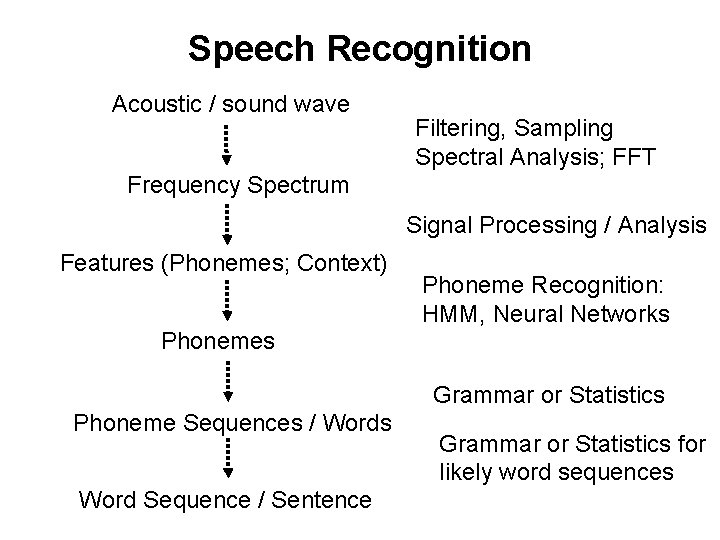
Speech Recognition Phases Speech Recognition • • • acoustic signal as input signal analysis - spectrogram feature extraction phoneme recognition word recognition conversion into written words
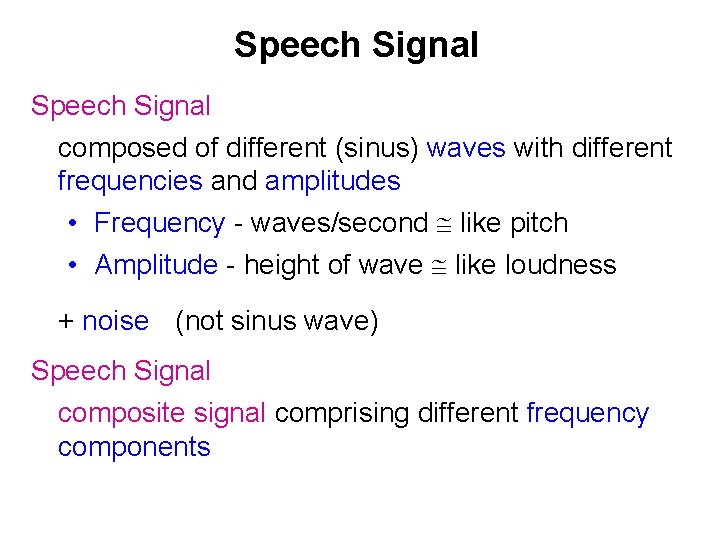
Speech Signal composed of different (sinus) waves with different frequencies and amplitudes • Frequency - waves/second like pitch • Amplitude - height of wave like loudness + noise (not sinus wave) Speech Signal composite signal comprising different frequency components
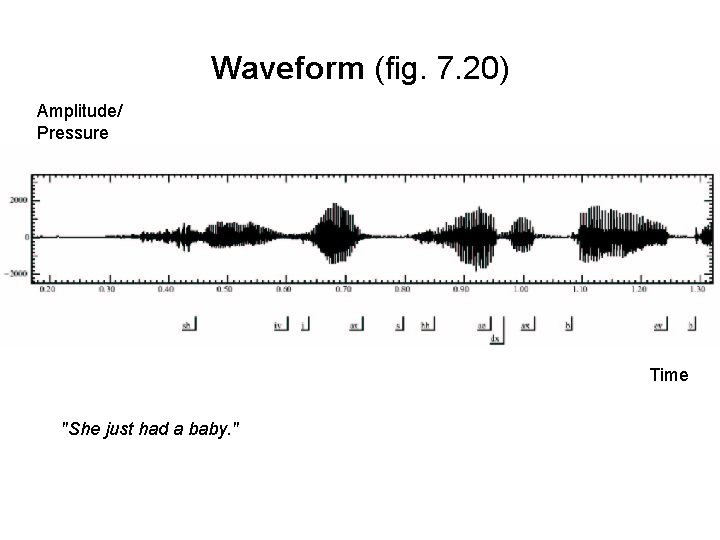
Waveform (fig. 7. 20) Amplitude/ Pressure Time "She just had a baby. "
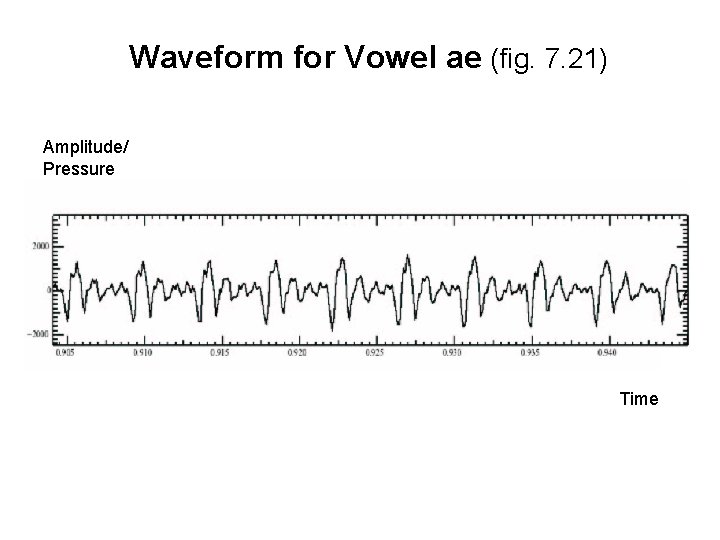
Waveform for Vowel ae (fig. 7. 21) Amplitude/ Pressure Time
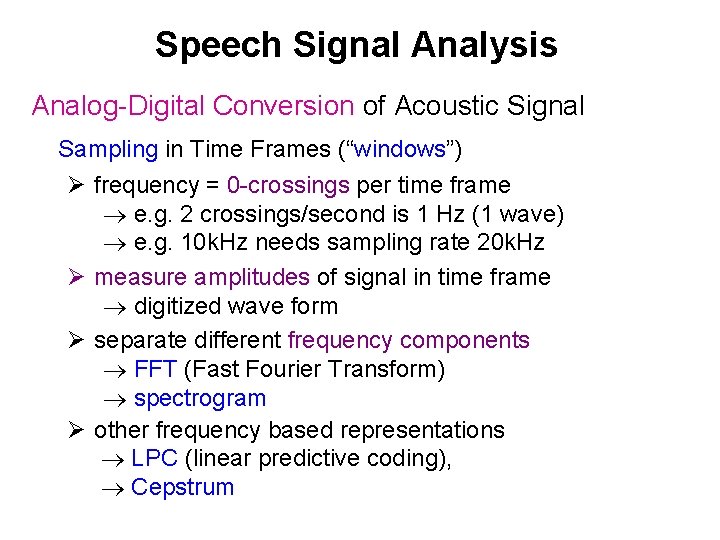
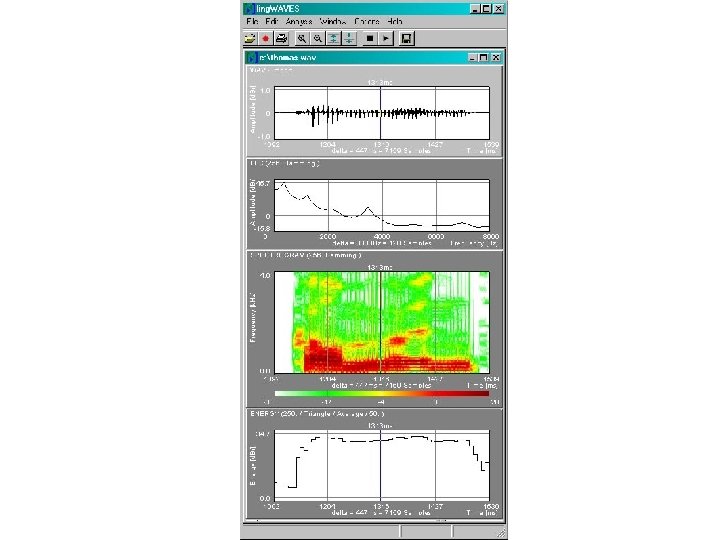
Speech Signal Analysis Analog-Digital Conversion of Acoustic Signal Sampling in Time Frames (“windows”) Ø frequency = 0 -crossings per time frame e. g. 2 crossings/second is 1 Hz (1 wave) e. g. 10 k. Hz needs sampling rate 20 k. Hz Ø measure amplitudes of signal in time frame digitized wave form Ø separate different frequency components FFT (Fast Fourier Transform) spectrogram Ø other frequency based representations LPC (linear predictive coding), Cepstrum
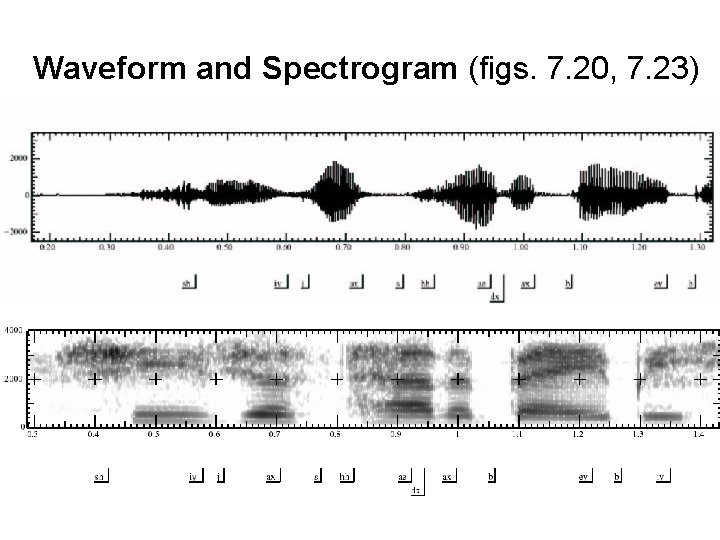
Waveform and Spectrogram (figs. 7. 20, 7. 23)
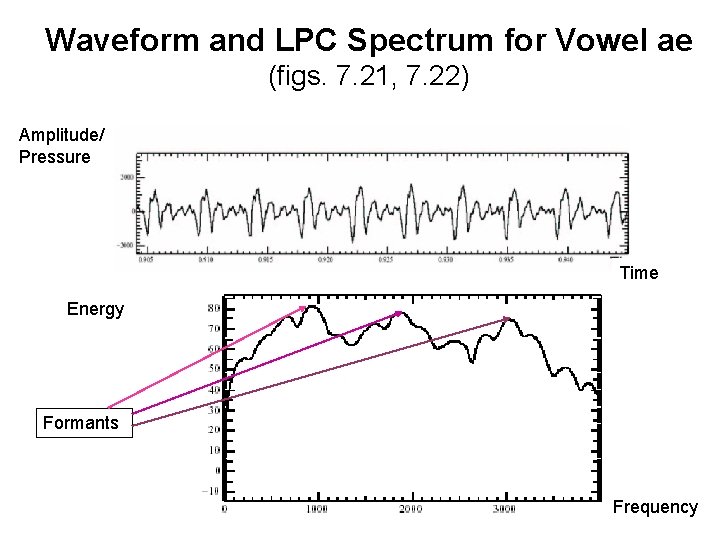
Waveform and LPC Spectrum for Vowel ae (figs. 7. 21, 7. 22) Amplitude/ Pressure Time Energy Formants Frequency
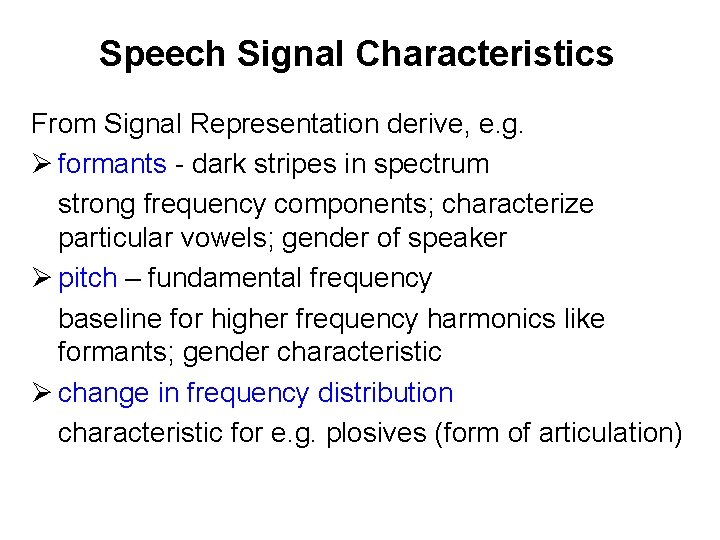
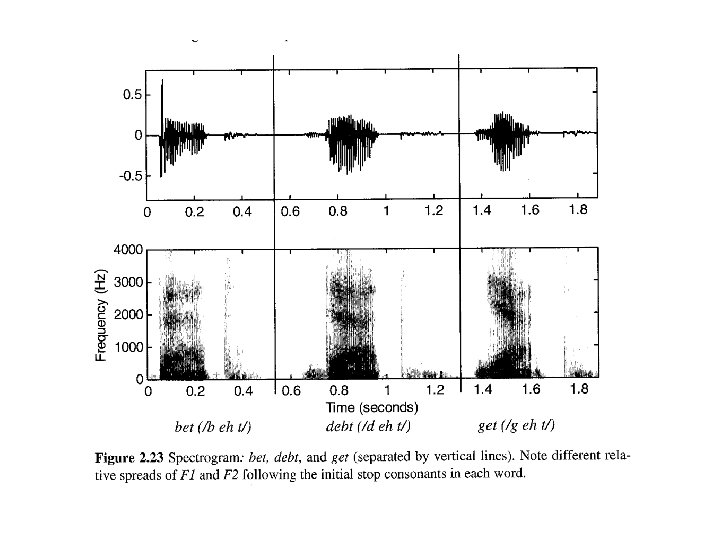
Speech Signal Characteristics From Signal Representation derive, e. g. Ø formants - dark stripes in spectrum strong frequency components; characterize particular vowels; gender of speaker Ø pitch – fundamental frequency baseline for higher frequency harmonics like formants; gender characteristic Ø change in frequency distribution characteristic for e. g. plosives (form of articulation)
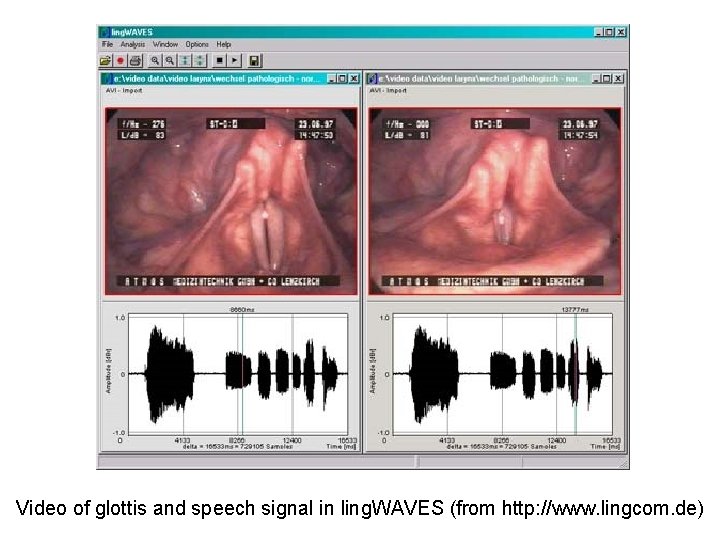
Video of glottis and speech signal in ling. WAVES (from http: //www. lingcom. de)
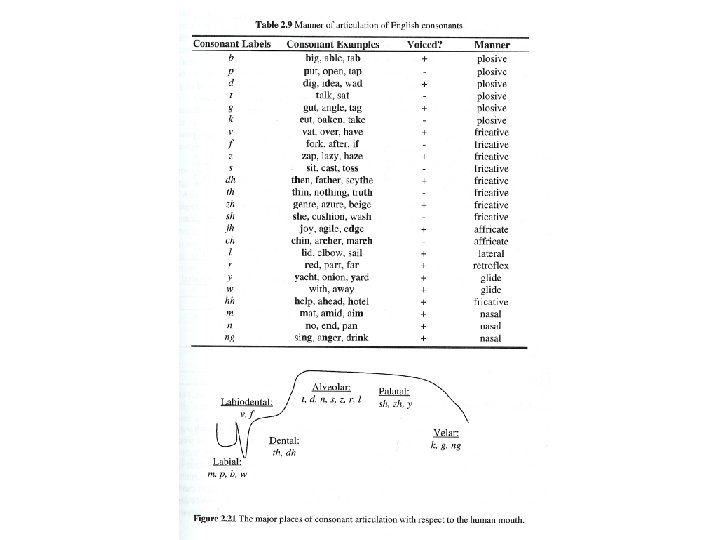
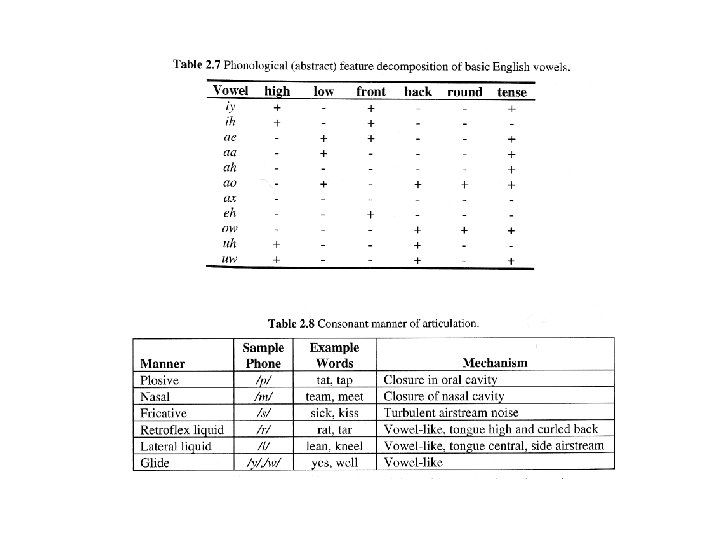
Phoneme Recognition Process based on • features extracted from spectral analysis • phonological rules • statistical properties of language/ pronunciation Recognition Methods • Hidden Markov Models • Neural Networks • Pattern Classification in general
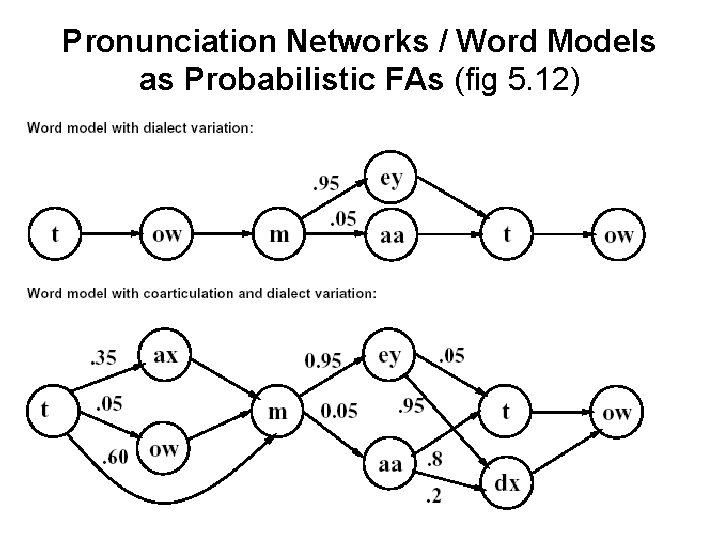
Pronunciation Networks / Word Models as Probabilistic FAs (fig 5. 12)
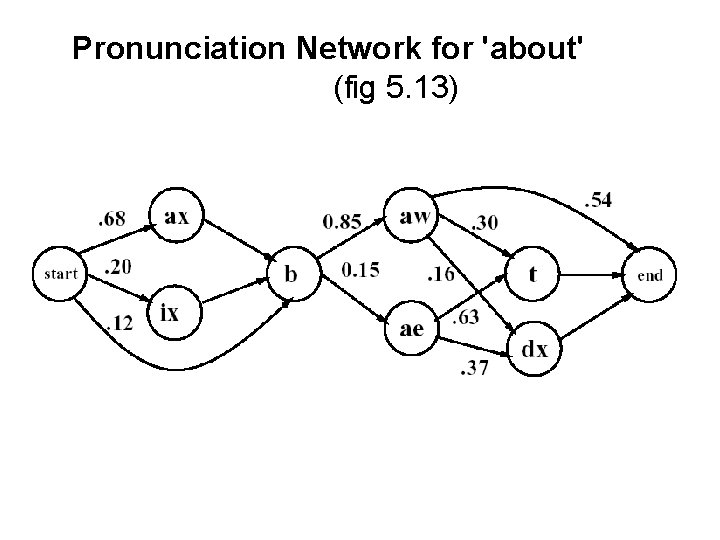
Pronunciation Network for 'about' (fig 5. 13)
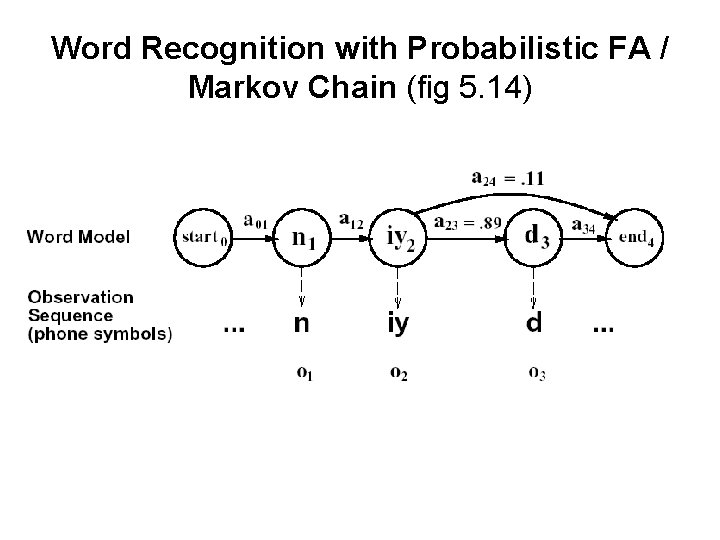
Word Recognition with Probabilistic FA / Markov Chain (fig 5. 14)
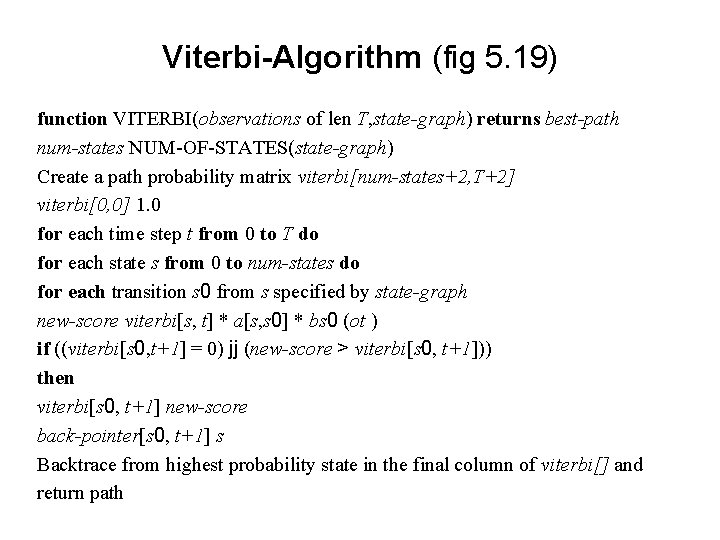
Viterbi-Algorithm The Viterbi Algorithm finds an optimal sequence of states in continuous Speech Recognition, given an observation sequence of phones and a probabilistic (weighted) FA. The algorithm returns the path through the automaton which has maximum probability and accepts the observed sequence.
Viterbi-Algorithm (fig 5. 19) function VITERBI(observations of len T, state-graph) returns best-path num-states NUM-OF-STATES(state-graph) Create a path probability matrix viterbi[num-states+2, T+2] viterbi[0, 0] 1. 0 for each time step t from 0 to T do for each state s from 0 to num-states do for each transition s 0 from s specified by state-graph new-score viterbi[s, t] * a[s, s 0] * bs 0 (ot ) if ((viterbi[s 0, t+1] = 0) jj (new-score > viterbi[s 0, t+1])) then viterbi[s 0, t+1] new-score back-pointer[s 0, t+1] s Backtrace from highest probability state in the final column of viterbi[] and return path
Speech Recognition Acoustic / sound wave Filtering, Sampling Spectral Analysis; FFT Frequency Spectrum Signal Processing / Analysis Features (Phonemes; Context) Phoneme Recognition: HMM, Neural Networks Phonemes Grammar or Statistics Phoneme Sequences / Words Word Sequence / Sentence Grammar or Statistics for likely word sequences
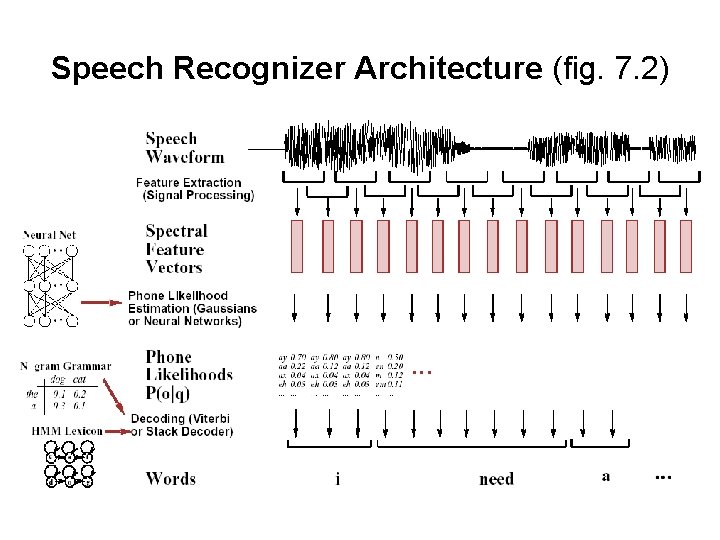
Speech Recognizer Architecture (fig. 7. 2)
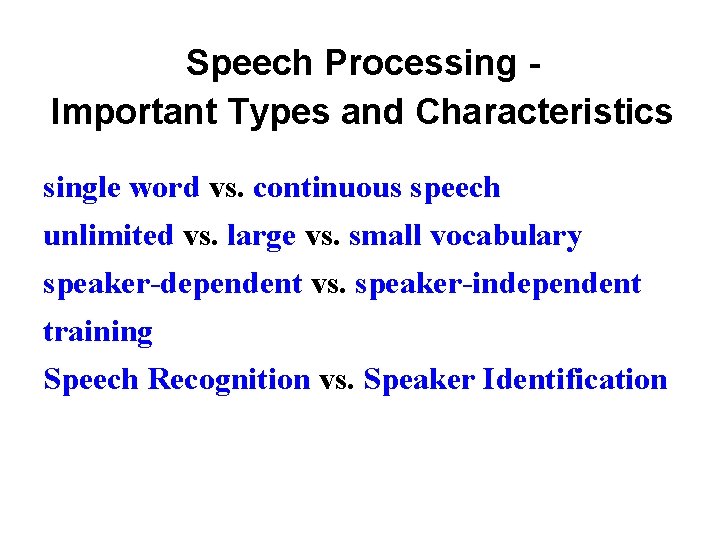
Speech Processing Important Types and Characteristics single word vs. continuous speech unlimited vs. large vs. small vocabulary speaker-dependent vs. speaker-independent training Speech Recognition vs. Speaker Identification
Additional References Hong, X. & A. Acero & H. Hon: Spoken Language Processing. A Guide to Theory, Algorithms, and System Development. Prentice-Hall, NJ, 2001 Figures taken from: Jurafsky, D. & J. H. Martin, Speech and Language Processing, Prentice-Hall, 2000, Chapters 5 and 7. ling. WAVES (from http: //www. lingcom. de