
732 A 02 Data Mining Clustering and Association
- Slides: 11
732 A 02 Data Mining Clustering and Association Analysis • • FP growth algorithm Correlation analysis ………………… Jose M. Peña jospe@ida. liu. se
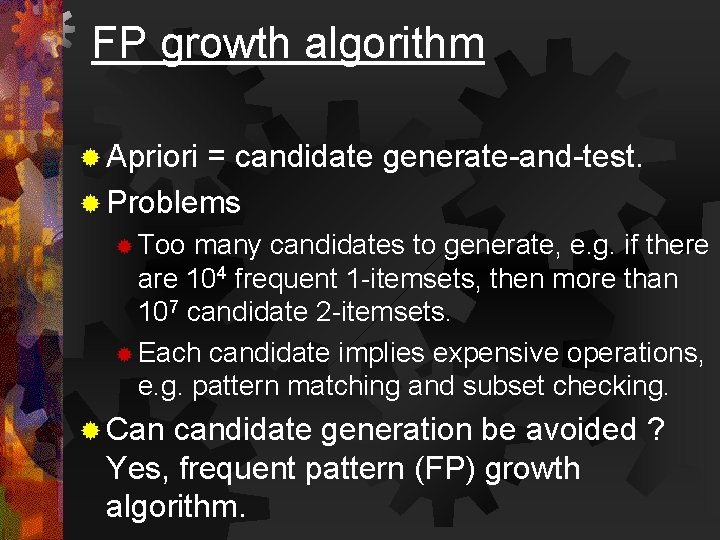
FP growth algorithm ® Apriori = candidate generate-and-test. ® Problems ® Too many candidates to generate, e. g. if there are 104 frequent 1 -itemsets, then more than 107 candidate 2 -itemsets. ® Each candidate implies expensive operations, e. g. pattern matching and subset checking. ® Can candidate generation be avoided ? Yes, frequent pattern (FP) growth algorithm.
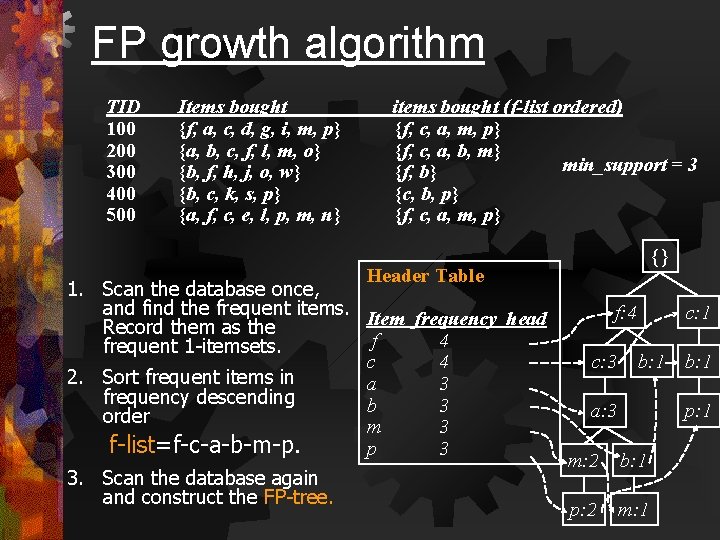
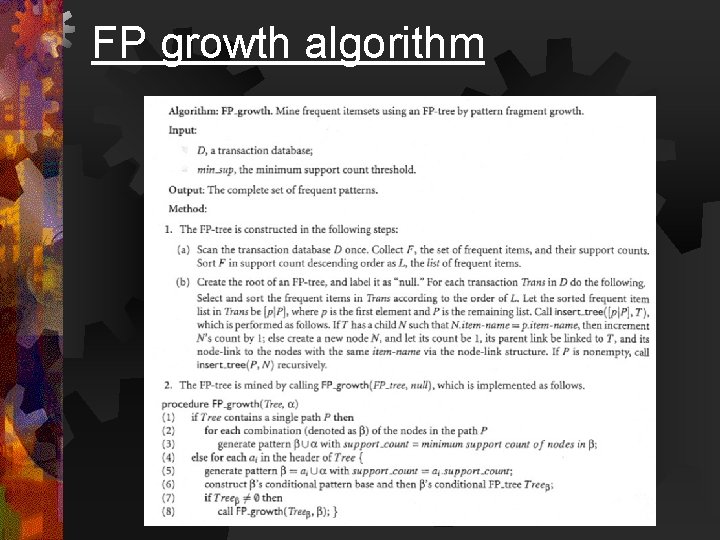
FP growth algorithm TID 100 200 300 400 500 Items bought {f, a, c, d, g, i, m, p} {a, b, c, f, l, m, o} {b, f, h, j, o, w} {b, c, k, s, p} {a, f, c, e, l, p, m, n} items bought (f-list ordered) {f, c, a, m, p} {f, c, a, b, m} min_support = 3 {f, b} {c, b, p} {f, c, a, m, p} Header Table 1. Scan the database once, and find the frequent items. Item frequency head Record them as the f 4 frequent 1 -itemsets. c 4 2. Sort frequent items in a 3 frequency descending b 3 order m 3 f-list=f-c-a-b-m-p. p 3 3. Scan the database again and construct the FP-tree. {} f: 4 c: 3 c: 1 b: 1 a: 3 b: 1 p: 1 m: 2 b: 1 p: 2 m: 1
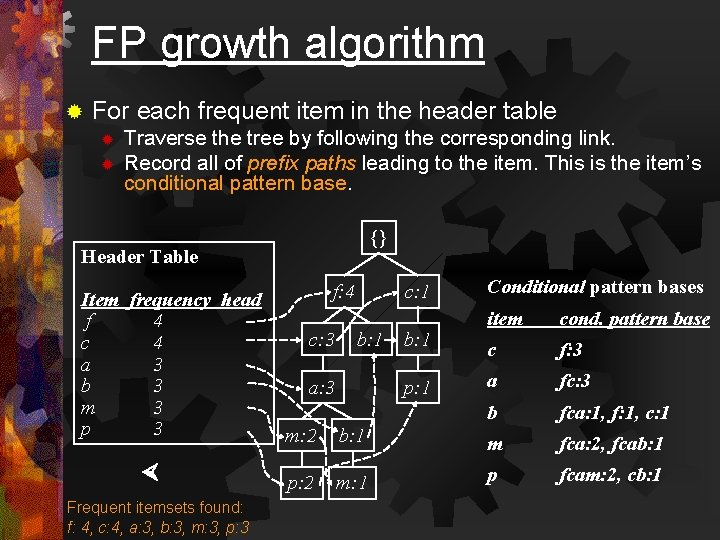
FP growth algorithm ® For each frequent item in the header table ® ® Traverse the tree by following the corresponding link. Record all of prefix paths leading to the item. This is the item’s conditional pattern base. {} Header Table Item frequency head f 4 c 4 a 3 b 3 m 3 p 3 Frequent itemsets found: f: 4, c: 4, a: 3, b: 3, m: 3, p: 3 f: 4 c: 3 c: 1 b: 1 a: 3 b: 1 p: 1 Conditional pattern bases item cond. pattern base c f: 3 a fc: 3 b fca: 1, f: 1, c: 1 m: 2 b: 1 m fca: 2, fcab: 1 p: 2 m: 1 p fcam: 2, cb: 1
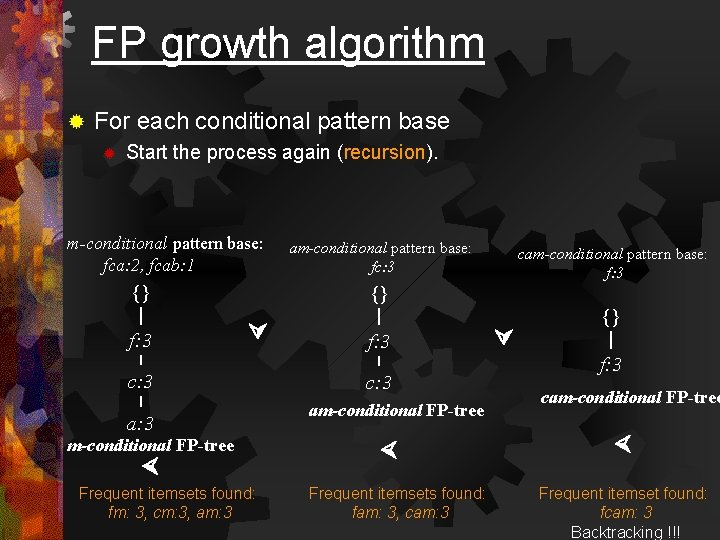
FP growth algorithm ® For each conditional pattern base ® Start the process again (recursion). m-conditional pattern base: fca: 2, fcab: 1 {} f: 3 am-conditional pattern base: fc: 3 cam-conditional pattern base: f: 3 {} c: 3 Frequent itemsets found: fm: 3, cm: 3, am: 3 am-conditional FP-tree c: 3 Frequent itemsets found: fam: 3, cam: 3 f: 3 cam-conditional FP-tree a: 3 f: 3 {} Frequent itemset found: fcam: 3 Backtracking !!!
FP growth algorithm
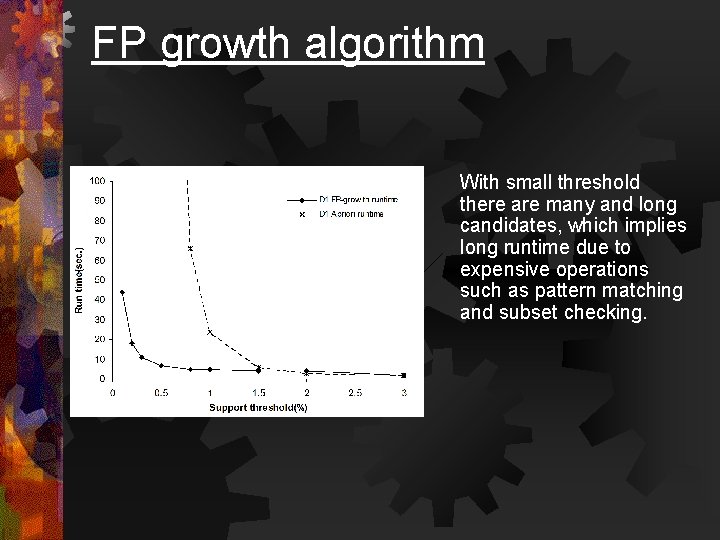
FP growth algorithm With small threshold there are many and long candidates, which implies long runtime due to expensive operations such as pattern matching and subset checking.
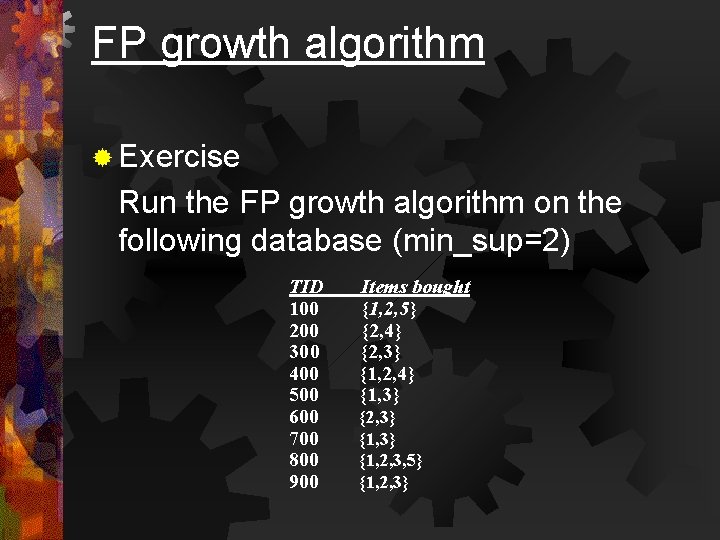
FP growth algorithm ® Exercise Run the FP growth algorithm on the following database (min_sup=2) TID 100 200 300 400 500 600 700 800 900 Items bought {1, 2, 5} {2, 4} {2, 3} {1, 2, 4} {1, 3} {2, 3} {1, 2, 3, 5} {1, 2, 3}
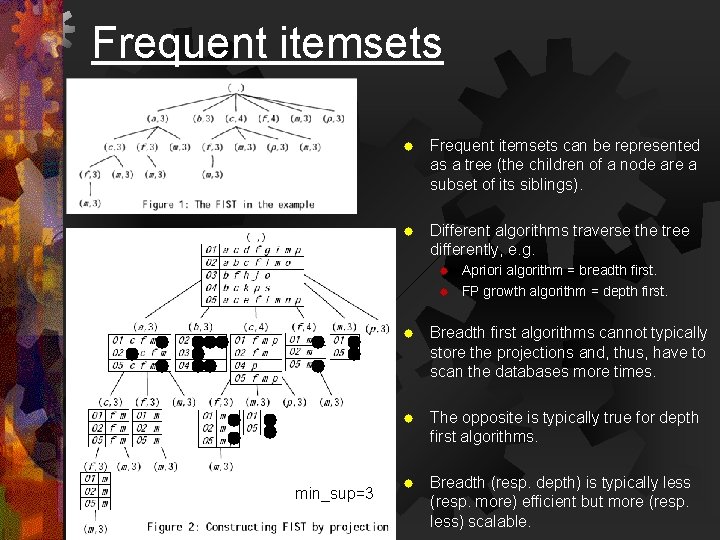
Frequent itemsets ® Frequent itemsets can be represented as a tree (the children of a node are a subset of its siblings). ® Different algorithms traverse the tree differently, e. g. ® ® min_sup=3 Apriori algorithm = breadth first. FP growth algorithm = depth first. ® Breadth first algorithms cannot typically store the projections and, thus, have to scan the databases more times. ® The opposite is typically true for depth first algorithms. ® Breadth (resp. depth) is typically less (resp. more) efficient but more (resp. less) scalable.
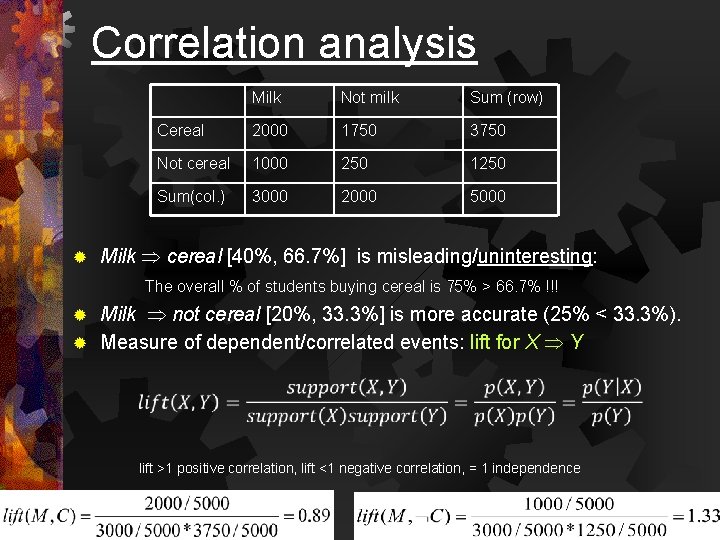
Correlation analysis ® Milk Not milk Sum (row) Cereal 2000 1750 3750 Not cereal 1000 250 1250 Sum(col. ) 3000 2000 5000 Milk cereal [40%, 66. 7%] is misleading/uninteresting: The overall % of students buying cereal is 75% > 66. 7% !!! Milk not cereal [20%, 33. 3%] is more accurate (25% < 33. 3%). ® Measure of dependent/correlated events: lift for X Y ® lift >1 positive correlation, lift <1 negative correlation, = 1 independence
Correlation analysis • Exercise: Find an example where • A C has lift(A, C) < 1, but • A, B C has lift(A, B, C) > 1.