
717 Chapter 12 BoundaryValue Problem in Rectangular Coordinates
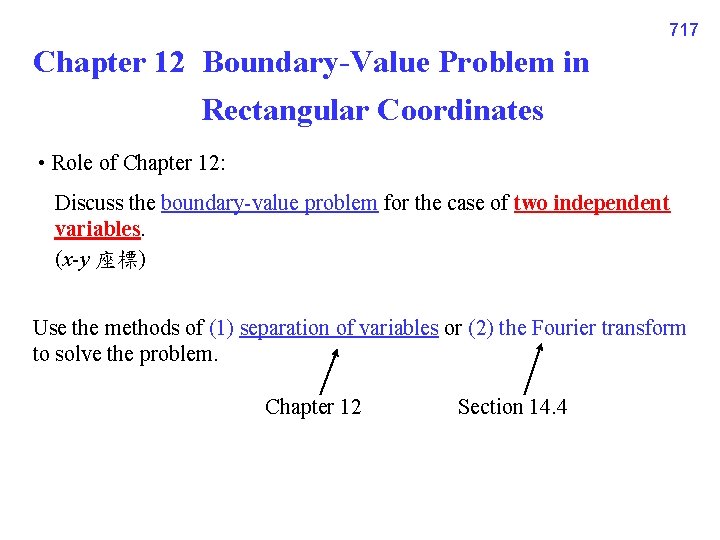
717 Chapter 12 Boundary-Value Problem in Rectangular Coordinates • Role of Chapter 12: Discuss the boundary-value problem for the case of two independent variables. (x-y 座標) Use the methods of (1) separation of variables or (2) the Fourier transform to solve the problem. Chapter 12 Section 14. 4
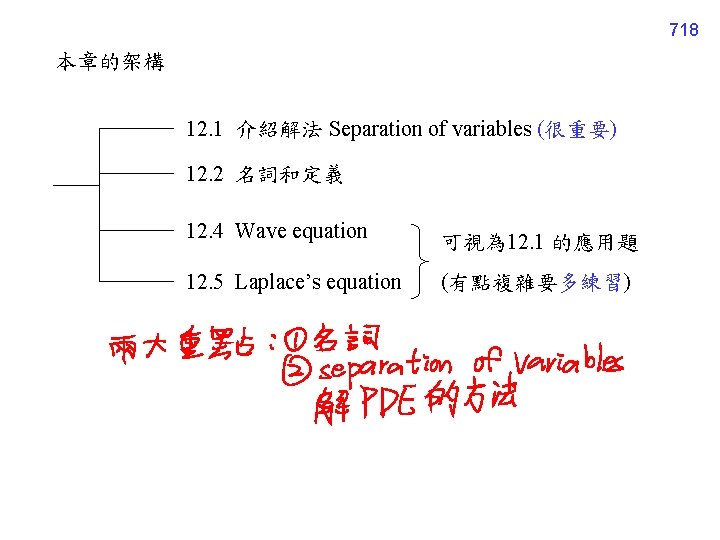
718 本章的架構 12. 1 介紹解法 Separation of variables (很重要) 12. 2 名詞和定義 12. 4 Wave equation 可視為 12. 1 的應用題 12. 5 Laplace’s equation (有點複雜要多練習)

719 縮寫: boundary value problem (BVP) initial value problem (IVP) 例: BVP: IVP: partial differential equation (PDE) ordinary differential equation (ODE)
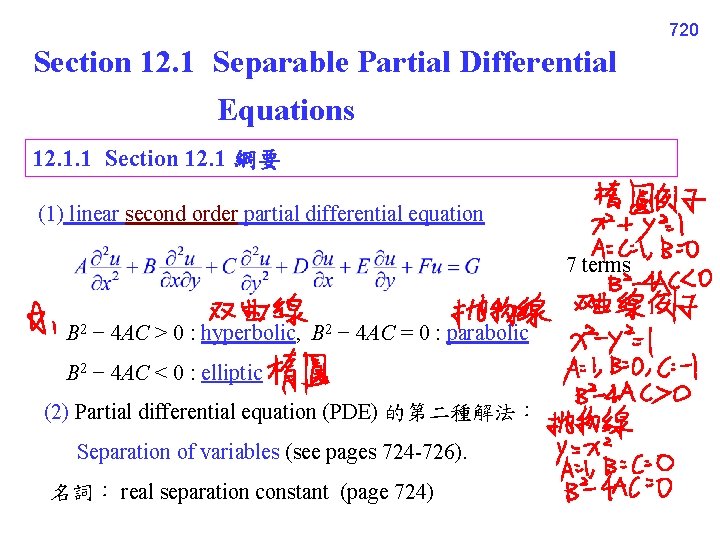
720 Section 12. 1 Separable Partial Differential Equations 12. 1. 1 Section 12. 1 綱要 (1) linear second order partial differential equation 7 terms B 2 − 4 AC > 0 : hyperbolic, B 2 − 4 AC = 0 : parabolic B 2 − 4 AC < 0 : elliptic (2) Partial differential equation (PDE) 的第二種解法: Separation of variables (see pages 724 -726). 名詞: real separation constant (page 724)
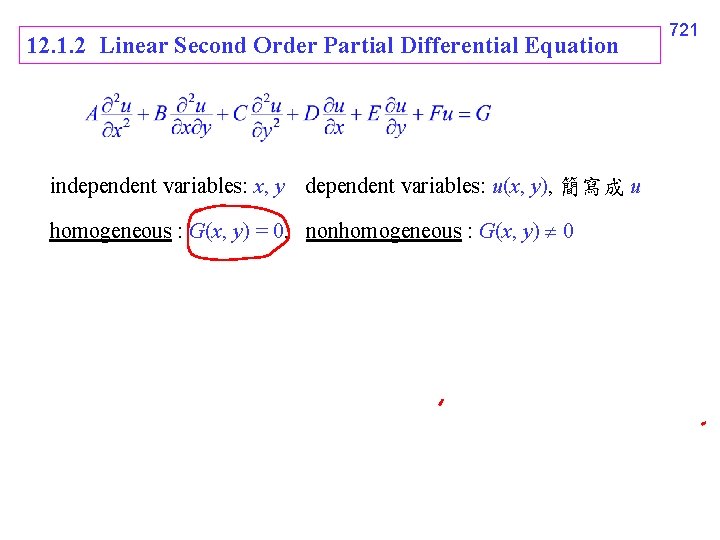
12. 1. 2 Linear Second Order Partial Differential Equation independent variables: x, y dependent variables: u(x, y), 簡寫成 u homogeneous : G(x, y) = 0, nonhomogeneous : G(x, y) 0 721
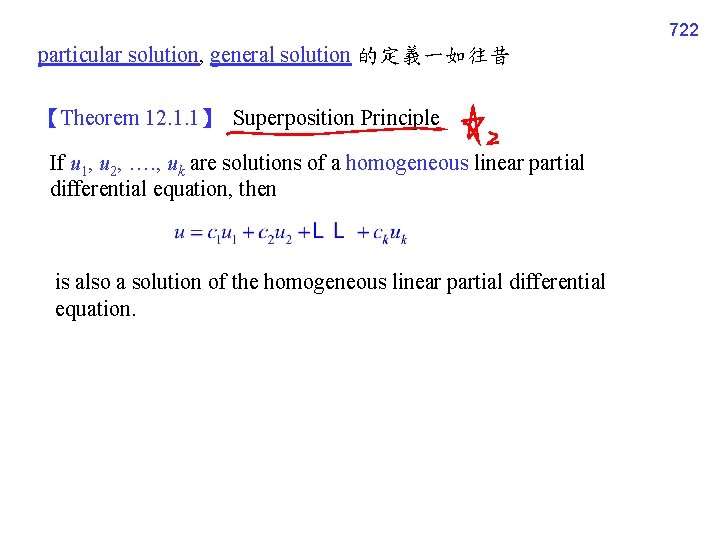
722 particular solution, general solution 的定義一如往昔 【Theorem 12. 1. 1】 Superposition Principle If u 1, u 2, …. , uk are solutions of a homogeneous linear partial differential equation, then is also a solution of the homogeneous linear partial differential equation.
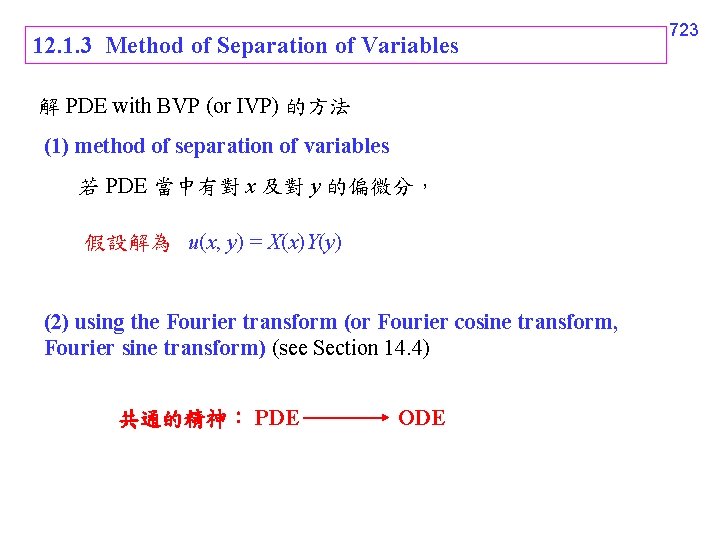
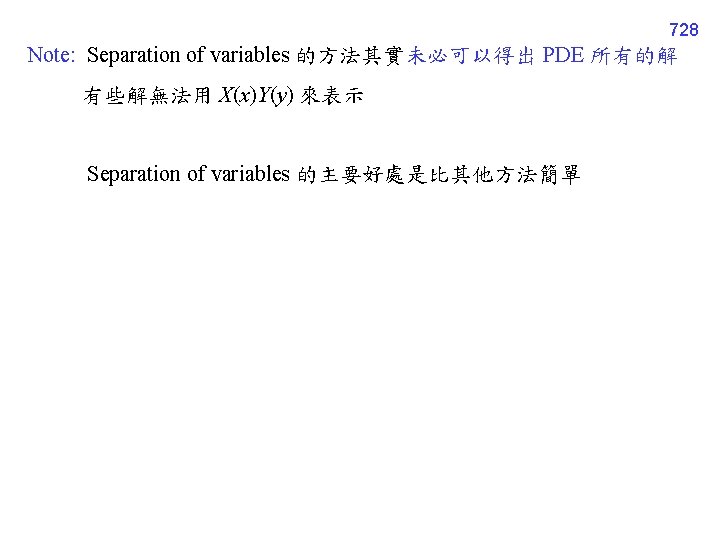
12. 1. 3 Method of Separation of Variables 解 PDE with BVP (or IVP) 的方法 (1) method of separation of variables 若 PDE 當中有對 x 及對 y 的偏微分, 假設解為 u(x, y) = X(x)Y(y) (2) using the Fourier transform (or Fourier cosine transform, Fourier sine transform) (see Section 14. 4) 共通的精神: PDE ODE 723
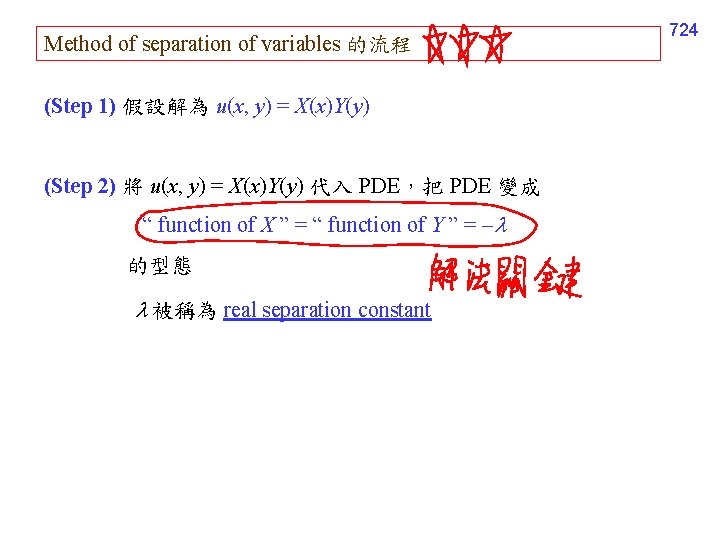
Method of separation of variables 的流程 (Step 1) 假設解為 u(x, y) = X(x)Y(y) (Step 2) 將 u(x, y) = X(x)Y(y) 代入 PDE,把 PDE 變成 “ function of X ” = “ function of Y ” = 的型態 被稱為 real separation constant 724
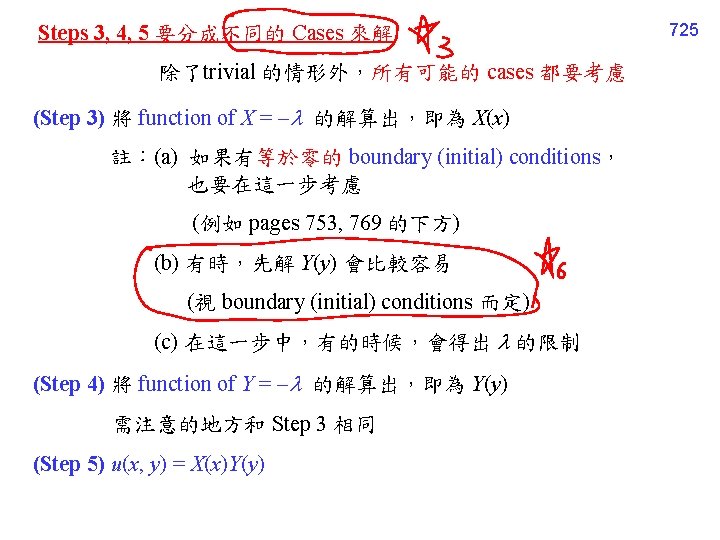
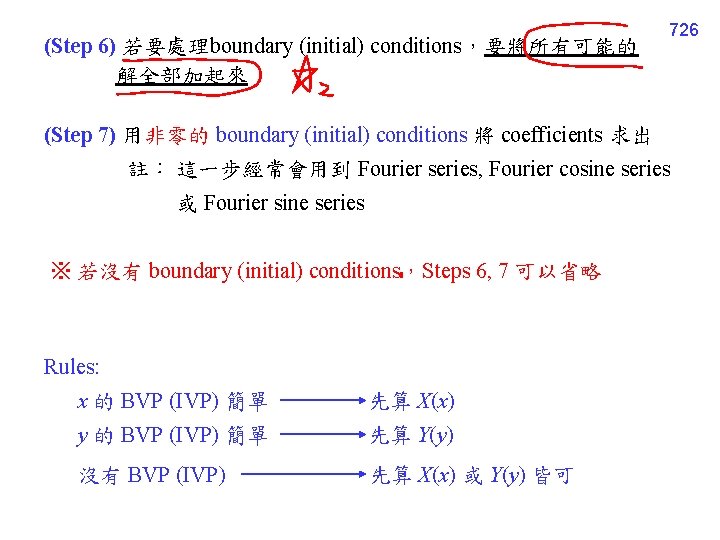
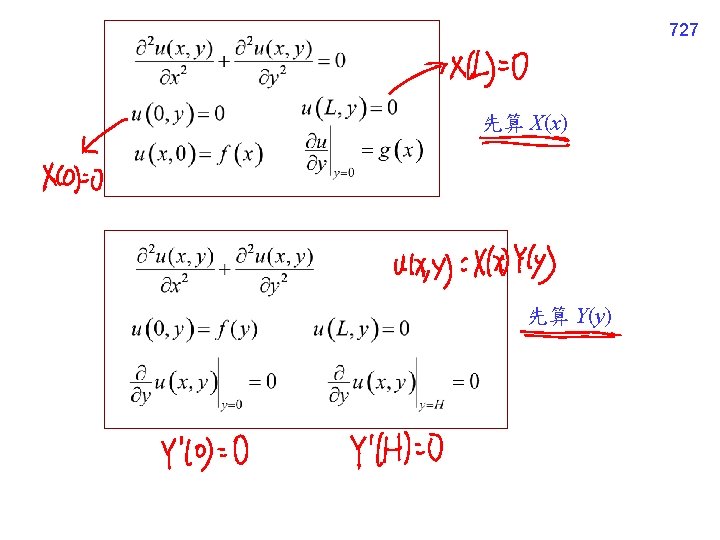
(Step 6) 若要處理boundary (initial) conditions,要將所有可能的 解全部加起來 726 (Step 7) 用非零的 boundary (initial) conditions 將 coefficients 求出 註: 這一步經常會用到 Fourier series, Fourier cosine series 或 Fourier sine series ※ 若沒有 boundary (initial) conditions,Steps 6, 7 可以省略 Rules: x 的 BVP (IVP) 簡單 先算 X(x) y 的 BVP (IVP) 簡單 先算 Y(y) 沒有 BVP (IVP) 先算 X(x) 或 Y(y) 皆可
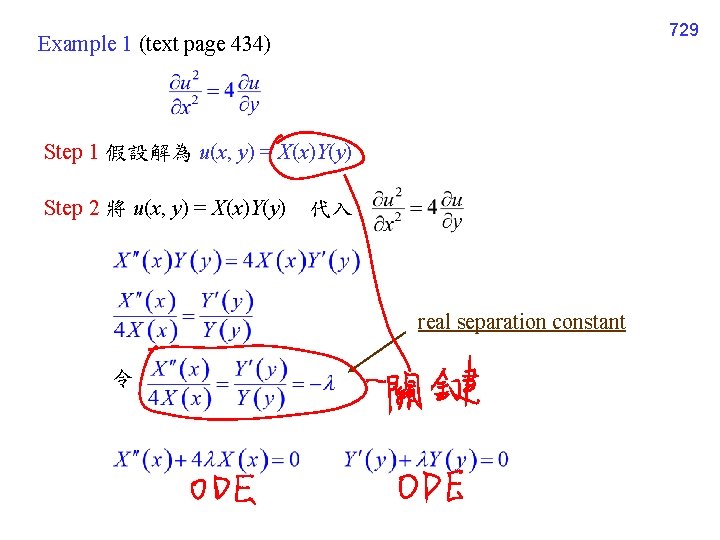
729 Example 1 (text page 434) Step 1 假設解為 u(x, y) = X(x)Y(y) Step 2 將 u(x, y) = X(x)Y(y) 代入 real separation constant 令
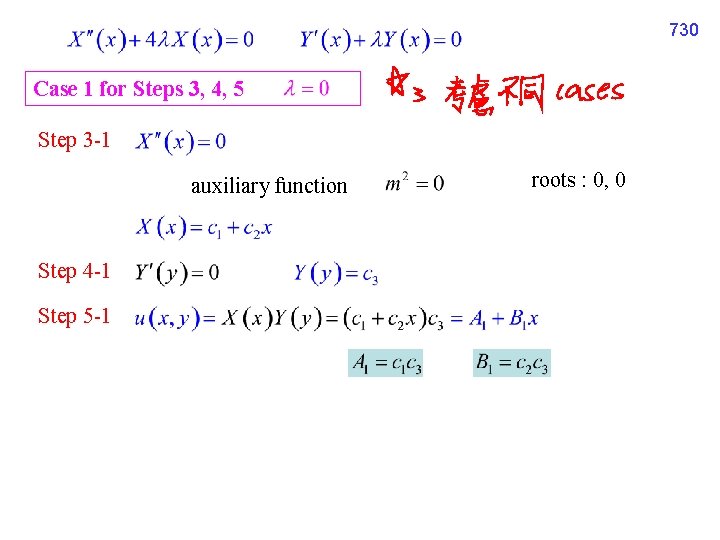
730 Case 1 for Steps 3, 4, 5 Step 3 -1 auxiliary function Step 4 -1 Step 5 -1 roots : 0, 0
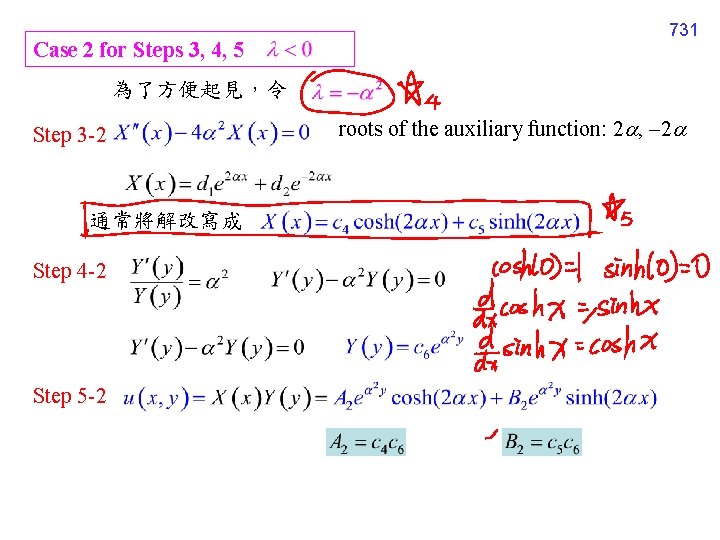
Case 2 for Steps 3, 4, 5 731 為了方便起見,令 Step 3 -2 通常將解改寫成 Step 4 -2 Step 5 -2 roots of the auxiliary function: 2 , 2
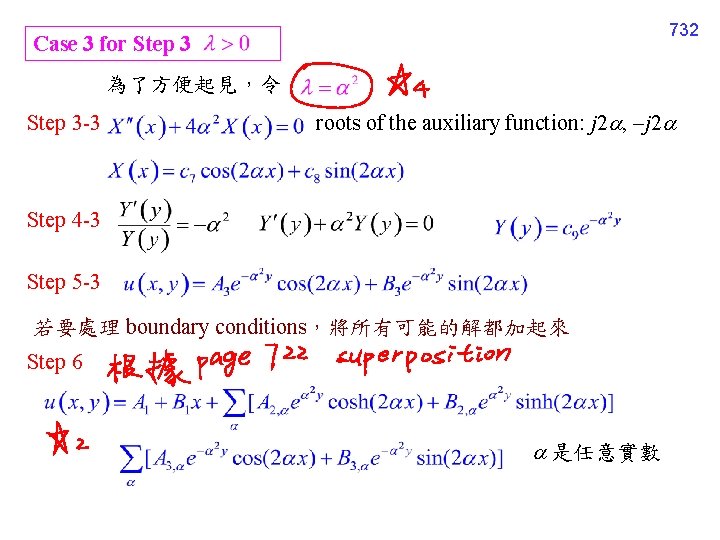
732 Case 3 for Step 3 為了方便起見,令 Step 3 -3 roots of the auxiliary function: j 2 , j 2 Step 4 -3 Step 5 -3 若要處理 boundary conditions,將所有可能的解都加起來 Step 6 是任意實數
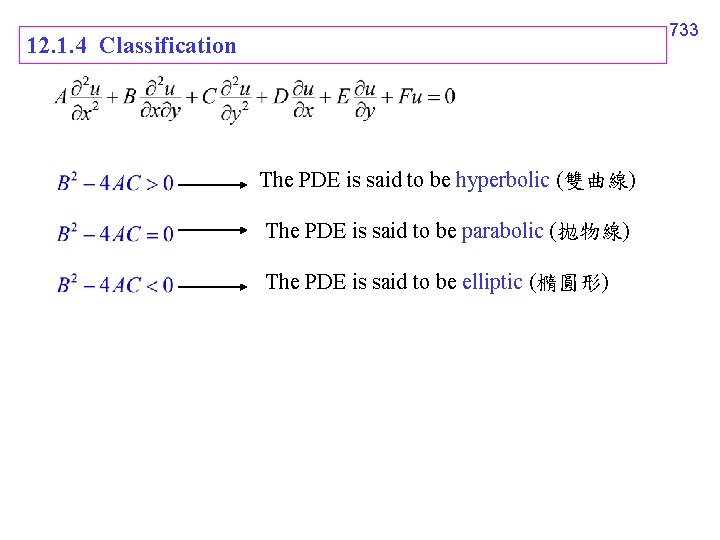
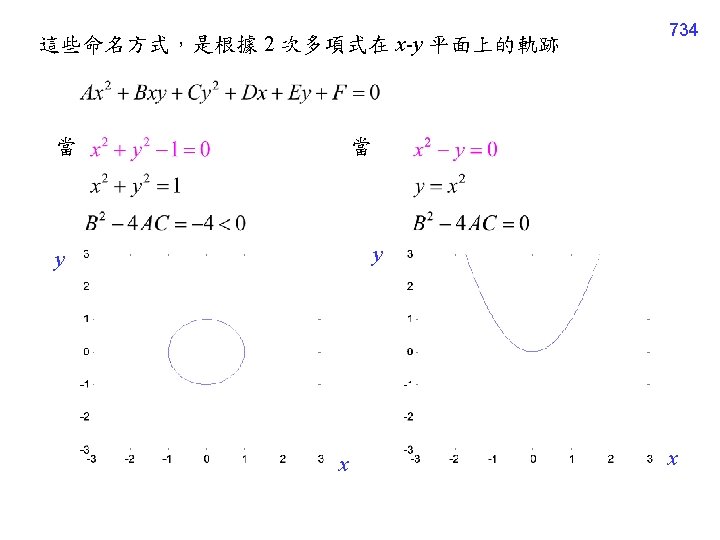
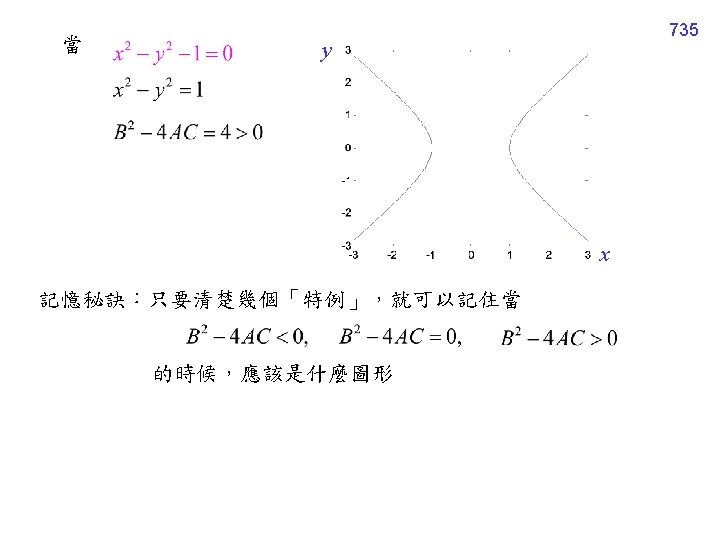
733 12. 1. 4 Classification The PDE is said to be hyperbolic (雙曲線) The PDE is said to be parabolic (拋物線) The PDE is said to be elliptic (橢圓形)
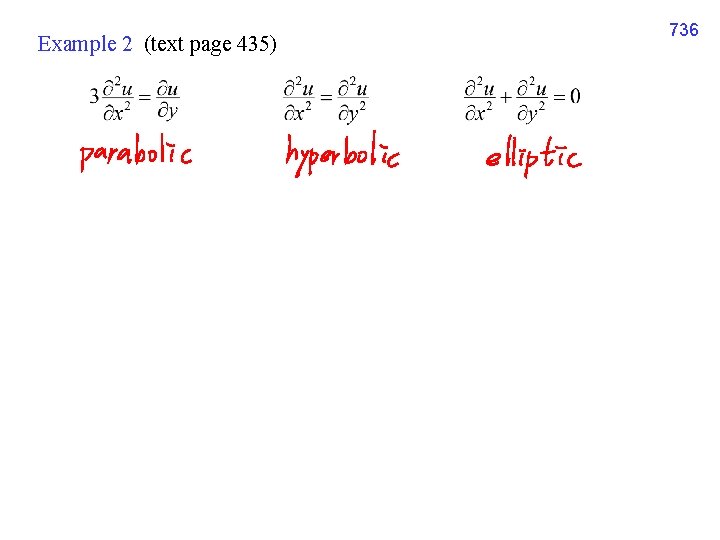
Example 2 (text page 435) 736
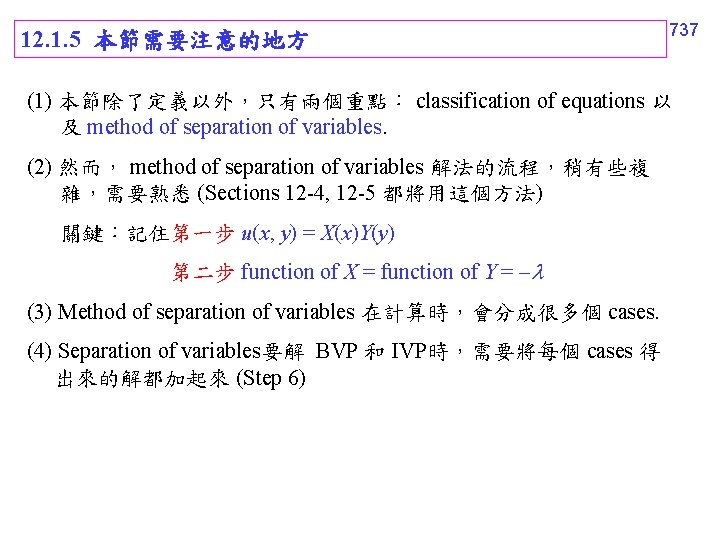
12. 1. 5 本節需要注意的地方 737 (1) 本節除了定義以外,只有兩個重點: classification of equations 以 及 method of separation of variables. (2) 然而, method of separation of variables 解法的流程,稍有些複 雜,需要熟悉 (Sections 12 -4, 12 -5 都將用這個方法) 關鍵:記住第一步 u(x, y) = X(x)Y(y) 第二步 function of X = function of Y = (3) Method of separation of variables 在計算時,會分成很多個 cases. (4) Separation of variables要解 BVP 和 IVP時,需要將每個 cases 得 出來的解都加起來 (Step 6)
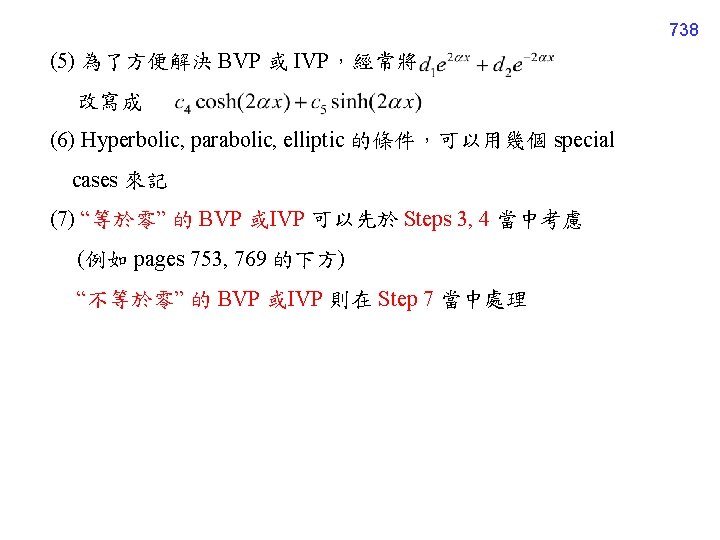
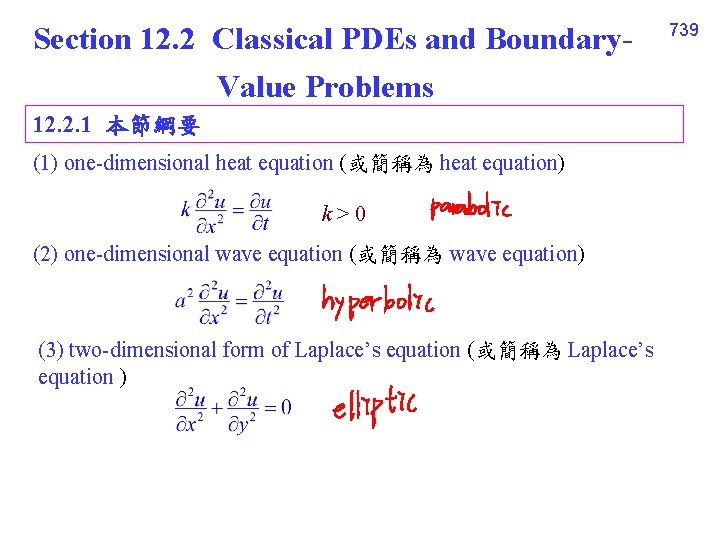
Section 12. 2 Classical PDEs and Boundary. Value Problems 12. 2. 1 本節綱要 (1) one-dimensional heat equation (或簡稱為 heat equation) k>0 (2) one-dimensional wave equation (或簡稱為 wave equation) (3) two-dimensional form of Laplace’s equation (或簡稱為 Laplace’s equation ) 739
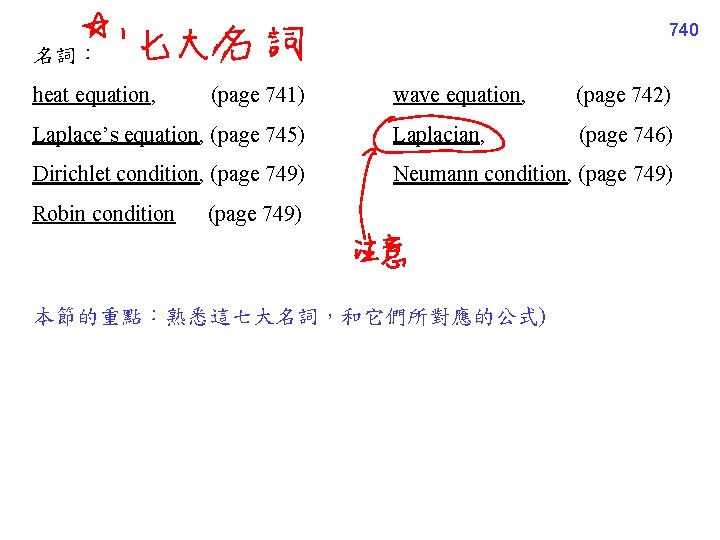
740 名詞: heat equation, wave equation, (page 742) Laplace’s equation, (page 745) Laplacian, (page 746) Dirichlet condition, (page 749) Neumann condition, (page 749) Robin condition (page 741) (page 749) 本節的重點:熟悉這七大名詞,和它們所對應的公式)
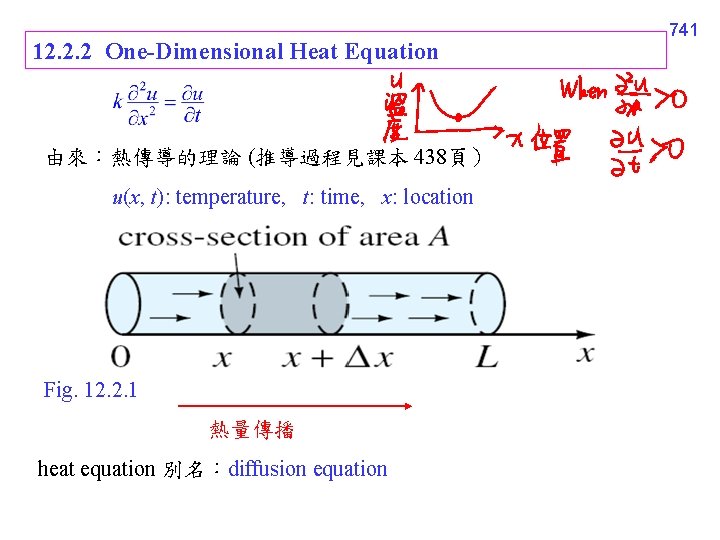
12. 2. 2 One-Dimensional Heat Equation 由來:熱傳導的理論 (推導過程見課本 438頁) u(x, t): temperature, t: time, x: location Fig. 12. 2. 1 熱量傳播 heat equation 別名:diffusion equation 741
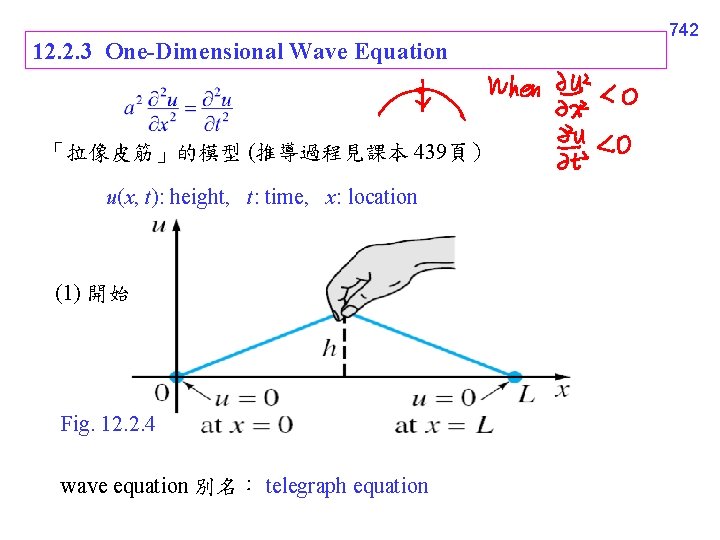
12. 2. 3 One-Dimensional Wave Equation 「拉像皮筋」的模型 (推導過程見課本 439頁) u(x, t): height, t: time, x: location (1) 開始 Fig. 12. 2. 4 wave equation 別名: telegraph equation 742
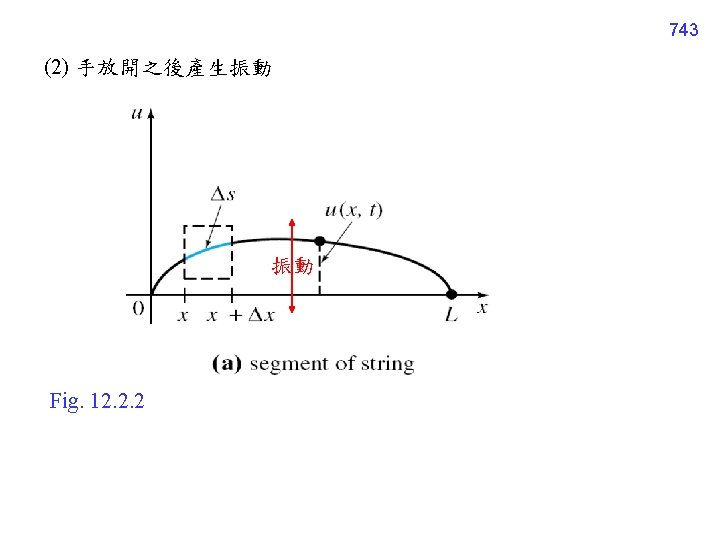
744 Wave equation 其他的應用: Theory of high-frequency transmission line Fluid mechanics (流體力學) Acoustics (聲學) Elasticity (彈力學) Microwave engineering (電波 程)
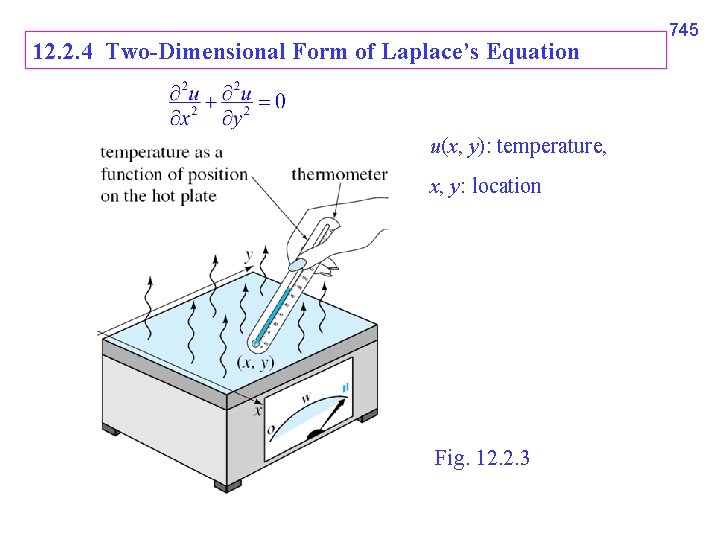
12. 2. 4 Two-Dimensional Form of Laplace’s Equation u(x, y): temperature, x, y: location Fig. 12. 2. 3 745
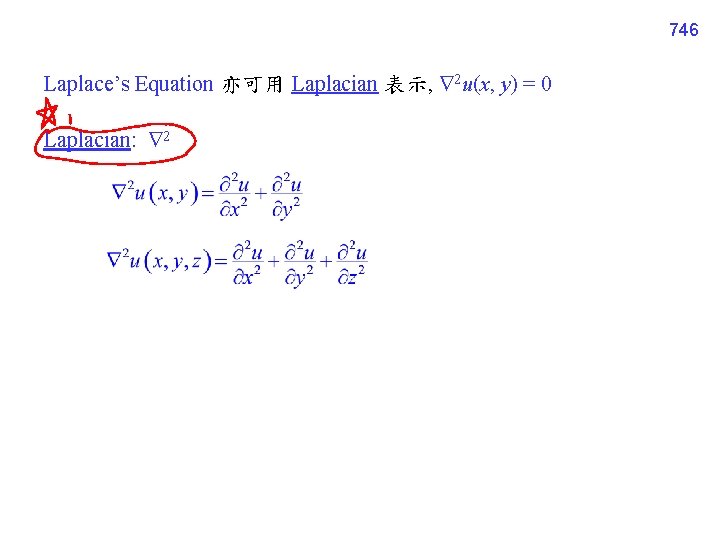
746 Laplace’s Equation 亦可用 Laplacian 表示, 2 u(x, y) = 0 Laplacian: 2
747 Laplace’s Equation 的其他應用 Static displacement of membranes Edge detection (邊緣偵測) Microwave engineering (電波 程)
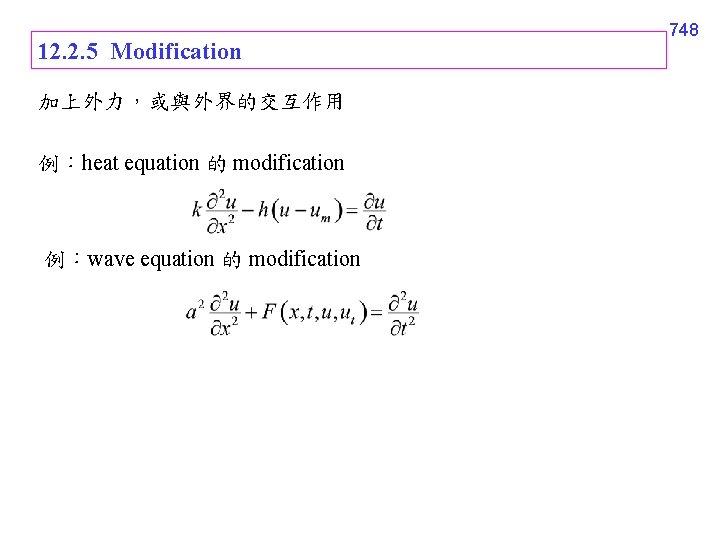
12. 2. 5 Modification 加上外力,或與外界的交互作用 例:heat equation 的 modification 例:wave equation 的 modification 748
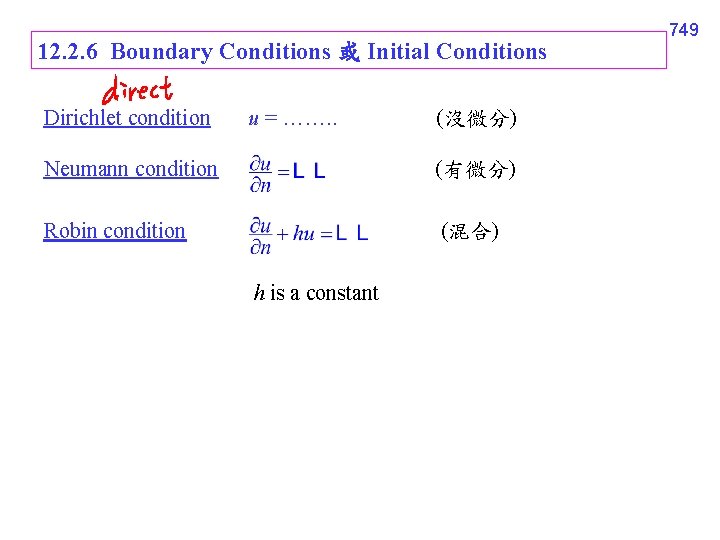
12. 2. 6 Boundary Conditions 或 Initial Conditions Dirichlet condition u = ……. . (沒微分) Neumann condition (有微分) Robin condition (混合) h is a constant 749
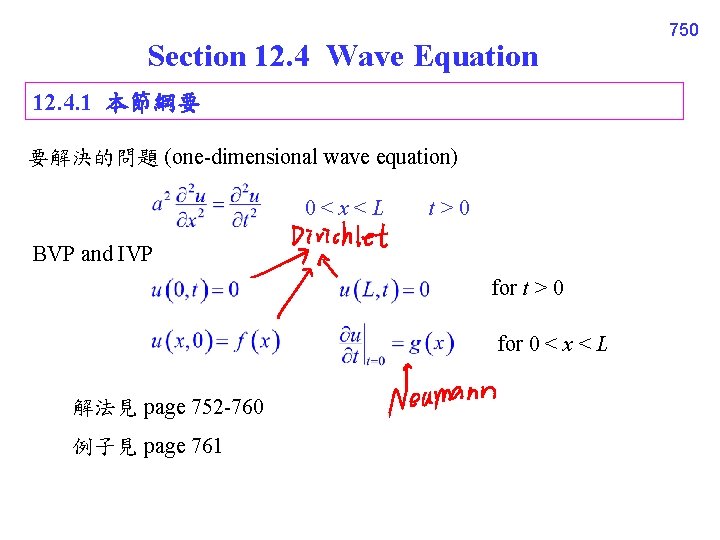
Section 12. 4 Wave Equation 12. 4. 1 本節綱要 要解決的問題 (one-dimensional wave equation) 0<x<L t>0 BVP and IVP for t > 0 for 0 < x < L 解法見 page 752 -760 例子見 page 761 750
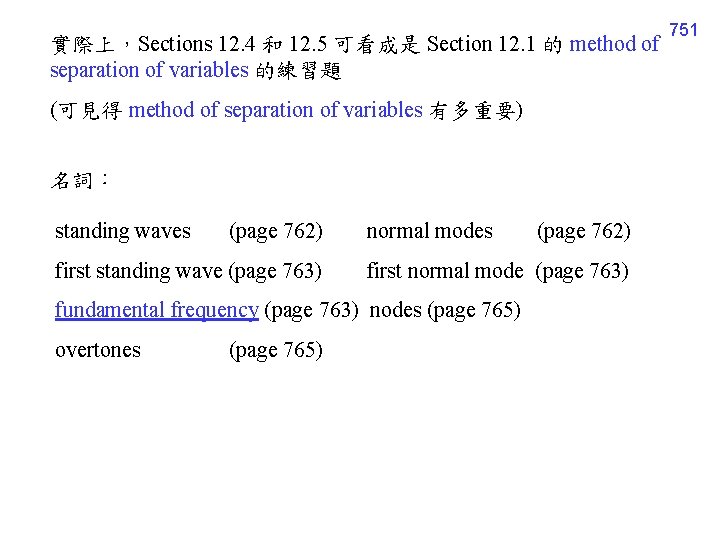
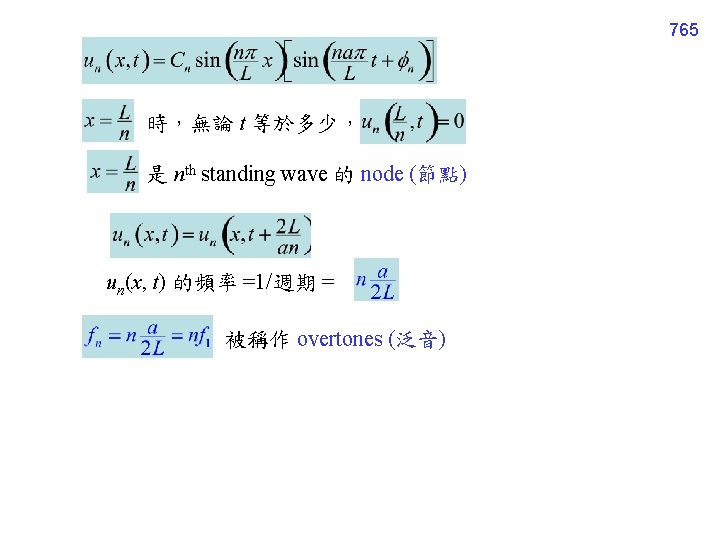
實際上,Sections 12. 4 和 12. 5 可看成是 Section 12. 1 的 method of separation of variables 的練習題 (可見得 method of separation of variables 有多重要) 名詞: standing waves (page 762) first standing wave (page 763) normal modes first normal mode (page 763) fundamental frequency (page 763) nodes (page 765) overtones (page 765) (page 762) 751
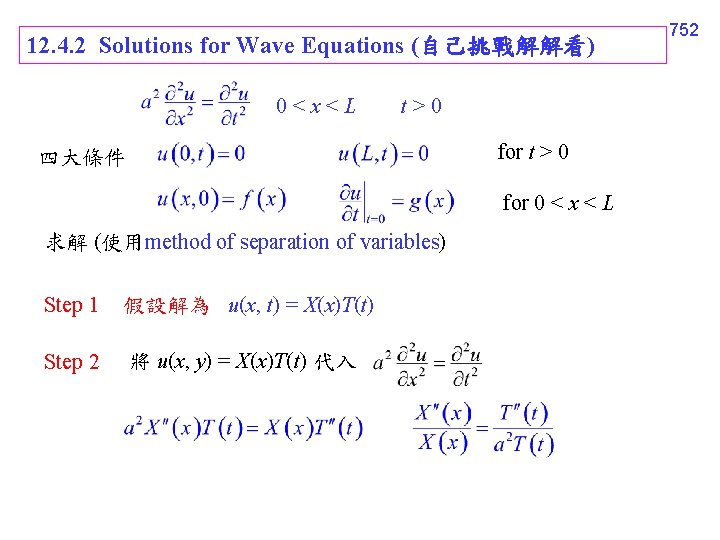
12. 4. 2 Solutions for Wave Equations (自己挑戰解解看) 0<x<L t>0 for t > 0 四大條件 for 0 < x < L 求解 (使用method of separation of variables) Step 1 假設解為 u(x, t) = X(x)T(t) Step 2 將 u(x, y) = X(x)T(t) 代入 752
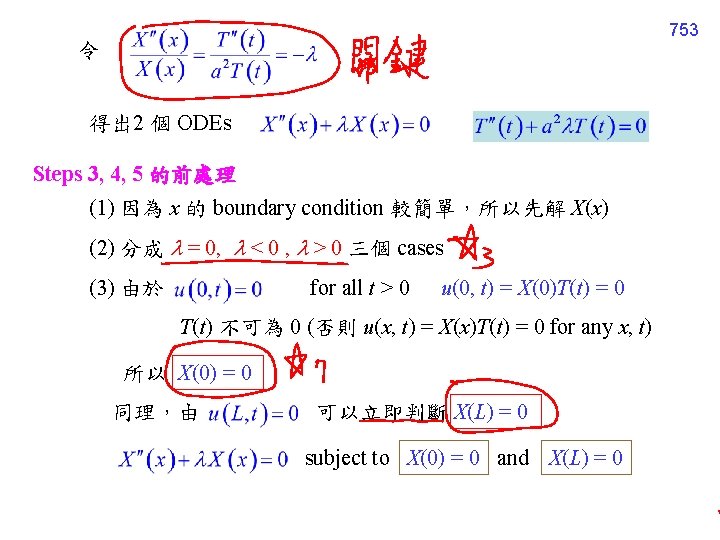
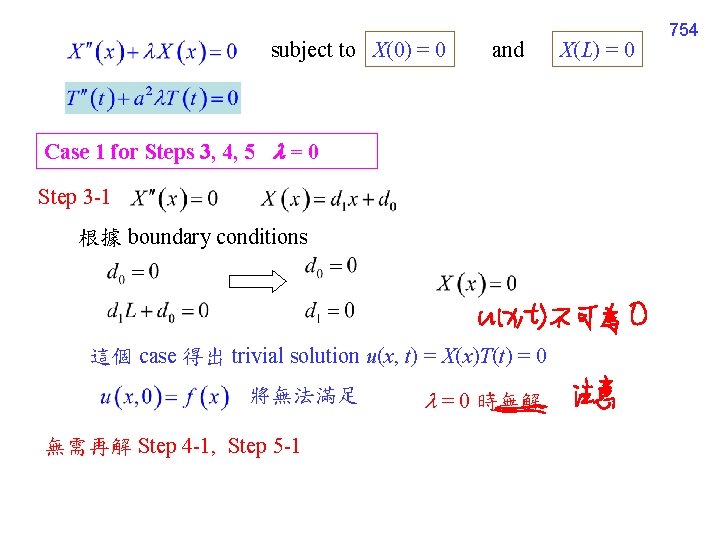
subject to X(0) = 0 and Case 1 for Steps 3, 4, 5 = 0 Step 3 -1 根據 boundary conditions 這個 case 得出 trivial solution u(x, t) = X(x)T(t) = 0 將無法滿足 無需再解 Step 4 -1, Step 5 -1 = 0 時無解 X(L) = 0 754
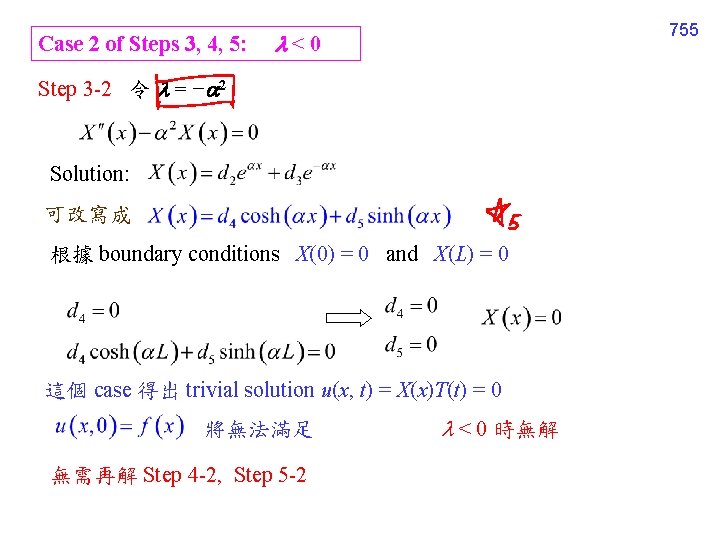
Case 2 of Steps 3, 4, 5: 755 <0 Step 3 -2 令 = − 2 Solution: 可改寫成 根據 boundary conditions X(0) = 0 and X(L) = 0 這個 case 得出 trivial solution u(x, t) = X(x)T(t) = 0 將無法滿足 無需再解 Step 4 -2, Step 5 -2 < 0 時無解
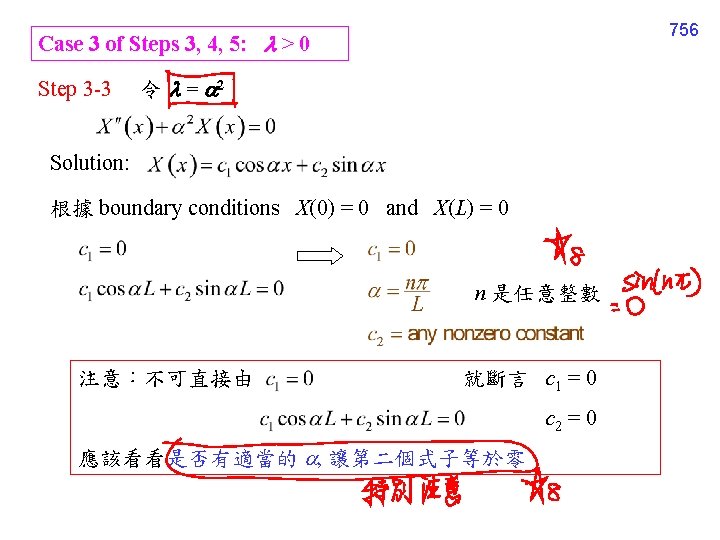
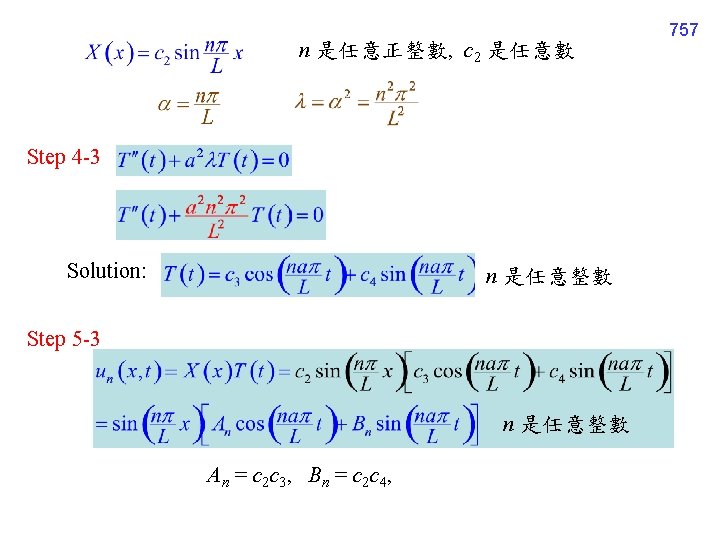
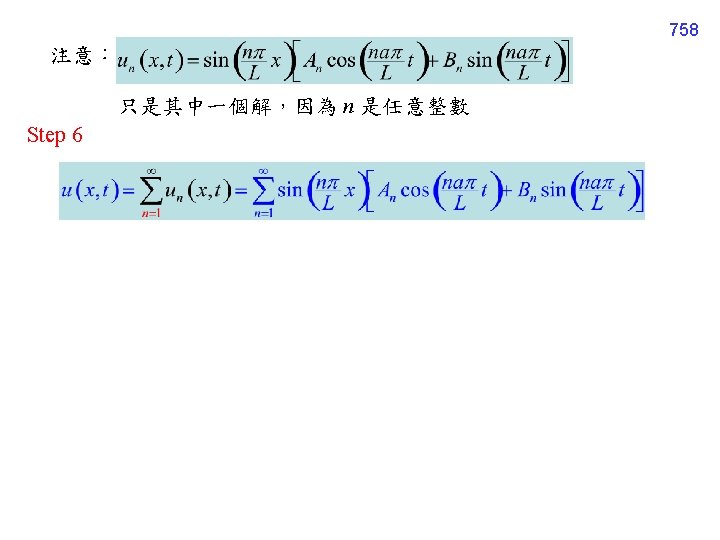
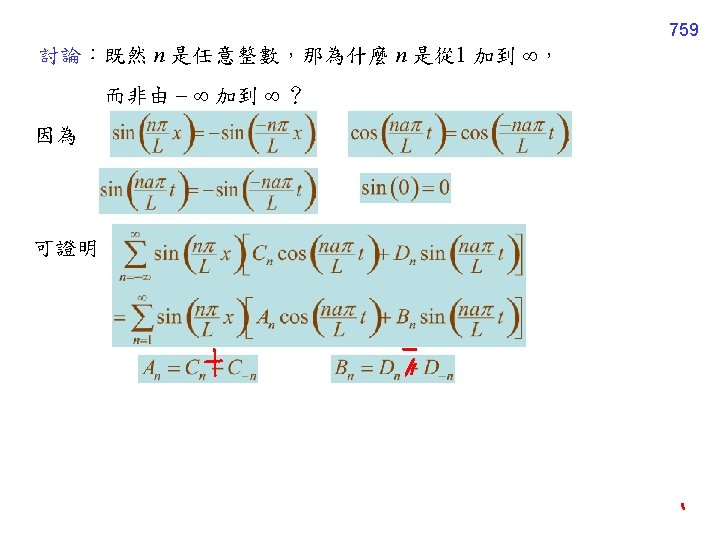
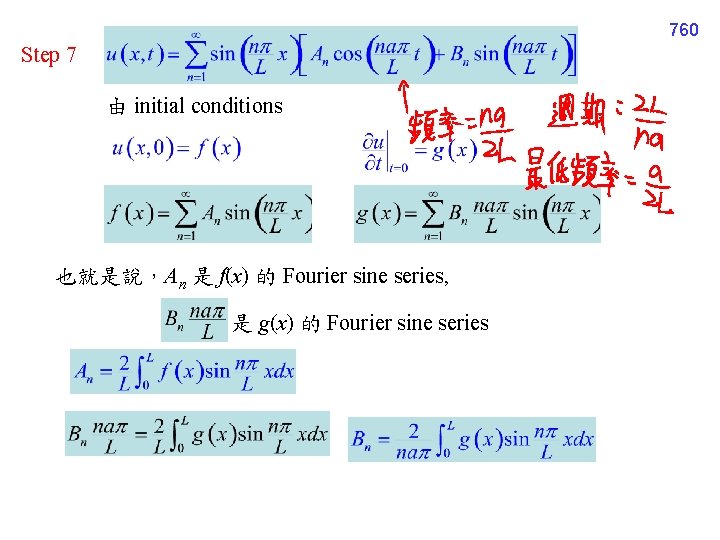
760 Step 7 由 initial conditions 也就是說,An 是 f(x) 的 Fourier sine series, 是 g(x) 的 Fourier sine series
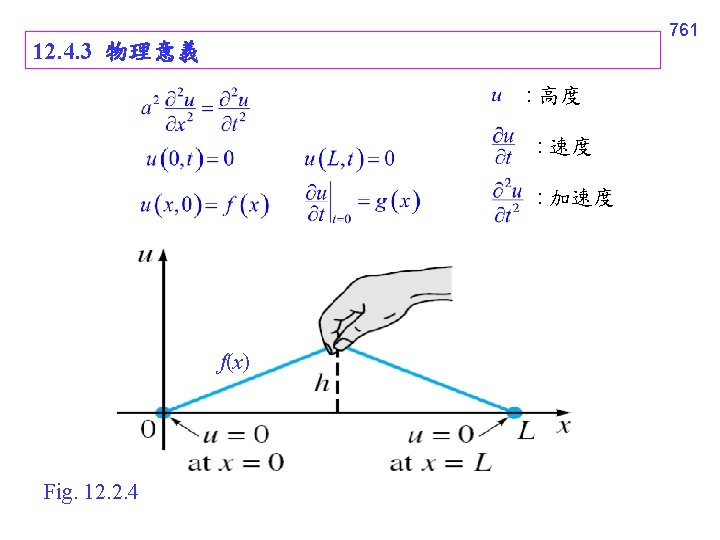
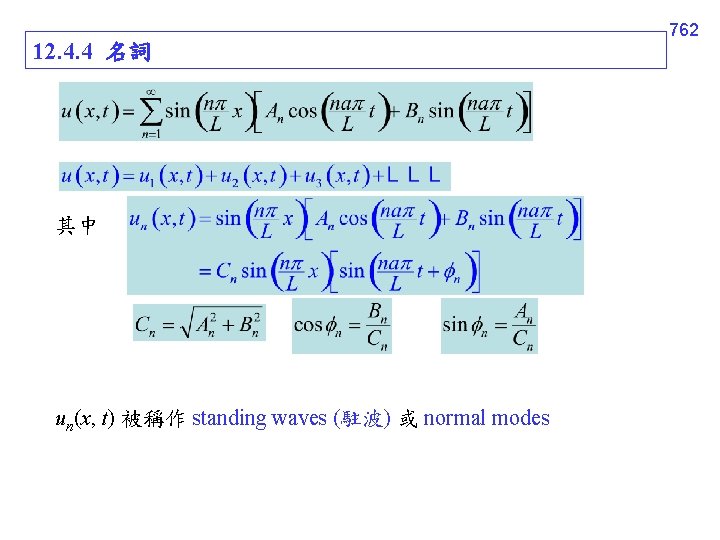
12. 4. 4 名詞 其中 un(x, t) 被稱作 standing waves (駐波) 或 normal modes 762
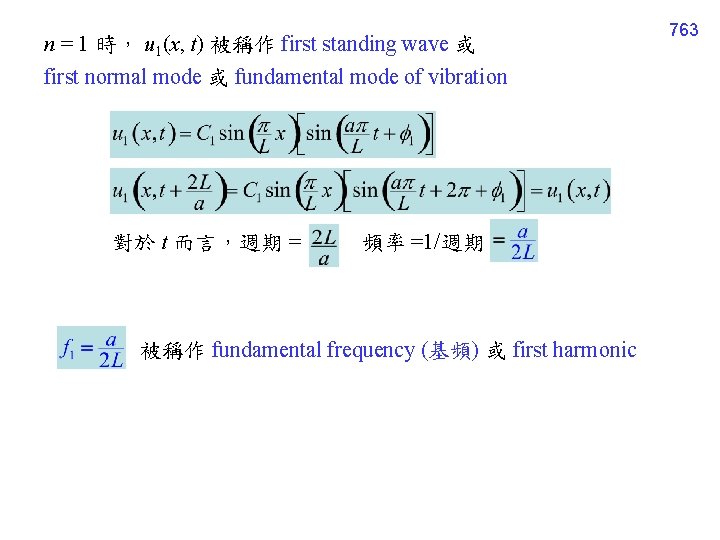
n = 1 時, u 1(x, t) 被稱作 first standing wave 或 first normal mode 或 fundamental mode of vibration 對於 t 而言,週期 = 頻率 =1/週期 被稱作 fundamental frequency (基頻) 或 first harmonic 763
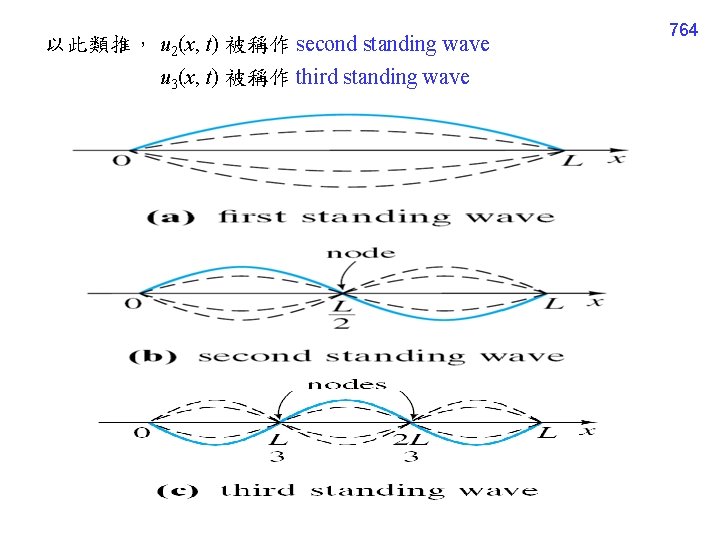
以此類推, u 2(x, t) 被稱作 second standing wave u 3(x, t) 被稱作 third standing wave 764

Section 12. 5 Laplace’s Equation 12. 5. 1 Section 12. 5 綱要 0 < x < a, 0 < y < b, (使用method of separation of variables 來解) 「問題 1」 for 0 < y < b, for 0 < x < a 「問題 2」 for 0 < y < b, for 0 < x < a 「問題 3」 for 0 < x < a for 0 < y < b, 766
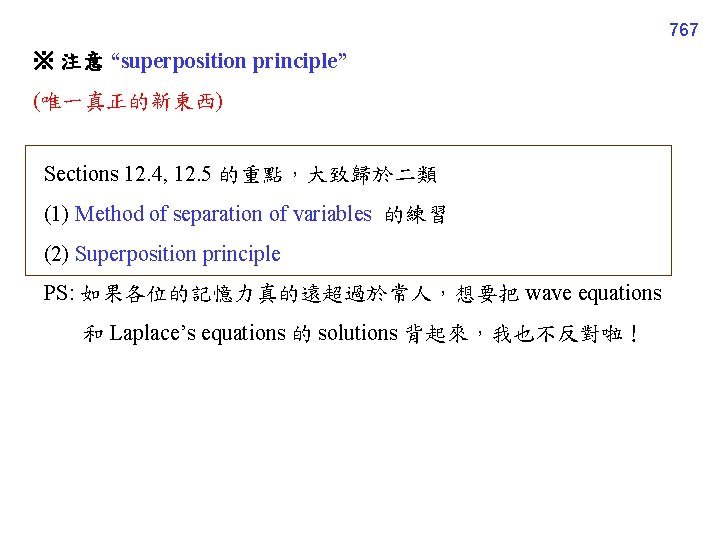
767 ※ 注意 “superposition principle” (唯一真正的新東西) Sections 12. 4, 12. 5 的重點,大致歸於二類 (1) Method of separation of variables 的練習 (2) Superposition principle PS: 如果各位的記憶力真的遠超過於常人,想要把 wave equations 和 Laplace’s equations 的 solutions 背起來,我也不反對啦!
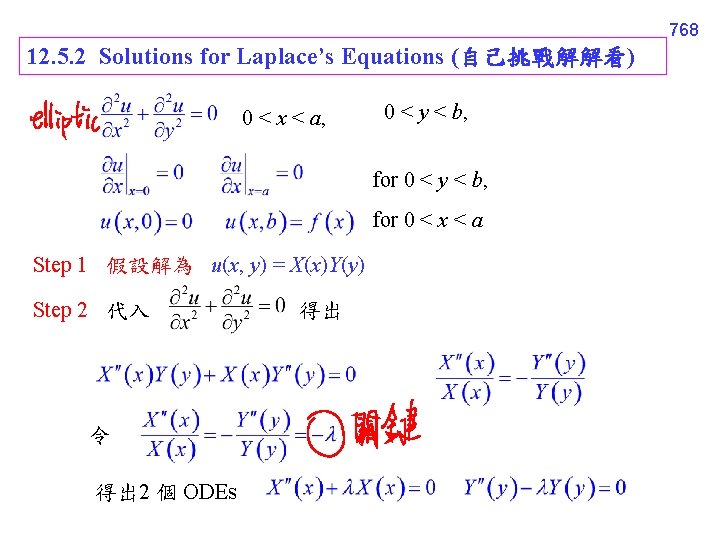
768 12. 5. 2 Solutions for Laplace’s Equations (自己挑戰解解看) 0 < x < a, 0 < y < b, for 0 < x < a Step 1 假設解為 u(x, y) = X(x)Y(y) Step 2 代入 令 得出 2 個 ODEs 得出
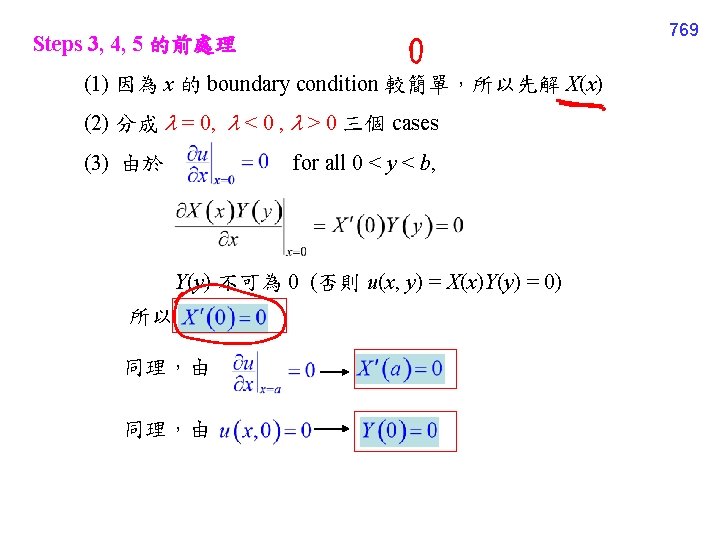
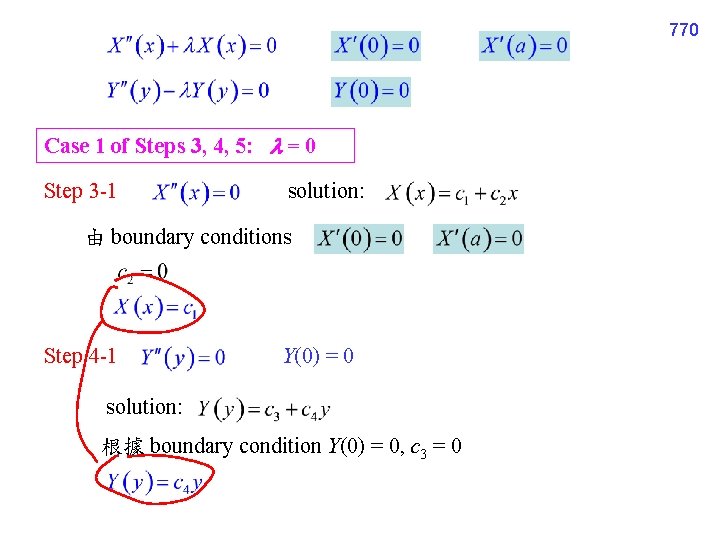
770 Case 1 of Steps 3, 4, 5: = 0 Step 3 -1 solution: 由 boundary conditions Step 4 -1 Y(0) = 0 solution: 根據 boundary condition Y(0) = 0, c 3 = 0
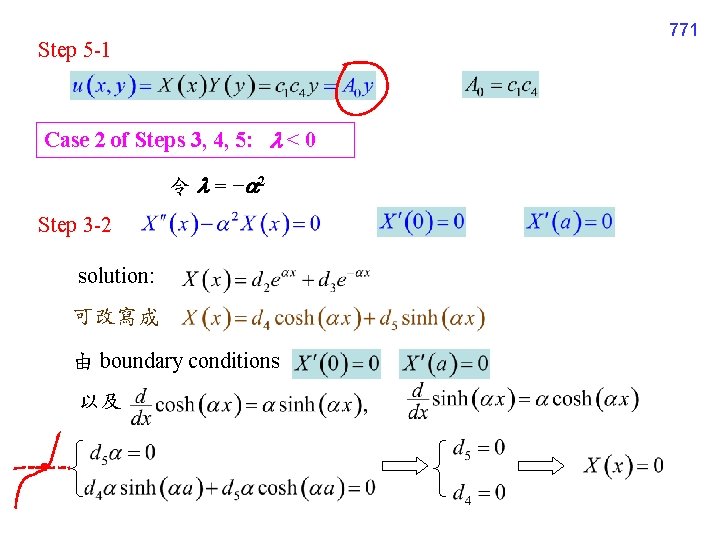
771 Step 5 -1 Case 2 of Steps 3, 4, 5: < 0 令 = − 2 Step 3 -2 solution: 可改寫成 由 boundary conditions 以及

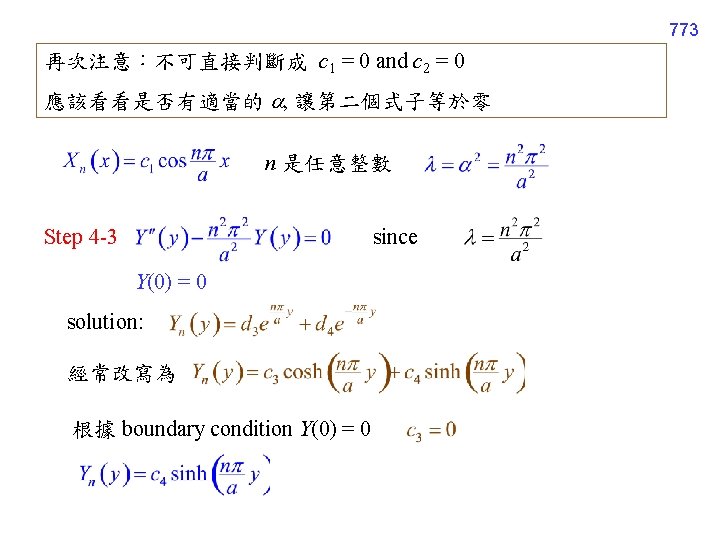
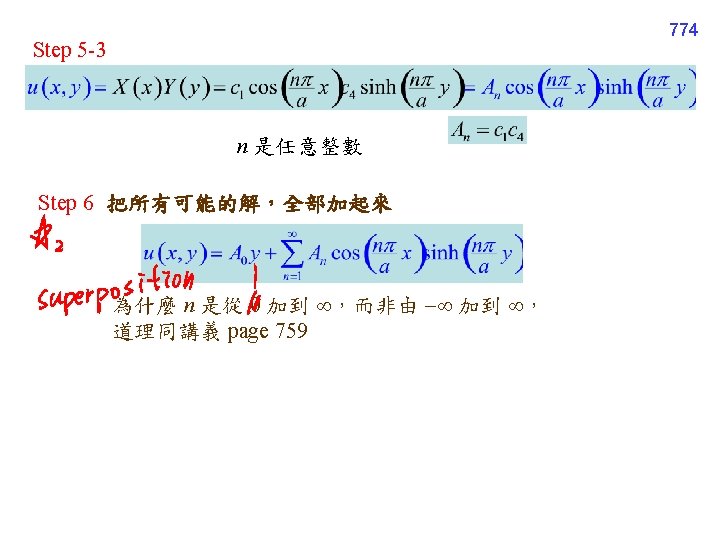
772 因此, case 2 得出 trivial solution u(x, y) = X(x)Y(y) = 0 將無法滿足 < 0 時無解 (不需再算 Steps 4 -2, 5 -2) Case 3 of Steps 3, 4, 5: > 0 令 = 2 Step 3 -3 solution: 由 boundary conditions n 是任意整數
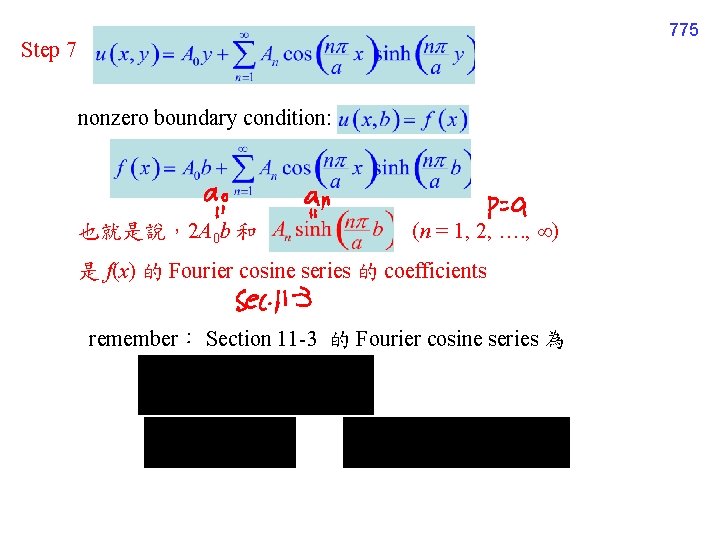
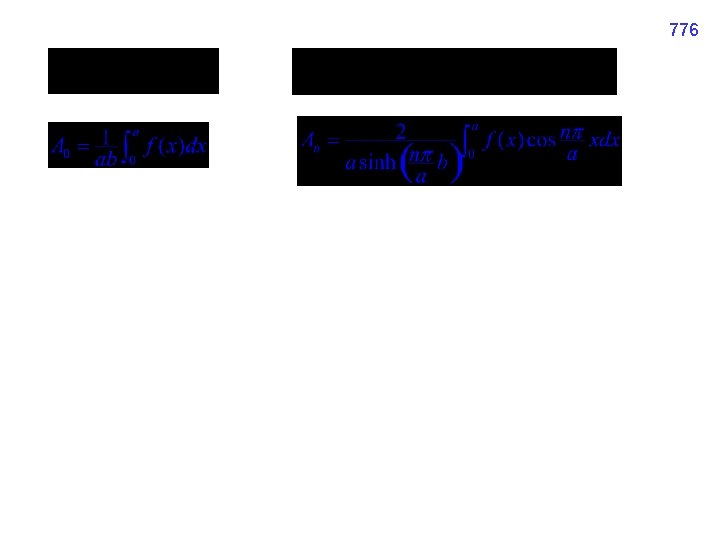
775 Step 7 nonzero boundary condition: 也就是說,2 A 0 b 和 (n = 1, 2, …. , ) 是 f(x) 的 Fourier cosine series 的 coefficients remember: Section 11 -3 的 Fourier cosine series 為
776
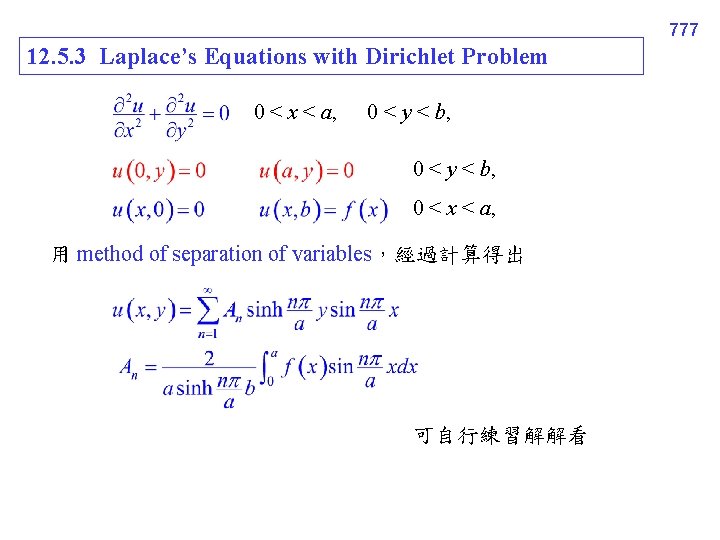
777 12. 5. 3 Laplace’s Equations with Dirichlet Problem 0 < x < a, 0 < y < b, 0 < x < a, 用 method of separation of variables,經過計算得出 可自行練習解解看
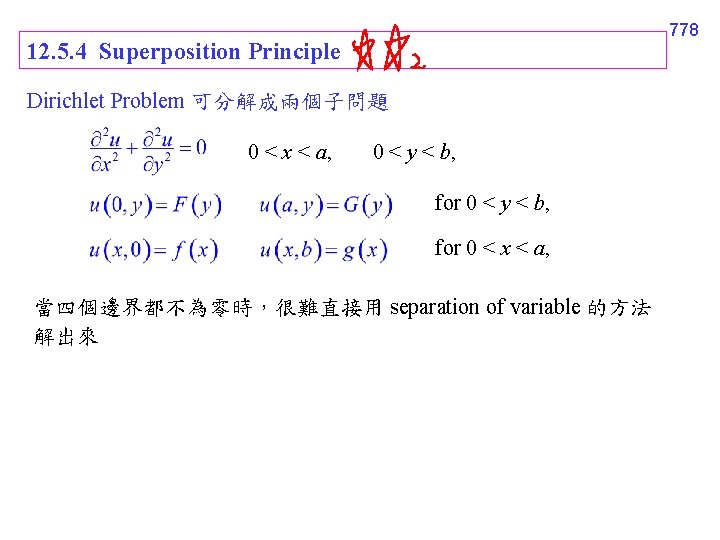
778 12. 5. 4 Superposition Principle Dirichlet Problem 可分解成兩個子問題 0 < x < a, 0 < y < b, for 0 < x < a, 當四個邊界都不為零時,很難直接用 separation of variable 的方法 解出來
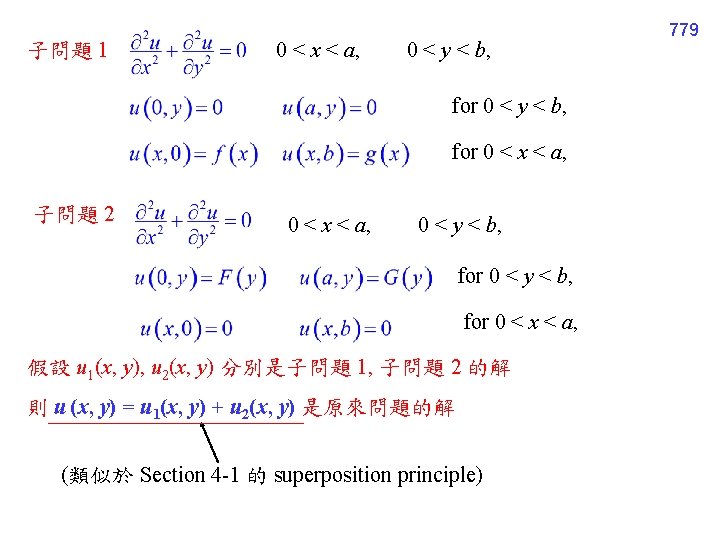

當 u (x, y) = u 1(x, y) + u 2(x, y) u (0, y) = u 1(0, y) + u 2(0, y) = 0 + F(y) = F(y) u (a, y) = u 1(a, y) + u 2(a, y) = 0 + G(y) = G(y) u (x, 0) = u 1(x, 0) + u 2(x, 0) = f(x) + 0 = f(x) u (x, b) = u 1(x, b) + u 2(x, b) = g(x) + 0 = g(x) 780


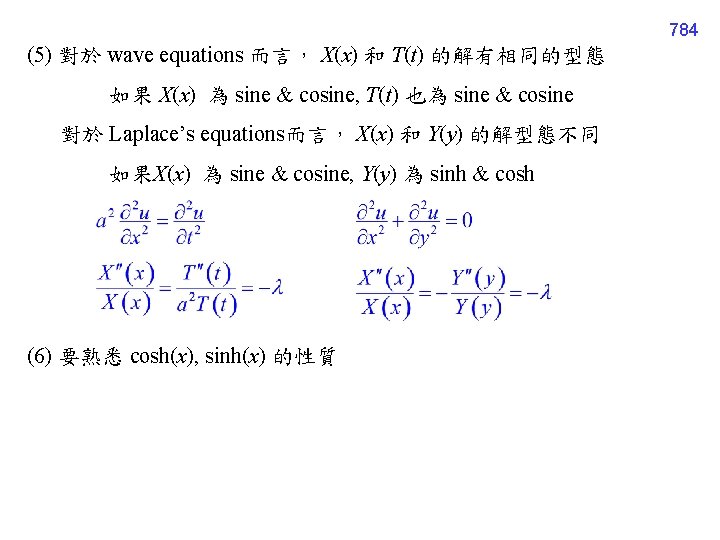
784 (5) 對於 wave equations 而言, X(x) 和 T(t) 的解有相同的型態 如果 X(x) 為 sine & cosine, T(t) 也為 sine & cosine 對於 Laplace’s equations而言, X(x) 和 Y(y) 的解型態不同 如果X(x) 為 sine & cosine, Y(y) 為 sinh & cosh (6) 要熟悉 cosh(x), sinh(x) 的性質
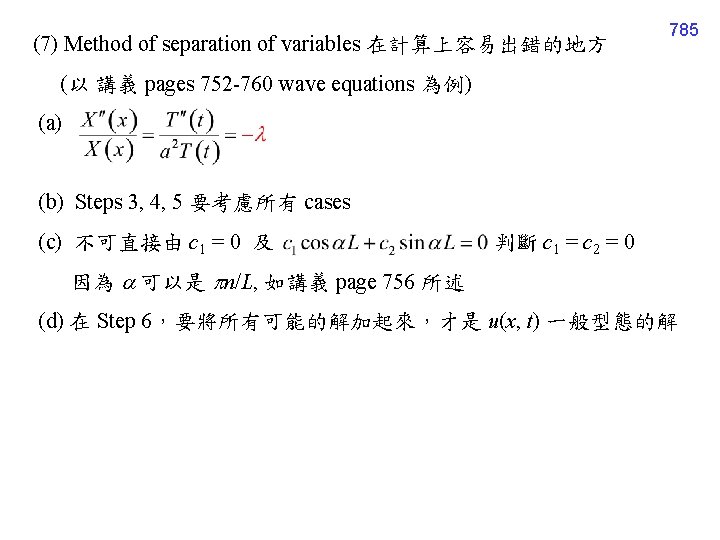
786 Exercise for Practice Section 12 -1 2, 3, 6, 9, 12, 16, 18, 22, 23, 27, 30 Section 12 -2 3, 4, 8, 9 Section 12 -4 1, 3, 4, 7, 8, 9, 11, 14 Section 12 -5 2, 5, 6, 9, 11, 12, 14, 16, 17, 18 Review 12 1, 2, 6

- Slides: 71