
704 MHZ FPC EVOLUTION TOWARDS FPC SERIES FOR
- Slides: 28
704 MHZ FPC EVOLUTION TOWARDS FPC SERIES FOR ESS G. Devanz
OUTLINE q PROTOTYPES q DESIGN EVOLUTIONS FOR ESS q PREPARATION FOR SERIES PRODUCTION WWFPC | June 26 th 2017 | PAGE 2
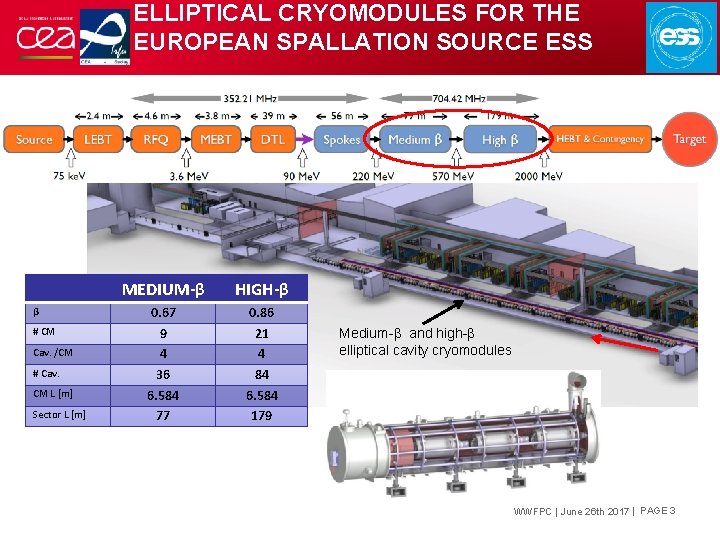
ELLIPTICAL CRYOMODULES FOR THE EUROPEAN SPALLATION SOURCE ESS β # CM Cav. /CM # Cav. CM L [m] Sector L [m] MEDIUM-β HIGH-β 0. 67 9 4 36 6. 584 77 0. 86 21 4 84 6. 584 179 Medium-b and high-b elliptical cavity cryomodules WWFPC | June 26 th 2017 | PAGE 3
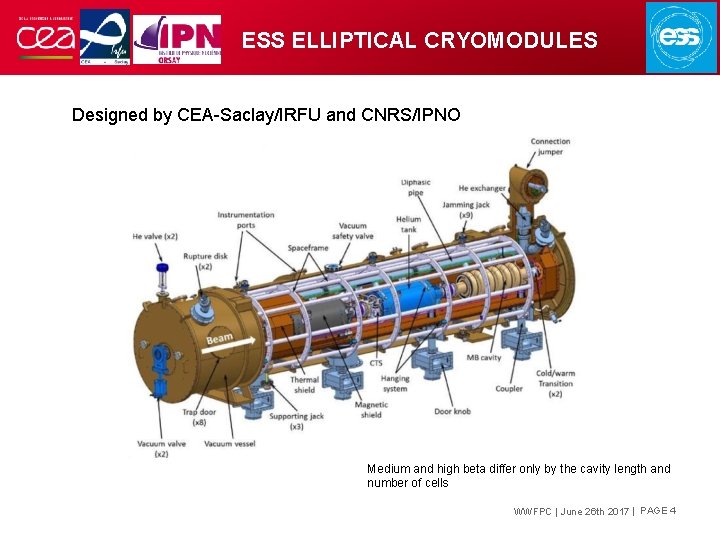
ESS ELLIPTICAL CRYOMODULES Designed by CEA-Saclay/IRFU and CNRS/IPNO Medium and high beta differ only by the cavity length and number of cells WWFPC | June 26 th 2017 | PAGE 4
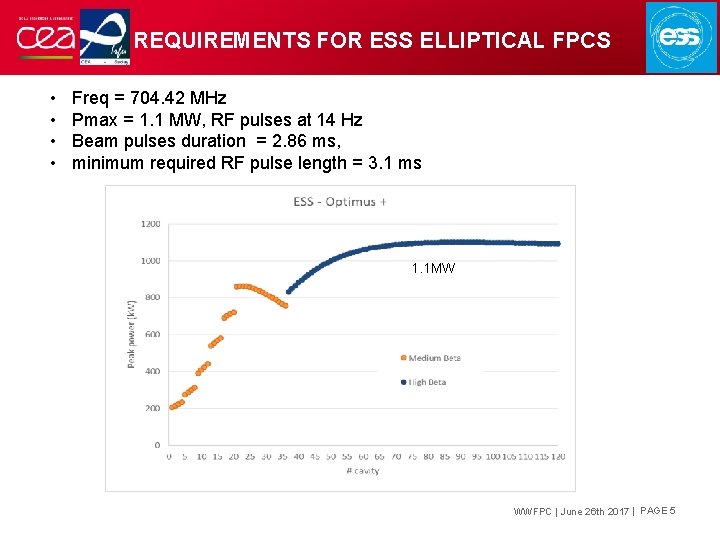
REQUIREMENTS FOR ESS ELLIPTICAL FPCS • • Freq = 704. 42 MHz Pmax = 1. 1 MW, RF pulses at 14 Hz Beam pulses duration = 2. 86 ms, minimum required RF pulse length = 3. 1 ms 1. 1 MW WWFPC | June 26 th 2017 | PAGE 5
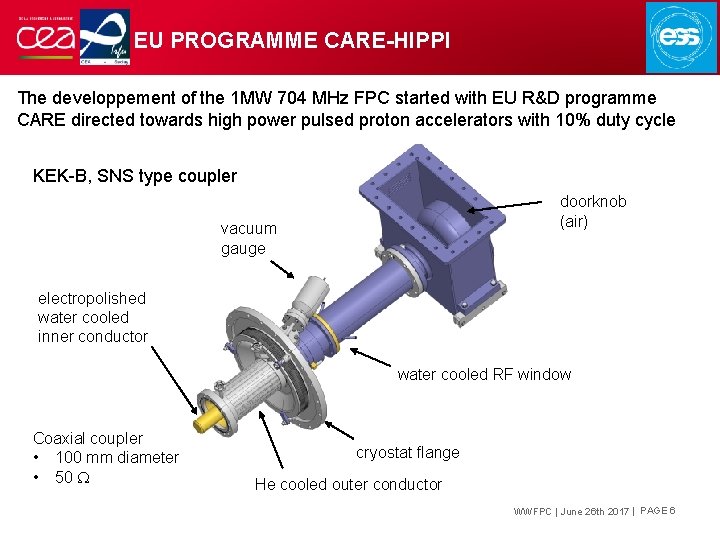
EU PROGRAMME CARE-HIPPI The developpement of the 1 MW 704 MHz FPC started with EU R&D programme CARE directed towards high power pulsed proton accelerators with 10% duty cycle KEK-B, SNS type coupler doorknob (air) vacuum gauge electropolished water cooled inner conductor water cooled RF window Coaxial coupler • 100 mm diameter • 50 W cryostat flange He cooled outer conductor WWFPC | June 26 th 2017 | PAGE 6
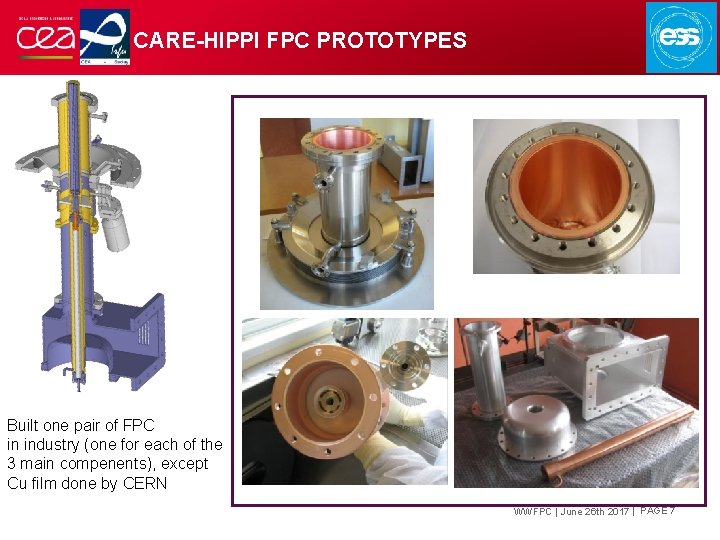
CARE-HIPPI FPC PROTOTYPES Built one pair of FPC in industry (one for each of the 3 main compenents), except Cu film done by CERN WWFPC | June 26 th 2017 | PAGE 7
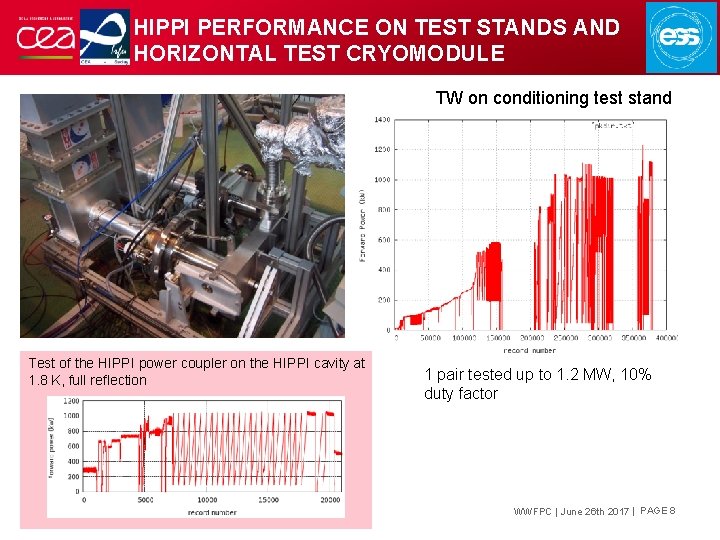
HIPPI PERFORMANCE ON TEST STANDS AND HORIZONTAL TEST CRYOMODULE TW on conditioning test stand Test of the HIPPI power coupler on the HIPPI cavity at 1. 8 K, full reflection 1 pair tested up to 1. 2 MW, 10% duty factor WWFPC | June 26 th 2017 | PAGE 8
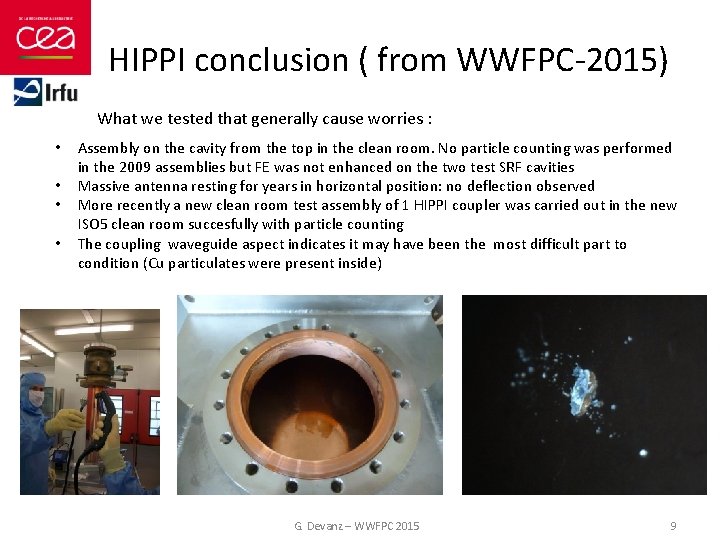
HIPPI conclusion ( from WWFPC-2015) What we tested that generally cause worries : • • Assembly on the cavity from the top in the clean room. No particle counting was performed in the 2009 assemblies but FE was not enhanced on the two test SRF cavities Massive antenna resting for years in horizontal position: no deflection observed More recently a new clean room test assembly of 1 HIPPI coupler was carried out in the new ISO 5 clean room succesfully with particle counting The coupling waveguide aspect indicates it may have been the most difficult part to condition (Cu particulates were present inside) G. Devanz – WWFPC 2015 9
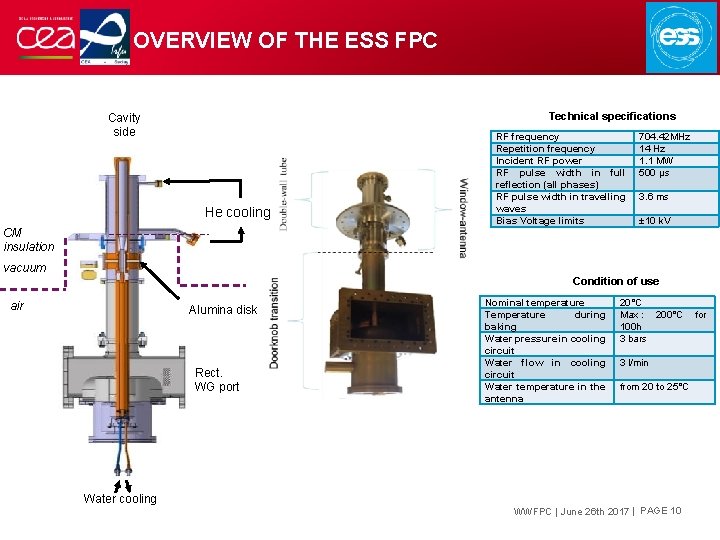
OVERVIEW OF THE ESS FPC Technical specifications Cavity side He cooling CM insulation RF frequency Repetition frequency Incident RF power RF pulse width in full reflection (all phases) RF pulse width in travelling waves Bias Voltage limits 704. 42 MHz 14 Hz 1. 1 MW 500 μs 3. 6 ms ± 10 k. V vacuum Condition of use air Alumina disk Rect. WG port Water cooling Nominal temperature Temperature during baking Water pressure in cooling circuit Water flow in cooling circuit Water temperature in the antenna 20°C Max : 200°C 100 h 3 bars 3 l/min from 20 to 25°C WWFPC | June 26 th 2017 | PAGE 10 for
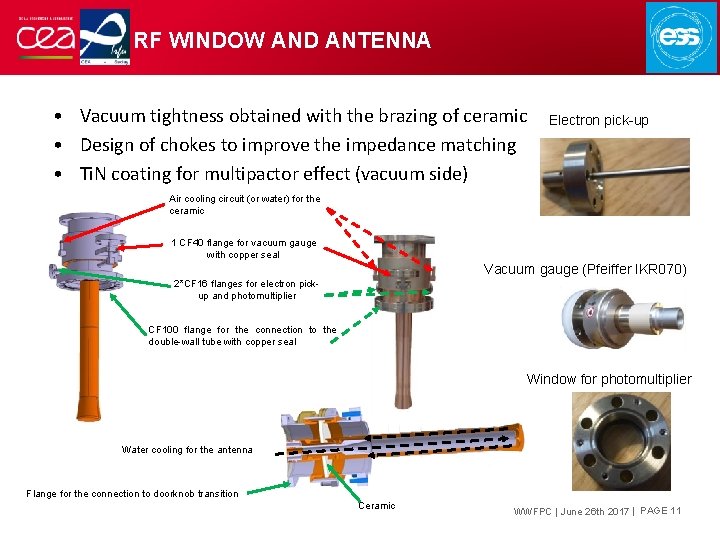
RF WINDOW AND ANTENNA • Vacuum tightness obtained with the brazing of ceramic • Design of chokes to improve the impedance matching • Ti. N coating for multipactor effect (vacuum side) Electron pick-up Air cooling circuit (or water) for the ceramic 1 CF 40 flange for vacuum gauge with copper seal Vacuum gauge (Pfeiffer IKR 070) 2*CF 16 flanges for electron pickup and photomultiplier CF 100 flange for the connection to the double-wall tube with copper seal Window for photomultiplier Water cooling for the antenna Flange for the connection to doorknob transition Ceramic WWFPC | June 26 th 2017 | PAGE 11
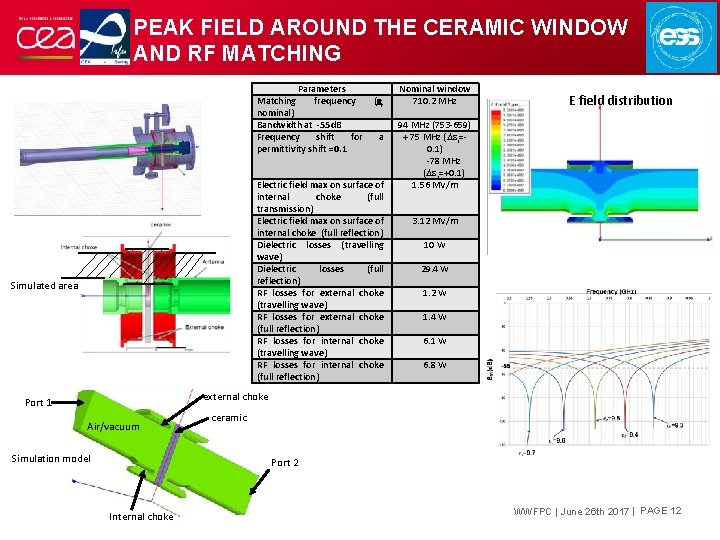
PEAK FIELD AROUND THE CERAMIC WINDOW AND RF MATCHING Parameters Matching frequency nominal) Bandwidth at -55 d. B Frequency shift for permittivity shift =0. 1 • RF simulations (er a Electric field max on surface of internal choke (full transmission) Electric field max on surface of internal choke (full reflection) Dielectric losses (travelling wave) Dielectric losses (full reflection) RF losses for external choke (travelling wave) RF losses for external choke (full reflection) RF losses for internal choke (travelling wave) RF losses for internal choke (full reflection) Simulated area Nominal window 710. 2 MHz E field distribution 94 MHz (753 -659) + 75 MHz (Der=0. 1) -78 MHz (Der=+0. 1) 1. 56 MV/m 3. 12 MV/m 10 W 29. 4 W 1. 2 W 1. 4 W 6. 1 W 6. 8 W external choke Port 1 Air/vacuum Simulation model ceramic Port 2 Internal choke WWFPC | June 26 th 2017 | PAGE 12
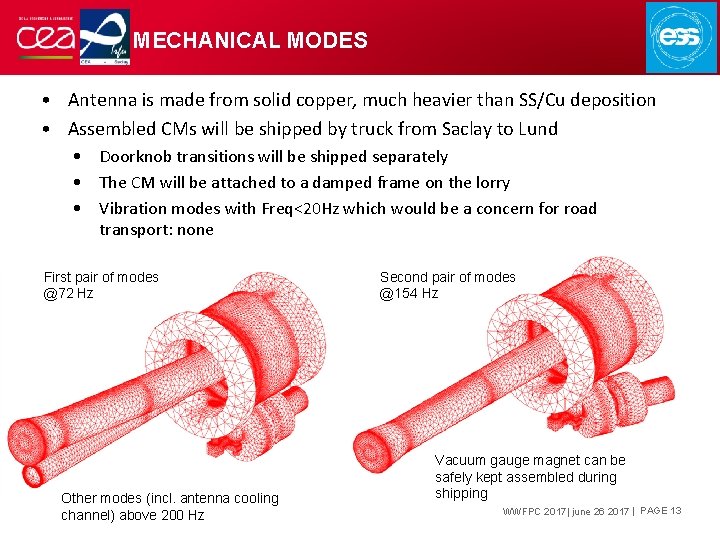
MECHANICAL MODES • Antenna is made from solid copper, much heavier than SS/Cu deposition • Assembled CMs will be shipped by truck from Saclay to Lund • Doorknob transitions will be shipped separately • The CM will be attached to a damped frame on the lorry • Vibration modes with Freq<20 Hz which would be a concern for road transport: none First pair of modes @72 Hz Other modes (incl. antenna cooling channel) above 200 Hz Second pair of modes @154 Hz Vacuum gauge magnet can be safely kept assembled during shipping WWFPC 2017| june 26 2017 | PAGE 13
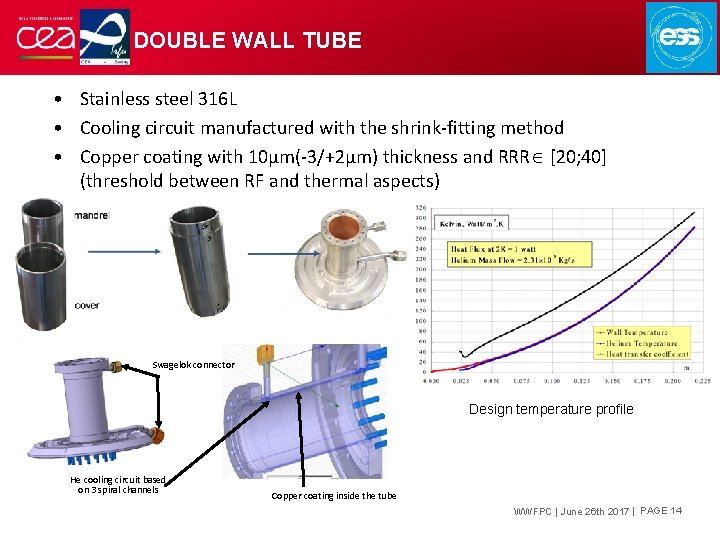
DOUBLE WALL TUBE • Stainless steel 316 L • Cooling circuit manufactured with the shrink-fitting method • Copper coating with 10µm(-3/+2µm) thickness and RRR [20; 40] (threshold between RF and thermal aspects) Swagelok connector Design temperature profile He cooling circuit based on 3 spiral channels Copper coating inside the tube WWFPC | June 26 th 2017 | PAGE 14
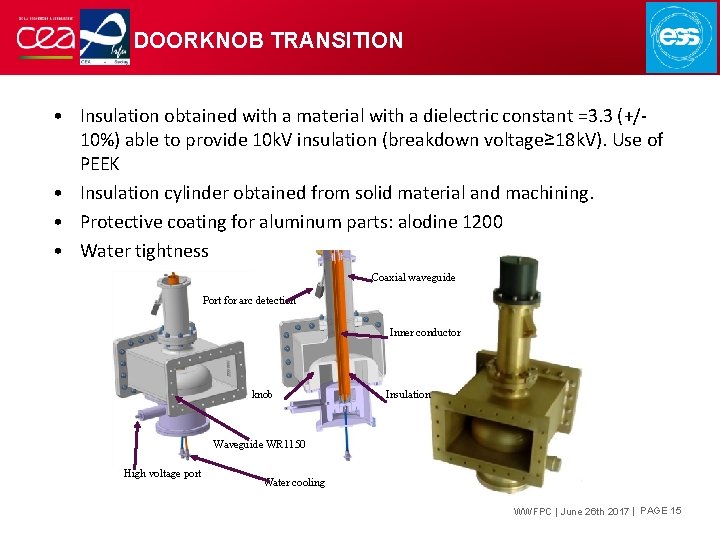
DOORKNOB TRANSITION • Insulation obtained with a material with a dielectric constant =3. 3 (+/10%) able to provide 10 k. V insulation (breakdown voltage≥ 18 k. V). Use of PEEK • Insulation cylinder obtained from solid material and machining. • Protective coating for aluminum parts: alodine 1200 • Water tightness Coaxial waveguide Port for arc detection Inner conductor knob Insulation Waveguide WR 1150 High voltage port Water cooling WWFPC | June 26 th 2017 | PAGE 15
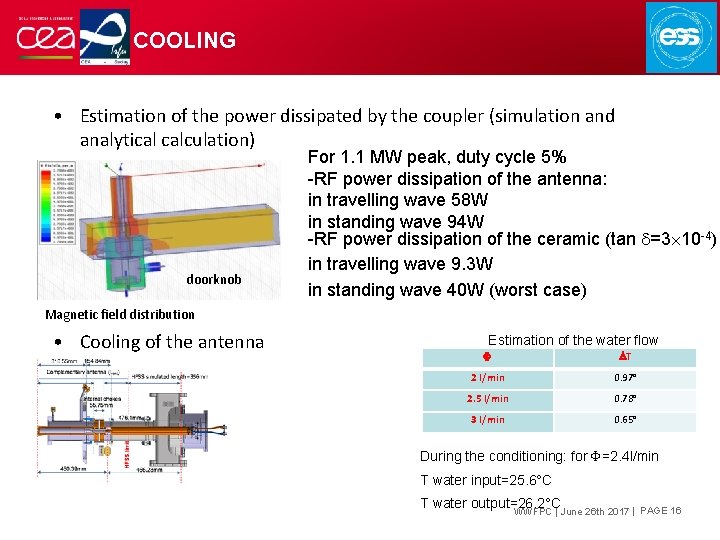
COOLING • Estimation of the power dissipated by the coupler (simulation and analytical calculation) doorknob For 1. 1 MW peak, duty cycle 5% -RF power dissipation of the antenna: in travelling wave 58 W in standing wave 94 W -RF power dissipation of the ceramic (tan d=3 10 -4) in travelling wave 9. 3 W in standing wave 40 W (worst case) Magnetic field distribution • Cooling of the antenna Estimation of the water flow DT 2 l/min 0. 97° 2. 5 l/min 0. 78° 3 l/min 0. 65° During the conditioning: for =2. 4 l/min T water input=25. 6°C T water output=26. 2°C WWFPC | June 26 th 2017 | PAGE 16
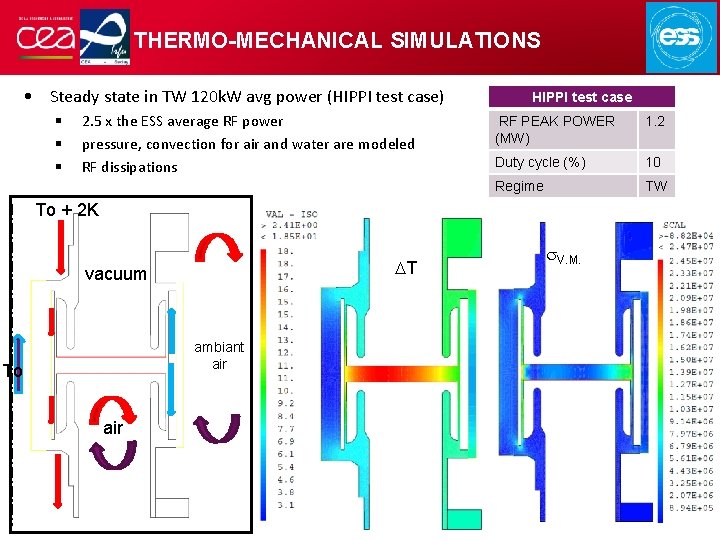
THERMO-MECHANICAL SIMULATIONS • Steady state in TW 120 k. W avg power (HIPPI test case) § § § 2. 5 x the ESS average RF power pressure, convection for air and water are modeled RF dissipations HIPPI test case RF PEAK POWER (MW) 1. 2 Duty cycle (%) 10 Regime TW To + 2 K DT vacuum s. V. M. ambiant air To air WWFPC 2017| june 26 2017 | PAGE 17
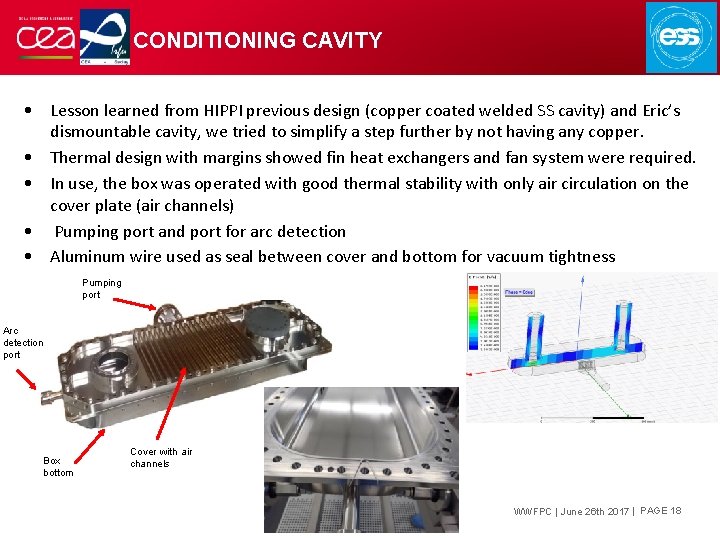
CONDITIONING CAVITY • Lesson learned from HIPPI previous design (copper coated welded SS cavity) and Eric’s dismountable cavity, we tried to simplify a step further by not having any copper. • Thermal design with margins showed fin heat exchangers and fan system were required. • In use, the box was operated with good thermal stability with only air circulation on the cover plate (air channels) • Pumping port and port for arc detection • Aluminum wire used as seal between cover and bottom for vacuum tightness Pumping port Arc detection port Box bottom Cover with air channels WWFPC | June 26 th 2017 | PAGE 18
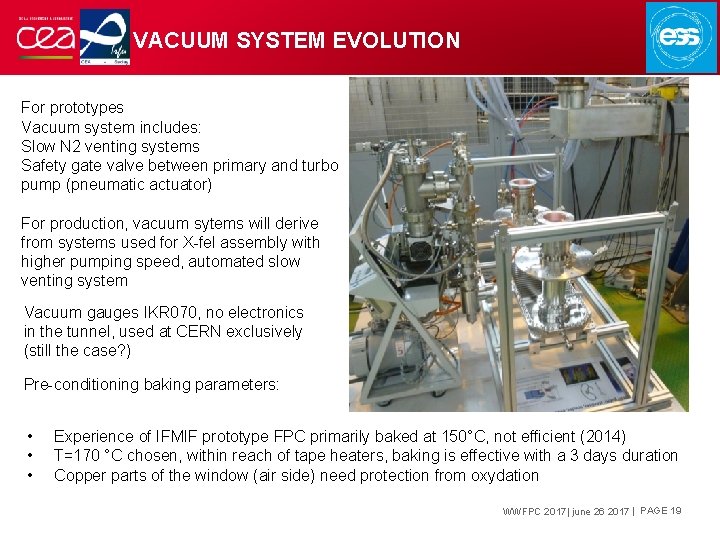
VACUUM SYSTEM EVOLUTION For prototypes Vacuum system includes: Slow N 2 venting systems Safety gate valve between primary and turbo pump (pneumatic actuator) For production, vacuum sytems will derive from systems used for X-fel assembly with higher pumping speed, automated slow venting system Vacuum gauges IKR 070, no electronics in the tunnel, used at CERN exclusively (still the case? ) Pre-conditioning baking parameters: • • • Experience of IFMIF prototype FPC primarily baked at 150°C, not efficient (2014) T=170 °C chosen, within reach of tape heaters, baking is effective with a 3 days duration Copper parts of the window (air side) need protection from oxydation WWFPC 2017| june 26 2017 | PAGE 19
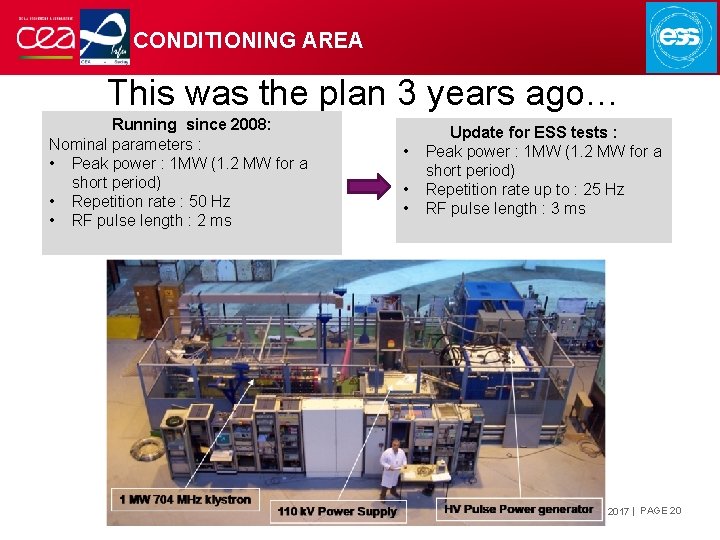
CONDITIONING AREA This was the plan 3 years ago… Running since 2008: Nominal parameters : • Peak power : 1 MW (1. 2 MW for a short period) • Repetition rate : 50 Hz • RF pulse length : 2 ms • • • Update for ESS tests : Peak power : 1 MW (1. 2 MW for a short period) Repetition rate up to : 25 Hz RF pulse length : 3 ms WWFPC | June 26 th 2017 | PAGE 20
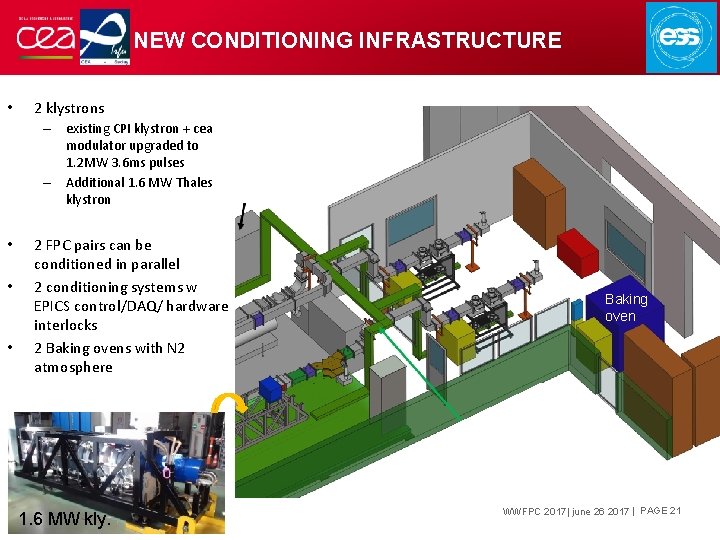
NEW CONDITIONING INFRASTRUCTURE • 2 klystrons – existing CPI klystron + cea modulator upgraded to 1. 2 MW 3. 6 ms pulses – Additional 1. 6 MW Thales klystron • • • 2 FPC pairs can be conditioned in parallel 2 conditioning systems w EPICS control/DAQ/ hardware interlocks 2 Baking ovens with N 2 atmosphere 1. 6 MW kly. Baking oven WWFPC 2017| june 26 2017 | PAGE 21
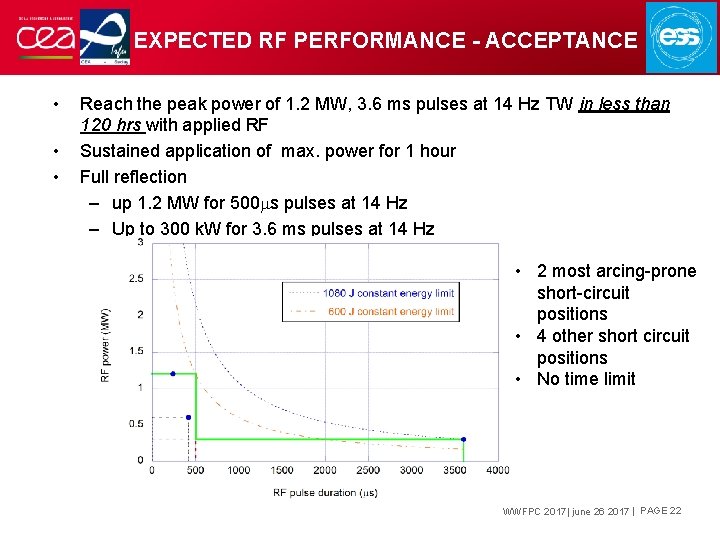
EXPECTED RF PERFORMANCE - ACCEPTANCE • • • Reach the peak power of 1. 2 MW, 3. 6 ms pulses at 14 Hz TW in less than 120 hrs with applied RF Sustained application of max. power for 1 hour Full reflection – up 1. 2 MW for 500 ms pulses at 14 Hz – Up to 300 k. W for 3. 6 ms pulses at 14 Hz • 2 most arcing-prone short-circuit positions • 4 other short circuit positions • No time limit WWFPC 2017| june 26 2017 | PAGE 22
MANUFACTURING PREPARATION • Prototypes have been fabricated in a different context than the series production (FPC procurements for ECCTDs , ESS CM prototypes) • Difficult step is to have the manufacturing company endorse the design which is not its own to the point they agree to have the coupler accepted based on high power performance (previous slide conditions) • It was not required to have them built ESS FPC prototypes beforehand in order to be part of the call for tender for the series • Having a power test of the prototypes was anyway necessary to prove them the level of risk that the FPC fails is acceptably low and at least that the design (RF, thermo-mechanical) is valid. WWFPC 2017| june 26 2017 | PAGE 23
MANUFACTURING PREPARATION • ESS FPC Prototypes (before call for tender): ‒ ‒ 8 window antenna assemblies from supplier 1 4 double wall tubes from supplier 2, Cu coating subcontracted by supplier 3 4 doorknob transitions from supplier 2 2 complete FPCs inluding doorknob from supplier 3 • RF conditioning passed with success involving windows from 1 and 3 • Being aware of the succesful RF test of 2 pairs , 3 companies presented offers for the series (supplier 1, 3 and 4) • Two major companies involed in FPC manufacturing did not build any protoype, nor RF window: – One did not even participate to the first round of the Cf. T (publicity) – The other did WWFPC 2017| june 26 2017 | PAGE 24
SERIAL MANUFACTURING CONTRACT STRATEGY After the production readiness review is passed, manufacturer capability is assessed based on • Initial Samples of each critical manufacturing step: – – • Cu coating on real size ss tube Window Antenna weld and electropolishing Bias insulator a pre-series of 6 couplers : they must pass acceptance test For each pair acceptance is based on : • Dimension control • Leak test, RGA • Visual inspection • RF performance After preseries acceptance, and QC control audit, series production is authorized Sampling of critical processes is maintained but is set at a different rate WWFPC 2017| june 26 2017 | PAGE 25
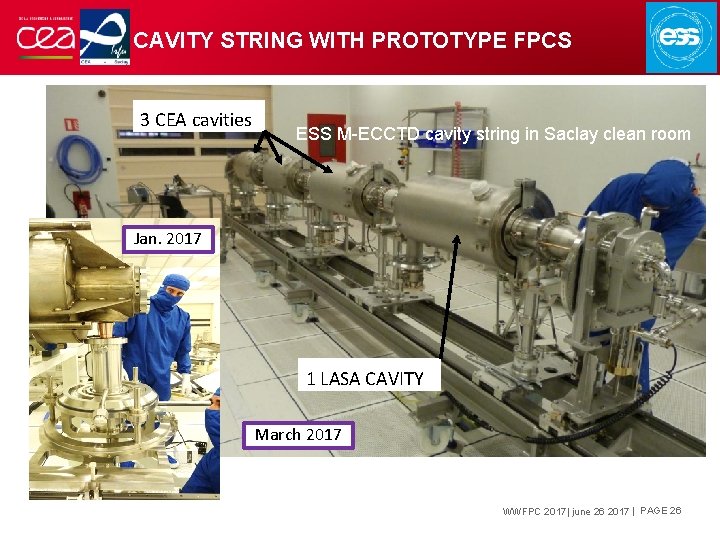
CAVITY STRING WITH PROTOTYPE FPCS 3 CEA cavities ESS M-ECCTD cavity string in Saclay clean room Jan. 2017 1 LASA CAVITY March 2017 WWFPC 2017| june 26 2017 | PAGE 26
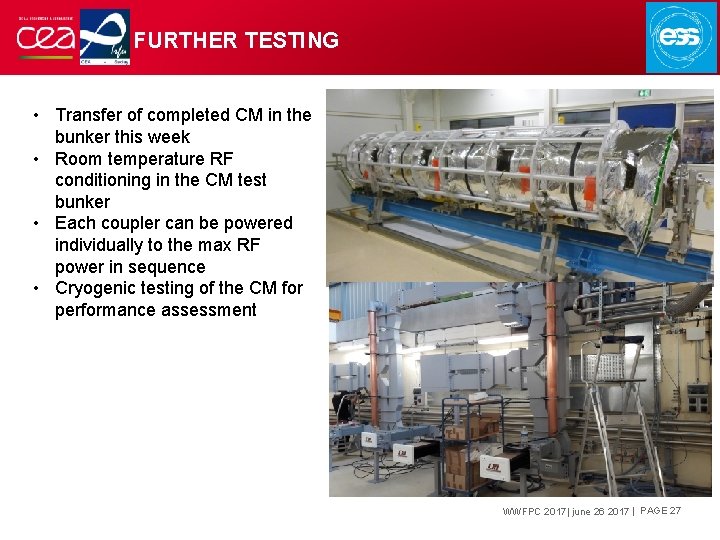
FURTHER TESTING • Transfer of completed CM in the bunker this week • Room temperature RF conditioning in the CM test bunker • Each coupler can be powered individually to the max RF power in sequence • Cryogenic testing of the CM for performance assessment WWFPC 2017| june 26 2017 | PAGE 27
Thank you | PAGE 28 Commissariat à l’énergie atomique et aux énergies alternatives Centre de Saclay | 91191 Gif-sur-Yvette Cedex T. +33 (0)1 69 08 76 11 | F. +33 (0)1 69 08 30 24 Etablissement public à caractère industriel et commercial RCS Paris B 775 685 019 |