
7 The Nervous System PART A Power Point
- Slides: 27
7 The Nervous System PART A Power. Point® Lecture Slide Presentation by Jerry L. Cook, Sam Houston University ESSENTIALS OF HUMAN ANATOMY & PHYSIOLOGY EIGHTH EDITION ELAINE N. MARIEB Copyright © 2006 Pearson Education, Inc. , publishing as Benjamin Cummings
Functions of the Nervous System § Sensory input – gathering information § To monitor changes occurring inside and outside the body § Changes = stimuli § Integration § To process and interpret sensory input and decide if action is needed Copyright © 2006 Pearson Education, Inc. , publishing as Benjamin Cummings
Functions of the Nervous System § Motor output § A response to integrated stimuli § The response activates muscles or glands Copyright © 2006 Pearson Education, Inc. , publishing as Benjamin Cummings
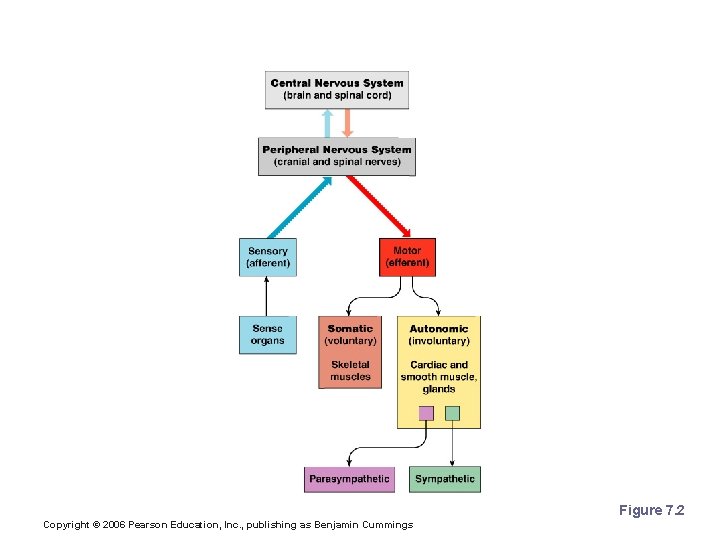
Structural Classification of the Nervous System § Central nervous system (CNS) § Brain § Spinal cord § Peripheral nervous system (PNS) § Nerve outside the brain and spinal cord Copyright © 2006 Pearson Education, Inc. , publishing as Benjamin Cummings
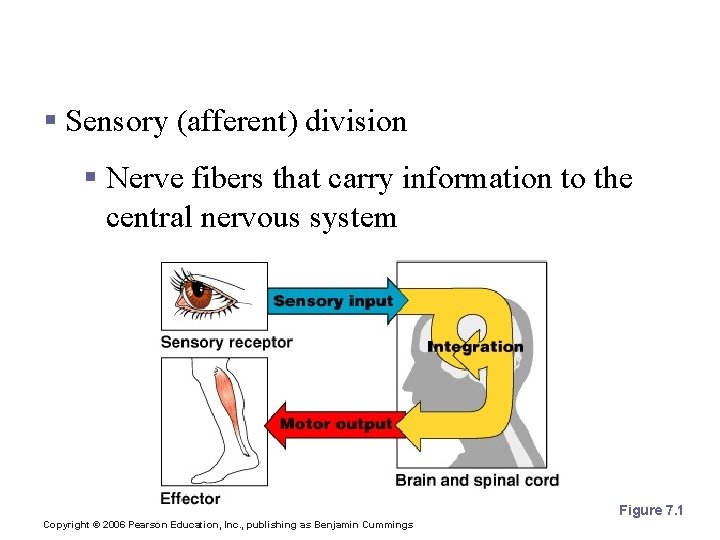
Functional Classification of the Peripheral Nervous System § Sensory (afferent) division § Nerve fibers that carry information to the central nervous system Figure 7. 1 Copyright © 2006 Pearson Education, Inc. , publishing as Benjamin Cummings
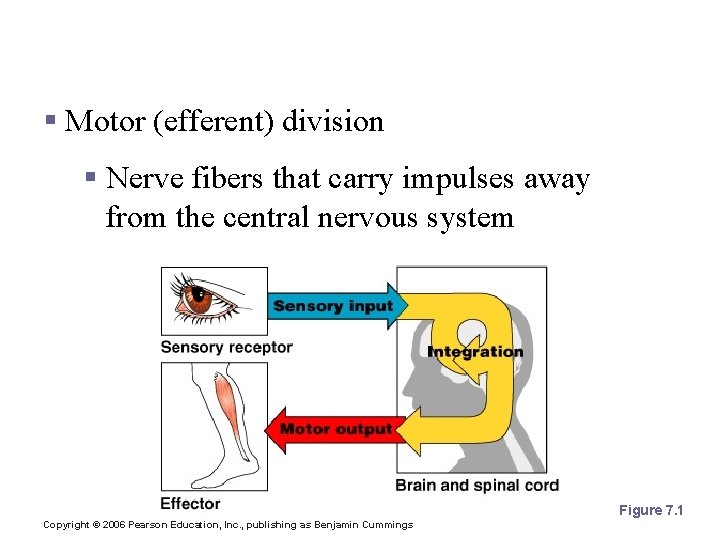
Functional Classification of the Peripheral Nervous System § Motor (efferent) division § Nerve fibers that carry impulses away from the central nervous system Figure 7. 1 Copyright © 2006 Pearson Education, Inc. , publishing as Benjamin Cummings
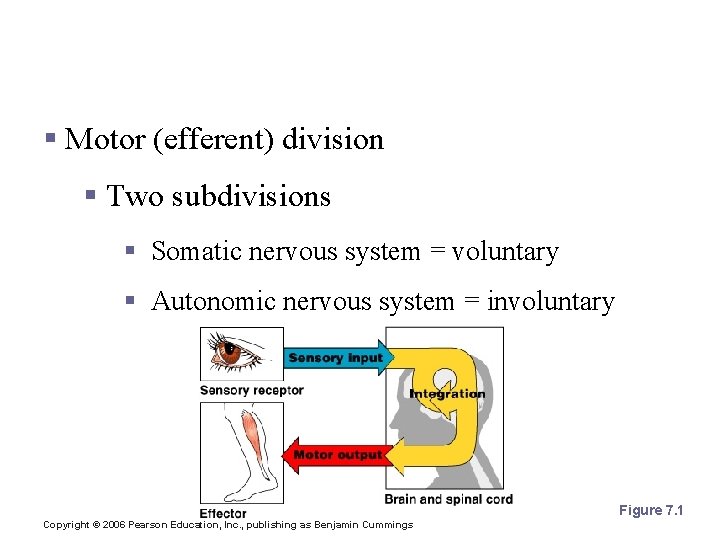
Functional Classification of the Peripheral Nervous System § Motor (efferent) division § Two subdivisions § Somatic nervous system = voluntary § Autonomic nervous system = involuntary Figure 7. 1 Copyright © 2006 Pearson Education, Inc. , publishing as Benjamin Cummings
Organization of the Nervous System Figure 7. 2 Copyright © 2006 Pearson Education, Inc. , publishing as Benjamin Cummings
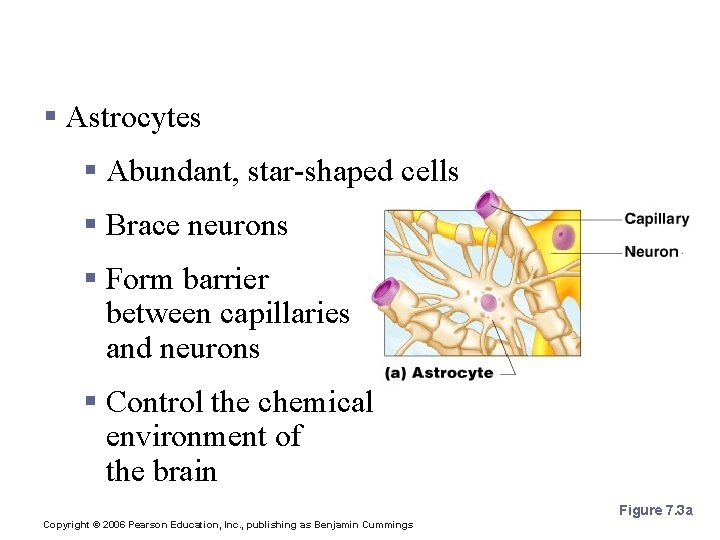
Nervous Tissue: Support Cells (Neuroglia) § Astrocytes § Abundant, star-shaped cells § Brace neurons § Form barrier between capillaries and neurons § Control the chemical environment of the brain Figure 7. 3 a Copyright © 2006 Pearson Education, Inc. , publishing as Benjamin Cummings
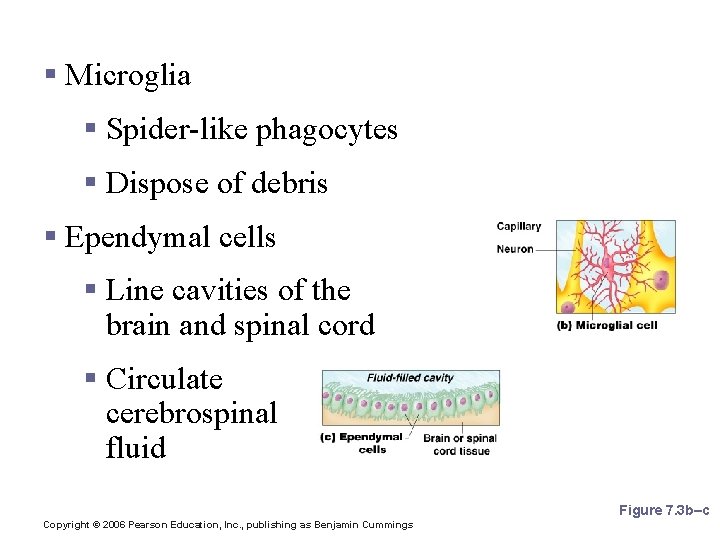
Nervous Tissue: Support Cells § Microglia § Spider-like phagocytes § Dispose of debris § Ependymal cells § Line cavities of the brain and spinal cord § Circulate cerebrospinal fluid Figure 7. 3 b–c Copyright © 2006 Pearson Education, Inc. , publishing as Benjamin Cummings
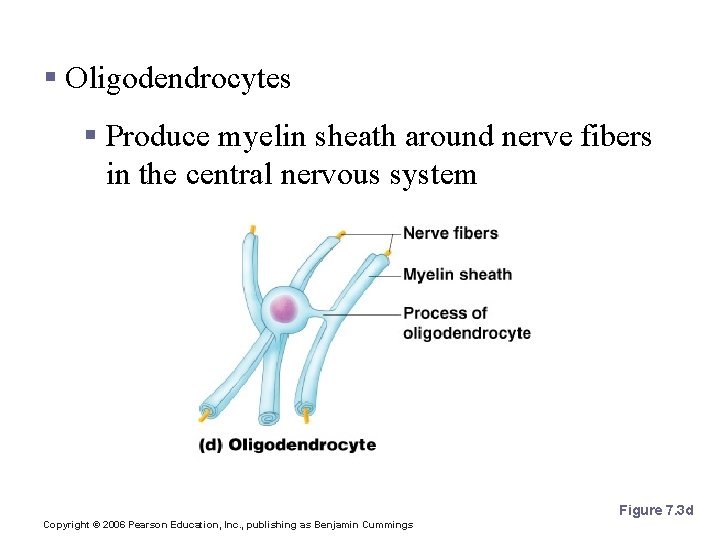
Nervous Tissue: Support Cells § Oligodendrocytes § Produce myelin sheath around nerve fibers in the central nervous system Figure 7. 3 d Copyright © 2006 Pearson Education, Inc. , publishing as Benjamin Cummings
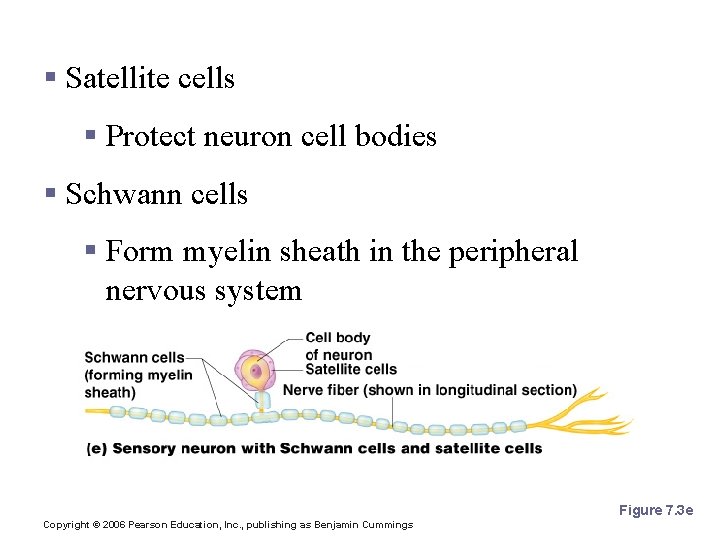
Nervous Tissue: Support Cells § Satellite cells § Protect neuron cell bodies § Schwann cells § Form myelin sheath in the peripheral nervous system Figure 7. 3 e Copyright © 2006 Pearson Education, Inc. , publishing as Benjamin Cummings
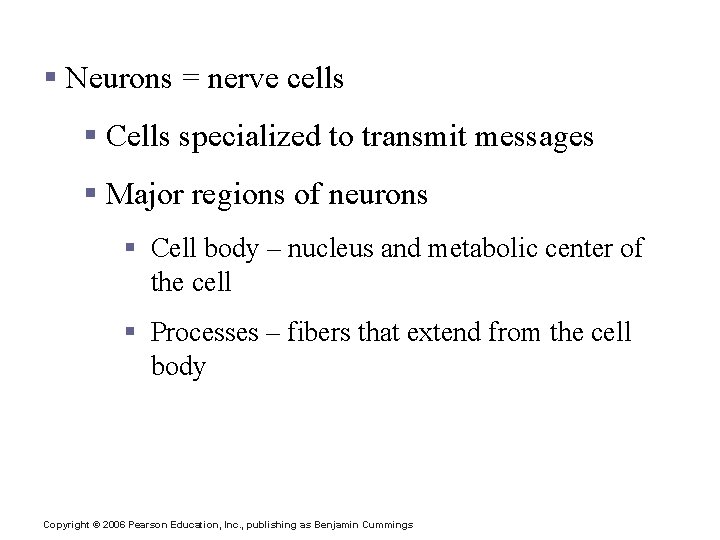
Nervous Tissue: Neurons § Neurons = nerve cells § Cells specialized to transmit messages § Major regions of neurons § Cell body – nucleus and metabolic center of the cell § Processes – fibers that extend from the cell body Copyright © 2006 Pearson Education, Inc. , publishing as Benjamin Cummings
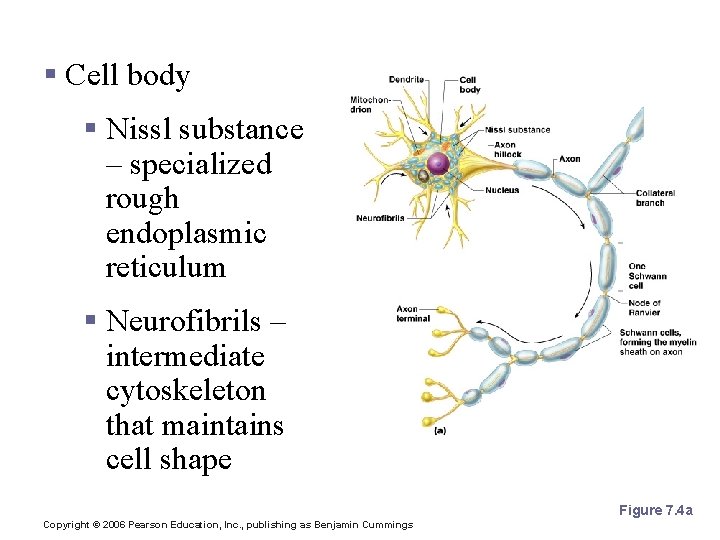
Neuron Anatomy § Cell body § Nissl substance – specialized rough endoplasmic reticulum § Neurofibrils – intermediate cytoskeleton that maintains cell shape Figure 7. 4 a Copyright © 2006 Pearson Education, Inc. , publishing as Benjamin Cummings
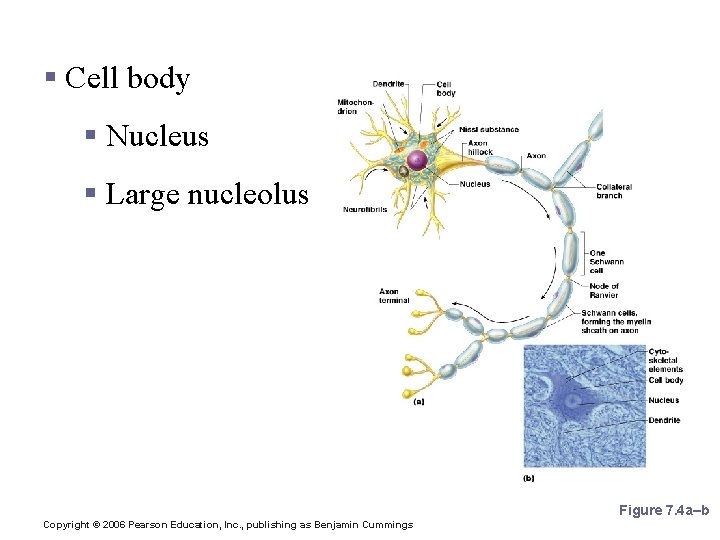
Neuron Anatomy § Cell body § Nucleus § Large nucleolus Figure 7. 4 a–b Copyright © 2006 Pearson Education, Inc. , publishing as Benjamin Cummings
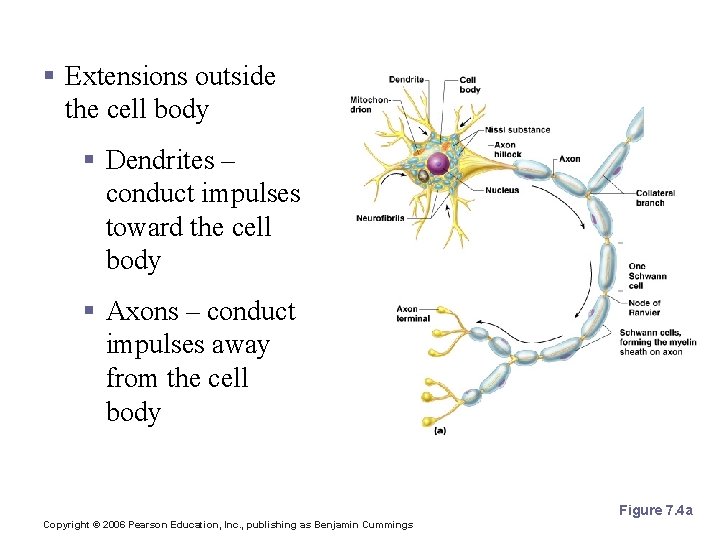
Neuron Anatomy § Extensions outside the cell body § Dendrites – conduct impulses toward the cell body § Axons – conduct impulses away from the cell body Figure 7. 4 a Copyright © 2006 Pearson Education, Inc. , publishing as Benjamin Cummings
Axons and Nerve Impulses § Axons end in axonal terminals § Axonal terminals contain vesicles with neurotransmitters § Axonal terminals are separated from the next neuron by a gap § Synaptic cleft – gap between adjacent neurons § Synapse – junction between nerves Copyright © 2006 Pearson Education, Inc. , publishing as Benjamin Cummings
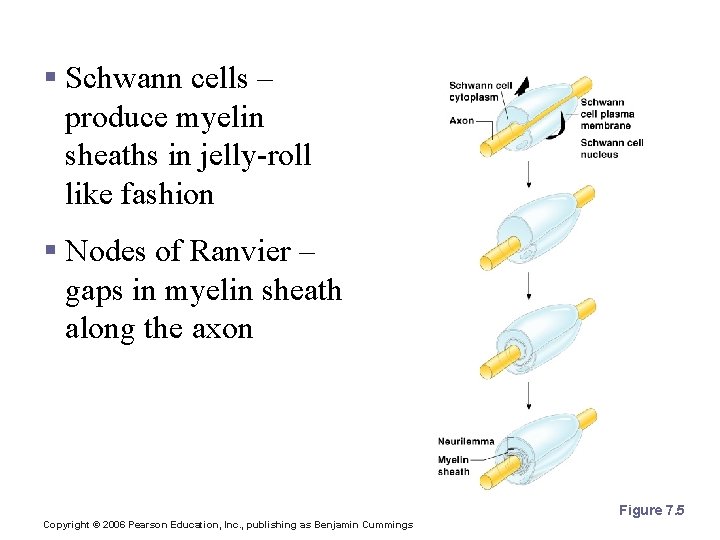
Nerve Fiber Coverings § Schwann cells – produce myelin sheaths in jelly-roll like fashion § Nodes of Ranvier – gaps in myelin sheath along the axon Figure 7. 5 Copyright © 2006 Pearson Education, Inc. , publishing as Benjamin Cummings
Neuron Cell Body Location § Most are found in the central nervous system § Gray matter – cell bodies and unmylenated fibers § Nuclei – clusters of cell bodies within the white matter of the central nervous system § Ganglia – collections of cell bodies outside the central nervous system Copyright © 2006 Pearson Education, Inc. , publishing as Benjamin Cummings
Functional Classification of Neurons § Sensory (afferent) neurons § Carry impulses from the sensory receptors § Cutaneous sense organs § Proprioceptors – detect stretch or tension § Motor (efferent) neurons § Carry impulses from the central nervous system Copyright © 2006 Pearson Education, Inc. , publishing as Benjamin Cummings
Functional Classification of Neurons § Interneurons (association neurons) § Found in neural pathways in the central nervous system § Connect sensory and motor neurons Copyright © 2006 Pearson Education, Inc. , publishing as Benjamin Cummings
Functional Properties of Neurons § Irritability – ability to respond to stimuli § Conductivity – ability to transmit an impulse § The plasma membrane at rest is polarized § Fewer positive ions are inside the cell than outside the cell Copyright © 2006 Pearson Education, Inc. , publishing as Benjamin Cummings
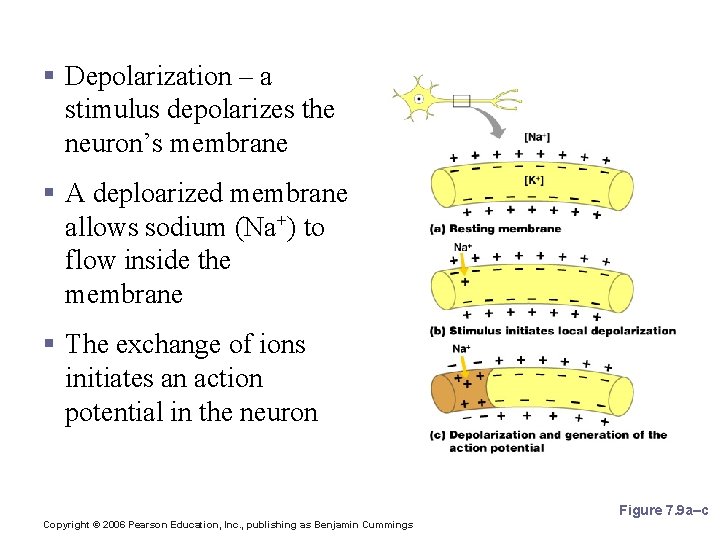
Starting a Nerve Impulse § Depolarization – a stimulus depolarizes the neuron’s membrane § A deploarized membrane allows sodium (Na+) to flow inside the membrane § The exchange of ions initiates an action potential in the neuron Figure 7. 9 a–c Copyright © 2006 Pearson Education, Inc. , publishing as Benjamin Cummings
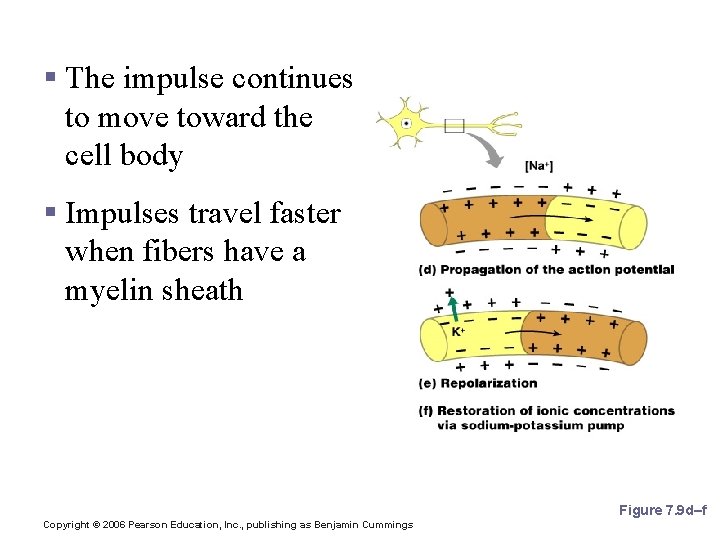
The Action Potential § If the action potential (nerve impulse) starts, it is propagated over the entire axon § Potassium ions rush out of the neuron after sodium ions rush in, which repolarizes the membrane § The sodium-potassium pump restores the original configuration § This action requires ATP Copyright © 2006 Pearson Education, Inc. , publishing as Benjamin Cummings
Nerve Impulse Propagation § The impulse continues to move toward the cell body § Impulses travel faster when fibers have a myelin sheath Figure 7. 9 d–f Copyright © 2006 Pearson Education, Inc. , publishing as Benjamin Cummings
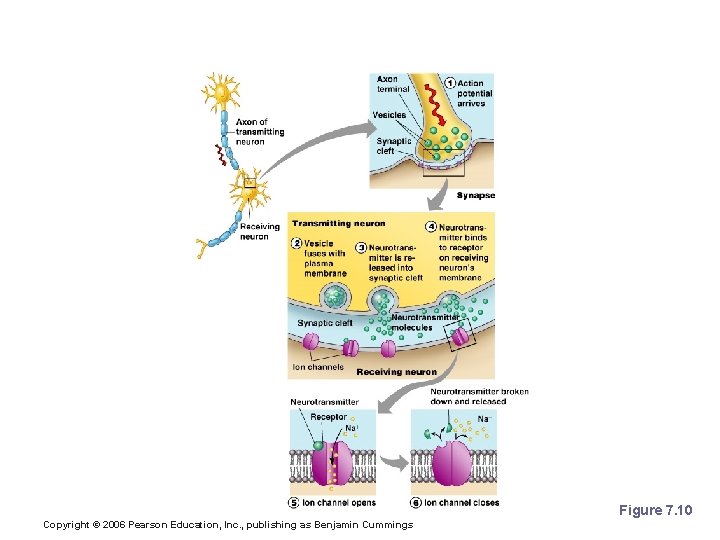
Continuation of the Nerve Impulse between Neurons § Impulses are able to cross the synapse to another nerve § Neurotransmitter is released from a nerve’s axon terminal § The dendrite of the next neuron has receptors that are stimulated by the neurotransmitter § An action potential is started in the dendrite Copyright © 2006 Pearson Education, Inc. , publishing as Benjamin Cummings
How Neurons Communicate at Synapses Figure 7. 10 Copyright © 2006 Pearson Education, Inc. , publishing as Benjamin Cummings