
7 The Multilateral Mediterranean Frame Prof Susanna Cafaro
![The projects De-pollution of the Mediterranean Maritime and land highways. ] Civil protection. Alternative](https://slidetodoc.com/presentation_image_h/2e6573476ef75ef4ff68a42385e4cc82/image-19.jpg "The projects De-pollution of the Mediterranean Maritime and land highways. ] Civil protection. Alternative")
- Slides: 33
7. The Multilateral Mediterranean Frame Prof. Susanna Cafaro A. A 2017/2018 – Law Faculty. Università del Salento
Art. 8 TEU 1. The Union shall develop a special relationship with neighbouring countries, aiming to establish an area of prosperity and good neighbourliness, founded on the values of the Union and characterised by close and peaceful relations based on cooperation. 2. For the purposes of paragraph 1, the Union may conclude specific agreements with the countries concerned. These agreements may contain reciprocal rights and obligations as well as the possibility of undertaking activities jointly. Their implementation shall be the subject of periodic consultation.
The bilateral dimension European Economic Area (EEA), 1994 Association agreement with Turkey (1963) Euromediterranean Association agreements (Algeria Tunisia Egypt Giordania Morocco Israel Lebanon Palestine)- last generation Agreements 2000 -… Association and Stabilization Agreements (Croatia, Bosnia-Herzegovina, Albania, Serbia) Partnership and cooperation agreements (Armenia; Azerbaijan; Georgia; Kazakistan; Kirghistan; Moldavia; Russia; Ukraina; Uzbekistan e Tagikistan) Cotonou Agreement with the 78 African, Caribbean and Pacific States (ACP countries), Latest revision 2010
Article 21. 1 TEU The Union’s action on the international scene shall be guided by the principles which have inspired its own creation (…) The Union shall seek to develop relations and build partnerships with third countries, and international, regional or global organisations which share the principles referred to in the first subparagraph. It shall promote multilateral solutions to common problems, in particular in the framework of the United Nations.
Article 216. 1 TFEU The Union may conclude an agreement with one or more third countries or international organizations where the Treaties so provide or where the conclusion of an agreement is necessary in order to achieve, within the framework of the Union’s policies, one of the objectives referred to in the Treaties, or is provided for in a legally binding Union act or is likely to affect common rules or alter their scope.
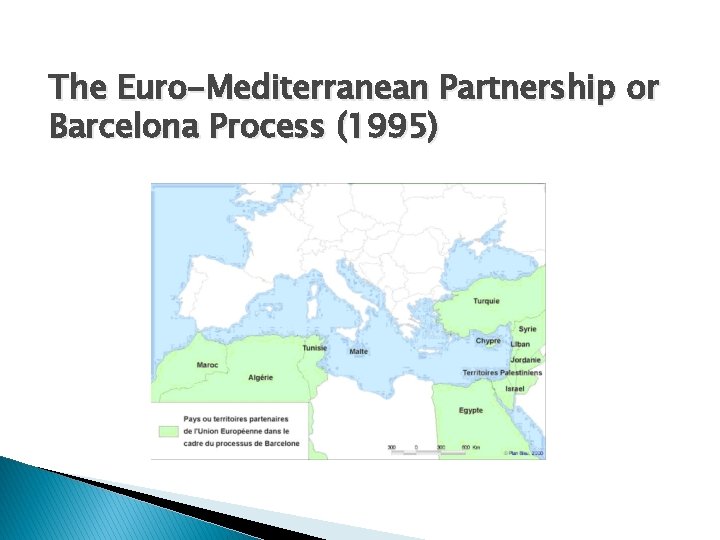
The Euro-Mediterranean Partnership or Barcelona Process (1995)
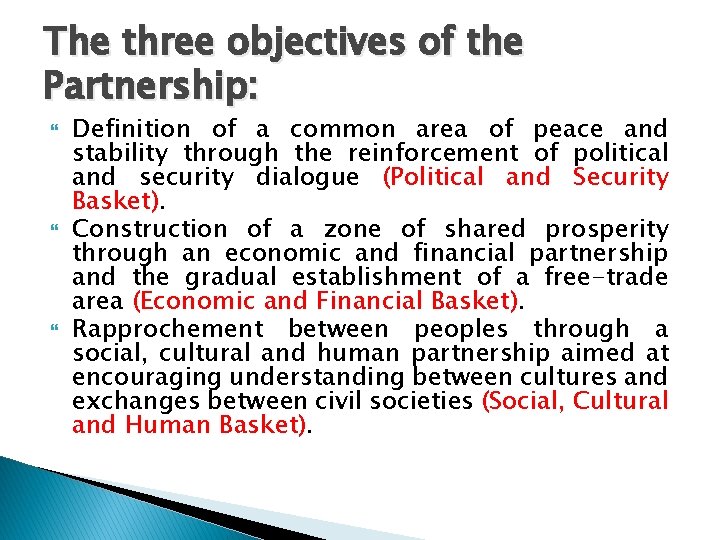
The three objectives of the Partnership: Definition of a common area of peace and stability through the reinforcement of political and security dialogue (Political and Security Basket). Construction of a zone of shared prosperity through an economic and financial partnership and the gradual establishment of a free-trade area (Economic and Financial Basket). Rapprochement between peoples through a social, cultural and human partnership aimed at encouraging understanding between cultures and exchanges between civil societies (Social, Cultural and Human Basket).
Two dimensions Bilateral : the association agreements Multilateral or Regional: the ministerial conferences
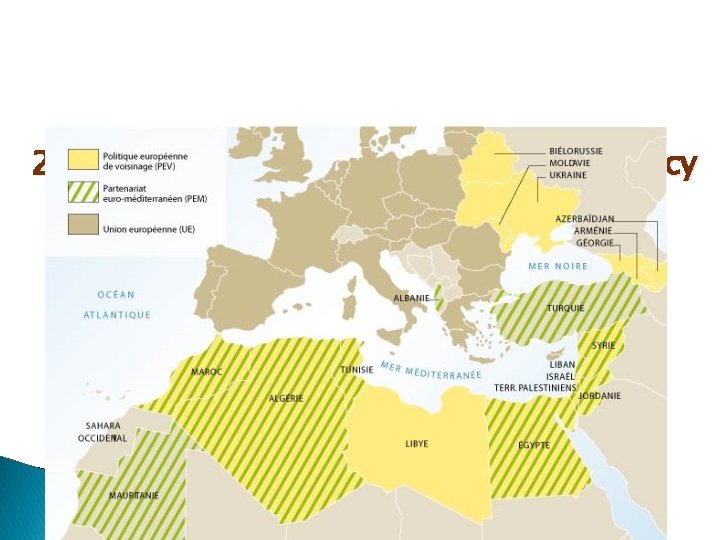
2004: The European Neighbourhood Policy
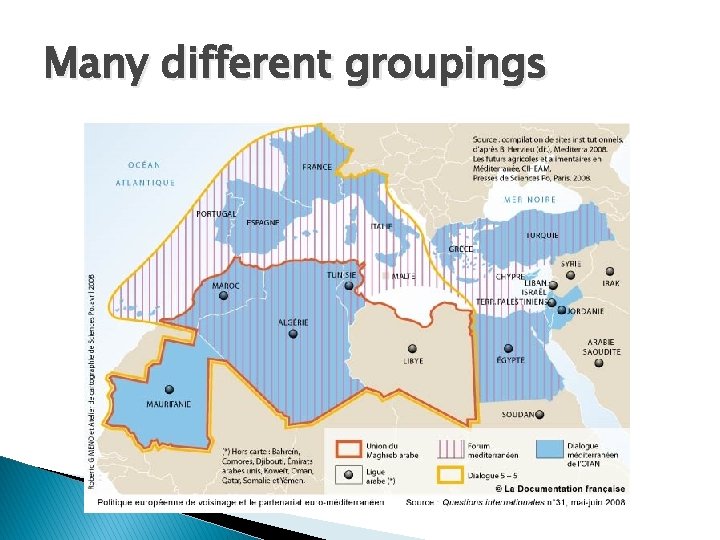
Many different groupings
All the limits of the previous multilateral groups Lack of ownership; Lack of a supranational dimension (intergovernmental) A preminent bilateral dimension, and a minimal south - south dimension Broad and general objectives
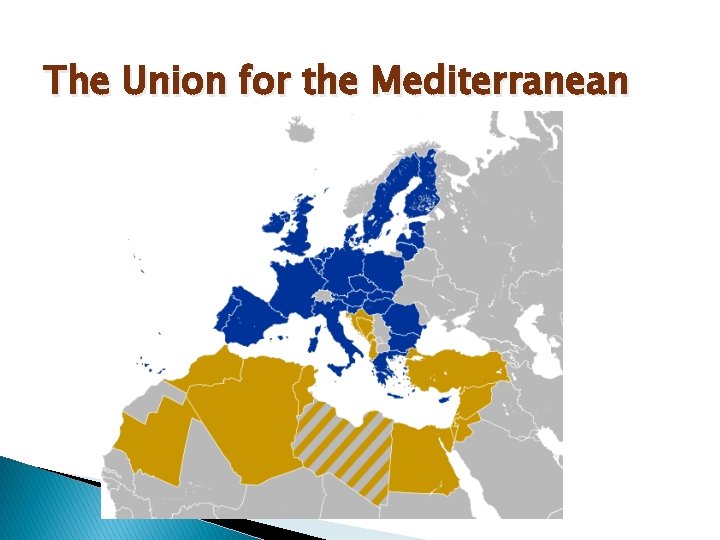
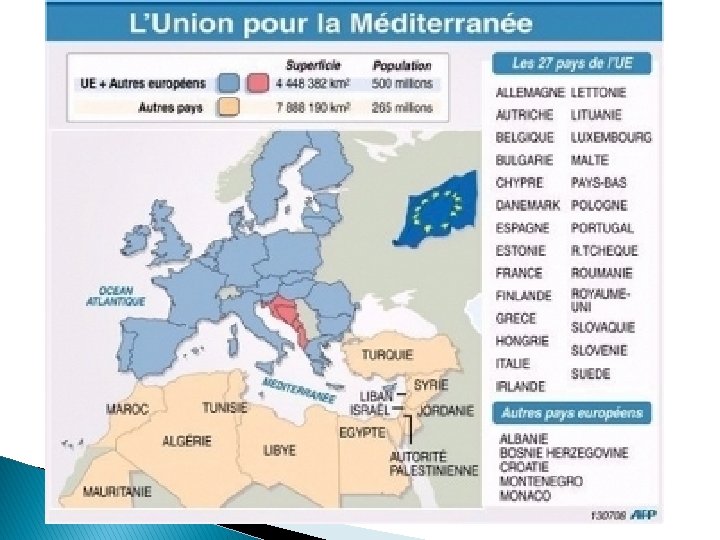
The Union for the Mediterranean
2007 A proposal to establish a "Mediterranean Union" was part of the election campaign of Nicolas Sarkozy during the French presidential election campaign in 2007. It had to be modelled on the European Union. Once elected, President Sarkozy invited all heads of state and government of the Mediterranean region to a meeting in June 2008 in Paris, with a view to laying the basis of a Mediterranean Union
2008 At the start of 2008 Sarkozy began to modify his plans for the Mediterranean Union due to widespread opposition from other EU member states and the European Commission. Following a meeting with German Chancellor it was agreed that the project would include all EU member states, not just those bordering the Mediterranean, and would be built upon the existing Barcelona process.
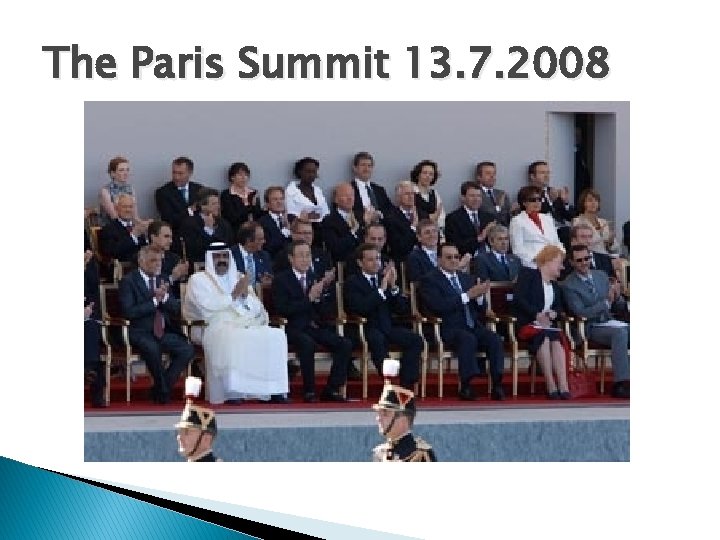
The Paris Summit 13. 7. 2008
The main novelties Ownership Institutional frame Not only objectives, but projects
The institutional architecture Summit of Heads of State and Government to be held every two years; Ministerial conferences North and South Co-presidency system Secretariat Euro-Mediterranean Parliamentary Assembly Euro-Mediterranean Regional and Local Assembly Anna Lindh Foundation for the Dialogue between Cultures
The projects De-pollution of the Mediterranean Maritime and land highways. ] Civil protection. Alternative energies: Mediterranean solar plan. Higher education and research: Euro. Mediterranean University. The Mediterranean business development initiative.
Funding European Neighbourhood Policy Instrument (ENPI)- European Commission Euro-Mediterranean Investment and Partnership (FEMIP) – EIB Infra. Med Infrastructure Fund, established in June 2010 by five financial entities World Bank
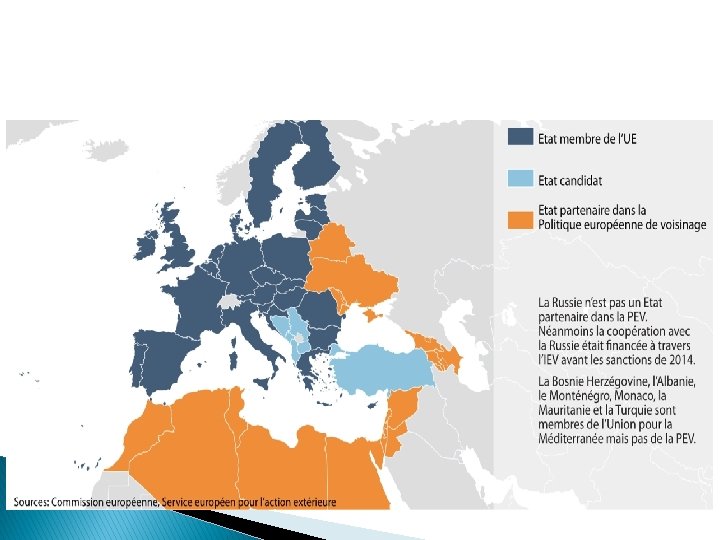
European Neighbourhood Policy
The goal Since 2004, the European Neighborhood Policy (ENP) has established a framework for the EU's relations with its nearest 16 neighboring states to the east and south. This framework offers enhanced cooperation and market access through bilateral action plans which ultimately will become new or updated agreements
commitments Partner countries agree with the EU an ENP action plan or an Association Agenda demonstrating their commitment to democracy, human rights, rule of law, good governance, market economy principles and sustainable development. The EU supports the achievement of these objectives.
benefits financial support – grants worth € 12 bn were given to ENP-related projects from 2007 to 2013 economic integration and access to EU markets – in 2011 trade between the EU and its ENP partners totalled € 230 bn easier travel to the EU – 3. 2 m Schengen visas were issued to citizens, and in particular to students from ENP countries in 2012 technical and policy support Support to civil society
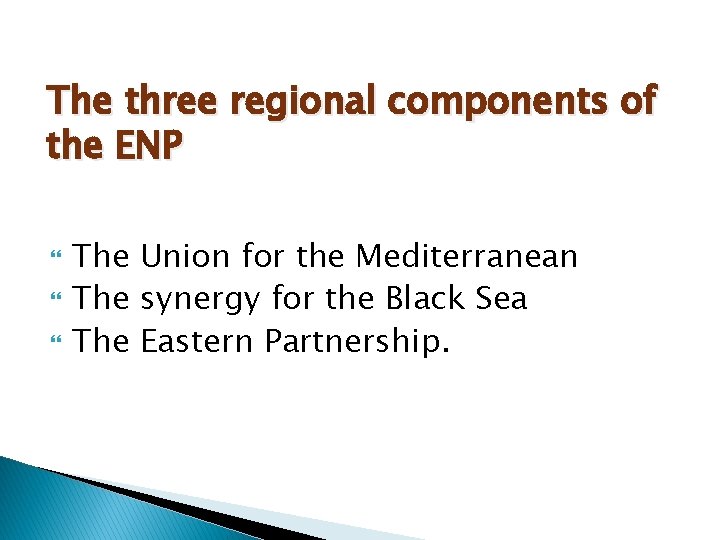
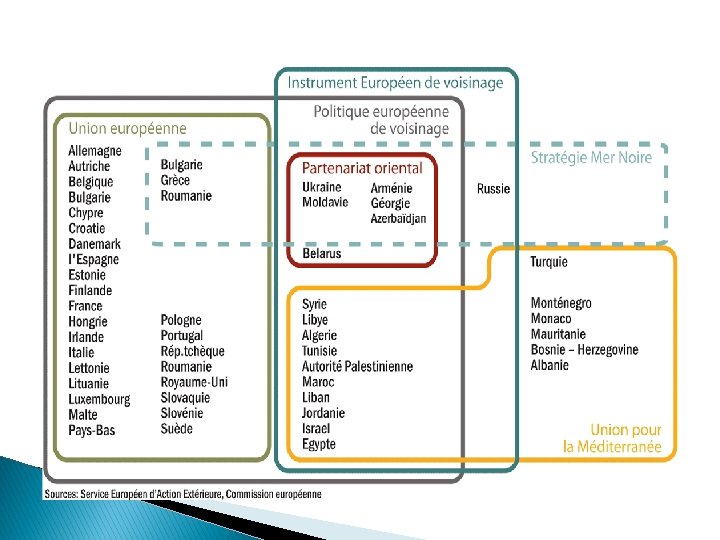
The three regional components of the ENP The Union for the Mediterranean The synergy for the Black Sea The Eastern Partnership.
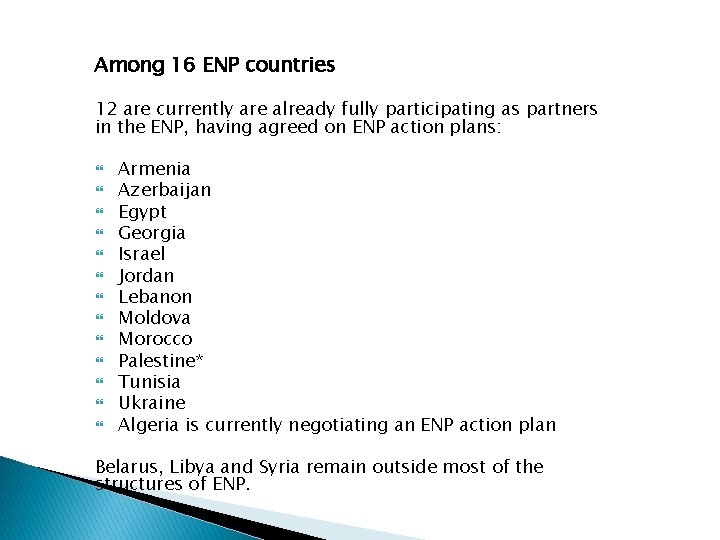
Among 16 ENP countries 12 are currently are already fully participating as partners in the ENP, having agreed on ENP action plans: Armenia Azerbaijan Egypt Georgia Israel Jordan Lebanon Moldova Morocco Palestine* Tunisia Ukraine Algeria is currently negotiating an ENP action plan Belarus, Libya and Syria remain outside most of the structures of ENP.
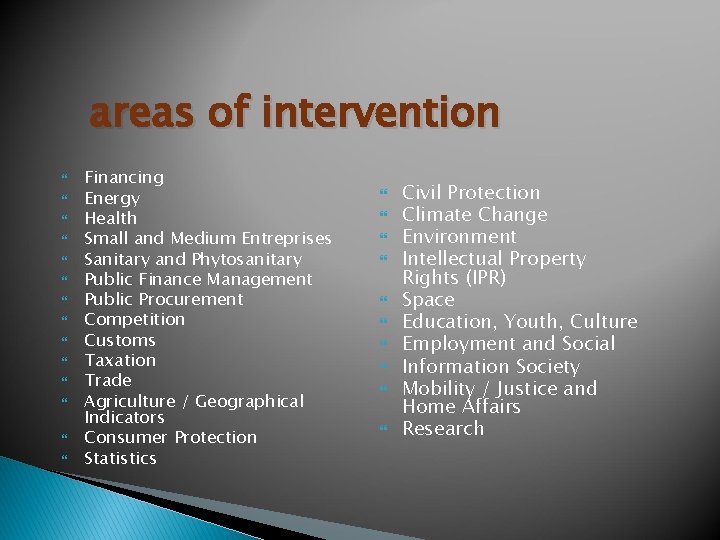
areas of intervention Financing Energy Health Small and Medium Entreprises Sanitary and Phytosanitary Public Finance Management Public Procurement Competition Customs Taxation Trade Agriculture / Geographical Indicators Consumer Protection Statistics Civil Protection Climate Change Environment Intellectual Property Rights (IPR) Space Education, Youth, Culture Employment and Social Information Society Mobility / Justice and Home Affairs Research
Legal (? ) bases Commission Européenne, Communication au Conseil et au Parlement européen "L’Europe élargie - Voisinage. Un nouveau cadre pour les relations avec nos voisins à l’Est et au Sud", COM(2003) 104 final. Commission Européenne, Communication "Politique européenne de voisinage – Document d’orientation", COM(2004) 373, 12 mai 2004. Commission Européenne, Communication au Conseil et au Parlement européen relative au renforcement de la politique européenne de voisinage, COM(2006) 726 final. Commission Européenne et La Haute Représentante de l’UE pour les Affaires étrangères et la politique de sécurité, Communication conjointe, "Politique européenne de voisinage: un renforcement du partenariat". Commission Européenne et La Haute Représentante de l’UE pour les Affaires étrangères et la politique de sécurité, Communication conjointe, "Un Partenariat pour la démocratie et une prospérité partagée avec le sud de la Méditerranée", COM(2011) 200 final. Commission Européenne et La Haute Représentante de l’Union pour les Affaires étrangères et la politique de sécurité, communication conjointe "Une stratégie nouvelle à l’égard d’un voisinage en mutation. Examen de la politique européenne de voisinage", COM(2011) 303 final. - EC Joint Communication European Neighbourhood Policy: Working towards a Stronger Partnership (2013) REGULATION (EU) No 234/2014 OF THE EUROPEAN PARLIAMENT AND OF THE COUNCIL of 11 March 2014 establishing a Partnership Instrument for cooperation with third countries JOINT COMMUNICATION TO THE EUROPEAN PARLIAMENT, THE COUNCIL, THE EUROPEAN ECONOMIC AND SOCIAL COMMITTEE AND THE COMMITTEE OF THE REGIONS Review of the European Neighbourhood Policy {SWD(2015) 500 final}
Accountability The action plans build on existing legal agreements with the EU – partnership & cooperation agreements (PCAs) or association agreements (AAs). Implementation is monitored through committees set up by these agreements. Once a year, the European External Action Service and the European Commission publish ENP progress reports assessing the progress made towards the objectives of the Action Plans and the Association Agendas. The European External Action Service and the European Commission publish yearly ENP progress reports. The next reports are planned to be published on 25 March 2015.
Today The major geopolitical upheavals engendered by the Arab Spring in the South of the Mediterranean since 2011 and by the conflict in Ukraine since 2014 oblige the EU to review its action in the neighborhood. The success of this reform and of its implementation is essential in the EU's external relations and to define the role of the EU as a global actor
Http: //ufmsecretariat. org/