
7 Symmetric Matrices and Quadratic Forms 7 2
- Slides: 19
7 Symmetric Matrices and Quadratic Forms 7. 2 QUADRATIC FORMS © 2012 Pearson Education, Inc.
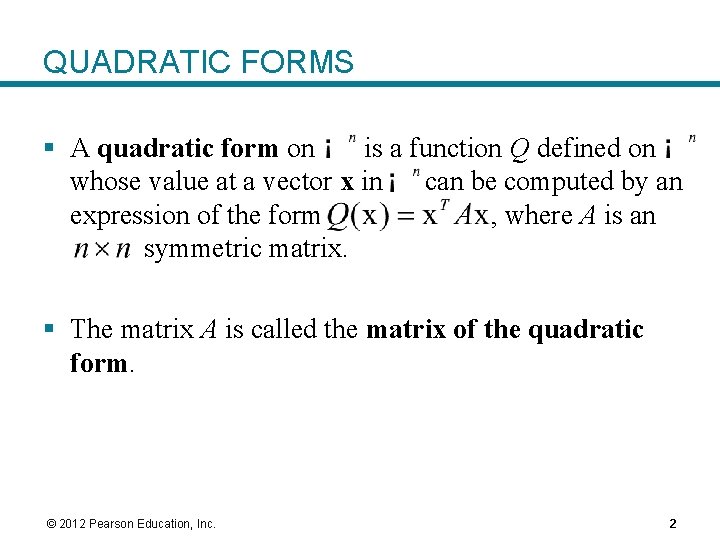
QUADRATIC FORMS § A quadratic form on is a function Q defined on whose value at a vector x in can be computed by an expression of the form , where A is an s symmetric matrix. § The matrix A is called the matrix of the quadratic form. © 2012 Pearson Education, Inc. 2
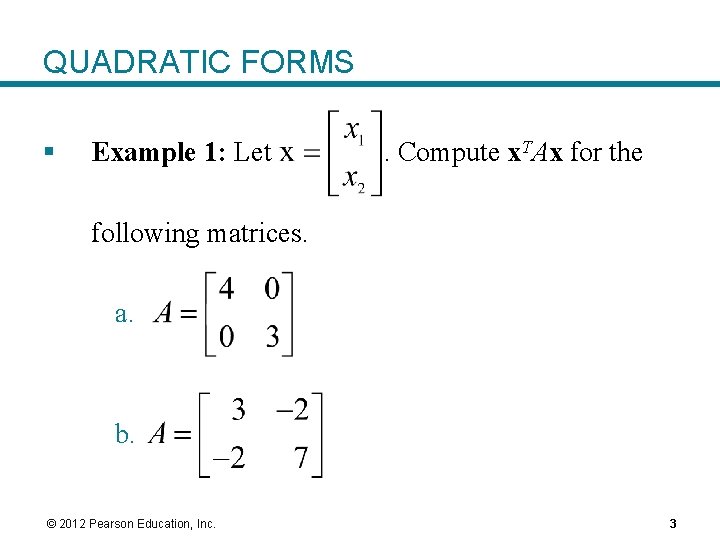
QUADRATIC FORMS § Example 1: Let . Compute x. TAx for the following matrices. a. b. © 2012 Pearson Education, Inc. 3
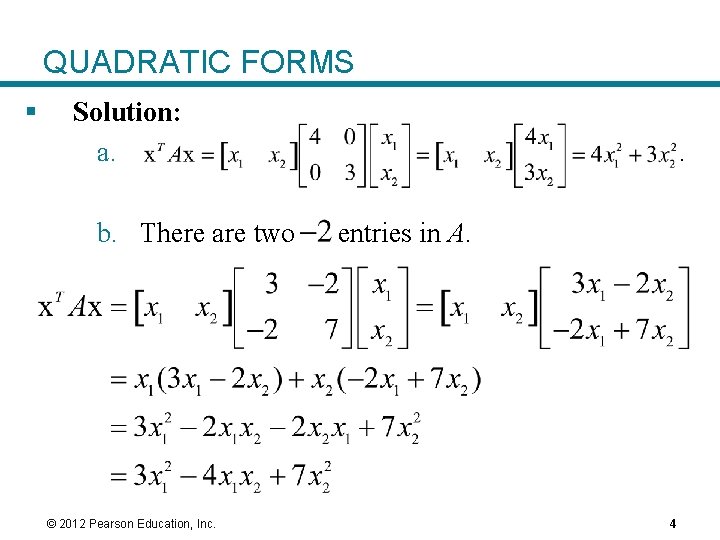
QUADRATIC FORMS § Solution: a. b. There are two © 2012 Pearson Education, Inc. . entries in A. 4
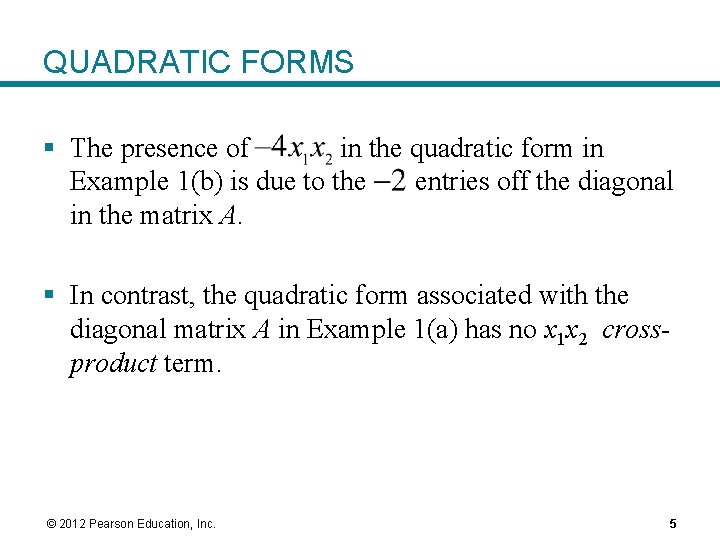
QUADRATIC FORMS § The presence of in the quadratic form in Example 1(b) is due to the entries off the diagonal in the matrix A. § In contrast, the quadratic form associated with the diagonal matrix A in Example 1(a) has no x 1 x 2 crossproduct term. © 2012 Pearson Education, Inc. 5
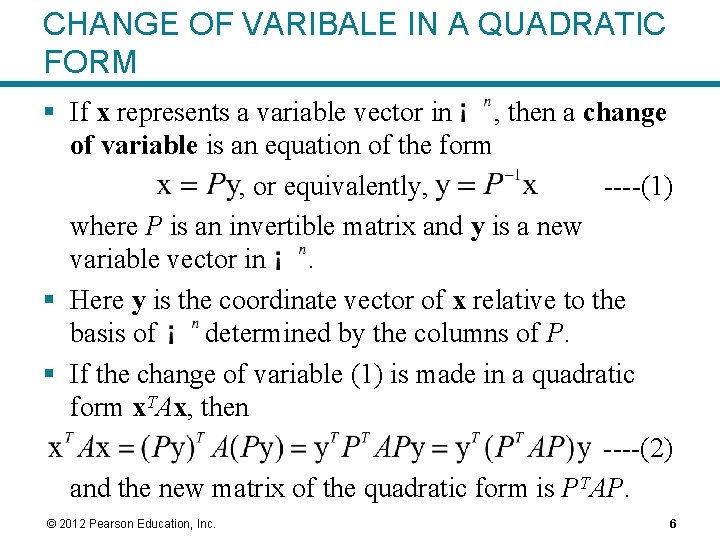
CHANGE OF VARIBALE IN A QUADRATIC FORM § If x represents a variable vector in , then a change of variable is an equation of the form , or equivalently, ----(1) where P is an invertible matrix and y is a new variable vector in. § Here y is the coordinate vector of x relative to the basis of determined by the columns of P. § If the change of variable (1) is made in a quadratic form x. TAx, then ----(2) and the new matrix of the quadratic form is PTAP. © 2012 Pearson Education, Inc. 6
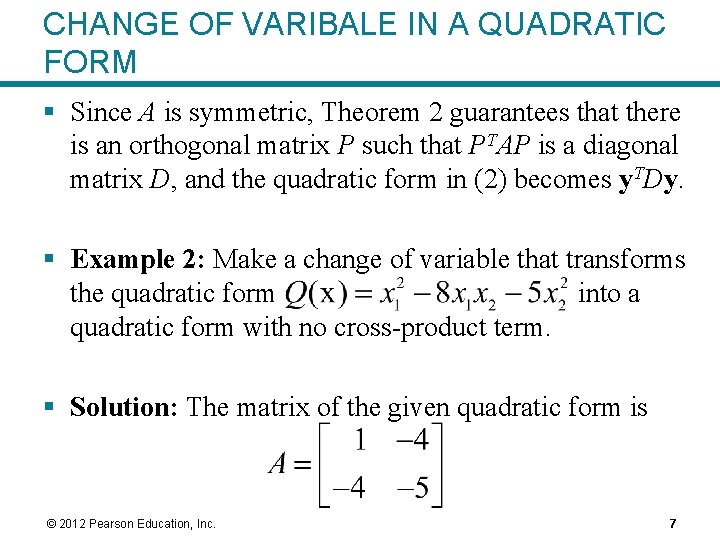
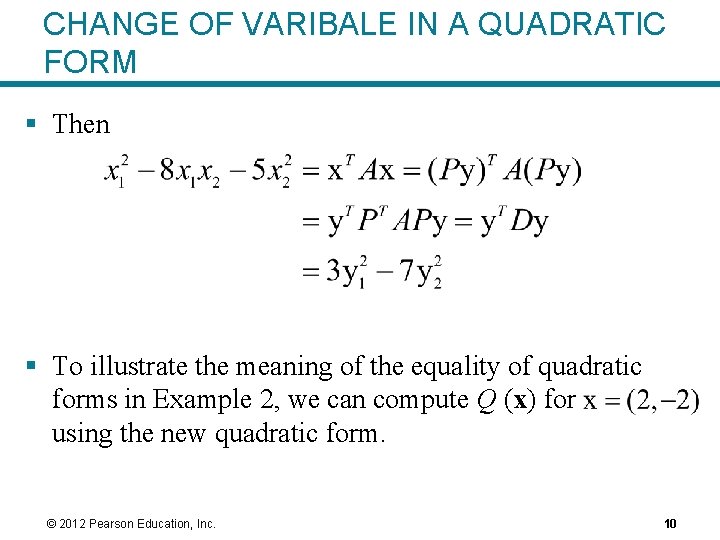
CHANGE OF VARIBALE IN A QUADRATIC FORM § Since A is symmetric, Theorem 2 guarantees that there is an orthogonal matrix P such that PTAP is a diagonal matrix D, and the quadratic form in (2) becomes y. TDy. § Example 2: Make a change of variable that transforms the quadratic form into a quadratic form with no cross-product term. § Solution: The matrix of the given quadratic form is © 2012 Pearson Education, Inc. 7
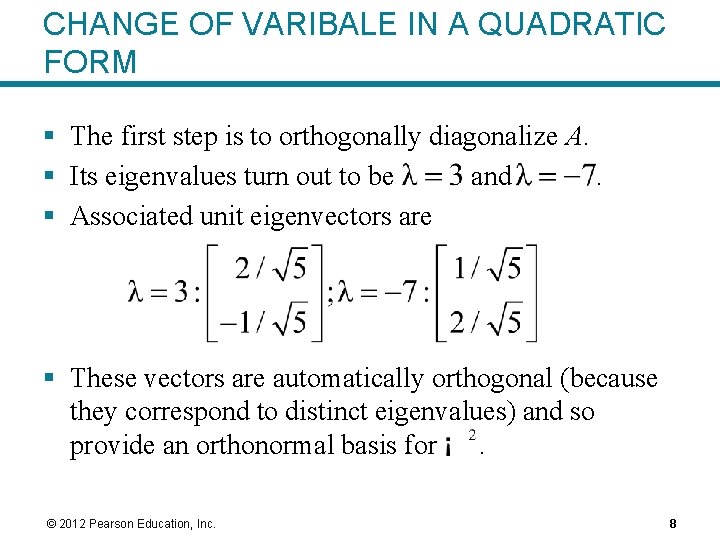
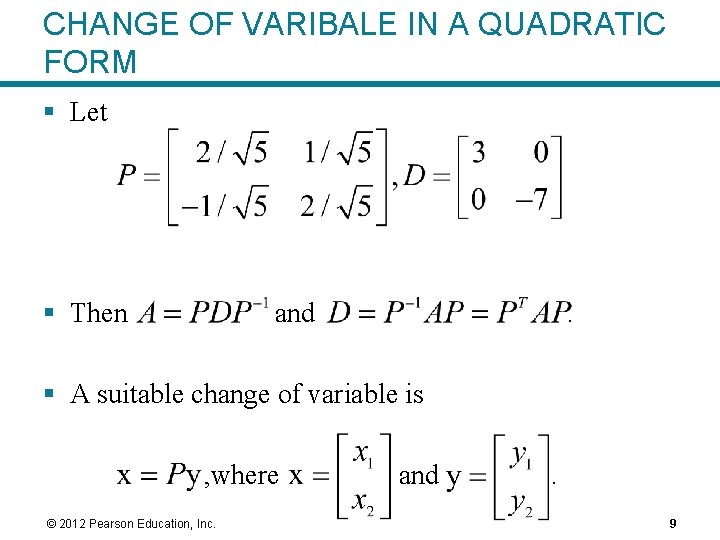
CHANGE OF VARIBALE IN A QUADRATIC FORM § The first step is to orthogonally diagonalize A. § Its eigenvalues turn out to be and. § Associated unit eigenvectors are § These vectors are automatically orthogonal (because they correspond to distinct eigenvalues) and so provide an orthonormal basis for. © 2012 Pearson Education, Inc. 8
CHANGE OF VARIBALE IN A QUADRATIC FORM § Let § Then and . § A suitable change of variable is , where © 2012 Pearson Education, Inc. and . 9
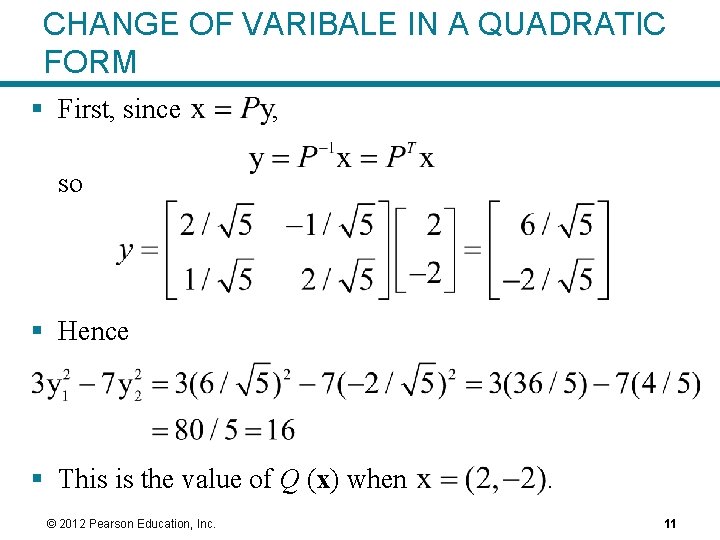
CHANGE OF VARIBALE IN A QUADRATIC FORM § Then § To illustrate the meaning of the equality of quadratic forms in Example 2, we can compute Q (x) for using the new quadratic form. © 2012 Pearson Education, Inc. 10
CHANGE OF VARIBALE IN A QUADRATIC FORM § First, since , so § Hence § This is the value of Q (x) when © 2012 Pearson Education, Inc. . 11
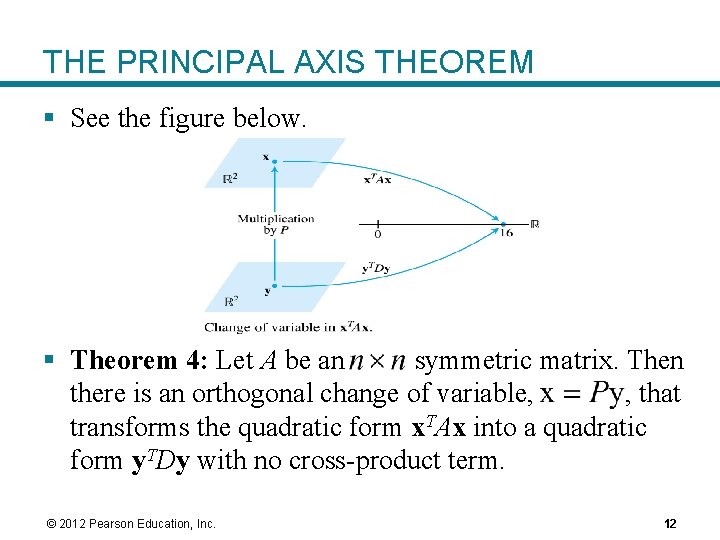
THE PRINCIPAL AXIS THEOREM § See the figure below. § Theorem 4: Let A be an symmetric matrix. Then there is an orthogonal change of variable, , that transforms the quadratic form x. TAx into a quadratic form y. TDy with no cross-product term. © 2012 Pearson Education, Inc. 12
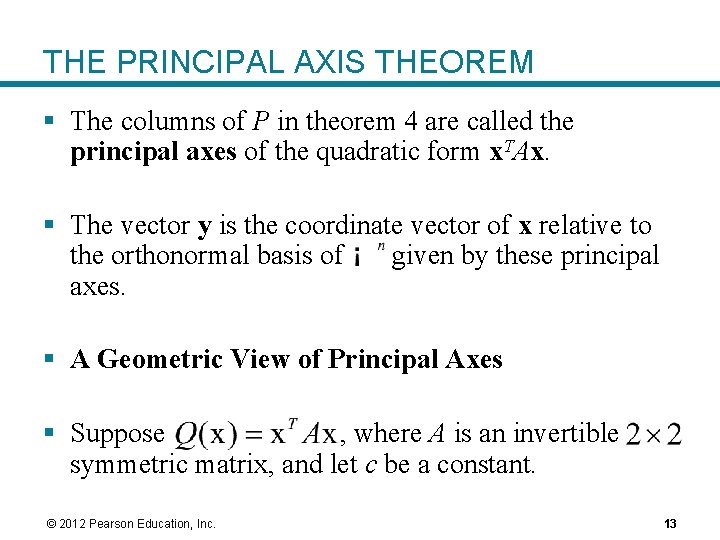
THE PRINCIPAL AXIS THEOREM § The columns of P in theorem 4 are called the principal axes of the quadratic form x. TAx. § The vector y is the coordinate vector of x relative to the orthonormal basis of given by these principal axes. § A Geometric View of Principal Axes § Suppose , where A is an invertible symmetric matrix, and let c be a constant. © 2012 Pearson Education, Inc. 13
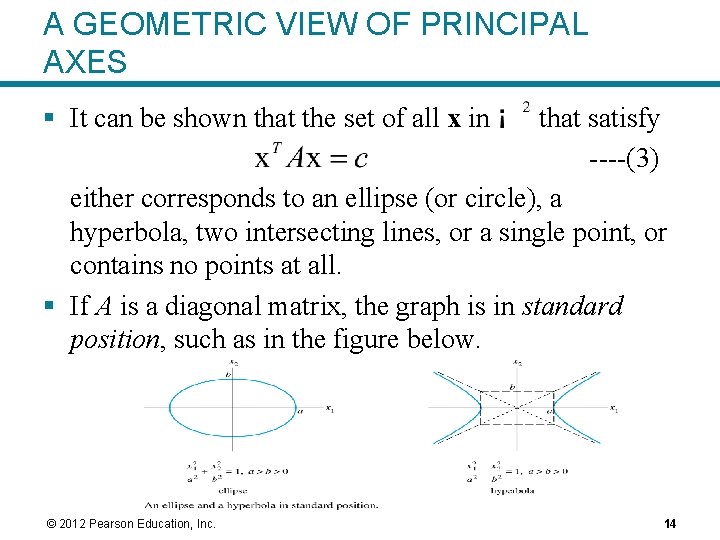
A GEOMETRIC VIEW OF PRINCIPAL AXES § It can be shown that the set of all x in that satisfy ----(3) either corresponds to an ellipse (or circle), a hyperbola, two intersecting lines, or a single point, or contains no points at all. § If A is a diagonal matrix, the graph is in standard position, such as in the figure below. © 2012 Pearson Education, Inc. 14
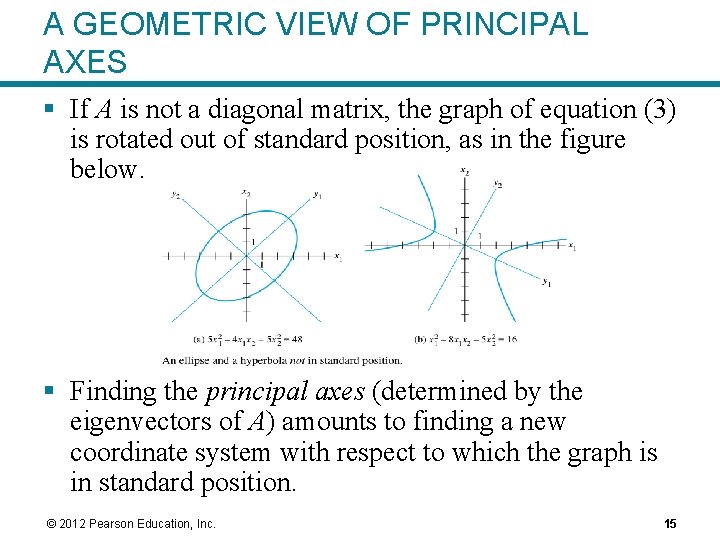
A GEOMETRIC VIEW OF PRINCIPAL AXES § If A is not a diagonal matrix, the graph of equation (3) is rotated out of standard position, as in the figure below. § Finding the principal axes (determined by the eigenvectors of A) amounts to finding a new coordinate system with respect to which the graph is in standard position. © 2012 Pearson Education, Inc. 15
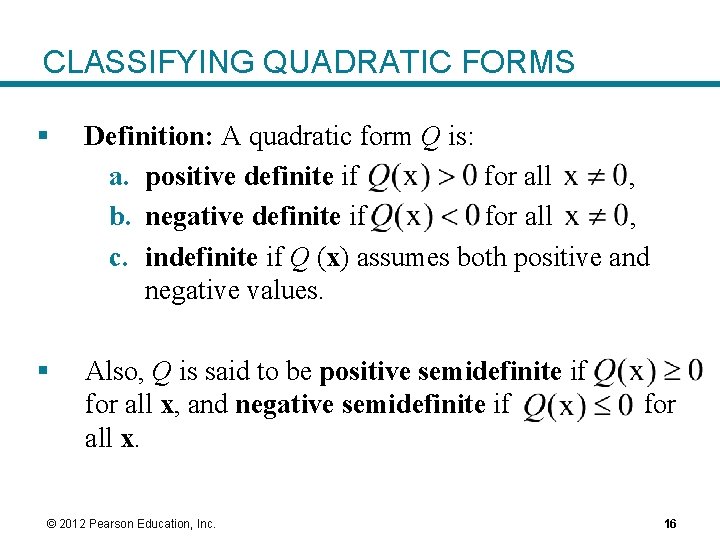
CLASSIFYING QUADRATIC FORMS § Definition: A quadratic form Q is: a. positive definite if for all , b. negative definite if for all , c. indefinite if Q (x) assumes both positive and negative values. § Also, Q is said to be positive semidefinite if for all x, and negative semidefinite if all x. © 2012 Pearson Education, Inc. for 16
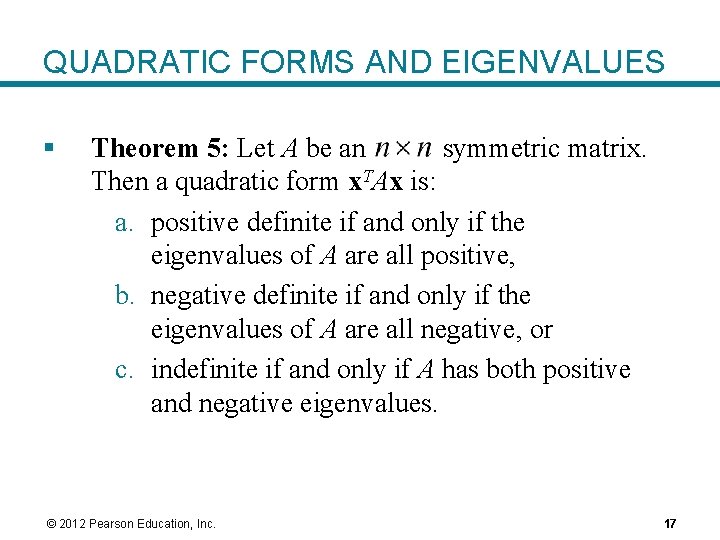
QUADRATIC FORMS AND EIGENVALUES § Theorem 5: Let A be an symmetric matrix. Then a quadratic form x. TAx is: a. positive definite if and only if the eigenvalues of A are all positive, b. negative definite if and only if the eigenvalues of A are all negative, or c. indefinite if and only if A has both positive and negative eigenvalues. © 2012 Pearson Education, Inc. 17
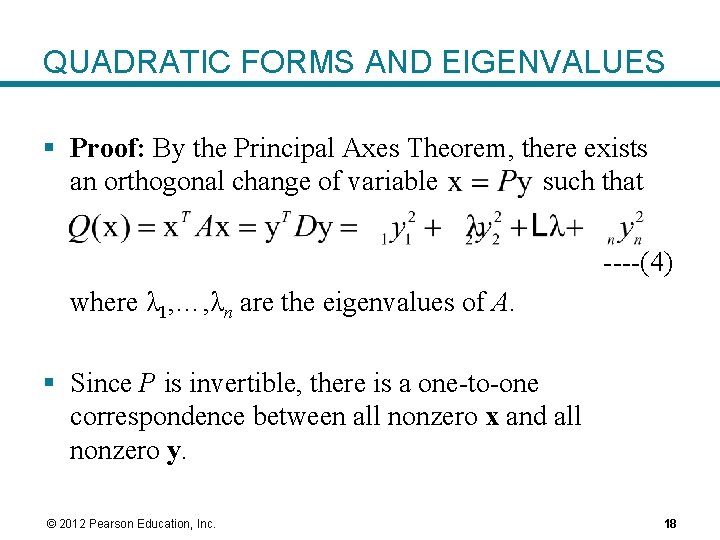
QUADRATIC FORMS AND EIGENVALUES § Proof: By the Principal Axes Theorem, there exists an orthogonal change of variable such that ----(4) where λ 1, …, λn are the eigenvalues of A. § Since P is invertible, there is a one-to-one correspondence between all nonzero x and all nonzero y. © 2012 Pearson Education, Inc. 18
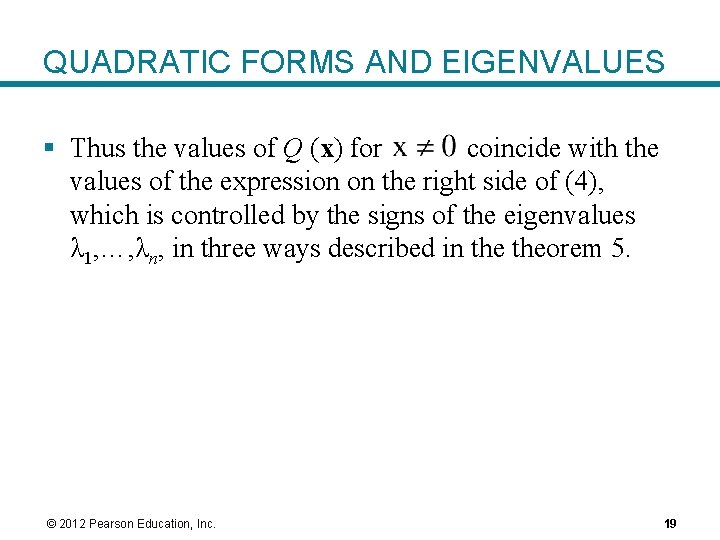
QUADRATIC FORMS AND EIGENVALUES § Thus the values of Q (x) for coincide with the values of the expression on the right side of (4), which is controlled by the signs of the eigenvalues λ 1, …, λn, in three ways described in theorem 5. © 2012 Pearson Education, Inc. 19