
7 Steps of Scientific Method By Eric Cortez

7 Steps of Scientific Method By: Eric Cortez and Alex Shaw

State the Problem • Describe the problem you’re facing • The best way to do this is to state it as a question
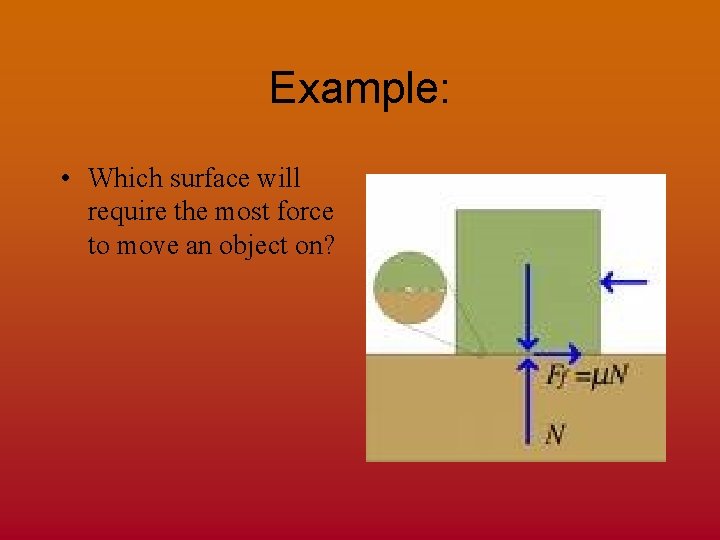
Example: • Which surface will require the most force to move an object on?

Gather Information on the Problem • Using the internet or a library, research the problem

Example • • • Friction is a force that opposes movement between 2 surfaces The force and the surfaces’ textures determine how much friction occurs. Different surfaces generate different amounts of friction

Form a Hypothesis • Think of an idea about what’s going to happen • Remember to use the “if…then” format when coming up with a hypothesis
Example: • If an object is pushed across a smooth surface, then the force will be less than when the object is pushed across a rough surface

Design and Perform the Experiment • Come up with an experiment that you think will help you solve your problem • List the materials you’ll need • List the steps you need to take • After that, do the experiment
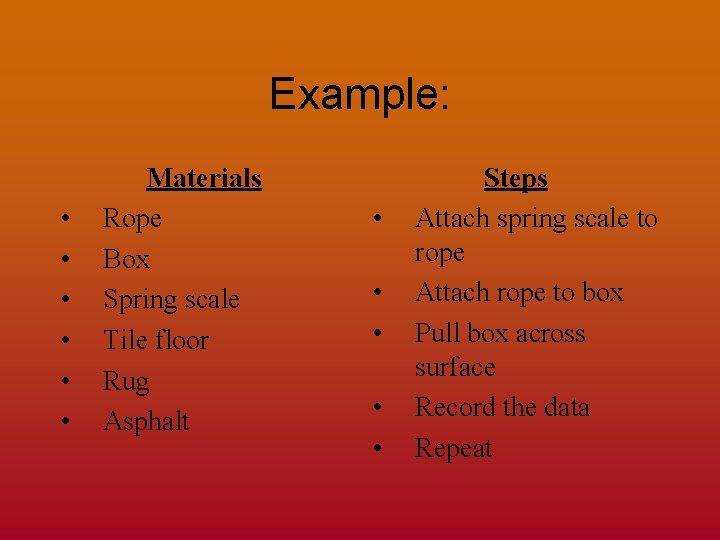
Example: • • • Materials Rope Box Spring scale Tile floor Rug Asphalt • • • Steps Attach spring scale to rope Attach rope to box Pull box across surface Record the data Repeat

Record and Analyze the Data • Write down the information that you got and study the data
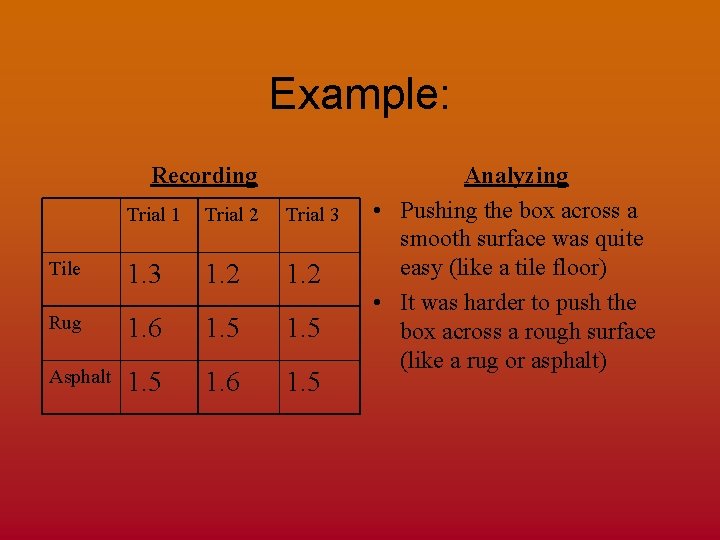
Example: Recording Trial 1 Trial 2 Trial 3 Tile 1. 3 1. 2 Rug 1. 6 1. 5 Asphalt 1. 5 1. 6 1. 5 Analyzing • Pushing the box across a smooth surface was quite easy (like a tile floor) • It was harder to push the box across a rough surface (like a rug or asphalt)

Form a Conclusion • State the solution to the problem
Example: • Rougher surfaces cause it to be harder to move objects across them
Repeat • Perform everything you just did again and again • Do this to ensure that the first experiment wasn’t just a fluke
Example: • We’ll repeat the experiment a few more times just to make sure we got the right answers

- Slides: 16