
7 Service Management 5 e Operations Strategy Information
- Slides: 23
7 Service Management (5 e) Operations, Strategy, Information Technology By Fitzsimmons and Fitzsimmons Chapter – 7 The Service Encounter
7 -2 Learning Objectives Use the service encounter triad to describe a service firm’s delivery process. Ø Discuss the role of organizational control systems for employee empowerment. Ø Prepare abstract questions and write situational vignettes. Ø Discuss the role of customer as coproducer. Ø Describe how elements of the service profit chain lead to revenue growth and profitability. Ø
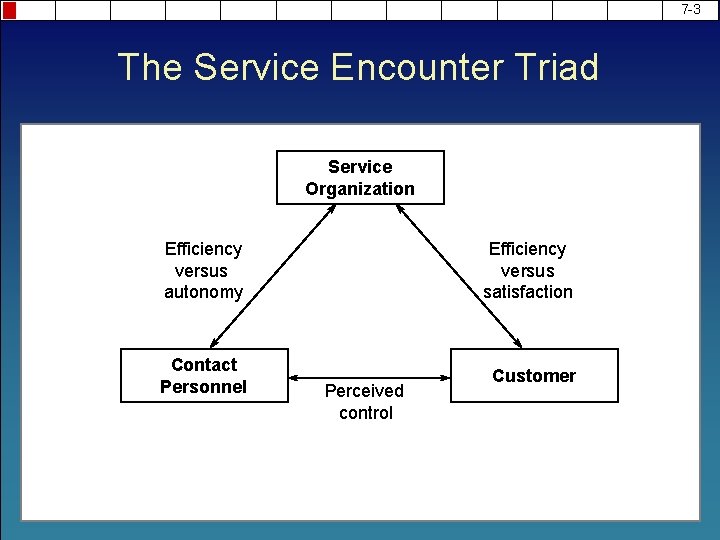
7 -3 The Service Encounter Triad Service Organization Efficiency versus autonomy Efficiency versus satisfaction Contact Personnel Customer Perceived control
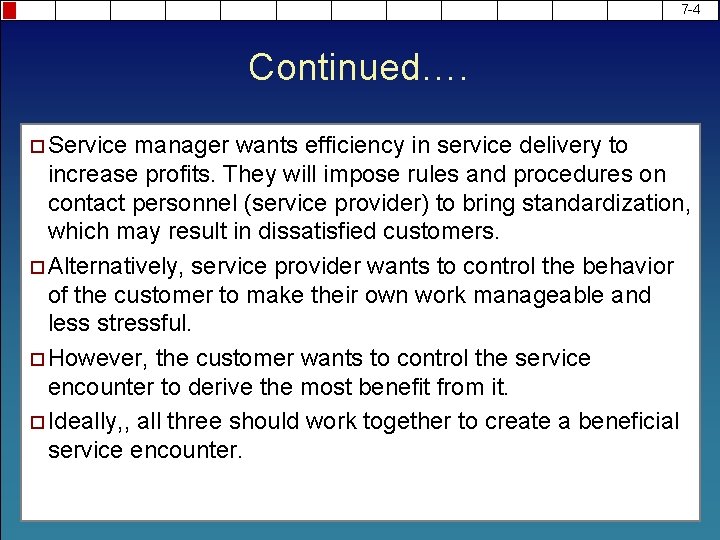
7 -4 Continued…. ¨ Service manager wants efficiency in service delivery to increase profits. They will impose rules and procedures on contact personnel (service provider) to bring standardization, which may result in dissatisfied customers. ¨ Alternatively, service provider wants to control the behavior of the customer to make their own work manageable and less stressful. ¨ However, the customer wants to control the service encounter to derive the most benefit from it. ¨ Ideally, , all three should work together to create a beneficial service encounter.
7 -5 Encounter dominated by the service organization ¨ To achieve efficiency and follow a cost leadership strategy, an organization may standardize service delivery by imposing strict operating procedures and limit the discretion of contact personnel, example, Mc. Donald’s. ¨ Success here can come from teaching the customer what not to expect from their service.
7 -6 Contact personnel-dominated encounter ¨ Service personnel attempt to limit the scope of the service encounter to reduce their own stress in meeting demanding customers. ¨ The customer is expected to place considerable trust in the contact person’s judgment because of the service provider’s perceived expertise. Example doctor-patient.
7 -7 Customer-dominated encounter ¨ In standardized service, self-service is an option that gives the customer complete control over the limited service that is provided. Example, gas station that is equipped with a creditcard reader, the customer need not interact with anyone. ¨ The result can be very efficient and satisfying to the customer who needs or desires very little service.
7 -8 Balance of control ¨ A satisfactory and effective encounter should balance the need for control by all three participants. ¨ The organization’s need for efficiency can be satisfied when contact personnel are trained properly and the customer’s expectations and role in the delivery process are communicated effectively.
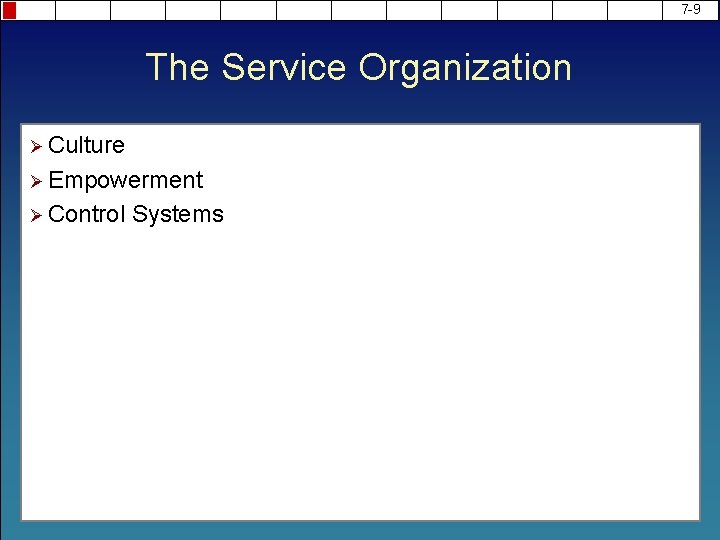
7 -9 The Service Organization Ø Culture Ø Empowerment Ø Control Systems
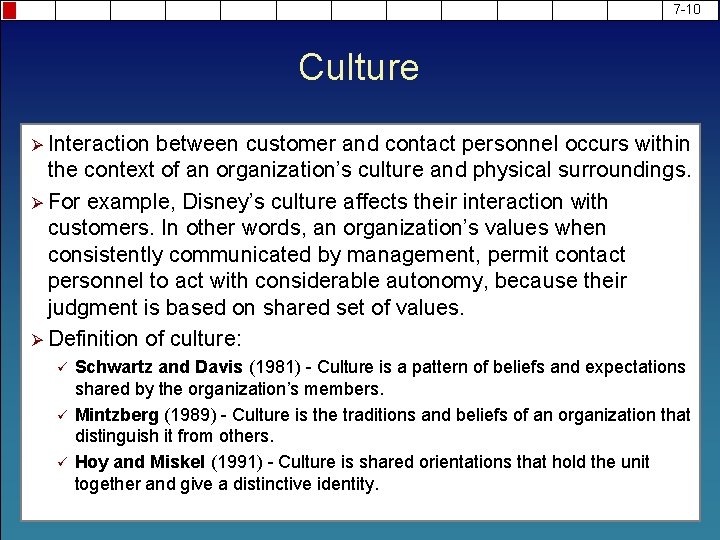
7 -10 Culture Ø Interaction between customer and contact personnel occurs within the context of an organization’s culture and physical surroundings. Ø For example, Disney’s culture affects their interaction with customers. In other words, an organization’s values when consistently communicated by management, permit contact personnel to act with considerable autonomy, because their judgment is based on shared set of values. Ø Definition of culture: ü ü ü Schwartz and Davis (1981) - Culture is a pattern of beliefs and expectations shared by the organization’s members. Mintzberg (1989) - Culture is the traditions and beliefs of an organization that distinguish it from others. Hoy and Miskel (1991) - Culture is shared orientations that hold the unit together and give a distinctive identity.
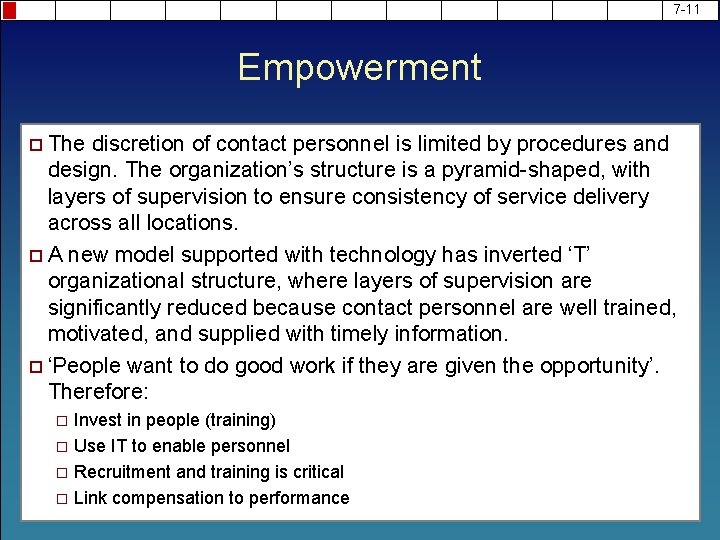
7 -11 Empowerment ¨ The discretion of contact personnel is limited by procedures and design. The organization’s structure is a pyramid-shaped, with layers of supervision to ensure consistency of service delivery across all locations. ¨ A new model supported with technology has inverted ‘T’ organizational structure, where layers of supervision are significantly reduced because contact personnel are well trained, motivated, and supplied with timely information. ¨ ‘People want to do good work if they are given the opportunity’. Therefore: ¨ ¨ Invest in people (training) Use IT to enable personnel Recruitment and training is critical Link compensation to performance
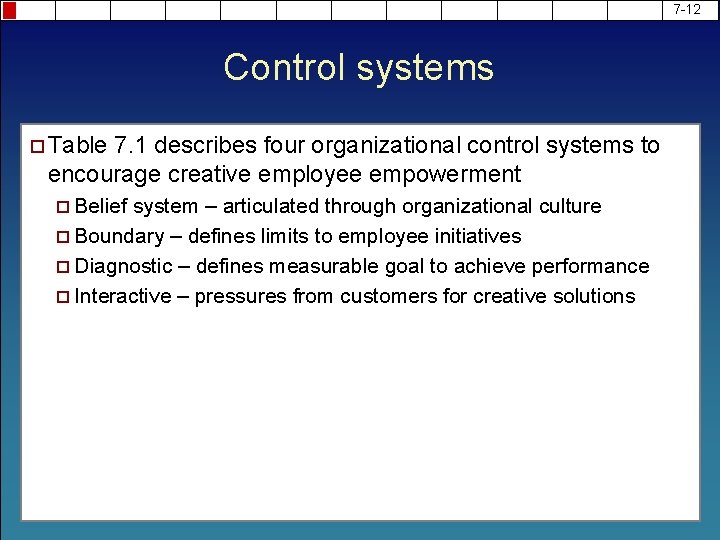
7 -12 Control systems ¨ Table 7. 1 describes four organizational control systems to encourage creative employee empowerment ¨ Belief system – articulated through organizational culture ¨ Boundary – defines limits to employee initiatives ¨ Diagnostic – defines measurable goal to achieve performance ¨ Interactive – pressures from customers for creative solutions
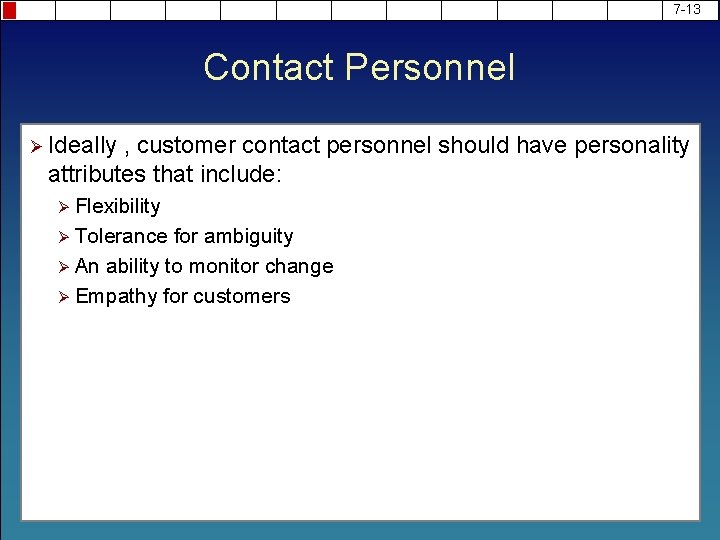
7 -13 Contact Personnel Ø Ideally , customer contact personnel should have personality attributes that include: Flexibility Ø Tolerance for ambiguity Ø An ability to monitor change Ø Empathy for customers Ø
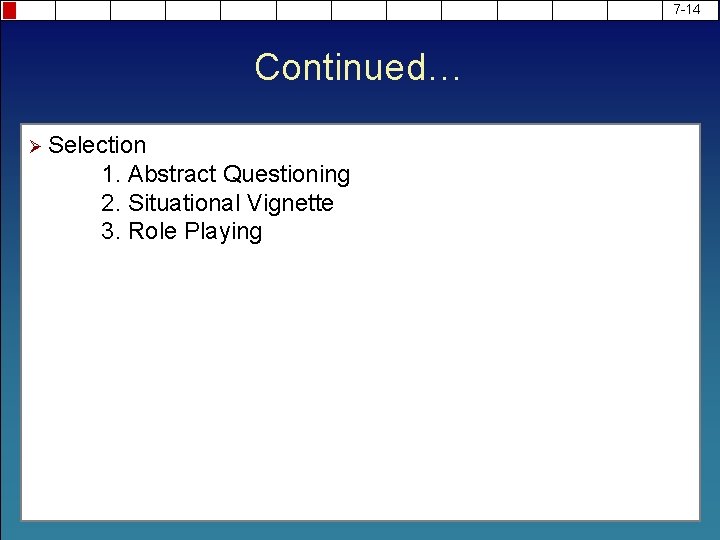
7 -14 Continued… Ø Selection 1. Abstract Questioning 2. Situational Vignette 3. Role Playing
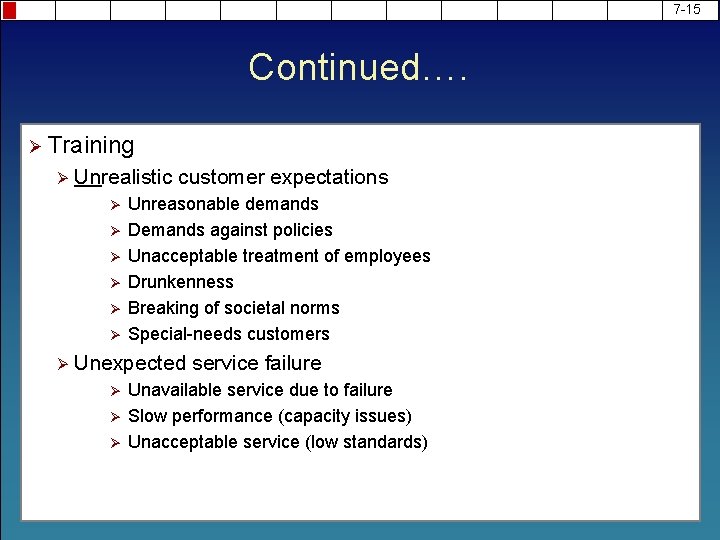
7 -15 Continued…. Ø Training Ø Unrealistic customer expectations Ø Ø Ø Ø Unreasonable demands Demands against policies Unacceptable treatment of employees Drunkenness Breaking of societal norms Special-needs customers Unexpected service failure Ø Ø Ø Unavailable service due to failure Slow performance (capacity issues) Unacceptable service (low standards)
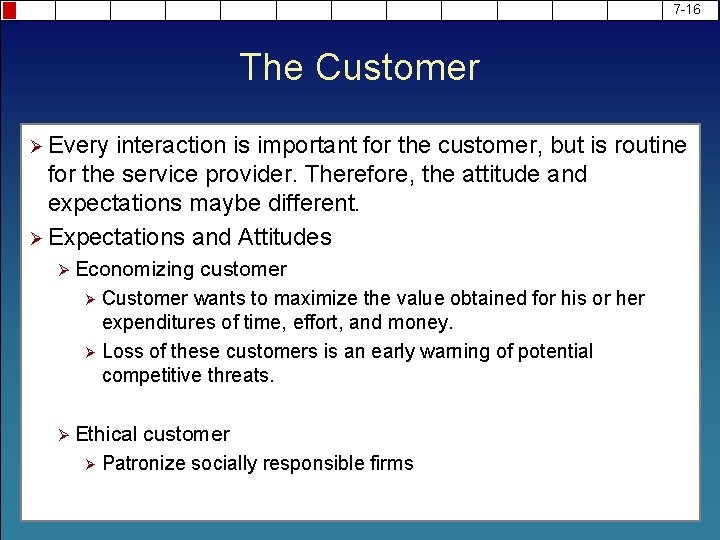
7 -16 The Customer Ø Every interaction is important for the customer, but is routine for the service provider. Therefore, the attitude and expectations maybe different. Ø Expectations and Attitudes Ø Economizing customer Ø Customer wants to maximize the value obtained for his or her expenditures of time, effort, and money. Ø Loss of these customers is an early warning of potential competitive threats. Ø Ethical customer Ø Patronize socially responsible firms
7 -17 Continued…. Ø Personalizing customer Ø These customers want interpersonal gratification such as recognition, respect, etc. Ø Convenience customer Ø These customers have no interest in shopping for the serive; convenience is most important.
7 -18 Customer as Co-Producer Ø Both customer and service provider have role to play in transacting the service. Ø Customers role maybe defined by societal norms or implied by the particular design of the service offered. If and when these roles change due to re-design and/or technology – then there is resistance. Ø See figure 7. 2 – it presents some success factors for categories of service encounter, where the service provider could be a machine serving a human being (ex. ATM machine), or a machine serving another machine (ex. EDI), or a human being serving a machine (ex. Elevator repair).
7 -19 Continued…. ¨ Study of the bank revealed: ¨ When employees perceive a strong service orientation, customers report superior service ¨ Customers perceived better service in branches where employees were more enthusiastic, good training of tellers, well maintained equipment, service is considered important. ¨ After a bank employee gets to know the customer, the cost of serving that customer decreases because time is saved in identity verification and the customer needs can be better anticipated.
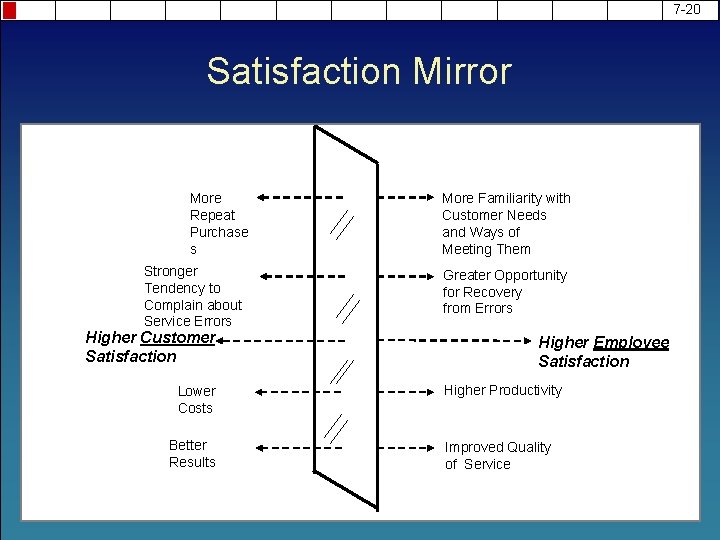
7 -20 Satisfaction Mirror More Repeat Purchase s More Familiarity with Customer Needs and Ways of Meeting Them Stronger Tendency to Complain about Service Errors Greater Opportunity for Recovery from Errors Higher Customer Satisfaction Lower Costs Better Results Higher Employee Satisfaction Higher Productivity Improved Quality of Service
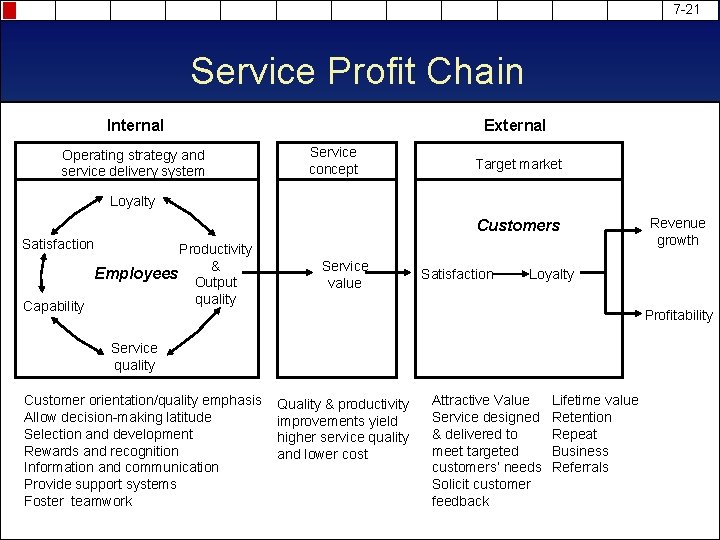
7 -21 Service Profit Chain Internal Operating strategy and service delivery system External Service concept Target market Loyalty Satisfaction Productivity & Employees Output quality Capability Service quality Customer orientation/quality emphasis Allow decision-making latitude Selection and development Rewards and recognition Information and communication Provide support systems Foster teamwork Customers Service value Satisfaction Revenue growth Loyalty Profitability Quality & productivity improvements yield higher service quality and lower cost Attractive Value Service designed & delivered to meet targeted customers’ needs Solicit customer feedback Lifetime value Retention Repeat Business Referrals
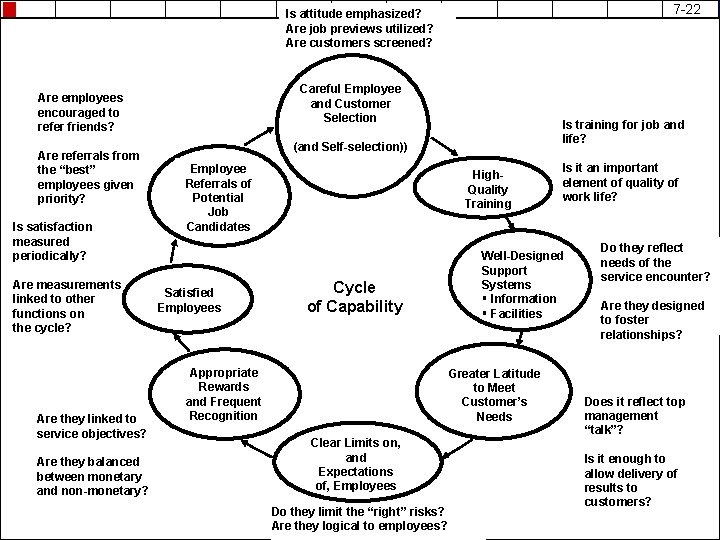
7 -22 Is attitude emphasized? Are job previews utilized? Are customers screened? Careful Employee and Customer Selection (and Self-selection)) Are employees encouraged to refer friends? Are referrals from the “best” employees given priority? Is satisfaction measured periodically? Are measurements linked to other functions on the cycle? Are they linked to service objectives? Are they balanced between monetary and non-monetary? Employee Referrals of Potential Job Candidates Satisfied Employees High. Quality Training Cycle of Capability Appropriate Rewards and Frequent Recognition Well-Designed Support Systems § Information § Facilities Greater Latitude to Meet Customer’s Needs Clear Limits on, and Expectations of, Employees Do they limit the “right” risks? Are they logical to employees? Is training for job and life? Is it an important element of quality of work life? Do they reflect needs of the service encounter? Are they designed to foster relationships? Does it reflect top management “talk”? Is it enough to allow delivery of results to customers?
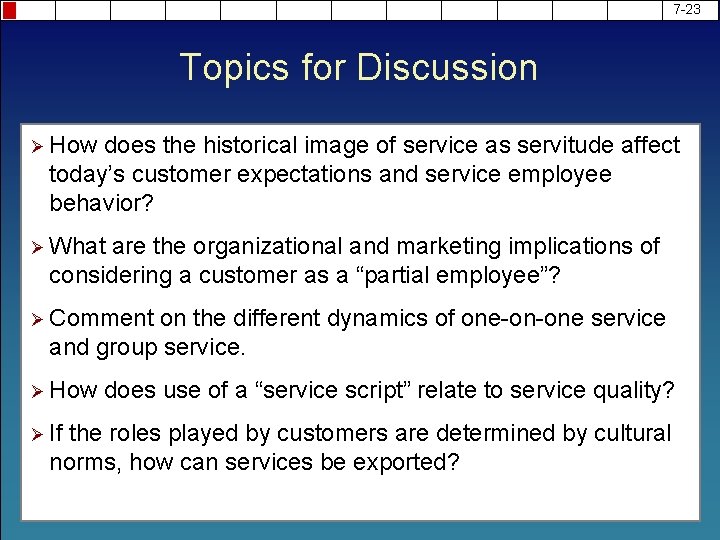
7 -23 Topics for Discussion Ø How does the historical image of service as servitude affect today’s customer expectations and service employee behavior? Ø What are the organizational and marketing implications of considering a customer as a “partial employee”? Ø Comment on the different dynamics of one-on-one service and group service. Ø How does use of a “service script” relate to service quality? Ø If the roles played by customers are determined by cultural norms, how can services be exported?