
7 Self Diagnosis and Trouble Codes Automotive Engine
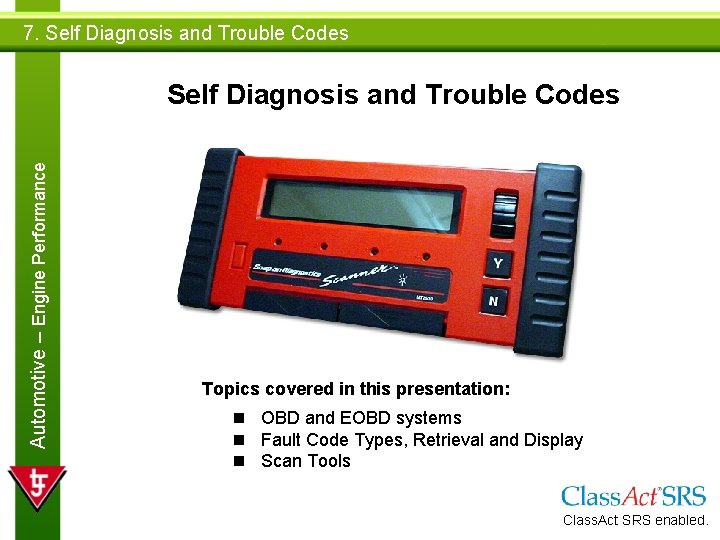
7. Self Diagnosis and Trouble Codes Automotive – Engine Performance Self Diagnosis and Trouble Codes Topics covered in this presentation: n OBD and EOBD systems n Fault Code Types, Retrieval and Display n Scan Tools Class. Act SRS enabled.
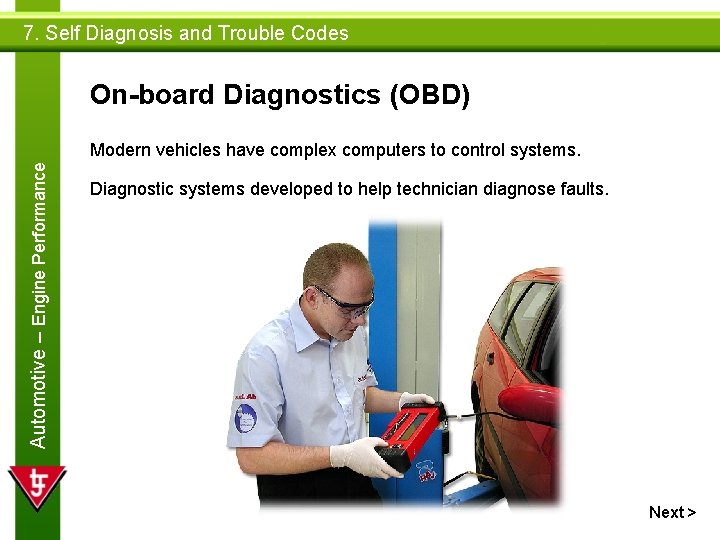
7. Self Diagnosis and Trouble Codes On-board Diagnostics (OBD) Automotive – Engine Performance Modern vehicles have complex computers to control systems. Diagnostic systems developed to help technician diagnose faults. Next >
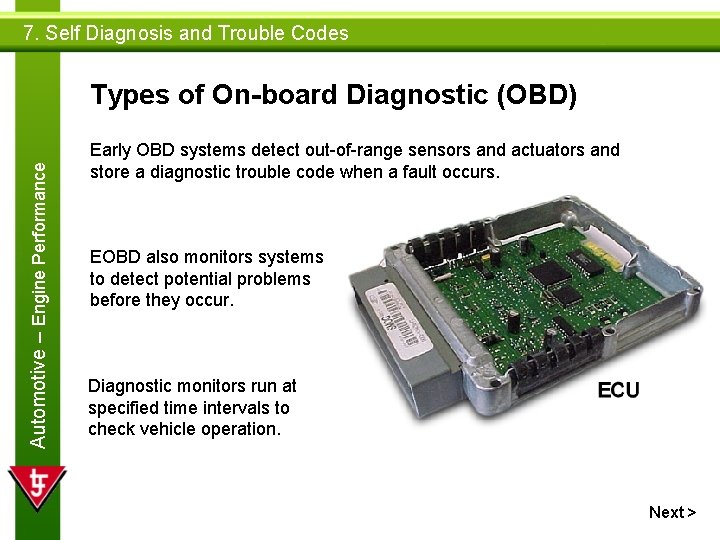
7. Self Diagnosis and Trouble Codes Automotive – Engine Performance Types of On-board Diagnostic (OBD) Early OBD systems detect out-of-range sensors and actuators and store a diagnostic trouble code when a fault occurs. EOBD also monitors systems to detect potential problems before they occur. Diagnostic monitors run at specified time intervals to check vehicle operation. Next >
7. Self Diagnosis and Trouble Codes Automotive – Engine Performance Question 1 Which of the following is a major difference between ODB and EODB systems? A) EODB gets the data faster B) EODB can detect potential problems C) EODB ONLY runs at specified time intervals D) EODB does not detect out of range sensors and actuators

7. Self Diagnosis and Trouble Codes Automotive – Engine Performance Malfunction Indicator Lamp Dashboard mounted malfunction indicator lamp (MIL) indicates presence of fault. MIL (CHECK ENGINE) On OBD systems, MIL illuminates if fault occurs. On EOBD systems, MIL also illuminates if emission limits are going to be exceeded. Continuous illuminated MIL represents non-critical fault. Flashing MIL represents critical fault. Next >
7. Self Diagnosis and Trouble Codes Question 2 Automotive – Engine Performance How does an EODB system warn of a critical fault? A) It turns off the engine B) It sounds a warning buzzer C) It flashes a warning light D) It illuminates a warning light
7. Self Diagnosis and Trouble Codes Automotive – Engine Performance Question 3 Where on an EOBD system, would a malfunction indicator lamp normally be mounted? A) On the ECU B) In the engine compartment C) Near the fusebox D) On the dashboard
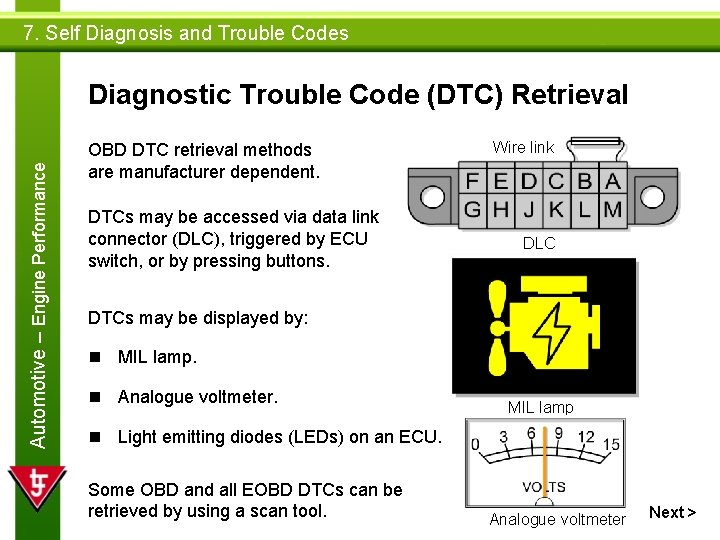
7. Self Diagnosis and Trouble Codes Automotive – Engine Performance Diagnostic Trouble Code (DTC) Retrieval OBD DTC retrieval methods are manufacturer dependent. DTCs may be accessed via data link connector (DLC), triggered by ECU switch, or by pressing buttons. Wire link DLC DTCs may be displayed by: n MIL lamp. n Analogue voltmeter. MIL lamp n Light emitting diodes (LEDs) on an ECU. Some OBD and all EOBD DTCs can be retrieved by using a scan tool. Analogue voltmeter Next >

7. Self Diagnosis and Trouble Codes Automotive – Engine Performance Scan Tool Scan tool accesses and retrieves stored trouble codes. On OBD systems, scan tool retrieves, displays and clears codes, via DLC. On EOBD systems, scan tool also displays ‘live’ data and engine condition ‘snap shots’. Next >
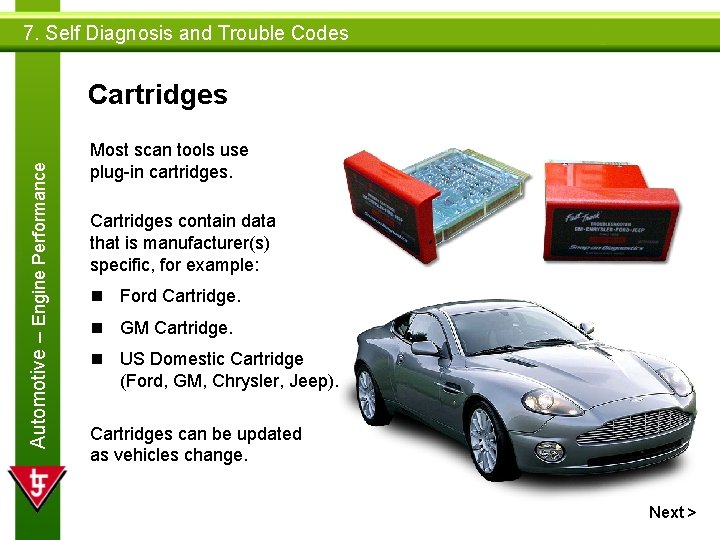
7. Self Diagnosis and Trouble Codes Automotive – Engine Performance Cartridges Most scan tools use plug-in cartridges. Cartridges contain data that is manufacturer(s) specific, for example: n Ford Cartridge. n GM Cartridge. n US Domestic Cartridge (Ford, GM, Chrysler, Jeep). Cartridges can be updated as vehicles change. Next >
7. Self Diagnosis and Trouble Codes Automotive – Engine Performance Question 4 Scan tools use plug in cartridges that are vehicle specific. Is this true or false? Answer True or False.
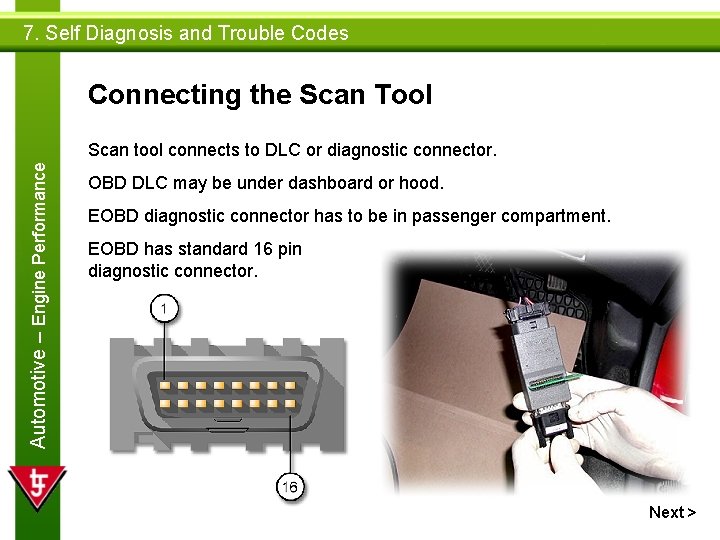
7. Self Diagnosis and Trouble Codes Connecting the Scan Tool Automotive – Engine Performance Scan tool connects to DLC or diagnostic connector. OBD DLC may be under dashboard or hood. EOBD diagnostic connector has to be in passenger compartment. EOBD has standard 16 pin diagnostic connector. Next >
7. Self Diagnosis and Trouble Codes Automotive – Engine Performance Question 5 An EOBD scan tool diagnostic connector will be found in the passenger compartment. Is this true or false? Answer True or False.
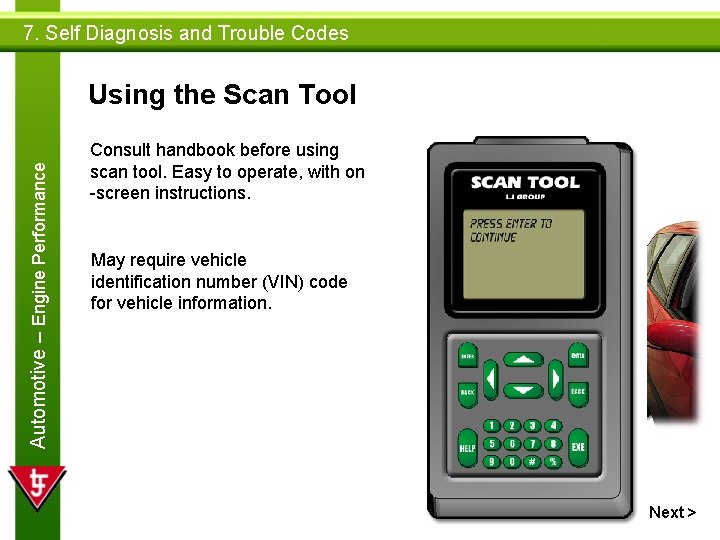
7. Self Diagnosis and Trouble Codes Automotive – Engine Performance Using the Scan Tool Consult handbook before using scan tool. Easy to operate, with on -screen instructions. May require vehicle identification number (VIN) code for vehicle information. Next >
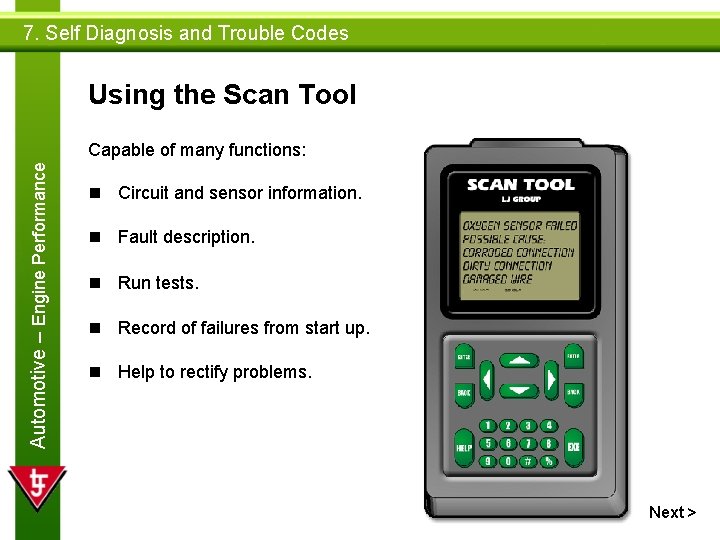
7. Self Diagnosis and Trouble Codes Using the Scan Tool Automotive – Engine Performance Capable of many functions: n Circuit and sensor information. n Fault description. n Run tests. n Record of failures from start up. n Help to rectify problems. Next >
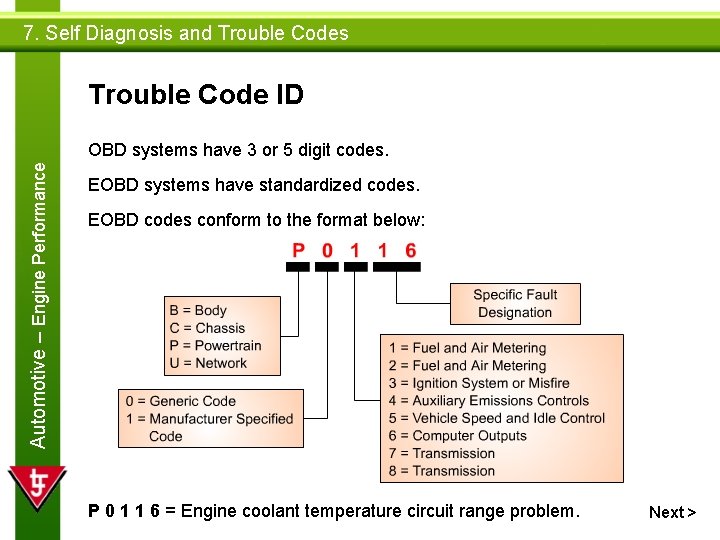
7. Self Diagnosis and Trouble Codes Trouble Code ID Automotive – Engine Performance OBD systems have 3 or 5 digit codes. EOBD systems have standardized codes. EOBD codes conform to the format below: P 0 1 1 6 = Engine coolant temperature circuit range problem. Next >
7. Self Diagnosis and Trouble Codes Automotive – Engine Performance Question 6 How many letters and numbers will be found in a standard EOBD trouble code? Enter your answer and press SEND.
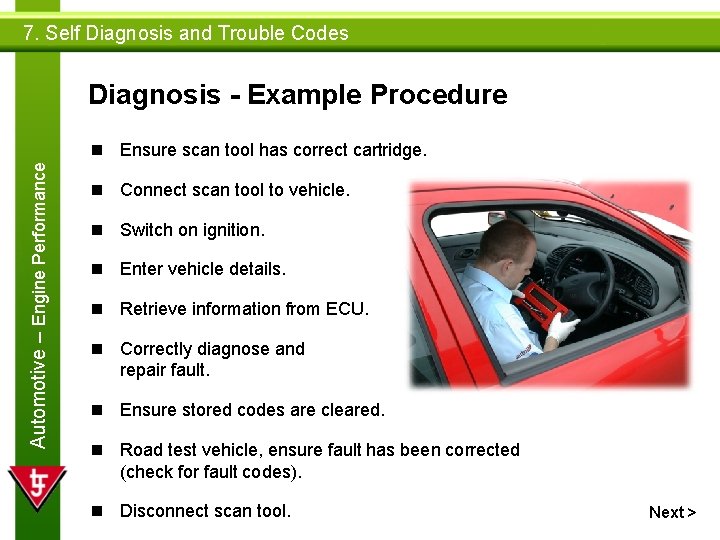
7. Self Diagnosis and Trouble Codes Diagnosis - Example Procedure Automotive – Engine Performance n Ensure scan tool has correct cartridge. n Connect scan tool to vehicle. n Switch on ignition. n Enter vehicle details. n Retrieve information from ECU. n Correctly diagnose and repair fault. n Ensure stored codes are cleared. n Road test vehicle, ensure fault has been corrected (check for fault codes). n Disconnect scan tool. Next >
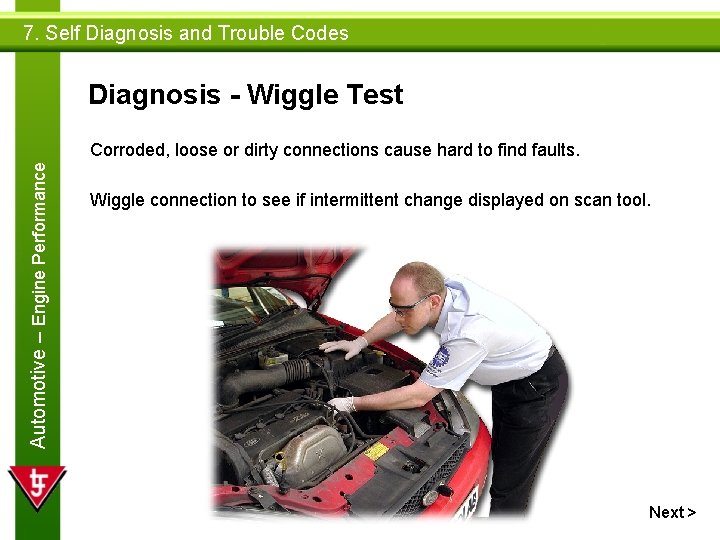
7. Self Diagnosis and Trouble Codes Diagnosis - Wiggle Test Automotive – Engine Performance Corroded, loose or dirty connections cause hard to find faults. Wiggle connection to see if intermittent change displayed on scan tool. Next >
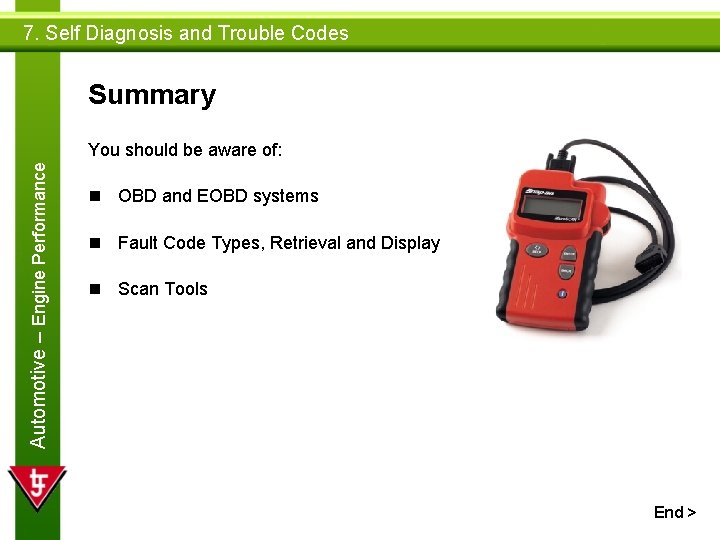
7. Self Diagnosis and Trouble Codes Summary Automotive – Engine Performance You should be aware of: n OBD and EOBD systems n Fault Code Types, Retrieval and Display n Scan Tools End >
- Slides: 20