
7 Secularisation Defining secularisation Bryan Wilson the process

7. Secularisation Defining secularisation • • • Bryan Wilson ‘the process whereby religious thinking, participation and institutions lose social significance’ Steve Bruce – there is not one secularisation theory – but a ‘cluster of descriptions & explanations’ Jose Casanova – notes 2 approaches to defining secularisation: (a) Structural level (institution) (b) Individual level (personal belief) • Glock & Stark – multi-dimensional and no general agreement on what a truly religious society is • David Martin – ‘an intellectual holdall’ that should be abandoned The classical theorists Rise of science + industrialisation = secularisation • Marx – communism = no classes = no religion needed • Durkheim – industrialisation = organic solidarity = shared beliefs from other sources – education replace religion • Weber – rationalisation = control of environment/efficiency – rise of science = bureaucratic organisation = actions driven by rational goals 1
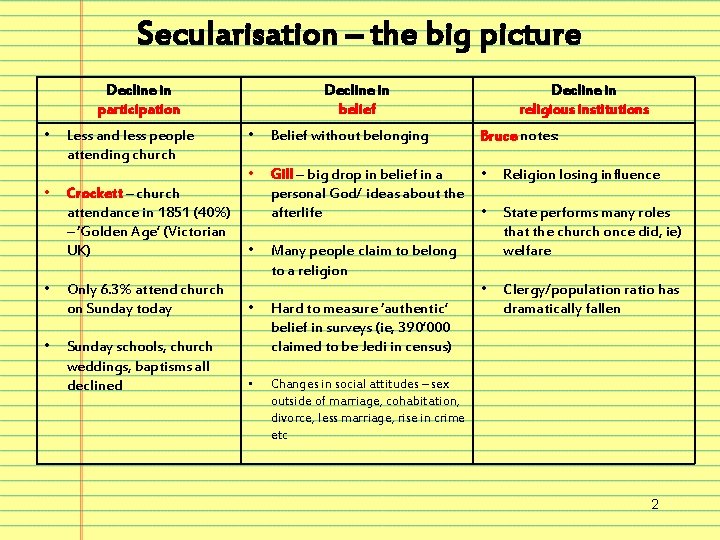
Secularisation – the big picture Decline in participation • • Less and less people attending church Crockett – church attendance in 1851 (40%) – ‘Golden Age’ (Victorian UK) Decline in belief Decline in religious institutions • Belief without belonging Bruce notes: • Gill – big drop in belief in a personal God/ ideas about the afterlife • Religion losing influence • State performs many roles that the church once did, ie) welfare • Clergy/population ratio has dramatically fallen • Many people claim to belong to a religion Only 6. 3% attend church on Sunday today • Sunday schools, church weddings, baptisms all declined Hard to measure ‘authentic’ belief in surveys (ie, 390’ 000 claimed to be Jedi in census) • Changes in social attitudes – sex outside of marriage, cohabitation, divorce, less marriage, rise in crime etc 2

Support for Secularisation Evidence/Explanation • • • In brief Decline in Religious Participation • Fewer people attend church/less ceremonies Decline in beliefs • • Changing attitudes on issues Less belief in God Religious pluralism • • Many faiths = no universal faith in society Fragmented – less influence • • • Church withdrawn from society Less power and influence Church not focal point of community • • Rational attitude – faith in science Man control of the world • Marketisation of religion has lessened its authenticity in a postmodern age Disengagement/ differentiation Disenchantment Disneyfication/loss of meaning 3
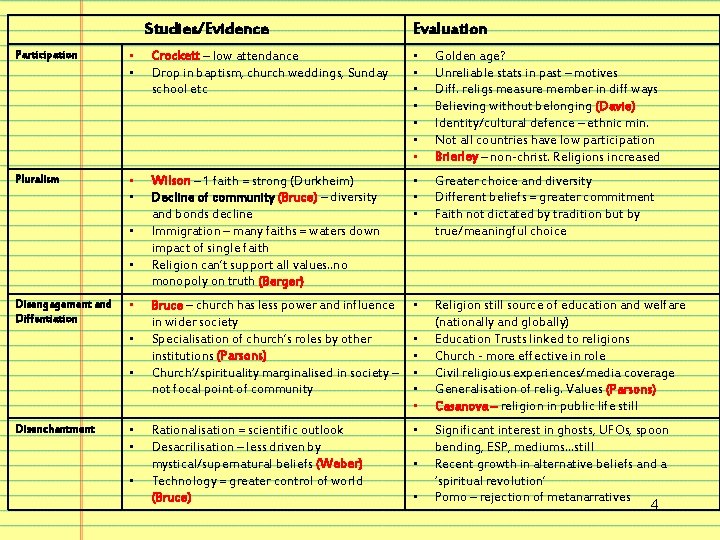
Studies/Evidence Evaluation Participation • • Crockett – low attendance Drop in baptism, church weddings, Sunday school etc • • Golden age? Unreliable stats in past – motives Diff. religs measure member in diff ways Believing without belonging (Davie) Identity/cultural defence – ethnic min. Not all countries have low participation Brierley – non-christ. Religions increased Pluralism • • Wilson – 1 faith = strong (Durkheim) Decline of community (Bruce) – diversity and bonds decline Immigration – many faiths = waters down impact of single faith Religion can’t support all values. . no monopoly on truth (Berger) • • • Greater choice and diversity Different beliefs = greater commitment Faith not dictated by tradition but by true/meaningful choice Bruce – church has less power and influence in wider society Specialisation of church’s roles by other institutions (Parsons) Church‘/spirituality marginalised in society – not focal point of community • Religion still source of education and welfare (nationally and globally) Education Trusts linked to religions Church - more effective in role Civil religious experiences/media coverage Generalisation of relig. Values (Parsons) Casanova – religion in public life still Rationalisation = scientific outlook Desacrilisation – less driven by mystical/supernatural beliefs (Weber) Technology = greater control of world (Bruce) • • • Disengagement and Diffentiation • • • Disenchantment • • • Significant interest in ghosts, UFOs, spoon bending, ESP, mediums…still Recent growth in alternative beliefs and a ‘spiritual revolution’ Pomo – rejection of metanarratives 4

Challenges to Secularisation Evidence/Explanation In brief • Resacrilisation & the spiritual revolution • • A religious revivalism – more individualist spirituality Growth in NAMs and sects • Believing without belonging • • Private sphere = religion No longer need ‘collective worship’ • Rise of fundamentalism • People turning to fundamentalism rather than traditional faiths • Existential security theory • • Certain people/places have a greater need for religion, ie) poorer societies Richer countries are more ‘secure’ so have less need = certainty • • Religion can be important source of identity Religion provides support/community for migrants • Religion specialises role now/more effective in spiritual matters • Greater diversity and choice – not dictated by tradition links to resacrilisation) • Cultural defence/transition • Structural differentiation (the flip side) • Pluralism (the flip side) 5

Studies/Evidence Resacrilisation • • • Evaluation Heelas – move from trad. religion Religious renewal – individualistic spirituality ‘self religions’ (World Affirming NRMS/NAMs) Personalised – hybrids – pick n mix Spiritual market is growing. . Personal choice/less demanding Evangelic faith’s appeal = healing and self improvement • • • Bruce – very few into ‘New Age’ Wilson – ‘sects = last gasp for religiosity’ Wilson – NRMs etc = middle class indulgence – ‘meditation & sushi’ Davie – privatised faith Less community focused nature • Voas & Crockett – continual decline in believing as well as belonging Attendance = commitment Believing without belonging • • Rise of fundamentalism • • • Almond – global rise in fundamentalism Need for certainty/tradition Roof & Mc. Kinney – USA – New Christian Right = Conservatives – tradition/morality • • Bruce – slowed down secularisation but lack power/influence and impact Only gained attention because they are so ‘extreme’…in a secular world Existential security theory • Norris & Inglehart – 3 rd world religion is strong = high risks and need for security (compensation) • • • Vasquez – over reliance on income data See religion as a negative response Ignore positive appeal to wealthy too Cultural defence/ transition • Bruce – focal point for identity for some groups – under threat (cult. defence) Help migrants/eth, min. with support and community (cult. Transition) • Bruce – religion only survives because of identity role (not about spirituality) Structural differentiation • Parsons – religion more specialised and generalisation of values • Are values so generalised today? Pluralism • Greater choice/diversity – religiosity = more meaningful • • More diversity = fragmented and weak Ecumenicalism is proof of weakness of faiths (Wilson) (see Fundamentalism slides) • • 6

Secularisation – Other considerations International comparisons • • USA – high religiosity Most Europe – 40% Brierley (only small drop in Christianity globally) Islam increasing globally Christianity in Ireland USA – New Christian Right/Televangelism It is not a single process equal to all societies (Martin) Martin Strength of religion depends on : • link to identity (ethnic, national and regional) • Link between church/state • Degree of pluralism Kepel • Religious revivals around the world (Islamization, Christian fundamentalism) • Reactions to ‘secular’ governments & modernity Different social groups • Ethnic minorities maintain religiosity (although 2 nd generation less so) • Women more religious than men • Different groups = different needs, ie) cultural defence/transition, compensation etc Problems defining secularisation • • • Sects/Cults/NRMS/NAMS • • • Greeley – renewed interest in spiritual in the West Brierley – rise in non-trinitarian christian churches/other faiths Heelas & Woodhead – spiritual revolution – New Age rise – meet personal choice/self-religions/suit lifestyle/hybridity/self-improve. Bruce ‘irrelevant with little impact in society’ – new age beliefs are weak/personal Berger ‘islands in a secular sea’ Shiner – at least 6 definitions of secularisation in use Glock and Stark – multidimensional Martin – ‘abandon the term’ This theory underestimates the level of diversity in practice/belief ‘inclusive’ definitions are vague and allow religiosity to ‘trap’ more religiosity How far religious institutions are religious? (Herberg/Bellah) – ‘secularisation from within’ (Bruce) Problems measuring secularisation Church participation • Under-estimates/over-estimates • Self collected data issues • Using different definitions/criteria • People attending in past for ‘social’ reasons/status/pressure (Martin) • Problem defining ‘golden age’ Opinion polls • Measuring belief =problem – abstract • Interpretation of questions • How far do actions match beliefs? (Haddaway et al) 7
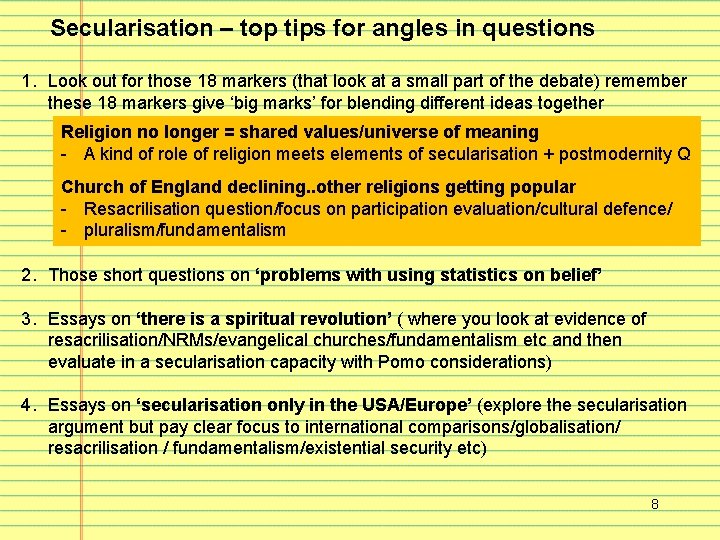
Secularisation – top tips for angles in questions 1. Look out for those 18 markers (that look at a small part of the debate) remember these 18 markers give ‘big marks’ for blending different ideas together Religion no longer = shared values/universe of meaning - A kind of role of religion meets elements of secularisation + postmodernity Q Church of England declining. . other religions getting popular - Resacrilisation question/focus on participation evaluation/cultural defence/ - pluralism/fundamentalism 2. Those short questions on ‘problems with using statistics on belief’ 3. Essays on ‘there is a spiritual revolution’ ( where you look at evidence of resacrilisation/NRMs/evangelical churches/fundamentalism etc and then evaluate in a secularisation capacity with Pomo considerations) 4. Essays on ‘secularisation only in the USA/Europe’ (explore the secularisation argument but pay clear focus to international comparisons/globalisation/ resacrilisation / fundamentalism/existential security etc) 8
- Slides: 8