
7 ROLES OF THE PRESIDENT Head of State
- Slides: 13
7 ROLES OF THE PRESIDENT
Head of State As head of state the President represents the nation and performs ceremonial duties. EXAMPLES: 1. Serve as host to visiting Kings, Queens, and heads of governments. 2. Throw out first pitch of MLB season. 3. Lighting the national Christmas tree. •
Chief Executive As chief executive, the president sees that the laws of Congress are carried out. Tools of Influence for the President to use: Executive Orders- rules that have the force of law. (Implied Power from the Constitution which states that the President ensures that “laws be faithfully executed”)
Chief Executive Tools of Influence for the President to use: Presidential Appointments- Including cabinet members, and about 2, 200 other top level officials. (Consent of the Senate) Right to remove officials- This is done if they do not agree with the President. (Nixon fired Sec. of Interior Vietnam) Impoundment- Pres. Refuses to spend money Congress has appropriated.
Chief Executive Tools of Influence for the President to use: Reprieve- a postponement of legal punishment. Pardon- a release of legal punishment. (Usually from federal crimes) Amnesty- is a group pardon to people for an offense against the Govt. (Ford and Carter granted amnesty to draft dodgers)
Chief Legislator The President is expected to propose legislation it wants to see enacted. How it works: President describes legislative program in the State of the Union Address. President’s staff writes legislation and sends it to Congress. President works with Congress to see bills get through the Congress.
Chief Legislator How it works cont. President may hand out Political favors (visit home state of Congressman, start programs that send money and jobs to districts). Uses veto power to influence Congress.
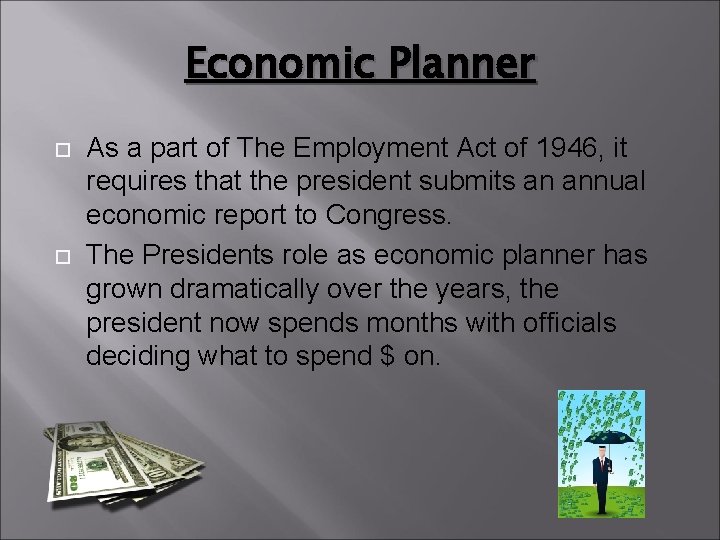
Economic Planner As a part of The Employment Act of 1946, it requires that the president submits an annual economic report to Congress. The Presidents role as economic planner has grown dramatically over the years, the president now spends months with officials deciding what to spend $ on.
Party Leader The President’s political party expects him to lead the party in a number of ways. Examples: 1. Give speeches to help in re-elections 2. Fund-raising for the party. 3. Selects the party’s national chairperson. 4. Helps plan the party’s future election strategies.
Party Leader More Examples: 5. Pres. Is expected to appoint members of his party to Govt. jobs. 6. Patronage- appointment to political office in reward for supporting the President’s programs.
Chief Diplomat The President directs the foreign policy of the U. S. , making key decisions about the relations the U. S. has with other countries in the world. Diplomatic Tools President has sole power to negotiate and sign treaties- formal agreements between the governments of two or more countries. (Senate must approve)
Chief Diplomatic Tools cont. President also has authority to make executive agreements with other countries. (These are pacts between the Pres. and the head of a foreign Govt. do not require Senate approval) The President decides whether the U. S. will recognize governments of other countries. (Georgia, Cuba)
Commander in Chief The Constitution makes the president commander in chief of the armed forces of the United States. Power to Make War President shares with Congress the power to make war. The President can send troops to battle without consent of the Congress. For a war to be officially declared Congress must approve.