
7 Reliability based design Objectives Learn formulation of
7. Reliability based design Objectives • Learn formulation of reliability design problem. Understand difference between reliability-based design and deterministic design • Learn how to quickly approximate reliability of component using mean value, first order, second moment method • Be exposed to three example problems involving analysis and design
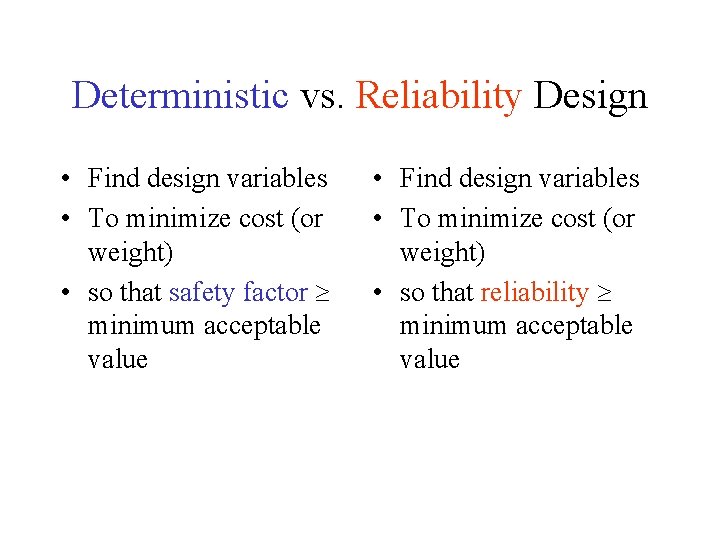
Deterministic vs. Reliability Design • Find design variables • To minimize cost (or weight) • so that safety factor minimum acceptable value • Find design variables • To minimize cost (or weight) • so that reliability minimum acceptable value
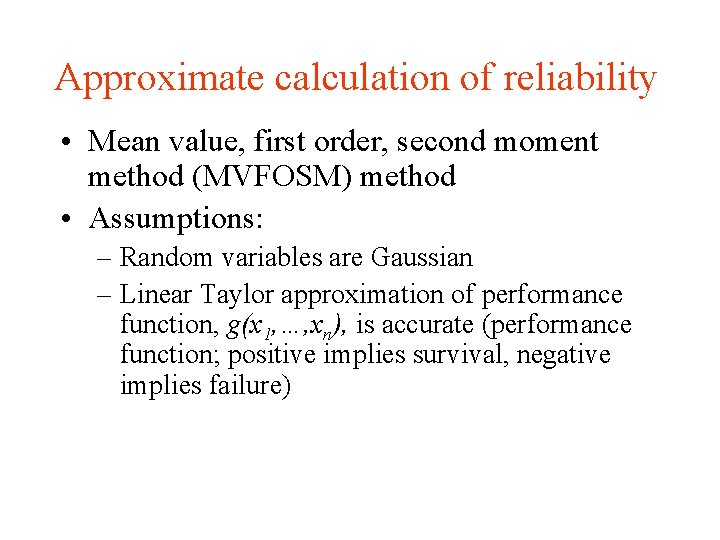
Approximate calculation of reliability • Mean value, first order, second moment method (MVFOSM) method • Assumptions: – Random variables are Gaussian – Linear Taylor approximation of performance function, g(x 1, …, xn), is accurate (performance function; positive implies survival, negative implies failure)
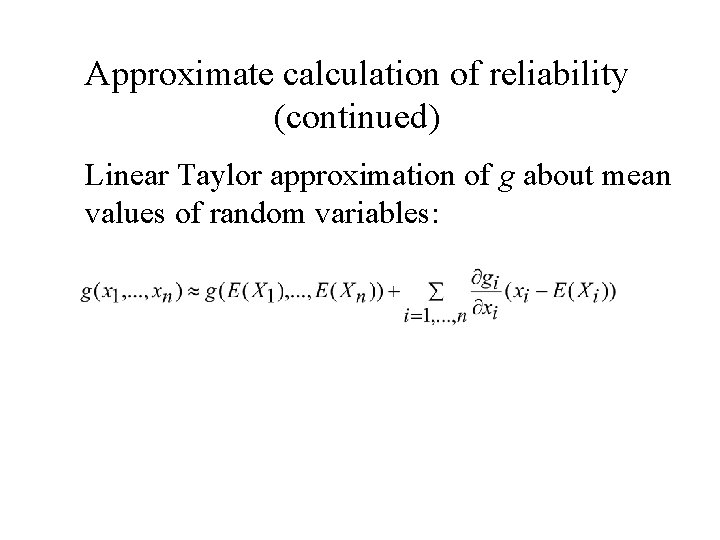
Approximate calculation of reliability (continued) Linear Taylor approximation of g about mean values of random variables:

Approximate calculation of reliability (continued) Mean value of g Standard deviation of g The derivatives are calculated at the mean values of r. v. s

Approximate calculation of reliability (continued) Failure probability = (- ) Reliability=1 -failure probability
Generic procedure for solving reliability design problem • Develop equation for performance function • Develop method for calculating the reliability as a function of the design variable(s). Since many iterations are required in design we need an approximate method (e. g. MVFOSM) for calculating reliability at this stage • Find the optimum values of the design variable(s) so that the requirement for acceptable reliability as well as other requirements are satisfied • Validate the final design, i. e. compute the reliability of the final design using an accurate method (for example Monte. Carlo simulation) • Redesign the system if needed.
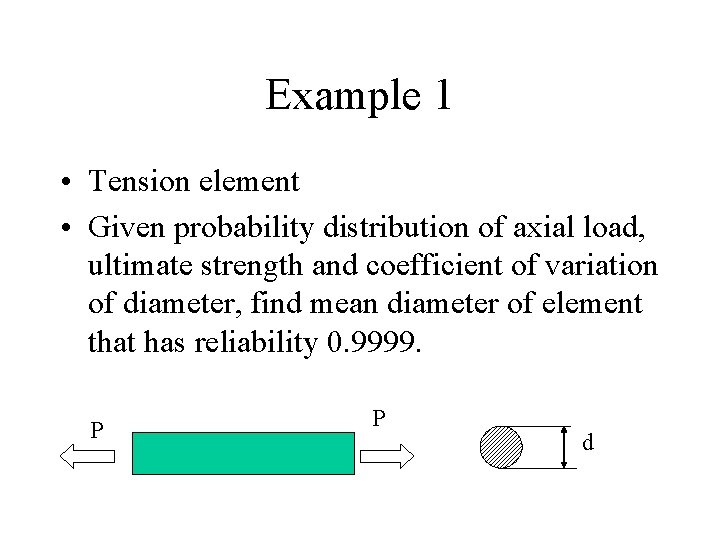
Example 1 • Tension element • Given probability distribution of axial load, ultimate strength and coefficient of variation of diameter, find mean diameter of element that has reliability 0. 9999. P P d
Example 2: Design of I-beam • Find web height of I-beam to meet given reliability target
Example 3: Design-oriented analysis of torsion bar of a truck
Suggested reading • Frangopol, D, M. , and Maute, K. , “Reliabilitybased Optimization of Civil and Aerospace Structural Systems, ” Engineering Design Reliability Handbook, CRC press, 2004, p. 24 -1. • Mourelatos, Z. , P. , et al. , “Probabilistic Analysis and Design in Automotive Industry, ” Engineering Design Reliability Handbook, CRC press, 2004, p. 38 -1.
- Slides: 11