
7 Probability Living With The Odds Fundamentals of
7 Probability: Living With The Odds Fundamentals of Probability Copyright © 2015, 2011, 2008 Pearson Education, Inc. Chapter 7, Unit A, Slide 1
Definitions Outcomes are the most basic possible results of observations or experiments. For example, if you toss two coins, one possible outcome is HT and another possible outcome is TH. An event consists of one or more outcomes that share a property of interest. For example, if you toss two coins and count the number of heads, the outcomes HT and TH both represent the same event of 1 head (and 1 tail). Copyright © 2015, 2011, 2008 Pearson Education, Inc. Chapter 7, Unit A, Slide 2
Example Consider families of two children. List all the possible outcomes for the birth order of boys and girls. If we are only interested in the total number of boys in the families, what are the possible events? Solution There are four different possible birth orders (outcomes): BB, BG, GB, and GG. Copyright © 2015, 2011, 2008 Pearson Education, Inc. Chapter 7, Unit A, Slide 3
Example (cont) Because we are asked to consider only the total number of boys, the possible events with two children are: 0 boys, 1 boy, and 2 boys. The event 0 boys (0 B) consists of the single outcome GG, the event 1 boy (1 B) consists of the outcomes GB and BG, and the event 2 boys (2 B) consists of the single outcome BB. Copyright © 2015, 2011, 2008 Pearson Education, Inc. Chapter 7, Unit A, Slide 4
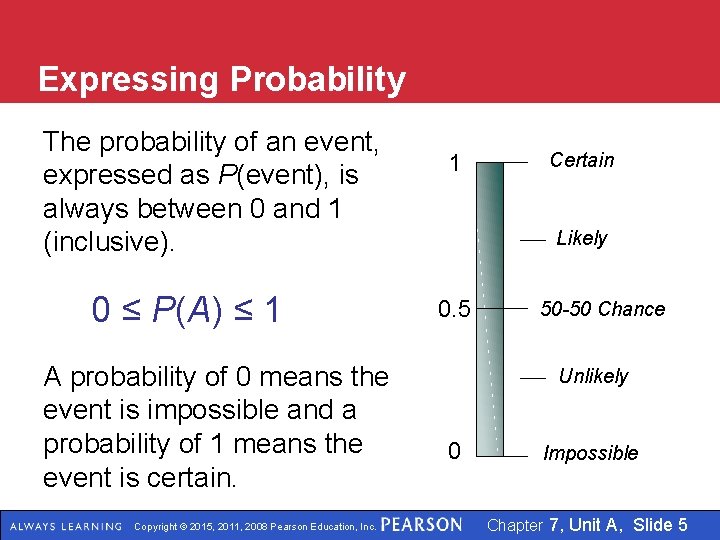
Expressing Probability The probability of an event, expressed as P(event), is always between 0 and 1 (inclusive). 0 ≤ P(A) ≤ 1 A probability of 0 means the event is impossible and a probability of 1 means the event is certain. Copyright © 2015, 2011, 2008 Pearson Education, Inc. 1 Certain Likely 0. 5 50 -50 Chance Unlikely 0 Impossible Chapter 7, Unit A, Slide 5

Theoretical Method for Equally Likely Outcomes Step 1: Count the total number of possible outcomes. Step 2: Among all the possible outcomes, count the number of ways the event of interest, A, can occur. Step 3: Determine the probability, P(A). Copyright © 2015, 2011, 2008 Pearson Education, Inc. Chapter 7, Unit A, Slide 6
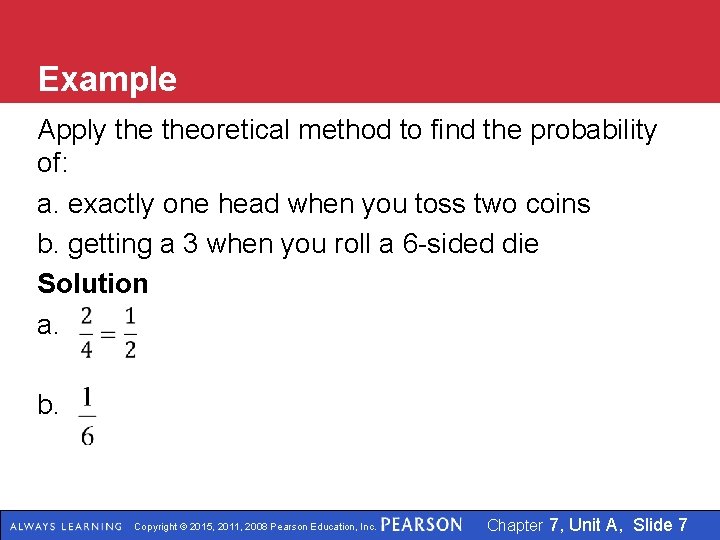
Example Apply theoretical method to find the probability of: a. exactly one head when you toss two coins b. getting a 3 when you roll a 6 -sided die Solution a. b. Copyright © 2015, 2011, 2008 Pearson Education, Inc. Chapter 7, Unit A, Slide 7
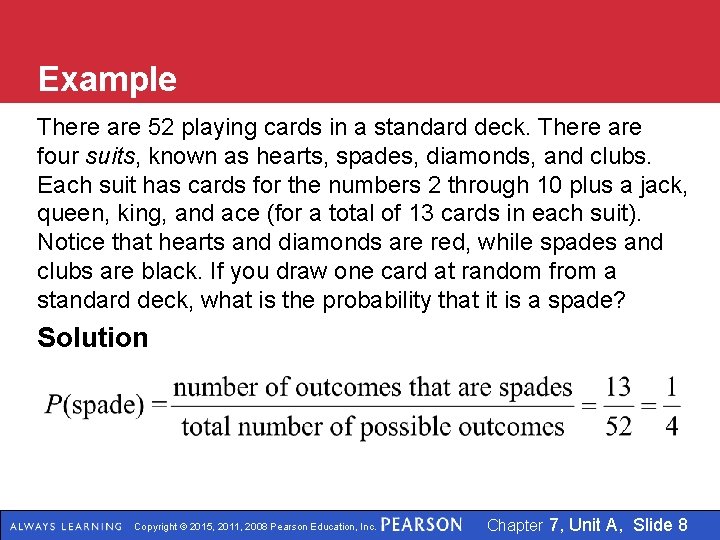
Example There are 52 playing cards in a standard deck. There are four suits, known as hearts, spades, diamonds, and clubs. Each suit has cards for the numbers 2 through 10 plus a jack, queen, king, and ace (for a total of 13 cards in each suit). Notice that hearts and diamonds are red, while spades and clubs are black. If you draw one card at random from a standard deck, what is the probability that it is a spade? Solution Copyright © 2015, 2011, 2008 Pearson Education, Inc. Chapter 7, Unit A, Slide 8
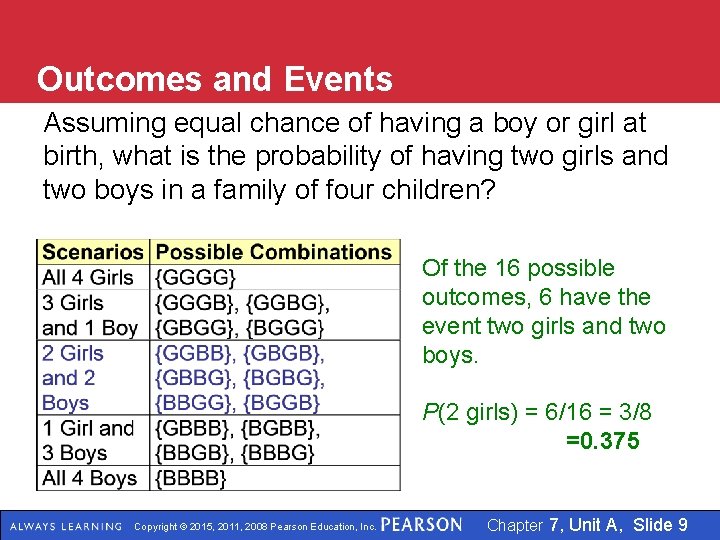
Outcomes and Events Assuming equal chance of having a boy or girl at birth, what is the probability of having two girls and two boys in a family of four children? Of the 16 possible outcomes, 6 have the event two girls and two boys. P(2 girls) = 6/16 = 3/8 =0. 375 Copyright © 2015, 2011, 2008 Pearson Education, Inc. Chapter 7, Unit A, Slide 9
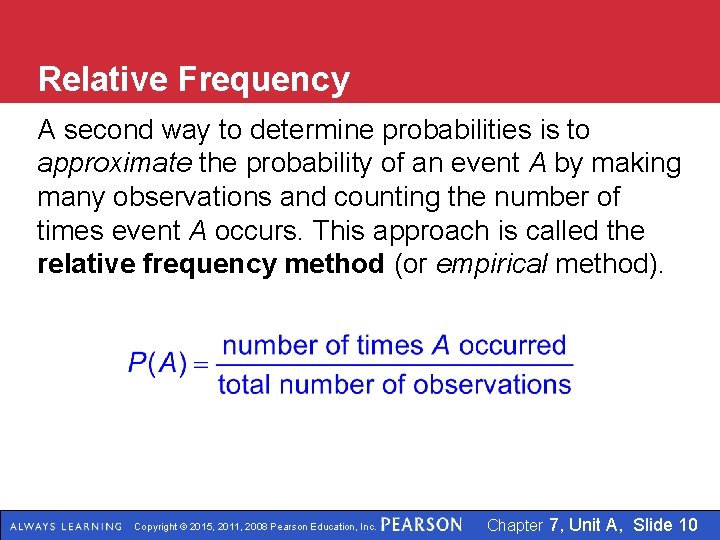
Relative Frequency A second way to determine probabilities is to approximate the probability of an event A by making many observations and counting the number of times event A occurs. This approach is called the relative frequency method (or empirical method). Copyright © 2015, 2011, 2008 Pearson Education, Inc. Chapter 7, Unit A, Slide 10
Example If you are interested only in the number of heads when tossing two coins, then the possible events are 0 heads, 1 head, and 2 heads. Suppose you repeat a two-coin toss 100 times and your results are as follows: • 0 heads occurs 22 times. • 1 head occurs 51 times. • 2 heads occurs 27 times. Compare the relative frequency probabilities to theoretical probabilities. Do you have reason to suspect that the coins are unfair? Copyright © 2015, 2011, 2008 Pearson Education, Inc. Chapter 7, Unit A, Slide 11
Example (cont) The theoretical probabilities are … 0 heads: 1/4, or 0. 25 1 head: 2/4 or 0. 5 2 heads: 1/4 = 0. 25 Find the relative frequencies: 0 heads: 22/100 = 0. 22 1 head: 51/100 = 0. 51 2 heads: 27/100 = 0. 27 The relative and theoretical probabilities are fairly close. There is no reason to suspect the coins are unfair. Copyright © 2015, 2011, 2008 Pearson Education, Inc. Chapter 7, Unit A, Slide 12
Three Types of Probabilities A theoretical probability, based on the assumption that all outcomes are equally likely, is determined by dividing the number of ways an event can occur by the total number of possible outcomes. A relative frequency probability, based on observations or experiments, is the relative frequency of the event of interest. A subjective probability is an estimate based on experience or intuition. Copyright © 2015, 2011, 2008 Pearson Education, Inc. Chapter 7, Unit A, Slide 13
Example Identify the method that resulted in the following statements. a. I’m 100% certain that you’ll be happy with this car. subjective b. Based on government data, the chance of dying in an automobile accident during a one-year period is about 1 in 8000. relative frequency Copyright © 2015, 2011, 2008 Pearson Education, Inc. Chapter 7, Unit A, Slide 14
Example Identify the method that resulted in the following statements. c. The probability of rolling a 7 with a 12 -sided die is 1/12. theoretical probability Copyright © 2015, 2011, 2008 Pearson Education, Inc. Chapter 7, Unit A, Slide 15
Probability of an Event Not Occurring If the probability of an event A is P(A), then the probability that event A does not occur is 1 – P(A). Since the probability of a family of four children having two girls and two boys is 0. 375, what is the probability of a family of four children not having two girls and two boys? P(not 2 girls) = 1 – 0. 375 = 0. 625 Copyright © 2015, 2011, 2008 Pearson Education, Inc. Chapter 7, Unit A, Slide 16
Making a Probability Distribution A probability distribution represents the probabilities of all possible events. To make a probability distribution, do the following: Step 1: List all possible outcomes. Use a table or figure if it is helpful. Step 2: Identify outcomes that represent the same event and determine the probability of each event. Step 3: Make a table listing each event and probability. Copyright © 2015, 2011, 2008 Pearson Education, Inc. Chapter 7, Unit A, Slide 17
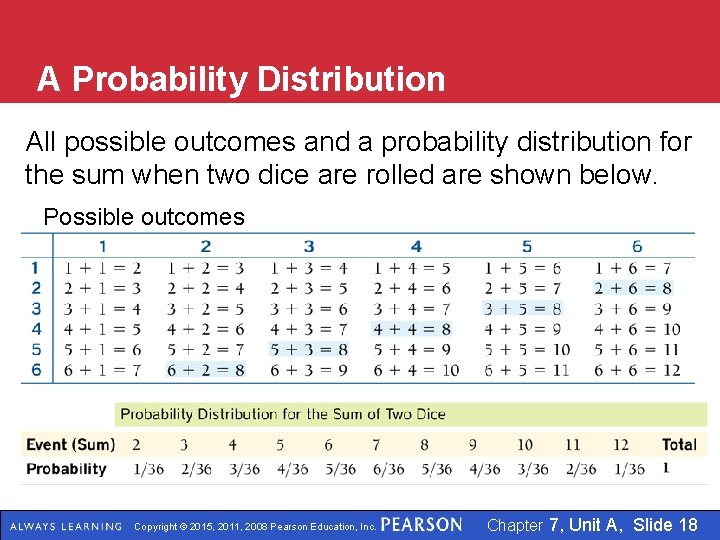
A Probability Distribution All possible outcomes and a probability distribution for the sum when two dice are rolled are shown below. Possible outcomes Copyright © 2015, 2011, 2008 Pearson Education, Inc. Chapter 7, Unit A, Slide 18
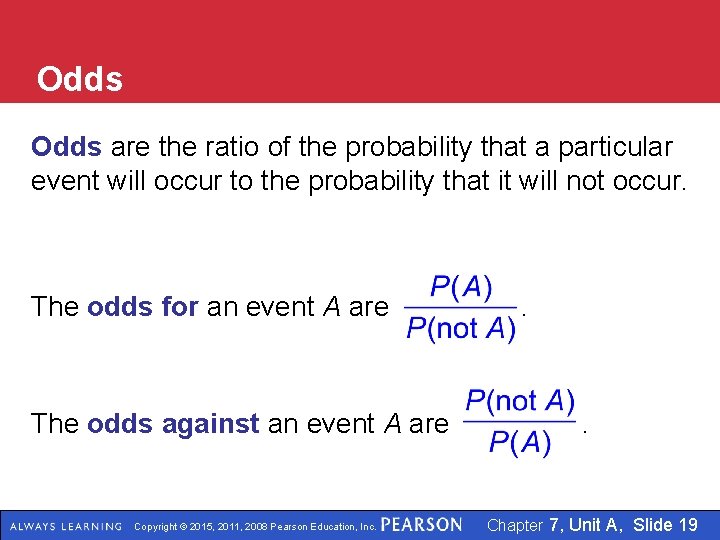
Odds are the ratio of the probability that a particular event will occur to the probability that it will not occur. The odds for an event A are The odds against an event A are Copyright © 2015, 2011, 2008 Pearson Education, Inc. . . Chapter 7, Unit A, Slide 19
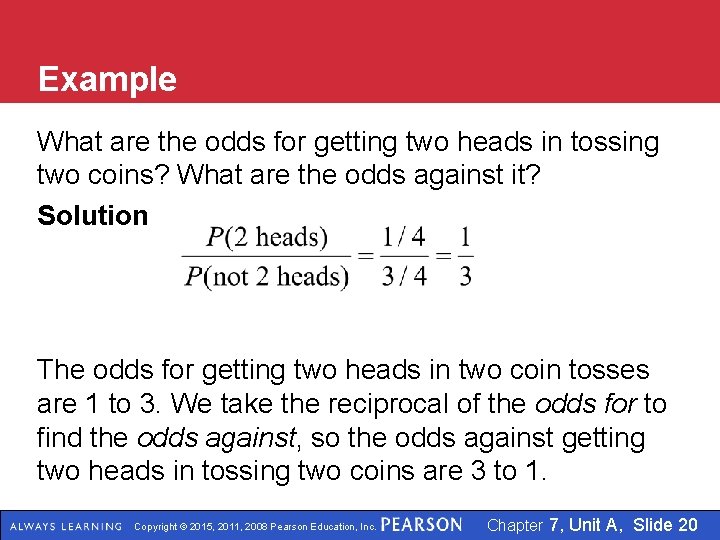
Example What are the odds for getting two heads in tossing two coins? What are the odds against it? Solution The odds for getting two heads in two coin tosses are 1 to 3. We take the reciprocal of the odds for to find the odds against, so the odds against getting two heads in tossing two coins are 3 to 1. Copyright © 2015, 2011, 2008 Pearson Education, Inc. Chapter 7, Unit A, Slide 20
Example At a horse race, the odds on Blue Moon are given as 7 to 2. If you bet $10 and Blue Moon wins, how much will you gain? Solution The 7 to 2 odds mean that, for each $2 you bet on Blue Moon, you gain $7 if you win. A $10 bet is equivalent to five $2 bets, so you gain 5($7) = $35. You also get your $10 back, so you will receive $45 when you collect on your winning ticket. Copyright © 2015, 2011, 2008 Pearson Education, Inc. Chapter 7, Unit A, Slide 21
- Slides: 21