
7 OSI Layers 1 Application Layer Provides services
- Slides: 11
7 OSI Layers
1. Application Layer: Provides services for user applications. This layer is responsible for the exchange of information between computer programs, such as e-mail programs, and other service roads on the network, such as a printer server or other computer applications.
2. Presentation Layer: Concerned with how data is converted and formatted for data transfer. Examples of ASCII text format conversion for documents, . Gif and JPG for images. This layer performs code conversion, data translation, encryption and conversion.
3. Session Layer: Determines how two devices establish, maintain and manage a connection how they talk to each other. These connections are called "session".
4. Transport Layer: Responsible for breaking data into segments, logical connection "end-to-end" between the terminals, and provide error handling (error handling).
5. Network Layer: Responsible for determining the network address, specify the route to be taken during the trip, and keep the network traffic congestion. The data on this layer-shaped package
6. Data Link Layer: Menyediakan link untuk data, memaketkannya menjadi frame yang berhubungan dengan “hardware” kemudiangkut melalui media. komunikasinya dengan kartu jaringan, mengatur komunikasi layer physical antara sistem koneksi dan penanganan error.
7. Physical Layer: Responsible for the process data into bits and transfers them via the media, such as cables, and maintaining the physical connection between systems.
IEEE 802. 11 a, b, g, n 802. 3 u, x, z
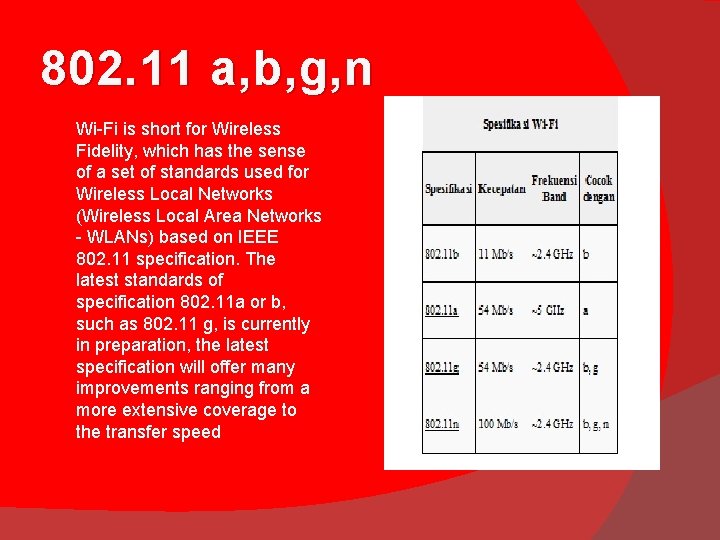
802. 11 a, b, g, n Wi-Fi is short for Wireless Fidelity, which has the sense of a set of standards used for Wireless Local Networks (Wireless Local Area Networks - WLANs) based on IEEE 802. 11 specification. The latest standards of specification 802. 11 a or b, such as 802. 11 g, is currently in preparation, the latest specification will offer many improvements ranging from a more extensive coverage to the transfer speed
802. 3 u, x, z a. IEEE 802. 3 u (1995) Standard Fast Ethernet 100 Base. TX, 100 Base. T 4, 100 Base. FX, which is capable of transmitting data at 100 megabits per second over a twisted copper wires (twisted pair) and also offers autonegotiation function b. IEEE 802. 3 x (1997) Full duplex and flow control c. IEEE 802. 3 z (1998) Standard Gigabit Ethernet 1000 Base-X, which is capable of transmitting data at speeds of 1000 megabits per second (1 gigabit per second) over fiber optic cables (fiber-optic).